Month: May 2020 Page 1 of 5

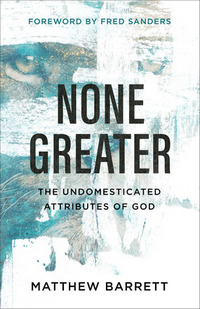
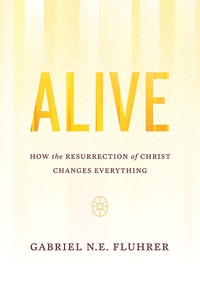
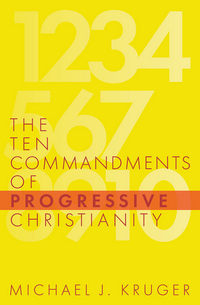
Catch-Up Quick Takes None Greater by Matthew Barrett; Alive by Gabriel N.E. Fluhrer; The Song of Songs by G. I. Williamson; The Ten Commandments of Progressive Christianity by Michael J. Kruger

The point of these quick takes post sto catch up on my “To Write About” stack—emphasizing pithiness, not thoroughness.

None Greater

None Greater: The Undomesticated Attributes of God

by Matthew Barrett
Kindle Edition, 304 pg.
Baker Books, 2019
Read: December 22-29, 2020
Grab a copy from your local indie bookstore!

(the official blurb)
This is a popular-level, very approachable introduction to the Attributes of God—Incomprehensibility, Aseity, Simplicity, Immutability, Impassibility, Eternity, Omnipresence, Omnipotence, Omniscience, Omnisapience, and a few others. He does so using the works of Augustine, Anselm,— and Aquinas to define Classical Theism—with help from Charnock and Bavinck.

Tackling all that in 300 accessible pages is no mean feat. I cannot tell you how many times I thought as I read this that this is the book that R.C. Sproul would have written about the Attributes of God. Sure, the illustrations aren’t the ones that Sproul would’ve used—but they’re of a kind. In my books, that’s a high compliment—we need someone who can communicate like Sproul. Barrett will do fine if he continues to put out this kind of work.

This is a really helpful and useful work—I recommend it strongly to everyone.

4 Stars

Alive

Alive: How the Resurrection of Christ Changes Everything

by Gabriel N.E. Fluhrer
Kindle Edition, 167 pg.
Reformation Trust, 2020
Read: April 5-12, 2020
Grab a copy from your local indie bookstore!

(the official blurb)
The book starts with a look at the evidence for the Resurrection of Christ, and why it’s important to wrestle with it and to be ready to defend it in our current culture. Then Fluhrer moves on to looking at the way the Resurrection was foreshadowed in the Old Testament, described in the Gospels, preached in Acts, explained in the rest of the New Testament, and serves as the basis for our sure hope. He covers all the bases and does so well.

Fluhrer has an apologetic goal for this book, it’s not as compelling as he seems to think it is. Which really describes the book as a whole. In the end, it’s too surface-level. It’s helpful, the theology behind it is the kind of thing we need more of—a robust Redemptive-Historical approach à la Vos and Gaffin—and it’s approachable. I just couldn’t sink my teeth into it. I liked it, I just wanted to like it more.

3 Stars

Song of Songs

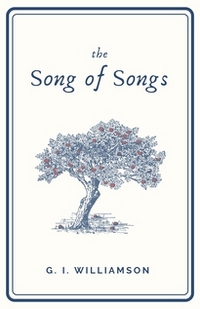
The Song of Songs

by G. I. Williamson
Kindle Edition, 112 pg.
P&R Publishing, 2020
Read: April 26, 2020
Grab a copy from your local indie bookstore!

(the official blurb)
This is a great and helpful collection of sermons. This particular book of the Bible is often misinterpreted, so having someone bring careful clarity to the text is valuable. It’s not the final word—Williamson would never claim to be. But it’s helpful.

It’s also Christ-centered. Something far too often neglected when approaching this text. Yes, there’s a focus on love, marriage, sexuality. But with the goal of bringing glory to God through that.

I really appreciated this book and will be returning to it.

3.5 Stars

The Ten Commandments of Progressive Christianity

The Ten Commandments of Progressive Christianity

by Michael J. Kruger
Paperback, 54 pg.
Cruciform Quick, 2019
Read: May 24, 2020
Grab a copy from your local indie bookstore!

(the official blurb)
There’s part of this that’s a tribute to Machen and Christianity & Liberalism, while being an update to it, too. To see how Liberalism is alive and well (running under the moniker of “Progressive” now), he uses two contemporary works to respond to. He stresses repeatedly that the tenents taught in these books aren’t wholesale departures from the faith. However, these half-truths are so misleading they amount to the same. Being half-truths, they’re all the more dangerous and will easily fool some.

The analysis and critique are sharp, spot-on, and easy to read. Well worth your time.

But…

I know that the point of this imprint is “quick,” but this was just too brief to be really valuable. I’d have liked some more depth, for Kruger to use more than just the two works he’s critiquing, that sort of thing. It was an appetizer—and it turns out that after a couple of bites, I wanted a meal.
3.5 Stars

This post contains affiliate links. If you purchase from any of them, I will get a small commission at no additional cost to you. As always, opinions are my own.


Saturday Miscellany—5/30/20

Once again, the last week of the month translates into a short collection of links and new releases (a short work week here in the States probably contributes to that, too). Still, I hope you find something fun to read here.

Odds n ends about books and reading that caught my eye this week. You’ve probably seen some/most/all of them, but just in case:

bullet 6 Unconventional Tips for Building a Reading Habit—I’ve shared many posts over the years about creating a reading habit–this is the most unconventional (truth in advertising!), it’s possibly also the best list. I can think of many people who’ve done some/all of these and become readers (possibly more of them than those who’ve done the usual steps)
bullet On The Tolkienic Hero
bullet Interview with M. W. Craven—the promotional build-up for The Curator goes into full-swing.
bullet Five Books That Will Make Your Child a Future Crime Writer—I had completely forgotten about the third book she talks about here…Some good suggestions for readers young or older.
bullet It’s Not You, It’s Me..—one blogger bravely makes her stand on the paper vs. ebook debate. She’s not wrong.
bullet What is the Best Fantasy Mode of Transportation?—This episode of the Great Fantasy Debate features Marie Lu and Naomi Novik

This Week's New Releases That I’m Excited About and/or You’ll Probably See Here Soon:
bullet Fair Warning by Michael Connelly—On the one hand, I don’t remember the Jack McEvoy novels as being particular favorites. On the other, I remember being incredibly gripped by them. And, hey, it’s Connelly. Gotta read it.

Lastly I’d like to say hi and extend a warm welcome towonderouspages for following the blog this week. Don’t be a stranger, and use that comment box, would you?

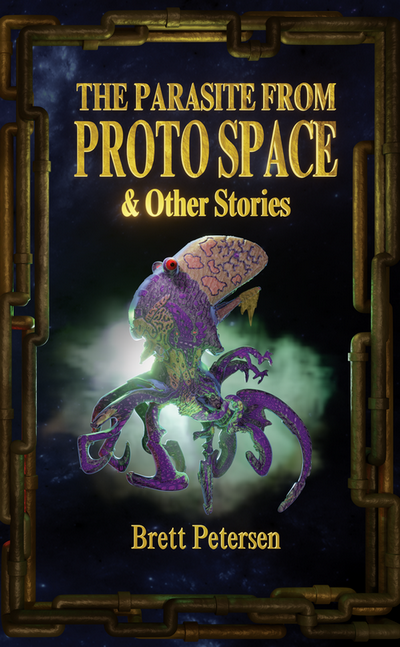
BOOK SPOTLIGHT: The Parasite From Proto Space & Other Stories by Brett Petersen

I just don’t have time to read every book that comes my way, but I’d like to do my part to expose them to as many eyeballs as I can. So, from time to time, I’ll post a Spotlight to lend a hand. If this looks like it’s up your ally, you should jump on it.


Book Details:

Book Title: The Parasite From Proto Space & Other Stories by Brett Petersen
Release date: 1/28/2020
Format: Ebook/Paperback
Publisher: CLASH Books
Length: 66 Pages

Book Blurb:

A parasite from Proto Space, summoning memory eaters, funeral machines eating teenagers, space rides to Pleroma, and a frog baby that transcends time and space. These are just some of the stories that will warp your sense of reality until you’re living in Brett Petersen’s mind and you won’t want to leave.

About the Author:

Brett Petersen is a writer, musician and artist from Albany, New York, whose high-functioning autism only enhances his creativity. He earned his B.A. in English from the College of Saint Rose in 2011, and since then, his stories and poems have appeared in over a dozen print and online publications. “The Parasite From Proto Space & Other Stories” is his first book, and unless he is apprehended by the Trump Regime for being an outspoken autistic, will certainly not be his last. Academic critics should note that the subject matter of his stories and his taste in literature in general was heavily inspired by Japanese role-playing video games such as Xenogears, Chrono Trigger, and Shin Megami Tensei. Aside from his writing career, he is the rhythm guitarist and vocalist for sludge rock band Raziel’s Tree, a competent visual artist, Tarot reader, and would-be Kabbalist. All things Brett Petersen can be found at http://www.jellyfishentity.wordpress.com.

Purchase Links

Clash Books ~ Amazon

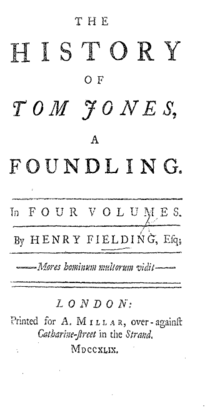
The History of Tom Jones, a Foundling by Henry Fielding: BOOK VII., v.-x.

Fridays with the Foundling
Tom Jones Original CoverI assume the problem is with me, I really do. But man, oh, man—Book VII is just not clicking with me. The story’s fine, but I’m not crazy with the pacing. Fielding’s narration isn’t doing much for me, either.

So, there’s some (figurative) kissing and making up between Sophia and her father as well as her father and her aunt. Which starts to give you a dash of hope, but then Blifil and Mr. Western get their heads together and things go downhill. We’ll start with Western talking Sophia into another meeting with Blifil.

Scenes like this, when painted at large, afford, as we have observed, very little Entertainment to the Reader. Here, therefore, we shall strictly adhere to a rule of Horace; by which Writers are directed to pass over all those Matters which they despair of placing in a shining Light;—a Rule, we conceive, of excellent Use as well to the Historian as to the Poet; and which, if followed, must at least have this good Effect, that many a great Evil (for so all great Books are called) would thus be reduced to a small one.

I do appreciate him sparing us that scene.

Blifil is so determined to beat Tom that he cons both Blifil and Allworthy (the former being very predisposed to believe him) into thinking that Sophia’s come around and arrangements are made to get married the next day. Her maid overhears Western making further arrangements and informs Sophia.

Sophia considers suicide at this point, but her maid dissuades her from that. So, she decides to run away from home—she has a friend in London who’ll take her in for a bit.

We get a quick glimpse of Tom—he gets some bad directions and ends up in a different location than he’d intended. He finds himself in an inn with a Quaker gentleman distraught over his daughter’s marriage to a poor man. So, that goes over about as well as you’d think. Details about Tom’s background and circumstance are circulated amongst people at the Inn—suddenly, his Quaker friend makes himself scarce and the landlord decides that he can’t use a room. So, Tom sleeps in the dining room—where it’s easy to keep an eye on this obvious scoundrel.

Hopefully, things get a bit better (in my own mind or the book, whichever is applicable) from here. There’s still a long way to go in this book, there’s plenty of time for that.

The Friday 56 for 5/28/20

The Friday 56This is a weekly bloghop hosted by Freda’s Voice

RULES:
The Friday 56 Grab a book, any book.

The Friday 56 Turn to Page 56 or 56% on your ereader. If you have to improvise, that is okay.
The Friday 56 Find a snippet, short and sweet.
The Friday 56 Post it

from Page 56 of:
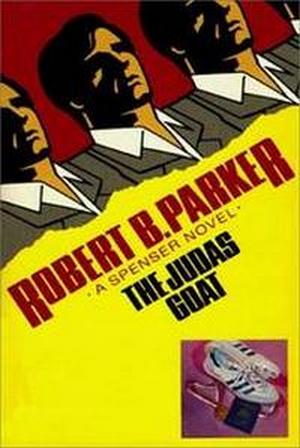
The Judas Goat

The Judas Goat by Robert B. Parker

The doctor put a pressure bandage on my, ah, thigh, and gave me some pills for the pain. “You’ll walk funny for a few days,” he said. “After that you should be fine. Though you’ll have an extra dimple in your cheeks now.”

“I’m glad there’s socialized medicine,” I said. “If only there was a vow of silence that went with it.”

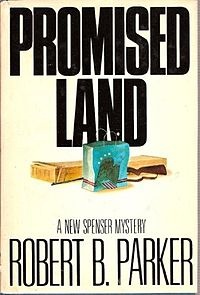
Classic Spenser: Promised Land by Robert B. Parker

Classic Spenser

Promised Land

Promised Land

by Robert B. Parker
Series: Spenser, #4

Mass Market Paperback, 218 pg.
Dell Publishing, 1976

Read: April 30, 2020
Grab a copy from your local indie bookstore!

“Whose picture is on a one-hundred dollar bill?” I said.

“Nelson Rockefeller.” [Susan said]

“Wrong.”

“David Rockefeller?”

“Never mind.”

“Laurence Rockefeller?”

“Where would you like to go to lunch?”

“You shouldn’t have shown me the money. I was going to settle for Ugi’s steak and onion subs. Now I’m thinking about Pier 4.”

“Pier 4 it is…Come on, we’ll go back to my place and suit up.”

“When you get a client,” Susan said, “you galvanize into action, don’t you?”

“Yes, ma’am. I move immediately to the nearest restaurant.”

Harv Shepard’s wife walked out on him and he wants Spenser to find her and bring her home. Spenser agrees to the first part of that—he’ll find her, make sure she’s healthy and under no duress, but he won’t force her to come home. Shepard agrees to that, so Spenser starts digging. It takes him practically no time at all to discover that their relationship wasn’t as good as Shepard insists it was (Shepard doesn’t seem to find his wife leaving home to be a big clue)—and that Pam herself might not be as happy or well-adjusted as she let on.

It doesn’t take Spenser that long at all to find Pam and see that she’s okay. She’s not that interested in coming home, and Spenser’s prepared to let it lie like that. But she soon calls Spenser for help—and like the knight errant he is, Spenser obliges. She’s found herself neck-deep in serious legal problems and it’ll take an ingenious plan to get her out of it while not letting criminals get away with anything.

The trickier part of the equation comes from a man called Hawk.* When Spenser first arrives at Shepard’s house,

Shepard appeared from the door past the stairs. With him was a tall black man with a bald head and high cheekbones. He had on a powder blue leisure suite and a pink silk shirt with a big collar. The shirt was unbuttoned to the waist and the chest and stomach that showed were hard and unadorned as ebony. He took a pair of sunglasses from the breast pocket of the jacket and put them on, he stared at me over their rims until very slowly the lenses covered his eyes and he started at me through them.

* Yeah, I couldn’t resist.

As Spenser soon tells Shepard, Hawk’s presence means that he’s got bigger problems than a missing wife. Shepard denies it, but Spenser believes he’s into a loan shark and/or mobster for a pretty large sum and is behind on payments. It won’t be long until Hawk is hurting Shepard—if not more than that—in order to get this money.

Hawk and Spenser go far back—they used to fight on the same heavyweight card and come into frequent contact in their current occupations. Hawk’s a freelancer and is one of the best in Boston. He’s not a good guy, but he has a code. There’s a mutual respect between the two and Spenser is quick to defend Hawk against Shepard’s racial slurs. Hawk as a character deserves more space than I’m giving him at the moment—but that’s all I can do for now. I’ll probably find a way to give him a few paragraphs in the post about the next book.

So not only does Spenser need to get Pam out of her legal mess, he takes on getting Harv out of his illegal mess. He does so through a complicated set-up assisted by a couple of the funniest cops I remember reading about. It’s a shame that neither of these reappear the way that Healy, Belson and Quirk do (although, it’d be hard to take them seriously). It’s hard to explain, you’ll need to read them for yourselves.

Toward the end of the previous book, Mortal Stakes it looked like Spenser is getting more serious about Susan and less serious about his other dating relationship with Brenda Loring—there’s a reference to Brenda early on in this book*, but by the end, Susan and Spenser are as close to married as they’re ever going to get—essentially pledging monogamy without the legal/religious contract. This is huge for the genre at the time—and bigger for the character.

* Unless I’m mistaken, that’s the last reference to Brenda outside of a short story in the series. [Update: She’s mentioned in the next book, so I read the reference about 5 hours after I published this]

While Spenser tries to extricate the Shepards from the trouble they’ve found themselves in—and hopefully provide them with the opportunity to work on their marriage (at least enough to make a calm decision about its fate), Parker uses the Shepards as well as Susan and Spenser to discuss second-wave feminism in a somewhat abstract fashion, but also in concrete terms as it applies to each of these couples. Parker takes the opportunity to opine a bit on isms and how they tend to swallow the individual—where he prefers to consider such topics (this is assuming that Spenser and Parker align on these ideas, but there’s no reason to suspect they don’t). The reader may not agree with them any of the views they read in these pages, but they’re fairly well reasoned.

In Promised Land, we meet Hawk and Susan and Spenser become permanent (for lack of a better term). These two things are the final pieces to come into place as the foundation for the series—they’ll take a more final form in the next book, but we have them all now. Every other book in the series is built on what’s introduced up to this point and finalized in The Judas Goat. For a series that’s lasted 44 years after the publication of this one, that’s quite the accomplishment.

A significant portion of American Detective Fiction since then will be shaped by this, too—people will be reacting against this set-up or putting their series in a similar vein. Personally, I’ll get to the point (eventually) where Susan stops adding anything to the series. But I’ve yet to tire of Hawk. He may be the kind of guy who should spend the rest of his life behind bars, but he’s also the kind of character than you can’t help but love when he shows up on the page. We’ll revisit Hawk (and his contribution to the series) later, but for now, it’s just good to sit back and enjoy him.

You take all the above, mix them together—and you’ve got a true classic. Parker looks at marriage and feminism—and, of course, honor—while his protagonist matches wits with a mobster. Told with Parker’s trademark style and wit. Few things are as good as that—fewer yet are better.


5 Stars

This post contains an affiliate link. If you purchase from it, I will get a small commission at no additional cost to you. As always, opinions are my own.

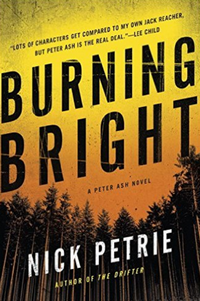
Bullet Points about Burning Bright by Nick Petrie: There’s No Sophomore Slump in the Second Peter Ash Adventure

Burning Bright

Burning Bright

by Nick Petrie
Series: Peter Ash, #2

Hardcover, 416 pg.
G. P. Putnam’s Sons, 2017

Read: May 11-14, 2020
Grab a copy from your local indie bookstore!

He climbed down to the dry riverbed, hurting all over but more or less functional. His forehead felt warm and wet. He put his hand up, felt the slickness of blood, and wiped it away, reminding himself that head wounds always bleed like crazy.

He knew too much about damage to human bodies.

This post is overdue (as was reading this in the first place), and I can’t seem to find time to do it right. So, I won’t. Here’s a quick and dirty way to get it taken care of. I wish I had it in me to do a better job, but I don’t. Here’s the blurb taken from Petrie’s site:

War veteran Peter Ash sought peace and quiet among the towering redwoods of northern California, but the trip isn’t quite the balm he’d hoped for. The dense forest and close fog cause his claustrophobia to buzz and spark, and then he stumbles upon a grizzly, long thought to have vanished from this part of the country. In a fight of man against bear, Peter doesn’t favor his odds, so he makes a strategic retreat up a nearby sapling.

There, he finds something strange: a climbing rope, affixed to a distant branch above. It leads to another, and another, up through the giant tree canopy, and ending at a hanging platform. On the platform is a woman on the run. From below them come the sounds of men and gunshots.

Just days ago, investigative journalist June Cassidy escaped a kidnapping by the men who are still on her trail. She suspects they’re after something belonging to her mother, a prominent software designer who recently died in an accident. June needs time to figure out what’s going on, and help from someone with Peter’s particular set of skills.

Only one step ahead of their pursuers, Peter and June must race to unravel this peculiar mystery. What they find leads them to an eccentric recluse, a shadowy pseudo-military organization, and an extraordinary tool that may change the modern world forever.

If I had the time to do this properly, here are the things I’d be talking about.

bullet At multiple points both Peter and June note that Peter’s having fun when it’s dangerous, when things are violent, when the bullets are flying. As a reader, this is great—you don’t see Reacher, Charlie Fox, Evan Smoak, etc. enjoying things quite like this. But I’m a little worried about what it says about him as a person.

bullet We get some good backstory on Peter—before he enlisted.

bullet On a related note, Peter has a family! A well-adjusted, not violent, family.

bullet Lewis is back from the first book—he’s essentially Hawk and Pike with flair. His growing family ties are a real strength of character.

bullet June is tough, capable, smart. She’s complex in a way that most characters in this role usually aren’t, and really ought to be.

bullet The villains in this novel are great. Their motives are complex, they don’t approach things the way you think they’re going to (up to the last couple of chapters).

bullet While trying not to give too much away, I appreciate that Ash doesn’t have a scorched-earth approach to his opponents in either book.

bullet Best of all, in the middle of the technothriller stuff, the action hero stuff, and all the rest, there’s a real attempt to portray what a vet with PTSD goes through. How it molds everything he does, but doesn’t define him.

bullet The biggest compliment I can give is this: it kept me awake when I should have been. Since I got my new CPAP last summer, I haven’t been able to read more than 2-5 pages with it on before I’m out like a light. So imagine how shocked I was when I realized that I’d barreled through over 50 pages one night! That’s a feat.

This is a great thrill-ride, I’m not going to wait another year and a half before I get to the next one (it’s sitting on my shelf as we speak). I strongly recommend the Peter Ash books.


4 Stars

2020 Library Love Challenge

This post contains an affiliate link. If you purchase from it, I will get a small commission at no additional cost to you. As always, opinions are my own.

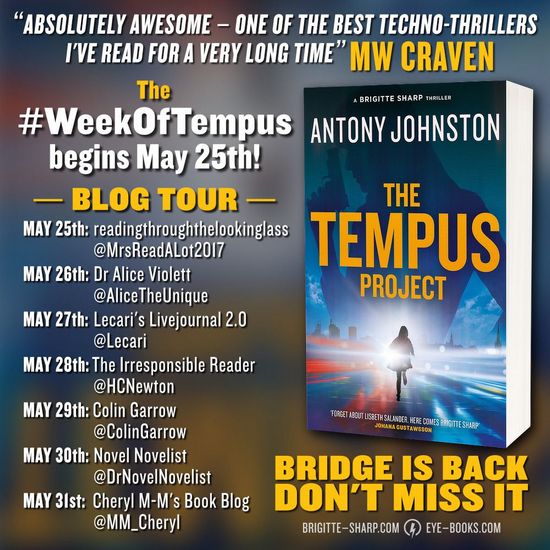
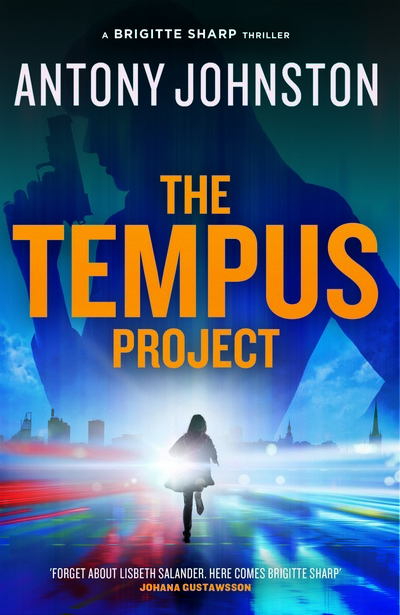
The Tempus Project by Antony Johnston: High-Tech Methods Fuel a Very Old-School Thirst for Revenge

The Tempus Project

The Tempus Project

by Antony Johnston
Series: Brigitte Sharp Thriller , #2

eARC, 353 pg.
Lightning Books, 2020

Read: May 22-26, 2020

This is the second in a series—but it’s not essential to read the first. Bridge will cover everything you need to know in her narration.

Following a botched pickup of a journalist who wants to give some evidence to the British government, Brigitte Sharp—cyber-analyst extraordinaire—is out for payback. Her hunt for those responsible to the op going wrong, as well as a hunt for those to behind a cyber-attack at G20 summit in London, puts her neck-deep in international intrigue (her early guess that there’s a connection between the two just adds impetus).

The motives behind these two attacks—in addition to some other cyber-hijinks—is beyond her ability to guess. So Bridge focuses on the how and who, leaving aside the considerations of why for later. It’s an exciting ride, full of enough twists and turns to satisfy any thriller reader.

I’ve always been bugged by it, but Dreyer’s English has emboldened me in this particular hang-up: there are significant, multiple-page long, sections in all italics. It’d make the reading process nicer if we didn’t need to wade through that. It’s a minor thing, but I’d be lying if I didn’t say it bugged me.

The tension is played just right. The technobabble* feels authentic—or at least enough to get away with. The plot’s intricate without becoming Byzantine. There’s plenty of character development, but it felt…forced? By the numbers? Heartless? I can’t put my finger on it, but it’s like Johnston knew he needed some character development and did what he could to put it in, even if it didn’t feel natural or earned. That shortcoming colored the rest of it for me. Still, I liked Bridge and the rest of this cast of characters.

* That’s not a term of derision, just trying for an all-encompassing term.

I have a friend who will regularly upbraid me for not liking things as much as he does (he doesn’t comment here, it’ll be via text, email, or in-person—depending how much he has to say about my wrong-ness). I can easily see where this is one of those books where he—or others—will feel like scolding me for not liking it enough. And they really might be right to do so. I liked this, I recommend it, I just wanted a bit more from it. I can easily see me coming back for another installment, too, I should add.


3 Stars

My thanks to damppebbles blog tours for the invitation to participate in this tour and the materials (including a copy of the novel) they provided.

BOOK SPOTLIGHT: The Tempus Project by Antony Johnston

Today I’m pleased to welcome the Book Tour for the Cyber Thriller The Tempus Project by Antony Johnston. Following this spotlight post, I’ll be giving my take on the novel here in a bit. But let’s start by learning a little about this here book, okay?


Book Details:

Book Title: The Tempus Project by Antony Johnston
Release date: May 25, 2020
Publisher: Lightning Books
Format: Paperback/Ebook
Length: 353 pages

Book Blurb:

In The Exphoria Code, MI6 officer and elite hacker Brigitte Sharp foiled a terror attack on London that used stolen military drone software to deliver a ‘dirty bomb’.

Now Bridge is back, battling a series of hacks and ransom-ware attacks, masterminded by a hacker known only as ‘Tempus’, who is targeting politicians and government officials with impunity.

Discovering that this campaign is linked to a cyber-attack on the London G20 summit, she is drawn into the dark-web world of crypto-currencies, Russian hackers and an African rebel militia.

In another compelling cyber-thriller from the creator of Atomic Blonde, Bridge races against time to prevent a disaster that could alter the balance of global power forever.

About Antony Johnston:

Antony JohnstonAntony Johnston is a New York Times bestselling writer. The Charlize Theron movie Atomic Blonde is based on his graphic novel; his Brigitte Sharp thriller novels are critically acclaimed; and his first videogame, Dead Space, redefined its genre.

Antony’s books, graphic novels, and videogames include The Exphoria CodeThe Tempus ProjectThe FuseDaredevilShang-ChiShadow of Mordor, the Alex Rider graphic novels and the adaptation of Alan Moore‘s ‘lost screenplay’ Fashion Beast.

He also hosts the podcast Writing And Breathing. Find him online at twitter.com/AntonyJohnston and antonyjohnston.com.

He lives in Lancashire.

Social Networks:

Twitter ~ Facebook ~ Website ~ Instagram

Purchase Links:

Amazon UK ~ Amazon US ~ Waterstones ~ Foyles ~ Google Books ~ Kobo

My thanks to damppebbles blog tours for the invitation to participate in this tour and the materials (including a copy of the novel) they provided.

WWW Wednesday, May 27, 2020

Hey, it’s the middle of the week already–time’s already difficult to keep track of in self-isolation, but throw in a three-day weekend? Fuhgeddaboudit. So, I guess it’s for WWW Wednesday!

This meme was formerly hosted by MizB at A Daily Rhythm and revived on Taking on a World of Words—and shown to me by Aurore-Anne-Chehoke at Diary-of-a-black-city-girl.

The Three Ws are:

What are you currently reading?
What did you recently finish reading?
What do you think you’ll read next?

Easy enough, right?
What are you currently reading?
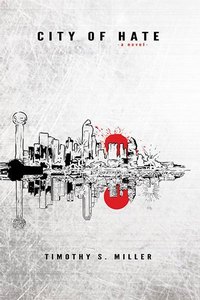
I’m reading City of Hate by Timothy S. Miller and am listening to North! Or Be Eaten by Andrew Peterson, Peter Sandon (Narrator).

City of Hate North! Or Be Eaten

What did you recently finish reading?
I just finished Antony Johnston’s The Tempus Project and Promises Forged by Devri Walls, Daniel Thomas May (Narrator) on audio.

The Tempus Project Promises Forged

What do you think you’ll read next?
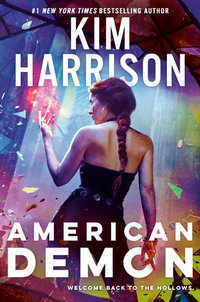
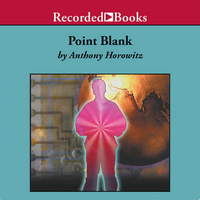
My next book should be American Demon by Kim Harrison and Point Blank by Anthony Horowitz, Simon Prebble (Narrator) on audiobook.

American Demon Point Blank

Hit me with your Three W’s in the comments! (no, really, do it!)

Page 1 of 5

Powered by WordPress & Theme by Anders Norén