Month: May 2015 Page 2 of 3

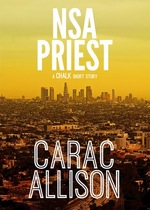
“Concussion Cover-Up” & “NSA Priest” by Carac Allison

Sure, in the month between downloading these and reading them, they’ve disappeared from Smashwords’ site. Oh well, I read ’em, might as well talk about them a little.

First thing to know is that when Mr. Allison says “Short Story,” he means short. This is annoying when reading both stories, but for different reasons that I’ll get to in a moment. They are, however, a great length for reading while sitting in uncomfortable hard plastic chairs while waiting for an elementary school musical to begin.

Still, both had juuuuuuust enough of good ol’ Chalk to make you want the next novel.
Concussion Cover-UpConcussion Cover-Up

by Carac Allison
Series:Chalk Short Stories

ebook, 12 pg.
Smashwords, 2014
Read: May 18, 2015

2 Stars

Chalk’s trying to track down — or at least confirm the existence of — a report from the 1980’s showing that the NFL was fully aware of concussion (and other) risks. A report that just might be an Urban Legend — or it could be the smoking gun to force the League to pony up the money to pay for medical care/damages to many, many current and former athletes. Sort of like the papers that demonstrated that Tobacco Executives knew about Nicotine’s addictiveness long ago.

I just didn’t get enough to justify Chalk’s reaction at the end, not enough meat to chew on during these 12 pages. This one felt incomplete. I’d need to see more of it before I could really get a handle on it.

NSA PriestNSA Priest

by Carac Allison
Series:Chalk Short Stories

ebook, 11 pg.
Smashwords, 2014
Read: May 18, 2015
3 Stars

This one starts with a nice little paranoid (unless they are out to get you) description of the NSA’s work, and sets up a need for Chalk to get some of that information. He knows how to get it, but it comes with an unusual price — and as Chalk sets off to get what he needs to pay that price, things get interesting.

This was great, this was everything I wanted it to be. Except I wanted more. This feels like the bare bones of something — not an entire novel, but a good setup for one. It’s condensed, it’s the synopsis of something — powdered fiction, just add water. Whereas Concession Cover-Up felt like it was missing a lot, this was complete, it just would be better if there was more detail, more time spent with it all.

Still, glad I read it.

Saturday Miscellany – 5/16/15

Odds ‘n ends over the week about books and reading that caught my eye. You’ve probably seen some/most/all of them, but just in case:

    This Week’s New Releases I’m Excited About and/or You’ll Probably See Here Soon:

  • How to Start a Fire by Lisa Lutz — doesn’t look like your typical Lisa Lutz novel, but at this point, I don’t care. I’m in.
  • Dry Bones by Craig Johnson — a new Walt Longmire. At the rate I’m going, I’ll probably get to it in November.
  • Luckiest Girl Alive by Jessica Knoll — I’ve heard nothing but great things about this one, looks great.
  • Goddess of Buttercups & Daisies by Martin Millar — one of the odder looking books I’ve seen lately. Should work on tracking it down rightaway.
  • Rumrunners by Eric Beetner — this looks like it could be a fun read.

Lastly, I’d like to say hi and welcome to facetioussoup for following the blog this week (possibly the greatest moniker I’ve come across online), and to Nothing better than a good book… for following the BookLikes clone (which I really wish I could make look nicer…). Thanks to Injoy’s Blogs + Book Reviews for the signal boost to a post at said clone. Lastly, big thanks to Joseph Finder for bothering to read my post about his book and for responding on Twitter — don’t think I’ll ever get used to someone doing that.

Review Catch Up: Rolling Thunder; Fun House; Free Fall by Chris Grabenstein

It infuriates me that I haven’t written anything on these books — Ceepak and Boyle (and, probably, Grabenstein) deserve better. But…here’s something, at least.

The points I’ve had all along are still here — I like Grabenstein’s voice and tone. I like the subtle character growth. Ceepak is a super-hero. Danny, on the other hand, is the real star of this series (no matter what it’s called) — we’re watching him grow in to a real cop, into a man. Yes, he’s trying to model himself off Ceepak, but he’s the focus, he’s our entry into this world and Ceepak’s mission.

The biggest problem with this series is that I just can’t bring myself to listen to enough Bruce Springsteen to appreciate all the references. I’ve tried. Really I have.

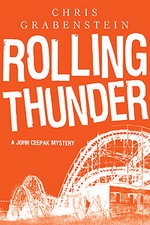
Rolling ThunderRolling Thunder

by Chris Grabenstein
Series:John Ceepak Mystery, #6

Hardcover, 304 pg.
Pegasus, 2010
Read: November 24 – 25, 2014


Not much worse than a prominent citizen dying on the initial run of the new Roller Coaster that was supposed to guarantee one of the best tourist seasons in recent years for Sea Haven. The resulting investigation is as filled with the typical twists and turns, heroics from Ceepak and good tries from Danny.

Not that Danny doesn’t get his chance to shine — and brightly, I should add.

I liked this one, not as much as I wanted to, but spending time with good friends in NJ is always a treat.

I’ll take a moment to say that I’m not crazy about the whole arc about Ceepak’s father. Initially, I liked it — but now? I don’t know — maybe they’re just spending too much time with it without resolving anything, but I’m done with it. There’s another arc kicked off here that works much better (particularly as it’s a subtle kick-off here, that grows into prominence).
3.5 Stars

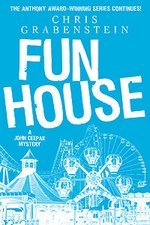
Fun HouseFun House

by Chris Grabenstein
Series:John Ceepak Mystery, #7

Hardcover, 336 pg.
Pegasus, 2012
Read: February 25, 2015


A competitive version of The Jersey Shore comes to Sea Haven, and with it comes chaos, attention, and gobs of money. Oh, and because this is Sea Haven — murder.

We’re treated to a nice bit of social satire/cultural commentary along with our usual Ceepak/Boyle antics. Sure, it’s at the admittedly easy targets of The Jersey Shore/”Reality TV” in general. Still, it was fun, like this little bit about the host of just before a commercial break:

…teases Chip, because they like to do that a lot on these shows: hint that something good is coming. In fact, they do more hinting and teasing than actual entertaining.

I’ve had the same thought (not as well-articulated) more than once and appreciated someone else saying the same thing.

I also liked that the book starts with drunk and disorderly charge and then an investigation into anabolic steroids. Not every book (especially those set in small towns) has to be about murder or serial killers, right?

Overall, one of the weaker entries — but the TV commentary and Danny’s personal story made up for it.
0 Stars

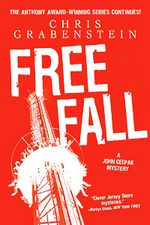
Free FallFree Fall

by Chris Grabenstein
Series:John Ceepak Mystery, #8

Hardcover, 352 pg.
Pegasus, 2013
Read: March 11 – 12, 2015


Sure, there are draw backs to having a mystery series in a smaller town – at some point the crime rate gets ridiculously high, for example. On the other hand, when at least one of your characters has known half of the victims/suspects/witnesses all their lives, you can save a lot of time getting to know them finding narrative hooks, emotional ties, etc. That helps a lot here.

There’s something to this murder — this victim that doesn’t seem like the typical Ceepak/Boyle case. Same with the motive, really. I really liked the characters, the murder, the way this pushed our protagonists in different ways. If this wasn’t the best mystery — the best book in the series, it’s the best in a long time. Hope it’s a sign of things to come.
4 Stars

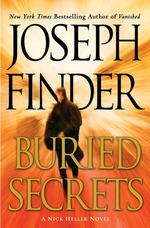
Buried Secrets by Joseph Finder

Buried SecretsBuried Secrets

by Joseph Finder
Series: Nick Heller, #2

Hardcover, 386 pg.
St. Martin’s Press, 2011
Read: April 13, 2015

Private Spy, Private Investigator, Private Vengeance-Taker, whatever you want to call him, Nick Heller one of the best — he’s tough, he’s resourceful, troubled kids like him and he quotes The Punisher. Who doesn’t love that?

Heller’s relocated himself, his computer wiz, and his nephew to Boston since we saw him last, setting up shop marketing his peculiar trade. True to form, he’s pretty picky about who he accepts as a client, but there is one who he can’t turn away. Marshall Marcus, the richest man in Boston, was a lifeline for Heller’s mother after his father’s prison sentence was handed down. Now he needs a lifeline — actually, his 17 year old daughter does. She’s been kidnapped and will be executed if her father doesn’t give the men responsible exactly what they want.

The kidnapping itself, and the way Alexa is being held captive aren’t that novel — most readers who’ve watched a police procedural or two in the last few years will have seen one or two scenarios like it. But Finder does make it distinctive by making the man holding her into a particularly sick and evil man. Thankfully, we don’t spend so much time with Dragomir that the reader sympathizes with him, or starts to like him (à la Dr. Lecter). What he’s doing to Alexa is just wrong — as is pretty much everything that has led up to this point in his life.

Nick’s not just up against this twisted man — and those behind him — he also has to contend with a client who continually lies to him, an FBI official that seems to be blocking his efforts, and more than one person who isn’t who they say they are. Thankfully, he has Dorothy, his old military friends, international intelligence contacts, and a different FBI agent backing him.

There’s less action (as defined by explosions, gunplay, fights, etc.) than in Vanished, but it’s more suspenseful. In Vanished, it wasn’t until the closing pages that you had any idea what was happening with the victim — but here, there’s never any doubt about what’s going on with her, and what’s going to happen to her if Nick doesn’t put the pieces together. Soon. Which isn’t to say it’s all-thriller-all-the-time, there’s moments where Nick and the reader catch their breath. Even a couple moments of levity (Nick’s narrative voice helps a lot on that front) — his observation, “Veganism is apparently the paramilitary wing of vegetarianism” helped set the tone. Dorothy’s eventual use of the word “Pepsi” to close a chapter made me chuckle audibly (you’ll get it when you read this).

I should probably add that this book includes one of the grosser character deaths I’ve read in the last couple of years. Didn’t bother me much, he had it coming.

We get to see a bit more of Nick’s life and backstory this time. He’s a better-rounded character now. It’d have been easy to see him as a workaholic who had no contact with anyone outside of work and his nephew before. But that’s clearly not the case now. There’s not much more to him — but there used to be, and getting that glimpse helps you care a bit.

It’s taught, it’s a page turner, it’s a “I can always sleep later” kind of read. Man, oh man, I hope Finder has at least one other Heller adventure up his sleeve.
4 Stars

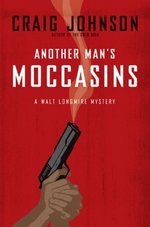
Another Man’s Moccasins by Craig Johnson

Another Man’s MoccasinsAnother Man’s Moccasins

by Craig Johnson
Series: Walt Longmire, #4

Hardcover, 290 pg.
Viking Adult, 2008
Read: May 11 – 12, 2015

“Do you think I’m a racist?”
[Ruby] smiled and then covered it with a hand. “You?”
“Me.” I stuffed my hands in my pockets.
She tipped her head up and considered me, and I felt like I should be wearing a lead vest. “You mean because of your experiences in the war?”
“Yep.”
“No.”
It was a strong response, and one that didn’t leave a lot of room for further discussion. I glanced at her unyielding eyes and shrugged, turning to look back as Virgil’s arm moved and he looked at the two of us. “Just wondering.”
“You do have one prejudice though.” I looked back at her again from under the brim of my hat. “You don’t care about the living as much as you do the dead.”

There’s a lot to that observation. It’s what makes Walt Longmire, like Harry Bosch, such a good investigator — and a character that readers want to spend more and more time with. They have friends, family — even loved ones. But the dead — murder victims or those they’ve lost over their lives — those seem to carry the weight of their attention and care. Could make an iffy friend, a frustrating spouse — but (as Arthur Fancy once said of a certain Polish detective) “If a member of my family was murdered, I’d want [him] to catch the case.”

The dead in this particular book take two forms — first and foremost is the young Vietnamese girl dumped off the side of the road and almost baled with hay. It’s the kind of thing that Walt — and similar lawmen dread — “There you stand by some numbered roadway with a victim, no ID, no crime scene, no suspects, nothing.” This woman’s ancestry does help her stick out in Absaroka County, and it doesn’t take Walt too long before he’s able to find a thread to pull. But he has no idea what’s on the other end of that thread, and it takes a lot of work to find it.

Walt Longmire books aren’t just about what’s going on in Absaroka County, Wyoming — at least not in the physical realm. There’s something going on in the spiritual, spectral, or some other realm — typically tied in with Cheyenne thought. This time there are spirits of a different kind, the ghosts that haunt each of us — the ones we bring along with us all the time. In particular, the ghosts of Walt’s past, specifically his time in Vietnam as a Marine Investigator. The narrative cuts back and forth between the present day investigation and one that young Walt Longmire is involved with as a Marine Inspector in Vietnam in the days immediately preceding the Tet Offensive. The Marine we meet isn’t the Sheriff we know — he doesn’t have the experience or authority — but the essence of the man is there, he just needs a little refining.

Additionally, Walt, Cady and Vic are dealing with the various forms of fallout from Kindness Goes Unpunished, with various levels of success. It’s not that Walt necessarily cares more for the dead — recent or decades old — it’s just that their needs seem far more immediate, and probably more importantly, Walt knows what to do to help them. With the living? He has far less idea what he should do.

You take those three plotlines, mix them together with a giant homeless Crow Indian and you’ve got yourself one compelling read.

This had a slightly different feel than Kindness Goes Unpunished — which is good, I don’t want to read the same novel over and over. Where Kindness was light and fun (when not harrowing and deadly), this was sober, thoughtful. Walt’s not sure what to do on various fronts of his personal life, he’s remembering a lot of things he could’ve done better in Vietnam and trying not to make mistakes with the case in front of him.

This is the fourth installment in this series, and you know pretty much what you’re going to get at this point when you pick one up. Which is exactly what this delivers. A straight-forward, thoughtful mystery novel with a protagonist who matches that description. A good choice for fans of Connelly, Crais, or Parker that don’t mind urban sprawl being replaced by ghost towns.

—–

3.5 Stars

The Younger Gods by Michael R. Underwood

yyyyyeeeeesh, almost, but not quite 6 months late. What is wrong with me? Let’s see if I can remember enough to make this work:

The Younger GodsThe Younger Gods

by Michael R. Underwood
Series:The Younger Gods, #1


ebook, 280 pg.
Pocket Star, 2014
Read: November 20 – 22, 2014

Are you quite sure you don’t want to even try to seek cover?” I asked.
“Cover is what stands between me and stabbing things,” [Carter] said by way of response.
Let it not be said to my resident assistant that I constrained my roommate. He was his own man. Even if that man was insane at times.

One of Michael R. Underwood’s most impressive traits is his versatility. We’ve got the fun Urban Fantasy adventures of Ree Reyes, the strange superheroes of Audec-Hal, and now, this darker UF about a cult’s white sheep trying to stop the apocalypse.

Jacob Greene — of those Greenes (apparently) — has come to New York to attend university — and get away from his family and their demon-worshiping apocalyptic cultish practices that will usher in The End of the World as We Know It. He’s had enough of all of it, and is trying to get beyond their teachings, their practices, their . . . murderous ways. It’s more difficult than he expects, especially when his sister comes to town in order to usher in Doomsday.

Jacob finds himself surrounded with a motley crew of allies — mostly in the mold of the-enemy-of-my-enemy — trying to keep his sister from accomplishing her Ultimate To-Do list. Let me tell you, this particular UF version of NYC is full of quite the assortment of magical cultures/subcultures. The rules governing them, the way they interact with each other are one of the strengths of this novel — a nice little bit of world-building that was revealed, not dumped on the reader.

Jacob, understandably, spends a good deal of the book sorting out his identity in light of his family — as well as his feelings for/about them. There are no easy answers waiting for him. It’s here, not his running away from his family, not his attempts to stop his sister, that Jacob finds that bit of humanity that he’s been missing.

Was it still love if the people that loved you were monsters? Did their actions taint everything they did, or was there some humanity in the family? Had they ever really loved one another, or was it a mask, a role that each Greene has played to further the goals of the Bold and awaken the unborn? There was a film, some film, that matched this feeling. I’d heard someone talk about it in class.

Jacob’s ending gambit had me groaning, “Underwood’s not going to do that, is he?” Turns out 1. He did; and 2. It totally worked. I couldn’t believe it. I was expecting a cheesy car wreck, but he nailed it. Note to self: don’t doubt Michael R. Underwood again.

My biggest gripe was Jacob’s language. He starts off with the most formal, stilted dialogue this side of an Austen novel; slang was a foreign language he was trying to adopt. By the end of the novel, however, a lot of that was gone. Now, it’s possible, I just got used to his language — but I don’t think so. Mostly, it was his use of slang that improved dramatically. Now, if it had happened slower — over a book or two, I wouldn’t have noticed — or, more likely, I’d have given Underwood props for it. But . . .this book covers events of a few days, far too quickly for Jacob to pull that off. Still, as far as gripes go . . . that’s pretty small.

It’s not Underwood’s best — but it’s a good start, and I can eventually see me saying something different about the series as a whole. Great magic system, a situation I’ve never encountered in any of the UF I’ve read, a solid group of characters to build from — I can honestly say that I have almost no idea what’s up next for Jacob Greene et al. But I’m looking forward to finding out.

—–

3.5 Stars

Saturday Miscellany – 5/9/15

Odds ‘n ends over the week about books and reading that caught my eye. You’ve probably seen some/most/all of them, but just in case:

    This Week’s New Releases I’m Excited About and/or You’ll Probably See Here Soon:

  • Unseemly Science by Rod Duncan — didn’t realize the sequel to strong>The Bullet-Catcher’s Daughter was this close to being released when I read it recently. This should be really good.
  • The Worst Class Trip Ever by Dave Barry — an MG book by Barry about a field trip gone bad? Should be a fun way to kill an hour or so.
  • Revision by Andrea Phillips — this looks to be a trippy read.
  • Corsair by James L. Cambias — Computer hackers and space pirates, sounds like a winning combo
  • Lois Lane: Fallout by Gwenda Bond — Lois Lane in high school (and, thankfully, not the version from Smallville).
  • Burning Down George Orwell’s House by Andrew Ervin — the tagline, “A darkly comic debut novel about advertising, truth, single malt, Scottish hospitality—or lack thereof—and George Orwell’s Nineteen Eighty-Four” is enough to get me looking for it.

Lastly, I’d like to say hi and welcome to legalreader for following the blog this week — and the tip — check out her blog, there’s some good stuff there. Thanks also to andrewknighton for the interaction.

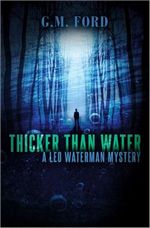
Thicker Than Water by G.M. Ford

Thicker than WaterThicker than Water

by G. M. Ford
Series:Leo Waterman, #7

Kindle Edition, 264 pg.
Thomas & Mercer, 2012
Read: April 29 – 30, 2015
So, I stumbled onto this series in ’06, I think — and read them in a pretty quick succession. I don’t have crystal clear memory of them, but I remembered Waterman, the lovely (and smart) Rebecca, the homeless people that he uses to help, his wit — and a scene or two from books 1-5. I remember book 6, The Deader the Better pretty well — I really remember how much I wanted to go on to to the next one, and how frustrated I felt when I discovered there was no book 7. How could Ford leave us hanging like that? Just when I was really getting to like the guy (see also: Koryta’s Lincoln Perry; Levine’s Solomon vs. Lord; Lehane’s Kenzie and Gennaro).

So imagine my delight when I stumbled onto a new Leo Waterman (even if I found it a few years late). It took me very little time to get back into things — Ford quickly reminded me of the details I’d forgotten while plunging Waterman (and the reader) into the thick of things.

I’d forgotten how quotable Ford can be. This description of a lifelong, um, acquaintance and current gun dealer probably beats the competition in this book (by a hair):

Junior Bailey couldn’t have been more than a couple of Oreos short of three hundred pounds. A corpulent corpuscle in a hideous purple suit, he looked like a Cuban headwaiter who had been held hostage in a doughnut shop. Except for the rosebud lips, he bore little or no resemblance to his father.

How can you not like a book with lines like that? 1. It’s funny, 2. You have a clear picture of this guy in your head, 3. Given the phrasing, you’re pretty sure just what the narrator thinks of ol’ Junior Bailey. This kind of writing keeps me turning pages — I almost don’t care about plot or character. Almost.

But despite the years, Ford hasn’t lost a step with these characters — Leo is still Leo. Yes, aged, and clearly affected by Rebecca’s moving on. But still the same man — and when called upon to come to her aid, he dives right in. The folks at the bar are still as fun (and tragic) and silly as remembered.

And the case? Rebecca’s gone missing, her bad choice of husband is, too — and no one seems to care other than her mother. Granted, she thinks Leo would’ve been a worse choice for Rebecca, but she knows that if anyone will look for Rebecca it’d be Leo. There’s some brutal action, some good twists and turns to the tale, a few criminals that are requisitely evil and demented, and more than enough chuckles before reaching a very satisfying conclusion. I’m so glad to see that Ford’s at work on another in this series.

And I truly wish I could say more about the biggest laugh, but it’d take too long and it’d ruin it for you, so I’ll just conclude with this:

That last chapter? Reader, I lol-ed.

—–

4 Stars

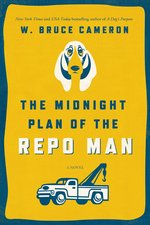
The Midnight Plan of the Repo Man by W. Bruce Cameron

The Midnight Plan of the Repo ManThe Midnight Plan of the Repo Man

by W. Bruce Cameron
Series: Ruddy McCann, #1

Hardcover, 319 pg.
Forge Books, 2014
Read: May 6, 2015
Disgraced college football star, ex-con, turned hometown shame and repo man, Ruddy McCann suddenly finds himself hearing voices — well, a voice, one that claims to be a local Realtor who disappeared 8 years earlier. Ruddy eventually convinces himself that he’s not going crazy, there’s actually a ghost living inside his brain, one who used to be Alan Lottner. Alan was murdered by someone he vaguely recognizes and a complete stranger, for reasons unknown to him. He also doesn’t know why he’s in Ruddy’s mind. There are a couple of things he does know: Ruddy needs to take better care of himself and his home; and that Ruddy can help him figure out what happened to him, and why.

While working on this quest, Ruddy works on some repo jobs, tries to help a friend out of a jam, and attempts to help keep his sister’s bar afloat — oh, and he’s met this great gal that he can’t stop thinking about. The fact that she’s Alan’s daughter just complicates things.

Cameron doesn’t bother explaining much about how Alan and his host were linked, why it took so long for Alan to become aware, or anything like that. It doesn’t even pretend to. And that’s okay, it works, somehow — even though I wouldn’t generally stand for that kind of thing.

I didn’t find this as funny as most people seem to — I found bits amusing, I thought the characters were drawn with a comedic brush, but that Cameron played it straight — rarely going for jokes or laughs, but finding the humor in these people just living — a more grounded, and genuine kind of humor. The Midnight Plan of the Repo Man is a pretty solid suspense story, with a side of romance, a few people looking for a second chance (maybe a bit of redemption), a loyal dog, and some silly characters. This one hit the spot.

—–

3.5 Stars

Goodbye Ginny Madison by Dave Gehrke

Goodbye Ginny MadisonGoodbye Ginny Madison

by Dave Gehrke
Kindle Edition, 300 pg.
Amazon Digital Services, 2014
Read: May 1 – 5, 2015
This just didn’t work for me. It was cute enough, I guess — and the solution was pretty clever (although I saw the heart of it very early on). But at the end of the day, it just wasn’t well-written. I’m getting ahead of myself a bit.

Here’s the gist of the book, from the Publisher’s Description:
Greg Monroe writes romance novels under the nom de plume Ginny Madison. That’s what he’s “gotta do”. What he wants to do is write mysteries; hard-boiled mysteries with bite. But his publisher tells him his mysteries lack originality, his plots are simplistic and his characters… well, they just aren’t real.

Complicating matters, Greg’s live-in Uncle George brings home an attractive new housekeeper. Hattie Fulton is intelligent, capable, resourceful and not who she pretends to be.

But before Greg can uncover the truth behind the attractive Hattie Fulton, Uncle George becomes the main suspect in a real murder mystery. Suddenly thrust into the role of a real detective, Greg digs into the mystery hoping to prove his uncle’s innocence while at the same time struggling to meet his next publishing deadline. And surprisingly, Greg’s fictional plots suddenly become edge-of-the seat compelling and his characters take on a life of their own. If you discount the strong resemblance to both Hattie and Greg and the sparks that are flying between them.

Now all Greg has to do in order to clear his uncle, finish the best mystery novel he’s ever written and win over his housekeeper is uncover the real murderer, without revealing to everyone that he’s really a romance writer pretending to be a mystery writer.Sounds like a straight-to-DVD Rom Com, doesn’t it?

Greg, simply put, is a chauvinist. Mystery novels are “real ‘guy’s’ books” and no guy should come anywhere near a romance novel. He’s doing well enough writing full-time under a nom de plume to afford a nice house for himself and his uncle, which can’t be easy. Yet, somehow, someone who thinks, “I mean what the hell does a guy know about romance? Beer, sports, guns. That’s guy stuff. Romance; female stuff” can write well enough for a female audience to support himself, despite a lousy work ethic. I guess it’s the Melvin Udall-phenomenon. He’s really pathetic, professionally and personally — if not for his uncle, it’d be easy to see him holed-up in his house forever.

Uncle George is a fire-cracker of a guy, pushing Greg into the world by any means necessary. Beyond his healthy nest-egg, poker buddies and bookie, he has a pretty full life on his own — think Stephanie Plum’s Grandma Mazur, but more together and grounded.

Hattie? Hattie’s a fantasy come to life — a knockout who can drive, shoot, take down bad guys with a couple of martial arts and cook. Did I mention she was hot?

And these are the well-drawn characters. The murder suspects are stock characters, as are the mobsters that Greg runs into. The police detectives are worse.

I really don’t want this to turn in to a litany of complaints, because I’ve really covered the major ones already, but I do have a few more, that I’ll just list without too much expansion:

  • The samples of Greg’s writing are, like almost every fictional example of someone’s fiction, are over-written. More adjectives and adverbs than any published author would use, lousy dialogue, unnatural vocabulary choices. This tendency occasionally spills over into the narrative, too.
  • Gehrke seems incapable of writing out the words “Lieutenant” and “Sergeant.” Sorry, man, but only using abbreviations? That’s just lazy.
  • Along the same line — this thing is just riddled with typos. Most are forgivable/easy to ignore. But there are some that are just nasty. If Gehrke got “losing”/”lose” right once, it slipped by me. Sure, it seems minor — but if you have to re-read the sentence because the wrong word (i.e., “loosing”/”loose”) was used, it takes you out of the moment.
  • Greg, George and Hattie spend so, so, so much time bantering about their choice of words in conversation it gets annoying. If he used that joke maybe one-third (or less) as often as he did, it could be amusing. But he just goes to that well too often, and it’s off-putting.

The murder mystery itself was well done. The steps that Greg and the rest went through to solve it were pretty rambling and chaotic — but they were supposed to be. The tone was generally right — except when he wrote the same joke 15 times.

Cute enough, like I said, and pretty amusing. It’s the literary equivalent of the straight-to-DVD Rom Com I mentioned earlier. Goodbye Ginny Madison is entertaining enough to justify the time — just entertaining enough. Still, if you’re looking for novel about a rookie detective on his first murder case, check out Jim Cliff’sThe Shoulders of Giants.

—–

2 1/2 Stars

Page 2 of 3

Powered by WordPress & Theme by Anders Norén