Month: January 2019 Page 1 of 5

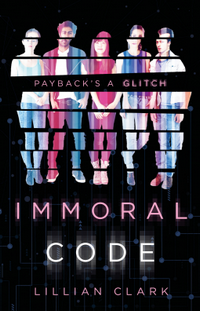
Immoral Code by Lillian Clark: A Heist Novel where the Heist is maybe the Dullest Part

Immoral CodeImmoral Code

by Lillian Clark


eARC, 272 pg.
Alfred A. Knopf Books for Young Readers, 2019

Read: January 22 – 23, 2019


It’s their senior year, their lives are stretching out before them, this incredibly close group of five friends are preparing for graduation, college, etc. — even (not that they’ll confront this quite yet) living without each other. They all excel in one or two ways — one’s a hacker/activist, one’s an artist, one’s got a real shot at the Olympics — etc. One is a physics genius (or close enough to a genius to count) who was admitted early to MIT. But there’s a catch. She can’t afford it. Her mom works two jobs to help the two of them barely make it and her dad hasn’t been in her life since he was a poor student and impregnated her mom. Since then he’s gone on to become one of the richest of the rich. The kind of rich that people really can’t believe exists. So when MIT looks at her financial aid, they roll their eyes and move on to the next student.

Not content to shake their heads sadly at injustice, her friends come up with a plan to hack into her dad’s company and skim a little bit of money. Not enough that he’d ever notice — just enough to pay tuition for a year. Their hacker friend is good, but not good enough to break in remotely — she has to be physically in touch with the network — for just a few seconds. Like the tagline on the cover says, “Payback is a glitch.” So over Spring Break they take a little road trip — bigger than their families know — to get access to the network. It’s going to take a lot of nerve, some real disregard for the law, and their combined talents to pull this off.

The question they don’t really consider until it’s too late isn’t what will happen if they fail (although, they all could think of that more), it’s what happens if they succeed?

On the whole, I haven’t seen many people classifying this as a Crime Novel, despite the Heist story at the core. It’s definitely not a thriller. Because the Heist story is just an excuse to talk about friendship, figuring your life out, the pressure on teens to know what they want the next few decades to be about (not the same as the previous item on the list), the complicated relationship that exists between parents and their teens on the cusp of adulthood, and the hugeness of the moment where you leave home/family/friends to start the next phase of your life. Oh, also, morality. Somehow Clark does all that while telling a fast-moving, funny, and heart-felt story.

Which is not to say that the Heist story isn’t important, or well executed. And you can read the book just for the Heist. But you’ll miss out on a lot — and you’ll probably wonder why I rated this so highly. As fun as the Heist/prep for the Heist is, the heart of the book is the rest.

Each chapter jumps between first-person narration from each kid, keeping things moving nicely. There’s plenty to like/identify with in each character. You learn a lot about them as individuals, them as friends, and generally them as children (not that much about them as students, oddly). They’re so well-drawn, I’m sure what I respond to in one character or another will not be the same as what another reader responds to. There is one character who serves as the group’s Jiminy Cricket — their vocal and ever-present conscience. Like Jiminy, the character is ignored a lot and fought against. But I appreciated them — the voice of moral reason, the one trying to save the others from themselves, the only one who demonstrated a sense of right and wrong, not just about what feels right.

The writing is breezy, engaging — no matter whose POV you’re reading. Clark did a fantastic job differentiating the characters, giving them all a unique voice so that you don’t even have to pay attention to the indicator at the beginning of the chapter to know whose voice is telling that particular chapter. Now, as each chapter is told from the Point of View of a teenager, and fairly realistically done, that means you have to check your inner grammarian at the door — so much of this book can drive you around the bend if you don’t.

The novel is engaging, it’s beyond that really — it’s infectious.There were several points during reading that I asked myself why I was enjoying it as much as I was. Not that I thought I should dislike it, but I liked it a lot more than I should have. I don’t mind that I did, I’m just not sure I understand why. I’m just going to chalk it up to Lillian Clark being a very good author — someone you should check out, starting with her debut, Immoral Code.

Disclaimer: I received this eARC from Random House Children’s Books via NetGalley in exchange for this post — thanks to both for this.

—–

4 Stars

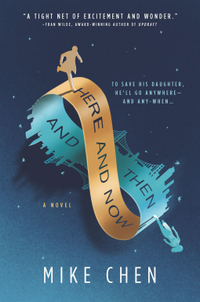
Pub Day Repost: Here and Now and Then by Mike Chen: A Dad. A Daughter. And Time Travel. (Kleenex may be required)

When I really love a book and don’t know how to express it, I tend to ramble. Case in point:

Here and Now and ThenHere and Now and Then

by Mike Chen

eARC, 336 pg.
Mira Books, 2019

Read: January 15 – 16, 2019

You can have fun with a son
But you gotta be a father to a girl

That’s Rodgers and Oscar Hammerstein, not Mike Chen — but the spirit of the book is in that second line, so I’m going to use it. I found myself singing those lines a lot while thinking about the book. If you’re a father to a daughter, you will love this book. I don’t think it’s necessary to appreciate the book — non-parents, mothers, people with sons should still be able to see how good it is and to empathize with the characters. But I can’t imagine any Father of a Daughter won’t see themselves (and Daddy’s Little Princess) in these pages.

In the past, I’ve said something about not really liking non-Doctor Who Time Travel stories. I’m starting to think it’s because I haven’t been reading the right kind of Time Travel stories. In the last year (give or take), I’ve read and loved four Time Travel novels — All Our Wrong Todays by Elan Mastai, Just One Damned Thing After Another by Jodi Taylor, Paradox Bound by Peter Clines, and now Here and Now and Then by Mike Chen. In all of them, the tropes of Time Travel are honored — while played with a little bit — but are really just excuses to tell very real emotional stories about some pretty great characters. Which is what Who does best, too, now that I think about it. So maybe for me, Time Travel has to be a means to an end, not the end itself.

Maybe I should leave the introspection for another time, and just get on with talking about the book, eh? My point was supposed to be that, like Matsai, Taylor and Clines, Mike Chen has surprised and excited me beyond expectations and hopes.

The day I started (and fell in love with) this book, I tried to explain it briefly to someone. I did so in a way that was clearly reductionistic (because, that’s what you do in a couple of sentences), spot on, and yet horribly inaccurate — all at the same time. Here’s what I said: It’s a gender-flipped Outlander, except the protagonist goes to the future instead of the past, and they use science-y stuff to the Time Travel instead of magic-y stuff.

Kin (pronounced /ˈkēn/) is, or was — or will be — a Secret Agent for the Temporal Corruption Bureau in 2142. He came back to 1996 to prevent a Twenty-Second Century criminal from altering the timeline for their own profit — and did so. But things went wrong in carrying out the mission and he was unable to be returned to his time. So he got stuck in 1996 for a bit. For him, it was 18 years. For the TCB it was a couple of weeks. For Kin, he had to give up hope of rescue, get a job — and then he fell in love, got married and had a kid. He has a nice life — he’s a success in IT for a video game company, he’s a pretty decent amateur chef and is working on trying out for a reality show for home chefs, his wife is great, and his daughter is, too. Miranda’s fourteen, a soccer star, wicked smart, a SF nerd and loves her parents.

Then his partner Markus shows up to bring him back to their time — Kin’s largely forgotten his former, er, past, er…other life and has really become a resident of 2014 (this is explained in science-y wibbly wobbly, timey wimey terms that actually make sense in context), so Markus has to take him by force. Once he’s back to his future, Kin starts remembering his life — his job, his hobbies, his utter ineptitude in the kitchen — and his fiancé (Markus’ sister). But it doesn’t come back to him immediately, and he has to work at it.

One thing he can’t do, is let go of his Twenty-First Century life, and he schemes for ways to remain a part of Miranda’s life. For awhile, this works — but only for a while. The instant it starts, every reader knows that Kin won’t be able to fly under the radar forever and he gets found out. It turns out that what he’s doing risks the future — but the only fix the TCB has in mind will mean Miranda’s death. While Kin can understand their decision, there’s no way he can let that happen to his daughter.

I don’t think I’ve said (much) more than the publisher’s blurb — but I can’t say much more without spoiling. And trust me, Chen’s version is much better than mine would be.

Kin is a great character — he’s thoughtful, skilled, smart — and human. He makes a lot of mistakes, his judgement is shaky (not just when it comes to Miranda, either) — but he tries to do the right thing. His loved ones — in all eras — are people you can believe are in his life and you can see why he cares for them, and you do too — because of Kin. That’s all I’m going to say about the other characters because I can’t talk about any of them without ruining something.

The world of 2142 is just about perfect — it’s different than 2014, but there are straight lines connecting it all. It’s the little changes that make it right — often Kin’s perspective allows us to see it. Like the offhand way he mentions to someone that temperatures are 5 degrees lower in 2014. Or the way he reacts to a recreation of 21st Century fast food. There are things about Mars that are just tossed off in conversation without explanation that clearly mean humans are doing something on the surface of the planet. Don’t ask me what — Chen doesn’t say. It even took me seeing him use the phrase a couple of times before I realized what it meant. But once I did, I got very excited about how he pulled it off. There are many subtle details like these that really make this a believable read.

The story and the writing are imaginative and playful — you will smile a lot while reading this. But the instant that Markus shows up and says it’s time to go, you just know that your heart is going to get broken in these pages. And you will be right. Thankfully, Chen will give you almost as many reasons to be happy — some small, some big. It’d have been very easy to make this maudlin or depressing. He could’ve also make this a playful romp. Chen instead walks the tightrope between the extremes in a performance worthy of Philippe Petit. The pages fly by, I really couldn’t believe how quickly I read this — part of it was because I just had to find out what happened to Kin, Miranda and the rest — but part of it was Chen’s writing. Despite hitting you with all that he hits you with, it’s very (and at times, deceptively) easy to read.

(this next paragraph could get a bit spoiler-y. But not really, just in vague sentiments, no particulars…Still, skip if you want)
This worked for me on just about every level and on just about every front — it checked all of my boxes and did just about every superlative thing I can think of. But the ending — I loved the ending, don’t get me wrong — just felt a little too easy. Things worked a little too well. Which the fanboy in me loves, but . . . I dunno, the book was filled with twists and struggles and challenges and the in the last three or four chapters everything was a little too easily overcome — and even the challenges melted away. And yes, I cheered, but I wanted Kin and everyone to have to work a little harder for my cheers. So, I’m docking this 1/2 star. (which is easy to do because on Goodreads/Amazon/NetGalley I have to round up, because they won’t accept half-stars, so the ratings average still gets to stay high).

Heart, soul, laughs, and heartbreak — I don’t know what else you want out of a time travel story. Or any story, really. Characters you can like (even when they do things you don’t like), characters you want to know better, characters you want to hang out with after the story (or during it, just not during the major plot point times), and a great plotline. This book is about as good as it gets. Grab your copy now while I start eagerly anticipating Chen’s next book.

Disclaimer: I received this eARC from HARLEQUIN – MIRA via NetGalley in exchange for this post — thanks to both for this. These are my own honest — and hopefully not convoluted — thoughts and opinions.

—–

4 1/2 Stars

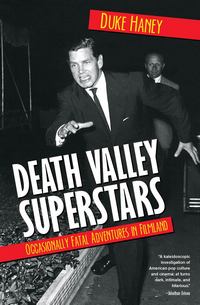
Death Valley Superstars by Duke Haney: Cautionary Tales about Hollywood

Death Valley SuperstarsDeath Valley Superstars: Occasionally Fatal Adventures in Filmland

by Duke Haney
Kindle Edition, 306 pg.
Delancey Street Press, 2018
Read: January 2 – 16, 2019

Duke Haney, actor, screenplay writer, novelist, essayist, has delivered a well-written collection of sixteen essays revolving around some of those impacted by, affected by, corrupted(?) by, shaped by Fame — that fleeting authority and celebrity bestowed by a chosen few in the Hollywood system that has captured the American imagination and attention since the 1900s.

The quality of the writing throughout was pretty consistent, as was the voice, etc., etc. But my own interest varied widely from piece to piece. I think that’s largely on me, not Haney. But then again, maybe Haney shouldn’t have picked topics that have been done to death. I’m not sure that the universe needs another essay/reflection/biography/anything about Marilyn Monroe, Lee Harvey Oswald, or Jim Morrison. It certainly doesn’t need any further effort to celebrate Hugh Hefner.

On the other hand, the pieces about Sean Flynn (son of Errol), William Desmond Taylor, Christopher Jones, and other people that I’d never heard of were fascinating. I learned something, I was introduced to people I’d missed out on. They weren’t slightly different takes on worn-out ideas about legends that have had dozens of books written about them.

Better yet were the pieces that were about his life — encountering Elizabeth Taylor as a youth, working on various films, his nude scenes, his crush on (and seen in retrospect, stalking) of a noted actress, the encounter with the lady on the bus talking about the video store they both frequented, even the part of the Jim Morrison essay about his quest to hire a psychic (it shouldn’t be that hard in L.A.) to do a séance in a hotel room Morrison lived in. He’s really his best — and most entertaining — subject (although when the subject of an essay is someone else, Haney tends to talk about himself too much). He doesn’t come across as someone trying to gloss over mistakes, missteps, or embarrassing moves — in fact, he seems to revel in them. These are honest (seeming), frequently funny and charming.

I have no doubt that there are plenty of people out there who will invert my rankings, or dispute them all together. And they’d likely be right to do so (I doubt they’d convince me, but you never know). Most collections I read are pretty uneven. This isn’t the case with Death Valley Superstars, I think the quality is consistent — it’s just my own reaction to the chapters that are varied. I’d wager the same will be true for other readers.

If nothing else, I think the above summary rundown demonstrates the variety of pieces in this collection — and I didn’t make mention of all of them. One thing that is fairly consistent is the takeaway from the collection as a whole — fame is fleeting, but its effect on the lives of the famous (and those near them) is long-lasting, and rarely pleasant or beneficial. Really, the whole book can be seen as a collection of cautionary tales with a persistent message — stay away from Hollywood.

I didn’t love this book, but I really liked parts of it, and am glad I read it. I can easily see many readers wondering what was wrong with me, however, and eating this thing up.

Disclaimer: I was provided with a copy of this book in exchange for my honest opinion, which is seen above.

—–

3 Stars

✔ An essay collection.

LetsReadIndie Reading Challenge

Saturday Miscellany — 1/26/19

I almost had this one up in time — but like two other nights this week, I woke up hours after I started a sentence to read utter gibberish on my screen. Maybe next week? (and yes, I’m probably the only one who cares about the time this posts, I realize.)

This week’s list is light on news-y posts and primarily features authors I greatly appreciate sounding off about interesting topics and updates for their fans/readers/etc. Honestly, I prefer weeks like this — a lot of stuff to think about/debate. Some good odds ‘n ends over the week about books and reading that caught my eye. You’ve probably seen some/most/all of them, but just in case:

  • Book clinic: what contemporary literary fiction is uplifting? — on the one hand, I’m not sure I need my literature to be “uplifting” — but I do like the idea of it. Regardless, some interesting looking reads here.
  • The Pressure to Continue the Story After the Story — some good stuff from typical font of good stuff, Harry Connolly
  • I Write Fiction About Border Crime, But Unlike Trump I Tell the Truth. — The political stuff in this piece by Don Winslow is easy to ignore (I’m not suggesting you should ignore it, but for the purposes of this blog, we’re going to focus on other bits).
  • While reading the above, I saw this: If I Hate Violence So Much, Why Do I Love Writing About It? by Adam Sternbergh. I’ve loved his novels — which do feature a lot of violence, so I had to read this (although I could’ve guessed almost everything he said about himself — but still, the “why” is intriguing).
  • Lots of Lee Coming Your Way — some updates from one of the favorites around here, Lee Goldberg.
  • Exciting news to share on publication day! — M. W. Craven, a new favorite since last summer, has a lot of good news to share on the day his The Puppet Show (which featured prominently on my 2018 wrap up posts) came out in paperback (at least in the UK).
  • Ranking Jonathan Tropper’s Novels — Matthew Hanover discusses and ranks Jonathan Tropper’s novels. I could feel Tropper’s influence in Hanover’s work, so this was in my sweet spot (am hoping to do a Tropper re-read later this year, btw). I’d argue about #4’s place on the list, but I think Hanover could convince me to keep it that high. However, he’s dead wrong about #1 and #2 and should flip them after publicly repenting. No sackcloth and ashes required, but . . .

    Somehow no books were published this week that piqued my interest. At least not that I saw. Good. Catch up time.

Lastly, I’d like to say hi and extend a warm welcome to allmyheroesareweirdos, ladolceamara, William J. Fulton, Shawn P. B. Robinson, Davida Chazan, wanderingminds2019 and Elle for following the blog this week (I think this is my biggest week ever — thanks, guys & gals!).

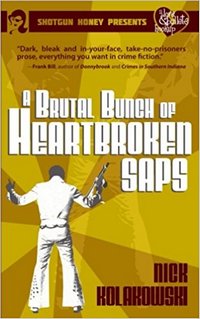
A Brutal Bunch of Heartbroken Saps by Nick Kolakowski: A fast, fun, and bullet-ridden adventure

A Brutal Bunch of Heartbroken SapsA Brutal Bunch of Heartbroken Saps

by Nick Kolakowski
Series: A Love & Bullets Hookup, #1

Kindle Edition, 128 pg.
Shotgun Honey, 2017

Read: January 17, 2019


Bill is a con man, a hustler, a grifter with a gift — one that has been put to good use by the Rockaway Mob until the day that Bill has had enough. He just can’t keep going the way he’s been going. So he leaves New York and heads off on his secret plan to leave the country. Of course, before he left town, he helped himself to a large amount of the Mob’s money to fund his retirement. Which is as popular a choice as you can expect.

Only . . . his plan isn’t as secret as he thinks and people are on his tail immediately. A pair of employees are sent to take care of Bill and retrieve the cash. And then another is shooter is sent before those first two have even had a chance to fail. And it’s a good thing that happened.

Which is all I should probably say about the plot. Very little goes the way you think it’ll go once things get rolling. What follows is fast, fun and violent. It’s the least subtle critique of civil forfeiture possible — and a whole host of other things.

The backup assassin is our entry into this world, these characters — .he’s notorious, he’s infamous, he’s “that guy.” And . . . he’s kind of falling apart — his wife can’t handle his vocation any more and is divorcing him. His point of view chapters are a mix of attitude, a little snark, mayhem and despondency. Somehow, that mix is a blast.

On the other hand, we have Bill — who you somehow can’t believe was ever brought into the fold by the Rockaway Mob, but he’s clearly good at what he does. But little else, it seems. He has a real knack for moving from fire to fireplace to somewhere hotter yet. One of the other assassins sent after him was the one who brought him to the Rockaway Mob, who vouched for him. Her name is Fiona, and she’s one of the fiercest, deadly, aggressive characters you’ve met recently — and at least until recently, was in love with Bill (not that he treated her too well in his exit, and probably cooled her affections as a result).

This is a novella — and there’s not a lot of space for character development, for fully drawing out a character — and while these three aren’t as well drawn as Kolakowski has in other work, they’re good enough for what he’s wanting to accomplish here. (I hope that doesn’t sound like a slight — it’s not supposed to be). They may not be fully drawn, but they’re a lot of fun — and there’s some intriguing emotional beats between them and some of the other characters in these pages.

This book is primarily an exercise in violence — there’s a hint of torture, just a hint (but most of it happens off-screen). What’s not hinted at are explosions and gunfire. There’s a lot of it — the literary equivalent of so much of the stylized cinematic violence inspired by Tarantino in the 90’s. It’s adrenaline set to music — think Edgar Wright action scenes, but more lethal — to skip a couple of decades (actually, I bet this novella would pair well with much of the Baby Driver soundtrack).

I had a hard time accepting how the last few chapters went, because I had the wrong idea about what Kolakowski was up to with this book (and, I bet, the next two books that follow). But I had a blast with it — even the last chapters, once I gave up my preconceptions.

This is a fast, lean novella — there’s not an ounce of fat, not one unnecessary sentence to this. Kolakowski has a story to tell and he tells it. I knew going in that this was going to be a fast read, but I couldn’t believe how quickly I got through it — between the lean prose, the fast pace of the book and the action scenes, this was just a bullet train of a read (no pun intended).

Disclaimer: I received a copy of this book from the author. My opinions expressed above are my own. I appreciate the book, but I didn’t sell out my opinions because of that..

—–

3.5 Stars

LetsReadIndie Reading Challenge
2019 Cloak & Dagger Challenge

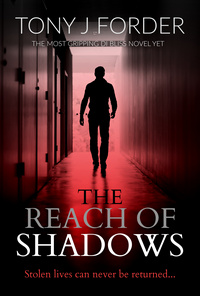
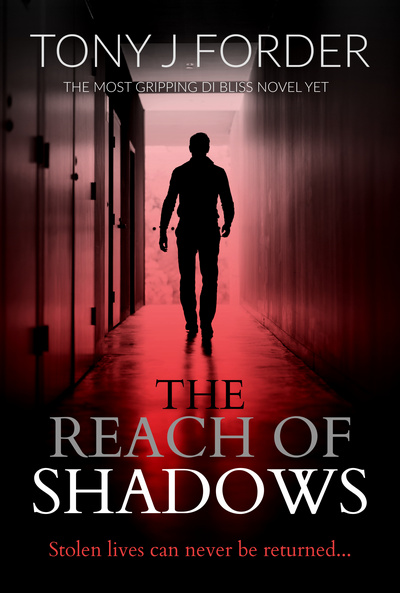
The Reach of Shadows by Tony J. Forder: A Gripping Mystery, a Haunted Past, A Strong Novel


The Reach of ShadowsThe Reach of Shadows

by Tony J. Forder
Series: DI Bliss, #4


eARC, 372 pg.
Bloodhound Books, 2019

Read: January 18 – 21, 2019

‘Three days on, are you any closer to finding out who murdered our daughter?’ Tony Coleman asked. His hands were resting palm down on the bed, fingers splayed as if he were about the leap into action at any moment. The shock was palpable in every line of his face, and the man’s glazed eyes told Bliss that so much grief was yet to sink in. It was looking at faces just like this throughout his career that caused Bliss to take his cases personally. He never forgot a murder victim , but it was the expression on the faces of those they left behind that haunted him most of all.

Some time back, I noticed a strong link between how a novelist depicted the grieving of a murder victim’s family (particularly if it features the family identifying the body) and my overall reaction to the book. It’s the little things that are the most telling, right? Now, by the time I got to this father, I was already pretty sure that Forder knew what he was doing with this book, but it was nice to get the confirmation.

There is so much going on in this novel that it’s hard to know where to start. The book opens with a bang, with DI Bliss finding someone prowling around his house in the middle of the night. He pursues them on foot, in totally inappropriate clothing for such a thing. His pursuit is only called off when he’s struck by a car while crossing the road. When DS Chandler, his partner, comes to the hospital to bring him home, she tells him they have a stop to make — at a murder scene. He’s been ordered there despite his need to recover from the injuries sustained by being hit by a car.

Bliss is informed later that the reason he’s being pressured to work on this while recuperating is that the victim, Jade Coleman, had recently filed a complaint with the police about a stalker — and two of Bliss’ detectives had interviewed her. Nothing came of this complaint, and now she’s dead. So did they miss something? What should these two have done better/differently?

So Bliss has quite a few plates spinning right away — recovering from a concussion, broken ribs, etc.; solve a murder; ensure that the stalker investigation isn’t going to blow up in anyone’s face; when a few more plates are introduced: The Independent Office for Police Conduct (a replacement for The Complaints department) is looking into some of his cases — recent, and less-so. In fact, their investigation goes back over a decade, to when Bliss had been investigated for — and exonerated from — his wife’s murder. Bliss’ superiors are supporting him, and encouraging him to defend himself however is necessary — but he wants to find Coleman’s murderer, too. Bliss does keep the more senior members of his team in the loop about the IOPC investigation and they all want to help him as they can. So we have a whole lot of detectives trying to do a whole lot in a very short time.

Now, I haven’t read the previous three DI Bliss novels, and I don’t know what kind of overlap those books have with the particulars of the IOPC investigation — I think if I had more of a history with Bliss I could’ve cared more about this story, I could’ve appreciated the dangers he was in. Now, you never want the protagonist of the book you’re reading to be framed for a crime (especially if you get the sense that they’re one of the good guys in the world), but I just don’t have the investment to really care. So my primary concern was the Coleman case (and it was ultimately Bliss’ too).

The ways in which I wanted to be invested, but couldn’t, in the storylines about Bliss’ past were matched in the ways I was invested in Coleman’s case — there were some very believable red herrings dealt with, and Forder faked me out more than once. I’m not saying I got fooled by the same red herrings that distracted the detectives, but that Forder makes the reader thing he’s doing X with the plot while he’s setting up a Y. I was pretty impressed with the way he kept the characters and readers on their toes with the various stages and phases of the Coleman investigation while dealing with the crisis prompted by the Bliss investigations.

There is a great supporting cast around Chandler and Bliss — all of whom I wanted more time with — either above or below them in rank. I don’t know that if the book wasn’t quite as busy as this one if we’d have got to enjoy more of them, or if this is typical of the series. I can’t think of one of them I wouldn’t mind a few more pages with. Bliss is a very interesting character — he’s a good man and an old-school cop who’s doing his best to adapt and evolve into the modern concept of a detective. Chandler is a loyal friend, partner and sidekick — who could be more, who could (and maybe should) be a DI herself, but it perfectly content where she is. Watching them navigate the challenges of leadership and the pressures from above as tools to solve Coleman’s murder as well as being obstacles to efficient detecting is a lot of fun.

This really is a well-written, well-conceived and well-executed book — I think most of my lack of engagement (not that I wasn’t pretty engaged, I just think the book expected/deserved more on my end) comes from the fact that I was getting to know Bliss, Chandler and the rest. As I’ve said — the novel was just built on a lot of history, and not having any familiarity with that history, I couldn’t care as much as I should have. If I had the foundation, I’d have liked it more — and I already liked it a good deal. I do think this is a fine jumping on point — as long as you go into it knowing that you’re coming late to the party and won’t care about missing some things. Because of the way that this book seems to have wrapped up that stage of Bliss’ life, I’m not sure I want to go back and read the first three books (but I might), but I do want to see what happens in Bliss’ future — I haven’t talked much about Chandler, but I’m very interested in what lies in her future.

So, to wrap up, this is a strong novel that I couldn’t appreciate as much as I wanted to — but I really liked and it made me want to read more about these characters. My guess is you’ll react the same way (unless you’ve had the good sense to try these novels before hand — you are in for a treat).

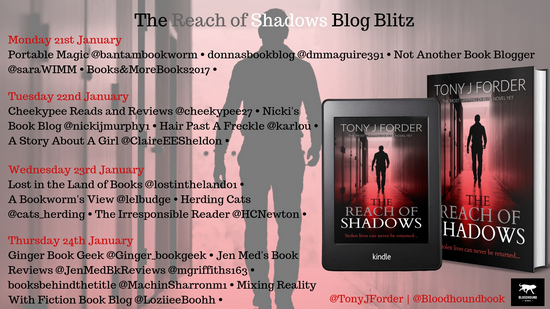
My thanks to Bloodhound Books for the invitation to participate in this tour and the materials (including the book) they provided.

—–

3.5 Stars

LetsReadIndie Reading Challenge
2019 Cloak & Dagger Challenge

BOOK SPOTLIGHT: The Reach of Shadows by Tony J. Forder

Today I welcome the Book Tour for the aptly named The Reach of Shadows by Tony J. Forder (note: shadows have a long reach). Along with this spotlight post, I’ll be giving my take on the novel here in a bit.

Book Details:

Book Title: The Reach of Shadows by Tony J. Forder
Publisher: Bloodhound Books
Release date: January 9, 2019
Format: Paperback/ebook
Length: 372 pages

Book Blurb:

Recovering from injuries sustained in a road collision, DI Bliss is taken directly from hospital to a fresh crime scene and ordered to investigate the vicious stabbing and murder of Jade Coleman.

When Bliss realises the victim had reported being stalked, and that two of his own team had been drafted in to take her statement, he is given the unenviable task of interviewing both of his detectives.

Increasingly it appears that the stalker may be their killer. However, several other people soon become part of the team’s suspect list.

Bliss also finds himself being questioned about his own past, and has to battle to defend himself whilst continuing to investigate the murder.

Soon more questions arise.

Why would anybody target Jade Coleman?

Why are the team unable to identify the victim’s close female friend?

And why did Jade recently leave her job without any explanation?

With his work cut out, and his team under pressure, can Bliss solve the case before more victims show up?

Or will the shadows of his own past reach out and drag him under before he can succeed?

About Tony J. Forder:

Tony J. ForderTony J Forder is the author of the critically acclaimed, internationally best-selling crime thriller series featuring detectives Jimmy Bliss and Penny Chandler. The first three books, Bad to the Bone, The Scent of Guilt, and If Fear Wins, are now joined by The Reach of Shadows, published in January 2019.

Tony’s dark, psychological crime thriller, Degrees of Darkness, featuring ex-detective Frank Rogers, was also published by Bloodhound Books. This is a stand-alone novel. Another book that was written as a stand-alone was Scream Blue Murder. This was published in November 2017, and received praise from many, including fellow authors Mason Cross, Matt Hilton and Anita Waller. Before it had even been published, Tony had decided to write a sequel, and Cold Winter Sun was published in November 2018.

Tony lives with his wife in Peterborough, UK, and is now a full-time author.

Tony J. Forder’s Social Media/Links:

Website ~ Facebook ~ Twitter: @TonyJForder
Goodreads ~ Barnes & Noble ~ Bloodhound Books


My thanks to Bloodhound Books for the invitation to participate in this tour and the materials (including the book) they provided.

A Few Quick Questions With…Matthew Hanover

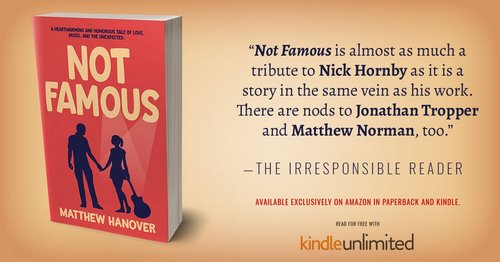
Matthew Hanover’s Not Famous was released last week (see my initial post about it)– and he was clearly and understandably busy with that. Still, he took the time to answer a few questions for me — which I greatly appreciate. As usual, this is designed to whet your appetite for the author so you go check out their website/twitter feed/etc., but more importantly, you check out their book. I hope that’s what happens here.

I threw in a bonus question about the Nick Hornby/Ben Folds album Lonely Avenue to see just how deeply the Hornby-fan in him ran. Also, his book is about a musician — we should talk music, right?

You’ve spent a lot of time blogging your way through the production of Not Famous — which, incidentally, forces lazy bloggers to get more creative than usual when coming up with interview questions — why did you decide to do that? Did thinking about what you were going through via reporting it help you in any way?
My hope was to build an audience before my novel came out and help motivate me to get the novel finished.Talking about my novel’s progress on my website and on Twitter did help me connect with potential readers and book bloggers like you, so I guess it worked!
In the writing of Not Famous, what was the biggest surprise about the writing itself? Either, “I can’t believe X is so easy!” or “If I had known Y was going to be so hard, I’d have skipped this and watched more TV.”
I think the biggest surprise was how much I cared about the story and the characters. There came a point where, even though I was the writer, I felt I was just transcribing the story as the characters I’d developed would play it out naturally. As nice as that sounds, it was really difficult other times… If I didn’t feel inspired to write, I didn’t force it. There were definitely stretches of weeks and months at a time I never touch it.
I’ve made it clear that Lacy is the character that I’m most interested in — where did Lacy come from? Was it a conscious choice to make her role in the Nick/Alli relationship so pivotal, or did that just happen as you wrote?
Lacy, as you know, is Nick’s half-sister. Originally, she was just his sister, but as various plot points evolved, I felt it was necessary to put as much distance between them as I could, and so she became the daughter of their mother’s second marriage which contributed to his struggle to connect with her, and gave him a stronger opportunity to redeem himself with her. It seemed like an interesting way to explore a different kind of relationship (other than a dating relationship), and the problems that exist in that dynamic. Intertwining those to arcs was a real learning experience because I wanted it feel natural, and not forced.
Is “Lad Lit” all you write/want to write? Can you articulate what draws you to the genre? Is there a genre that you particularly enjoy reading, but could never write?
As far as novels go, yes. When I first read books by Nick Hornby and Jonathan Tropper, they were totally the kinds of stories I want to read… and eventually discovered I wanted to write. I do like science-fiction and post-apocalyptic novels, and I’ve written one sci-fi/paranormal short story… but I don’t think a novel in those genres in my future. Lad lit has always been the genre I’ve been most drawn to, and there’s quite a few stories in my head trying to get out!
What’s next for Author Matthew Hanover? Is Novel #2 underway, or are you solely focused (for now) on getting this launched?
I’ve been plotting out my next novel since before Not Famous was finished. I’m not actively writing it yet, and I should tell you straight out it is not a sequel, but is set in the same universe as Not Famous. Some characters you met in Not Famous will make an appearance… but this will be an office comedy / romantic dramedy. I hope to start it soon!
Oooh, sounds great. Hope to see it soon.

Bonus Question: Best song on Lonely Avenue and why?

Wow, what a great, and difficult question. How about I give you my top five? I’m guessing since you’re a Nick Hornby fan you’ll understand!

5. Picture Window
4. From Above
3. Claire’s Ninth
2. Practical Amanda
1. Your Dogs

As for why? I think these are the most solid songs on album… they’re all different… each tell vastly different stories…

Technically cheating — but I figure Rob Fleming would approve of the Top 5 approach. Good answers, too — although if we were hanging out in Championship Vinyl, I’d be compelled to tell you that you got 3 out of 5 correct, but your order is wrong. Good thing we’re not there, right? 🙂

Seriously, thanks for taking the time to answer these questions, I hope that Not Famous does well — and I look forward to your future work.

Here and Now and Then by Mike Chen: A Dad. A Daughter. And Time Travel. (Kleenex may be required)

When I really love a book and don’t know how to express it, I tend to ramble. Case in point:

Here and Now and ThenHere and Now and Then

by Mike Chen


eARC, 336 pg.
Mira Books, 2019

Read: January 15 – 16, 2019

You can have fun with a son
But you gotta be a father to a girl

That’s Rodgers and Oscar Hammerstein, not Mike Chen — but the spirit of the book is in that second line, so I’m going to use it. I found myself singing those lines a lot while thinking about the book. If you’re a father to a daughter, you will love this book. I don’t think it’s necessary to appreciate the book — non-parents, mothers, people with sons should still be able to see how good it is and to empathize with the characters. But I can’t imagine any Father of a Daughter won’t see themselves (and Daddy’s Little Princess) in these pages.

In the past, I’ve said something about not really liking non-Doctor Who Time Travel stories. I’m starting to think it’s because I haven’t been reading the right kind of Time Travel stories. In the last year (give or take), I’ve read and loved four Time Travel novels — All Our Wrong Todays by Elan Mastai, Just One Damned Thing After Another by Jodi Taylor, Paradox Bound by Peter Clines, and now Here and Now and Then by Mike Chen. In all of them, the tropes of Time Travel are honored — while played with a little bit — but are really just excuses to tell very real emotional stories about some pretty great characters. Which is what Who does best, too, now that I think about it. So maybe for me, Time Travel has to be a means to an end, not the end itself.

Maybe I should leave the introspection for another time, and just get on with talking about the book, eh? My point was supposed to be that, like Matsai, Taylor and Clines, Mike Chen has surprised and excited me beyond expectations and hopes.

The day I started (and fell in love with) this book, I tried to explain it briefly to someone. I did so in a way that was clearly reductionistic (because, that’s what you do in a couple of sentences), spot on, and yet horribly inaccurate — all at the same time. Here’s what I said: It’s a gender-flipped Outlander, except the protagonist goes to the future instead of the past, and they use science-y stuff to the Time Travel instead of magic-y stuff.

Kin (pronounced /ˈkēn/) is, or was — or will be — a Secret Agent for the Temporal Corruption Bureau in 2142. He came back to 1996 to prevent a Twenty-Second Century criminal from altering the timeline for their own profit — and did so. But things went wrong in carrying out the mission and he was unable to be returned to his time. So he got stuck in 1996 for a bit. For him, it was 18 years. For the TCB it was a couple of weeks. For Kin, he had to give up hope of rescue, get a job — and then he fell in love, got married and had a kid. He has a nice life — he’s a success in IT for a video game company, he’s a pretty decent amateur chef and is working on trying out for a reality show for home chefs, his wife is great, and his daughter is, too. Miranda’s fourteen, a soccer star, wicked smart, a SF nerd and loves her parents.

Then his partner Markus shows up to bring him back to their time — Kin’s largely forgotten his former, er, past, er…other life and has really become a resident of 2014 (this is explained in science-y wibbly wobbly, timey wimey terms that actually make sense in context), so Markus has to take him by force. Once he’s back to his future, Kin starts remembering his life — his job, his hobbies, his utter ineptitude in the kitchen — and his fiancé (Markus’ sister). But it doesn’t come back to him immediately, and he has to work at it.

One thing he can’t do, is let go of his Twenty-First Century life, and he schemes for ways to remain a part of Miranda’s life. For awhile, this works — but only for a while. The instant it starts, every reader knows that Kin won’t be able to fly under the radar forever and he gets found out. It turns out that what he’s doing risks the future — but the only fix the TCB has in mind will mean Miranda’s death. While Kin can understand their decision, there’s no way he can let that happen to his daughter.

I don’t think I’ve said (much) more than the publisher’s blurb — but I can’t say much more without spoiling. And trust me, Chen’s version is much better than mine would be.

Kin is a great character — he’s thoughtful, skilled, smart — and human. He makes a lot of mistakes, his judgement is shaky (not just when it comes to Miranda, either) — but he tries to do the right thing. His loved ones — in all eras — are people you can believe are in his life and you can see why he cares for them, and you do too — because of Kin. That’s all I’m going to say about the other characters because I can’t talk about any of them without ruining something.

The world of 2142 is just about perfect — it’s different than 2014, but there are straight lines connecting it all. It’s the little changes that make it right — often Kin’s perspective allows us to see it. Like the offhand way he mentions to someone that temperatures are 5 degrees lower in 2014. Or the way he reacts to a recreation of 21st Century fast food. There are things about Mars that are just tossed off in conversation without explanation that clearly mean humans are doing something on the surface of the planet. Don’t ask me what — Chen doesn’t say. It even took me seeing him use the phrase a couple of times before I realized what it meant. But once I did, I got very excited about how he pulled it off. There are many subtle details like these that really make this a believable read.

The story and the writing are imaginative and playful — you will smile a lot while reading this. But the instant that Markus shows up and says it’s time to go, you just know that your heart is going to get broken in these pages. And you will be right. Thankfully, Chen will give you almost as many reasons to be happy — some small, some big. It’d have been very easy to make this maudlin or depressing. He could’ve also make this a playful romp. Chen instead walks the tightrope between the extremes in a performance worthy of Philippe Petit. The pages fly by, I really couldn’t believe how quickly I read this — part of it was because I just had to find out what happened to Kin, Miranda and the rest — but part of it was Chen’s writing. Despite hitting you with all that he hits you with, it’s very (and at times, deceptively) easy to read.

(this next paragraph could get a bit spoiler-y. But not really, just in vague sentiments, no particulars…Still, skip if you want)
This worked for me on just about every level and on just about every front — it checked all of my boxes and did just about every superlative thing I can think of. But the ending — I loved the ending, don’t get me wrong — just felt a little too easy. Things worked a little too well. Which the fanboy in me loves, but . . . I dunno, the book was filled with twists and struggles and challenges and the in the last three or four chapters everything was a little too easily overcome — and even the challenges melted away. And yes, I cheered, but I wanted Kin and everyone to have to work a little harder for my cheers. So, I’m docking this 1/2 star. (which is easy to do because on Goodreads/Amazon/NetGalley I have to round up, because they won’t accept half-stars, so the ratings average still gets to stay high).

Heart, soul, laughs, and heartbreak — I don’t know what else you want out of a time travel story. Or any story, really. Characters you can like (even when they do things you don’t like), characters you want to know better, characters you want to hang out with after the story (or during it, just not during the major plot point times), and a great plotline. This book is about as good as it gets. Grab your copy now while I start eagerly anticipating Chen’s next book.

Disclaimer: I received this eARC from HARLEQUIN – MIRA via NetGalley in exchange for this post — thanks to both for this. These are my own honest — and hopefully not convoluted — thoughts and opinions.

—–

4 1/2 Stars

Saturday Miscellany — 1/19/19

Remember when this was posted at about the same time every week? Yeah, me neither. On the other hand, I slept well last night. Even if that started well before I was ready/aware of it.

Oh, btw, the whole “Block Editor” thing that WordPress is trying to get me to use — I don’t see the point and man, there’d better be a whole lotta very accessible help files ready to go when they impose this on us w/o the option to go back to the Classic Editor.

With no further ado or delay, here are the odds ‘n ends over the week about books and reading that caught my eye. You’ve probably seen some/most/all of them, but just in case:

    This Week’s New Releases I’m Excited About and/or You’ll Probably See Here Soon:

  • Back Door To Hell by Paul Gadsby — a couple of amateurs try to steal from a crime lord to start their lives. Am thinking the title gives a hint about how that goes.
  • Marked by S Andrew Swann– what a fantastic premise — click the link to read it. A detective, magic, time travel and extra-dimensional bad guys.
  • Tear It Down by Nick Petrie — my goal of catching up on the Peter Ash series this year just got 384 pages harder.
  • Night School: A Reader for Grownups by Zsófia Bán — Click the link to read the description, I can’t do it justice. I’ve only heard good things about this and can easily see it living up to the hype.

Lastly, I’d like to say hi and extend a warm welcome to Dalindcy Koolhoven and ailishsinclair for following the blog this week.

Page 1 of 5

Powered by WordPress & Theme by Anders Norén