

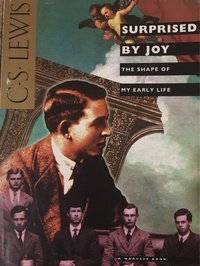
 Surprised by Joy: The Shape of My Early Life
by C. S. Lewis
DETAILS:
 Publisher: Harcourt Brace & Company
Publication Date: 1984
Format: Paperback
Length: 238 pg.
Read Date: May 10-25, 2025


The reader who finds these three episodes of no interest need read this book no further, for in a sense the central story of my life is about nothing else. For those who are still disposed to proceed I will only underline the quality common to the three experiences; it is that of an unsatisfied desire which is itself more desirable than any other satisfaction. I call it Joy, which is here a technical term and must be sharply distinguished both from Happiness and from Pleasure. Joy (in my sense) has indeed one characteristic, and one only, in common with them; the fact that anyone who has experienced it will want it again. Apart from that, and considered only in its quality, it might almost equally well be called a particular kind of unhappiness or grief. But then it is a kind we want. I doubt whether anyone who has tasted it would ever, if both were in his power, exchange it for all the pleasures in the world. But then Joy is never in our power and pleasure often is.
What’s Surprised by Joy About?
This is a look at the early part of Lewis’ life—his childhood, education (in boarding schools primarily), his acceptance to Oxford—and taking time off to serve in WWI—then returning and his eventual conversion to Christianity.
As he puts it in the preface,
This book is written partly in answer to requests that I would tell how I passed from Atheism to Christianity and partly to correct one or two false notions that seem to have got about. How far the story matters to anyone but myself depends on the degree to which others have experienced what I call “joy.”…The book aims at telling the story of my conversion and is not a general autobiography.
He’s not striving to be exhaustive, but to tell us enough that we understand what he was going through and how his education/experiences helped shape his mind for converting.
Endless Books
I am a product of long corridors, empty sunlit rooms, upstairs indoor silences, attics explored in solitude, distan; noises of gurgling cisterns and pipes, and the noise of wind under the tiles. Also, of endless books. My father bought all the books he read and never got rid of any of them. There were books in the study, books in the drawing room, books in the cloakroom, books (two deep) in the great bookcase on the landing, books in a bedroom, books piled as high as my shoulder in the cistern attic, books of all kinds reflecting every transient stage of my parents’ interest, books readable and unreadable, books suitable for a child and books most emphatically not. Nothing was forbidden me. In the seemingly endless rainy afternoons I took volume after volume from the shelves. I had always the same certainty of finding a book that was new to me as a man who walks into a field has of finding a new blade of grass.
Just about anyone who takes the time to read this post is going to resonate with that quotation. Possibly be envious of that kind of childhood.
That’s one thing that comes through in clarity through this book—he is the product of so many books. So much of his experiences are shaped by, illustrated by, and reflected in what he reads—particularly what he returns to.
Yes, there’s some creative work. Some dry education. A lot of emotional development (largely phrased in other terms). Even a little socialization outside of his father, brother, and instructors—but really not much outside of that until Oxford.
What’s there throughout it all? Books. Hard not to identify with a guy like that.
So, what did I think about Surprised by Joy?
I was at this time living, like so many Atheists or Antitheists, in a whirl of contradictions. I maintained that God did not exist. I was also very angry with God for not existing. I was equally angry with Him for creating a world.
Sure, it’s about his early years. But I think the emphasis was on the wrong bits. I know, it’s not my life, he knows what got him to the point he was trying to focus on better than I do. But if the book “aims at telling the story of my conversion,” I really don’t see it.
It happens so quickly, with little fanfare leading up to it—it reminded me of one of those books where you stop a sentence or two after something happens, “Wait, did X just die?” That’s an exaggeration in this case, but not by much.
More of his WWI experience, more about the wrestling with ideas in Oxford. More showing the kind of thinking he encourages others to do about their faith/lack thereof, would be a plus.
Is it a good look at Lewis’ early life? Yes. Does it contain some of his best turns of phrase? Yeah, I think so. Does it deliver on what he aimed to? I really don’t think so. I recommend it for someone who wants to know more about the man—just come in with the proper expectations.

This post contains an affiliate link. If you purchase from it, I will get a small commission at no additional cost to you. As always, the opinions expressed are my own.

Read Irresponsibly, but please Comment Responsibly