

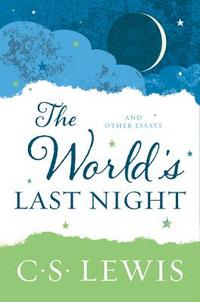
 The World’s Last Night
And Other Essays
by C. S. Lewis
DETAILS:
Publisher: HarperOne
Publication Date: February 14, 2017
Format: Paperback
Length: 122 pg.
Read Date: August 3-10, 2025


What’s The World’s Last Night About?
This is a collection of essays by Lewis, quite simply. I don’t know that they belong together more than that. GIven the original date of publication (1952), he was alive when this was collected, but I have no idea if he was involved in the selection—I am curious about that. So much so that I’ve written 3 more sentences (including this one) about it than I intended to.
Here’s what the jacket flap on my copy says:
In these seven satirical yet poignant essays, C.S. Lewis tackles the temptations of evil. He challenges readers to decide how they would live on thew world’s last night and writes, “We are not the playwright, we are not the producer, we are not even the audience. We are on the stage. To play well the scenes in which we are ‘on’ concerns us much more than to guess about the scenes that follow it.” The infamous Screwtape makes a special appearance with a toast that explores the prospects for exploiting evil. Blending irony, humor, and paradox, Lewis tackles religion’s most difficult and intriguing questions regarding immorality, belief, and the meaning of prayer.
I’m also not sure “satirical” applies to all seven essays. But I didn’t come here to pick a fight with anyone involved with putting this together. So let’s move on with a quick look at each essay (the premise should be clear for most from the title).
The Efficacy of Prayer
I loved this essay. I’m glad I read the collection, if only for this—sadly, the rest of the collection really didn’t live up to it. But I’m okay with paying most of the $17 I spent on the book for this essay. It’s one I will be returning to.
On Obstinancy in Belief
This is sort of a Science v. Faith (a ridiculous debate). Lewis made some pretty good points, and it was generally good. But I’m not sure it’s a home-run.
That demand for our confidence which a true friend makes of us is exactly the same that a confidence trickster would make. That refusal to trust, which is sensible in reply to a confidence trickster, is ungenerous and ignoble to a friend, and deeply damaging to our relation with him. To be forewarned and therefore forearmed against apparently contrary appearance is eminently rational if our belief is true; but if our belief is a delusion, this same forewarning and forearming would obviously be the method whereby the delusion rendered itself incurable. And yet again, to be aware of these possibilities and still to reject them is clearly the precise mode, and the only mode, in which our personal response to God can establish itself. In that sense the ambiguity is not something that conflicts with faith so much as a condition which makes faith possible. When you are asked for trust you may give it or withhold it; it is senseless to say that you will trust if you are given demonstrative certainty. There would be no room for trust if demonstration were given. When demonstration is given what will be left will be simply the sort of relation which results from having trusted, or not having trusted, before it was given.
Lilies that Fester
This is an interesting take on anti-intellectualism and related ideas. It really feels like it could be a recent composition.
There’s a paragraph about a child reading Science Fiction that sold me.
Screwtape Proposes a Toast
I was just going to refer you to what I wrote about this as an add-on to The Screwtape Letters, but apparently, I never finished that post. So, um, that won’t work.
This fell short of the original Screwtape material. It doesn’t have the wit, the insight. It feels like a sequel to The Abolition of Man crammed into Screwtape’s mouth, and it didn’t work nearly as well.
Good Work and Good Works
Second-best essay in the batch.
‘Good works’ in the plural is an expression much more familiar to modern Christendom than ‘good work’. Good works are chiefly alms-giving or ‘helping’ in the parish. They are quite separate from one’s ‘work’. And good works need not be good work, as anyone can see by inspecting some of the objects made to be sold at bazaars for charitable purposes. This is not according to our example. When our Lord provided a poor wedding party with an extra glass of wine all round, He was doing good works, But also good work; it was a wine really worth drinking, Nor is the neglect of goodness in our ‘work’, our job, according to precept. The apostle says everyone must aot only work but work to produce what is ‘good’.
Religion and Rocketry
Huh. Interesting take on extraterrestrial life, etc. I’m not sure what else to say.
The World’s Last Night
There are many reasons why the modern Christian and een the modern theologian may hesitate to give to the doctrine of Christ’s Second Coming that emphasis which was usually laid on it by our ancestors.
It’s hard to believe that someone in the 20th Century could start an essay about escathology that way. But there it is, in black and white.
We must admit at once that this doctrine [of the Second Coming] has, in the past, led Christians into very great follies. Apparently many people find it difficult to believe in this great event without trying to guess its date, or even without accepting as a certainty the date that any quack or hysteric offers them. To write a history of all these exploded predictions would need a book, and a sad, sordid, tragi-comical book it would be.
I’ve read some of those books, and he describes them well.
Overall, this is a really good look at the doctrine of the Second Coming and Judgement and how we should act before then—and why we should do so.
So, what did I think about The World’s Last Night?
I liked this more than some of what I’ve read by Lewis this year, but it doesn’t hold a candle to him at his best. There are moments of brilliance. Moments of spiritual insight and wisdom. Some moments of wit and common sense (which should never be sneezed at). Some moments where you wonder why he has impacted so many (including myself) in such a strong and lasting way.
Still, it’s worth the time—not just for completistis, either. Just know going in that not every essay is going to wow you.
I’m tempted to give it 4 Stars just for the first essay, but let’s not get carried away by such a strong start.

This post contains an affiliate link. If you purchase from it, I will get a small commission at no additional cost to you. As always, the opinions expressed are my own.

Read Irresponsibly, but please Comment Responsibly