

As the title implies, I’m in the middle of this book, so this is not a review, just some thoughts mid-way through. This time, however, I’m not reading the book, my good friend, Lawrence Gale is. These are actually a series of texts he sent me recently about this book–it’s things like this that keep me from making progress on my TBR. (also, who texts like this?)
When he’s not sending oddly articulate and grammatically correct text messages, Lawrence has been known to write over at his substack: Keep the West, Honor the Rest.
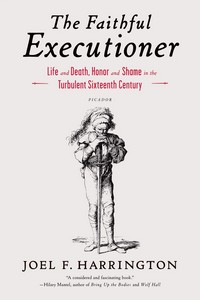
The Faithful Executioner: Life and Death, Honor and Shame in the Turbulent Sixteenth Century
Book Blurb:
In a dusty German bookshop, the noted historian Joel F. Harrington stumbled upon a remarkable document: the journal of a sixteenth-century executioner. The journal gave an account of the 394 people Meister Frantz Schmidt executed, and the hundreds more he tortured, flogged, or disfigured for more than forty-five years in the city of Nuremberg. But the portrait of Schmidt that gradually emerged was not that of a monster. Could a man who practiced such cruelty also be insightful, compassionate—even progressive?
In The Faithful Executioner, Harrington teases out the hidden meanings and drama of Schmidt’s journal. Deemed an official outcast, Meister Frantz sought to prove himself worthy of honor and free his children from the stigma of his profession. Harrington uncovers details of Schmidt’s life and work: the shocking, but often familiar, crimes of the day; the medical practice that he felt was his true calling; and his lifelong struggle to reconcile his craft with his religious faith.
In this groundbreaking and intimate portrait, Harrington shows us that our thinking about justice and punishment, and our sense of our own humanity, are not so remote from the world of The Faithful Executioner.
Imagine minding your own business, then a tyrannical German prince points to you and demands you execute three criminals because there are no executioners around. You realize the second you do that, society will declare you an executioner and your family is permanently ostracized from society and will lose all standing you have. You refuse. Prince then says, you’ll get executed too if you refuse. You don’t want to leave your wife and kids without their protector and provider, so you do the deed and now society has branded you as a necessary evil they don’t want anything to do with.
You then teach your son how to be the most professional and best executioner he can be, and then this son spends the next 50 years of his life being the most above board, skilled, and faithful executioner/citizen he can be in an attempt to free the rest of his family from being executioners and restore their honor before the eyes of society and be formally elevated by the government on your retirement.
My heart will ache if I reach the end and his honor wasn’t restored despite all his efforts.
This post contains an affiliate link. If you purchase from it, I will get a small commission at no additional cost to you. As always, the opinions expressed are my own.

KWHR
An exemplary tale of a man devoted to providing for his family and regaining their honor in a dark and brutal profession. He maintained his faith, and it often guided his struggles upon the darkness he saw every day in his career. What is most striking is that he was professionally an executioner, yet his greatest longing was to be a physician, and his trade as an executioner did provide many opportunities to heal people. This was because it was commonly believed that those who killed people also knew how to heal them (which was not without warrant given the knowledge of anatomy his profession gave him). Beyond the ways in which we can be aghast at the world he lived in, he does provide an example of someone making the most of his situation while also making positive changes for his profession and his city. Neither a revolutionary nor a passive bystander, he was a man who was dealt an atrocious hand, and he played it faithfully and well.
HCNewton
Honestly, between what you said here, some of your other texts and a monologue or two from a mutual friend–I could have a thorough review without ever reading the book 🙂
(but it’s on my list)