Music Monday's originated at The Tattooed Book Geek's fantastic blog and has shown up hither, thither, and yon since then.


Music Monday's originated at The Tattooed Book Geek's fantastic blog and has shown up hither, thither, and yon since then.
I finished 28 titles (and haven’t finished 4) last month. That’s two months in a row with 4 left unfinished (given that I have 3 project reads, I think that’s going to be a common number). Given the number of days in February, I’m not going to complain about that (particularly given how long it too me to read Banners of Wrath.
The Month in Reading
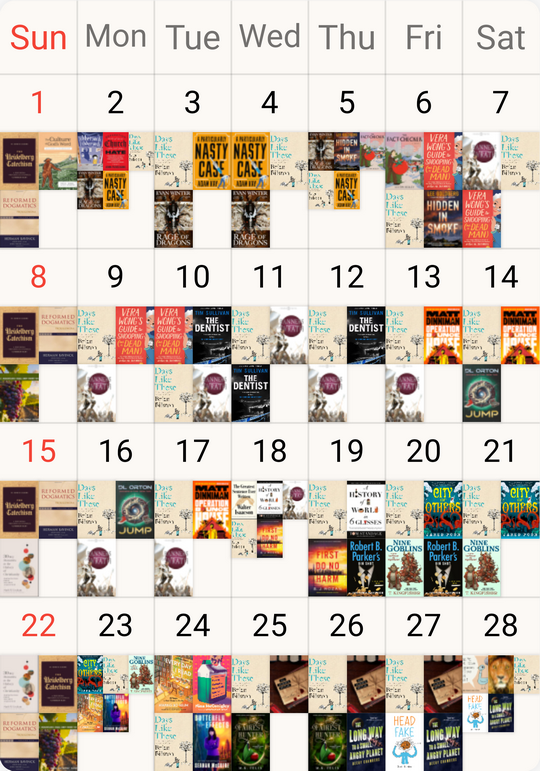
(thanks to Bookmory for the image)
TBR Piles
| Audio | E-book | Physical | Goodreads Want-to-Read |
NetGalley Shelf/ARCs/Review Copies |
|
|---|---|---|---|---|---|
| End of 2025 |
4 | 89 | 112 | 192 | 11 |
| 1st of the Month |
3 | 89 | 112 | 193 | 9 |
| Added | 2 | 1 | 5 | 9 | 4 |
| Read/ Listened |
2 | 3 | 2 | 0 | 6 |
| Current Total | 3 | 87 | 115 | 202 | 7 |
My TBR Range
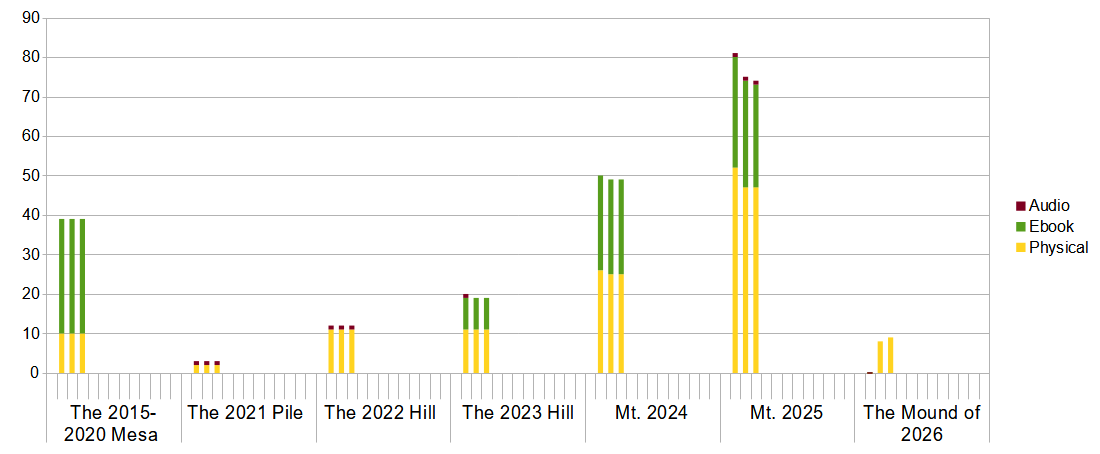
(feel free to click on the chart if you want a version that’s a little easier to read)
Breakdowns:
“Traditionally” Published: 26
Self-/Independent Published: 2
| Genre | This Month | Year to Date |
|---|---|---|
| Children’s | 3 (11%) | 6 (10%) |
| Fantasy | 4 (14%) | 8 (14%) |
| General Fiction/ Literature | 2 (7%) | 5 (9%) |
| Mystery/ Suspense/ Thriller | 6 (21%) | 16 (28%) |
| Non-Fiction | 4 (14%) | 5 (9%) |
| Science Fiction | 3 (11%) | 4 (7%) |
| Theology/ Christian Living | 2 (7%) | 4 (7%) |
| Urban Fantasy | 3 (11%) | 8 (14%) |
| “Other” (Horror/ Humor/ Steampunk/ Western) | 0 (0%) | 1 (0%) |
Review-ish Things Posted
Books of the Month
Other Recommended Reads
Other Things I Posted
Spotlights/Cover Reveals
Music Mondays
WWW Wednesdays
Saturday Miscellanies
Enough about me—how Was Your Month?
Fantasy with Friends is a weekly meme hosted by the good people over at Pages Unbound. Fantasy with Friends poses questions each Monday about fantasy, either as a genre as a whole or individual works.
This week’s prompt is:
On the one hand, I feel like I’ve read a million of these, but I’m having trouble coming up with actual names:
This suggests that I haven’t read as many as I think I have, or that my memory is garbage. I’m ready to believe either.
The Summer Program at the Bureau of Supernatural Affairs kind of counts, but not really. Ditto for Camp Half-Blood or Camp Jupiter. Drew Hayes’ Trestlevend University comes close, too. But all of these are really for parahuman/supernatural beings, not quite magic schools.
So, do I think they’re overdone? Maybe, but I clearly haven’t over-read from them. But also, anything can be “overdone” until it’s not. It’s all about the execution, not the elements that make it up. Sure, many things could scream “Hogwarts Knockoff,” but it could be written in such a distinct, clever, and engrossing way that we’ll all start saying that “Hogwarts walked so [insert name] could run.” Any trope, theme, setting, or character type can be overdone, tired, or used enough to be a cliche. But if the right author comes along and deals with them in their own particular way, we just won’t care.
Do I enjoy these? Sure–if everything else is compelling. That’s kind of the core, really–I liked the silly escapism of Hogwarts, and the almost complete lack of silliness to Brakebills. I can’t tell you why I enjoyed Osthorne, but I think it was just a step or two away from a typical American High School depiction, just with that magic flair. It’s really not the school–it’s the depiction of it and the world it’s in.
Basically, if you throw a bunch of mages (or whatever you want to call them) of various skill levels in a building together, and insert some sort of outside complication or inside conflict, something entertaining is bound to happen. Kids with adults, rookie adults with experienced adults? Doctorates and grad students mixing together? Whatever. All of those can be a source of whimsy, comedy, horror, drama, trauma, adventure, and so many other things. So yeah, bring ’em on.
I’m sure some of the other posts in response to this prompt will be more thoughtful. I’m looking forward to reading them. Do you have responses to this? (either for the comment section below or from your own post)
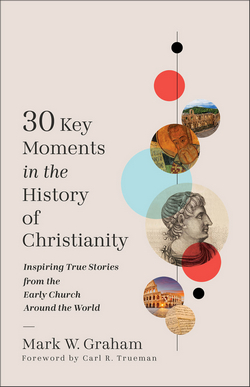 30 Key Moments in the History of Christianity:
DETAILS:
Publisher: Baker Books
Publication Date: January 27, 2026
Format: Paperback
Length: 272 pg.
Read Date: February 15-22, 2026


This emphasis on Our People* across space and time might prompt us to question the extent to which our own national, political, and cultural identities compete with or even overshadow our most foundational (and eternal) identity as Christians. In some important ways, modern American Christians have more in common with Christians from seventh-century Nubia, Persia, and southern Arabia than with agnostic neighbors who share our national flag.
* The term that Graham uses to describe Christians.
This is one of those that’s all in the title and subtitle. Graham, a history professor, looks at thirty moments from various parts of the world during the first millennium that proved to be turning points in Church History—he focuses on movements, teachings, and individuals to bring these “Moments” to life.
Each chapter—each “moment”—is considered in three steps:
When Graham outlined this in his Introduction, I was sold—if this was going to be how the book went, I was in for the long haul, period. It was, and I really appreciated it. If only so it makes it easy to come back to look at one or two moments for something and get everything you need in that chapter.
I’m not overly familiar with the Early Church—and my Medieval Church history is okay. But when I looked over the Table of Contents astounded by how few of the chapter subjects rang any kind of bell for me. I found that a little embarrassing, but it also excited me—I was going to learn a lot.
For example: Constantine turning to Christianity (Chap 8); Arius at Nicea (Chap 10); Justin Martyr (Chap. 2); Perpetua’s martyrdom (Chap 4)—all of those made sense to include, and I was glad to refresh my memory and see how Graham addressed things like that. On the other hand you’ve got: the Church in the Sassanian Persian Empire (Chaps. 6, 11, 13, 19); Nubian Christians twice saving their Church in Sudan (Chap. 21), or Armenia as the first “Christian Nation” (Chap. 7)—I was utterly clueless about these things. Granted, at last 95% of what I know about Sassanian Persia comes from some Fantasy novels from a decade or so ago—so that’s not saying much. But, wow, all of these were just so fascinating. (ditto for all of the chapters not mentioned)
I’m not—by any means—claiming to be any kind of an expert on any of these moments in time now. But I’ve at least been exposed to them, and am intrigued enough to try and track down a deeper history about some of them.
It’s not a drawback—it’s a feature, but you need to know going in that these chapters are brief and you can’t get meaty history or analysis. 30 moments from 1,000 years in less than 300 pages? Yeah, depth isn’t on the menu. But, to stretch the metaphor, it’s a great tasting.
If you read this in a sitting or two—or just a chapter at a time—you’re going to get rewarded. You’re going to get a good reminder that The Church isn’t just something that happened in the New Testament and in your local congregation. Nor can the history be reduced from New Testament→Early Fathers/Councils/Creeds→long time of nothing important→Protestant Reformation→Late 20th Century Evangelicalism/today.
Our People (I’m really liking that phrase) have been around since The Garden, and we can relate to them, learn from them, and be inspired by them wherever they’re found in time or on the globe. Graham gives an accessible introduction to some outstanding examples of this from the first millennium A.D.
I really hope there’s a sequel covering the next 1,000 years or another 30 from that same period. I’d rush to get it. In the meantime, I heartily encourage you to go pick this up.
Disclaimer: I received this book as a participant in the Baker Publishing Group Nonfiction Reviewer Program. However, as always here, I read this book because it interested me, and the opinions expressed are my own.
This post contains an affiliate link. If you purchase from it, I will get a small commission at no additional cost to you. As always, the opinions expressed are my own.
Odds ‘n ends about books and reading that caught my eye this week. You’ve probably seen some/most/all of them, but just in case:
 Libro.fm has a neat deal–donate $15 to a library, and get a free audiobook—this campaign ends today, but there’s still time! Also, apparently today is the end of National Library Week, which is totally a thing I knew about before now.
New book collects the weirdest forgotten stories of printing history—Okay, this article is just a thinly-disguised advertisement for a Kickstarter, but it’s still a fun read
My New Take on Whether We Should Remove “Old” Books from School Classrooms
Monthly Manga Mania Featuring Firsty Duelist Blue Exorcist by Kazue Kato—It’s the time of the month for Firsty Duelist to educate people like me about Manga
It’s also time for the Captivating Characters of the Month Linkup
A couple of month-end link wrap-ups to check out are: 10 Interesting Posts from the Book Blogosphere You May Have Missed in Feb. 2026 from Pages Unbound and February 2026 Book Blog Wrap-Up from A Literary Escape
A Book-ish Related Podcast episode (or two) you might want to give a listen to:
Crime Time FM‘s NADINE MATHESON In Person With Paul—was a lot of fun to listen to
My favorite sentence/passage/phrase (or two) that I read this week:
“The questions we have for the dead haunt us like unfinished dreams.”
—Head Fake by Scott Gordon
To help talk about backlist titles (and just for fun), What Was I Talking About 10 Years Ago This Week?
The Story of Lucius Cane: Book One by Vanya Ferreira—(I’d completely forgotten about the existence of this book)
Steal the Sky by Megan E. O’Keefe
Freedom’s Child by Jax Miller—that was 10 years ago??
I mentioned the releases of: The Absconded Ambassador by Michael R. Underwood; Out of the Blues by Trudy Nan Boyce; The Drowned Detective by Neil Jordan; The Forbidden Wish by Jessica Khoury; Kill the Boy Band by Goldy Moldavsky
This Week’s New Releases that I’m Excited About and/or You’ll Probably See Here Soon (and one I forgot last week):
Prey of Angels by JCM Berne—the latest in The Hybrid Helix looks great!
The Book of Spores—the ebook for this anthology is available now, “Collecting fungal tales from across countless universes, this FanFiAddict anthology spotlights the best of fantasy, science fiction, and horror.”
After the Fall by Edward Ashton—”Part alien invasion story, part buddy comedy, and part workplace satire, After The Fall… asks an important question: would humans really make great pets?”
Amari and the Metalwork Menace by B. B. Alston—huh. I thought this was a trilogy, but the publication of the fourth book reminds me to not assume so often.
 (full credit to @jasonroygaston)
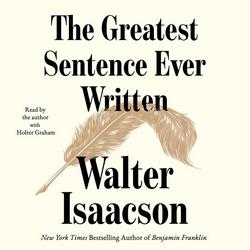 he Greatest Sentence Ever Written
by Walter Isaacson, appendices read by Holter Graham
DETAILS:
Publisher: Simon & Schuster Audio
Publication Date: November 18, 2025
Format: Unabridged Audiobook
Length: 1 hr., 28 min.
Read Date: February 18, 2026
To celebrate America’s 250th anniversary, Walter Isaacson takes readers on a fascinating deep dive into the creation of one of history’s most powerful sentences: “We hold these truths to be self-evident, that all men are created equal, that they are endowed by their Creator with certain unalienable Rights, that among these are Life, Liberty, and the pursuit of Happiness.”
Drafted by Thomas Jefferson and edited by Benjamin Franklin and John Adams, this line lays the foundation for the American Dream and defines the common ground we share as a nation.
Isaacson unpacks its genius, word by word, illuminating the then-radical concepts behind it. Readers will gain a fresh appreciation for how it was drafted to inspire unity, equality, and the enduring promise of America. With clarity and insight, he reveals not just the power of these words but describes how, in these polarized times, we can use them to restore an appreciation for our common values.
If this is how his lectures go? Sign me up for a class. Isaacson comes across as a knowledgeable person just talking to you about something he cares deeply about–not as someone reading text (even text he wrote). There’s just enough personality to it to keep you listening, but not so much that it overshadows the material.
It’s just what this book needs.
It feels strange to talk about a book that clocks in at 80 pages or 88 minutes in audiobook format (and that counts the appendices). But that’s how it’s being sold, so that’s how I’m going to talk about it. And really, he’d have had to tackle at least one more sentence
Do I wish he’d spent a little more time on a phrase or two? Did I really need as much detail has he gave on one thing or another? Yes to both. But I can’t remember what those things were now. And if I listened to/read it again today, I’d probably have other things I’d like to hear more/less about.
At the end of the day, this is a very nice meditation on that vital sentence, and a reminder that it’s still something important, something to rally around.
For the 250th anniversary of the Declaration, this is something important to think about. On the 249th or 252nd, it would be to. It’s sort of an evergreen idea. Probably an evergreen book, too.
This post contains an affiliate link. If you purchase from it, I will get a small commission at no additional cost to you. As always, the opinions expressed are my own.
It’s the last Friday of the month, so it’s time for my Most Captivating Character of the Month post. This is actually my third choice of a character for this month–the first two are from a book that I really want to dig into, but I honestly didn’t have as much to talk about when it came to them as I thought. But DS George Cross? I think I could go on and on about him–and that’s just from the first book in his series. But before I get into this, let me point you to my post about The Dentist, where Tim Sullivan introduces the world to him.
George–as the novel tells us, has Asperger’s Syndrome (we’d say he’s on the Spectrum now). Obviously, this presents differently in each individual, and it’s reassuring that Sullivan didn’t play into stereotypes. Yes, George has almost no social skills, and that causes problems in the office. Or with people he’s interacting with in the course of an investigation. But when it comes to the Interrogation Room? He shines. He can focus on parts of a suspect’s statement in a way to get them to reveal details. He’s also good at exploiting his own social ineptitude to exasperate a suspect enough to slip up.
Beyond that, he’s methodical, he’s careful, he’s thorough. A case that’s not put together correctly will bother him on a level that goes beyond conscientious employee. But he’s not the obsessively-driven kind of detective like say, Harry Bosch. It’s just who he is.
His relationship with his father is odd (for an observer, anyway) and sweet. His hobby–playing and maintaining pipe organs–seems a little strange in the abstract, but when as you get to know George, it really fits.
The more you get to know George, the more fascinating–make that captivating–he becomes. At least through the first book–I’m willing to bet that continues in the next book, too.
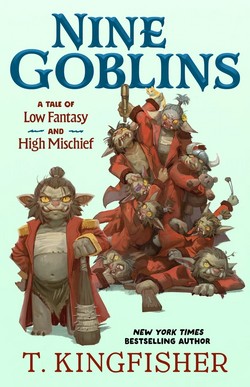 Nine Goblins:
DETAILS:
Publisher: Tordotcom
Publication Date: January 20, 2026
Format: Hardcover
Length: 160 pg.
Read Date: February 20-23, 2026
No one knows exactly how the Goblin War began, but folks will tell you that goblins are stinking, slinking, filthy, sheep-stealing, henhouse-raiding, obnoxious, rude, and violent. Goblins would actually agree with all this, and might throw in “cowardly” and “lazy” too for good measure.
But goblins don’t go around killing people for fun, no matter what the propaganda posters say. And when a confrontation with an evil wizard lands a troop of nine goblins deep behind enemy lines, goblin sergeant Nessilka must figure out how to keep her hapless band together and get them home in one piece.
Unfortunately, between them and safety lies a forest full of elves, trolls, monsters, and that most terrifying of creatures…a human being.
Nessilka and her troops are not the sole focus of the book. We also spend a lot of time with an Elf who is a veterinarian. We meet Sings-to-Trees when he’s struggling to help deliver a breach unicorn—it took me back to James Herriot books that I read in Junior High—but with a bit more graphic detail than the genteel Herriot would give.
I was very happy to read in the Author’s Note that he was the inspiration of Sings-to-Trees, incidentally.
While the goblins are good for laughs and ridiculous antics, Sings-to-Trees grounds this in a sort of reality, and brings most of the heart and maturity to the book.
There’s part of me that wonders why we got him in this book rather than some other party that seems more thematically on point. But I liked him so much that I really don’t care if it doesn’t make sense to feature a veterinarian in this. (then again, something making sense would feel a little out of place)
I picked this up on the strength of A Wizard’s Guide to Defensive Baking.
I kept reading for a few reasons: it was too short to quit once I started (not that I ever wanted to, I’m just saying); and it was so sweet and amusing that I couldn’t help but keep going.
I like this side of goblins—it reminded me of Jim C. Hines’ Jig the Goblin. The nasty, grim, killing type of goblin is all well and good. Same for the super-clever tinkerer types. But there’s something about the not-terribly-bright, misunderstood goblin that really gets me.
But this book is about more than that; there’s this great elf—and some okay elves, too. And the wizard turned out to be a lot more interesting than you’d think when we first met him (and an interesting wizard is always a welcome sight).
I laughed, I chortled and chuckled, and I found a lot of this to be surprisingly sweet. It’s a quick read that’s practically pure pleasure. Fantasy fans should pick it up.
This post contains an affiliate link. If you purchase from it, I will get a small commission at no additional cost to you. As always, the opinions expressed are my own.
Today has gotten away from me, so this is 1. the only post I’m getting up today (obviously), and 2. it’s really late. But, it’s the thought that counts, right?
(yeah, not really)
This meme was formerly hosted by MizB at A Daily Rhythm and revived on Taking on a World of Words—and shown to me by Aurore-Anne-Chehoke at Diary-of-a-black-city-girl.
The Three Ws are:
What are you currently reading?
What did you recently finish reading?
What do you think you’ll read next?
Seems easy enough, right? Let’s take a peek at this week’s answers:
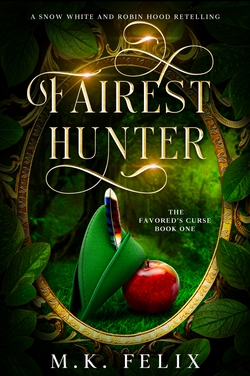 |
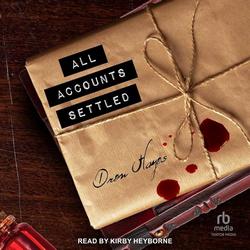 |
| Fairest Hunter by M. K. Felix |
All Accounts Settled by Drew Hayes, read by Kirby Heyborne |
I haven’t made it very far in Felix’s gender-swapped Robin Hood/Snow White mashup. But it’s entertaining so far.
While Fred the Vampire Accountant hasn’t been my favorite series, it’s been a reliable pleasure. I’m going to miss it, I just hope (and trust) that Hayes lands the finale in a satisfying way.
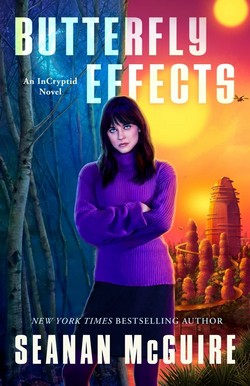 |
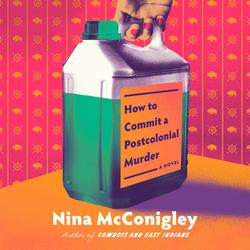 |
| Butterfly Effects by AUTHOR |
How to Commit a Postcolonial Murder by Nina McConigley, read by Reena Dutt |
I’m lamenting that no one in any of my circles–online or offline–reads McGuire’s InCryptid series, because I really want to talk to someone about the new book (which will be getting a very positive write-up here as soon as I can find the time).
I’m pretty ambivalent about Nina McConigley’s 1980s-set murder story, to be honest. I’d like to hear what others have to say.
 |
 |
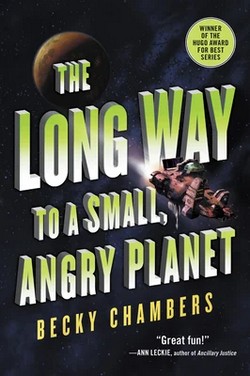
| The Long Way to a Small, Angry Planet by Becky Chambers |
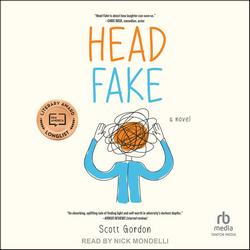
Head Fake by Scott Gordon, read by Nick Mondelli |
As I said at the beginning of the month, I read this back in 2018 (and liked it better than I recalled), and it’s the next title for the Science Fiction Book Club. Time to freshen my memory. I trust 2018-me, and should have some fun.
I can’t remember what it was that made me put Head Fake on a list to get, but looking at the blurb, I think I’ll enjoy it.
The topic for this week’s Top Ten Tuesdays is “Quotes From/About Books (Share book quotes you love, quotes about being a reader, etc.)”
Once upon a time, I had a really good list of these going–and I have no idea what happened to that (it was before this blog). But I do have a decent collection of quotations that I’ve used once or twice over the years in my Saturday Miscellany posts, so I picked the ten best of those.
(alphabetically by author)
 |
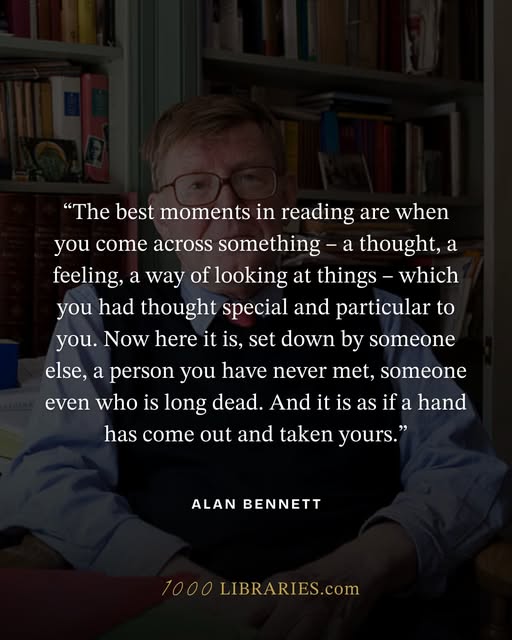
“The best moments in reading are when you come across something – a thought, a feeling, a way of looking at things – which you had thought special and particular to you. Now here it is, set down by someone else, a person you have never met, someone even who is long dead. And it is as if a hand has come out and taken yours.” Alan Bennett |
 |
I love people who read. I think it screams humility. When someone reads, they are essentially admitting they want more, that the world is not enough for them. They want more knowledge, more experience. Whatever this life is, they want more of it. – Nicholas Browne |
 |
I couldn’t decide which one of these to keep; they’re variations of the same idea, so I’m sticking with them both.
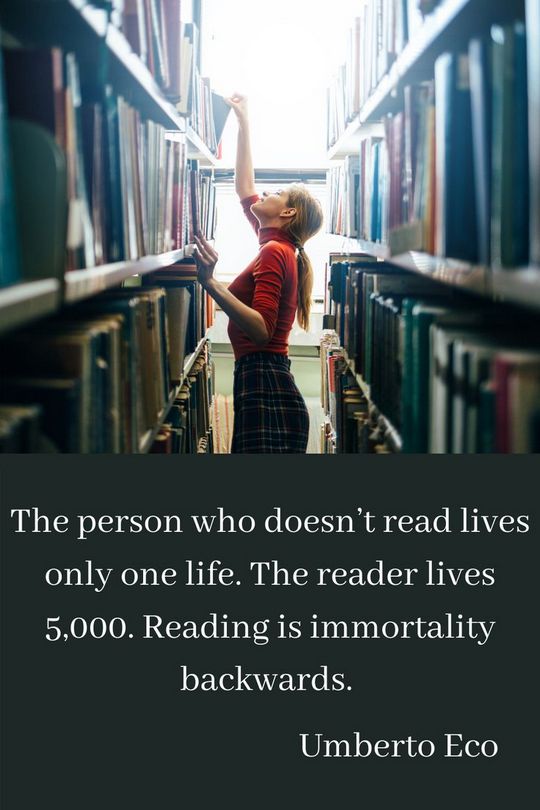
The person who doesn’t read lives only one life. The reader lives 5,000. Reading is immortality backwards. – Umberto Eco
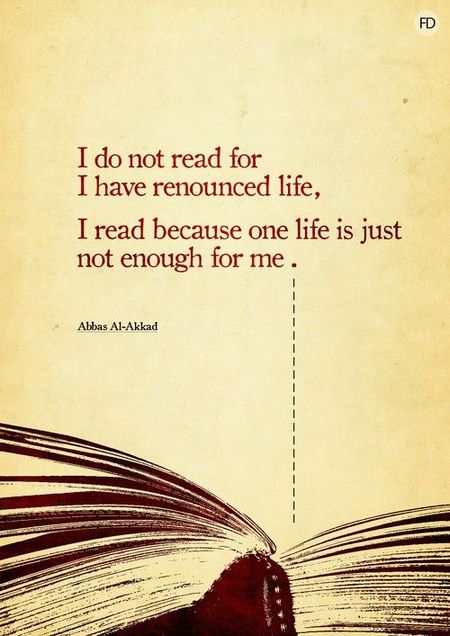
I do not read for I have renounced life, I read because one life is just not enough for me. – Abbas Al-Akkad |
 |
Do not read, as children do, to amuse yourself, or like the ambitious, for the purpose of instruction. No, read in order to live. — Gustave Flaubert (I don’t remember where I got this image) |
 |
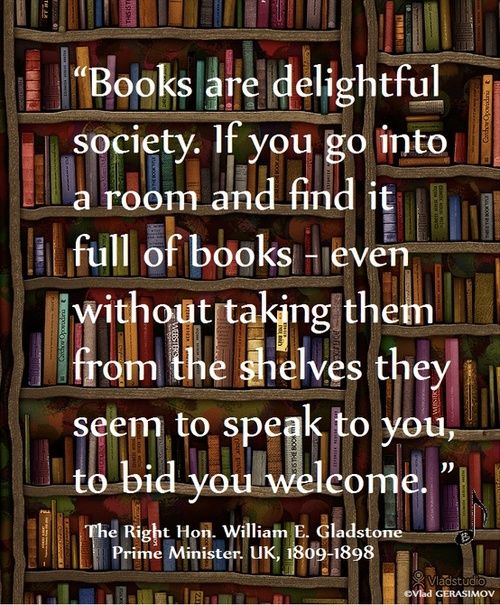
“Books are delightful society. If you go into a room and find it full of books—even without taking them from the shelves they seem to speak to you, to bid you welcome” The Right Hon. William E. Gladstone Prime Minister. UK, 1809-1898 |
 |
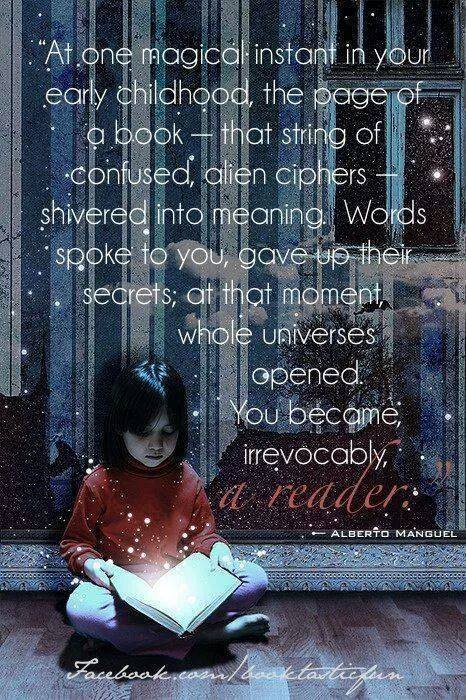
At one magical instant in your early childhood, the page of a book—that string of confused, alien ciphers—shivered into meaning. Words spoke to you, gave up their secrets; at that moment, whole universes opened. You became, irrevocably, a reader.” ― Alberto Manguel |
 |
When I think of all the books still left for me to read, I am certain of further happiness. Jules Renard |
 |
Reading books is the most glorious pastime that humankind has yet devised. Wislawa Szymorska |
 |
“I cannot remember a time when I was not in love with them–with the books themselves, cover and binding and the paper they were printed on, with their smell and their weight and with their possession in my arms, captured and carried off to myself.” ― Eudora Welty |
 |
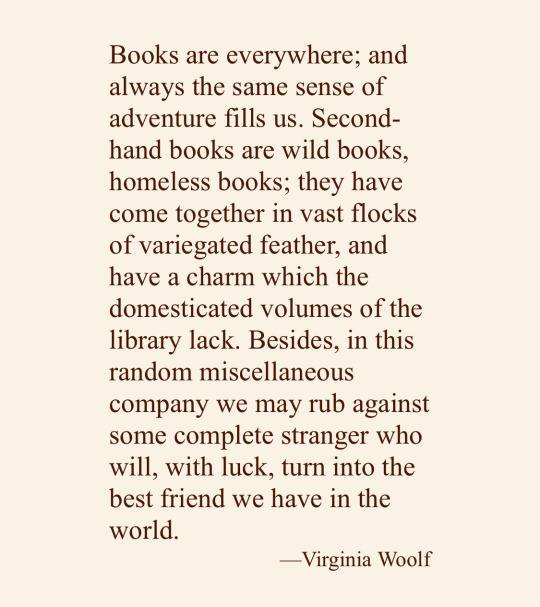
Books are everywhere; and always the same sense of adventure fills us. Second-hand books are wild books, homeless books; they have come together in vast flocks of variegated feather, and have a charm which the domesticated volumes of the library lack. Besides, in this random miscellaneous company we may rub against some complete stranger who will, with luck, turn into the best friend we have in the world.― Virginia Woolf |
Powered by WordPress & Theme by Anders Norén