Author: HCNewton Page 517 of 629

The Key to the Coward’s Spell by Alex Bledsoe

The Key to the Coward's SpellThe Key to the Coward’s Spell

by Alex Bledsoe
Series: Eddie LaCrosse, #?

Kindle Edition, 27 pg.
Tor Books, 2016

Read: September 3, 2016


This over-before-you-realize-it short story is a welcome dip of the toe back into the world of Eddie LaCrosse, sword jockey (i.e., medieval private eye). Bledsoe’s Tufa series is one of the best things around, but man, I enjoy this series so much.

LaCrosse has been hired by a local blacksmith to find his kidnapped son. LaCrosse is sporting a broken arm, so he’s going to need a little more help than normal, Jane Argo, for one — and some new faces, too. There’s really not a lot to say, here — half of the action takes place before the story starts. LaCrosse gets a little more intel, and then jumps into action.

The action is brief and to the point — with a nice twist or two along the way. Nothing special, but it’s a good couple of sequences. And a brief reminder that no matter what you dress it up in — modern time/tech/clothing, generic fantasy tropes, SF, whatever — there are some forms of evil that transcend those details and are just evil that need to be fought in whatever little way we can.

Yeah, it was fun to spend some time in this world and with LaCrosse and everyone. But man, just as you get into it, the story’s over. Just not enough to really satisfy, but it was a fun taste. I don’t know that this is a good intro to the character (it might be), but it’s a good reminder for those who’ve met him before that they want to read more about him.

—–

3 Stars

The Essential Trinity by Brandon D. Crowe and Carl R. Trueman, eds.

The Essential Trinity The Essential Trinity: New Testament Foundations and Practical Relevance

by Brandon D. Crowe and Carl R. Trueman, eds.

Paperback, 273 pg.
Inter-Varsity Press, 2016

Read: July 31 – August 14, 2016

As far as consistency of quality amongst edited volumes goes, Crowe and Trueman have assembled one of the stronger line-ups I’ve read in a while — men from a spectrum of persuasions of Evangelical-ish thought have given the Church fourteen articles (approximately 20 pages each) to deepen our thinking about the Trinity. The aim was for a volume that “eschews overly technical discussion and focuses attention on the importance of the doctrine for every Christian.”

In Part 1, the articles look at the “trinitarian contours of every corpus of the New Testament, along with a chapter reflecting on the Old Testament roots of trinitarian doctrine.” If there are weak chapters in the volume, they’re in this part — but they aren’t that weak, either. Crowe’s chapter on Matthew is excellent, but the chapters on the Mark, Luke-Acts and John aren’t far off that Mark. Brian S. Rosner’s chapter on “Paul and the Trinity” is worth the price of the book. The chapters on the rest of the epistles are very helpful (particularity Hebrews). Mark S. Gignilliat’s article, “The Trinity and the Old Testament: real presence or imposition?” is very helpful and insightful — and as an added bonus, it’s the most stylistically entertaining and engaging piece in the book.

Benjamin Gladd’s chapter exploring Daniel’s influence on Revelation’s view of the Trinity is the biggest mental workout you’ll get in the book. I appreciated the material covered and the argument Gladd makes, but I’m going to have to read it a few more times before I think I have a good handle on it.

Part 2 addresses the importance of the Trinity for everyday living — many would say the doctrine is impractical and only belongs in Statements of Faith and academia. The authors here show the fallacy of that. It begins with a brief, but excellent, description of the doctrine by Scott R. Swain. Carl Trueman has the next chapter, “The Trinity and prayer,” which is probably as valuable as Rosner’s — it’s actually about more than prayer, but the material specifically on prayer is great — hugely indebted to John Owen (but not uncritically so). Robert Letham’s chapter on “The Trinity and worship” also draws deeply from Owen; if he doesn’t move you to worship as you understand the work of the Trinity in it, you aren’t paying attention (I probably have more problems with some of what he says than anything else in the book). Michael Reeves, typically, made me chuckle in his chapter on preaching — but he did more than that, too.

Timely, convicting, thoughtful and inspiring, this examination of the Trinity in Scripture and Life should be a great benefit to any believer ho reads it. It may not be the easiest thing read all year (but really, it’s not that difficult), but it’ll be one of the most rewarding.

—–

4 Stars

Saturday Miscellany – 9/3/16

Odds ‘n ends over the week about books and reading that caught my eye. You’ve probably seen some/most/all of them, but just in case:

    This Week’s New Releases I’m Excited About and/or You’ll Probably See Here Soon:

  • The Kingdom of Speech by Tom Wolfe — ’nuff said
  • Curioddity by Paul Jenkins — Urban Fantasy’s version of Warehouse 13?
  • The Key to the Coward’s Spell by Alex Bledsoe — an Eddie LaCrosse short story. Our favorite sword jockey is on the hunt for a missing kid and finds more than he bargained for.

Lastly, I’d like to say hi and welcome to drjohnpatrickkeefeii, Char’s Horror Corner and BrokenTune for the new follows this week.

Timothy Other: The Boy Who Climbed Marzipan Mountain by L. Sydney Abel

Timothy Other: The Boy Who Climbed Marzipan MountainTimothy Other: The Boy Who Climbed Marzipan Mountain

by L. Sydney Abel
Series: Timothy Other, #1

Kindle Edition, 325 pg.
Speaking Volumes, 2016

Read: August 11 – 13, 2016


A nameless boy is left at the Dreams and Hopes Orphanage (and don’t think I didn’t have to concentrate really hard not to flip those two every time I read/wrote the name) and is named Timothy Other — which is not the most interesting name in the book, trust me — where he spends the first twelve years of his life happy, healthy (insanely so) and cared for. Until the man who ran the orphanage dies and the bank takes ownership of the mortgaged-to-the-hilt facility. The people that take it over might as well have been Miss Hannigan and Dolores Umbridge.

Not surprisingly, Timothy wants something else in his life, runs away — and straight out of Candide ends up at Marzipan Mountain (his name for it); befriending a giant mouse, caterpillar and Sasquatch-like creature; and on the trail of his birth parents (something he learns much later); and a way to rescue the orphanage. Meanwhile, back home we learn about the nefarious schemes that are behind the takeover of the orphanage and the various motivations behind them.

Some of the subject matter and way it’s depicted seem a little more “adult,” dark or whatever than is acceptable for kids’ literature. On the whole (there might be a line or two I wouldn’t defend), this is silly and doesn’t give kids enough credit. It also ignores the history of these kind of books — from Lewis Carroll and J. M. Barrie to Rowling and Gaiman — kids can handle this stuff if presented right. Frequently better than adults can.

Eventually, Timothy and one of his new friends come back home to save the day, right wrongs, and give many the happy ending you expect given the genre and setup. There’s a bit of redemption, a bit of justice, and a lot of hope and love at work here — Dreams and Hopes, I guess you could say, as these various characters pursue the Golden Life and launch Timothy on further adventures in the sequel(s). All the makings of a good introductory novel for a series.

There’s a nice hat-tip to another British children’s fantasy series that should tickle everyone who catches it — and mean nothing at all to those who don’t.

With each major character (and most of the minor) there’s a moment or two, a couple of lines, or a scene that doesn’t seem to fit with what we’ve been told/seen about the character. It’d take too much space to illustrate this, but when you get to that scene (and you’ll recognize it just about every time), just shake it off and move on, Timothy or Edwin or Itling or whoever will get back to themselves soon.

I had a hard time nailing down the feel of this one, there’s sort of a fairy-tale feel to it. Not Grimm Brothers’ fairy-tale, but the warm-fuzzy kind (with a hint of the other), like J. K. Rowling-light. Even a dash Mrs. Piggle-Wiggle at the beginning. Later on, it morphs into a Neil Gaiman-esque children’s book feel. Now, Abel never quite hits the Rowling/MacDonald/Lewis/Gaiman tone exactly — which is good, he’s doing his own thing, but it’s in those ballparks. The one thing that would help his tone is a bit more economy of words — he takes a few too many to pull of the whimsy, the sense of play, that he seems to be going for.

Actually, that goes for pretty much the book as a whole — Abel could’ve trimmed just about everything a bit. It’s a slow read, which is not necessary a bad thing, I’ve got nothing against them. But I think it works against what he’s trying to do and I think I have a little more patience than the target audience would. I’m not saying it needs to be a hundred pages shorter — but it could read a little smoother, quicker. Really — how many people noticed the length of Goblet of Fire? You didn’t because of the way it was written (not just the exciting parts, either).

I want to be clear, I’m not saying the writing isn’t good — but the pacing and language are so close to being very good, the fact that he misses the target by a little emphasizes the fact that he missed it. This is a winsome and charming book that should enchant younger readers, if they just give it the opportunity.

Disclaimer: I received a copy of this book from the author in exchange for this post/my honest thoughts. I’d like to thank him for the book and for his patience, I took far too long with this.

—–

3 Stars

The Granite Moth by Erica Wright

Granite MothGranite Moth

by Erica Wright
Series: Kathleen Stone, #2

Kindle Edition, 284 pg.
Pegasus, 2015

Read: August 23, 2016


Kathleen Stone (sometimes known as Kennedy Vaners, as Katya Lincoln, Kathy Stevens, or Kevin(!)), is a former NYPD undercover officer turned P.I.

You know, typing that sentence made me think of Orphan Black, and I’m now picturing Tatiana Maslany as our main character. Which absolutely works. I may see her in my mind when I get the chance to read the first book about Kathleen, and probably as I write the rest of this.

Where was I? Oh yeah, so the circumstances leading to the “former” part of her NYPD tenure are a little murky — maybe we get it all explained in The Red Chameleon and I just need to catch up, or maybe it’s left vague because Kathleen doesn’t want to share the details. Either explanation is believable. Not since Stephen J. Cannell’s Wiseguy, have I seen something deal so effectively with the emotional toll of a double life — although strangely enough, Brooklyn Nine-Nine, came close last season (I’m not saying there aren’t others, I just don’t know about them — feel free to fill me in in the comments).

Kathleen has two cases to work here, a personal vendetta to pursue, and some personal/personnel issues to deal with. Not a bad day’s reading. Although, really everything sort of fits in the personal vendetta category, come to think of it — but she’s only paid for 2 of them. First, she’s watching the Halloween parade, just to see her friend Dolly and other drag queens perform on the float advertising their club. While she’s watching, the float explodes — her friend survives, but not everyone does. The club owner hires Kathleen to track down whoever sabotaged the float. There’s a pretty good reason to suspect foul play, and that the police aren’t taking things as seriously as they should.

The personal vendetta is related to her assigned target in the undercover operation, who is still walking around. While following up a new bit of information she’s come across, she witnesses a murder. Another witness to this actually knows who she is and hires her to investigate.

Both of these cases involve Kathleen donning a few wigs (her wigs are almost as good as those used by Elizabeth and Philip on The Americans) and personalities, putting herself in harms’ way, dealing with grieving families (which might be harder on her than the physical danger), and facing some unpleasant truths about herself. Although honestly, the personal/personnel issues might be the most dangerous, come to think of it.

The nature of leading a double life — undercover cop, drag queen, upper class heir living a middle class life, etc. — runs throughout this book and gives you a lot to think about while doing so. Yet, Wright doesn’t beat you over the head with it, you could probably ignore it if you wanted to.

This was a well-written, well-paced and engaging mystery novel, with a narrator that I thoroughly enjoyed and was intrigued by. Kathleen is the kind of detective that Ellie Hatcher wants to be, and Lydia Chin would be if circumstances and ethnicity were different. I want to read more of her, soon. I hope I get the chance.

Disclaimer: I received a copy of this book from the author in exchange for this post/my honest thoughts. I’d like to thank her for the book and for her patience, I took too long with this.

—–

3.5 Stars

August 2016 Report

So, here’s what happened here in August.

Books/Novellas Read/Listened to/Consumed:

The Essential Trinity Calvin The Phantom Tollbooth
4 Stars 3.5 Stars 4 Stars
Meeting of the Mustangs Beyond the Gray Leaf Deep Down
3 Stars 3 Stars 4 Stars
The Corruption of Chastity Forever We Play Lady Cop Makes Trouble
3 Stars 3 Stars 4 Stars
Full of Briars The Purloined Poodle Off to be the Wizard
3 Stars 4 Stars 4 Stars
United as One Timothy Other: The Boy Who Climbed Marzipan Mountain Reformed Dogmatics, Volume 3
3 Stars 3 Stars 5 Stars
The Lordship of Christ Time Siege Mechanical Failure
3 Stars 4 Stars 4 Stars
Shadowed Career of Evil Debt to Pay
3.5 Stars 4 1/2 Stars 4 1/2 Stars
Granite Moth Trampling in the Land of Woe Before the Fall
3.5 Stars 3 Stars 3.5 Stars
Outfoxed The Twelve Dogs of Christmas The FATOFF Conspiracy
3.5 Stars 4 Stars 3 Stars
Dirk Gently's Holistic Detective Agency            
3.5 Stars            

Still Reading:

Biblical Authority after Babel Reformed Dogmatics, Volume 4 The Hidden Oracle

Reviews Posted:

How was your month?

Mechanical Failure by Joe Zieja is Not [EXPLETIVE] Reviewed Here Today

Mechanical FailureMechanical Failure

by Joe Zieja
Series: Epic Failure, #1

Hardcover, 343 pg.
Saga Press, 2016

Read: August 17 – 18, 2016

I tried, I really, really tried to get this up today, but I didn’t. So I’ll just say: read it. Probably best if you buy it so 1. the publisher/Zieja get money and want to do more and 2. you’ll have it to loan to people when you’re done. It’s good, it’s funny, you’ll enjoy it.

If you want more details, come back in a day (I hope) or seven (ugh, I hope not) and they’ll be here.

Update: Yeah, come back next week — I’m out of town, and want my copy at hand while I write it up. Rats.

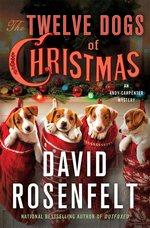
The Twelve Dogs of Christmas by David Rosenfelt

The Twelve Dogs of ChristmasThe Twelve Dogs of Christmas

by David Rosenfelt
Series: Andy Carpenter, #15

eARC, 336 pg.
Minotaur Books, 2016

Read: August 27, 2016


I’m not a big fan of holiday-themed installments of long-running series (see the Holiday Plum novels or the Silent Night Spenser novel as glaring examples of how bad these can be). But you know I’m a completist — and if I could make it through the aforementioned books, I could handle this. Thankfully, this was pretty light on the Christmas theme (sure, there are trees and gifts and whatnot, but it’s not really that different from your standard Andy Carpenter novel. So, if you think like I do — don’t worry. If you don’t mind/like a little holiday cheer — don’t worry, you’ll find it.

A friend of the Tara Foundation, “Pups” (so-called because she takes care of stray puppies until they’re old enough to adopt out, and might be pickier than Willie when it comes to worthy humans). Is facing eviction because of the large number of puppies she has in her home, and a new neighbor is complaining. Pups isn’t really what you call “friendly,” “polite” or someone who “should be allowed to interact with people.” She’s crabby, opinionated, blunt and has no patience for fools — particularly fools that seem intent on messing with her and her puppies. So Pups has said a few things that make it sound like she’d be happy if the neighbor stopped breathing.

Which, naturally, means that he ends up killed and that someone did a really sloppy frame job on ol’ Pups. The frame job is actually bigger than just this one killing, but you can read that for yourself.

Why prosecutors continue to play hardball with Carpenter clients, I just don’t get. I never understood why Hamilton Burger insisted on taking Perry Mason’s clients to trial, and I can’t understand why New Jersey’s prosecutors don’t just dismiss charges the instant that Carpenter and Hike show up on the other side of a courtroom. But they don’t, which means we get to watch Andy do his thing, fret about his jury deliberation superstitions, and annoy a judge. Who could ask for more?

I really think the mystery, the culprit and the way things unfold in Twelve Dogs is better than the last few books in this series. Everything’s clicking just like it should in these pages. This may be some of the best Marcus material in quite a while — the way that the gang leader acts around and talks about “Mr. Marcus” tells you more about Marcus than anything that Andy could possible tell us. The book would be worth reading just for that.

Minor spoiler: and hopefully once the book is published, this’ll be taken care of. It was a shame to see Andy betting since he and Ricky and just made a promise to stop doing that about a third way through the last book (I’m too lazy to look up page number, an approach Andy would probably endorse) — and Laurie made it clear that he was expected to keep that promise. It’s a minor note that I probably only caught because I read the two passages in the same 24-hour period.

It’d be really hard to rank Carpenter books in terms of happy and/or sweet endings. But if you were bored/ambitious enough to take on that task, I’m pretty sure that this would find itself close to the top. A great addition to one of the more entertaining mystery series around.

Disclaimer: I received this eARC from Minotaur Books via NetGalley in exchange for this post — thanks to both for this.

—–

4 Stars

Outfoxed by David Rosenfelt

OutfoxedOutfoxed

by David Rosenfelt
Series: Andy Carpenter, #14

Hardcover, 326 pg.
Minotaur Books, 2016

Read: August 26 – 27, 2016


Last week, I talked about how difficult it is to come up with things to talk about with a long-running series like the Walt Longmire books — at a certain point, series like that hit a good stride and only vary a little in quality or interest for readers. Well, the Andy Carpenter series is even longer and more difficult to write about. I don’t know if I can do much, but I’ll try.

This time out, Andy has inherited a client already in prison, he’s basically supposed to deal with routine things and be ready to help him at the end of his sentence. This is made easier in that the client, Brian Atkins, is working with a dog training program that the Tara Foundation has going with the minimum security prison he’s in.

But then he breaks out of prison and is found leaving the scene of the murder of his estranged wife and his former partner.

But it’s so much bigger than just this (really, the case doesn’t seem as difficult as many of his — finding the actual killer is, but not the case) — Andy’s going to find himself at odds with one of the most dangerous foes he’s tangled with. Speaking of easy, I sort of think that everything ended a bit too easily, a bit too pat — I’m not sure how doing what they did really keeps Andy and his family safe.

I was wondering how Andy and Laurie were going to deal with juggling parenting and these cases, and man, do I hope they come up with better ways than this one. It works once, but not twice. I liked the little bit of fathering we get to see from Andy, though, and Ricky seems like he can be a decent addition to the series.

I don’t want to sound like I’m down on this book — or this series. It was a whole lotta fun, a nice puzzle, and watching the pieces fall into place was pretty satisfying. If you’re not reading these books, you’re missing out.

—–

3.5 Stars

United States of Books – Empire Falls by Richard Russo

Believe it or not — this was almost a lot longer, but I trimmed a lot to hopefully make it better.

Empire FallsEmpire Falls

by Richard Russo

Hardcover, 483 pg.
Knopf, 2001


A few years ago, my parents took a trip through New England in the Fall to look at the leaves — I know, not an original idea, but for people from the Northwest, it’s not as common as it is for others. One of the places they drove through was Empire Falls and were telling me about some HBO series/book based there — I was vaguely aware of the book, having recently finished Russo’s Straight Man and told them that they’d probably enjoy it. I don’t think either of them gave it a shot (I could be wrong).

A few months later, I got around to reading it myself — wow. It so different in style and content from Straight Man, but it took me a long time to read, and (best of all) it was fantastic. It sent me reeling and made me want to read more by Russo. Sadly, the next book I read by him just about killed that (That Old Cape Magic). A couple of years go by and I decide to read all of his novels in order. When I get to Empire Falls, I skipped it. I just couldn’t do it again. I really didn’t enjoy about half of Russo’s novels, but I couldn’t deny the power of them, nor his skill. Nobody’s Fool, for example, I really didn’t enjoy — but here I am a couple of years later, and I still find myself thinking about a couple of characters and scenes at least three times a month. That’s staying power. (no, I haven’t gotten to the sequel that came out this year, for reasons I don’t fully understand)

Incidentally, I liked That Old Cape Magic better the second time around — actually, I think that was true for Straight Man, too. Liking Cape Magic was almost a given (would be hard to like it less), but I really enjoyed Straight Man the first time out — the second time I loved it. Both of those books deal with a different kinds characters than the rest of his books (including Empire Falls, which I’m getting to — I promise). Most of his books are about small towns and their citizens, usually dealing with economic hardships on the municipal and individual level. Frequently, cafes and bars are used to get the characters to interact with each other and there’s typically one guy who drinks too much, is fairly unreliable, yet everyone likes and enables. There’s humor, tragedy, history (actual and fictional), mixed with character and family struggles. Empire Falls checks every single box on the “what makes a Richard Russo novel” list, but does it bigger. If you’ve read Empire Falls, you’ve read almost every one of his books — which is not to say you shouldn’t read the rest (especially Straight Man and Bridge of Sighs) — but you’ll get a good idea what kind of things Russo typically deals with and how he does it.

Richard Russo is what Jonathan Tropper, Nick Hornby and Matthew Norman (and many others, probably, but these are the three I’m most familiar with) could easily become if they got a little more serious and a little darker. On the whole, the latter three are more entertaining (and funnier) — but Russo can pull that off when he wants to. You could also say that Russo is what Jonathan Franzen could be if he lightened up and got less pretentious. But mostly, you can say that I’m a giant fan.

Why am I blathering on? Mostly trying to give context for this post, but partially because it is just daunting to try to talk about this book — especially in something that’d make a decent-length blog post and not a full-fledged dissertation. But I’d better suck it up and get to it.

Empire Falls won Richard Russo his (seemingly) inevitable Pulitzer Prize in 2002 and stands as one of the greatest achievements in his storied career. It is at once a story about a town and a man, microcosms for the state and the nation; it’s both sweeping and epic while being personal and intimate.

The story centers on Miles Roby, manager of the Empire Grill in Empire Falls, ME. He has an ex-wife (who I truly despised), a daughter (who I wanted more of), an ex-mother-in-law that seems to like and respect him a lot more than her own daughter, s (even if they don’t see eye to eye much lately). But more importantly he has a patron — the town matriarch, owner of the Empire Grill, and most of the various places of employment in town. She’s a patron, a would-be surrogate mother (for a select few), and petty tyrant over the city. It’s one of those small towns where the mayor/council/etc. have real power, but it’s only the power she lets them have, you know? Francine Whiting isn’t evil — well, I’ll let you decide for yourself — but at the end of the day, she thinks she’s doing what is right for Empire Falls, the Whiting legacy and her daughter — whether or not anyone wants what she thinks is best. She still could be evil, I guess, and I could very likely made a case for it. Anyhow, let the reader decide.

The trials and dreams and efforts of Miles and his family as he tries to do something different with his life are the core of the novel — but they’re not all of it. The town is full of interesting people — many aren’t vital to the overall story (but you can’t know until the end who those are), but they all add flavor. Most are so fleshed out that you could imagine a short story/novel centered on them. While reading Song in Ordinary Time a few months back, I kept asking myself what made the people in that novel so unlikeable when in many ways they reminded me of Empire Falls‘ cast. I came to this conclusion (and have since reconsidered and still think it’s basically right): Russo uses the flaws in his characters to emphasize their humanity, Morris uses the flaws to emphasize their flaws.

But I come not to bury Morris (again), but to talk about Empire Falls, so let me focus on this a bit more: the flawed humanity isn’t pretty, it’s frequently ugly, people who make mistakes (some tragic, some dumb) are usually trying to do the right/moral/noble thing and it doesn’t work. But it’s real. This could all be real. Even Janice, Miles’ ex, is a well-developed character — and I think I’ve met a handful of people just like her — and I wouldn’t dislike her as much as I did if Russo hadn’t nailed the writing.

There’s an event towards the end — one of the two or three that you ultimately realize the whole novel has been leading up to — that in 2001 would’ve been truly shocking (shocked me a few years ago), but in many ways it’s de rigueur now. 2016 readers might be bored by it, but I can’t imagine that many readers in 2001 were. I’m not going to say more — just if you read this, put yourself in the shoes of readers from 15 years ago when you get to that bit.

Yes, Empire Falls is slow (sometimes), ponderous (sometimes) but it’s also inspiring (sometimes), heartwarming (sometimes) and many other things that I could parenthetically qualify. But every negative about it is utterly worth it for the positives.

What I learned about Maine: (haven’t done this in awhile, whoops). It’s a beautiful state, filled with people who could be better educated, who aren’t vocationally ready for what’s coming for them thanks to the technological shift in jobs. It’s a state where people, nature and industry who have been damaged by reckless policies and practices. It’s a state where nature exerts itself every now and then to remind people how powerful it is. Basically, Maine’s just like every other state in the union — just a little different.

One more thing, not that this’ll surprise many, but I’d advise skipping the HBO miniseries — yeah, it’s a fairly faithful adaptation, it just doesn’t have the heart.

I’ll be honest with you, I didn’t read this book for this series of posts — breaking a personal resolution. There were 3 reasons for this: 1. Time; 2. I really wasn’t up for the emotional punches this delivers, and 3. I didn’t need to — I still remember it well enough to discuss at a length greater than I have despite being 4 years and change since I read it. That right there should tell you something about the book — hundreds of books later and I almost feel like I read it a couple of weeks ago. I’m not sure that this is the Russo novel I’d tell people to start with (probably Straight Man), and I don’t think it’s his best (probably Bridge of Sighs (tells a story almost as epic in scope, with greater economy and greater depth when it comes to individual characters), but there’s no denying the talent on display here, the greatness of the execution, the vibrancy of the characters, or the impact it has on the reader. No brainer, 5 Stars from me.

—–

5 Stars

Page 517 of 629

Powered by WordPress & Theme by Anders Norén