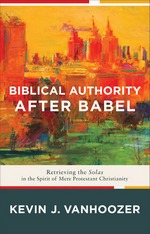
by Kevin J. Vanhoozer
eARC, 288 pg.
Brazos Press, 2016
Read: August 21 – September 4, 2016

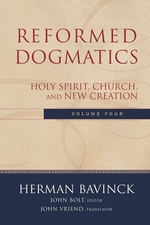
With the 500th Anniversary of the Protestant Reformation’s accidental start coming up next year, we’ll be seeing a lot of books celebrating and/or critiquing the movement (more than usual, that is). This is one of the former, but done mostly in the way of a defense against some of the most common critiques. There’s a very real sense in which I’m not qualified to discuss this book — and I’m really looking forward to reading reviews from those who are. But, there’s another sense in which I am — I’m a Christian, I like to read and think about these issues, and VanHoozer wrote a book about them, so, you know — I might as well blather on about it some.
In the Introduction, Vanhoozer rehearses some of the more common critiques of Protestantism, mostly relying on those talking about the lack of organizational unity and those that relate that level of disunity to the doctrine of Sola Scriptura:
One adjective seems custom-made to describe the unintended consequence of the Reformation. It is a word that I never come across except in the descriptions or criticisms of Protestantism: “fissiparous”—“inclined to cause or undergo division into separate parts of groups,” from the Latin fissus, past participle of findere (to split; cf . “fissure” ).
In much of the introduction, he seems to buy into the conventional wisdom/stereotypes of Protestantism/what Protestantism teaches — including a weird reading of the Ann Hutchison case — using too many scattered quotations out of context from various authorities to build the case.
To respond to the fissiparousness of Protestantism (which he does lament), Vanhoozer uses the “Solas” of the Reformation to show why the problem isn’t inherent in Protestantism’s principles — the examination of the Solas (rooted in Sola Gratia) provides the framework for the rest of the book and his apologetic. I really appreciated this way of framing his argument, and think I need to work on doing that myself.
Throughout this work, Vanhoozer
will be arguing not for the superiority of [his] own Reformed tribe but for “mere Protestant Christianity.” This refers neither to a lost “golden age” nor to a particular cultural instantiation of Protestantism, but rather to a set of seminal insights —- encapsulated by the five solas — that represent a standing challenge, and encouragement, to the church.
While I have some concerns of the “Mere Christianity” and “Mere Orthodoxy” approaches that are gaining popularity in some circles, I can’t fault this. Sure, he’d be able to make a stronger case if he did argue for the superiority of Reformed thinking (if you ask me), but given the arguments he’s responding to it makes sense to adopt this approach.
As he looks at each Sola, he begins by examining what the Reformers meant by the phrase (too frequently different from what their heirs mean by the phrase). He then looks at competing views (historical and contemporary — with an emphasis on the contemporary), focusing each discussion on the doctrine’s relationship to Bible, Church and Authority. He starts with Grace Alone, moves on to Faith Alone, Scripture Alone, then In Christ Alone and finishing with For the Glory of God Alone. The latter part begins with a look at “The Lord’s Supper as a Test of Christian Unity.” Even the most ardent Protestant would have to admit that this is where the Reformers stumbled most — when Luther and the Reformed couldn’t come to an acceptable consensus on the meaning and nature of this Sacrament, our fissiparousness became most evident and quite possibly firmly established as a mark of Protestantism. For my money, everything else comes as a result of this failure — so for VanHoozer to focus on it at this point, really resonated with the reading/studies I’ve been doing lately. Sure, it’s not that novel an approach, but as a reader, when an author seems to be on the same page, it draws you in.
I do think some of the more technical arguments he makes get a little too creative, maybe too focused on innovation and novelty — but I’m pretty cautious when it comes to this stuff. So again, I’m looking forward to seeing what others make of this.
This isn’t an academic work, but it’ll appeal most to the academically-inclined (whether by occupation or temperament/interest). Lay people shouldn’t be put off by it, but it will be a challenge at times. Frequently, he’s deceptively easy to read — you’ll be chuckling at some remark, smiling at a bit of whimsy, and miss the fact that he’s left the shallow end of the pool for something deep and thoughtful. Re-reading paragraphs and sections is highly recommended.
Vanhoozer writes with a very engaging style, some great metaphors and imagery. One paragraph I picked while reading to try to explain this to my wife went like this: It began with some historical notes; then made references to Philip Schaff, John Nevins, and John Calvin; moved on to a quote by Augustine; and ended with a line from a line from Lewis’ The Last Battle (one that elicited a grin in addition to sealing his point). Yes, sometimes he lets that creativity run away from him — okay, he does that often (my notes are filled with that observation). I found myself frequently giving mental fist pumps to something he said and then almost immediately holding up a palm to say, “slow down!” On more than one occasion, I wondered if I was being charmed by his writing more than being convinced by it. I don’t think so, ultimately, but it’s something to be aware of.
One last note that I won’t develop because it was a slight digression for him at one point, but I really appreciated his discussion of Biblical vs. Systematic theology. It was a creative way to frame the discussion, and a helpful one at that.
On the whole, I might have cringed at or questioned his thinking, some of the details of his arguments, but typically I thought his conclusions were spot on. Which probably says more about me than him. There’s a few area to be cautious of here, but largely this is an encouraging, well-constructed, challenging and encouraging read. For those ready to gird up their minds, I’d strongly encourage picking this up. This was my first encounter with Vanhoozer outside the occasional footnote in someone else’s work — I don’t think it’ll be my last.
Disclaimer: I received this eARC from Brazos Press via NetGalley in exchange for this post — thanks to both for this.
N.B.: As this was an ARC, any quotations above may be changed in the published work — I will endeavor to verify them as soon as possible.
—–