Category: F-J Page 25 of 27

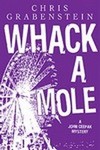
Whack A Mole by Chris Grabenstein

Whack A Mole
Whack A Mole

by Chris Grabenstein
Hardcover, 320 pg.
Carroll & Graf, 2007

How does Sea Haven, NJ continue to have summer tourism? For three years straight, the peaceful, quaint tourist town has been shaken by murders — some pretty ghastly. Sure, they’ve got a police chief and a mayor dedicated to keeping the havoc and mayhem under wraps. That’s part of it. And perhaps people looking to spend a week or two along the beach in Jersey aren’t the most discriminating of people (suddenly, I’m thinking of a MTV series).

Another factor, of course, has to be how the Sea Haven police deal with these murderers. In particular, rookie officer Danny Boyle and his partner John Ceepak. Ceepak’s practically a modern-day paladin — honor-bound, noble, with a deep sense of justice, law and order, infinitely patient with his partner — who spends almost every off-duty hour trying to learn all he can about forensic and investigation methods. If not for Ceepak, Boyle’d probably be on track for a life of partying, waiting tables, and trying to stay entertained. But now he’s on-track to become a better-than-average cop.

This time out, Ceepak and Danny are on the track of a serial killer who was pretty busy in the late 1970s and 1980s, but took a decade or two off — but now he’s back on his holy crusade to rid the world — or at least Sea Haven — from promiscuous young women. Of course, last time he was active, Ceepak wasn’t anywhere near Sea Haven (or a police force), things are going to go differently for the killer this time.

Grabenstein’s style is what makes these work — the mysteries, the situations, the characters, the setting — they’d probably be okay. But Grabenstein makes them sparkle. These are occasionally laugh-out-loud funny, but mostly these stories are just told with a dazzling wit, Danny’s voice is naive and worldy-wise at the same time — his devotion to his partner, along with his inapplicability of really understanding him, make me think of the Archie Goodwin/Nero Wolfe pairing. Ceepak’s too good to be true, but Danny’s incredibly believable, and as long as he believes in Ceepak, the reader does, too.

Good, solid entry in this series that I hope keeps going for a long time.

—–

3.5 Stars

Saturday Miscellany – 10/26

Odds ‘n ends over the week about books and reading that caught my eye. You’ve probably seen some/most/all of them, but just in case:

    This Week’s New Releases I’m Excited About and/or You’ll Probably See Here Soon:

  • Allegiant by Veronica Roth — The concluding volume of the Divergent Trilogy came out this week to much wailing and moaning from fans, apparently. I finished it yesterday and was satisfied — review to come soon.
  • Rags & Bones edited by Tim Pratt and Melissa Marr — the concept behind this is great, an impressive lineup of authors. What’s not to like here? Read The Big Idea entry on it.
  • Silent Night: A Spenser Holiday Novel by Robert B. Parker with Helen Brann — On the one hand, I’d really like to read what it was that Parker was working on at his death, and I’m curious to see how well his editor/someone other than Ace Atkins can do with the Spenser-verse. On the other hand — a Christmas story?!?!?
  • Poe by J. Lincoln Fenn — this one intrigues me — sounds creepy, suspenseful, and really good

Categories: Books, News/Misc.
Tags: Miscellany

R is for Ricochet by Sue Grafton

R is for Ricochet
R is for Ricochet

by Sue Grafton
Series: Kinsey Millhone, #18
Hardcover, 352 pg.
G.P. Putnam’s Sons, 2004

So here we are at the 18th Kinsey Millhone mystery, and as is the case with a lot of these books, this is a really mixed bag. However, this time, it’s the non-case work that’s the most interesting (pretty sure that’s a first for me). There were some moments to the main story, but on the whole I found it dissatisfying.

Kinsey’s hired by the father of Reba Lafferty, a soon-to-be-paroled woman, to pick her up from the prison and accompany her for the first few days, help her get established on the outside — he’s too old and frail to do this himself, and there’s no other family to call upon. It doesn’t take long before she’s teetering on the verge of parole violations and seeking revenge on those from her old life that wronged her before and/or during her incarceration. Kinsey spends the book trying to minimize the damage and help out various law enforcement agencies who have an interest in Reba’s targets.

On the whole, I found this story to be wholly predictable and I couldn’t understand why Kinsey was allowing this woman to pull her around by her nose. Maybe it’s because Reba becomes the closest thing she’s had to a female friend since her days with an office in the insurance agency building. Regardless, there’s no excuse for someone with Kinsey’s experience to act like she does here.

There’s one character involved with Reba’s family that primarily serves as a giant red herring — mostly for the reader — I don’t remember Grafton doing that before. Sure, Kinsey’s investigated a dead end or two from time to time, but I don’t recall Grafton misleading the reader like this before. This was a totally useless character and source of conflict that went nowhere.

It isn’t the first time that it’s occurred to me during this series, but the back of my mind screamed about it this time: this book, especially the last 100 pages or so, would be radically different if it were set in the last decade or so rather than in the mid-80s. You put cell phones and email in the hands of Rachel, Kinsey and various law enforcement officers and this book just doesn’t play out like it does. So often this series has plot developments hinge on Kinsey returning to her home or office to check messages or make a call — or her not knowing something because she couldn’t do that. I understand Grafton keeping everything to that era, but man, it’d be fun to see Kinsey work a case now.

As I said, the part of the book that worked best for me was the personal-life stories, but I find it difficult to talk about them without getting very spoiler-y, so I’ll keep this to bullet points.

  • As interesting as I find the saga of Kinsey’s reconnecting with her mother’s family, I was glad to get a break from it in this book — Q is for Quarry had a lot of movement on that front, and it was good to let that settle a bit more.
  • I trust Grafton has an end game in mind on the Henry’s love life, particularly where his brothers are involved, I just hope we see what it is soon. I was utterly unimpressed (as I think we were supposed to be) with the behavior of William and Lewis here, not that Henry came off much better
  • I’m not sure what I think about the whole Chaney-romance thing. Sure, the seeds were planted a while ago, but things seemed almost too good here. Still, nice to see Kinsey happy/content/on the verge of it — and not deluded like she was with Dietz or the married cop; or self-destructive like she was with her exes.

Not my favorite in the series, but there’s enough here to keep me going. Eh, at this point I’m in through Z is for Z___, who am I trying to kid?

—–

3 Stars

The Ocean at the End of the Lane by Neil Gaiman

It’s been months since I read this, and I haven’t written the review yet, because I wanted it to be the best thing on this blog because this book deserves it. But that’s just not going to happen, so I’ll just ramble a bit and get this posted. If Rothfuss can’t write a review, I shouldn’t worry if I can’t.

—–

The Ocean at the End of the LaneThe Ocean at the End of the Lane

by Neil Gaiman
Hardcover, 181 pg.
William Morrow Books, 2013

I like myths. They weren’t adult stories and they weren’t children’s stories. They were better than that. They just were.

Adult stories never made sense, and they were so slow to start. They made me feel like there were secrets. Masonic, mythic secrets to adulthood. Why didn’t adults want to read about Narnia, about secret islands and smugglers and dangerous fairies?

While not properly a myth, there is a mythic quality to The Ocean at the End of the Lane. This slim volume is magic. Just magic. It struck me in a very personal place. Between lines like:

I was not happy as a child, although from time to time I was content. I lived in books more than I lived anywhere else.

Books were safer than other people anyway.

and

I went away in my head, into a book. That was where I went whenever real life was too hard or too inflexible.

I can’t remember a narrator I identified with as much as I have this one, that’s where my head was as a child — I don’t think I could’ve come close to putting it into those words then . . . but now? I tell you, those words resonated with me.

Other than a little time with the narrator as an adult bookending the novel, this is primarily a story about a boy — but this isn’t a children’s book. Yeah, Coraline and The Graveyard Book aren’t your typical children’s books in subject or tone, but there’s something different about this. Yeah, there’s a sex scene, but that’s not what makes it adult fiction (not that it’d be appropriate elsewhere, obviously) but this is 1. a look at childhood from an adult perspective, it’s about looking back — kids wouldn’t be able to appreciate that and 2. honestly, I found it too frightening for kids. Since it’s told as a flashback, I knew the narrator would survive — but that didn’t keep me from being worried about what was going to happen to him in some pretty nasty situations.
The narrator tells us

I was a normal child. Which is to say, I was selfish and I was not entirely convinced of the existence of things that were not me and I was certain, stock-solid unshakably certain, that I was the most important thing in creation. There was nothing that was more important to me than I was.

and while remaining honest about children, as is typical with Gaiman, there’s an (over-?)romanticizing of childhood throughout The Ocean, this time coupled with a de-romanticizing of adulthood — or at least of grown-ups. We’re told,

grown-ups don’t look like grown-ups on the inside either. Outside, they’re big and thoughtless and they always know what they’re doing. Inside, they look just like they always have. Like they did when they were your age. The truth is, there aren’t any grown-ups. Not one, in the whole wide world.

Hard to argue with that.

Childhood friendship is also a theme in this book, but one I really don’t have a nice quote for — it’s something that Gaiman shows us throughout rather than telling us about. The Ocean is about the power of reading, and one good friend — which is all a lonely boy needs. And as we see here, the effect of that friendship and the memory of will last decades.

A quick, engrossing and moving read — with the added bonus that a quotation from “The Nightmare Song” got Mandy Patinkin’s voice stuck in my head for a while. A book I will return to soon.

Still don’t have a good answer to why “adults want to read about Narnia, about secret islands and smugglers and dangerous fairies?”

—–

5 Stars

Chosen by Benedict Jacka

Chosen
Chosen by Benedict Jacka
Series: Alex Verus, #4


Before I say anything about this really good book, let me point you to The Big Idea that Jacka wrote about it over on John Scalzi’s blog, if that doesn’t convince you to try this, nothing I say will. If you read this and are intrigued, go grab the first three books before you read this one. They’re more than worth it.
First off, I want to talk about the non-plot related stuff in the first chapter, but it’s better if you read it yourself — it warmed the geeky cockles of my heart in a way few other books have this year.

The fun is short-lived, of course. Verus is still training Luna, trying to find a place for the former Dark Apprentices, Anne and Variam, that he took in following the events of Taken. While he’s busy, he’s realizing that for the first time in long time, he isn’t alone, he has friends, companions — there’s the three just mentioned, plus the mage Sonder and, of course, Arachne. You start to get the idea that Verus is on the verge on contentment, starting to think about a future in this community he’s building (and not the way he’s known for).

Which is a tried and true signal that things are about to go pear shaped. Which it does, pretty decisively. It’s been clear from the start that Verus’ past is dark, but we’ve never been given many details. Well, that’s over — we get a real clear look at what life was like for Verus while he was apprenticed to Richard Drakh, and what it was like for him as he started to break away. While we’re learning this, Verus himself gets a much clearer view of what was going on back then.

What sets this off is the relative of someone that Verus and his fellow apprentices had wronged (details avoided), years ago has come to town. He’s an untrained adept, and so are his friends — they start off as a vigilante gang attacking Dark Mages. It doesn’t take long before they find their way to their target, Alex Verus.

It takes all Verus’ cunning, guts, and determination to survive this. Everything’s on the line here — his friends learn almost as much as the reader does about his past (and their reactions are complex and ring true emotionally), he barely escapes his first encounter with the gang with his life, and he has to open himself to part of his life he’d rather be done with. And the tactics he has to employ to save his life — and others’ — are morally murky at best.

There was really nothing about this book I didn’t like — Jacka keeps getting better and better (and he started very strong). To say that I’m eager for book #5 is an understatement, it’s going to be great.

—–

5 Stars

Dusted Off: Taken by Benedict Jacka

Taken (Alex Verus, #3)Taken by Benedict Jacka
Series: Alex Verus, #3


My rating: 4 of 5 stars

really don’t know what to say about this one…good read. Another good read in a string of ’em. Jacka’s got this down–Verus and co. are back and better than before.

I really like the way that these characters are growing and the world is being built.

I feel like I should have more to say, but I don’t. Ready and waiting for the next one!

Dusted Off: Cursed by Benedict Jacka

Cursed (Alex Verus, #2)Cursed by Benedict Jacka
Series: Alex Verus, #2

My rating: 4 of 5 stars

Jacka did a great job following up his first Alex Verus novel. Fated. introduced us to Verus’ world, and Cursed lives in it. With the universe so well established, Jacka can focus on this particular adventure, building on Fated.

This makes for a more exciting read–more action, more character development, more of everything we liked in the first book.

Jacka’s got us all hooked now, we just have to wait for the next hit.

Dusted Off: Fated by Benedict Jacka

Fated (Alex Verus, #1)Fated by Benedict Jacka
Series: Alex Verus, #1

My rating: 4 of 5 stars

Britain’s answer to Harry Dresden. Well, not really. But, pretty much, yeah. Okay, his magic specialty isn’t the same as Dresden’s, but his backstory, attitudes and relationships to the magic world are pretty similar. Which means this is a fun, gripping read.

Alex Versus’ version of fore-telling is very interesting, and a type of magic that I haven’t run into before in Urban Fantasy. I’m really looking forward to seeing what else Jacka can do with it in further volumes. As well as the way he develops Versus’ accidental apprentice.

I’m not sure that my nascent arachnophobia needed a couple of scenes, but if I could get past Shelob and Aragog, I’ll get over this, too. Well, as long as a future Versus adventure doesn’t focus exclusively on that storyline…probably won’t sleep for weeks if that happens.

Q Is For Quarry by Sue Grafton

Q Is For Quarry
Q Is For Quarry by Sue Grafton
Series: Kinsey Millhone, #17

My rating: 4 of 5 stars

This 17th novel in the Kinsey Millhone series is the most satisfying yet — in character, mystery, and the ongoing family story, not a mis-fire anywhere. I honestly am not sure what to say beyond that.

But let me try…

Kinsey was her typical self — a little uncertain of some personal choices, proudly defiant in them though she may be; has some good moments with Henry and the other regulars. We got to spend a lot of time with Lt. Con Nolan, and his mentor (a new character) Detective Stacey Oliphant in this investigation. I’ve always liked Nolan, and just about every time Grafton deals with another cop, I’ve wanted it to be Nolan. Oliphant was fun to get to know, and I hope she teams up with them again (maybe not in “R”, but maybe by “T”).

Okay, then we got a healthy dose of the whole long-lost family thing that’s been going on for a few books. I’m about fed up with the bickering with Kinsey and the cousins. But she meets another family member this time, and has a great conversation with her. I’ve always understood the anger that informs her interaction with the family, but she doesn’t seem to do anything with the naval-gazing it brings up. This time, there’s a touch of anger, but she moves on to something else — really appreciated that.

Okay, the mystery itself was just great. I mean really great. Watching the pieces come together, like a satisfying puzzle…perfect. On the one hand, it was just a well-written Millhone mystery. But it seemed more, it seemed (frequently) like the case was more complex than usual. There’s a mental “click” I get when clues start coming together and you can start to see what happened — and this is horribly subjective, and hard to explain, but — the “click”s this time felt more like a Harry Bosch novel than a Kinsey Millhone. Maybe it was the cold case-nature of this one. And I’m not trying to knock Grafton saying her best book (so far) is more like someone else than herself. Yeah, I think Michael Connelly crafts a better mystery, that’s not saying Grafton can’t.

To top it all off, there’s the Author’s Note at the end that tells us that this was based on an actual unsolved case, and that Grafton hoped the book and the pictures of the facial reconstruction of the actual victim in the back of the book (funded by Grafton), would help turn up new leads in the investigation. Icing on a really good cake. For details, see, “Who Was Jane Doe? True Life Subject of Sue Grafton’s Q Is for Quarry Still a Mystery” by Barney Brantingham.

The Cuckoo’s Calling by Robert Galbraith (wink, wink)

A briefer version of this appears on Goodreads.

—–

The Cuckoo's Calling
The Cuckoo’s Calling by Robert Galbraith
Series: Cormoran Strike, #1

My rating: 4.5 of 5 stars

I have to admit, if I didn’t know the name that’s on Robert Galbraith’s birth certificate, I don’t know that I’d have picked this book up. It’s possible– I pick up odd mysteries sometimes(the U.K. cover would’ve been more likely to get me to do it than the U.S. cover). But by the time I was halfway through with this one, I was ready to buy the next 2 or 3 in the series, regardless how this one turned out.

This is not the J. K. Rowling of Harry Potter — that’s obvious, and as it should be. Nor is this the J. K. Rowling of The Causal Vacancy — and that’s just merciful and wise. Let me quote (in it’s entirety) my Goodreads review of that one:

I don’t know, man…I just don’t know.

. It’s ten months later, and I still don’t know. But here, she taps into the same vein that brought her success — a different voice, a different world, different characters — but the same ability to tell a story. Not necessarily all that new, perhaps not written in the most “literary” way, but in a way that grabs the reader, draws them in and keeps them turning pages. At the end of the day, isn’t that what we want? (unless we’re professional critics or professors)

Our entry into this world comes via Robin Ellacott, newly moved to London with her fiancé who comes to the office of a P.I. as a temp secretary. She’s smart (and we eventually get an idea just how smart), spunky, and has long had an interest in detecting, it turns out (which must be nice — I’ve never had a temp job that was in a field I’d been interested for years and years). It’s through her eyes that we get confirmation that yes, the protagonist is a decent guy, despite problems he might be having — and a good detective. While we are introduced to this world through Robin’s eyes, we eventually get to the point where we envy her as she gets to take part in the investigative work.

Her temporary boss, on the other hand isn’t someone we envy — nor is he noticeably spunky, there’s reason to doubt his intelligence from time to time — although he’s clearly an experienced and well-equipped detective. Injured in Afghanistan, he now (almost) ekes out a living doing private investigations. He has an interesting — and novel — past, one that opens doors for him (although he hates having to cash in on it). With the unlikely (but inherently cool) name of Cormoran Strike, he’s a member of a long-line of down-on-their luck, idealistic, hard-boiled, hard-drinking, lone-wolf detectives that goes back to Chandler (if not further). The friendship that Strike develops with Robin gives him the motivation–at least temporarily — to be a better version of himself than he’s apt to be, if only to pay her back for the extraordinary amount of help she’s been to him. It seems inevitable from almost the beginning that thus will develop into at least an unrequited love on his part, as long as Galbraith moves the relationship along in future books as deftly as she does here, I don’t see it becoming the cliche it so really could.

Given the subject of Strike’s investigation — a well-known model from a prominent family, who socializes almost exclusively with A-listers — Galbraith is given plenty of opportunity to comment on celebrity culture –a subject Galbraith has had a certain degree of experience with, and obviously an informed opinion or two about. Hard-boiled detectives tend to comment on society as they go about their detecting, and Cuckoo’s Calling does its fair share, particularly regarding the paparazzi and tabloid journalism, as well as the ridiculous aspects of the lives of celebrities.

The case that Strike is hired to investigate has plenty of twists and turns, more than enough to keep those who don’t care for the rest of the book entertained. I was pretty sure who the Big Bad was early on, and I was right. But I wasn’t in the same time zone as the motive. I was about 50/50 on some of the more minor mysteries, which is nice — for a first time mystery author, I’d have expected to be right about 70% of the time or so. But when I was wrong — I was very wrong. I should add that Galbraith didn’t cheat — everything we needed to know in order to identify the villains of the piece is right out there for us to see, just wish I’d done a better job of it.

A solid set-up for a series, decently interesting characters, and a mystery solid enough to prove that this newbie author (at least in this genre) has some chops. A distinct pleasure. I’ll be waiting for more Cormoran Strike — no matter what author’s name is attached.


Page 25 of 27

Powered by WordPress & Theme by Anders Norén