Category: Authors Page 68 of 123

BOOK SPOTLIGHT: Rubicon by Ian Patrick

Today we welcome the Book Tour for the provocative Rubicon by Ian Patrick — frankly, half the reason that I’m happy about this is that now I can read all the great content that’s been put together for this tour. Along with this spotlight post, I’ll be giving my take on the novel here in a bit.

Book Details:

Book Title: Rubicon by Ian Patrick
Publisher: Fahrenheit Press
Release date: August 21, 2017
Format: Paperback/ebook
Length: 232 pages

Book Blurb:

Two cops, both on different sides of the law – both with the same gangland boss in their sights.

Sam Batford is an undercover officer with the Metropolitan Police who will stop at nothing to get his hands on fearsome crime-lord Vincenzo Guardino’s drug supply.

DCI Klara Winter runs a team on the National Crime Agency, she’s also chasing down Guardino, but unlike Sam Batford she’s determined to bring the gangster to justice and get his drugs off the streets.

Set in a time of austerity and police cuts where opportunities for corruption are rife, Rubicon is a tense, dark thriller that is definitely not for the faint hearted.

About Ian Patrick:

Ian PatrickEducated in Nottingham, Ian left school at sixteen. After three years in the Civil Service he moved to London for a career in the Metropolitan Police.

He spent twenty-seven years as a police officer, the majority as a detective within the Specialist Operations Command. A career in policing is a career in writing. Ian has been used to carrying a book and pen and making notes.

Now retired, the need to write didn’t leave and evolved into fiction.


Ian’s Social Media:

Twitter: https://twitter.com/IPatrick_Author
Amazon Author Page: https://www.amazon.co.uk/Ian-Patrick/e/B075VB1MP4/ref=dp_byline_cont_ebooks_1

Buy Rubicon direct from Fahrenheit Press:
http://www.fahrenheit-press.com/books_rubicon.html


My thanks to damppebbles blog tours for the invitation to participate in this tour and the materials they provided.

How It Happened by Michael Koryta: A great thriller to kick off your summer (and/or a Russo novel gone awry)

How it HappenedHow It Happened

by Michael Koryta

Hardcover, 368 pg.
Little, Brown and Company, 2018
Read: May 29 – 30, 2018

The rain had tapered off overnight and given way to a gorgeous day, the sky and sea competing for the deepest blue, a light wind pushing off the water, temperature nearing eighty. The air was scented with ocean breezes and pines and held only the faintest trace of humidity. A quintessential Maine day, more suited to July than May.

If you weren’t looking for a drug addict and self-confessed murderer, it would be a day to treasure.

This is one of those that comes down to the set-up. Because it’s executed practically flawlessly, and if you’re in for a penny, you’re in for the whole pound — and it’s a heckuva ride. You won’t want to get off until the end, and then you’ll be able to breathe for the first time in seventy pages or so. If you’ve read Koryta before, you have an idea what things’ll be like — and you’ll be right. If you’ve not read him before, you probably will make arrangements to familiarize yourself with him soon after finishing this.

So, what is the setup? FBI Agent/expert on eliciting/evaluating confessions from criminal suspects, Rob Barrett returns to the small Maine community of his childhood summers to investigate a missing persons case/potential double homicide. After weeks of work, he finally gets a seemingly reliable confession from Kimberly Crepeaux to what happened to the missing young people. It’s a harrowing confession, I have to say — I’ve read novels with less tension than her recounting of what happened that night. Kimberly is a drug addict, jailhouse snitch, and all-around unreliable person — everyone in town knows this. But Rob believes her (and you will, too).

But there are a couple of problems. Problem one: Mathias Burke is the man that Kimberly says is the murderer. Mathias is a go-getter of a young man, and has been since he was a kid — the dictionary might as well feature his picture under “industrious.” No one in town can believe anything Kimberly says about the way he acted that night — even the non-criminal aspects of it. None of it is characteristic of him. Problem two: the bodies aren’t where she says they were. In fact, they’re found miles away and seemingly killed in a different fashion, with the fingerprints and DNA of someone not Mathias Burke present.

So much for Kimberly’s confession — and Rob’s career. He’s shipped out to a field office in Montana, probably for the rest of his career.

But Kimberly sticks to her story, and convinces the father of one of the victims, Howard Pelletier, to believe her (and fear for her safety from Burke). Howard’s wife died when his daughter, Jackie, was young. He became the most devoted single father in history, and in time, she reciprocated. The story of Jackie and Howard would be enough for a novel, were it not for the murder. Howard’s insistence that Rob pay attention to Kimberly again and his need for answers brings Rob back for one more try at finding out how it happened.

Pretty good hook, eh? And like I said, once it’s set, Koryta reels the reader in just like the seasoned pro he’s become.

A strange thought occurred to me this weekend: this could very easily have been a Richard Russo novel — I’m not sure who the protagonist would’ve been — maybe the cafe owner or something. But Rob, returning to his childhood stomping grounds (however temporarily), Howard and Jackie would’ve easily have been fixtures — ditto for Mathias Burke (and even Kimberly, come to think of it). Mathias would be a major player, really — not the protagonist, but a lead character for sure, his troubled youth, his Horatio Alger-ish work ethic/success story, the way that this silly FBI interloper messed up his life, etc. The tangled lines connecting all these people would be seen more clearly, and traced back a generation or two, making everything more complex. Actually, the more I think about this, the more I want to see Russo write his take on these elements. Anyhow, this isn’t a Richard Russo novel — this is a Michael Koryta novel. So, it won’t be anywhere near as funny, the psychology will be presented in starter light, the tension level will be much higher, and the sense of right and wrong will be much less murky.

A knockout of a read — a great thriller to kick off your summer with.

—–

4 Stars2018 Library Love Challenge

Fleshmarket Alley by Ian Rankin: Rebus finds himself in his most tangled case yet

Fleshmarket AlleyFleshmarket Alley / Fleshmarket Close

by Ian RankinSeries: John Rebus, #15

Hardcover, 420 pg.
Little, Brown and Company, 2005
Read: May 18 – 23, 2018

           Rebus had never seen children in a mortuary before, and the sight of« fended him. This was a place for professionals, for adults, for the widowed. It was a place for unwelcome truths about the human body. It was the antithesis of childhood.

Then again, what was childhood to the Yurgii children but confusion and desperation?

Which didn’t stop Rebus pinning one of the guards to the wall. physically, of course, not using his hands. But by dint of placing himself: an intimidating proximity to the man and then inching forward, until the guard had his back to the wall of the waiting area.

“You brought kids here?” Rebus spat.

This — even by Rebus’ standards — is a dark book, but we keep finding Rebus pushing back against it. It actually almost seems against his character — the cynicism and pessimism that is so definitive of him seems frequently absent. That’s not a bad thing — it’s just a little strange when you stop and think about it. Of course, there’s an easy line to draw between idealism and cynicism, and Rebus has always been an absolutist about justice — and doesn’t let much stand in his way to pursue it. This time there’s a lot more injustice that he seems to be targeting. Something about this murder that has gotten under his skin.

Maybe it’s because he knows it could be one of the last cases he’s involved in — St. Leonard’s has been reorganized and no longer has a CID, so the detectives have been reassigned throughout the city. He and Clarke were sent somewhere that reminds them on a regular basis that they’re not welcome — Rebus doesn’t even get a desk. The message is clear: he should retire. Fat chance of that happening while he can say anything about it.

Which leads to Rebus jumping in to help some old friends investigate the what appears to be a race-based murder, which ends up opening up a tangled web of crimes in so many circles it’s difficult to summarize (I deleted a couple of attempts to do that because they ended up undreadable) while staying spoiler-free. Just know that pretty much everywhere Rebus goes, he’s going to find something else that’s very, very wrong. The more Rebus learns about the victim — and his life — the less likely the fact that he’s Kurdish seems to play in his killing, but it’s inescapable — the press, other police, and every one he talks to about the case won’t stop bringing it up. It’s easier for everyone when first impressions are right, but when you can’t make the facts fit the narrative, you’d better have a detective like John Rebus around to actually get somewhere.

Siobhan meanwhile, gets involved in a couple of things that aren’t really cases but end up dragging her into one. First, she starts doing a favor for a couple she knew years ago when their daughter was raped and later committed suicide. Now their younger daughter has gone missing and they fear the worst. Also, there’s a couple of skeletons uncovered in Fleshmarket Alley that have an interesting story to tell. One thing leads to another and Siobhan becomes involved in a murder investigation that while not connected to Rebus’ keeps the two of them brushing into one another at interesting points.

We also get to see Big Ger for a few minutes, and isn’t that always fun?

There’s some odd tension between Rebus and Siobhan in these pages — something that feels natural, organic. They’re not as static as Spenser and Hawk (for one bad example), with differing goals, aspirations, etc. It’s good to see this dimension to their relationship, really. It makes be believe in them more.

Dark, tangled, well-paced, oddly timely for something written over a decade ago, and so wonderfully constructed that you really can’t believe it when all the pieces start to fall in place. Fleshmarket Alley/Close is just one more bit of evidence that Ian Rankin is a master of his craft.

—–

4 Stars
2018 Library Love Challenge

Towel Day ’18: Do You Know Where Your Towel Is?

The Hitchhiker’s Guide to the Galaxy has a few things to say on the subject of towels.

A towel, it says, is about the most massively useful thing an interstellar hitchhiker can have. Partly it has great practical value. You can wrap it around you for warmth as you bound across the cold moons of Jaglan Beta; you can lie on it on the brilliant marble-sanded beaches of Santraginus V, inhaling the heady sea vapors; you can sleep under it beneath the stars which shine so redly on the desert world of Kakrafoon; use it to sail a miniraft down the slow heavy River Moth; wet it for use in hand-to-hand-combat; wrap it round your head to ward off noxious fumes or avoid the gaze of the Ravenous Bugblatter Beast of Traal (such a mind-bogglingly stupid animal, it assumes that if you can’t see it, it can’t see you); you can wave your towel in emergencies as a distress signal, and of course dry yourself off with it if it still seems to be clean enough.

More importantly, a towel has immense psychological value. For some reason, if a strag (strag: non-hitch hiker) discovers that a hitch hiker has his towel with him, he will automatically assume that he is also in possession of a toothbrush, face flannel, soap, tin of biscuits, flask, compass, map, ball of string, gnat spray, wet weather gear, space suit etc., etc. Furthermore, the strag will then happily lend the hitch hiker any of these or a dozen other items that the hitch hiker might accidentally have “lost”. What the strag will think is that any man who can hitch the length and breadth of the galaxy, rough it, slum it, struggle against terrible odds, win through, and still knows where his towel is is clearly a man to be reckoned with.

Hence a phrase that has passed into hitchhiking slang, as in “Hey, you sass that hoopy Ford Prefect? There’s a frood who really knows where his towel is.” (Sass: know, be aware of, meet, have sex with; hoopy: really together guy; frood: really amazingly together guy.)

One of my long-delayed goals is to write up a good all-purpose Tribute to Douglas Adams post, and another Towel Day has come without me doing so. Belgium.

Next year . . . or later.

Adams is one of those handful of authors that I can’t imagine I’d be the same without having encountered/read/re-read/re-re-re-re-read, and so I do my best to pay a little tribute to him each year, even if it’s just carrying around a towel (I’ve only been able to get one of my sons into Adams, he’s the taller, thinner one in the picture from a couple of years ago below).

TowelDay.org is the best collection of resources on the day, recently posted this pretty cool video, shot on the ISS by astronaut Samantha Cristoforetti.

Even better — Here’s an appearance by Douglas Adams himself from the old Letterman show — so glad someone preserved this:

Love the anecdote (Also, I want this tie.)

The Fairies of Sadieville by Alex Bledsoe: I hate to say good-bye to the Tufa, but this is the way to do it.

I’ve got to stop doing this. I had most of a post written about this book for yesterday, didn’t like it and trashed the whole thing. This isn’t as analytical as I wanted to be, but it does a better job capturing what I felt about the experience, and I think I happier about that than I’d have been with my planned post.

The Fairies of SadievilleThe Fairies of Sadieville

by Alex Bledsoe
Series: Tufa, #6

Kindle Edition, 368 pg.
Tor Books, 2018

Read: May 9 – 11, 2018

For many years [the Tufa] were on the wrong side of the South’s color line, and suffered for it. Their secretive ways and legendary musical aptitude spawned rumor and legend, which in turn prompted more and more withdrawal.

But now the twenty-first century, with its pervasive interconnectedness, pushed against this isolation. More and more Tufa risked the consequences of leaving and sought their way in the world. They all knew they would someday have to come back, since all Tufa were inextricably tied to Needsville. But they also knew that the seclusion of the past was no longer practical. Like it or not, the world now knocked on their door.

Such a depressing thought, but a pretty good summary of the State of the Tufa.

I still remember some of the reactions I had back in 2011 during my first read of The Hum and the Shiver and met the Tufa. There was something otherworldly, ethereal and haunting — and yet, very human, and even fun. It was, in short, magic. I thought the same when I re-read it before the sequel, and maybe it impressed me more that time. Each book since has felt the same — not all have them as successful as the first, but they’ve all had that same core magic.

When it was announced a couple of months ago that this was going to be the final novel in the series I was struck by two thoughts — the first, and strongest, was lament. The second was, “how?” There’s not an overarching narrative that needs tieing up, a goal to meet or anything. Partway through this book, I started to understand how Bledsoe was wrapping things up and concluding the series — and it felt perfect. I should add at this point that I was wrong about what he was doing, and that the reality was better than my guess.

As it’s the final book, all bets are off — the first novel contained many hints about the nature of the Tufa, but the successive books were less and less subtle in that regard, and ended up telling more than the previous. At this point, there’s no hinting, no suggesting — not only that, Bledsoe answers many questions readers have had since the beginning, and probably a few we should’ve had. And he does so in a way that enriches the series and the Tufa, not just something that reveals. There were so many little tidbits that came out that just made me smile or utter a quiet “Ah ha!”

I actually haven’t talked much about the plot yet — how odd. There are a couple of graduate students from a university in Tennessee — one in psychology (would be parapsychology if she could get away with it) and one in English with a focus in folk music as a way to improve his own music (minor spoiler: I spent a few pages waiting for him to be revealed to be a Tufa — nope, just a kindred spirit). These two have come across an old film — silent film old — shot near Needsville, showing a young woman losing her glamour and flying off on wings. There’s no way that it could be silent film quality FX, it’s a woman with wings. This town it was filmed in, Sadiesville, disappeared shortly afterwards. The two want to find this town and explore what happened to it.

Which brings them into contact with the people of Needsville — and the night winds have instructed them to help these two find what they’re looking for, despite the fact that no one in Needsville has a clue about the town. For readers, the idea that Tufa have forgotten anything that happened in their area is pretty astounding the kind of thing that piques your curiosity.

What happens next is wonderful, and horrible, and beautiful — awful in every sense, archaic and otherwise. I loved it and hated it while admiring how Bledsoe played this out. Structurally, tonally, thematically different from the rest (as each book in this series has been), yet undeniably part of the series. I loved seeing friends who’ve been around since The Hum and the Shiver or those as fresh as Gather Her Round just one last time (not that the new characters are slouches. For example, Veronica, our aspiring parapsychologist, is someone I’d hope to see if there was going to be a book 7).

There are a million little touches here — none of which I can talk about without ruining something, that make this good-bye the best installment of this series since The Hum and the Shiver. This is a must for Tufa fans (not that they need me to say it), and one more chance for me to suggest that people who haven’t started the series yet get on it. I don’t believe in actual magic — but Bledsoe’s series make me want to, especially if it looked like this. I hate to say good-bye to this series, but this is the way to do it.

Bravo.

—–

5 Stars

Not Talking Italics by Russell Day: This Short Story contains enough entertainment value to carry a novel.

Not Talking ItalicsNot Talking Italics

by Russell Day
Series: Doc Slidesmith

Kindle Edition
2018, Fahrenheit Press
Read: May 7, 2018
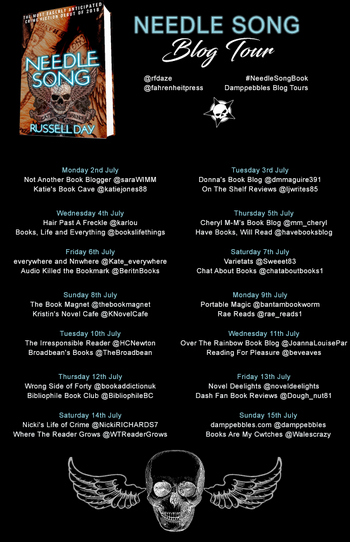
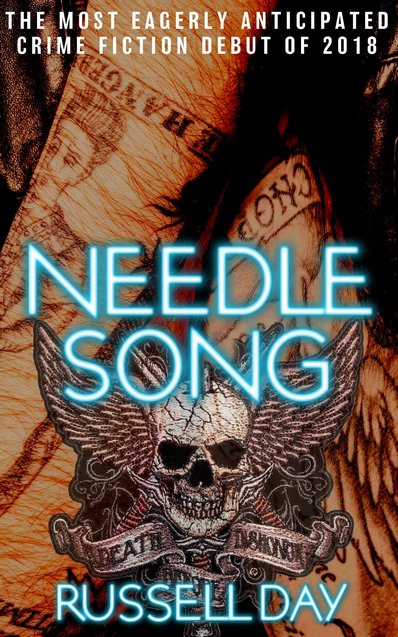
In a couple of months, I’ll be taking part in a book tour for Russell Day’s debut novel, Needle Song, and I’m really looking forward to that (and am having a hard time not reading it now). But today, we’re going to look at a short story featuring the protagonist of the book, Dr. James Slidesmith. A little something to whet our collective appetities.

I know very little about Slidesmith after reading this short story, and I can’t wait to find out more. Here’s what I do know — 1. He has a PhD in Psychology, and is touchy about those who don’t consider him to be a “real” doctor; 2. He owns and runs a tattoo parlor/shop; 3. he plays poker; 4. He’s very smart; 5. He has the gift of gab.

All five of these are important, but in this short story, that last one is essential. Everything in this is dialogue — no dialogue tags, no narrative, no descriptive passages — just characters talking. Which will involve all that other stuff, but that’s not how the story is told. It takes place in a police interrogation room — you’ve got a Detective Constable, a Detective Sergeant and Dr. Slidesmith talking about an incident at a poker game earlier that night. Things got nasty and two men died, given the small number of people at the game, the Police are looking to quickly identify the killer(s) and wrap this up quickly.

But first they’ve got to get past the silver-tongued Slidesmith. That won’t be easy. He offers a detailed explanation of the night’s events — including doing some educating on Texas Hold-’em, the ins and outs of betting in the game (and how to manipulate betting). There are a couple of characters that we only learn about from questions and answers in the interrogation, and I feel like I ahve a pretty good handle on them, without seeing them speak for themselves. That’s a nice move.

As it’s just dialogue — and well-written dialogue, at that — this is a fast, breezy read (so fast, you might miss a thing or two the first time through). It’s not so much a book that you read, it’s one you hear with your eyes. I’m not certain that makes a lot of sense, but it’s the best way I can put it. These are fast-moving conversations, they have a certain rhythm, a certain feel — and you just want to keep reading more and more of it. This could’ve been twice as long and I don’t think my attention would’ve wavered an iota. Imagine your favorite scene written by Aaron Sorkin, then imagine it changing into an interrogation in a British Police Station — that’s what this story is.

This is good stuff, my friends — better than good. There’s an extent to which the reveal seems “oh, sure, I should’ve seen that coming” — and it wouldn’t surprise me if many readers get there before Day wants you to (I was not one of them) — but it’s so satisfying, so well-executed, I can’t imagine a soul complaining about it. If Needle Song is anything like this, I’m going to have to go down to the superlative store this weekend to stock up before I write anything about it.

Stop whatever you’re doing — including reading this — and click the links at the top of the page to go get this story. You’re welcome.

—–

5 Stars

Born to the Blade 1.4: The Gauntlet by Michael Underwood: Kris’ opportunity finally knocks in the most satisfying episode yet.

The GauntletThe Gauntlet

by Michael R. Underwood
Series: Born to the Blade, #1.4

Kindle Edition, 53 pg.
Serial Box, 2018
Read: May 10, 2018
Since Episode One, we’ve been waiting for this: Kris Denn of Rumika facing the gauntlet. A series of 6 duels against the members of the Warders Circle of Twaa-Fei to gain a seat at the table for Rumika. Failure here means a decade (or so) before the next potential warder from Rumika has an opportunity. That’s pretty much the whole episode in a nutshell — can Kris make it?

Ultimately, I don’t think anyone will be shocked at the outcome — it’s about the journey, how the outcome is reached. Underwood nails it. A couple of weeks ago, I linked to a piece he wrote about how fight scenes can reveal character (he also tweeted about it this week), and this episode is him displaying that theory in practice. It really works — not only do we get a better idea about who Kris is, but we get a better understanding of the other Warders. Sure, we may not actually learn anything about Lavinia and Ojo — we just get more evidence of what we already know — but there are other duels.

This is longer than the previous two episodes — and it helped. The extra length gave things a chance to happen. I assume that’s not something we’ll see next week, but I can hope, right?

I’ve liked the previous episodes enough to justify the purchase of the season and to keep going, but I just flat-out liked this one. Good fight scenes, good character moments and the plot moves ahead. Where this goes next, I’m not sure, but having concluded this initial arc, I’m ready to see it. These authors took their time establishing this world, and carefully built up to this point and what lies beyond. I’m looking forward to see what else comes on this foundation.

—–

4 Stars

Robert B. Parker’s Old Black Magic by Ace Atkins: Atkins delivers a solid dose of Old Boston Magic

Old Black MagicRobert B. Parker’s Old Black Magic

by Ace Atkins
Series: Spenser, #46

Hardcover, 319 pg.
G.P. Putnam’s Sons, 2018
Read: May 2 – 3, 2018

Wow. The Forty-Sixth Spenser novel. Atkins’ seventh, too — it’s hard to believe. I can still remember some of these as clearly as if I read them yesterday — I’m a little vague on some of them, I have to admit (sorry Bad Business and Painted Ladies), but by and large, this is one of those series that’s defined me as a reader. This is one of those that in years to come that I’m going to remember pretty clearly, too, I’m glad to report.

Also, I’m pretty sure that 46 books in, nothing I say here is going to get the series a new reader. Still, I want to talk about it some.

So here’s the pitch: Locke, an older P.I. and friend/associate of Spenser, comes to him for help — he’d like Spenser to take over one of his cases, as she’s fighting a losing battle with a medical problem. Twenty years ago, a Boston museum was robbed — two paintings and one Picasso sketch were stolen. The Boston Police, the FBI and he have turned over every rock they can think of, he’s traveled the word just to find them. But he’s gotten no where — but there’s some new information coming to light — and with the statute of limitations about to kick in, there’s probably no better time to find the painting then now. Spenser agree and plunges right into the hunt.

Whether you’re Spenser or Nero Wolfe, the worst type of client has to be a committee or board* — a committee that’s not entirely sure they want you to work for them is even worse. The museum committee is led by a classic stuffed shirt, Spenser’s always fun to read when he’s antagonizing the pompous. We’ve also got another Spenser trope — a tough, no-nonsense, hard-to-impress client that Spenser slowly wins over — in the museum director. Putting the two of those together is a good combination. The committee has their own replacement for Locke — an anti-Spenser. British, polished, cultured (he’s probably forgotten more about art than Spenser has ever known), not obviously prone to violence, with an approach to this case that’s very different from Spenser’s. As much as I disliked him, I wish we’d gotten a little more time with him.

This is a novel largely dependent on the non-regular characters — clients, witnesses, sources, suspects. There’s no Hawk, no Sixkill, limited Susan, not enough Pearl — so who does Spenser talk to? Henry (a little more than usual), Frank, Quirk, and Rita — and a couple of chats with Vinnie Morris. Things are still not good with Vinnie, but there might be room in that direction — and common enemies can help a lot. Given the Gino Fish connection, of course we have to have a lot of Vinnie.

Spenser’s approach to this case is classic — he goes around talking to every witness, suspect that he can — annoying some, charming some, learning a very little. Then he moves on to the next and the next, and then circles back to the first. Prying a little more, and a little more. This is a very talk-y book. There’s the threat of violence — and even some actual violence — but most of the actual violence was associated with the original burglars, so we hear about it, but don’t see it. Atkin’s solid take on Parker-dialgoue means that this is a fast, fun read. And that’s fine with me.

Back when Robert B. Parker was writing multiple series, one of the fun aspects was watching characters from one series (typically the longer-running, Spenser books) show up in one of the others. Watching Capt. Healy’s interactions with Jesse Stone, for example, provided an interesting counter-point to the way Healy and Spenser got along. Now that there are three authors actively writing the Spenser-verse series, there’s an added twist to that. Recently (long enough ago that I don’t feel too bad saying it), Reed Farrel Coleman killed off Gino Fish. There are huge chunks of this book that are little else than seeing the effects of that death in Boston’s criminal society (for lack of a better term).

How do we get to Gino Fish? When it comes to Art Crimes — especially higher-end stuff — and the resulting fencing, at that time in Boston everything came through Gino’s fingers. Between the references to the late Gino and the fact that the crime in question took place two decades ago, there’s a lot of history covered here as Spenser talks to various criminals/criminal associates while hunting for these paintings. I do mean a lot of history — going back to events in Mortal Stakes (my first encounter with the series) and characters from The Godwulf Manuscript (the first in the series). Yes, there’s a certain element of this being fan-service-y nostalgia on Atkins part. As a serviced-fan, I’m not complaining. But I think it’s more, it’s the kind of series that Parker and Atkins have given us — one that is very aware of its past and draws on it always. (there’s an interesting contrast to be made with the Jesse Stone series on this front).

If you’re looking at this as a mystery novel, or focusing on the plot — I’m not sure how successful it is (better than many, but I’m not sure it’s up to Atkins’ typical standards). But, if you look at it as some time with old friends — Spenser primarily, but even Quirk, Belson, Henry, etc. — it gets better, especially if you’ve got as much history with these characters as many readers do. Throw in the atmosphere, the perfect voice, the longer-term character moves, and you’ve got yourself a heckuva read. Spenser #46 is as entertaining as you could ask for and I’m already looking forward to #47.


* Yes, it bothers me that I can only come up with two names for this truncated list. I can’t imagine that other P. I.’s are immune to this kind of client, but I can’t think of another example. I’ll probably lose sleep over this memory failure.

—–

4 Stars

Born to the Blade 1.1: Arrivals by Michael Underwood: The Start of a Promising Series

ArrivalsArrivals

by Michael R. Underwood
Series: Born to the Blade, #1.1

Kindle Edition, 61 pg.
Serial Box, 2018
Read: April 21, 2018

Publisher’s Blurb:

For centuries the Warders’ Circle on the neutral islands of Twaa-Fei has given the countries of the sky a way to avoid war, settling their disputes through formal, magical duels. But the Circle’s ability to maintain peace is fading: the Mertikan Empire is preparing for conquest and the trade nation of Quloo is sinking, stripped of the aerstone that keeps both ships and island a-sky. When upstart Kris Denn tries to win their island a seat in the Warder’s Circle and colonial subject Oda no Michiko discovers that her conquered nation’s past is not what she’s been told, they upset the balance of power. The storm they bring will bind all the peoples of the sky together…or tear them apart.

So there’s the setup for this “season” of 11 novella-length episodes, releasing weekly. Episode 1 — Arrivals is very much a pilot episode. After an action-packed opening, the story settles into introducing the pretty large cast of characters and the world the inhabit.

I found most of what follows pretty dry, and I had a hard time maintaining interest. It reminded me of the Game of Thrones pilot — at least for those of us who hadn’t read the book — so many names and places to learn that it was hard to pay attention to any story. It’s a rich world and most of the characters seem well-developed and complex — I just don’t care about any of it yet.

It is not the most accessible world, with a specialized vocabulary, and political and magic systems that the reader has to dig in to really understand. This isn’t a complaint — it’s just something to know going in. There’s no real pay off for the effort now, but you can assume it’s coming.

But those last couple of pages? Hoo-boy, there’s the hook — I might have had to wait longer than I wanted to just to get to this point, but it was worth the wait. I think that gave me enough motivation to read at least a couple more episodes. Given the strength of the list of authors involved in this one — Michael R. Underwood (the author of this installment), in particular — I’m confident that I’ll be singing the praises of Born to the Blade soon. You might want to jump on board now and enjoy the progress.

—–

3 Stars

Dark Queen by Faith Hunter: Jane Yellowrock’s latest has everything — including the kitchen sink.

Dark QueenDark Queen

by Faith Hunter
Series: Jane Yellowrock, #12

eARC, 432 pg.
Ace, 2018
Read: April 23 – 28, 2018

I’ve stopped reading the blurbs for the Jane Yellowrock books, so I had no idea what to expect out of this one when I started it. I spent a couple of days planning on how this was a rumination of/celebration of family disguised as an Urban Fantasy novel. Don’t get me wrong, there was plenty of action and plot and all the things we have come to expect from a Jane Yellowrock book. But, yeah, family was the overarching theme. But then . . .

But then, Hunter kicks it into high gear and the long-awaited Sangre Duello starts. Which I didn’t expect — I figured we’d get an entire novel (minus an introductory and follow-up chapter, maybe) dedicated to it. Man, am I glad I was wrong — I’m not sure I could’ve handled more of the tension surrounding it than Hunter gave us. Still, everything I’d planned on saying pretty much went out the window.

I’ve gotten ahead of myself. This series (like any that has gone more than 5 books) needs a “Previously . . .” section. Things have changed so much since Jane rode into New Orleans in Skinwalker that it’s almost impossible to remember everything that’s happened. Hunter does do enough in the text to remind you who is who and what they’ve done in the past, so I’m not saying the book is inaccessible. It’d just be nice to have a reminder just where we are in the story without having to re-read eleven novels (not that I have a problem with that — I’d probably pick up a few more nuances).

The book begins with Leo solidifying his organization. Moving people around, giving promotions, and cleaning house (not as much as he should have, but even someone who’s as politically savvy as Leo isn’t perfect). Part of this is the official recognition and establishment of Clan Yellowrock — which was just so strange. One of the groups that Leo is dealing with is a werewolf pack from the Western part of the US, who are doing some work for him related to the Sangre Duello, who are pretty interesting, and I’d like to see more of them in the future. There’s also a new PsyLED honcho floating around — Rick’s boss and Soul’s underling — and his presence is almost as disruptive to Jane’s world as the European Vampires are.

Then before you know it — there we are, the European Vampires are coming ashore to start the Sangre Duello. Which is basically a series of duels — some to first blood, some to the death (true death, in the case of vampires) — and just about everyone connected to Leo ends up fighting at least once. It is clear from the way this is set up, the way it’s carried out, the way that just about everyone acts during it — that vampires act on a different morality than just about anyone else. Jane has a very hard time with it all, and many readers will, too. That’s good — that means you’re not a monster. I will say that Leo’s psychological games with the EV’s are a lotta fun. If you have much of an emotional attachment to the characters in this series, you will stress out during this part of the book. Not all survive. Not all who do survive do so unscathed. Without saying what happens to him, I didn’t realize how invested I was in Leo Pellissier’s continued existence.

Faith Hunter puts all of her experience, all her skill and talent on display here — and it works. This is really a tour de force for her and it’s just a pleasure to read. On the one hand, I thought the pacing was a bit slow at first and wasn’t sure what she was doing — but at a certain point, I recognized that she knew exactly what she was doing and you needed the slow-burn of a start so that you’d be ready for the almost non-stop action to come. There’s some brave choices she makes here — totally shaking up the series, the status is not quo, as a horrible doctor might say. While that might seem like the kind of thing writers need to do (and it is), it can’t be an easy choice — because no matter what we say, we fans want our comfortable series: where we know that Riker will be Picard’s Number One for far too long, Lisa will be 8, and that one couch at the Central Perk will always be available for Monica’s friends to sit on.

Jane continues to grow and mature, embracing — and even expanding — the emotional ties she has to people in her life, taking on more people to protect and defend. She’s not a loner anymore, and has stopped fighting this reality. It’s great to see. And everything I wanted to say about family is present here, and you’ll know exactly what I was talking about when you read this. And if you’re someone who threatens any of those she’s decided to align herself with? I pity you, because, well, Beast is best hunter, and there’s nothing really that’ll stop Beast/Jane from making you regret that threatening.

If I was a better blogger — or at least one who had better time management, I’d come up with a post just about Eli Younger. I really wish I was that guy — because Eli deserves more attention. As I write this, I remember that Carrie Vaughn gave Cormac a novel to himself (pretty much) — Hunter should consider letting Eli have his own.

This would’ve been a great series finale just as it is. I am so glad that it’s not — Hunter’s got things set up so well for the next couple fo books (at least) that I’m as excited about this series as I’ve ever been. But, Dark Queen could’ve worked as the end. Which is really just to say two things: 1. If you’re looking for a new Urban Fantasy series to start, full of magic, vampires, shape-shifters and more? This series is a great one — but don’t start here, start with Skinwalker. 2. Hunter has tied up a lot of loose ends, a lot of long-going plotlines are resolved (or at least brought to a satisfying resting point), which should satisfy long-term readers. I won’t say that they’ll all be happy about where everything ends up — I’m not — but I will say that it’s nice to have some sense of closure and resolution.

I laughed, I got angry, I cheered, I fretted, I got awfully close to letting water leak out of my eyes — I loved this book from start to finish.

Disclaimer: I received this eARC from Berkley Publishing Group via NetGalley in exchange for this post — thanks to both for this.

—–

5 Stars

Page 68 of 123

Powered by WordPress & Theme by Anders Norén