Category: Book Tour Page 55 of 56

Q & A with Robert Germaux Author of Hard Court

Hard Court by Robert Germaux Virtual Book Tour Banner
These questions were provided by My Book Tour

Why a novel about a private detective?

I’ve always loved mysteries, starting when I read the Nancy Drew and Hardy Boys books as a kid. As I got older, I enjoyed Ed McBain’s 87th Precinct novels, and eventually I also got hooked on the characters of Spenser, Elvis Cole and Myron Bolitar, among others. When I decided to write my first full-length novel, there was no doubt in my mind that my protagonist would be a private detective.

How would you describe Jeremy Barnes, Bob?

There’s an old line about people you wouldn’t want to run into in a dark alley. Well, if you did end up in that dark alley with one of those people, JB’s the person you’d want covering your back. He’s a tough guy with a soft spot in his heart for life’s underdogs, and while he’d much rather diffuse a tense situation with his sense of humor, if push comes to shove, he’s more than capable of handling himself that way, too.

Is JB based on anyone in particular?

There’s a little bit of several people I’ve known in JB, but mostly he’s a product of my fertile imagination. Actually, other than the fact that he’s bigger, stronger, younger, smarter and better-looking than I am, we’re remarkably similar!

How do you come up with the plots for your books?

It’s a combination of finding subjects I’m knowledgeable about and things I have an interest in. For example, in Leaving the LAW, JB attempts to help a young man who’s involved with gangs at the school where JB used to teach. In the early 90s, I was teaching at a Pittsburgh high school that the local cops called Gang Central, so I had some personal experience with that whole scene.

Why first person narrative?

I can’t imagine writing about JB in any other way. When I write my Jeremy Barnes novels, I’m right there inside his head. At those moments, we’re one and the same. He’s definitely my alter ego.

You’ve said you can’t see yourself ever writing a character interview with Jeremy. Why is that?

Jeremy exists in the world I created for him, and I’m very comfortable writing about him in that world. But bringing him into this world just doesn’t work for me. It would be sort of like the literary equivalent of breaking the fourth wall in a stage production. I’m sure some authors can pull that off, but I’m not one of them.

Do you have a reading group?

Yes, and the group’s name is Cynthia. As soon as I finish writing a chapter, I give it to my wife. Cynthia knows my characters as well as I do, so I almost always end up using her comments/suggestions.

How important was it for you that Jeremy would have a love interest in the character of Laura Fleming?

I knew from the start that Jeremy would have a woman in his life, a soul mate. The scenes with JB and Laura are my favorite to write, whether they’re discussing one of his cases, talking about her kindergarten kids or just sharing a candlelight dinner at one of Pittsburgh’s hilltop restaurants.

Okay, Bob, last question. Are there other Jeremy Barnes mysteries on the horizon?

I’ve actually written three other books about Jeremy: Small Bytes, Speak Softly and the aforementioned Leaving the LAW. If there’s a demand, I will definitely publish them, too.

My Book Tour Website Banner

Tour Hosted by Susan Barton, My Book Tour

Guest Post: Writer’s Block? Step Into My Shower By Robert Germaux

Hard Court by Robert Germaux Virtual Book Tour Banner

Does this sound familiar? You’ve placed one of your characters (let’s call her Jenny) in a pretty sticky situation, and now you have no idea how to get her out of that pickle. You’ve tried several scenarios, but none of them quite works. Finally, you decide to take a break, clear your mind a bit. You’re thinking grab a quick shower, drive over to Starbucks for a latte, then come back and get to work on saving Jenny. Five minutes later, you’re halfway into that shower, and suddenly, it hits you, the perfect way to extricate Jenny from that sticky situation.

That sort of thing has happened to me often enough that, at some point, I began to wonder about the possibility of a connection between water and creativity. So, of course, I Googled it, and I quickly learned that there is a veritable waterfall of information on this topic. Yeah, I know. Waterfall of info on water. I couldn’t resist it. No more, I promise. Anyway, I discovered that there does, indeed, appear to be a connection, although it’s not the water per se, but rather a progression of events in which water is just one part. With apologies to Mr. Metcalf, my high school science teacher, I’ll do my best to walk you through the process. It involves dopamine, and one of the few things I still remember from Mr. Metcalf’s class is that dopamine equals good. Apparently, dopamine aids in the creative process (no idea; I got a C- in science), but to get the dopamine released into our brains, we first need to be doing something relaxing, like taking that warm shower or a long walk or a leisurely drive in the country. During these types of activities, your mind is distracted from whatever subject you’ve been concentrating on all day (for instance, poor Jenny), which allows your brain to relax at the same time it’s being flooded with dopamine, and before your know it, genius hits.

Okay, there you have it. Maybe not the most scientific explanation of the process (again, C-), but it gives you the general idea. Relaxation plus distraction plus dopamine equal problem solved. So the next time you’re sitting there staring at that blank page, take a hike.

My Book Tour Website Banner

Tour Hosted by Susan Barton, My Book Tour

Guest Post: Literally? Really? By Robert Germaux

Hard Court by Robert Germaux Virtual Book Tour Banner
A few weeks ago, a friend of mine was telling me about a horror movie he’d just seen, and he ended his narrative by saying, “I was literally scared to death!”  My first thought was, not unless I’m getting this information in your Memoir from Beyond the Grave.  The word literally means actually or really, as in There are literally thousands of people following her on Twitter.  That’s a completely believable and verifiable fact.  However, if someone says he literally exploded with anger, well, probably not.  What’s happened here is that so many people have misused the word literally for so long, it’s become acceptable to use it incorrectly.  This has happened with other words, too, the best example possibly being the word bye as it’s both used and misused in professional football.  The NFL gives the two teams with the best regular-season records in each conference a bye in the first round of the playoffs, meaning they’ve earned the right to skip that first week.  That’s a correct usage of the word bye.  However, during the regular season, every team in the league gets one week off, and that’s what it should be called, an off week.  But somewhere along the way, someone began referring to that off week as the bye week, and thanks to the Internet, that term went viral and was repeated thousands and thousands of times, until it eventually became part of our national lexicon.

A final example of this linguistic phenomenon involves the word factoid.  A little history lesson first.  Factoid was coined by Norman Mailer in 1973.  Mailer stuck the suffix –oid (which means resembling or having the appearance of) on the word fact to create factoid, which he said referred to “facts which have no existence before appearing in a magazine or newspaper.”  Jump ahead several decades, have a few people, including some in major media outlets, start using the word factoid to mean an interesting bit of trivia about a person or event, throw in the Internet (of course) and voila!  You have a new definition for factoid.

Okay, let’s take a step back here for a minute.  Does all this stuff matter?  I mean, what harm is being done by someone saying he was literally scared stiff while watching the latest episode of The Walking Dead?  Or by hearing a local sports anchor talk about your favorite team’s bye week in the middle of the season.  In the greater, or even lesser, scheme of things, this is all pretty irrelevant.  I’m well aware that there are far greater issues to be discussed and debated, and I completely get it that our language is constantly evolving.  That’s why, for instance, we ask a new acquaintance where he or she is from instead of saying Whence comest thou?  It’s just that I like to see and hear words being used properly.  So I hope you’ll forgive me if the next time I hear a reporter on a national newscast say And here’s an interesting factoid, this longtime lover of language smiles a bit as he slowly, quietly and, yes, literally gives his head a small shake.

My Book Tour Website Banner

Tour Hosted by Susan Barton, My Book Tour

Hard Court by Robert Germaux Book Tour

Hard Court by Robert Germaux Virtual Book Tour Banner
Coming up: We’ve got a Guest Post from Robert Germaux about the continuing evolution of the English language (and how curmudgeons like us react to it), another Guest Post from him about dealing with writer’s block (applies to all sorts of creative endeavors), a Q & A with him (longer than usual ’round here), too — and finally, my $.02 about the book. Oh, yeah, and I’ll be giving away a copy of it, too. Come back and check these posts out (the links will work when the posts go up) — or just go get the book — might be easiest to just do that.

But first: about the book and the author:

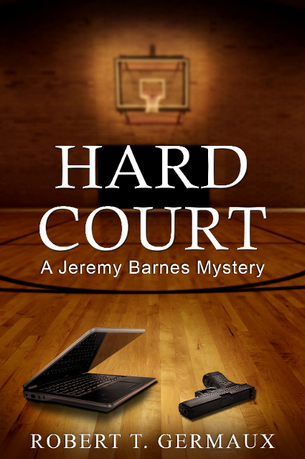
Hard Court by Robert Germaux Cover Reveal Event - Book Cover Photo


  • File Size: 638 KB
  • Print Length: 253 pages
  • Simultaneous Device Usage: Unlimited
  • Publisher: Robert T. Germaux (April 6, 2016)
  • Publication Date: April 6, 2016
  • Sold by: Amazon Digital Services LLC
  • Language: English
  • ASIN: B01DX54ZFO


ABOUT HARD COURT:

Miles Bradshaw, the dot-com billionaire owner of Pittsburgh’s first NBA franchise, hires private detective Jeremy Barnes to look into what appears to be a simple case of harassment of one of the team’s players. But when Jeremy (JB to his friends) begins his investigation, the case proves to be anything but simple, eventually involving a local businessman with suspected criminal ties, a major FBI task force, a computer geek in California and a mob boss in Erie. Along the way, JB, who can quote Shakespeare as quickly and easily as he can land a solid left jab, uses his wits and his ever-present sense of humor to wend his way through a cast of characters who range from the ridiculously inept to the ruthlessly lethal.

As Hard Court unfolds, there are numerous surprises and plot twists, culminating in a dramatic confrontation that neither JB nor the reader could have predicted.


PURCHASE HARD COURT ON AMAZON


Robert Germaux Author PhotoABOUT ROBERT GERMAUX:

Both my parents were readers. I’m talking stacks-of-books-on-their-nightstands readers. So it’s no surprise that at an early age, I, too, became an avid reader. Everything from sports books (especially baseball) to Nancy Drew to the Hardy Boys to almost anything about distant and exotic places.

Although I’ve always enjoyed putting words on paper, the writer in me didn’t fully emerge until I retired after three decades of teaching high school English. I quickly wrote two books aimed at middle school readers, at which point my wife urged me to try a novel for adults. As is usually the case, Cynthia’s idea was a good one.

Over the next few years, I wrote several books about Pittsburgh private eye Jeremy Barnes. I took a brief hiatus from the detective genre to write Small Talk and The Backup Husband. Now I’m back and I just released my first Jeremy Barnes novel, Hard Court, on April 11.

In our spare time, Cynthia and I enjoy reading (of course), going to live theater productions, watching reruns of favorite TV shows such as “Sports Night” and “Gilmore Girls,” and traveling to some of those distant and exotic places I used to read about as a child. So far, we’ve been fortunate enough to walk in the sands of Waikiki, swim in the warm waters of the South Pacific and share a romantic dinner in Paris.

I love interacting with my readers and getting their input on my characters and stories. Please feel free to contact me via my website and connect with me on Twitter and Facebook.

READ “LOGAN – A JEREMY BARNES SHORT STORY” HERE

My Book Tour Website Banner

Tour Hosted by Susan Barton, My Book Tour

Thursday, 1:17 PM by Michael Landweber

Thursday, 1:17 PMThursday, 1:17 PM

by Michael Landweber

Kindle Edition, 208 pg.
Coffeetown Press, 2016

Read: May 18 – 19, 2016

Towel Day is tomorrow, so it seems apropos to start with a couple of Douglas Adams lines that I’d imagine Duck quoted to himself, assuming he read the book: “This must be Thursday . . .I never could get the hang of Thursdays.” and “Time is an illusion. Lunchtime doubly so.” Now, if anyone could empathize with Arthur and Ford, it’s Duck.

(like I need an excuse to quote Adams, really, but I’ll take one)

And you never know, maybe he had read Adams, after all:

We’d read Fight Club in Mr. Lorenzo’s Anarchy in Modern American Fiction class . . . And Lord of the Rings in Ms. Tutwell’s Geography of Fictional Lands seminar, which somehow got me Social Studies credit. Damn, I went to a really questionable high school.

So, earlier today, I posted something from the publisher with the idea behind this one. Basically, Duck’s head is nowhere near where it should be as he walks the busy streets of D. C. and he steps out in front of a car that doesn’t hit him. Not because of lightning-fast reflexes of the driver, nor because of fantastic brakes, or because some hero pulled/pushed/tackled him out of the way. Nope, none of those — but because faster than you can say “Rod Serling,” time stopped.

Now our 17-year-old protagonist has to figure out: what happened (if he can); how to survive in this Frozen World (if he can); and most importantly — how can he get things moving again (if he can).

Simple enough premise, right? Yup. One that seems like you’ve probably read/seen it a few times (seems that way, but I can’t remember once) — but Landweber executes it like he’s the first. It feels fresh, new and innovative — while being an old stand-by, figure out how he pulled that off and I’ll probably end up talking about your book, too.

As we talked about a little while ago, there are very strict rules governing this reality and Duck figures them out pretty fast (at least fast enough to survive awhile).

Now seems like a good place to explain what people feel like in the frozen world. Skin feels like skin, hair like hair, lips like lips. It’s one of those things that is almost normal. When no one moves, you expect them to feel like molded plastic, like mannequins, limbs swiveling on set pivots without much range. A secondary possibility was that everyone would feel rubbery, like the well-preserved fetal pig [Duck’s friend] Grace dissected for me. Wrong on both counts.

The inert water hung down from the showerhead like strands of silk caressing his body. I touched one and it came away from its cohorts, wet and liquid on my fingertips.

And, yes, that sounds kind of creepy going around touching skin, hair, lips, some dude’s shower water — but don’t worry, that’s only because it is creepy. And Duck would be the first to admit that (probably while blushing). One reason I liked the paragraphs I quoted was because, yeah, molded plastic is exactly how I’d have figured it to feel.

Duck composing a “Guidebook” to how to live in this kind of reality ticks off a few boxes: lets us see his personality, lets him talk about his experimentation to discover the rules in a slightly more objective way than the rest of his narration, and lets him give the readers an info dump — several, actually — without it feeling like one. A very nice move there.

Landweber gives us a few details a little at a time about this reality, what Duck’s been going through in the days/weeks/months leading up to stepping in front of the car (like where that nickname comes from — a tale that’s both tragic and funny). As little as he’s been paying attention to the outside world, it might as well have stopped. So one of the things he does during this time is figure out what’s been going on with his friends — between family crisis and adolescent male hormones, he’s missed a lot. He just hopes that he can make up for this time.

For the most part, this book comes across as light entertainment — but there are (at least) two big dramatic stories at play here in addition to the fun and games. There’s death, the nature of love (and reality of lust, teenage style), growing up, friendship, hurting others . . . and Duck coming to grips with all of these, and coping with them isn’t done in a heavy-handed, or overly serious manner. On the whole, while you’re chuckling about something he’ll slide right into a consideration of one of the heavier themes. Over and over again, Landweber does this seamlessly so you barely notice it. No mean trick to pull off.

In addition to that, Duck deals with some pretty deep ethical questions (and doesn’t always come up with the right answer). His father, a philosopher, had posited that:

there is no good or evil without time. Empirically, he argued, man’s actions in themselves are not right or wrong. It is only the interaction of those deeds with the passage of time and the judgments of others that leads to morality. If you were to freeze time at the instant of the act, and never allow for there to be recriminations or regret or accusations or revenge, then the act itself becomes a meaningless one. No matter what that act is. Merely a moment detached from all other moments. A moment without consequence.

Duck’s got more than enough of these detached moments, moments without consequences, to deal with. And watching him deal with these ideas and try to be moral (frequently) is a really nice touch that I don’t think I expected from the premise.

It’s told in a light tone — and never gets spooky or too tense, but that doesn’t stop what Duck is dealing with from being serious — and dealt with seriously (much of the time). Landweber balances that pretty well most of the time — while keeping Duck as believable as possible in this situation. It is a compelling read, a fun read, and a moving read. Breezy enough to keep the YA crowd engaged, and thoughtful enough to make it worthwhile.

You really want to go get your hands on this one, readers, you’ll enjoy it.

Disclaimer: I received a copy of this book from the author in exchange for an honest review.

—–

4 Stars

Guest Post: 5 Books about Time by Michael Landweber


I’m a little obsessed about the concept of time in my writing. My first book, We, was about a man who travels back in time only to get stuck as a parasite inside the head of his seven-year-old self. In my latest novel, time stops completely, except for one 17-year-old kid. I suppose the recurring theme is that we have no control over time, even when it gets a little bit wonky. In honor of my obsession, I have created a list of five time-related books (or more precisely that have the word “time” in the title) that I’ve enjoyed over the years.

1) The Time Machine by H.G. Wells
The one that started it all. The original time travel story. Without it, there never would have been Timecop. Seriously though, it is a little hard to imagine that we’d have more than a century of time travel related books, movies, TV shows, etc. if Wells hadn’t had the idea that a time machine was the way to travel to different eras. Of course, unlike most modern time travel fiction, which focuses on the ways that traveling through time can change the present, purposefully or not, Wells had his protagonist travel into the far future where he encountered a parable about class and society. Still, the guy coined the phrase “time machine.” That’s pretty cool.

2) A Wrinkle in Time by Madeleine L’Engle
We don’t need no stinking time machine. In L’Engle’s classic children’s book series, the characters travel through space by “wrinkling time” by means of the tesseract. Most writers now call it a wormhole. No vehicle required. That freed a lot of writers to just zap characters from place to place without tricking out a Delorean. The book also is about how children can save the world without the help of the adults around them, particularly parents. Hello, Harry Potter!

3) A Tale for the Time Being by Ruth Ozeki
OK, this one has the least to do with manipulating time though it is a story about how past family narratives can help soothe present pain. A young woman in Tokyo considers suicide, but researching the stories of her feminist Buddhist nun great-grandmother and her disgraced WWII pilot great-uncle lead her to some surprising revelations about herself.

4) Time’s Arrow by Martin Amis
Amis uses a unique device to write about the horrors of the Holocaust. The narrator is a consciousness inside the head of a former Nazi who is now living a new life in America. But the story is told in reverse chronological order. Time in the book literally runs backward, so we start with the war criminal as an old man and travel unavoidably to his horrific past. It is an unusual and difficult book that allows the reader a new window into understanding the inconceivable cruelty that people are capable of.

5) Time Bandits
OK, I’m totally cheating here. Time Bandits is a movie. But it also happens to be my favorite movie. And it is about traveling through time. So there. One of Terry Gilliam’s earliest films, this one follows a young boy who falls in with a group of dwarfs who previously worked for the Supreme Being until they stole the Big Guy’s map of time holes and decided to use it to steal from the rich throughout history. That only begins to describe how gloriously messed up this movie is.

Thursday, 1:17 PM Book Tour

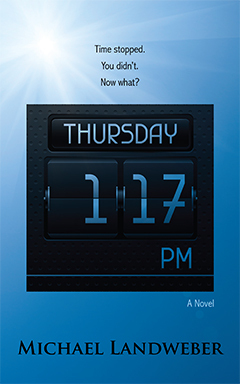
Thursday, 1:17 PMTime stopped. You didn’t. Now what?

Duck is 17. He will never be 18.

Tomorrow is his birthday. It will never be tomorrow.

Time stopped at 1:17 p.m. on a beautiful Thursday afternoon in Washington, DC. Duck is the only person moving in a world where all other living beings have been frozen into statues in an endless diorama. Duck was already in limbo, having lost his mother to cancer and his father to mental illness.

Now, faced with the unimaginable, he approaches his dilemma with the eye of an anthropologist and the heart of a teenager trying to do the right thing under the strangest of circumstances. Ultimately, he realizes that while he doesn’t understand the boundaries between friendship and love, that uncertain territory may be the key to restarting the world.

Trade Paperback – Available now
Publisher: Coffeetown Press
ISBN13: 9781603813570
208 pages

Coming up: We’ve got a Guest Post from Michael Landweber, a Q & A with him, too — and finally, my $.02 about the book. Come back and check these posts out (the links will work when the posts go up) — or just go get the book. Whatever.

Guest Post: Behind the Scenes and Advice for Writers by Erin Rhew

I’d like to welcome Erin Rhew to the blog today to promote her fantasy trilogy, The Fulfillment Series (and other things), as part of The Rhew 2 Rhew blog tour. The Fulfillment Series looks like a good investment of your time, I’ll add, be sure to check it out. After you read her post, of course — and enter the drawing.

Also, this was supposed to post this on Monday, and I messed up the posting. I’d like to publicly apologize to Erin for the mess-up. Irresponsible is supposed to by a name, a philosophy of reading, not a description of the guy behind the blog.

Thank you to H.C. for hosting me today, and thank you to his readers for joining us!! <waves> Today, I’m here to talk about the writing and publication process. I think I have a bit of a unique perspective because I’m a published author, AND I work for a publishing company. PS. Stay tuned to find out about a Rafflecopter giveaway for a $50 Amazon gift card!!

3707196_orig

People always ask me when I knew I wanted to be a writer, but I didn’t really have that “ah-ha” moment. Since I was four and read my first book, I’ve been fascinated with the written word. At four, I also wrote my first poem. My grandparents run a car dealership, and I wrote a little rhyming poem about the cars on their lot. When I received serious accolades for it, the writer in me bloomed. I wrote in middle school and had a whole gaggle of girls who waited not-so-patiently for me to complete a new chapter. In high school, I continued writing and also took up acting, and in college, I continued to do both. After graduation, I ran a theater company, where I both acted and wrote plays. I did that for many, many years, and my novel writing took a back seat. But I eventually returned to my first love and started a novel. In fact, I’m STILL working on that novel. LOL! I’ve finished it, rewritten it, and I’m in the process of rewriting it again. But while that book marinated, another book emerged–three, in fact. And The Fulfillment Series was born. I assembled a group of friends, called the Dream Team, to help keep me on task (ADD and all).

6762080_origFrom right to left: Danielle Craver, Dawn Ward, Ginny Hunsberger, and Kim Sharp–I’m kneeling)

I wrote the trilogy in three months (yep!) with the help of my friend, Kim, who required a chapter a day from me. But editing is a much longer, more arduous process, especially if you’re a grammar nerd like I am. Once I’d self-edited, I sent it to beta readers and critique partners, and then I edited it again, I sent out query letters. Rejections came in, lots of them, with a few requests for partials and fulls sprinkled in. And then one day, as I stood in the pet store, it came…the offer! I *may* have jumped up and down and squealed right there in the middle of that pet store. LOL!

And the rest, as they say, is history. All three books of the trilogy have been published, and I’m pleased as punch about it. Now I have to return to my original book…apparently to be my magnum opus!

89930301 My first book. Wonderful cover created by Anita at Race-Point!

Publication

I think working at a publication company has a great deal for my writing. I’ve learned a lot about what to do and what not to do just by reading other people’s work and working with the fabulous group of editors we have on staff. The lovely Heather Powell Van Fleet taught me a whole lot about “showing versus telling” and “actions before words.” And I learned a lot from my husband’s editor, Anya Kagan, about the big picture and “talking heads.” For those of you who don’t have the ability to benefit from working in a publishing company, I say this: Talk to other writers and editors. Immerse yourself in the world of writing. Follow Twitter contests like #PitMad and see what storylines are being overdone (you’d be surprised how many are alike).

Here is some of my advice:

1) Edit, edit, edit. (As I write this, I know my post will have an error–LOL!) I’m a HUGE grammar nerd and will spot mistakes in your writing right away. You only get one chance to make a good first impression. If you’re not good with grammar, find a friend who is or hire an editor (but make sure they’re legit). You won’t be sorry.

2) Be friendly and stay “in the know.” Reach out to readers, bloggers, agents, editors, and other authors on social media platforms. Stay informed about what’s going on in the writing world.

3) Decide on your path ahead of time. Think about the publishing options available to you and pursue the one that works best for you and your work. Please don’t submit to small presses and turn down a contract because “you wanted an agent.” If you want an agent, go after agents. Self-publishing, small presses, and traditional publication are all equally valid means of getting your book into the world. But be aware of the potential downfalls of each path: use sound editors for self-publishing, don’t use vanity presses or “fake” agents, etc.

4) Always, always, always better yourself. Even the greatest writers still have stuff to learn. We can all better ourselves and our craft. Be open to suggestions and critiques. Don’t make the mistake of thinking your writing is perfect like it is; you can always improve.

Thanks for hosting me, H.C.! Now I’d like to share a little bit about my books (and my husband’s books) with you and your readers! Hint: Giveaway link coming soon!

For those that don’t know, I’m a young adult fantasy author who is married to adult thriller author, Deek Rhew. Together, we are “the Rhews,” and our street team is the Rhewination!

8659935_origDeek and Erin– Join the Rhewination! 😉

So, here’s a little bit more about me, Deek, and The Fulfillment Series:

The Prophecy (Fulfillment Series Book 1)

89930301

Title: The Prophecy

Author: Erin Rhew

Publisher: BookFish Books

Cover Design: Anita at Race-Point

Available Now! Amazon Buy Link

Synopsis:

Growing up on a small farm in the kingdom of Vanguard, seventeen-year-old Layla Givens lives a deceptively tranquil existence. But her carefully constructed life quickly falls apart when she’s abducted by a religious zealot who proclaims her The Fulfillment of an ancient peace prophecy and whisks her away to marry her greatest enemy.

Wilhelm, Prince of the Ethereals, is reluctant to meet his new bride. He’s grown up believing Vanguards are evil, an enemy to fight and fear…not love. Can he set aside his prejudices and work alongside Layla to bring lasting peace after centuries of war?

Nash, a loner who has never fit in, carries a huge secret, one big enough to destroy both kingdoms. When he accidently meets Layla, he’s no longer content to live in the shadows, but he must resist his growing attraction–for her safety and for the longevity of the two kingdoms.

When Nash’s secret is revealed, a firestorm sweeps through both realms, with Layla at the center. Now she must choose between duty and desire while the fate of two nations hangs in the balance.

The Outlanders (Fulfillment Series Book 2)

3369516

Title: The Outlanders

Author: Erin Rhew

Publisher: BookFish Books

Cover Design: Anita at Race-Point

Available Now! Amazon Buy Link

The Fulfillment (Fulfillment Series Book 3)

Title: The Fulfillment

Author: Erin Rhew

Publisher: BookFish Books

Cover Design: Anita at Race-Point

Available Now! Amazon Buy Link

About Erin Rhew

9054840

Erin Rhew is an editor, a running coach, and the author of The Fulfillment Series. Since she picked up Morris the Moose Goes to School at age four, she has been infatuated with the written word. She went on to work as a grammar and writing tutor in college and is still teased by her family and friends for being a member of the “Grammar Police.”

A Southern girl by blood and birth, Erin now lives in a rainy pocket of the Pacific Northwest with the amazingly talented (and totally handsome) writer Deek Rhew and their “overly fluffy,” patient-as-a-saint writing assistant, a tabby cat named Trinity. She and Deek enjoy reading aloud to one another, running, lifting, boxing, eating chocolate, and writing side-by- side.

Connect with Erin Online!

For the latest and greatest, visit her web page:

www.ErinRhewBooks.com


About Deek Rhew

1411450442

Deek lives in a rainy pocket in the Pacific Northwest with the stunning YA author bride, Erin Rhew, and their writing assistant, a fat tabby named Trinity. They enjoy lingering in the mornings, and often late into the night, caught up Erin’s fantastic fantasy worlds of noble princes and knights and entwined in Deek’s dark underworld of the FBI and drug lords.

He and Erin love to share books by reading aloud to one another. In addition, they enjoy spending time with friends, running, boxing, lifting weights, and exploring the little town–with antique shops and bakeries–they call home.

Connect with Deek!


For the latest and greatest, visit his web page:
www.DeekRhewBooks.com

Rafflecopter Giveaway

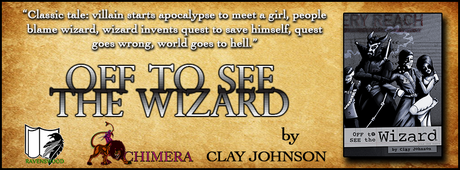
Off to See the Wizard by Clay Johnson


Here we are at the end of our day-long Book Tour stop for Off to See the Wizard (see Parts One, Two, and Three). Hope you enjoyed it.

Off to See the WizardOff to See the Wizard

by Clay Johnson

Kindle Edition, 373 pg.

Ravenswood Publishing, 2016
Read: April 18 – 22, 2016

From the beginning? Are you certain? The beginning is pretty dull, you know. All of the violence comes later. The beginning is just sex and blood and guts, and— yes, right, I see it now; fair point.

Let’s see… it began with that dwarf. At least, I think he was a dwarf. He may have been a child. I don’t honestly pay much attention to the jesters they hire. Mostly, they are little more than jingling bells in the background. I know he was very short. Wait! He had a beard. One of those awful, disgusting sort that grow scraggly and in patches. Looked like he’d glued stringy chunks of carpet to his cheeks; do you know the sort?

Yes, had to have been a dwarf.

A tale of an attempted apocalypse, a quest to thwart it, love (or something like it) in bloom, love (or something like it) in trouble, and the aftermath of it all. It may not sound like fodder for comedy, but in Clay Johnson’s hands, it is.

A royal feast ends abruptly, and in a disturbing way (although the way it’s narrated, its pretty humorous). And then soon, horrible things (mostly involving blood in places and amounts no one wants) start happening all over. Naturally, citizens, royalty and everyone in between demands answers — so they turn to a wizard to tell them what’s going on and how to stop it. The wizard has no clue (this will be a recurring theme), but sets off on a quest to find out. He takes his girlfriend, a swordsman, and a redshirt (the wizard has a strong sense of self-preservation). He soon regrets all of these choices — his girlfriend spends most of the time upset with him, the redshirt is a mopey kid who writes horrible poems (and is never used as cannon fodder), the swordsman deserts them. Thankfully, a better swordsman, and a drunken elf queen in training join up after that. Really, very little goes well on the quest.

Meanwhile, the Demon Lord who started the whole thing, really didn’t mean to — he was actually trying to do something else, and it went horribly wrong (I’ll leave it to you to learn what) — and he spends most of the book trying to ameliorate the situation and get his original purpose back on track. Very little goes well for him, either.

In the end, things are a giant mess, so a Royal Inquisitor is sent out to investigate it afterwards, and the book is a edited together compilation of transcripts of his interviews with witnesses, the quest party, the villains of the piece, and others. The mutually contradictory takes on the events given by the various interviewees are hilarious — each person has a strong voice, you pretty much get to the point where you skip the text identifying who’s speaking, you can tell who it is just from their language. It doesn’t take long for the reader to suss out how to take the competing versions and get to a pretty good idea of what really happened.

I don’t remember the details, and am short on time, so I can’t look for them. But somewhere, C. S. Lewis talks about why it’s appropriate (well, at least not totally inappropriate) to laugh at bawdy jokes if they’re cleverly told, involve some creative word play, and so on — not at the vulgarity of them. Given that cover by the noted apologist, I can freely admit that I laughed plenty at this. Johnson’s characters, their dialogue, and his creative use of words and imagery are wielded so well, that you just could help but laugh (even a few times when I knew Lewis wouldn’t approve of it). This is what Franco, McBride and the rest were going for in the movie Your Highness a couple of years ago — a funny fantasy. The Princess Bride for those who appreciate rated-R comedies.

For example, there’s a moment that got me laughing out loud — a lot — where someone inadvertently invents/coins one of the seven words you can’t couldn’t say on TV. The effect that word has on the most hardened criminals in the kingdoms was fantastic — it’s a moment that’ll stick with me for awhile.

From time to time the narrative started to drag a little bit, and I’d start to wonder if anything was actually going to happen. But within a page, I’d chuckle at something again and forget about the slow plot.

In the end, it was a little too off-color for me, but Johnson pulled it off in such a way that I was able to put that aside and enjoy his story and his story-telling. Really, Off to See the Wizard is the funniest thing I’ve read this year — and I can’t imagine much topping it.

Disclaimer: I received this book from the nice folks at Ravenswood Publishing in exchange for an honest review.

—–

4 Stars

Guest Post: The Machine Keeps Feeding Me by Clay Johnson


Welcome to Part Two of our participation in the Off to See the Wizard Book Tour (see Part One), a couple more posts will be up in a while. This is a Guest Post by Clay Johnson, the novel’s author, about his process:


I have to hear the words in my head before I start writing, or I’m pretty much hosed. I used to plan out the whole story, or at least try to. I spent a lot of time thinking about it, picturing the action and the plot points, really getting into the thing. I did a lot of imagining while listening to music. I figured if I could see what I wanted to write, then I was golden. Unfortunately, when it came time to actually sit down and do it, I’d hit a dry spot. It wasn’t writer’s block, though; it was more like I was incredibly bored. What I pictured so vividly in my head just wasn’t coming out anywhere nearly so thrilling, and in the few instances that it did I still wasn’t particularly captivated by the process. I kept trying though, and I kept ending up with a bunch of barely started or, at best, half-finished manuscripts.

One day, somewhere around senior year, of high school, instead of an idea, I had just a line. It wasn’t a particularly good line. It was something like: Bill woke up to find death staring down at him and asking if they had any nachos. But I liked what the line made me think of, and I was bored in class, so instead of trying to plan out what that story might be I just went with it. The result was an awesome mess. But it was an “awesome” mess. It was full of great little moments, and a lot of threads that led nowhere. I couldn’t use the story for anything, but I felt invigorated the whole way through. In working on that story I finally figured out my problem. If I knew where the story was going, I didn’t care. I’d already thought that part out; I just wanted to move on to the next story. Somewhere in the transition from over-planning to not planning, I’d found my voice.

I started riffing on just a line, or a vague idea built around a specific image. But the trick was that I had to be able to hear at least the opening line in my head. I had to be able to hear the voice the character would use. As long as I could tap into that, then I could continue the story. The rest seems to take place beneath the surface.

It feels like there is some constantly running story machine cranking away somewhere in the basement of my mind, and while I’m busy doing other things, it’s making connections and drawing paths between two unplanned plot points. Those are the moments I love the most when I write, those moments where two bits that I wrote on a whim meet up and fit together so well that I can’t believe they weren’t planned. Writing this way makes it harder in the revision process, because I end up with a lot of gems I want to keep and can’t, and there’s also a lot of connections that still have to be made after the fact, but almost always less of them than I would expect. As long as I can tap into the sound of the story, the way the words flow and the beat of the thing, the machine keeps feeding me.

Page 55 of 56

Powered by WordPress & Theme by Anders Norén