Category: Further Up and Further In Page 1 of 2

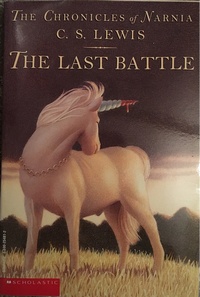
A Few Scattered Thoughts on My Latest Reading of The Last Battle by C.S. Lewis

Further Up and Further In A Year with C.S.Lewis

Cover of The Last Battle by C.S. LewisThe Last Battle

by C. S. Lewis , illustrated by Pauline Baynes

DETAILS:
Series: The Chronicles of Narnia, #7
Publication Date: June 25, 1994
Format: Paperback
Length: 211 pg.
Read Date: December 24, 2025

Buy from Bookshop.org Support Indie Bookstores


If you need to know what this book is about, or anything about this series…seriously, just stop what you’re doing and pick up this book. I don’t mean to be a snob, or maybe I do, but something was missing from your childhood, and now is your time to fix it. I realize that there are many legitimate reasons for people not to have read this (more than some of the earlier), and I’m not questioning the choices you or your parents made (actually, I guess I am). But I’m not going to try to talk about this book like I do most others.

If only because everything worth saying has been said by other, better, writers. Probably several times.

I’ve also read this too many times to count as a child—even through my college years, and at least once a decade since. I’ll probably pick up the pace of re-reading them so I can talk to the grandcritters about them, too.

But I feel the need to say something now, so here are a few things that jumped out at me during this read:

bullet Shift is the first Narnian primate we’ve seen, right? There’s probably a lot of meaning to be mined from that. hmmm….
bullet A couple of pages of watching Shift in action is enough to make a guy want to go hang out with pre-Dragon Island Eustace just for the company.
bullet I just want to yell at Tirian to pay attention to the Centaur and his reading of the stars. I mean sure the astrology is nonsense (or is it in Narnia?), but the rest of it…
bullet Then just a few pages later, we get word that “Aslan” is ordering tress to be cut down and sold. Sorry, just how clueless are Tirian, Jewel, and anyone else who thinks, “yeah, this could maybe be the guy.”
bullet

The King was so dizzy from being knocked down that he hardly knew what was happening until the Calormenes untied his wrists and put his arms straight down by his sides and set him with his back against an ash tree. Then they bound ropes round his ankles and his knees and his waist and his chest and left him there. What worried him worst at the moment—for it is often little things that are hardest to stand—was that his lip was bleeding where they had hit him and he couldn’t wipe the little trickle of blood away although it tickled him.

That is just a great little detail there at the end. Hard to resist the impulse to wipe your mouth/chin there.
bullet Even in the midst of the end of the world, Lewis can find time to bring a smile with something like this:

…in Narnia your good clothes were never your uncomfortable ones. They knew how to make things that felt beautiful as well as looking beautiful in Narnia: and there was no such thing as starch or flannel or elastic to be found from one end of the country to the other.

bullet I thought about talking about Susan’s absence at the end, but it seems even less controversial to me on this read than on others. Also, I just got my hands on Gaiman’s “The Problem with Susan,” and should keep my powder dry until I can read/interact with it.
bullet I didn’t take that many notes while reading this one–I think I just caught up in the reading. Oops. I really liked Jill here (nothing against Eustace, but Jill really got to shine).
bullet This isn’t a wholly satisfying ending to the series, but it’s such a good one. I wonder a bit if Lewis could’ve done more–but I really can’t complain. It’d have been really easy for him to bungle this–I’ll take a pretty good conclusion over a mess.

And as He spoke He no longer looked to them like a lion; but the things that began to happen after that were so great and beautiful that I cannot write them. And for us this is the end of all the stories, and we can: most truly say that they all lived happily ever after, But for them it was only the beginning of the real story. All their life in this world and all their adventures in Narnia had only been the cover and the title page: now at last they were beginning Chapter One of the Great Story which no one on earth has read: which goes on forever: in which every chapter is better than the one before.

This post contains an affiliate link. If you purchase from it, I will get a small commission at no additional cost to you. As always, the opinions expressed are my own.

Irresponsible Reader Pilcrow Icon

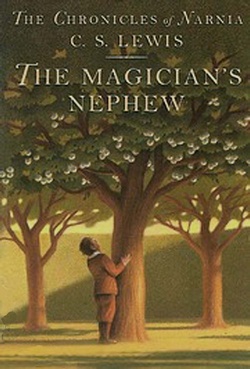
A Few Scattered Thoughts on My Latest Reading of The Magician’s Nephew by C.S. Lewis

Further Up and Further In A Year with C.S.Lewis

Cover of The Magician’s Nephew by C.S. LewisThe Magician’s Nephew

by C. S. Lewis , illustrated by Pauline Baynes

DETAILS:
Series: The Chronicles of Narnia, #6
Publication Date: June 25, 1994
Format: Paperback
Length: 202 pg.
Read Date: December 19-20, 2025
Buy from Bookshop.org Support Indie Bookstores


If you need to know what this book is about, or anything about this series…seriously, just stop what you’re doing and pick up this book. I don’t mean to be a snob, or maybe I do, but something was missing from your childhood, and now is your time to fix it. I realize that there are many legitimate reasons for people not to have read this (more than some of the earlier), and I’m not questioning the choices you or your parents made (actually, I guess I am). But I’m not going to try to talk about this book like I do most others.

If only because everything worth saying has been said by other, better, writers. Probably several times.

I’ve also read this too many times to count as a child—even through my college years, and at least once a decade since. I’ll probably pick up the pace of re-reading them so I can talk to the grandcritters about them, too.

But I feel the need to say something now, so here are a few things that jumped out at me during this read:

bullet

“The Wood between the Worlds,” said Polly dreamily. “It sounds rather nice.”

I wholeheartedly agree, Polly. And I do wish you two had taken the opportunity to dip in and out of a few more before you stumbled into the worst pool possible.
bullet Ugh. I hate reading things like this:

And you could see at once, not only from her crown and robes, but fro mthe flash of her eyes and the curve of her lips, that she was a great queen.

Yes, please, Mr. Lewis–let’s focus on the surface appearance. Greatness of appearance=greatness of person. No matter how the adjective “great” is meant here–since when does this work out? He very easily could’ve thrown in some remark that this is how Pool and Diggory thought, but that it obviously was a wrong way to think–he makes that sort of comment all over the place.
bullet Oooh, a growing lamp-post. Now that is interesting and strange. And if you read this in Chronological order, you really won’t care much (or will want to see a lot more of it). But if you read them in the publication order, you get to that point and say, “ahhhhh. That’s cool,” feel a warm glow of recognition/satisfaction, and move on. This is the only time I’m going to say anything about the reading order in this series. But I could go on.
bullet Watching the animals crawl out of the land as they’re created–very cool. Some clever writing, and the best part of this book. Sadly, it’s pretty short.
bullet The bit where the Talking Beasts are trying to figure out just what Uncle Andrew is (animal–but not talking one like them, a tree maybe?) is pretty funny and good engagement.
bullet Where Jadis tempts Diggory with the apple (a bit heavy-handed on the symbolism) is just fantastic. A better bit of temptation than we got with Edward succumbing.
bullet The whole thing with the garden and the apples, the Tree of Protection, etc., feels…I dunno. Sort of crammed in other than the temptation bit. It just left me feeling “meh”–particularly the little quest that Aslan sent Diggory on to get there. I even checked Paul F. Ford’s Companion to Narnia (yes, I am the sort of nerd that has books like that sitting on my shelves), and it was less than helpful on this point.
bullet The book as a whole feels like Lewis is trying to augment the mythology he’s already created for Narnia, fill it out some (how is this the first we’re hearing of former Sons of Adam/Daughters of Eve as rulers??), so he can bring it all home in an epic conclusion. Even if the augment doesn’t make much sense, largely falls flat (in my eyes), and doesn’t do much other than establish a framing device of sorts to get us to The Last Battle. But other than giving us Diggory and Pool, I’m unconvinced that this does anything for the series and is almost entirely skippable.

This post contains an affiliate link. If you purchase from it, I will get a small commission at no additional cost to you. As always, the opinions expressed are my own.
Irresponsible Reader Pilcrow Icon

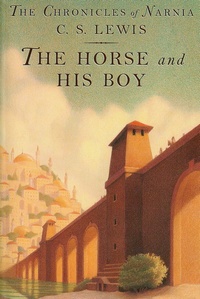
A Few Scattered Thoughts on My Latest Reading of The Horse and His Boy by C.S. Lewis

Further Up and Further In A Year with C.S.Lewis

Cover of The Horse and His Boy by C.S. LewisThe Horse and His Boy

by C. S. Lewis , illustrated by Pauline Baynes

DETAILS:
Series: The Chronicles of Narnia, #5
Publication Date: June 25, 1994
Format: Paperback
Length: 243 pg.
Read Date: December 16-17, 2025
Buy from Bookshop.org Support Indie Bookstores


If you need to know what this book is about, or anything about this series…seriously, just stop what you’re doing and pick up this book. I don’t mean to be a snob, or maybe I do, but something was missing from your childhood, and now is your time to fix it. I realize that there are many legitimate reasons for people not to have read this, and I’m not questioning the choices you or your parents made (actually, I guess I am). But I’m not going to try to talk about this book like I do most others.

If only because everything worth saying has been said by other, better, writers. Probably several times.

I’ve also read this too many times to count as a child—even through my college years, and at least once a decade since. I’ll probably pick up the pace of re-reading them so I can talk to the grandcritters about them, too.

But I feel the need to say something now, so here are a few things that jumped out at me during this read:

bullet

And when all the serious eating and drinking was over, a blind poet came forward and struck up the grand old tale of Prince Cor and Aravis and the horse Bree, which is called The Horse and His Boy and tells of an adventure that happened in Narnia and Calormen and the lands between, in the Golden Age when Peter was High King in Cair Paravel. (I haven’t time to tell it now, though it is well worth hearing.)

Seriously, who reads this bit from The Silver Chair for the first time, and says, “I want to know that story”?
bullet It is so hard to read all the “true Northern stock,” “dark faces,” and “accursed but beautiful barbarians” of the North stuff. You remember going in that kind of thing is going to be there, along with the pseudo-Arabian caricatures. But remembering it and reading it are two different things.

…Bree said, “And now, Tarkheena, tell us your story. And don’t hurry it—I’m feeling comfortable now.”

Aravis immediately began, sitting quite still and using a rather different tone and style from her nusual one. or in Calormen, story-telling (whether the stories are true or made up) is a thing you’re taught ,just as English boys and girls are taught essay writing. The difference is that people want oto hear the stories, whereas I enver heard of anyone who wanted to read the essays.

Granted, his students were much more advanced than these boys and girls, but this is not really something you want to read after a sleepless night or two finishing up an assignment. (still, who’s going to disagree with him?)
bullet Edmund, Susan, and the rest of their party are indulging in that court-speak that bugged me at the end of LWW. I’m so glad Caspian didn’t get too into that. Surely there’s another way to signal that they’re all royal and grown-up?
bullet During the climactic battle, rather than seeing it from the perspective of a combatant or two, we just get a play-by-play from the Hermit observing it for those with him. This is a fantastic way to get this information—especially for Lewis’ audience. All the highlights, none of the blood and gore.
bullet I thoroughly enjoyed Bree going on about the nature of Aslan (just before meeting him and showing how little he knew)—he reminded me so much of the pompous Liberal from The Great Divorce.
bullet Shasta/Cor’s line, “And by the way, Father’s an absolute brick [how odd that a Calorman uses slang from the UK]. I’d be just as pleased—or very nearly—at finding he’s my father even if he wasn’t a king. Even though Education and all sorts of horrible things are going to happen to me.” Just delights me. Huck Finn lives!
bullet It’s interesting that Lucy is able to tell the tale of the Wardrobe here at the end of the book. How long are the Pevensies around after this before they get to the point that they’ve forgotten it? How are Lucy and Susan (who is likely pursued by more than just this twerp) unmarried in all that time? Pfui—how are Peter and Edmund? The more I think about this point, the more bothered I am.
bullet Speaking of marriage, this is likely my favorite bit of writing from this book (and really, this is book has more genuinely funny moments/depictions than the rest of the series):

Aravis also had many quarrels (and, I’m afraid, even fights) with Cor, but they always made it up again: so that years later, when they were grown up, they were so used to quarreling and making up again that they got married so as to go on doing it more conveniently.

bullet At the end of the day, this is a perfectly fine MG adventure story. Could it be better? Yeah. Does it almost feel like someone was trying to establish the Narnia Cinematic Universe? Yeah. Is it as unsatisfying as The Magician’s Nephew? Nope.

This post contains an affiliate link. If you purchase from it, I will get a small commission at no additional cost to you. As always, the opinions expressed are my own.
Irresponsible Reader Pilcrow Icon

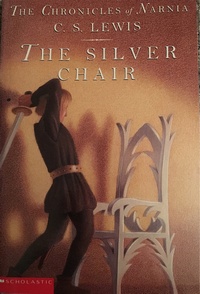
A Few Scattered Thoughts on My Latest Reading of The Silver Chair by C.S. Lewis

Further Up and Further In A Year with C.S.Lewis

Cover of The Silver Chair by C.S. LewisThe Silver Chair

by C. S. Lewis , illustrated by Pauline Baynes

DETAILS:
Series: The Chronicles of Narnia, #4
Publication Date: July 01, 1994
Format: Paperback
Length: 243 pg.
Read Date: December 10-11, 2025
Buy from Bookshop.org Support Indie Bookstores


If you need to know what this book is about, or anything about this series…seriously, just stop what you’re doing and pick up this book. I don’t mean to be a snob, or maybe I do, but something was missing from your childhood, and now is your time to fix it. I realize that there are many legitimate reasons for people not to have read this (more for some of the later books), and I’m not questioning the choices you or your parents made (actually, I guess I am). But I’m not going to try to talk about this book like I do most others.

If only because everything worth saying has been said by other, better, writers. Probably several times.

I’ve also read this too many times to count as a child—even through my college years, and at least once a decade since. I’ll probably pick up the pace of re-reading them so I can talk to the grandcritters about them, too.

But I feel the need to say something now, so here are a few things that jumped out at me during this read:

bullet Awww, even Eustace gets rejuvinated by the Narnian air. He really changed from the whiney twerp.
bullet Outside of Reepicheep, is there a more fully-drawn charcter in the Chronicles than Puddleglum? It’s also just a great name, summing him up in a nutshell. The other Marsh-wiggles finding him adventurous and devil-may-care is hilarious. As are his encouragements to the children to be more like him–upbeat and happy.
bullet Describing Rilian as “altogether looked a little bit like Hamlet,” is one of the oddest lines in the series.
bullet Everything that the Queen is up to is wrong, that’s a given. But the whole Prince/Queen mother-pseudo son thing is strange–when you add in the wedding plans? Ew, ew, ew, ew, and ew.
bullet That’s an unexpected–and odd–lesson in Centaur anatomy and diets. (one stomach human, one stomach equine and needs to feed both appropriate food). Is this common to other Fantasy uses of Centaurs?
bullet I just didn’t like Aslan this time out–disciplining Jill and wreaking havoc on the entire mission for something simple and understandable?
bullet Even stranger–sending Caspian and an unusually-still-Narnian-garbed Eustace to rough up some human bullies at the end back on Earth. That just doesn’t match with the Aslan we’ve been getting to know.
bullet Take our Lion out of things, and this was a pretty enjoyable adventure.

This post contains an affiliate link. If you purchase from it, I will get a small commission at no additional cost to you. As always, the opinions expressed are my own.
Irresponsible Reader Pilcrow Icon

A Few Scattered Thoughts on My Latest Reading of The Voyage of the Dawn Treader by C.S. Lewis

Further Up and Further In A Year with C.S.Lewis

Cover of The Voyage of the Dawn Treader  by C.S. LewisThe Voyage of the Dawn Treader

by C. S. Lewis , illustrated by Pauline Baynes

DETAILS:
Series: The Chronicles of Narnia, #3
Publisher: HarperCollins
Publication Date: July 1, 1994
Format: Paperback
Length: 248 pg.
Read Date: December 2, 2025
Buy from Bookshop.org Support Indie Bookstores


I have a very distinct memory of the day I bought this book (well, my first copy, anyway). I was finished with a 1-2 week thing at a local liberal arts college one summer (I think it was after 4th grade–it might have been after 3rd), and my mother said we could look at the book store there. I got a textbook about the Supreme Court (yes, my 8 or 9 year-old-self had ambition–wasted, I should note) and this book. I could’ve picked any of the 7, but I’d watched parts of the cartoon version of Lion, the Witch and the Wardrobe a few months earlier, and wasn’t that interested in it. But his had a cool looking ship on the cover. So I went with it.

In the years since, it remained my most-read of the series (followed closely by Prince Caspian, with Wardrobe coming in third). And it’s the one I have the hardest time being objective about. I also didn’t take as many notes for this post as I read it. I just go swept up in the reading. Still, I do have a few things to say.

bullet

There was a boy called Eustace Clarence Scrubb, and he almost deserved it.

Is possibly the best sentence Lewis ever wrote. It’s one of my all time favorites.
bullet The rest of the paragraph isn’t too shabby, either:

His parents called him Eustace Clarence and masters called him Scrubb. I can’t tell you how his friends spoke to him, for he had none. He didn’t call his Father and Mother “Father” and “Mother,” but Harold and Alberta. They were very up-to-date and advanced people. They were vegetarians, nonsmokers and teetotalers and wore a special kind of underclothes, In their house there was very little furniture and very few clothes on beds and the windows were always open.

bullet This book features my all-time favorite portal fantasy depiction of someone from “our world” going to another. This may come from it being the first that I remember. But I don’t think so.
bullet

[Lucy] spent a good deal of time sitting on the little bench in the stern playing chess with Reepicheep. It was amusing to see him lifting the pieces, which were far too big for him, with both paws and standing on tiptoes if he made a move near the center of the board. He was a good player and when he remembered what he was domg he usually won. But every now and then Lucy won because the Mouse did something quite ridiculous like sending a knight into the danger of a queen and castle combined. This happened because he had momentarily forgotten it was a game of chess and was thinking of a real battle and making the knight do what he would certainly have done in its place. For his mind was full of forlorn hopes, death-or-glory charges, and last stands.

bullet In case it wasn’t clear from the get-go (and it absolutely was), Eustace swinging Reep around by his tail tells you everything you need to know about the lad–to paraphrase Linda Ronstadt, “He’s no good, he’s no good, he’s no good, Eustace, you’re no good.”
bullet In Chapter 6, “The Adventures of Eustace,” we’re told twice that reading the wrong books (or not reading the right books) keeps you from knowing anything about dragons. Fantasy readers, take heart!
bullet After Eustace is transformed into a dragon, say what you will about the kid, he figures out his situation far quicker than his cousins did theirs in Prince Caspian–and they’d read the right books!
bullet I will just never not love Chapter 6. Whether it’s just on the story front, or if you want to go deeper with an exploration of Sanctification…it doesn’t matter. This one chapter in the Chronicles stands out above all others.
bullet If you’d asked me who my favorite characters in the Chronicles were, Reepicheep would’ve been at the top of my list. But getting to read about him over these last two books reminded me just how much I enjoyed him.
bullet Aslan isn’t overthrowing malevolent kings or queens this time, he largely shows up for little things–a quick morality lesson here and there to keep his people in-line. It’s a different way to see him.
bullet That spellbook that Lucy browses is just cool. Hogwarts wishes it has something cool, Madam Pince would have so many people breaking into the restricted section to get a look at it.
bullet I will defend a lot of what Lewis does in this series–but only referring to Caspian’s eventual bride as “Ramadu’s daughter” is not one of those things. (or pretty much anything about their relationship–the last paragraph of the novel helps a little bit)
bullet Speaking of the last paragraph–nice parting shot at Eustace’s mother.
bullet This is probably the most blatant (pre: The Last Battle or maybe The Magician’s Nephew) time we are told that Aslan is known by a different name in our world. Lewis has apparently decided he should stop being subtle and make it clear who Aslan is to us. I don’t mind this a bit (even if I do have some third commandment-related questions)
bullet Really, we learn more about Aslan in this book than we do any other (with the possible exception of The Magician’s Nephew, I need to revisit that one before I know for sure).

This post contains an affiliate link. If you purchase from it, I will get a small commission at no additional cost to you. As always, the opinions expressed are my own.
Irresponsible Reader Pilcrow Icon

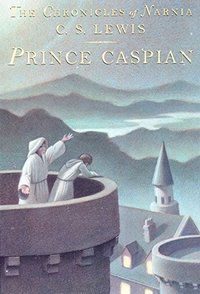
A Few Scattered Thoughts on My Latest Reading of Prince Caspian by C.S. Lewis

Further Up and Further In A Year with C.S.Lewis

Cover of Prince Caspian by C.S. LewisPrince Caspian

by C. S. Lewis , illustrated by Pauline Baynes

DETAILS:
Series: The Chronicles of Narnia, #2
Publisher: HarperCollins
Publication Date: July 01, 1994
Format: Paperback
Length: 223 pg.
Read Date: November 8-10, 2025
Buy from Bookshop.org Support Indie Bookstores


If you need to know what this book is about, or anything about this series…seriously, just stop what you’re doing and pick up this book. I don’t mean to be a snob, or maybe I do, but something was missing from your childhood, and now is your time to fix it. I realize that there are many legitimate reasons for people not to have read this (more for some of the later books), and I’m not questioning the choices you or your parents made (actually, I guess I am). But I’m not going to try to talk about this book like I do most others.

If only because everything worth saying has been said by other, better, writers. Probably several times.

I’ve also read this too many times to count as a child—even through my college years, and at least once a decade since. I’ll probably pick up the pace of re-reading them so I can talk to the grandcritters about them, too.

But I feel the need to say something now, so here are a few things that jumped out at me during this read:

bullet The cover on the edition we bought for our kids is just bad. The art’s fine, but this is a silly scene to capture. It really makes me miss the version I had growing up.
bullet It’s so hard to be patient with the Pevensies as they suss out where and when they are.
bullet I enjoyed the way that Trumpkin stumbled while trying to recap Caspian’s story and then just had to start at the beginning. I think this was a pretty smart move for impatient readers–give them a little bit of our friends and then go back to tell Caspian’s story–if he’d started with Caspian and his Nurse, how many of us would’ve put the book down? This way we get the Sons of Adam and Daughters of Eve, some excitement, then the long backstory, and we’re back into the action.
bullet I loved the way Reepicheep was introduced. NB: I love everything about Reepicheep, so I won’t note every example.
bullet It was good to see (and helped the single combat later on be believeable) the way that Narnia is slowly making the Pevensies back into who they were.
bullet

“Such a horrible idea has come into my head, Su.”
“What’s that?”
“Wouldn’t it be dreadful if some day in our won world, at home, men started going wild inside, like the animals here, and still looked like men, so that you’d never know which were which?”
“We’ve got enough to bother about here and now in Narnia,” said the practical Susan, “without imagining things like that.”

And if you like that kids, let me tell you about some books I’ve written for grown-ups…
bullet I truly appreciate the way that Edmund sticks up for Lucy here contra-Peter and Susan when it comes to beliving her experiences. As annoyed as I am with Susuan, Peter actually thinking Lucy’s right, but weaseled away from it is far worse.
bullet The betrayal of Nikabrik and the way he talks about Dwarfs sounds like Mr. Beaver’s prejudice. I’m glad we have Trumpkin, our DLF, and others to show him wrong.
bullet While dictating his letter, I rather enjoyed Peter (who surely looked like a punk kid) getting picky about the spelling used by a noted scholar.
bullet Trufflehunter’s insistence that animals don’t change, their beliefs are rock-solid, unlike flighty humans/human-esque people is striking. That has to be an impact of Eve–but where do Dwarfs come from then?
bullet

The first house they came to was a school: a girls’ school, where a lot of Narnian girls, with their hair done very tight and ugly tight collars round their necks and thick tickly stockings on their legs, were having a history lesson. The sort of “History” that was taught in Narnia under Miraz’s rule was duller than the truest history you ever read and less true than the most exciting adventure story.

That last sentence is such a good one.
bullet

…all the-Talking Beasts surged round-the Lion, with purrs and grunts and squeaks and whinnies of delight, fawning on him with their: tails, rubbing against him, touching him reverently with their noses and going to. and fro under his body and between his legs. If you have ever seen a little cat loving a big dog whom it knows and trusts, you will have a pretty good picture of their behavior.

That last sentence is such a good one, too.
bullet We just don’t get enough time from Caspian’s victory to the end of the book. There wasn’t a lot of denouement in the first volume, either. But this felt too rushed.
bullet That last line–which is simply not good–makes me think of the last line of an 80s TV show. Someone makes a dumb joke while the entire cast is sitting together, they all laugh too hard at it and the picture freezes before the credits roll.

This is the first of 3 Caspian novels–putting him on a level with Lucy and Edmund for appearances. There’s not a lot of deep theology here, just Aslan’s protection of the land with direct intervention when called for–with Old Narnia’s royals along for the ride (somewhat literally). I liked the different way the children were pulled into Narnia–I really like young Caspian here–and everything else. It’s just a fun read.

This post contains an affiliate link. If you purchase from it, I will get a small commission at no additional cost to you. As always, the opinions expressed are my own.
Irresponsible Reader Pilcrow Icon

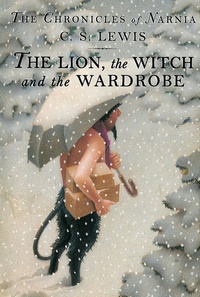
A Few Scattered Thoughts on My Latest Reading of The Lion, the Witch and the Wardrobe by C.S. Lewis

Further Up and Further In A Year with C.S.Lewis

Cover of The Lion, the Witch and the Wardrobe by C.S. LewisThe Lion, the Witch and the Wardrobe

by C. S. Lewis , illustrated by Pauline Baynes

DETAILS:
Series: The Chronicles of Narnia, #1
Publisher: HarperCollins
Publication Date: July 01, 1994
Format: Paperback
Length: 189 pg.
Read Date: November 8-10, 2025
Buy from Bookshop.org Support Indie Bookstores


If you need to know what this book is about, or anything about this series…seriously, just stop what you’re doing and pick up this book. I don’t mean to be a snob, or maybe I do, but something was missing from your childhood, and now is your time to fix it. I realize that there are many legitimate reasons for people not to have read this (more for some of the later books), and I’m not questioning the choices you or your parents made (actually, I guess I am). But I’m not going to try to talk about this book like I do most others.

If only because everything worth saying has been said by other, better, writers. Probably several times.

I’ve also read this too many times to count as a child—even through my college years, and at least once a decade since. I’ll probably pick up the pace of re-reading them so I can talk to the grandcritters about them, too.

But I feel the need to say something now, so here are a few things that jumped out at me during this read:

bullet On the second page of the story, Susan is already trying to act older than she is (which is really the problem that will recur in The Last Battle, people getting worked up about the makeup really miss the boat). Yes, it’s understandable—and maybe even necessary—at this point for her to do so. But it’s a trait that will define her.
bullet I could use another 3 or so chapters about the Professor’s house. Maybe even a book or two. As Lewis writes:

The house of the Professor’s—which even he knew so little about—was so old and famous that people form all over England used to come and ask permission to see over it. It was the sort of house that is mentioned in guide books and even in histories; and well it might be, for all manner of stories were told about it, some of them even stranger than the one I am telling you now.

bullet There is something just so…right…about Baynes’ illustrations. I can’t imagine this series without them (one of the many reasons I’ve avoided picture book retellings).
bullet Lewis stays on-brand by having the Professor bring out a version of the trilemma suited for the question of Lucy’s honesty.
bullet The way the children react just to the sound of Aslan’s name the first time. That’s a great touch.
bullet

This was bad grammar of course, but that is how beavers talk when they are excited; I mean, in Narnia—in our world they susually don’t talk at all.

bullet Mr. Beaver’s comment about not trusting things that look human but aren’t is an odd bit of prejudice. It’s nice to see it quickly shown to be false by the giant Rumblebuffin, unless by size alone, giants don’t look human. Still, I want to make a point to watch out for that idea later on in the series.
bullet I don’t care how many times I’ve read it, Aslan’s walk to the Stone Table is hard to read.
bullet The de-statued lion’s reaction to Aslan including him in the “us lions” group has brought a smile to my face every time I encounter it. Probably for different reasons, but it always works.
bullet I find it interesting that no one other than the adult Pevensies talk in that stuffy, faux-Medieval way throughout the series (maybe A Horse and His Boy will prove me wrong).
bullet The closing paragraphs suggest that the Pevensies are possibly going to encounter many other children who’ve been in Narnia. I wish we’d gotten more evidence of that throughout the books—especially in The Last Battle.

This isn’t a perfect novel—nor a perfect Christian allegory. But I can’t be critical about it, not even a little. I just love this book. (and it’s not even my favorite in the series!)

This post contains an affiliate link. If you purchase from it, I will get a small commission at no additional cost to you. As always, the opinions expressed are my own.
Irresponsible Reader Pilcrow Icon

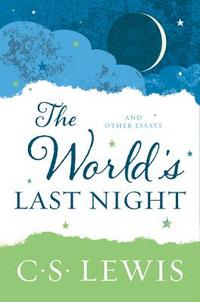
The World’s Last Night by C.S. Lewis: An Interesting (if Somewhat Scattered) Collection that Starts Off With a Banger

Further Up and Further In A Year with C.S.Lewis

Cover of The World's Last Night by C.S. LewisThe World’s Last Night
And Other Essays

by C. S. Lewis

DETAILS:
Publisher: HarperOne
Publication Date: February 14, 2017
Format: Paperback
Length: 122 pg.
Read Date: August 3-10, 2025
Buy from Bookshop.org Support Indie Bookstores

What’s The World’s Last Night About?

This is a collection of essays by Lewis, quite simply. I don’t know that they belong together more than that. GIven the original date of publication (1952), he was alive when this was collected, but I have no idea if he was involved in the selection—I am curious about that. So much so that I’ve written 3 more sentences (including this one) about it than I intended to.

Here’s what the jacket flap on my copy says:

In these seven satirical yet poignant essays, C.S. Lewis tackles the temptations of evil. He challenges readers to decide how they would live on thew world’s last night and writes, “We are not the playwright, we are not the producer, we are not even the audience. We are on the stage. To play well the scenes in which we are ‘on’ concerns us much more than to guess about the scenes that follow it.” The infamous Screwtape makes a special appearance with a toast that explores the prospects for exploiting evil. Blending irony, humor, and paradox, Lewis tackles religion’s most difficult and intriguing questions regarding immorality, belief, and the meaning of prayer.

I’m also not sure “satirical” applies to all seven essays. But I didn’t come here to pick a fight with anyone involved with putting this together. So let’s move on with a quick look at each essay (the premise should be clear for most from the title).

The Efficacy of Prayer

I loved this essay. I’m glad I read the collection, if only for this—sadly, the rest of the collection really didn’t live up to it. But I’m okay with paying most of the $17 I spent on the book for this essay. It’s one I will be returning to.

On Obstinancy in Belief

This is sort of a Science v. Faith (a ridiculous debate). Lewis made some pretty good points, and it was generally good. But I’m not sure it’s a home-run.

That demand for our confidence which a true friend makes of us is exactly the same that a confidence trickster would make. That refusal to trust, which is sensible in reply to a confidence trickster, is ungenerous and ignoble to a friend, and deeply damaging to our relation with him. To be forewarned and therefore forearmed against apparently contrary appearance is eminently rational if our belief is true; but if our belief is a delusion, this same forewarning and forearming would obviously be the method whereby the delusion rendered itself incurable. And yet again, to be aware of these possibilities and still to reject them is clearly the precise mode, and the only mode, in which our personal response to God can establish itself. In that sense the ambiguity is not something that conflicts with faith so much as a condition which makes faith possible. When you are asked for trust you may give it or withhold it; it is senseless to say that you will trust if you are given demonstrative certainty. There would be no room for trust if demonstration were given. When demonstration is given what will be left will be simply the sort of relation which results from having trusted, or not having trusted, before it was given.

Lilies that Fester

This is an interesting take on anti-intellectualism and related ideas. It really feels like it could be a recent composition.

There’s a paragraph about a child reading Science Fiction that sold me.

Screwtape Proposes a Toast

I was just going to refer you to what I wrote about this as an add-on to The Screwtape Letters, but apparently, I never finished that post. So, um, that won’t work.

This fell short of the original Screwtape material. It doesn’t have the wit, the insight. It feels like a sequel to The Abolition of Man crammed into Screwtape’s mouth, and it didn’t work nearly as well.

Good Work and Good Works

Second-best essay in the batch.

‘Good works’ in the plural is an expression much more familiar to modern Christendom than ‘good work’. Good works are chiefly alms-giving or ‘helping’ in the parish. They are quite separate from one’s ‘work’. And good works need not be good work, as anyone can see by inspecting some of the objects made to be sold at bazaars for charitable purposes. This is not according to our example. When our Lord provided a poor wedding party with an extra glass of wine all round, He was doing good works, But also good work; it was a wine really worth drinking, Nor is the neglect of goodness in our ‘work’, our job, according to precept. The apostle says everyone must aot only work but work to produce what is ‘good’.

Religion and Rocketry

Huh. Interesting take on extraterrestrial life, etc. I’m not sure what else to say.

The World’s Last Night

There are many reasons why the modern Christian and een the modern theologian may hesitate to give to the doctrine of Christ’s Second Coming that emphasis which was usually laid on it by our ancestors.

It’s hard to believe that someone in the 20th Century could start an essay about escathology that way. But there it is, in black and white.

We must admit at once that this doctrine [of the Second Coming] has, in the past, led Christians into very great follies. Apparently many people find it difficult to believe in this great event without trying to guess its date, or even without accepting as a certainty the date that any quack or hysteric offers them. To write a history of all these exploded predictions would need a book, and a sad, sordid, tragi-comical book it would be.

I’ve read some of those books, and he describes them well.

Overall, this is a really good look at the doctrine of the Second Coming and Judgement and how we should act before then—and why we should do so.

So, what did I think about The World’s Last Night?

I liked this more than some of what I’ve read by Lewis this year, but it doesn’t hold a candle to him at his best. There are moments of brilliance. Moments of spiritual insight and wisdom. Some moments of wit and common sense (which should never be sneezed at). Some moments where you wonder why he has impacted so many (including myself) in such a strong and lasting way.

Still, it’s worth the time—not just for completistis, either. Just know going in that not every essay is going to wow you.

I’m tempted to give it 4 Stars just for the first essay, but let’s not get carried away by such a strong start.


3.5 Stars

This post contains an affiliate link. If you purchase from it, I will get a small commission at no additional cost to you. As always, the opinions expressed are my own.
Irresponsible Reader Pilcrow Icon

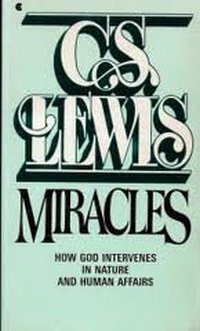
Miracles by C.S. Lewis: A Pleasant, If Not Particularly Helpful, Read

Further Up and Further In A Year with C.S.Lewis


Cover of Miracles by C.S. LewisMiracles: A Preliminary Study

by C. S. Lewis

DETAILS:
Publisher: Collier Books
Publication Date: 1960
Format: Mass Market Paperback
Length: 168 pg.
Read Date: March 2-9, 2025
Buy from Bookshop.org Support Indie Bookstores

…the shock comes at the precise moment when the thrill of life is communicated to us along the clue we have been following. It is always shocking to meet life where we thought we were alone. “Look out!” we cry, “it’s alive.” And therefore this is the very point at which s many draw back—I would have done so myself if I could—and proceed no further with Christianity. An “impersonal God”—well and good. A subjective God of beauty, truth and goodness, inside our own heads—better still. A formless life-force surging through us, a vast power which we can tap—best of all. But God Himself, alive, pulling at the other end of the cord, perhaps approaching at an infinite speed, the hunter, king, husband—that is quite another matter. There comes a moment when the children who have been playing at burglars hush suddenly: was that a real footstep in the hall? There comes a moment when people who have been dabbling in religion (“Man’s search for God”!) suddenly draw back. Supposing we really found Him? We never meant it to come to that! Worse still, supposing He had found us?

So it is a sort of Rubicon. One goes across; or not. But if one does, there is no manner of security against miracles. One may be in for anything.

What’s Miracles About?

In this book, Lewis sets out to defend the idea of miracles. The possibility of them. He flat out says he won’t defend the historicity of Christian miracles—that’s not his field (of course, neither is theology, but that doesn’t stop him). He wants to lay the groundwork. If he can convince the reader that miracles are possible—even better they expect them and appreciate the relationship between them and Christianity—well then, he hopes the reader will—like Lewis himself did—examine the claims of Christianity on a more reasonable and ready basis.

The Direction of the Argument

First, Lewis starts with Supernaturalism vs. Naturalism (and it’s here that he might be at his best for the book)

Belief in miracles, far from depending on an ignorance of the laws of nature, is only possible in so far as those laws are known. We have already seen that if you begin by ruling out the supernatural you will perceive no miracles, We must now add that you will equally perceive no miracles until you believe that nature works according to regular laws. If you have not yet noticed that the sun always rises in the East you will see nothing miraculous about his rising one morning in the West.

His point is essentially that his readers will fall into two camps: those who will refuse to accept a miracle because they can’t happen or those who are willing to accept there are—or at least might be—supernatural possibilities in the world. If you are a committed reader in the former camp, there’s nothing that Lewis can do or say to make you change your mind. He will, at least, help you to see that—and lay out the possibilities of a supernatural explanation.

If you’re open to a supernatural explanation for things—like a miracle. Then Lewis has some things he’d like to talk to you about.

…it is mere confusion of thought to suppose that advancing science has made it harder for us to accept miracles, We always knew they were contrary to the natural course of events; we know still that if there is something beyond Nature, they are possible. Those are the bare bones of the question; time and progress and science and civilisation have not altered them in the least.

Then he moves into Christian miracles—or at least the miracles that Christians claim as part of their story—their Scriptures, their religion.

…you cannot [remove miracles] with Christianity. It is precisely the story of a great Miracle. A naturalistic Christianity leaves out all that is specifically Christian.

This is, he suggests, part of the path that he took to get to where he is.

If at any point along the line of argument, Lewis loses you, he will not ask you to accept his conclusion—or at least he has no basis to do so. Otherwise…

So, what did I think about Miracles?

You are probably quite right in thinking that you will never see a miracle done: you are probably equally right in thinking that there was a natural explanation of anything in your past life which seemed, at the first glance, to be “rum” or “odd.” God does not shake miracles into Nature at random as if from a pepper-caster. They come on great occasions: they are found at the great ganglions of history—not of political or social history, but of that spiritual history which cannot be fully known by men. If your own life does not happen to be near one of those great ganglions, how should you expect to see one? If we were heroic missionaries, apostles, or martyrs, it would be a different matter. But why you or I? Unless you live near a railway, you will not see trains go past your windows. How likely is it that you or I will be present when a peace-treaty is signed, when a great scientific discovery is made, when a dictator commits suicide? That we should see a miracle is even less likely. Nor, if we understand, shall we be anxious to do so. “Nothing almost sees miracles but misery.” Miracles and martyrdoms tend to bunch about the same areas of history—areas we have naturally no wish to frequent. Do not, I earnestly advise you, demand an ocular proof unless you are already perfectly certain that it is not forthcoming,

I enjoyed it—this was the second or third post-Narnia book I read by Lewis, and it’s one of them I’ve returned to the most. It’s also less and less effective to me the more times I read it. I just don’t like his line of argument. Nor do I appreciate some of what he says about the Scriptures. But, I do enjoy reading this.

There are two major aims for an apologetic work, as I’ve heard from a few apologetic professors/writers. The first is to present a defense for the faith to unbelievers—to convince them, to provide evidence for the faith to them, or at least to show that Christianity has a rational basis (things along those lines). The second aim is to buttress the confidence of the believer that they haven’t taken a blind leap of faith, that their convictions can stand against a hostile culture—or a disinterested one. I don’t see this working to well with the unbeliever (outside of maybe stressing that they’re committed to not accepting the possibility of miracles), rather the strength of his book falls into the latter category.

I appreciate what Lewis attempted to do here. I enjoy seeing him think through these things, and generally have a good time with his language. But it’s not the best thing he penned, and I’m not sure it’s all that useful.

Still, I like it. And anyone who’s going to name a chapter what he called Chapter 9? I want to spend a little time with.


3.5 Stars

This post contains an affiliate link. If you purchase from it, I will get a small commission at no additional cost to you. As always, the opinions expressed are my own.
Irresponsible Reader Pilcrow Icon

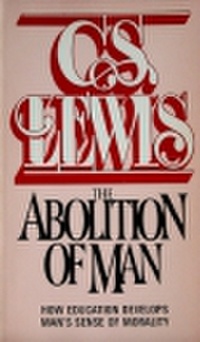
The Abolition of Man by C. S. Lewis: What Can Happen When a Bad Review Copy Falls Into the Right Hands

Further Up and Further In A Year with C.S.Lewis

Cover of The Abolition of Man by CS LewisThe Abolition of Man: Reflections on Education with Special Reference to the Teaching of English in the Upper Forms of Schools

by C. S. Lewis

DETAILS: 
Publisher: Macmillan Publishing Company
Publication Date: September 1, 1978 
Format: Paperback
Length: 91 pg.
Read Date: February 2, 2025
Buy from Bookshop.org Support Indie Bookstores

This thing which I have called for convenience the Tao, and which others may call Natural Law or Traditional Morality or the First Principles of Practical Reason or the First Platitudes, is not one among a series of possible systems of value. It is the sole source of all value judgements. If it is rejected, all value is rejected. If any value ts retained, it is retained. The effort to refute and raise a new system of value in its place is self-contradictory. There never has been, and never will be, a radically new judgement of value in the history of the world.

What’s The Abolition of Man About?

This starts off with starts off as a review of a textbook or two, “Teaching of English in the Upper Forms of Schools” (to quote the subtitle). He has strong objections to the direction (and the foundation) these books are taking. From there he shifts into English schooling/thinking in general, and the deficiencies he sees in it and what he fears it means for the nation as a whole.

This centers on the idea that English teachers and schools are abandoning objective truth, which he mounts a defense of while writing about what he thinks will happen to a society that abandons it.

English Education

This begins, as I said (as does the subtitle) by reviewing a couple of textbooks used in English classes in the upper grades. Lewis had been sent review copies of them and took issue with a lot of what he said.

Lewis (in a move I could never duplicate) doesn’t want to seem ungrateful for these copies, so disguises the authors and titles before he starts explaining the problems. I don’t know if his original audience could see through his thin disguises—or if that just became clearer later. I suspect the former.

From what he tells us about these books, I think he was being too generous in his appraisal. This was some lousy curriculum.

I’d have appreciated more along these lines—but I get why Lewis moved on to other things.

The Tao

As Lewis begins to leave the realm of English education toward looking at education—and thinking—as a whole, he begins to utilize and develop his concept of a Tao:

It is the doctrine of objective value, the belief that certain attitudes are really true, and others really false, to the kind of thing the universe is and the kind of things we are.

As the quotation that opened this post indicates, this comes in many names—Natural Law, Natural Revelation, “Traditional Morality,” and so on.

With the Tao, as assumed and/or believed throughout the world for most of human history, we get absolutes. We get objective values, objective truth. As we begin to neglect or throw off the concept of objective truth for subjectivity—or, worse yet, “pure” Reason on its own. We lose the basis of all civilization, the basis of the value of life and individual rights, and so much more.

While I think he could’ve been more thorough in his explanation of the Tao and in explaining his arguments—t’s hard not to look at the world around us today, as it’s developed (devolved?) since the early days of WWII when these lectures were delivered, and not think that Lewis was on to something.

One Issue that Troubles Me

In order to avoid misunderstanding, I may add that though I myself am a Theist, and indeed a Christian, I am not here attempting any indirect argument for Theism. I am simply arguing that if we are to have Values at all we must accept the ultimate platitudes of Practical Reason as having absolute validity: that any attempt, having become skeptical about these, to reintroduce value lower down on some supposedly more ‘realistic’ basis, is doomed. Whether this position implies a supernatural origin for the Tao is a question I am not here concerned with.

As good as this sounds—as reasonable, as open-minded, as whatever you might want to call it—I’m unconvinced that this is a position that a Christian can self-consciously hold (without trying to call into doubt Lewis’ faith, I just think he’s inconsistent on this point).

I have trouble holding that a consistent position regarding Practical Reason—or anything else, whatever “Values” you might choose—having absolute validity separate from the inspired Christian Scriptures is possible. I realize those of us who hold that kind of thinking are a minority in the history of the Church, but I can’t argue myself out of it. Lewis’ attempt to build his argument—his Tao—in this way is the part of this book that keeps me from getting super-excited about it.

The Appendix

The appendix features quotations from a variety of ancient (and less ancient) texts from around the globe illustrating that several civilizations held to certain positions on a variety of issues. This isn’t to prove the existence of his Tao (or whatever you want to call it); it’s to demonstrate that it exists in the way that “everyone” holds to something very much like each other in certain aspects.

I don’t know if I can take it as confidently as Lewis did—but I get what he’s trying to show, and can appreciate it

So, what did I think about The Abolition of Man?

I remember the first time I read this—in 1992 or 1993—and a few times since that this argument, this look toward the objective and the importance of it, while not absolutizing Science or much of anything else, hit me hard, impressed me, and really formed a lot of my thinking.

I wasn’t as impressed this time (at least a decade since my last reading)—don’t get me wrong, it’s good, and I share a lot of the concerns and convictions with Lewis. But I wonder if he goes as deeply as we need today. It’s not enough to argue for a vague absolute—we need to understand the absolute, and where it comes from. There’s also the question of what do we do when we cannot agree on absolutes in a civic society, how do we approach this with wisdom and grace. I believe Lewis would have a lot to teach us—even if I objected to some of it. I understand that given the nature of this book (written version of lectures), his cultural context, and the enemies (literal and figurative) he had in mind, why we don’t get that book here.

Also, even the English curriculum he critiqued is better than a lot of what is given today (by all sorts of stripes of schools).

That said—this is a superior work to The Problem of Pain that takes advantage of Lewis’ strengths in a way the other couldn’t while not exposing many of his weaknesses as the previous book did. He’s got better works waiting for me, and I’m eager to get to them.


3.5 Stars

This post contains an affiliate link. If you purchase from it, I will get a small commission at no additional cost to you. As always, the opinions expressed are my own.

Irresponsible Reader Pilcrow Icon

Page 1 of 2

Powered by WordPress & Theme by Anders Norén