Category: Blog Series Page 163 of 220

Classic Spenser: The Godwulf Manuscript by Robert B. Parker

Classic Spenser

The Godwulf Manuscript

The Godwulf Manuscript

by Robert B. Parker
Series: Spenser, #1

Mass Market Paperback, 204 pg.
Dell, 1973

Read: January 25-27, 2020

Grab a copy from your local indie bookstore!

Driving back to Boston, I thought about my two retainers in the same week. Maybe I’d buy a yacht. On the other hand maybe it would be better to get the tear in my convertible roof fixed. The tape leaked.

I came to this series about thirteen (possibly fourteen) years late, but to be fair, I would have been thirteen (possibly fourteen) when I started reading it. I wouldn’t have been able to appreciate Spenser without having spent some time with Leroy Brown, Jupiter Jones/Peter Crenshaw/Bob Andrews, Tabitha-Ruth Wexler and others (as I’ve invoked Brown, I hope I remember to draw a line between Sally Kimball and Spenser’s version when I discuss Promised Land). The Godwulf Manuscript wasn’t the first novel I read in the series, I’m going to guess I’d read three or four others before I found this in a used book store. I did find, I now know, a copy with the original cover (as seen above). A year or two later, I loaned it to a friend who proceeded to lose it. I got over it (probably because I didn’t care about things like early editions then) and despite losing that copy, that friend later became my first college roommate, and I didn’t kill him in his sleep for it. Not even once.

That excursus down memory lane means nothing to you, but I put it there in case that friend reads this post. I hope he remembers the Klingon proverb, bortaS bIr jablu’DI’ reH QaQqu’ nay’.

I’ll hold off on talking more about my background with this series for now, but the fact I’ve been reading, and re-reading, and re-re-reading, and re-re-re-reading these books since 1986 (possibly 1987) probably gives you a pretty good idea what I think of them. I could probably write lengthy posts on the first twenty novels in this series without reading them again—but where would be the fun in that? Of the twelve Spenser novels I’ll be revisiting this year, this one is in my bottom two and I’ve read it at least fifteen times, and I don’t see me stopping reading it anytime until I start sleeping the big sleep.

Yeah, that was a purposeful Raymond Chandler allusion. Why? Because this whole novel is a giant Chandler allusion*. From naming his main character after a British poet; to Spener’s attitude, demeanor, voice, etc.; to the opening paragraphs; and so, so much more this whole book screams Parker’s debt to and affection for Raymond Chandler. Spenser as a Shadow of Philip Marlowe will ebb and flow over the years, but I don’t think it’s ever more pronounced than it is in these pages.

* Yeah, there are other influences afoot in these pages, I realize. But Chandler is the primary influence, and this isn’t a dissertation. I don’t have the time to be exhaustive, I have at least 9 other posts I want to complete this week and if I don’t cut a corner or two, I won’t be able to get to them.

So what are these two retainers mentioned above? The first comes from an unnamed university that bears a striking resemblance to Northeastern (Parker’s employer when this was released). An illuminated manuscript has been stolen and is being held for ransom. The problem? (or at least one of them) The University doesn’t have the kind of cash the ‘script-nappers want. They do have a suspect, however, a radical political group on campus: SCACE (Student Committee Against Capitalist Exploitation). Catchy, eh? Spenser starts looking into the group, focusing on a couple of the leaders.

Within a few hours, one of those leaders is dead and another is the prime suspect for the murder. She’d called Spenser for help right after the murder, and he believes her (for compelling reasons you should read for yourself). This leads to the second retainer, her father—a pretty successful capitalist, it should be noted—hires Spenser to clear her for the murder.

The hunt for the manuscript and the murder will end up involving a cult, a couple of very dysfunctional marriages, drug dealing, a couple of hitmen, and a mob boss. Basically, Spenser has his hands full.

While there are many aspects of this novel that Parker will tweak for future installments, there’s a lot that he establishes here that he’ll revisit. Spenser gets fired because of his attitude (as demonstrated by his ignoring—rightly—the University’s insistence that he leave faculty alone), his being fired doesn’t stop him from sticking with the job, however. There’s a shootout in an unpopulated area near Boston*. Spenser cooks a pretty decent meal for himself (not quite Fritz Brenner’s level, but close enough for a guy cooking for one), and proves himself more literate than anyone looking at him would assume. The climactic fight will be echoed in upcoming books, featuring someone who has no business fighting anyone taking on a hardened criminal of sorts solely on the basis of love and desperation. Parker does get away from this, which is good—if only for the sake of variety—but man, I love it every time he uses this.

* My knowledge of Massachusetts geography comes wholly from the novels of Parker, William Tapply and Dennis Lehane, so I can’t be more specific than “unpopulated”.

Spenser physically roughs up a couple of college kids and verbally pushes around an older man. Each incident is followed by Spenser berating himself. This is the kind of thing that you don’t see a whole lot in the hardboiled world before Spenser’s debut. Parker will do a more subtle job in the future of showing that while Spenser will resort to violence when necessary, he doesn’t relish it (except when he knows the recipient is guilty of something) and regrets the act. But here, it’s pretty clear that Parker’s trying to show that Spenser isn’t unfeeling about acts of aggression.

There are things that show up here that will disappear—Spenser sleeps with two different women and is fairly casual about it. He’ll later become a paragon of monogamy, but that’s a couple of years away. Still, he’s less of a player next time we see him. He’s also a bit more antagonistic to most of the police that he encounters than he’ll be in books to come. Some of that is a shift in Spenser, some of that is a growth in the relationships he develops with individual members of BPD.

The main thing that sticks around in the future are some of the characters—we meet people here that Spenser still knows and interacts with on a regular basis. Spenser flirts a lot with the secretary for the head of Campus Security, and we’ll see her later. A reporter for the Campus newspaper gives Spenser a lot of help and information about various people/groups on campus, her name is Iris Milford and when Ace Atkins brought her back in 2015, I may have let out an audible whoop. We meet Spenser’s lawyer, Vince Haller, who not only helps Spenser, but the college student being framed. Haller will eventually disappear from the stage (I realize as I write this), but he’s a frequent presence for a long time to come.

But the three big recurring characters are Lt. Martin Quirk, Sgt. Frank Belson and Joe Broz. Spenser and Belson (a homicide detective) have some history and clearly respect (and even like) each other. Belson’s smart, appears lazy (appears), perpetually has a cheap cigar in his mouth (I think that’s a characteristic in this novel, if not, it will be next time we see him). Belson’s superior is Lt. Quirk. Quirk is a very no-nonsense cop, he’s driven, almost humorless, and has no use for private investigators, but sees a little value in Spenser and begins to trust him a bit over the course of this novel. Joe Broz, on the other hand, couldn’t be less a homicide detective if he tried—you could argue Broz (and his employees) are responsible for the continued careers for a handful of homicide detectives. He’s a crime boss of some notoriety and viciousness. At this point (and for some time to come), he’s the most powerful mobster in Boston (although we will soon meet competition). Spenser will be a thorn in Broz’s side for a long, long time.

It occurs to me that I haven’t described Spenser himself. He’s a former professional boxer (not that good, but he did get his nose broken by someone who was very good); a Korean War vet; a former Massachusetts State Trooper, assigned to the DA’s office in a County that fluctuates depending on Parker’s memory; and now a Private Investigator. He’s very literate, he likes to cook (as I mentioned), he drinks a lot, thinks he’s funnier than anyone else does (except the readers of the novels)—which brings him a lot of grief. We don’t get a lot of insight into it in this novel, but honor’s very important to him and it will influence the way he deals with clients, victims, criminals and everyone else along the way. He’s very much a latter-day knight.

I’m not sure that the mystery is all that clever, but the strength of this book is riding along with Spenser as he goes around annoying people until someone does something that he can catch them at (a strategy he’ll spell out in the future, but follows here). I love the voice, I enjoy the character, and watching him go about his business is a pure joy for me.

I haven’t discussed the action/fight scenes yet, and Parker’s approach to them (particularly in the first 15-20 of the series) has always greatly appealed to me. Parker has to address violence, given his chosen genre–and Spenser is a violent man. But in months to come, we see the character address that in such a way to give us insight into why Parker uses it the way he does (I think). So I’ll put a pin in this for now (also, this is long-winded enough at this point that I’ll take any excuse to wrap things up).

I, obviously, highly recommend this book—but I’ll be the first to say that the second is much better and the fourth and fifth in this series are better yet. You don’t have to start with this one for future books to make sense—in fact, you might appreciate Spenser more if you start later on. But for my money, you’re not likely to find many characters as compelling in contemporary (or at least late-Twentieth Century) hardboiled fiction. For introducing the character to the world/the world to the character of Spenser, The Godwulf Manuscript is well-worth the time. Even if it wasn’t the start of something big, it’s still entertaining enough for me to encourage you to read it.

This post contains an affiliate link. If you purchase from it, I will get a small commission at no additional cost to you. As always, opinions are my own.

The History of Tom Jones, a Foundling by Henry Fielding: BOOK III., ii.-vi.

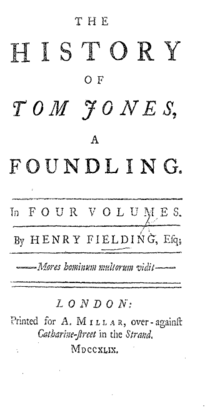
Tom Jones Original CoverAfter enjoying things so much last week, I hate to see things slip downward again this week–but I do understand why Fielding’s doing what he’s doing (at least I think I do). But yawn. It’s not that it was bad, it’s just the kind of thing that you need to read to establish one or more things so that future chapters/events will be interesting and make sense. It wouldn’t have occurred to me at all to evaluate these chapters if it weren’t for my reading schedule making them the only things I had to read.

We start with a long disclaimer/apology from Fielding for some of his content about religion/religious people–he’s not trying to focus on the failings of the religious or the virtuous, he says. On the contrary, those who come off poorly in his writing have a lack of real religion or virtue (despite their claims) and that’s what he’s highlighting. Whether or not this is sincere on his part I don’t know (I could probably read a lot about that if I cared to), but I like the approach, and it seems to apply to those we have seen/will see in these pages.

Basically, there’s an altercation between Master Blifil and Tom, resulting in Blifil getting his nose bloodied. To draw attention away from the fact that he provoked Tom, Blifil rats him out on some of the details of Tom’s earlier hijinks (recounted as evidence that he’s the sort “born to be hanged”). Tom had refused to name his accomplices at the time, but Blifil spilled the beans. Thwackum takes this as a sign of virtue in Blifil and proof of Tom’s hooligan status. Mr. Allworthy, on the other hand, sees honor in Tom’s refusal and commends it–but even better for Tom (I imagine), this act earns him a lot of fans within the servants.

The widowed Mrs. Blifil picks up a couple of other suitors, who misreading the situation, go out of their way to prefer her son to Tom and target him for condemnation. But all the while, her affections toward Tom grow and grow.

That’s the chapters in a nutshell, not a lot actually happens. I get the impression that Master Blifil is going to be a pain in Tom’s side in the way rich, preppy kids are to plucky middle/lower-class protagonists in 80’s movies. Not a lot happens, but I’m willing to bet all this comes up later. If not in the next chapter, soon enough.

The Gene Wizards by Clare Blanchard: A brief, humor-filled, Fantasy that’ll make you think.


The Gene Wizards

The Gene Wizards

by Clare BlanchardSeries: Wizards Series, #2

Kindle Edition, 155 pg.
CB Books, 2019

Read: February 17, 2019

I’m having a hard time deciding what to put here—everything that I think about writing seems like a bit too much information. But I need to put something here or this Tour Stop will seem pointless.

So what can I say?

This is a strange overlap of SF, Fantasy, mythology/theology, and literary criticism. Throw in some laughter that goes along with 20-somethings and responsibility and I will.

The tone is more humor-filled than the first in the series (you aren’t required to read both to get it) Some of it is plain silly (there’s an initial burst of goofiness with name-based humor that disappears quickly, leaving only a handful of silly names), some is more advanced—all of it seems fitting. I know the initial novel attempted some comedic moments, but Blanchard is more successful here.

My complaint would be that there’s too much space devoted to and not enough to the plot/character development. A group of characters is focused on story (to be as vague as possible), and members of that group (and or prospective members) spend an awful lot of time talking about some stories and their place in contemporary thoughts. Both the Bible and the Western Canon are discussed here—sometimes provocatively, sometimes error-filled (sometimes both), occasionally offensive, never dull. Although I can’t help but think that we get too much of it and not enough plot.

After an initial bit of setup, it feels like the plot is then put on hold for quite a while before things shift to finishing the story. Not only does it feel like we spend too much time with the story-discussion (see last paragraph), it feels like we don’t get enough time with the plot of this novel. Without having the time to carefully look through things I’d roughly guess less than 50% of the novel is devoted to the plot (and even if I’m wrong when it comes to actual word count, that it leaves that impression says a lot). Which is a shame, because it’s more entertaining than the first novel in this series.

Thought-provoking, with a good bit of entertaining plot, a strong dose of humor, and a definite improvement over its predecessor. The Gene Wizards is a Fantasy novel unlike any you’ve read.

My thanks to damppebbles blog tours for the invitation to participate in this tour and the materials (including a copy of the novel) they provided.

BOOK SPOTLIGHT: The Gene Wizards by Clare Blanchard

Today is my day for the Book Tour for The Gene Wizards by Clare Blanchard, the follow up to Wizard Ring (that I talked about a month ago). Along with this spotlight post, I’ll be giving my take on the novel here in a bit. But let’s start by learning a little about this here book, okay?


Book Details:

Book Title: The Gene Wizards (Wizards Series #2) by Clare Blanchard
Publisher: CB Books
Release date: September 18, 2019
Format: Ebook
Length: 155 pages

Book Blurb:

It’s bad enough you’re from a family of rich bankers, without having to deal with secret genetic engineering factories in the Dakotas.

Especially when you wake up one morning after a tab of E and find you’re thinking in Hebrew.

Follow the adventures of the Vanpyre family as they wrestle with the Dark Side of money and power.

Brilliant, strange, and fantastic

“Deep…”; “Laugh out loud funny…..”

If you enjoy more experimental writing styles and brilliant writing …then this is the book for you.” 5 out of 5 stars, by J.S. Menefee, author of the Rephaim: Bloodlines series


About Clare Blanchard:

 Clare BlanchardOriginally from the North Yorkshire coast in England, Clare Blanchard spent half her lifetime in Czechia in Central Europe, where her books are mainly set. Inspired by noir fiction, her settings are often like another character in the plot. She writes crime mysteries and dark urban fantasy with a historical twist.

Clare loves beautiful landscapes and architecture, cross-country skiing, the wine of South Moravia, and of course Czech beer. When she’s not being literary she knits funky socks.

Social Networks:

Twitter ~ Facebook ~ Website ~ Instagram

Purchase Links:

Scribd ~ Kobo ~ Nook
The Gene Wizards will be reduced in price from $2.99 to $0.99 until 1st March 2020.

My thanks to damppebbles blog tours for the invitation to participate in this tour and the materials (including a copy of the novel) they provided.

BOOK SPOTLIGHT: Hidden Steel by Stuart Field

Today is my day for the Book Tour for Hidden Steel by Stuart Field. Along with this spotlight post, I’ll be giving my take on the novel here in a bit. But let’s start by learning a little about this here book, okay?


Book Details:

Book Title: Hidden Steel (John Steel #2) by Stuart Field
Publisher: Next Chapter
Release date: December 25, 2019
Format: Ebook/Paperback
Length: 618 pages

Book Blurb:

In the UK, Detective John Steel is investigating the organization who killed his family. When he comes across information that something big is going to happen on the cruise ship Neptune, Steel goes undercover. He has fourteen days to figure out what is going to happen – and to stop it.

In New York, Steel’s NYPD partner, Detective Samantha McCall, is investigating a series of deaths. All seems run of the mill for the homicide detective until they find out that the deaths are somehow connected to the cruise ship John Steel is on.

McCall is convinced there is a mole in the department, but can she figure out who he is – and who he’s working for? Meanwhile, Steel is running out of options… and the clock is ticking.

About Stuart Field:

Stuart FieldStuart Field was born in the UK, in the West Midlands. He spent his early years in the army, seeing service in all the known (and some unknown) hotspots around the world. He now lives in Germany with his wife Ani. When not engaged in highly confidential security work, he writes thrillers which perhaps mimic his life-experience more than the reader would like to believe.

Purchase Links:

Amazon UK ~ Amazon US

My thanks to damppebbles blog tours for the invitation to participate in this tour and the materials (including a copy of the novel) they provided.

WWW Wednesday, February 19, 2020

Hey, it’s the middle of the week. Time for WWW Wednesday!

This meme was formerly hosted by MizB at A Daily Rhythm and revived on Taking on a World of Words—and shown to me by Aurore-Anne-Chehoke at Diary-of-a-black-city-girl.

The Three Ws are:

What are you currently reading?
What did you recently finish reading?
What do you think you’ll read next?

Easy enough, right?

What are you currently reading?

I’m reading the very fun Highfire by Eoin Colfer and am listening to Lies Sleeping by Ben Aaronovitch, Kobna Holdbrook-Smith (Narrator) as a refresher before the release of the next Rivers of London novel next week.

What did you recently finish reading?

I was away for a few days last week and got a little extra reading in, but yesterday I finished Joe Ide’s Hi Five (I have so many things to say about it) and Shadow of the Batgirl by Sarah Kuhn, Nicole Goux.

What do you think you’ll read next?

My next book should be Madam Tulip and the Serpent’s Tree by David Ahern (I’ve been waiting for this for a while) and Dark Harvest Magic by Jayne Faith, Amy Landon (Narrator) on audiobook.

Hit me with your Three W’s in the comments! (no, really, do it!)

QualityLand by Marc-Uwe Kling, Jamie Lee Searle (Translator): George Orwell Goes Shopping

QualityLand

QualityLand

by Marc-Uwe Kling, Jamie Lee Searle (Translator)

eARC, 352 pg.
Orion Books, 2020

Read: February 13-15, 2020

Grab a copy from your local indie bookstore!


When you boil it down, QualityLand is simply the epic tale of a man trying to return something he didn’t order (and doesn’t want) to an online retailer. Peter Jobless’s tale involves a paranoid hacker, a blackmail scheme, an armed stand-off, a smitten sex-bot, a TV news panel show, a revolutionary tablet computer, swaying a presidential election, and a revival of interest in the films of Jennifer Aniston. We’ve all been there, right?

There’s no way I could describe the plot in a way to do it justice—so we’ll stick with the broad sweep. Before much gets underway story-wise, there’s a lot of set up required. When the dominoes start to fall in earnest, they go quickly. But so much of the book is devoted to setting them up, establishing/explaining the culture, government and everyday life of the QualityLand’s citizenry.

Here’s the best part about the set-up time: it’s totally worth it, and the way the dominoes are being placed is enjoyable/entertaining enough that even if the results were duds, I wouldn’t really have minded all that much. The icing on the cake is that the plot works well (we’ve all seen too many examples of elaborate worldbuilding that accompany a story that’s not worth it).

This is a world given over to algorithms, a world where the algorithms of various retail entities know so much about their customers that they no longer have to wait for a customer to order something to provide it—no, the algorithm will know what you’re going to want and will deliver it before you know you want it.

Not only are all your possessions provided for you in this manner, the algorithm decides what kind of career you will pursue, but it will also guide and govern your romantic life, your health care, and so on and so on.

It even gets into politics—so much so that during the course of this novel, there is an android running for president—because, we’re told repeatedly (mostly by the candidate), “machines don’t make mistakes.” An android chief of state (the theory goes) will better all of society because the android will know what’s needed.

At each step of the way, as each aspect of society is introduced and explained, as each character appears for the first time, it’s done in a way that will make you grin, chuckle, or laugh. The world is so zany, so…out there—and yet, completely recognizable as a natural progression of our world/society/culture.

Unlike so many satirical novels, the ending of this novel doesn’t get out of control. The plotlines come to natural conclusions and resolve in a satisfying way.

The characters—from the Everyman Peter Jobless, to the campaign manager (she can give Malcolm Tucker some lessons on the use of words as weapons), to the history teacher’s trouble-maker daughter (in-person to public officials or in online comments), to Peter’s collection of electronic companions—are wonderful. They’re a little better rounded than I’m used to in satires.

There’s a wonderful playful quality to the language, making the whole thing a barrelful of fun. I’m assuming that Searle captured the feel of the original in that, and did a great job. There’s an acronym that’s used a couple of times, that I think may be funny in the original, but doesn’t translate into anything (at least as far as I can see). That one thing aside, the ability to make a translated text feel so natural, so easy is no small feat.

QualityLand is a fun read t’s a thought-provoking read, it is (occasionally) a frightening read as you realize how close to this dystopia we are (and how fast we’re running to it). I strongly recommend this one.


4 Stars


My thanks to Tracy Fenton and Compulsive Readers for the invitation to participate in this tour and the materials (including a copy of the novel) provided.


This post contains an affiliate link. If you purchase from it, I will get a small commission at no additional cost to you. As always, opinions are my own.

The History of Tom Jones, a Foundling by Henry Fielding: BOOK II., viii.-Book III., ii.

Tom Jones Original CoverNow this was more like it! We start off with getting a bit more insight into Capt. Blifil, who when not having to spend time with his wife, spends his time lost in his own thoughts, which were

were entirely employed on Mr. Allworthy’s Fortune; for, first, he exercised much Thought in calculating, as well as he could, the exact Value of the whole: which Calculations he often saw Occasion to alter in his own Favour: And, secondly and chiefly, he pleased himself with intended Alterations in the House and Gardens, and in projecting many other Schemes, as well for the Improvement of the Estate as of the Grandeur of the Place. For this Purpose he applied himself to the Studies of Architecture and Gardening, and read over many Books on both these Subjects; for these Sciences, indeed, employed his whole Time, and formed his only Amusement. He at last completed a most excellent Plan: and very sorry we are, that it is not in our Power to present it to our reader, since even the Luxury of the present Age, I believe, would hardly match it.

Y’know, just in case anyone forgot what he was really in love with when he entered into this marriage. One evening, while strolling by himself, “his Heart was exulting in Meditations on the Happiness which would accrue to him by Mr. Allworthy’s Death, he himself—died of an Apoplexy.” Yup. That’s right. Forty-seven pages after his introduction—seemingly as a major impediment for Tom to overcome—he’s dead. We spent so much time on him, his relationship with his wife and brother-in-law, etc. and he just dies in a sentence. Well, that’s not true, it seems like he does, but we end up spending a few more pages on his being pronounced dead after this, but that’s beside my point. In some books, I’d be annoyed by this, but I was amused by this little bit of fakery on Fielding’s part.

The hullabaloo surrounding finding his body, trying to resuscitate him and so on does give Fielding a chance to satirize the practice of medicine, which I enjoyed.

Which brings us to Book III, which is wonderfully entitled, “Containing the most memorable Transactions which passed in the Family of Mr. Allworthy from the Time when Tommy Jones arrived at the Age of Fourteen, till he attained the Age of Nineteen. In this Book the Reader may pick up some Hints concerning the Education of Children.” That last sentence just made my day, really (as did the title to Chapter 1 “Containing little or nothing,” I like some honesty in labeling)

The Reader will be pleased to remember, that, at the Beginning of the Second Book of this History, we gave him a Hint of our Intention to pass over several large Periods of Time, in which nothing happened worthy of being recorded in a Chronicle of this Kind.

In so doing, we do not only consult our own Dignity and Ease, but the Good and Advantage of the Reader: for besides that by these Means we prevent him from throwing away his Time, in reading without either Pleasure or Emolument, we give him, at all such Seasons, an Opportunity of employing that wonderful Sagacity, of which he is Master, by filling up these vacant Spaces of Time with his own Conjectures…

Now that Tommy is a young man, we get to meet him “…shall now bring forth our Heroe, at about fourteen Years of Age, not questioning that any have been long impatient to be introduced to his Acquaintance.” Yup, I’m not alone in getting fed up with this. For the record, “Heroe” (like all the weird capitalization) is what my book has.

Tom Jones is, apparently, “universally disliked” in his community (unlike Master Blifil, who is the model citizen), in fact,

we are obliged to bring our Heroe on the stage in a much more disadvantageous Manner than we could wish; and to declare honestly, even at his first Appearance, that it was the universal Opinion of all Mr. Allworthy’s Family that he was certainly born to be hanged.

“Born to be hanged…” I’ve got to find a way to use that line.

Tommy has a propensity to many vices, but a strong tendency to robbery—and at this point has already been convicted of three of them. We get a little information about them and his refusal to name names. It’s not really commended (but you can read it between the lines), that he doesn’t give up his accessories or accomplices—even under corporal punishment. Mr. Allworthy calls it a “mistaken Point of Honour” for him to be that way, but others don’t agree.

To help get him to confess (and implicate others), his tutor is brought in to whip him,. This tutor is named, most fittingly, Mr. Thwackum. That right there is the way to name a character, ladies and gentlemen. Sure, he may go on to play an important role, he may end up showing wisdom and insight, but at the end of the day, let’s not forget—his main role is to Thwack ’em around.

In these chapters, we get Capt. Blifil killed off, we meet Tommy—and see right away that he’s going to be an atypical “Heroe” at best—and the story starts to pick up, all with some fun narration and asides (most of which I left for you to discover for yourself). Once again, I’m very tempted to keep going here. At the very least, this makes up for last week’s chapters.

Down the TBR Hole (1 of 24+)

Down the TBR Hole

This meme was created by Lia @ Lost in a Story—but Jenna at Bookmark Your Thoughts is the one that exposed me to this, and as my Goodreads “Want To Read” shelf is scarily long, I had to do this.

The Rules are simple:

  1. Go to your Goodreads to-read shelf
  2. Order on ascending date added.
  3. Take the first 5 (or 10 if you’re feeling adventurous) books.
  4. Read the synopses of the books.
  5. Decide: keep it or should it go?
  6. Keep track of where you left off so you can pick up there next week! (or whenever)

What distinguishes this series from the Mt. TBR section of my Month-end Retrospectives? Those are books I actually own while Goodreads contains my aspirational TBR (many of which will be Library reads). The Naming of the two is a bit confusing, but…what’re you going to do?

I’ll probably be tackling 5 of these at a time, but this time I’m going for 10 because the first 3 are in one series, and it seems like cheating to have the first 3 of 5 to be answered together. I’ll probably slow down in the future.

(Click on the cover for an official site or with more info about the book)

The Ghost Brigades The Ghost Brigades by John Scalzi
My Thoughts: This is the sequel to Old Man’s War which was plenty of fun, but after I read it I couldn’t quickly get my hands on the sequel (although I could’ve gotten 3 & 4), and then I got distracted and…well, here I am 8 years later.
Verdict: Yeah, I’ll have to re-read Old Man’s War first, but that should be a good time anyway.
Thumbs Up
The Last Colony The Last Colony by John Scalzi
My Thoughts: See above.
Verdict:
Thumbs Up
Zoe's Tale Zoe’s Tale by John Scalzi
My Thoughts: See above.
Verdict:
Thumbs Up
The Naming of the Beasts The Naming of the Beasts by Mike Carey
My Thoughts: Similarly, I’ve read the first two of this series 3+ times, and the second two once, but couldn’t get my hands easily on this one (and it’s the only one not in my library system, how horrible is that?). Felix Castor was such a fun character, I really should get to this one—even if it means I have to spend a little money.
Verdict:
Thumbs Up
This Dog for Hire This Dog for Hire by Carol Lea Benjamin
My Thoughts: A P.I. Novel with a Canine sidekick. This should be a slam-dunk for me. But when I read the blurb, something fails to grab me. Don’t ask me what. Just don’t think I’m going to get around to it. Possibly my loss.
Verdict:
Thumbs Down
To Speak for the Dead To Speak for the Dead by Paul Levine
Blurb: The first mystery in Paul Levine’s best-selling series, To Speak for the Dead, introduces trial lawyer and ex-Miami Dolphins linebacker Jake Lassiter, who has an uncanny knack for digging up the truth – and the danger that comes with it.
My Thoughts: About 15 years ago, I gobbled up Levine’s Solomon vs. Lord series and probably should’ve jumped on this one at the time. I didn’t and have kicked myself for it frequently since. Maybe it’s the football thing? Odds are these are just as fun as the Andy Carpenter books.
Verdict: I don’t know when I’ll get around to it, but I can’t bring myself to cut this.
Thumbs Up
Devil in a Blue Dress Devil in a Blue Dress by Walter Mosley
Blurb: Set in the late 1940s, in the African-American community of Watts, Los Angeles, Devil in a Blue Dress follows Easy Rawlins, a black war veteran just fired from his job at a defense plant. Easy is drinking in a friend’s bar, wondering how he’ll meet his mortgage, when a white man in a linen suit walks in, offering good money if Easy will simply locate Miss Daphne Monet, a blonde beauty known to frequent black jazz clubs.
My Thoughts: In casual conversation, I’d tell you I’ve read this. But a quick look at the blurb tells me that I haven’t. It’s more than a little unthinkable, really. I need to change this.
Verdict:
Thumbs Up
Pelham Fell Here Pelham Fell Here by Ed Lynskey
My Thoughts: I have no idea how this one ended up on my radar in April ’12, but it did (the author’s name rings a bell for some reason…maybe people on a Nero Wolfe discussion group have mentioned him?). The blurb is semi-interesting, but a couple of the quotations on Goodreads make me leary.
Verdict: No idea what drew me to the book, leary quotations = time to go.
Thumbs Down
A Cold Day in Paradise A Cold Day in Paradise by Steve Hamilton
Blurb: Other than the bullet lodged near his heart, former Detroit cop Alex McKnight thought he had put the nightmare of his partner’s death and his own near-fatal injury behind him. After all, the man convicted of the crimes has been locked away for years. But in the small town of Paradise, Michigan, where McKnight has traded his badge for a cabin in the woods, a murderer with the same unmistakable trademarks appears to be back. McKnight can’t understand who else would know the intimate details of the old murders. And it seems like it’ll be a frozen day in Hell before McKnight can unravel truth from deception in a town that’s anything but Paradise.
My Thoughts: I remember reading that Hamilton has come back to this series after a while away. That blurb, my impression of Hamilton from his Nick Mason books, and the fact that Hamilton has been drawn back to the books make this a no-brainer.
Verdict: If anything, I need to prioritize this.
Thumbs Up
Detective Detective by Parnell Hall
Blurb: Stanley Hastings, the world’s most unlikely private eye, a struggling actor/writer trying to support his wife and kid in New York City, who chases ambulances for a negligence lawyer and carries a camera instead of a gun and photographs accident victims and the cracks in the sidewalk that tripped them, tackles his first real case, tracking down the murderers of a client he could not save because he wasn’t a real detective.
My Thoughts: Like the Lynskey book, I have no idea how this ended up on my radar.
Verdict: I dunno, just not feeling this.
Thumbs Down

Books Removed in this Post: 3 / 10
Total Books Removed: 3 / 240

Anyone out there read any of these books? Did I make the right call with any of them?

(Image by moritz320 from Pixabay)

WWW Wednesday, February 12, 2020

Hey, it’s the middle of the week. Time for WWW Wednesday! It’s also the last day of the work week for me, and I’m having a hard time focusing on anything productive. Thankfully, these posts are pretty easy to produce.

This meme was formerly hosted by MizB at A Daily Rhythm and revived on Taking on a World of Words—and shown to me by Aurore-Anne-Chehoke at Diary-of-a-black-city-girl.

The Three Ws are:

What are you currently reading?
What did you recently finish reading?
What do you think you’ll read next?

Easy enough, right?

What are you currently reading?

I’m reading Hi Five by Joe Ide and am listening to Lies Sleeping by Ben Aaronovitch, Kobna Holdbrook-Smith (Narrator).

What did you recently finish reading?

I just finished Joseph Finder’s House on Fire and yesterday, I completed Academ’s Fury by Jim Butcher, Kate Reading (Narrator) on audio.

What do you think you’ll read next?

My next book should be Qualityland by Marc-Uwe Kling.

Hit me with your Three W’s in the comments! (no, really, do it!)

Page 163 of 220

Powered by WordPress & Theme by Anders Norén