Category: Blog Series Page 222 of 232

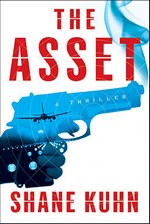
In Medias Res: The Asset by Shane Kuhn

as the title implies, I’m in the middle of this book, so this is not a review, just some thoughts mid-way through.

—–

The Asset
The Asset

by Shane Kuhn

This is not the Shane Kuhn you know. Well, sort of. This is a standalone thriller about Airport/Airplane Security, Terrorism, and the USA’s efforts to keep the friendly skies, well, friendly. It’s not as fun and funny as The Intern’s Handbook or Hostile Takeover (or whatever they’re called in your part of the world). BUT it is just as well-written and suspenseful — and a little easier to believe, actually.

There are hints, suggestions, indicators, and other things pointing to an immanent terrorist attack on the U.S., and not enough people are taking the situation seriously. At least, least that’s the point of view of Kennedy, the security expert and protagonist, who is taking it very seriously. Taking place over 64 days (not a spoiler, that’s literally the 2nd line — although, there could be some action that takes place after that). Will Kennedy be in time to stop it? How will he? this is a pulse-pounder, a nail-biter, a “oh, crud — do I really have to go to work tomorrow? Do I actually need to sleep before then?” kind of book.

I think I’d prefer it to be harder to believe than the other two books, come to think of it.

I’m almost at the mid-way point of the ARC (with thanks to Simon & Schuster and Shane Kuhn) and I’m telling you now, you want to pre-order this, get on your library’s wait-list, or whatever (legal) thing you do to get your hands on a book. It comes out on July 12, you want to be ready for it.

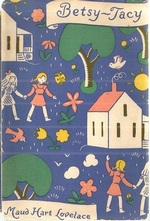
United States of Books – The Betsy-Tacy Treasury by Maud Hart Lovelace

The Betsy-Tacy Treasury The Betsy-Tacy Treasury

by Maud Hart Lovelace

Author: Serena Agusto-Cox at Savvy Verse & Wit

The Betsy-Tacy Treasury by Maud Hart Lovelace, which is the first four books in this 10 book series, was praised by Entertainment Weekly as “a rosy remembrance of a region already known for its niceness.” My daughter and I read these together over many weeks, reading little more than a chapter every couple of evenings.

Betsy-Tacy is the first book in the series, and young readers are introduced to five-year-old Betsy who lives in Deep Valley, Minnesota. She lives in a small mill town at the end of Hill Street, but she’s soon to have a new neighbor, as a new family moves into the house across the street. My daughter was thrilled to hear about a girl her age, and she was even more excited when I told her that there were pencil-like sketches inside for her to visualize what we were reading. Transitioning from only picture books to chapter books can be hard, especially for kids who love visuals. Betsy soon has a new friend, Tacy, and they share big imaginary adventures together before her baby sister arrives and before they even meet Tib, whose family is from Milwaukee and live in the chocolate-colored house they covet. Entertainment Weekly‘s assessment of a “rosy” picture of a “nice” little town is highly accurate, and it’s clear that this story takes place some time ago before many worried about strangers, criminals, or had cars, cellphones, and televisions. Imagination was a commodity that children needed in large supply. This is not to say that Betsy, Tacy, and Tib do not get into trouble.

Rating: Cinquain

Betsy-Tacy and Tib is the second book, and the girls are now eight years old. It becomes clear that even though these books were written during a time when women were supposed to be mothers and wives, these girls have bigger dreams. Betsy is a storyteller and she seems to have dreams of writing books, while Tacy wants to be a mother to a number of kids, just as her mother is. Tib is torn. To be an architect/engineer, mother, dancer, or something else. When kids think about what they want to be when they grow up, their dreams are big and seem to be out of reach. They are fantasies, like many of the stories these girls create in this book for Tib’s Aunt Dolly and themselves. My daughter is riveted by these books and the fun and trouble these girls get into, from visiting the Mirror Palace to cutting chunks of their hair off to put in lockets. These books remind me of the good old days when dreams were interchangeable and wonderful.

Rating: Cinquain

Betsy and Tacy Go Over the Big Hill is the third book and the girls are now age 10. It’s great how accurate Maud Hart Lovelace captures the competition between young kids when it comes to celebrating birthdays and feeling left out when others have birthday parties and they do not. But, ultimately, everything turns out well between Betsy, Tacy, and Tib, only to have a quarrel between Betsy and Tacy and their older sisters over who will become queen. This book has a lot in it about conflict resolution, which younger kids can definitely use as friendships grow and change, as well as in their relationships with siblings. My daughter enjoyed this one, but was a little unsure of the hubbub about kings and queens, even though she is an avid fan of princesses. I liked the historical details about the Syrian immigrants and foreign affairs involving the King of Spain, as well as a tidbit about the current president being Theodore Roosevelt. However, there are some “old-fashioned” ideas about immigrants and other cultures here that might need further explanation.

Rating: Quatrain

Betsy and Tacy Go Downtown is the fourth book, and at age 12, Betsy, Tacy, and Tib are a little too old for my daughter. She lost interest in this book series with this book, as their adventures downtown and their prodding of Winona to take them to see the play Uncle Tom’s Cabin did not resonate with her. She’s more interested in make-believe games and stories, and while these girls act as girls probably do at this age, manipulating a classmate is not a lesson I’d like my daughter to learn. It’s also interesting from an adult perspective to see how times have changed — a prized possession for one of the girls is a beer calendar! But here, we also see Betsy grow up and take an adventure to the new library on her own. While she apprehensive, she’s happy to be on her own and she thrives in the books she finds and reads, but also in the attention she seems to receive from others about her own writing. It’s wonderful to see her parents support her writing/art. It’s a lesson that is often not passed on today, as kids are tested and too focused on subjects that will net them lucrative careers.

Rating: Tercet

Average rating for all 4 books: 4.25

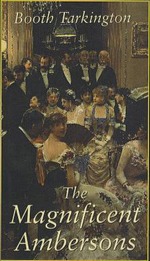
United States of Books – The Magnificent Ambersons by Booth Tarkington

The Magnificent AmbersonsThe Magnificent Ambersons

by Booth Tarkington
Series: The Growth Trilogy, #2

Mass Market Paperback, 346 pg.
Tor Classics, 2001 (first published 1918)
Read: May 12 – 14, 2016

… the grandeur of the Amberson family was instantly conspicuous as a permanent thing: it was impossible to doubt that the Ambersons were entrenched, in their nobility and riches, behind polished and glittering barriers which were as solid as they were brilliant, and would last.

If only, if only . . .

How do you enjoy a 300+ page book with a protagonist who is an arrogant, petulant, jackwad with no obviously redeeming qualities for the first 300 pages? Well, it’s tough. But if it’s as well told as The Magnificent Ambersons, it’s possible.

Sure, that’s a little bit of a spoiler — George Amberson Minafer does develop a couple of redeeming qualities in the last 30 pages or so. But you know what? The book is almost a century old, you’ve had plenty of time to read it if you’re worried about spoilers.

The plot is straightforward: At the dawn of the Industrial Revolution, an impossibly rich family produces an arrogant twit as the only heir. Unbeknownst to him, the economy is changing and the family is beginning to fall on hard times. Too proud to admit it, they continue living as if they have all the money in the world. Meanwhile, the twit falls for a girl who’s humble, kind, and wise. For some inexplicable reason, she falls for him, too. Things happen, they don’t get together and the bottom falls out on the Ambersons. There’s family drama, too — between the financial crisis, health problems, love, old flames, and scandal, there’s plenty to entertain a reader (if they can put up with younger George).

Most of the characters are pretty thin — there are exceptions (George’s mother, aunt and non-ambassador uncle, are the best) — but even the developed ones aren’t as fleshed out as we would have them today. But it fits with Tarkington’s overall style. It’s very, very difficult to like most of the people on these pages. So the ones you’d normally sort-of like, you end up really enjoying.

What makes this book work is Tarkington’s style. It’s hard to describe — highly detailed (for example, there’s so much attention paid to clothing and fashion that you’d almost think Gail Carriger had a hand in this), with a dry sense of humor, and plenty of cultural commentary. He changes his focus repeatedly: he’ll jusmp months or years at at time, and summarize events from those months in a paragraph or less and then cover a single evening in 15 pages, so he can highlight what matters and ignore the rest. But better than the plot (or characters), you get lines like this: “Some day the laws of glamour must be discovered, because they are so important that the world would be wiser now if Sir Isaac Newton had been hit on the head, not by an apple, but by a young lady.” How do you not keep reading for things like that?

Tarkington takes time out from the narrative to say

Youth cannot imagine romance apart from youth. That is why the roles of the heroes and heroines of plays are given by the managers to the most youthful actors they can find among the competent. Both middle-aged people and young people enjoy a play about young lovers; but only middle-aged people will tolerate a play about middle-aged lovers; young people will not come to see such a play, because, for them, middle-aged lovers are a joke–not a very funny one. Therefore, to bring both the middle-aged people and the young people into his house, the manager makes his romance as young as he can. Youth will indeed be served, and its profound instinct is to be not only scornfully amused but vaguely angered by middle-age romance.

I assume that captures the spirit of the late 19th/early 20th Century — if you take out the word “play” and put in “film” or “show,” it does a pretty good job of capturing the spirit of the early 21st Century, too. Which is a pretty nice achievement for a piece of writing.

The book isn’t a chronicle of the changes to the American culture/economy due to industrialization, it’s a family drama. But if you pay attention to what’s going around the lovebirds, cads and gossips, you can see those changes taking place. It’s a temptation for someone to cheat a little when writing historical fiction and make characters seem smarter than they are by knowing how predictions would actually turn out, Takington’s not above falling into that. Note what Eugene Morgan, early designer of automobiles says:

“With all their speed forward [automobiles] may be a step backward in civilization–that is, in spiritual civilization. It may be that they will not add to the beauty of the world, nor to the life of men’s souls. I am not sure. But automobiles have come, and they bring a greater change in our life than most of us suspect. They are here, and almost all outward things are going to be different because of what they bring. They are going to alter war, and they are going to alter peace. I think men’s minds are going to be changed in subtle ways because of automobiles; just how, though, I could hardly guess. But you can’t have the immense outward changes that they will cause without some inward ones, and it may be that George is right, and that the spiritual alteration will be bad for us. Perhaps, ten or twenty years from now, if we can see the inward change in men by that time, I shouldn’t be able to defend the gasoline engine, but would have to agree with him that automobiles ‘had no business to be invented.'”

That was 98 years ago, think what he’d say now about the automobile’s impact on culture (he’d probably cite James Howard Kunstler’s The Geography of Nowhere).

A dull(ish) story, full of unsympathetic characters acting foolishly (on the whole), with a quaint writing style that somehow makes it all work. I can’t explain it, I’m just glad I read it. You just might feel the same way, give it a shot.

—–

3.5 Stars

A Few Quick Questions With…Walt Hackman

Late last year, I was approached by Walt Hackman to read and review his book, No Problem, Mr. Walt. Which was absolutely not my kind of book, but there was something about it that appealed to me. I’m glad I did, it was quite a tale. I reposted my take on it earlier today, in honor of the book launch tomorrow. Walt was kind enough to take part in a Q & A with me — which was enough to make me want to re-read the book. Hopefully, it convinces some of you to give it a first read.

I’m always interested in the writing process, why writers make the choices they make along the way — why did you decide to approach your story by mixing Chinese history with the story of your junk?
When I started to outline and write “No Problem, Mr. Walt” it was not in chronological order. As each Chapter unfolded, I found myself writing about subject matter that emerged along with my story – like the reference to caulking from Marco Polo’s journal or the Cultural Revolution – and it occurred to me that including snippets of Chinese history would assist the reader by providing context to make my story more relevant. So, at the beginning of Chapter Two I begin with “I think it is safe to say that the average American may suffer a bit of historical amnesia regarding China’s recent history. Therefore, I have decided to start in the next chapter with the last Emperor Pu Yi in the early 1900s, and present the reader with a brief history up to the present; these bits of history will be presented at the beginning of each chapter. If you understand China’s recent past, it will be easier to understand references to history in the story, and easier to understand present-day China.”
For that matter, why did you decide to Where there some anecdotes/memories that you wanted to put in the book, but couldn’t find a way to fit them into the narrative? Care to share any?
Yes, there are a few but these stand out: the initial draft included poetry that I wrote depicting experiences I had such as the bus ride in Chapter 23. However, the editor felt including them would take away from the story’s narrative so I kept the content they included but the poems themselves were removed.

More importantly, my journey began with the sudden death of my only son Wally, which is something I find very difficult to talk or write about even to this day. I feel there are no words adequate to explain the anguish, sadness and magnitude of our loss. Those parts of the story that dealt with “Rebuilding a (my) Life” were tough for me to write (and rewrite).  That being said, Wally’s death was the catalyst that propelled me on that improbable journey and is an important part of the story even though I only talk about it briefly in the Preface.  I did the best I could to address it but feel that in a future revision I might find a better way to tell that part of the story. My daughter Lynn is a writer and owned the Mei Wen Ti from 2000 to 2008, I think hers might be the voice that best explains that time in our lives and we’ve been discussing a collaboration.

What was the biggest surprise about the writing itself?
Steven King said in On Writing, “….I believe the first draft of a book – even a long one – should take no longer than three months, the length of a season.” For me, my biggest surprise was how long it took me to write the book. Not months but years!

I tell people it was easier to build a boat in China than it was to write a book about it.  Even though I approached my writing with discipline, I found it impossible for me to write a fixed amount daily or weekly like King suggested. I set a goal and really believed that I would get the book completed before the China Olympics in 2008. But looking back, I would still do it all over again because this project has never been about notoriety or money, I have always thought it could be a good story that people might enjoy.

A lot of what makes a writer are the books that he’s read — what books in particular do you think made you the writer you are/the book the book it is? (other than the books on Chinese history, etc.) .
Before starting the book, I read Steven King’s On Writing. One of his main points is that generally, if you want to be a good writer you must be a good reader. I’ve always been an avid reader but I began reading a lot more beginning with every book Steinbeck ever wrote. Somehow, knowing I was going to write a book caused me to notice writing subtleties and styles that I liked. After all the Steinbeck, I read Hemingway’s Boat, The Sun Also Risesand A Farewell to Arms, etc. Even though King’s On Writing is centered around writing fiction, it helped me and I often referenced it along the way.
You’ve lived quite a life — is there another book in you?
The answer is yes. I have given this more thought than you can imagine. I’d like to write a revision of No Problem, Mr. Walt that would meet approval for sale in China (i.e. tone down any reference to Communism that might be viewed as “unfavorable”) And similar to how I included Chinese history for western audiences, this version would be a juxtaposition that includes U.S. history and customs.

On my trips to China, people were fascinated about the junk (surprisingly, you don’t see a whole lot of them especially the size and style of the Mei Wen Ti) and the fact that I was even there building it. Junks (sail boats) have not been built in China now for many years since the introduction of modern engines. Many people I met wanted to know what I was doing in China, why I walked to the bus station and rode the bus, why I was wearing cowboy boots, if I liked the food, if I could tell them about California, why the U.S. was selling our latest jets to Taiwan, etc. Lastly, I believe the book is a simple story that the current generation of Chinese people would enjoy. The collaborative work with my daughter is also a possibility since No Problem, Mr. Walt ends with the delivery of the Mei Wen Ti on the docks in San Pedro. The story that proceeded to unfold after the Mei Wen Ti hit U.S. soil (or rather, water) is a unique one all its own!

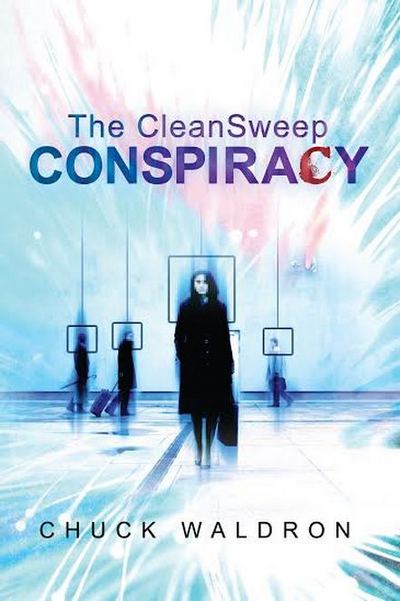
The CleanSweep Conspiracy by Chuck Waldron

The CleanSweep ConspiracyThe CleanSweep Conspiracy

by Chuck Waldron
Series: Matt Tremain Technothriller, #1

Kindle Edition, 304 pg.
CreateSpace Independent Publishing Platform, 2016

Read: May 21 – 25, 2016


Matt Tremain is a man on the run — authorities are broadcasting his picture all over, the police are hunting for him. Not a typical reaction to a tech/privacy blogger (this blogger would like that amount, not kind, of attention) — but that’s the impact that his stories about CleanSweep are possibly having. At the very least, he’s got a few very influential people paying attention, and that’s enough for the powers behind CleanSweep to want him quieted.

Thankfully, he has some allies who have his back — both in Toronto, and around the world, so he’s able to escape the initial attempts to bring him in. Unsure who to trust, he’s living as off-of-the-grid as he possibly can (while maintaining his blog as much as he can — not easy).

Still, this just emboldens him, as well as showing him that the clock is running, and he won’t be able to do anything to prevent this from becoming permanent soon. So Matt, a couple of allies in the press, one in law enforcement, and a few he hasn’t met yet, get busier at exposing what they believe to be a conspiracy devoted to stamping out undesirable elements in society. Toronto will be ground zero, but it won’t be long before this Conspiracy moves to other parts of the world, destroying privacy, civil liberties and lives along the way. Dystopia looms large in these pages, not one decades or centuries away, either; this is a 15-minutes into the future dystopia.

I can’t talk much more about the plot — or most of the characters — without giving too much away. So I’ll just say there are a lot of well-drawn characters trying to do their best at work here. Without exception, everyone of Matt’s allies would be someone I’d like to have more of (not saying that we didn’t get sufficient time with them, just that they were interesting enough to have around more).

And then there are (for wont of a different phrase) the bad guys. With one exception (Claussen’s security chief, Angela Vaughn), these are not well drawn, or that interesting — they’re evil, and that’s about it. Which makes it easier to root against them, but harder to get invested in them as characters.

I’ve got a couple of minor quibbles, and one that’s pretty big. First, for people thus concerned with being spied on, Matt and his allies sure do use their smartphones a lot. Also, the timeline is sometimes too hard to track with, it’s unclear frequently when we’re getting a flashback — and how far back we’re flashing — or when we’re back to “the present.” Lastly, governmental agencies move a little too quickly at the end — probably the hardest part to believe.

My biggest problem with the book was, to me, fairly significant, and ended up toning down my enthusiasm for recommending it. There’s a chapter (maybe two, but I’m pretty sure it was one) wherein Claussen meets with the men with the money and government clout needed to fully implement his plan. A lot of what is revealed about the plan, we readers knew and/or surmised from what had been hinted at, suggested, etc. before. But before it had been shown to us, here it was told to us. And not in a very interesting way — it was basically the part of a James Bond flick where the villain tells Bond his plan just before he leaves him to die (which, of course, he doesn’t). This time there were no Bonds around, just the people who’d enable the villain’s plan. The evil was as plain as day here, and told in the kind of detail no one needed — the only thing missing from this were the conspirators twirling their mustaches. Seriously, you take out this chapter (or edit it a lot), and this book would’ve got a higher rating from me.

Add a little more gray to this, tone down the villains just a shade, and you’ve got yourself a knock out. As it is, it’s a pretty good read — and a chilling reminder of what could be around the corner. The tech feels real, the police state imposed doesn’t sound that far-fetched, the aims of the conspirators carry the feel of legitimacy. This rings entirely of something that could’ve been ripped from the headlines — but thankfully wasn’t (I think). You will keep turning pages, wanting to know what happens to Matt and the rest — you’ll appreciate some small flashes of humanity and the courage that resides in unlikely places.

Give this one a shot. Not only will you probably enjoy this, but like me, you’ll want to get your hands on more by Waldron.

Disclaimer: This book was provided to me by the author in exchange for my honest thoughts.

—–

3.5 Stars

A Few Quick Questions With…Chuck Waldron

For part two of The CleanSweep Conspiracy tour, I got Chuck Waldron to A some Qs.

Why Canada? Is it because the U. S. would be the obvious and/or easy choice? Or is there something else going on?
Who would expect something like The CleanSweep Conspiracy can take place in a city known as “Toronto the Good?” After all, Toronto is part of a nation known and respected for civility, peace, and good government.

The story is completely a figment of my imagination. I could have used many places, but chose to keep it in Toronto. The setting in the original manuscript was a North American fictitious city. Since the inspiration for The CleanSweep Conspiracy was an event that took place in Toronto in 2010, I decided to rewrite my novel and let Toronto be the location.

I hope there are checks and balances in both Canada and the United States that will prevent something like this from ever happening. That said, I do believe there is an undercurrent in our society that keeps the thought of something like The CleanSweep Conspiracy a possibility.

Then again…

Clifford’s line: “Techies like you never think past high-tech solutions,” sounds like an oft-repeated aphorism. Is Clifford your cameo? If not, is there a Chuck Waldron-like character in this book?
Clifford my cameo? Maybe. According to research I’ve read, I’m of an age that should make me technologically phobic. Instead, I seem to embrace each new gadget, app, or program. At least I like to kick the tires. It may be an oft-repeated aphorism as you say, but as much as I like technology, I sometimes fear we give up part of our humanness when we reach for the high-tech cloud-world.

Part of Clifford’s role in the story was to really know Mattie. He was the link between her and Matt Tremain.

If Clifford is my cameo, I thank him for the honor.

How much of the plot (especially the conspiracy) did you have worked out before starting, and how much did you figure out mid-stream? Is this the way you normally go about things?
I lived with the idea for over two years before I started to think of an outline. I’m not sure where the conspiracy part came into it. I don’t jump on conspiracy theories like the FEMA trailers that will be turned into concentration camps. I don’t waste a lot of time thinking about Area 51.

My novel was simply a what-if idea that started to take shape as a story.

Writers talk about writing by plot or by the seat-of-the-pants. I usually have a rough outline, but I tend to be the latter. I like to let my characters dictate their story as I go along.

For me, if a character isn’t well developed it’s hard to carry a storyline.

Who are some of your major influences? (whether or not you think those influences can be seen in your work — you know they’re there)
I was a history major in college. Lawrence E. Gelfand, my professor, is an influence. Ironically he died the same year (2010) as the event that inspired my novel. I tip my hat to the memory of Henrietta Blake, my first writing teacher. She gave me permission to write and assured me I didn’t need a license to be a writer. Writers that have inspired me include Hemingway, John Le Carre, James Lee Burke, William Manchester and much, much more. Like most writers, I’m an avid reader.
What’s next for you? I’m assuming your next book is well underway, what can you tell us?
Two, actually. I’ve never tried it, but I’m working on two storylines that I can’t seem to let go. I like Matt Tremain, the protagonist in The CleanSweep Conspiracy. He just might hang around for another story. On a recent visit to Cuba, I couldn’t avoid thinking about Hemingway and the downward spiral at the end of his life. We all know he committed suicide in Idaho. But what if there is an alternative ending?

Just saying.

The CleanSweep Conspiracy by Chuck Waldron Book Tour

Welcome to our Book Tour stop for The CleanSweep Conspiracy. Along with this blurb about the book and author I’ve got a Q & A with the author, Chuck Waldron, and my 2¢ about the book.

Matt Tremain publishes Verité, a modest blog dedicated to writing about the truth and exposing scams. When he follows up on rumors concerning something called CleanSweep, a mysterious project in Toronto, Canada, Matt needs to decide if he’s going to take a stand and reveal the truth.

Book Details:

Book Title:  The CleanSweep Conspiracy by Chuck Waldron
Category:  Adult fiction, 304 pages
Genre:  Thriller / dystopian
Publisher:  CreateSpace Independent Publishing Platform
Release date:  March 2016
Content Rating:  PG + M

Book Description:

Matt Tremain publishes Verité, a modest blog dedicated to writing about the truth and exposing scams. Currently, he’s following up on rumors concerning something called CleanSweep, a mysterious project in Toronto, Canada.

Matt gets his break when a whistleblower connects CleanSweep to billionaire Charles Claussen. Claussen plans to rid Toronto of undesirables, beginning with street people and extending to any citizens who don’t match Claussen’s restrictive screening matrix.

With the help of a high-ranking government official, Claussen plans to incite riots and violent unrest, conning Torontonians into sacrificing privacy and civil liberties for illusionary security and safety. Toronto will be reduced to a repressive city-state.

The information overwhelms Matt, who doubts he has the courage, skill, or readership to take on CleanSweep. But the murder of his source convinces the blogger to take a stand—although he’s too late to prevent chaos from gripping Toronto’s streets.

To get the word out, Matt’s going to need allies. He may have found some in a Toronto police detective and a local TV reporter pursuing the same story—presuming they aren’t allied with Claussen. If they are, Matt’s going to become yet another victim of CleanSweep, and the truth will be buried forever.

Meet the author:

Born in Iowa, Chuck Waldron lived in Ontario, Canada, before relocating to Florida’s Treasure Coast. Over the years, he’s held many jobs. The ones he can mention in print include US Army soldier, truck driver, office manager, mailman, real estate salesman, social worker, hardware store clerk, and shuttle driver.
Chuck Waldron
Fate played a crucial role when he walked into his first writing class, and he still honors the memory of the teacher, Henrietta. She gave him permission to write. That—along with countless writing groups, classes, seminars, and much sweat—has resulted in over fifty short stories and four novels.

Waldron often likes to pretend interest, lacks perseverance, and could generally use a good talking to—until it comes to his writing, that is. He and his wife Suzanne reside in Port St. Lucie, Florida. While keeping an eye out for hurricanes, alligators, and Burmese pythons, he’s busy writing his next novel

Connect with the author:

Website   Twitter   Facebook

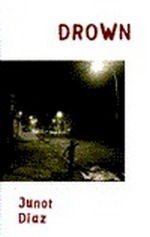
United States of Books – Drown by Junot Diaz

DrownDrown

by Junot Díaz

Author: Serena Agusto-Cox at Savvy Verse & Wit

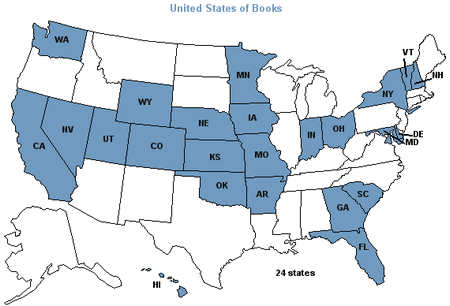
Drown by Junot Díaz, which Entertainment Weekly selected to represent New York, is not set in New York. It is set in New Jersey. In most cases, the neighborhoods in New Jersey can be transposed over those in New York City. However, given that the young boy views a trip across the bridge as a trip to another world, these New Jersey neighborhoods are unique in terms of how many residents are Dominican and how those residents interact with other minorities. EW said that the “book of stories stands out for its depiction of immigrants striving for their own versions of the American dream,” which is an accurate description.

There are 10 stories in this collection, and Díaz never shies away from the darkness that can envelop an immigrant’s life, especially when jobs and money are scarce and discrimination is around many corners. A young immigrant boy must come to terms with his new life in the United States, after spending his early years feeling abandoned by his father. Living an impoverished life with his mother and brother in the Dominican Republic, waiting for money from their father or even word from him, was somewhat easier because of its familiarity. In the United States, these children must learn to live with a father they barely know, and it is a jarring experience.

The uniforms Mami could do nothing about but with the mascotas she improvised, sewing together sheets of loose paper she had collected from her friends. We each had one pencil and if we lost that pencil, like I once did, we had to stay home from school until Mami could borrow another one for us. (pg. 71, “Aguantando”)

The immigrants in these stories are from the Dominican Republic, but even that does not summarize the power of these tales. A family is fractured by a man with big dreams, but even those dreams are not enough to keep his focus most of the time. One day after pledging his devotion to his wife and children, he takes his family’s money and flies to the United States, leaving his wife and two sons behind. They live a squalid life to say the least, and while they make the best of it with the girls and the friends they have on the dirty streets, they know that there is something missing, and in some cases even blame themselves for the empty space.
Drown by Junot Díaz is gritty. There are dark alleys, drug deals, fights, and sexual promiscuity, but there also is a desolation as these immigrants find that they are without an anchor in American but unable to return comfortably to their former lives. Immigration can provide opportunity, but it also can provide paths that are unsavory and dark, leading to loss and hardship, similar to those left behind in their home countries. These stories seek to shed light on the darker side of immigration and the breakup of families in search of an American dream.
Rating: Quatrain

About the Author:
Junot Díaz was born in the Dominican Republic and raised in New Jersey. He is the author of the critically acclaimed Drown; The Brief Wondrous Life of Oscar Wao, which won the 2008 Pulitzer Prize and the National Book Critics Circle Award; and This Is How You Lose Her, a New York Times bestseller and National Book Award finalist. He is the recipient of a MacArthur “Genius” Fellowship, PEN/Malamud Award, Dayton Literary Peace Prize, Guggenheim Fellowship, and PEN/O. Henry Award. A graduate of Rutgers College, Díaz is currently the fiction editor at Boston Review and the Rudge and Nancy Allen Professor of Writing at the Massachusetts Institute of Technology.

GIVEAWAY: Hard Court Giveaway by Robert Germaux

Hard Court by Robert Germaux Virtual Book Tour Banner
Thanks to Robert Germaux and My Book Tour, I have a Kindle version of Hard Court to give away!

Hard CourtWe’ll keep it simple — to enter, leave a comment on this post between now and June 2nd at noon (MDST) and I’ll draw a name out of a hat. Obviously, make sure your comment involves some way to get in touch with you 🙂

Hard Court by Robert Germaux

Hard Court by Robert Germaux Virtual Book Tour Banner

Hard CourtHard Court

by Robert Germaux
Series: Jeremy Barnes, #2


Kindle Edition, 253 pg.
Robert T. Germaux, 2016

Read: May 20 – 21, 2016

Miles Bradshaw was my first billionaire. I’ve worked for a few millionaires, a good many thousandaires and, occasionally, individuals with negative net worths. When law firms take on a client from the latter group, it’s called pro bono. When a one-man detective agency does it, it’s called not paying your bills. Since I like paying my bills, I try to keep the negative-net-worth clients to a minimum. Lately, it’s been a mixed bag. Most recently, a guy who owned a string of radio stations had hired me to find out who was sending threatening notes to one of his on-air personalities, and after that, a five-year-old neighbor of mine asked me to find Snowball, her lost kitten. I’d been successful in both endeavors. Ed Willoughby had given me a very big check, and Samantha Jane had given me a very big hug. Both the check and hug were appreciated, and both, in my estimation, constituted fair compensation for services rendered.

Whatever else I may end up saying about this book, get this: Germaux’s prose is as smooth as silk, jazz, a baby’s tush, a criminal in a Michael Jackson song, etc. I don’t know how many times while reading this I was tempted to check his list of published works again — he doesn’t write like someone with less than 10 books under his belt (with at least one exception — I’ll get to that in a minute).

Jeremy “JB” Barnes is an ex-English teacher turned P.I. — he’s tough, into yoga, and making wise cracks. He’s got a gorgeous girlfriend (I liked her a lot), an old buddy who’s a cop (a fun character), one that’s a computer expert (not stereotypical in anyway — phew!), and so on. He’s the whole package when it comes to P.I. characters — I soon felt like I’d been reading this series of books for a long time. He’s a little bit Spenser, a little bit Elvis Cole, and a heckuva lot of fun.

Miles Bradshaw, multi-billionaire tech-giant, is the owner of Pittsburgh’s new NBA team. He’s down to earth, brilliant, generous and completely dedicated to his team. Frankly, I’d love to have someone like him in my life (no, really — all down-to-earth, generous, multi-billionaires that read this should give me a call, we’ll do lunch or something — the Whoppers are on me.). He’s concerned because people involved with the team are being harassed — either by people stalking them, vandalizing their cars, or by screwing up electronic communications between suppliers and ticket holders. Miles is convinced that since the harassment is so varied in nature, it has to be coincidental.

But because this is a detective novel, naturally, there’s no way that these aren’t connected. What neither JB or Miles can figure out is how they’re connected. Before they figure that out, they discover that the silly harassment of the team is really something on the fringe of a large-scale criminal enterprise involving organized crime, computers and spoiler-y things. I appreciated the friendship that develops between Miles and JB, something you don’t see enough of in Detective Fiction (P.I.s rescuing clueless clients, teaching them life lessons? Dime a dozen. Two professionals bonding over mutual interests while letting each deal with their strengths? Practically unheard of.). There’s a subplot that has nothing to do with these stories, that basically delivers the message that JB’s lady love is a knockout and he’s not to be messed with.

I am so glad that when he gets to the nitty-gritty of computer crimes, Germaux doesn’t try to explain it in any kind of detail. JB just leaves his friends to it and goes off to do his thing. I’m tired of that kind of thing being explained like a technical manual, or with bad analogies while the tough-guy hero makes jokes about how he can’t understand them. Nope, we get plausible thumbnail explanations and trust that the experts know what they’re doing. Just like most of us do in real life.

There’s some violence (pretty mild, really), some sexuality (very mild, really), enough to let you know that this isn’t a YA novel, but not so terrible that you couldn’t recommend this to your mother. There’s nothing revolutionary to be found here — but Germaux doesn’t seem to be trying to do anything revolutionary. He’s writing a good, straightforward detective novel, and he does that well.

Okay, here’s my gripe: Germaux has clearly drunk deep at the well containing the advice about making sure you propel your readers to the next chapter with a plot development, cliffhanger or something else. Frequently, he does okay with that. But almost as frequently, what we end up getting is ham-handed and/or corny. You almost expect David Caruso to deliver some of his last paragraphs (no, not the cool NYPDBlue Caruso, but latter-season CSI: Miami Caruso).

I guess I have another one: the ending felt a little rushed. Not much though. Not enough to spend more time on. (making us even, I guess)

Both of these problems are easily overlooked and outweighed by the rest of the novel, and I have little doubt that in a few books (especially if they’re new Barnes books), Germaux will have figured out how to avoid both of these.

This book was a real pleasure to read — it felt like I was at least 4 books into a series. The relationships, the histories, the dialogue all felt like the kind of things that I’d been reading for years — I just hope this means I get to read more of them. Germaux knows what he’s going, and I heartily recommend them.

Disclaimer: I was provided a copy of this book by the author in exchange for an honest review.

—–

4 Stars

Page 222 of 232

Powered by WordPress & Theme by Anders Norén