Category: Mystery/Detective Fiction/Crime Fiction/Thriller Page 114 of 154

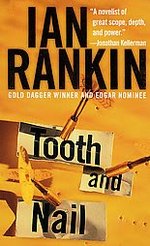
Knots & Crosses by Ian Rankin

Knots & CrossesKnots & Crosses

by Ian Rankin
Series: John Rebus, #1

Hardcover, 256 pg.
Minotaur Books, 1987

Read: February 1 – 4, 2016

Yet there had to be clues. There had to be. Rebus drank his coffee and felt his head spin. He was feeling like a detective in a cheap thriller, and wished that he could turn to the last page and stop all his confusion, all the death and the madness and the spinning in his ears.

After 21 novels and 30 years of being in print, I finally decided to give DS John Rebus and his author Ian Rankin a shot, it looks like they might stick around for a bit. Seriously, I’ve seen the names a lot over the last few years, and despite being unimpressed with his appearance in the Face/Off collection a couple of years ago (I’m sure I’ll change my opinion once I get to know Rebus a bit), when I needed a new mystery series to sink my teeth into, this looked like a good candidate.

In Knots & Crosses we meet DS John Rebus, a former SAS officer, now a Detective Sergeant in Edinburgh. He’s scraping by, he has an ex-wife and daughter; a small, dusty apartment; stacks of books; a pretty successful brother that he really has no relationship with; a large capacity for drinking; a surly attitude; and a not-that-successful program to limit his smoking. On the whole, that sounds a lot like many other fictional detectives (police and otherwise) — but there’s something about him that doesn’t seem that cookie-cutter when you read him. Maybe it’s just Rankin’s writing, maybe there’s something else — I’m not sure yet, I’ll have a better idea in a book or two (which will also give Rankin the time to distinguish Rebus). There is one other thing that separates him, but that’s the crux of this book, so I won’t get into it.

There’s a serial killer at loose in Edinburgh, killing girls and sending little notes to Rebus, taunting him about it. Sadly, Rebus doesn’t realize that for quite some time. Whoops. Not that there’s any reason for him to have seen the link, really — the killer was really more clever than he needed to be on that front. Rebus is part of the army of police working on his case, while dealing with some personal demons of his own — hopefully, the latter doesn’t prevent him from doing his part to help with the former.

The best part of the book for me was Rankin’s writing — the book is full of great sentences. Not so much that it distracts from the characters or story, but enough that you can admire his prose while enjoying the rest. This book wasn’t intended to be the beginning of a series, and doesn’t really feel like one — it’s a character study (probably a couple of characters, really), but one that’s rich enough that Rankin could come back to Rebus and build. There’s no way that future cases will be solved the way that this one was, this isn’t a prototype for Rebus’ methods, but an introduction to the detective and his world.

I liked Rebus — well, not “liked,” really. But as a character, he’s someone I want to spend more time with. Like Harry Bosch, he doesn’t seem to be a likable person, but frequently, those are the kind of guys you like reading about. I also liked that he wasn’t some sort of super cop. At one point, he’s described as not “a very good” cop, merely “a good one” (or something quite like that, I don’t have the book on me to get the exact wording). I imagine that over another 20 novels, he’ll get better — and I look forward to seeing that growth.

I really wish I’d known what “Noughts and Crosses” was before the killer mentioned it late in the book, sending me to google. I’m not sure it would’ve improved the book much for me, but I’d have appreciated aspects more and when I should’ve. Stupid “two countries separated by the same language”-thing….

Anyway, a solid beginning to the series, and more importantly, a good read for those who like police procedurals. I’ve already got the sequel on my shelf and will be getting to it in a week or so.

—–

3 Stars

2017 Library Love Challenge

Say Nothing by Brad Parks

Say NothingSay Nothing

by Brad Parks

eARC, 448 pg.
Dutton Books, 2017

Read: January 19 – 21, 2016


Since his debut novel, Faces of the Gone in 2009, I’ve considered myself a Brad Parks fan — but when I heard that he was going to step away from his series for a stand-alone, I got a little nervous. Maybe I wasn’t a Brad Parks fan — maybe I was just a Carter Ross fan. Honestly, the parts of the Carter Ross novels that he doesn’t narrate aren’t my favorite. Also, we all know all too well that for every Suspect or Mystic River, series writers can give us a The Two Minute Rule or Shutter Island — maybe grabbing this book was going to be a mistake.

Thankfully, it wasn’t.

While working on this post, I saw this from Sue Grafton talking about Say Nothing: “Terrific book. Truly terrific. Tension throughout and tears at the end. What could be better than that?” I’m a little annoyed by this, honestly. That’s pretty much how I was going to sum up things for this post. Frankly, I wish Grafton would focus her efforts on finding another 5 letters between X and Z rather than preemptively stealing my lines.

We meet Judge Scott Sampson a few minutes after the biggest crisis of his life has started — and a few minutes before he leans about it. Once you get to learn Sampson a little, you’ll see that the bar for biggest crisis for him is set a little higher than for most. He’s informed that his twin children have been kidnapped and is provided some pretty compelling reasons to believe that he’s under surveillance (and will soon be given even more reason to believe that). Basically, the message he gets is this: if you want to see you children alive and well, you will do what we tell you to with a case. There are a few tests he has to pass to demonstrate his compliance — tests that may do lasting damage to his career. But Sampson is eager to prove that he will do whatever he’s asked for his children, consequences notwithstanding.

This isn’t going to be an overnight escapade — in fact, for Sampson and his wife (how have I failed to mention Allison?), this is an ordeal of indefinite duration. The stress, the worry, the intense reaction to this situation begins taking its toll almost immediately. These pressures test their individual ethics, bring secrets to light, expose and exacerbate problems in their marriage, and generally bring them both to the breaking point. They are also both driven to discover their inner-Liam Neeson in order to get their daughter (and son) back — neither, really possess a particular set of skills fitting this goal, sadly. These attempts just make their personal and interpersonal woes worse — and their lives continue spinning out of their control.

There is a relentlessness to the pace that’s a pleasure — and a drain. Jack Reacher gets a good night’s sleep and enjoys coffee (and the less than occasional romantic interlude), Harry Bosch has jazz to relax him, Elvis Cole has that cat and Tai Chi — as intense as things may get, by and large these guys get a break. But for Scott and Allison — their children don’t stop being kidnapped, and whatever solace they might find in alcohol, sleep or family — it’s a temporary band-aid at best.

This doesn’t mean that it’s not an enjoyable read — Scott is a charming character and you will like him as you learn more about his life and family. You will not approve of every move he makes here (I guess you might, but I hope you don’t), but on the whole you will understand why he makes them and won’t judge him too harshly. Whoops, I was talking about tone here — I had fun with this, even as I was feeling a shadow of the pressure Scott and Allison are under, I even laughed once. There’s a real sense of peril when the narration focuses on the children — but it never feels exploitative.

Like most readers will, I had a couple of pretty compelling theories about who was behind everything (and why), and focused on the correct one pretty early on. Which didn’t stop me from being taken aback when it Parks revealed it — he really handled that well. Another weakness comes in the last couple of pages where Parks ties up a few loose ends, and a couple of them feel too tidy. But it’s instantly forgivable, and you want these characters to have something tidy after all they’ve gone through. On the whole, however, the characters and situations are complex and real (if heightened) — Parks nailed this whole thing. I think this will hold up to at least one repeat reading — the second read might even be more rewarding since you can appreciate what Parks is doing without being distracted by wondering what’ll happen.

The tears that Grafton mentioned? Yeah, she got that part right, too.

This is a thriller filled with real people and situations that you can believe. You’ll run the emotional gamut a time or two while reading this and will wish you could read faster just so you can make sure these kids make it home. I think I like the Carter Ross books more than this, but it’s in Say Nothing that Parks finds his stride as a crime fiction writer. Really well done.

By the way, It turns out that I am a fan of Brad Parks. Phew.

Disclaimer: I received this eARC from Dutton via NetGalley in exchange for this post — thanks to both for this, although my Primary Care Physician probably isn’t crazy about what it did to my blood pressure.

—–

4 1/2 Stars

Pub Day Repost: What You Break by Reed Farrel Coleman

This is one of those I spent a couple of days futzing around with — not sure I made it better (or worse) by doing so — I re-arranged a lot, that’s the best I can say. Both Murphy novels are tough to talk about in the abstract, which I think is a pretty good thing. There’s not a lot of fat on them — just good lean prose.

What You BreakWhat You Break

by Reed Farrel Coleman
Series: Gus Murphy, #2
eARC, 368 pg.
G.P. Putnam’s Sons, 2017
Read: December 1 – 5, 2016

Why? It’s three letters that permeate this novel. We’re all familiar with the need for an answer to that question. From the time that a toddler starts ever so persistently asking that question until the end, we keep wondering, “why?” Few need the answer as much as someone who has to deal with the unexpected death of a younger family member. In Where It Hurts, we saw just what the lack of an answer did to Gus Murphy and his life. So when a grandfather comes to Gus for help finding out why his granddaughter was brutally murdered, there’s no way that he can turn his back on the request. Especially given the inducements being offered.

He wasn’t recruited to solve the murder — the police have a man awaiting sentencing for the crime. But he won’t tell anyone anything about the crime or his relationship (or lack thereof) to the victim. The grandfather, Micah Spears, rubs Gus wrong from the get-go — if it weren’t for Father Bill’s endorsement, and his understanding of Spears’ deep need to know, Gus would’ve walked. It probably would’ve been better for him if he had. Almost no one — especially her family, the police (many of whom are still angry for what Gus turned up in the last book) — wants him to pursue this. The more Gus learns about Linh Trang (she preferred “LT”), the more he becomes convinced that there’s no reason for the killer to want her dead, which just makes the “Why?” even more pressing.

Before he can really start to work for Spears, Gus has a few other why’s to answer — why did his friend/co-worker, Slava, just drive off with the mysterious new guest at the hotel? Why did a Russian gangster get assassinated before Gus’ eyes shortly after Slava and the guest talk to him? Why is there a very formidable Russian running around Long Island looking for Slava? The focus of the novel is on the Spears case, but this storyline casts a shadow over everything. I didn’t really spend too much time in Where It Hurts worried about what would happen to anyone, and the Spears case is more of a puzzle than anything — but there’s peril to this Russian story, and the reader will become convinced that whatever happens in it, will have a large impact on Gus (and not just because of Slava’s involvement).

Gus has grown a bit, made some steps toward health since we last saw him, but he has a lot of work to do. Things with his ex- are about where they were previously, but with less anger (mutually), his romance is progressing with Maggie, and so on. Basically, Gus is becoming someone different from just the ex-cop with a dead son. That sill the core of his being, but there’s something more to it than that — maybe even some room for happiness. It’s hard to discuss briefly, but simply: Gus was better off by the end of Where it Hurts than he was at the beginning, and at the start of this novel, he was better off yet. As for the ending of this book? Well, read it and decide for yourself.

This book deals with some pretty potent things — as Coleman did when we met Gus — there’s love, friendship, loss, grief, confusion and resentment, to name a few of the ingredients in the emotional cauldron everything in the novel is steeping in. Not just from Gus, Slava and Spears — but everyone in the book is dealing with things that no one should have to, but most of us do. I’d like (but cannot expect) to circle back around and see how LT’s friends are doing in a couple of years, ditto for her sister and ex-step-grandmother. I’d like a lot more time with a judge that Gus interviews, as well as Gus’ lawyer. I expect the latter, at least, will be granted to me.

Spears and Gus do get some answers as to why LT was killed — but, as is so often the case, really those answers don’t satisfy much and lead to further questions. No tidy bows here for anything — which isn’t to say the concluding scenes of the novel won’t satisfy the reader, just that there’s no pat endings or rides off into the sunset. Just survivors (not saying how many of them there’ll be) moving on. The Epilogue will stay with you. That’s really all I can say.

This book put me through the wringer — not as much as Gus and Slava were, but still — Coleman has really topped himself from Where it Hurts, we know these people better now, so he can push them further. I lost sleep with this one, which isn’t that unusual, but I lost more sleep staying up to get through this than I have in a long time. There’s a darkness, an emptiness throughout that wasn’t there in our first encounter with Gus — or if it was, it’s changed in source and intensity. I’m not sure many readers will like where Gus is by the time we get to book 3 or 4 (including me) — but I’ll understand it. Coleman’s making sure his writing and characterization is honest, as real as fiction can get.

Once again, he delivers a crime novel that could be mistaken for a non-genre novel (as if such a thing exists), suitable for thoughtful crime readers or those who don’t mind crime to show up in a novel about a parent redefining himself after the death of a child.

Disclaimer: I received this eARC from G.P. Putnam’s Sons via NetGalley in exchange for this post — thanks to both for this. It didn’t change my opinions on the book, I was simply able to form them a couple of months early.

—–

4 1/2 Stars

The Innocent (Audiobook) by Taylor Stevens, Hilary Huber

The Innocent (Audiobook) The Innocent

by Taylor Stevens, Hillary Huber (Narrator)
Series: Vanessa Michael Munroe, #2

Unabridged Audiobook, 12 hrs, 30 min.
Random House Audio, 2011
Read: January 23 – 30, 2016


Michael Monroe’s best friend and most trusted ally, Logan needs help — he was raised by a cult as were most of his close friends, and despite being free of them for all of his adult life, he’s not been able to truly put The Chosen behind him. His friend, Charity, is possibly the only one closer to him than Michael, she grew up in the same cult and also left when she was old enough to make it on her own. Eight years before this book, her daughter was kidnapped by a member of The Chosen and taken somewhere to South America . Now, after years of searching, and her being moved from location to location, they have located her. There’s only one person that Logan trusts to bring Hannah home.

Locating one girl in the city of Buenos Aires is no easy feat. Extricating he from a controlling atmosphere without harming anyone isn’t much easier. Getting her out of the country and back into the US? More difficult yet. Throw in some donors and allies to The Chosen that aren’t who you’d expect — and aren’t nearly as pacifistic as the cultists — and you’ve got yourself a thriller.

Ever since the events of The Informationist, some months earlier, Michael’s been haunted by the deaths she’s caused — and is experiencing some kind of night terrors that keeps her chasing danger. Her own subconscious might be the biggest opponent that Michael has to deal with.

Frankly, for the first third or so (probably less), I had to force myself to stay with it, trusting that Stevens knew what she was doing — the way that Michael’s internal conflict was presented — as well as the way that Logan approached things, just didn’t work for me. I’m not sure if it was the way Stevens wrote the problems/solutions. But it wasn’t until the Michael got to Argentina that things really got me interested.

Hubner’s narration was capable and engaging — it wasn’t dazzling, but it delivered everything you want.

Despite a rocky start, once things got moving, this proved to be another satisfying thriller with Michael Monroe — and demonstrates what this series can be. I’ll be back for more soon.

—–

3 Stars

Repo Madness by W. Bruce Cameron

Repo MadnessRepo Madness

by W. Bruce Cameron
Series: Ruddy McCann, #2

Hardcover, 368 pg.
Forge Books, 2016

Read: September 7 – 8, 2016

I dropped Jake off at Kermit’s office before I headed out of town and tried to ignore how eager my dog was to leave the repo truck. ‘you know you belong to me,” I reminded him. He gave my hand an affectionate, reassuring lick. I think we both knew I was being condescended to by a basset hound.

Ahhh, Ruddy McCann — from local (and rising) sports star to someone pitied by a hound. Life isn’t that nice for him — even his heroics at the end of The Midnight Plan of the Repo Man didn’t do much to improve his life.

One day, he’s minding his business and a complete stranger comes up and tells him that he’s not guilty of the crime he was convicted of. This encounter turns his world upside down — he remembers nothing that happened around that time, he just assumed he was as guilty as he was told. But if he wasn’t?

He starts looking into things and soon finds more dead women than he expects — and before he knows it, Ruddy (and Alan) are on the trail of a possible serial killer.

He’s also found himself doing errands for (and maybe accidentally threatening people on behalf of) a corrupt banker — he is making pretty decent money this way, but he’s not sure he should. Still, he needs money as a couple of local police have taken to shutting down any of his repossession activities. So he soldiers on, while trying to find a way to take this guy down, too.

Ruddy’s having some difficulty in his personal life, too — both with his fiancée and his sister. Because a barely employed ex-con needs more complications in his life than stopping two crime sprees. Alan’s advice (as unwilling as he is to give it) probably saves the day, for him.

I’m not crazy about his psychologist as a character — but as an antagonist he worked well. Also, I’m not sure I like what we seem to have learned about Alan from him. The banker was amusing, I’m not sure I took him as seriously as a criminal, but I had fun with him. I may have liked Katie more in the last book, but she’s a good character and I enjoyed her effect on Ruddy.

I don’t know why Cameron gave Ruddy’s brother-in-law, Kermit, this knack for using the wrong word so often, but I have to tip my cap to him — it has to be hard to write (and not overdo it) and it works so well for building a character and bringing some extra lightness to his scenes.

Cameron walks a fine line between humor and serious drama — I don’t find this as funny as some, but it is light and amusing. That doesn’t take away from the drama, the danger or anything — it just makes the narrative easier to read.

This is one of those sequels that you don’t see the need for — The Midnight Plan was a fun novel, and a complete story, but it did leave the door open for this one (and Repo Madness has left at least one more open). I’m glad that Cameron brought Rudy back and look forward to his return. This was another solid outing for this unlikely hero.

—–

3 Stars

The Informationist (Audiobook) by Taylor Stevens, Hillary Huber

The Informationist The Informationist

by Taylor Stevens, Hillary Huber (Narrator)
Series: Vanessa Michael Munroe, #1

Unabridged Audiobook, 12 hrs, 30 min.
Random House Audio, 2011
Read: December 7 – 13, 2016


When I read this 4 years ago, I only had a little to say, but let’s start with it:
Heckuva ride. Vanessa Michael Munroe is Lisbeth Salander with a healthier mental state (not saying she’s perfectly well adjusted…she’s just better adjusted). Same intensity, same ferocity, same tenacity. A character you want to see more of.

I think the novel had a couple too many twists and turns–don’t ask me which could be cut out w/o sacrificing the whole, though. But really, if my major complaint about the novel is that the mystery is too complex, keeps you guessing too much? Is that really a knock?

This time through, I think I appreciated the depth of Munroe’s character and backstory a bit more. Stevens created a rich character and I look forward to seeing what she does with this world.

Huber’s narration was pretty good — she kept things going well, and captured both the emotion and tension. The only problem I had was with one character — an African male sounded too much like Kate Mulgrew doing a Russian accent for me.

—–

3 Stars

Night School by Lee Child

Night SchoolNight School

by Lee Child
Series: Jack Reacher, #21

Hardcover, 369 pg.
Delacorte Press, 2016

Read: January 5, 2016

One of the strengths of Lee Child’s Jack Reacher series is the way it bounces around in time — sometimes it’s Reacher’s post-military life, sometimes it’s while he’s serving, sometimes you get a couple of books in a row that are clearly tied together, sometimes it’s impossible to tell what chronological relationship a book has to the rest. The central character is what matters — is Reacher essentially the man we met in Killing Floor? As long as the answer is, “yes,” the rest of the details don’t matter that much.

So, following a successful classified mission, Major Jack Reacher is assigned to a training school. Which is just a flimsy cover for an inter-agency task force with Reacher, a FBI agent and a CIA analyst. The Intelligence and Defense world is trying to adjust to a post-Cold War reality, looking towards Middle East threats, rather than the Warsaw Pact. An undercover operative has indicated that something very big is on the verge of happening — no one is certain what, where, or when — but they know that a lot of money is exchanging hands to lead to it.

The White House’s directive is simple: find out what’s afoot and stop it. Whatever it takes.

Since this is Army-era Reacher, first thing he needs is Sgt. Frances Neagley, who continues to be just about as smart, possibly tougher, and more resourceful than Reacher. The CIA analyst and FBI agent are involved, but it doesn’t take long for Reacher to go his own way (with Neagley half a step behind). The other direction makes sense, but this is a Jack Reacher novel, so you know he’s right.

It’s a race against time and unknown calamity in a tense and taut thriller — just what Reacher fans want and expect. Not perfect, but a heckuva ride.

The thing that ties everything together for Reacher, allowing him to figure out what how the target pulled off what he pulled off was both entirely plausible and entirely hard to swallow. I have a hard time believing that no one before Reacher (or the target) figured it out before them. Even in the moment, with momentum driving the plot forward at top speed, I had to roll my eyes at it.

Despite the presence of Sgt. Neagley, Army-era Reacher books don’t work as well for me. He’s far better as a nomad, answerable to no one (save the occasional employer), not under any orders or required to follow certain regulations. Yes, given the setup for this one, he is able to disregard Army SOP, but only so much.

I liked it, but didn’t love it. I had a lot of fun, and was engaged throughout. But it was a little bit of a let-down after Make Me. A mediocre Reacher is still better than so many books — and this was both mediocre and better — I’m glad I read this, and can’t imagine how anyone who likes a suspense/thriller novel wouldn’t. Still, Child is capable of more, and I hope he delivers that next time.

—–

3.5 Stars

2017 Library Love Challenge

The Best Novels I Read in 2016

Yeah, I should’ve done this earlier, but I just needed a break from 2016 for a couple of days. Most people do this in mid-December or so, but a few years ago (before this blog), the best novel I read that year was also the last. Ever since then, I just can’t pull the trigger until January 1.

I truly enjoyed all but a couple of books this year (at least a little bit), but narrowing the list down to those in this post was a little easier than I expected (‘tho there’s a couple of books I do feel bad about ignoring). I stand by my initial ratings, there are some in the 5-Star group that aren’t as good as some of the 4 and 4½ books, although for whatever reason, I ranked them higher (entertainment value, sentimental value…liked the ending better…etc.). Anyway, I came up with a list I think I can live with.

(in alphabetical order by author)

Morning StarMorning Star

by Pierce Brown
My original post
I was a little surprised (but not really) today to see that every book in the trilogy made my year-end Best-Of list — so it makes sense that this one occupies a space. But it’s more than that, this book was an exciting emotional wringer that ended the trilogy in a perfect way. I can’t recommend this one enough (but only for those who’ve read the first two). When I was informed a month ago that there was going to be a follow-up series? I let out a whoop, thankfully none of my family noticed, so I don’t have to feel too silly.
5 Stars

A Star-Reckoner's LotA Star-Reckoner’s Lot

by Darrell Drake
My original post
I’m afraid if I start talking about this one that I’ll spill a few hundred words. Let me just slightly modify something I already wrote and spare us all the effort (that could be better spent actually reading these books). I’m afraid I’ll overuse the word imaginative if I tried to describe what Drake has done here in the depth I want to in this book about pre-Islamic Iran. You haven’t read a fantasy novel like this one before — almost certainly, anyway — but you should.
4 1/2 Stars

Blood of the EarthBlood of the Earth

by Faith Hunter
My original post
This probably should be a dual entry with Blood of the Earth and Curse on the Land, but that felt like cheating. Between the two, I thought that this was a slightly better work, so it got the spot. While remaining true to the Jane Yellowrock world that this springs from, Hunter has created a fantastic character, new type of magic, and basis of a series. I love these characters already (well, except for those I wasn’t crazy about previously) and can’t wait for a return trip.
4 1/2 Stars

BurnedBurned

by Benedict Jacka
My original post
I’m just going to quote myself here: I’ve seen people call this the Changes of the Alex Verus series — and it absolutely is. I’d also call it the Staked in terms with the protagonists coming to grips with the effects that his being in the lives of his nearest and dearest has on their life, and what that means for his future involvement with them. Which is not to say that Jacka’s latest feels anything like Butcher’s or Hearne’s books — it feels like Verus just turned up half a notch. It’s just such a great read — it grabs you on page 2 and drags you along wherever it wants to take you right up until the “He is not actually doing this” moment — which are followed by a couple more of them.
5 Stars

Fate BallFate Ball

by Adam W. Jones
My original post
Since the Spring when I read this, I periodically reminded myself to keep this in mind for my Top 10, I was that afraid I’d forget this quiet book. It’s not a perfect novel, there are real problems with it — but it was really effective. I fell for Ava, just the way Able did — not as hard (and only in a way that my wife wouldn’t mind) — but just as truly. This one worked about as well as any author could hope one would.
4 1/2 Stars

All Our Wrong TodaysAll Our Wrong Todays

by Elan Mastai
My original post
My all-time favorite time-travel novel, just a fun read, too. I will over-hype this one if I’m not careful. So, so good.
5 Stars

The Summer that Melted EverythingThe Summer that Melted Everything

by Tiffany McDaniel
My original post
I’m not sure what I can say about this book that others haven’t — this trip into a magical realism version of the 1980’s Mid-West will get you on every level — it’s entertaining, it’s thought-provoking, the language is gorgeous, the characters are flawed in all the right ways. I wish this was getting the attention (and sales!) that it deserves — I really hope its audience finds it.
5 Stars

Every Heart a DoorwayEvery Heart a Doorway

by Seanan McGuire
My original post
Here’s a book that doesn’t have to worry about attention or audience, it has one — and it’s probably growing. It deserves it. Short, sweet (and not-sweet) and to the point. I may have to buy a two copies of the sequel so I don’t have to fight my daughter for it when it’s released.
5 Stars

Lady Cop Makes TroubleLady Cop Makes Trouble

by Amy Stewart
My original post
Stewart took the really good historical crime novel she wrote last year and built on that foundation one that’s far more entertaining without sacrificing anything that had come before. We’ll be reading about the Kopp sisters for a while, I think.
4 Stars

Genrenauts: The Complete Season One CollectionGenrenauts: The Complete Season One Collection

by Michael R. Underwood
My original post
Yeah, here I am again, flogging Underwood’s Genrenaut stories — whether in individual novellas, audiobooks, or in this collection — you need to get your hands on this series about story specialists who travel to alternate dimensions where stories are real and what happens in them impacts our world — Underwood has a special alchemy of Leverage + The Librarians + Quantum Leap + Thursday Next going on here, and I love it.
5 Stars

There were a few that almost made the list — almost all of them did make the Top 10 for at least a minute, actually. I toyed with a Top 17 in 2016 but that seemed stupid — and I’ve always done 10, I’m going to stick with it. But man — these were all close, and arguably better than some of those on my list. Anyway here they are: What You Break by Reed Farrel Coleman (my original post), Children of the Different by SC Flynn (my original post), Thursday 1:17 p.m. by Michael Landweber (my original post), We’re All Damaged by Matthew Norman (my original post), A Hundred Thousand Worlds by Bob Proehl (my original post), and Mechanical Failure by Joe Zieja (my original post).

I hope your 2016 reads were as good as these.

Rise the Dark by Michael Koryta

Rise the Dark
Rise the Dark

by Michael Koryta
Series: Mark Novak, #2

Hardcover, 400 pg.
Little, Brown and Company, 2016
Read: September 13 – 14, 2016

“If you gave Charles Mason the mind of Nikola Tesla,” she said, “you would find yourself with Eli Pate. Or so he thinks.”

I’m really kind of annoyed that Eli Pate was described this way, because I’d pretty much came up with that comparison a page or two earlier, and thought it’d be a clever thing to say.

But first . . .

Markus Novak is continuing the hunt for his wife’s killer — and he’s starting to make progress, real progress for the first time. Far more than anyone else has in years. Markus’ prime suspect has just been released from prison, so the detective now has full access to him. I think it’s safe to say that the methods he uses aren’t endorsed by anyone. Not only that, but he’s utilizing sources that there’s no way he would’ve trusted before his experiences in the cave in the last book. Still, there’s no way he’s prepared for where the investigation takes him.

Meanwhile, on the other side of the country, Sabrina Garland is kidnapped in an effort to force her husband to do the unthinkable. The way these men come together — with plenty of ghosts from Markus’ past, results in a taught, tense thrill ride. To say more about the plot would be to ruin the thing, if you ask me, so we’ll just leave it here.

I really don’t like most of the plot devices used here — in any of the interweaving storylines. At least, I typically don’t like them — but Koryta pulled them all off. I bought them in the moment, and will still defend Koryta’s use of them (even if I feel like a hypocrite as I’ve thought about the book over the last couple of months or even as I write this). I wish I could be more specific here, but I just can’t.

The one exception to my plot problems is everything relating to Markus’ uncle.

Where plotwise this infuriated me (while entertaining me, I need to stress), on the character front, I really enjoyed this. Most of the criminals involved were interesting and well-drawn. Markus, his new allies and his uncle were so well done. I really liked where Markus went emotionally and psychologically here. Kortya has created a great character here, and I hope we see more of him.

I’m not going to rate this one as highly as I did the previous novel, but that doesn’t mean I don’t think people should read this. Everything that has Koryta’s name on it should be given a chance. In almost anyone else’s hands, this novel wouldn’t work and you’d see me trying to complain about it without giving things away. But Koryta pulled it all off, it works and leaves you wanting to return to this world.

—–

3.5 Stars

Tricky Twenty-Two by Janet Evanovich

Tricky Twenty-TwoTricky Twenty-Two

by Janet Evanovich

Series: Stephanie Plum, #22

Mass Market Paperback, 313 pg.
Bantam, 2016

Read: December 31, 2016

Stephanie’s on the hunt for a frat boy on the run, a lawn equipment thief, and a rapist. The latter two are pretty straightforward, but the frat boy, Ken “Gobbles” Globovic? Something’s not right with this one, and Stephanie puts on her deerstalker to try to figure that out.

Meanwhile, Ranger needs a woman for some security work, so naturally, Stephanie’s on the case. Things don’t go as well with that as it should’ve and bodies start to show up. That’s when things really start to get interesting.

Joe and Stephanie are both examining other career prospects, and watching Stephanie try out different ideas is good for a grin or two. I think I’d have preferred letting that play out a little more, honestly. She also could’ve played out the Grandma Mazur story longer, too — that’s something I almost never say. The former would’ve been easier than the latter, definitely. Still, there was a time when Evanovich seemed to drag out similar storylines longer than I’d like, so this “leave ’em wanting more” philosophy really works (“’em” roughly translates to The Irresponsible Reader here).

Ranger stood hands on hips and looked at me. “I’m completely enamored with you, and I have no idea why.”

“I’m cute?”

“Babe, there has to be more, but honestly, I don’t know what it is.”

I’m with him there, there are times I really wonder why I’ve read 22 of these (and plan on reading more). Now that I’m only reading one of these a year, it’s far easier to enjoy the Lula’s extremes (and/or Grandma Mazur), the same beats getting played out over and over, and so on — if anything, it’s comfortable. Part of the fun is to see the different ways that Evanvovich comes up with to hit these beats.

This time out, the stakes with Joe seem to be bigger than usual. And the crime that Stephanie uncovers during the course of her other investigations/hunts is bigger and more serious than usual. Not that serial killers and mafia bosses are the stuff of sitcoms, but we’ve seen them (in various TV/Book series) used in light ways pretty often lately.

In the end, this is a better than average Stephanie Plum adventure with enough of the old reliable characters and beats and some pretty good character moments. A satisfying read for new fans or old.

—–

3 Stars

Page 114 of 154

Powered by WordPress & Theme by Anders Norén