Category: Fiction Page 138 of 346

Across the Green Grass Fields by Seanan McGuire: The Sixth Wayward Children Novel is a Let-Down

Across the Green Grass Fields

Across the Green Grass Fields

by Seanan McGuire
Series: Wayward Children, #6

Hardcover, 174pg.
Tor, 2021

Read: January 25-26, 2021
Grab a copy from your local indie bookstore!

Regan slowed again, suddenly eager for her journey to take as long as possible. Maybe that was why the shape in the nearby growth caught her eye, and she stopped abruptly, sending a pebble clattering into the creek as she cocked her head and blinked at what was surely a trick of the light.

Two trees had grown around each other, branches tangling and twisting like the wicker of a basket. They looped in and out of one another’s embrace, until they formed what looked almost like a doorway. That was interesting, but not unique; branches often grew together, and the shapes they made in the process could be remarkably architectural. She’d seen castles in the trees when she was little, castles and dragons and all manner of fabulous things.

But she’d never seen a doorway before.

What’s Across the Green Grass Fields About?

Regan is ten-years-old when she finds this doorway, but we meet her when she’s a little younger. We see her making regrettable, entirely predictable (and understandable) mistakes when it comes to friendship, the kind of mistakes that shape her social future in ways she can’t imagine. We readers cringe, hope she’d make better choices, and then just wait to see how bad the damage is going to be when she realizes (probably too late) that she’s befriended and trusted the wrong sort of person. Other than that mistake, she seems like a sweet girl, she loves horses and riding, her family, and her friend.

The day after she learns something devastating from her parents, she learns that lesson about trust the hard way and runs away from school into the less-developed area between her school and home.

As children do in this series, she walks through that doorway and finds herself in a new world. The first person she meets (a centaur) tells her it’s called The Hoooflands. And she is excited to find a human. Humans arrive in The Hooflands when something is about to happen—when something that is plaguing their society will be confronted and defeated by the human (who have thumbs and can fit in places a centaur can’t, so there are two big advantages for the human).

But first, the centaur takes Regan to meet her family. And then years pass. She matures, she sees the errors she made in trusting the wrong people on Earth. She picks up skills, she learns who she is. Yes, she misses her family, but this is home to her and she’s content.

The Hooflands

…and there were people. Centaurs like the ones Regan knew. More delicate centaurs with the lower bodies of graceful deer and the spreading antlers to match. Satyrs and fauns and minotaurs and bipeds with human torsos but equine legs and haunches, like centaurs that had been clipped nearly in half. It was a wider variety of hooved humanity that Regan could have imagined.

On the one hand, I really like this world—of all the worlds on other sides of doors that we’ve visited in this series, it seems more viable than any of them (except maybe for maybe The Goblin Market), it takes a little less suspension of disbelief to see how the world works (once you accept the population, anyway).

At the same time…there’s something about this society that I don’t understand how it functions at all given the way that other species see each other. Obviously, this is a not-at-all-thinly-veiled metaphor for our society, but even metaphors should have some sort of air of believability. Maybe it’s just me, but every time that came up, it took me out of the story for a bit, because I couldn’t understand how the world functions (set aside justice and morality, I’m talking just in terms of practicality). It’d take too long to flesh this out, so I won’t. But it bugged me.

The individual people we spend time with in The Hooflands? Loved ’em.  They’re the best characters we’ve met in this series that weren’t connected to the School. I resented how much time McGuire let pass between chapters because I wanted to spend more time with them and to understand the Centaur culture a bit more.

So, what did I think about Across the Green Grass Fields?

It had been more than five years since Regan ran away from school on purpose and ran away from home by mistake.

So begins the endgame for this particular novella, Regan heads off to meet the Queen and do what she was brought to the Hooflands to do once and for all, and then (she assumes) to get her door back home. She doesn’t really want to leave the Hooflands, but circumstances are forcing her hand.

This is the crux of probably my biggest problem with the book—she’s spent five years telling anyone who’ll listen (primarily herself) that she doesn’t believe in Destiny, she won’t bend to Destiny. But in the end, that’s exactly what she does. I’m not going to get into a debate about determinism here, but Regan would be a great Exhibit A for my case if I wanted to.

This is not a subtle book, McGuire has things she wants to say about destiny, about the choices that others make on behalf of others that are just as binding as the choices they make themselves. And she goes about it in a blatant, almost ABC After School Special* manner. And this series is better than that. Or it usually is.

* Readers of a certain age might want to consult with a parent to fully understand that reference

I liked Across the Green Grass Fields, but this is not up to either McGuire’s standard or the standard of The Wayward Children series, and it was far enough short of those high marks that I’m having trouble generating much enthusiasm for it. The language, the storytelling style, the imaginative world were there. But they were overshadowed too frequently for my taste by the rest.

I was disappointed. Hopefully, you’re not, or if you were, it doesn’t put you off from trying the rest of this really wonderful series.

I fully expect (and hope) to see Regan at Eleanor West’s School for Wayward Children in the future and look forward to seeing what happens after she makes her way back home (even if I don’t think it’ll go well for her long-term). I’ll be back for the 2022 novella in this series, eager for what McGuire has in store, confident it won’t be like this.


3.5 Stars

This post contains an affiliate link. If you purchase from it, I will get a small commission at no additional cost to you. As always, opinions are my own.

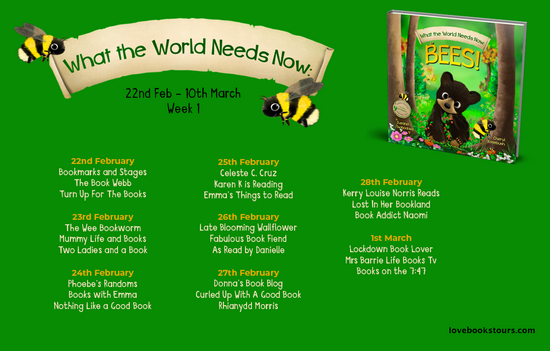
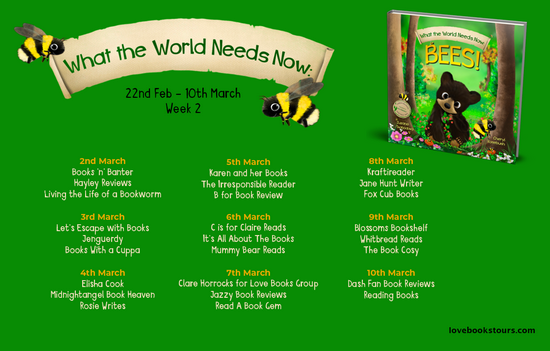
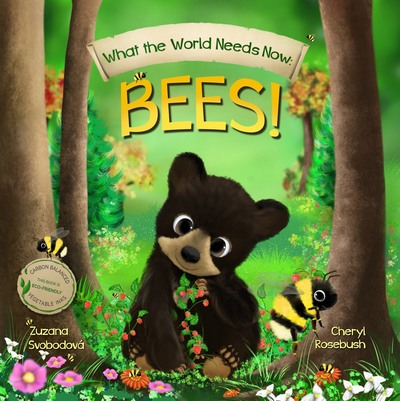
BOOK BLITZ: What the World Needs Now – Bees! by Cheryl Rosebush

Today I’m pleased to welcome the Book Blitz for What the World Needs Now – Bees! by Cheryl Rosebush.


Book Details:

Book Title: What the World Needs Now – Trees! by Cheryl Rosebush
Publisher: YPD Books
Format: Ebook/Paperback

Book Blurb:

Inside the sprawling forests of Ontario, Canada lives a friendly black bear named Melly. One of Melly’s favourite things to do is EAT! And many of the delicious fruits she snacks on wouldn’t grow without the help of some very important little forest creatures.

What the World Needs Now: Bees! explores the vital role busy, busy bees play in helping plants to grow the food people and animals love to eat.

About the Series:

What the World Needs Now is an environmental children’s book series for ages 4-8 that aims to connect the world’s youngest book lovers to the importance of nature, and our place in it.

Each book in the series follows a friendly animal through its habitat, helping kids learn about one thing the world needs now, be it more trees or bees or less plastic, to maintain a healthy planet.

The series is designed to help parents and educators lay the foundation for future learning on the world’s most pressing environmental challenges. But for our littlest kids, the connection starts at a much simpler point: their first job is to fall in love with nature – because you don’t protect what you don’t love.

The books support engaging with our kids on how we can better respect and care for the only planet we have.

About the Author:

Cheryl RosebushI was born and raised in Southern Ontario, Canada in the cities of Burlington and St. Catharines. Long before the internet and mobile phones (now I’m aging myself!), my childhood was spent in forests and parks, on bike rides, and playing hide and seek until the streetlights came on. My family did comical Griswold-style road trips in wood-paneled station wagons. We spent summers swimming in friends’ backyards. These are my very fortunate roots.

I knew from an early age that my destiny would take me far from Southern Ontario. I graduated high school and moved to Montreal to study international politics at McGill University. The subject fascinated me, but as graduation approached, I realized I didn’t know what I wanted to do with a degree in international politics. I didn’t want to become a lawyer. I didn’t want to become a politician or civil servant. The media industry, on the other hand, intrigued me.

The West Coast of Canada also intrigued me. So, after graduating McGill, I packed up again, moved to Vancouver and took the first media job I could get at a local Top 40 radio station (Z.95.3) in Vancouver. Best job. Great bosses. I learned so much. But after a couple of years there, the winds of change came calling again.

September 11, 2001. In a heartbeat, Z95.3 went from playing Britney Spears to reporting up-to-the-minute information on the local, national and international fallout of the terrorist attacks in New York and Washington. In that moment, I knew I had found my calling. I wanted to do something that was needed on a good day, and needed even more on a bad day. I wanted to become a full-time journalist.

So, I packed my bags again (a running theme in my life), and moved to Ottawa, Ontario to do my Masters of Journalism. Another incredible two years culminated in me getting a research internship with the Canadian Broadcast Corporation (CBC) in London, England. That position helped me land back in Montreal for a second chapter there as local news reporter for the CBC. While I was there, I wore just about every hat you could in CBC’s radio and TV newsrooms. Depending on the day, I was a researcher, producer, reporter, or online writer. I even filled in for the weather reports every once in a while.

https://www.cherylrosebush.com/

My thanks to Love Books Group for the invitation to participate in this tour and the materials they provided.

Love Books Group

White Trash Warlock by David R. Slayton: A Broken Family is at the Center of a Battle for A City

For the first part of this Tour Stop, we looked at the novel, White Trash Warlock from a distance, now it’s time to dive in.

White Trash Warlock

White Trash Warlock

by David R. Slayton
Series: The Adam Binder Novels, #1

Paperback, 307 pg.
Blackstone Publishing, 2020

Read: January 26-27, 2021

What’s White Trash Warlock About?

Adam Binder has the Sight. He can see mystical/magical beings, forces, phenomena. He can’t do much beyond that—he’s pretty lightweight in magical terms. But it’s enough that it messes up his childhood—he’s always looking at and responding to things that only he can see. A family that can’t—won’t?—see what he says worries for him and tries to get him to abandon this. After his father deserts the family and his brother becomes “The Man of the House,” they try to get him help and eventually put him in a treatment facility.

We don’t learn a lot about the facility, but it seems to be something right out of Cuckoo’s Nest. However, he does meet someone there who teaches him how the magical world works and how to use his meager abilities. He leaves the facility when he turned eighteen and now scrapes by doing car repairs for neighbors while he scours the area for items that seem to be produced by a Warlock. He’s convinced that the Warlock is—or will lead him to—his father, and then will understand how he got these abilities.

Meanwhile, his brother, Bobby, having done his duty for his brother got out of their small Southern town, went to college, and is now Robert J. Binder, M.D. in Denver. Robert’s wife has had a couple of miscarriages and isn’t coping well with them—he’s a shell of her former, vibrant self—and really should be getting professional treatment (I’m not sure why Robert has lost confidence in the profession). It wouldn’t have done any good, mind you, but he still should’ve tried—but as the book opens, Robert Sees something attached to his wife. Realizing he’s out of his depth, he calls Adam and asks for help.

Adam’s clues to the Warlock are also leading him to Denver, so he goes—killing two birds and one transcontinental drive, you could say. Once he arrives in Denver, he Sees that Annie is possessed by some sort of magical being that’s running amok through the city. We learn after a bit that this 98 lb. magical weakling is just the David necessary to take down this magical Goliath (yeah, it seems counter-intuitive, but that’s part of what makes it work).

He has to make alliances with some of the local Guardians (magical beings tasked with guarding an area) for aid, but ultimately it’s Adam versus the Big Bad for the safety of Denver.

Adam and Robert

This relationship is the most interesting thing in the book to me—there’s plenty of competition for that, I should add—the Guardians, the nature and origin of the Big Bad, Adam’s abilities, are a few examples. But it’s the brothers that captured my attention.

To start with, locking your brother up and never once visiting him to see how miserable the conditions were and how lousy the treatment was going, is not a great way to endear yourself to him. Robert would say he just wants what’s best for his brother, and was (and is) just looking out for him. He doesn’t understand why Adam just doesn’t get an education, find a respectable job and settle down to start a family—you know, be normal.

They grew up poor. Their father physically abused them and did not provide for the family at all. Their mother managed to keep them alive, but that’s about it—she was more than ready to let Bobby take over when it was time—and only signed the papers committing Adam because Bobby told her to.

Their horrific childhood left scars on both of them (physical—I assume—and mental). What happened to Adam made things worse for him, and the relationship is apathetic at best, and downright antagonistic at its worst.

Still, Robert knows who to call when he needs help. And Adam responds. They won’t admit it, but they need each other. Just neither is willing to pay the price to admit it, or do the work to restore the relationship in any way.

Yes, defeating the Big Bad seems to be what the book is about, but it all hinges on this relationship. I loved the dynamic, the dysfunction, and how that played out.

The Worldbuilding

I’m not going to describe it, it wouldn’t be fair to the novel (and I wouldn’t do that great a job at it). Ditto for the magic system.

The magic system reminds me of others I’ve encountered (more in traditional Fantasy than in Urban Fantasies), but Slayton’s take on it is pretty intriguing and fresh. His worldbuilding is very developed, it’s been a long time since I saw something this well-thought-out and constructed in the first book of a series. Both are commendable.

The Spoiler-y Things I’m Not Going to Talk About

So, the things I most want to discuss about this book are all things that are either spoilers or I’d have to spoil something to talk about. Which is pretty annoying. A couple of examples:

There’s someone I fully expected to develop and/or reveal magic abilities from the moment we meet them up until the point it’s clear that won’t happen. I’m happy that Slayton zagged there when I was waiting for him to zig. Also, I thought the way he pulled it off was really well done.

There’s a supernatural being that we’re introduced to—but don’t really get to see at work. I’ve seen this type in multiple TV series and books over the years. I’ve never, ever, ever, ever found it done successfully. Most of the time, I want to throw a shoe at the TV or the book across the room (timing has denied me the temptation to hurl one of these books at a fitting TV show—probably saving me from having to replace something). Slayton’s approach just might be the exception to the rule. It has good potential, but it’ll take at least one more book to know this for sure.

The Things that Frustrated Me

The fact that the most interesting part of the book (see above) was the least developed and explored. One honest conversation—or even a half-way honest conversation that gets cut off shortly before it finishes—and we could’ve seen some really strong development in these two as people and their relationship. Sure, it’s probably realistic that we didn’t get it. It’s a narrative choice to push it further to help with tension. I see and accept that, too. I can probably come up with a couple of other reasons to not give the reader that. That doesn’t mean I wasn’t frustrated by not getting it. It’s just not anything to hold against the book.

The romance on the other hand? Yeah, I think I’m going to. I’ve seen some references to it being a triangle (which would be reason enough to not be interested), but I think it’s more of someone not letting go of something that’s over than it is a viable option. On the other hand—the viable option . . . how do I say this? Adam himself wonders if it’s an organic, natural interest in each other, or if it’s magically-induced. I think the text is pretty clear that it’s the latter. Which makes it less a love story and more of two people coming to accept something that’s a fait accompli (even if they’re both not aware that’s the case).

Lastly, the way the book ends—both in stopping The Big Bad and launching into the second novel. I’m not complaining about what happens, just the way that Slayton told it. It felt to me* like as Slatyon’s gearing up to start the endgame portion of the novel, he’s continuing to plant the seeds for the second book/an ongoing arc that takes more than just two books to resolve, and gets so interested in that arc that he rushed the final 25-30% (or so) of the novel so he could get on to writing the stuff he was really interested in.

I was reading a hard copy, so I knew exactly how many pages were left in the novel, and my reaction was still, “Wait, what? That’s it?”

* I want to stress that I don’t think Slayton actually did this, it just felt like it.

So, what did I think about White Trash Warlock?

At this point, it may sound like I’m down on the novel. I’m not. As I’ve noted before, it takes more words to talk about a problem/frustration than it does to say something complimentary. Which really bothers me, but such is language, I guess. “The way that ____ hides among the humans and gets Adam the access to ____ that he needs to figure things out is pretty entertaining and cleverly done.” Especially without filling in those blanks, it’s hard to make that as large as the paragraph about the love story.

I liked the book. I didn’t like it as much as I wanted to. I didn’t like it as much as many other people did, based on the blog posts I’ve read since I finished. But I liked it.

I’m also plenty curious as to what happens next and I’m curious about Slayton’s development as a writer—does he figure out a better way to pace a novel and to wrap things up? (I’m betting he does). I liked the world he set up and the magic system (systems?) at work, and would like to see them both explored more—I really want to see more Guardians. There’s a rawness to the writing that makes it feel more natural than a lot of UF. There’s a brokenness—as well as a resiliency—to the characters that is compelling and draws you in. There’s nothing but potential for growth here and the series has a strong foundation.

I kept flashing back to last year’s Burn the Dark while reading this, they seem to come from a similar place and have a similar aesthetic. I’m glad to see Urban Fantasy like this (I’m sure there are precursors that I’m not thinking of at the moment), it makes me think that the genre is going to stay interesting.


3.5 Stars

My thanks to The Write Reads for the invitation to participate in this tour and the materials they provided.

BOOK SPOTLIGHT: White Trash Warlock By David R. Slayton

I’m very pleased and excited today to welcome The Blog Tour for the first in a new Urban Fantasy Series White Trash Warlock by David R. Slayton. This Tour Stop consists in this little spotlight post and then my take on the novel coming along in a bit. Let’s start by learning a little about this novel, okay?

Book Details:

Book Title: White Trash Warlock by David R. Slaton
Publisher: Blackstone Publishing
Release date: October 13, 2020
Format: Ebook/Paperback/Audiobook
Length: 307 pages

Book Blurb:

Guthrie was a good place to be from, but it wasn’t a great place to live, not when you were like Adam, in all the ways Adam was like Adam.

Adam Binder hasn’t spoken to his brother in years, not since Bobby had him committed to a psych ward for hearing voices. When a murderous spirit possesses Bobby’s wife and disrupts the perfect life he’s built away from Oklahoma, he’s forced to ask for his little brother’s help. Adam is happy to escape the trailer park and get the chance to say I told you so, but he arrives in Denver to find the local magicians dead.

It isn’t long before Adam is the spirit’s next target. To survive the confrontation, he’ll have to risk bargaining with powers he’d rather avoid, including his first love, the elf who broke his heart.

The Binder brothers don’t realize that they’re unwitting pawns in a game played by immortals. Death herself wants the spirit’s head, and she’s willing to destroy their family to reap it.

Purchase Links:

Amazon ~ Barnes & Noble ~ Bookshop ~ Apple Books ~ Indiebound ~ Audible

About the Author:

David R. SlaytonI grew up in Guthrie, Oklahoma, where finding fantasy novels was pretty challenging and finding fantasy novels with diverse characters was downright impossible. Now I live in Denver, Colorado and write the books I always wanted to read.

My debut fantasy, WHITE TRASH WARLOCK, is available now from Blackstone Publishing in paperback, ebook, and audio.

In addition to writing, I have taught workshops and appeared on panels at Denver Pop Culture Con, the Pikes Peak Writers Conference, the League of Utah Writers Quills Conference, and the Seymour Agency Winter Retreat. By day I’m a software implementation consultant.

I love connecting with readers, librarians, and booksellers.

My thanks to The Write Reads for the invitation to participate in this tour and the materials they provided.

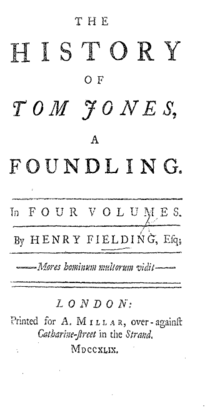
The History of Tom Jones, a Foundling by Henry Fielding: BOOK XV., iii. – vi.

Fridays with the Foundling
Tom Jones Original CoverWow. This section came within in seconds of being really dark. Sure, there have been serious moments in this novel, but…wow. I honestly had a hard time believing I was reading what the text was saying. This just didn’t seem like that kind of book. As Fielding says,

this being the most tragical matter in our whole history

But first, we’ll backtrack a bit (this whole section is a flashback that contains a flashback to get us up to the point we were at last week (or close to it, anyway).

You might recall that Lady Bellaston had this plan to help Lord Fellmar see how hung up Sophie was on Tom. It was this stupid plan where at a dinner party someone talked about witnessing a duel that resulted in the death of someone:

“A young fellow we none of us know; a Somersetshire lad just came to town, one Jones his name is; a near relation of one Mr Allworthy, of whom your lordship I believe hath heard. I saw the lad lie dead in a coffee-house.—Upon my soul, he is one of the finest corpses I ever saw in my life!”

Not at all shockingly, Sophia is distraught. And it’s not helped much when later Belaston tells her it was a prank.

Seriously? What kind of monster does that? Just wait a minute…

Fellmar sops by the next day to see Sophia, who doesn’t want to see him. He clearly has a thing for her, and she is not interested. She calls him an “odious lord” and doesn’t want anyone to admit him to her presence.

So, Bellaston comes up with a new plan—Fellmar rapes her, then she has no choice but to marry him. She’ll eventually come around and love him, but the important thing is that they’ll be married. Fellmar, to his credit, resists the notion on moral grounds. But Bellaston convinces him it’s the right thing (eventually) to do.

So, Bellaston clears out everyone from hearing range, and Fellmar corners Sophia as she reads. He pours his heart out to her, she rejects him. He’s deaf to that and more aggressively pours his heart out, she rejects him a bit more forcefully. And just as things start to get very dark Sophia is rescued.

By her drunk and enraged father, who we haven’t seen in a bit. He thinks he’s stumbled into a very different situation. He blows off Fellmar as he tries to ask for Sophia’s hand, Squire Western doesn’t want anything to do with the nobility, he wants an “honest country gentleman.” There’s a bit of a row, Western fires Mrs. Honour (so she can’t help Sophia escape again), and then Weston, the parson, and Sophia leave.

We get a chapter explaining how Western found Sophia (short version: Fitzgerald wrote a letter to his sister), but that’s pretty much where we leave things. Sophia’s on her way to get married to Blifil and Honour’s on her way to tell Tom what’s going on.

Bellaston’s gone from a semi-ridiculous plot device to a real monster. We’re done (I hope) with the Fellmar stuff and we’ve got to be headed toward the Endgame re: Blifil. The pace is picking up and I expect things are going to stay interesting from here on out.

Wake of the Bloody Angel (Audiobook) by Alex Bledsoe, Stefan Rudnicki: A Search for A Needle in a Very Wet Haystack

Small confession, before trying to write this post, I read my 2014 post from when I first read the novel, and it struck me that I didn’t have much else to say. So I shuffled it a bit, cleaned a couple of things up, and added bit here and there. That’s not cheating too much, is it?


Wake of the Bloody Angel

Wake of the Bloody Angel

by Alex Bledsoe, Stefan Rudnicki (Narrator)
Series: Eddie LaCrosse, #4

Unabridged Audiobook, 8 hrs., 51 min.
Blackstone Audio, 2012

Read: November 27-30, 2020
Grab a copy from your local indie bookstore!

What’s Wake of the Bloody Angel About?

I looked up at the stars. Finding one pirate after twenty years was a lot like picking one star out of this sky. Just when you thought you had it, a cloud slid by and you had to start all over when it passed.

Yet that’s just what Eddie LaCrosse sets out to do—find the unfindable, track the untrackable. For those of you who don’t know—Eddie lives in a fairly standard fantasy realm, and makes his living as a “sword jockey”—what we’d call a P.I. in our world. These books are first-person narratives and read a lot like good detective novels—but with swords, horses, and the occasional dragon or whatnot.

Eddie doesn’t go alone on his search for a pirate—he brings along his old friend/colleague, Jane Argo. Jane’s a former pirate turned pirate hunter turned sword jockey and is as tough as that résumé suggests. Having her come along on this adventure as the Hawk/Joe Pike figure was a great addition to a series that I didn’t think required it. But now, I want more of her—back in Eddie LaCrosse #6, or in Jane Argo #1. I could be pleased either way, as long as it’s soon.

A Killer Line

Every now and then, in the middle of this fun read, Bledsoe reminds you he can do more than tell a fun action story, and drop a sentence, or phrase that shows he’s just a good writer, period. One such line that stood out to me, and I’ve tried to find excuses to use in the last couple of days is:

Hawk’s been called many things over the years, but you know what captures him best, in my opinion? That he’s simply a shiver looking for a spine to run up.

You get a real clear idea about this Hawk guy, the image is pretty creepy in and of itself, and yet, it looks and sounds breezy unless you think about it. I like Eddie and the rest of his world plenty—but it’s that kind of thing that keeps me coming back to Bledsoe.

What I found interesting as I re-read what I wrote years ago is this very line. I’d completely forgotten it in the intervening years, but when I heard it, I mentioned it to a coworker and at least one family member, and even tweeted about it. It struck me as a perfect line in 2014, and it did the same again in 2020. I clearly have a well-defined taste and will probably rave about it the next time I read/listen to this novel.

The Paranormal

The last thing I can think to note is that this book briefly features the creepiest little girl I can remember since Let the Right One In. I really can’t talk about her without ruining too much, but let me just say that absolutely loved the way that Bledsoe used her. And no, I’m not going to talk about why I mention her under “The Paranormal.”

For a Fantasy series, Bledsoe is very careful—almost stingy—with his use of magic and the paranormal. But when he uses it? It’s so effective. We get just a few incidents of it here and I love watching the choices Bledsoe makes regarding them.

The Narration

Obviously, as it was over 6 years ago that I read the book, I could be wrong about this, but I think that Rudnicki’s narration added another layer to the novel, and it struck a deeper chord with me. It’s not like I didn’t enjoy the book when I read it, but listening to it seemed to be more effective. I attribute that solely to Rudnicki. He just does a great job not only with Eddie, but with all the other characters—Jane Argo and the last new character we meet in particular.

So, what did I think about Wake of the Bloody Angel?

There’s adventure, piracy, sword-play, banter, friendship, and a bit of betrayal. That’s pretty much what you want in a novel like this, right?

Bledsoe did a great job of nailing the life of a ship (says the guy who gets too seasick to even contemplate a day-long voyage)—both the tedium of day-to-day and the excitement of boardings (or other adventures at sea).

I couldn’t have seen the ending coming, nor the details it revealed. But it worked, it absolutely worked both as interesting plot development, and as strong character moments. So well done.

I’ve only got one novel in this series to go, and I’m excited to get to it, but I don’t want things to end. That’s a good place to be.


4 Stars

The Salvage Crew (Audiobook) by Yudhanjaya Wijeratne, Nathan Fillion: A Unusual Tale of Artificial Intelligence, Cascading Failure, and Poetry

The Salvage Crew

The Salvage Crew

by Yudhanjaya Wijeratne, Nathan Fillion (Narrator)

Unabridged Audiobook, 8 hrs., 21 min.
Podium Audio, 2020

Read: January 20-22, 2020

Red Dwarf Remix?

I’m not suggesting for a second that Wijeratne’s mind worked this way (at least I don’t mean to), but this is the impression I got as this started.

The Red Dwarf TV Show/Novels had a couple of great ideas at the beginning—an AI that ran the ship, that had a strange personality, an odd sense of humor, and wasn’t entirely reliable. The second was that the ship generated a holographic officer based on the memories and personality of one of a dead member of the crew (whoever was highest ranking/most needed among the dead). A long time ago, it had been determined that AI with memories and real emotions actually perform better than those not based on actual humans.

Our main protagonist and narrator in this novel is an AI, made from the memories and personality of an engineer who served his whole professional life in space (after leaving his family’s farm). He’s now in charge of a small salvage crew for the company Planetary Crusade Service, sent to a tiny planet Urmahon Beta to recover as much as they can from an old colony ship that presumably crashed there.

His role is Overseer, and his crew nicknames him OC. This is OC’s first command, if it goes well—and a few others—he can move up to a larger, better body/command. In a few decades or so, he could work is his up to a large ship, overseeing a major operation. Again, that’s if everything goes well.

Everything Doesn’t Go Well

OC is promised an “A-Team” of a crew for his first command. He doesn’t get one. They’re not a B-Team either. There are not enough letters to describe how far this trio is from an A-Team. For that matter, I’m not sure OC is A-Team material either—they land far off-course (turbulence during descent, we’re told).

Almost instantly, the crew starts falling apart, ignoring orders and protocol. They begin to build a base to work from, but get distracted by things like indigenous flora and fauna, personality conflicts, and evidence that suggests they may not be the only salvage crew on the planet (there’s a rival company with bionic operators with aggressive tendencies).

From a rough start, it gets worse, and the next few weeks are a spiral of cascading failure, disease, injuries, strife, crop failure, questionable vodka distillation, bargain-basement tech, and…well, I can’t keep going. It gets messy, and what starts off as a quirky, comedic version of The Martian with a side of Red Dwarf turns into something tense, taut, dark, and suspense-filled. It doesn’t stay that way, depending on how you want to count things, ends up taking one or two other overall flavors, while never completing shedding the offbeat humor that characterized the book since the opening paragraph.

Poetry and Other Quirks

I’m going to focus on OC, rather than the rest of the crew (and they are all worth writing about) to keep this short (and because you really need to get into spoilers to do a proper job of talking about the humans). He is funny. There’s a snarky, offbeat humor to his narration and dialogue throughout.

He’s also a poet. I’m not saying he’s a good one, but he is one. Frequently in Fantasy novels (particularly older ones that wear their Tolkien-influence on their sleeves), you get a lot of poetry/songs/etc., but that’s rarely a feature of Science Fiction novels. The Salvage Crew is the exception to this rule. OC writes it, recites it to his crew to encourage them, he quotes and ruminates on other’s poetry…he’s the most poetic AI I think I’ve ever encountered in a novel. He’s also a Buddhist, and will often apply that to his situation.

He also has the best curses. He’s frequently letting off steam by cursing his crew, PCS executives, or local fauna to a horrible future reincarnation. I could have listened to some of those for a solid hour.

Fillion’s Narration

It’s tough to say for certain, but I think that Fillion raised this about a star in my book (maybe just a half). It’s his voice, his charm that hooks you in and gets you to like, believe in and root for OC. That said, at some point, I stopped thinking of this as Fillion, and just let OC tell me a good story.

It’s not the best narration I’ve ever heard, but it’s really good and it made me hope that Fillion does more audiobooks.

Co-written by AI?

So, there was apparently actual AI software involved in the writing of this. I learned about this when I started writing this post, and I’m not sure I understood everything I skimmed (I didn’t want to take the time to read carefully instead of just posting this). I’m intrigued by this notion, but am relieved to see that the software only “helped” with portions of the book and that Wijeratne was the final word.

So, what did I think about The Salvage Crew?

Roughly the first half of the book* is about what I expected—an amusing SF adventure—and was a lot of fun to listen to. The rest of the book isn’t what I expected from the premise in terms of story or tone. And I was riveted. There are portions of the book that get into more philosophical territories, and while I wasn’t as interested in them as I think the novel wanted me to be, they were really well constructed and told.

* This is an estimate, I didn’t jot down notes about when the tenor of the plot/novel changes)

I’m really glad I took a chance on this book, I’ll definitely listen to future audiobooks by Fillion (assuming any are produced) and am probably going to be trying some of Wijeratne’s other novels. I heartily recommend it to SF readers/listeners.

Disclaimer: I received this eARC from Podium Audio via NetGalley in exchange for this post—thanks to both for this.


4 Stars

2021 Audiobook Challenge

Pub Day Repost: We Could Be Heroes by Mike Chen: A Super-Powered Thief and Vigilante Together Could Be Extraordinary

We Could Be Heroes

We Could Be Heroes

by Mike Chen

eARC, 336 pg.
Mira Books, 2021

Read: January 11-14, 2021
Grab a copy from your local indie bookstore!


At this point with Mike Chen, I don’t bother looking at the book blurb, I just read what he publishes. But so I could decide how much to say in this post, I had to go look at the blurb. Just between you and me, I think I wouldn’t have given as much away as it did, but now I feel a little freer about what to say.

Jamie Sorenson/The Mind Robber

Two years ago, Jamie Sorenson woke up in an apartment with no memory of who he was or how he got there (the name is something he picked). He’s a coffee snob, has taken in a stray cat that he’s named, “Normal.” He reads a lot of autobiographies and memoirs from the library, because he likes hearing life stories since he doesn’t have one.

Oh, and he has super-powers. He can read people’s memories, and erase a little bit of them. He uses these abilities to rob banks as “The Mind Robber.” He’s not living an extravagant lifestyle with these funds, in fact, he lives fairly frugally. His goal is to save up enough to finance his retirement on a tropical beach—just him, Normal, coffee, and books. If he can just pull off one or two more without getting caught, he should be able to do just that.

He was almost caught once, and he’s pretty sure he won’t be able to evade capture too easily next time. He was almost caught by:

Zoe Wong/The Throwing Star

She, too, woke up without memories in an apartment two years ago. She had a name tag, so at least she didn’t have to come up with a name. She spends her time watching horror movies on an app on her phone and drinking so much I think I might have liver damage from reading about it. She makes ends meet by working for a food delivery service.

She doesn’t drive for one, though, she has super-powers, too. Including speed—not Flash or Quicksilver fast, but she’s fast. So fast that she can deliver food fast enough to maintain a 5-Star rating, even though she’ll take quick detours to beat up criminals. She’s also super-strong (not quite Superman-level, but more than Captain America) and has a couple of other tricks up her sleeve.

She’s assembled enough of a uniform to stand up to the punishment her speed puts on normal clothing and to protect her identity, and was dubbed “The Throwing Star” by the press. Although, she’d prefer Shuriken, not that anyone asked. Besides, she’s pretty sure she’s of Chinese descent, not Japanese, so both names are problematic.

The Team Up

Jamie regularly attends a support group for people with Dementia or other memory problems. No one’s treating them there, it’s just a place for emotional support. One day, not long after he’s almost captured by The Throwing Star, Zoe walks in. Afterward, the two have a quick conversation by the coffee pot and (thanks to their abilities) recognize each other. For the sake of the group, they don’t start battling each other, instead, they talk.

A few things happen, and then Zoe decides to ask Jamie to help her with her memory—surely, he can use his powers for something other than crime, right? They strike a little quid pro quo deal and get to work.

From this point, two things happen, one harder to believe than the other. First, they start to uncover things about Zoe’s past (and Jamie’s, although he’s really not that interested at first) that lead them to a therapeutic organization that seems to have something else going on. And, the two begin to become friends.

It’s that “something else,” naturally, that gets their attention. It’s not long before they discover that not only does this organization (or maybe just what it’s a front for) hold the key to their pasts but has a secret plan to change to the world as we know it. To combat it, this thief and this vigilante might have to be something more, they might have to be heroes.

The Mad Scientist

A mad scientist at work is a mainstay of Super-Hero Fiction and Chen delivers that well. Not just a mad scientist, but one who doesn’t see herself in that way. Indeed, she’s going to save humanity from itself and the world from humanity while she’s at it. And sure, she’s doing this on her own, without consulting the countless lives that she’s going to radically alter, because when you’re a super-genius with a messianic-complex (among other psychiatric problems) playing with unimaginable technology, who cares what anyone else might think?

That sounds almost dismissive, and I don’t mean it to be. She’s a well-drawn character, absolutely convinced she’s doing the right thing, and is pretty convincing about it. Don’t get me wrong, I love a super-villain who’s just out to watch the world burn, or driven by pure avarice. I was raised on that stuff. But a super-villain convinced they’re the city’s/nation’s/world’s savior? There’s something more compelling about them, and that’s what we have here.

Extraordinaries

One challenge that non-Marvel/DC Super-Hero Fiction has it coming up with what they’re going to call their costumed, super-powered crime-fighters. Most of the time, I note the term and move on, while it’s usually a serviceable term, it’s a challenge to come up with something that really clicks on this front.

Chen’s world uses the term, “Extraordinaries.” That’s catchy, a little quirky, and it sticks with you. Sure, this is a minor point, but you add up enough of these minor points, and you elevate a good book into something more.

The Mike Chen Factor

The something more…does this have it? Readers of this blog know that I’m always game for a Super-Hero novel, and from early on, it was clear that this was a good one. And that’d be enough for me to recommend it, maybe even highly recommend it. But Here and Now and Then and A Beginning At The End have taught me that I should expect something more than just a good Time Travel/Dystopian/Super-Hero novel from him. The Mike Chen Factor.

And while I didn’t go looking for it—that would distract me from this entertaining story—I did keep wondering when it’d crop up (and if I’d recognize it right away). I think it popped up in a couple of different places and while I espied one instantly (or pretty quickly) the other slipped by me until it was in full bloom—making it my favorite.

The first thing that makes this more than a good Super-Hero novel is that it’s about the role our memories play in who we are—our identity, our personality, how we act. Two characters whose tabulas are about as rasa as you can get make excellent candidates to explore this. In the end, one character’s deliberate choices in spite of natural inclinations and what we learn about their past becomes something they didn’t expect. While the other character is driven by their past (especially the parts they can’t remember but shaped who they are) and ends up being a better (more complete) version of what they were all along.

So, you know, if you were looking for Chen to settle a debate, I think you can skip that.

The other expression of the Mike Chen Factor was the friendship that develops between Jamie and Zoe. This was something special. Too, too, too often when we look at relationships in fiction (in whatever medium) we focus on romantic relationships, familial bonds, or even that between enemies. We don’t see enough explorations of friendship. I wish we had more of them—Rick and Louis aren’t the only one’s with a beautiful friendship, a well-written one is a great thing.

And Jamie and Zoe’s friendship promises to be a beautiful friendship, it’s off to a great start, anyway. I think the reader sees it before either of them do, which is an added layer of fun. But before they realize it their mutual aid pact starts to carry shades of something else. They banter, they tease each other (including in that almost-cruel way that only good friends can), they look out for each other beyond what’s needed for their project and care about each other. Eventually, they’re inspiring each other to be more than they think they are.

So, what did I think about We Could Be Heroes?

This was great. It was a good Super-Hero Story that had a lot of other things going on. Like Chen’s other work, it could probably spawn a sequel or two—but probably won’t.

Can you enjoy this without spending time thinking about what he’s exploring in terms of identity, memory, and friendship? Sure—I don’t know why you’d want to, but if you’re just looking for a compelling story featuring people in outlandish dress flexing super-abilities, this would absolutely fill that need. On the flip side, if you prefer to focus on the other material? This would work, but you’d have to put up with the Super-Hero stuff, and that might be harder for you. If you’re a Greedy Gus like me and want it all? You’re definitely in for a treat.

There’s a little something for everyone here, get to it.

Disclaimer: I received this eARC from Harlequin Trade Publishing via NetGalley in exchange for this post—thanks to both for this.


4 Stars

This post contains an affiliate link. If you purchase from it, I will get a small commission at no additional cost to you. As always, opinions are my own.

The Mask of Mirrors by M. A. Carrick: I Struggle to Adequately Describe this Stunning Fantasy Novel

In the first part of this Tour Stop, we got quick intro to this novel, now let’s dive in and talk about it.
The Mask of Mirrors

The Mask of Mirrors

The Mask of Mirrors

by M. A. Carrick
Series: Rook & Rose, #1

eARC, 697 pg.
Orbit Books, 2021

Read: January 18-23, 2021
Grab a copy from your local indie bookstore!

What’s The Mask of Mirrors About?

What isn’t it about, really? In The Princess Bride novel, the fictionalized William Goldman recounts how his father introduced the story to him:

“Does it have any sports in it?”

“Fencing. Fighting. Torture. Poison. True love. Hate. Revenge. Giants. Hunters. Bad men. Good men. Beautifulest ladies. Snakes. Spiders. Beasts of all natures and descriptions. Pain. Death. Brave men. Coward men. Strongest men. Chases. Escapes. Lies. Truths. Passion. Miracles.”

That would work as a decent start on a list of what this book is about (except the bit about Giants, maybe they’ll be in the sequel), but just as a start. There’s just no way to say what this book contains briefly. At times it felt like Carrick* took an “everything but the kitchen sink—and all right, we’ll throw that in, too” approach.

* Yes, I know that Carrick actually equals two authors, but there’s one name on the cover and it’s just easier to play along with the conceit for the purposes of this post.

If you find yourself not particularly enjoying a storyline (either at all, or in a particular moment), that’s fine, just wait a couple of pages and you’ll be on to another that will quite possibly be to your liking.

Yeah, often this kind of thing feels unwieldy, clumsy, and hard to follow. But somehow—Carrick pulls it off. It’s a grand-scale novel—focusing on several people, classes, and segments of the city, but feels very contained, very personal, and not all that difficult to take in at once.

I joked while reading this that I didn’t know how I was going to be able to talk about this novel in less than 10,000 words. And I really think it’s true if I wanted to do a complete job. But no one wants me to do that. So I’ll set “complete” aside and go for “almost adequate” instead. The best way to do that is to start our discussion with the initial plotline:

The Long Con

Years ago, Ren and Tess were low-level thieves, working for a Fagin-esque character. The sisters split from that group in a fairly dramatic fashion and left the city of Nadežra. Now, they’re back to make their fortune. Ren poses as Renata Viraudux, an estranged family member of one of the city’s noble families, with Tess at her side as Renata’s maid.

The plan is to endear themselves to the Traementis family and to be officially listed as one of them. She can then plunder their accounts and set the two of them up for a comfortable life. Ren had a good period of time working as the maid of the woman she’s now pretending is her mother, so she knows her, she knows stories about her family—so she’s able to pull off the con pretty well (at least at first).

But there’s a catch..the Traementis family is on the verge of falling apart. Tragedy has whittled the family away to Donaia (the family’s head and the sister-in-law of Letilia, Renata’s supposed mother) and her two children, Leato and Giuna. And the family’s material wealth has been chipped away even more. There’s enough to barely sustain their lifestyle, and Donaia isn’t sure how long she can continue doing that. Some nobility suspects this to be true, but no one other than Donaia knows it—Renata is very ignorant about the status of her targets. Which almost makes her doomed before she begins.

Do note that “almost,” because Ren is as clever and resourceful as you could want for this situation. Once she discovers the family’s situation, she’s not going to let a simple thing like the verge of bankruptcy stop her.

There are times when I almost wanted Ren to get caught—protagonist or not, she has it coming and you will frequently like Leato and Giuna a lot more than her (also, it’d be a lot of fun to see Ren try to get out of it). But overall, you get sucked into her cause and find yourself rooting for her.

In many ways, this story is the heart of the novel. But the more I thought about it as I read—this story is really just an excuse to get Ren involved in everything else going on in Nadežra, and it could practically be eliminated without doing a lot of damage to the book. It is, however, a load-bearing plotline and can’t be removed without doing structural damage (it just feels like it). That may seem like a criticism, but it’s not intended to be one—I find myself oddly drawn to the idea that there’s enough other things of interest and weight going on that you could excise the Primary Plotline and still have a novel worth reading.

The Masked Vigilante

Nadežra, like all good fictional cities, has a masked vigilante running around. The Rook has been a presence for a couple of centuries, defending the helpless, punishing the wicked—particularly if they’re part of the nobility. The Rook is sort of a Batman/Zorro-esque figure, stepping out of the shadows (or on the rooftops). We meet him first as he comes to duel with an arrogant twit over an offense straight out of Cyrano de Bergerac, and who can resist that? He remains a favorite part of the novel for me, dropping in at pivotal moments, but not becoming a focus for long.

Ren quickly becomes fixated on him and in discovering his identity. It is fun watching her try and try to either discover or figure out his identity.

The Quest for Legitimacy

Derossi Vargo, how do I discuss him? Think Lando Calrissian meets Michael Corleone. Vargo has spent years building and building his power base and at the time that Ren comes to the city, he’s at the top of the criminal portion of the city. He’s so powerful now that he’s itching to shed that side of him and embrace being a legitimate businessman. He just needs the chance.

Renata sees this and forms an alliance with him. He aids her in some of her schemes to prop up the Traementis family’s standings and success and she, in turn, will help him with his schemes. Neither fully trusts the other, but they can be of mutual benefit to one another, and that’s enough for them. The relationship builds from this point—but both Ren and Vargo are careful enough with their secrets, their plans, and their ambitions to truly let the other see what’s going on—but they have that in common and can respect that.

Vargo is charming and suave, and it’s easy for the reader or other characters to get swept up in that to the extent that they forget how he got to the position he’s in. There’s a cunning and ruthless criminal underneath his finery and smooth words. At the end of the day, Vargo is about Vargo’s success, and if you’re in his way—you need to watch yourself.

An Eye for Tailoring

Now, while I had moments where I thought it’d be good to have Ren captured by the authorities, I never thought that for a moment about her sister, Tess. And Tess is the best argument for keeping Ren free and clear—I just couldn’t stomach her being injured or imprisoned herself (and either would happen if Ren fell). She’s one of those characters that readers immediately fall in love with and want to treat as a little sister. Woe betide any author who hurts her, I can’t imagine readers of this series letting anyone get away with that.

She’s Ren’s accomplice, for sure, but she’s not in her sister’s league when it comes to criminal behavior. She’s sweet, she’s not out to get rich—she just wants enough to be able to have enough money that she could design and make dresses—maybe do a little cooking. There’s a hint of a romance for her, and I found myself more invested in her happiness in that than I have been in other romances that form the central plot in several other books lately.

Tess has no magic abilities (that we know of), but she might as well have some when it comes to fabrics. She single-handedly keeps Ren at the forefront of Nadežran fashion, usually using scraps and bargain fabrics from the market. Her reactions to other people’s fine tailoring are a delight (she practically swoons the first time she encounters Vargo over the cut of his jacket). Frequently this is the only source of comic relief in some pretty dark places of the novel.

The Cards

One of the aspects of this novel, this world, that I appreciated most is a Tarot-like practice. The cards are called a Pattern Deck. Much like Tarot, the cards are cut and dealt out, then interpreted (and there’s both an art and a skill involved in that). There are people who read patterns (szoras), some of whom have the gift to truly do this and some are hucksters just making money off gullible patrons. I think it’s that fact that sold me on the novel. How often in Fantasy novels do you get that? A magic system that’s true, that really works, and yet many/most of its practitioners don’t have the necessary ability, yet continue to practice?

The Worldbuilding

As you read this and come across references to cultures and historical events/people, you almost get the impression that Carrick has a two or three-volume set of books on the history and culture of Nadežra to draw from. Not that the text approaches an info dump ever (even when you wouldn’t mind a little one), and Carrick is very sparing with the details drawn from my theoretical three volumes.

The world, the various religions, and magic systems, the system of nobility and government the cultures that make up the populace of Nadežra . . . it’s all so well and richly developed that it has to impress the reader. I love a good bit of worldbuilding as much as the next guy, and it doesn’t get much better than this.

So, what did I think about The Mask of Mirrors?

Time does not permit me to keep going (and, let’s be honest, this is already getting obnoxiously long), so let’s try to wrap it up (if only so I can go over my notes and see what all I forgot to mention).

This is an impressive novel. At one point I was going to try to discuss the greater themes this work dealt with. But I think it would be almost as Sisyphean as trying to list the plots in this brief of a post. For a long time, I was going to talk about the futility of vengeance. But I’m not that certain it’s correct (maybe by the end of the series, I’ll have an idea what they’re trying to say about revenge). There’s a great deal said about family, loyalty, being trapped by history (personal and cultural), perception, and…you know what? I’m falling into that trap I’d tried to avoid. There’s a lot to chew on while reading beyond the story and characters—and you’ll easily keep mulling on the novel and whatever themes you were more interested in from it for days.

Carrick has a wonderful style, there are some very cleverly assembled sentences here—and the way the story is told is clever and impressive, also. There were times when I didn’t care all that much about the characters being focused on or a storyline, but I couldn’t stop reading, I had to know what was going to happen next. I’m not sure how that’s possible to have no (conscious) investment or interest in people or what’s happening to them, but an intense desire to know what’s next for them. But Carrick does it—and does it in such a way that pretty soon I was interested in at least the story or characters again (usually both).

The plots (individually considered) are complex and layered, meticulously assembled and paced well throughout the novel’s progress. Then Carrick takes them and weaves them together in an intricate and smart way to make these plotlines a rich tapestry. The skill necessary for this, and the effect this has is stunning. I am a little concerned that when the sequel is published I won’t be able to remember enough of this to be able to dive in—and that’s the worst thing I can say about the book.

I can’t quite bring myself to give this all 5 stars, but I don’t feel too bad, when I cross-post this to platforms that won’t let me get away with half-stars I’ll end up rounding up. It’s entertaining, it’s impressive, it’s richly and wonderfully told, it’s complex and filled with complex and developed characters. It’s as difficult to succinctly evaluate the book as it is to describe it.

I guess I should just say: read The Mask and the Mirror, it’s absolutely worth your time and you’ll thank me for it. You’ll also see why I’m having trouble crystallizing my thoughts.


4 1/2 Stars

Disclaimer: I received this eARC from Orbit Books via NetGalley and Compulsive Readers in exchange for this post—thanks to all for this, but the opinions offered above are solely mine.

This post contains an affiliate link. If you purchase from it, I will get a small commission at no additional cost to you.


My thanks to Tracy Fenton and Compulsive Readers for the invitation to participate in this tour and the materials (including a copy of the novel) provided.

BOOK SPOTLIGHT: The Mask of Mirrors by M. A. Carrick

I’m excited to welcome the Book Tour for the compelling first installment in the Fantasy series, Rook & Rose, The Mask of Mirrors by M. A. Carrick this morning. As is my practice, I’ve got this little spotlight post and my take on the novel coming along in a bit. But let’s start by learning a little about this book, okay?
The Mask of Mirrors

Book Details:

Book Title: The Mask of Mirrors by M. A. Carrick
Publisher: Orbit Books
Release date: January 19, 2021
Format: Hardcover/Ebook/Audiobook
Length: 675 pages
The Mask of Mirrors

Book Blurb:

‘Utterly captivating. Carrick spins an exciting web of mystery, magic, and political treachery in a richly drawn and innovative world.‘ S. A. Chakraborty, author of The City of Brass

Darkly magical and beautifully imagined, The Mask of Mirrors is the unmissable start to the Rook & Rose trilogy, a rich and dazzling fantasy adventure in which a con artist, a vigilante, and a crime lord must unite to save their city.

Nightmares are creeping through the city of dreams . . .

Renata Virdaux is a con artist who has come to the sparkling city of Nadezra — the city of dreams — with one goal: to trick her way into a noble house and secure her fortune and her sister’s future.

But as she’s drawn into the aristocratic world of House Traementis, she realises her masquerade is just one of many surrounding her. And as corrupted magic begins to weave its way through Nadezra, the poisonous feuds of its aristocrats and the shadowy dangers of its impoverished underbelly become tangled — with Ren at their heart.

‘Wonderfully immersive–I was unable to put it down.’ Andrea Stewart, author of The Bone Shard Daughter

‘An intricate, compelling dream of a book’ Melissa Caruso, author of The Tethered Mage

‘I was utterly entranced by this glittering world filled with masked vigilantes, cunning conwomen, and dark magic. A sheer delight!’ Katy Rose Pool, author of There Will Come A Darkness

About M. A. Carrick:

M. A. CarrickM.A. Carrick is the joint pen name of Marie Brennan (author of the Memoirs of Lady Trent) and Alyc Helms (author of the Adventures of Mr. Mystic). The two met in 2000 on an archaeological dig in Wales and Ireland — including a stint in the town of Carrickmacross — and have built their friendship through two decades of anthropology, writing, and gaming. They live in the San Francisco Bay Area.


My thanks to Tracy Fenton and Compulsive Readers for the invitation to participate in this tour and the materials (including a copy of the novel) provided.

Page 138 of 346

Powered by WordPress & Theme by Anders Norén