Category: Fiction Page 260 of 351

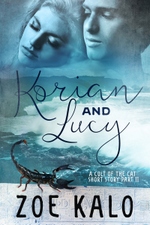
Korian and Lucy, Part II by Zoe Kalo

Korian and Lucy, Part IIKorian and Lucy, Part II

by Zoe Kalo
Series: The Cult of the Cat, #.06

Kindle Edition, 35 pg.
2016

Read: November 29, 2016


I’m not sure how to go about this — this makes no sense if you haven’t read Part 1 of this tale — and neither would really make that much sense without the novel, Daughter of the Sun. So if you haven’t read either — skip this, really. Go read Kalo’s novel (or at least my take on it) instead of this post.

Still, I want to say something — and not just because I said I would. I liked this a whole lot better than Part I , which is just about the fainted praise possible. And, like with the novel, Kalo is starting to win me over — she has a certain charm, no doubt about it. I liked Lucy more after this book — her mother. too — and I’m a tad more interested in the story. All good — and well done, Kalo.

Here’s the problem: I’m less convinced than I was after Part I that Kalo’s readers need this story. We haven’t gotten anything we couldn’t and wouldn’t have assumed from what we learned in the novel about this period. I don’t need to know anything about Trinity’s mother, or her romance with Trinity’s father, to be invested in Trinity. Also, I’m not sure that Part II actually accomplishes anything other than letting us know that time passed and that the pregnancy progressed — oh, and it charms curmudgeonly readers like myself. But the story needs to do more than that to justify itself, doesn’t it?

Now, will Part III be able to change my mind about this entire story? Sure. I truly hope it does. But at the present, I don’t see why she bothered with this installment.

Still, I enjoy this world — I like Kalo’s writing (which was better here than in Part I, but not as good as in Daughter of the Sun, Kalo’s one of those writers that needs space), so I’m glad I read this, as will most of her readers be. I’m looking forward to Part III (and truly hope that it wraps things up) — but even more, I’m looking forward to the sequel to Daughter of the Sun.

Disclaimer: I received a copy of this from the author in exchange for this post and my honest opinion.

—–

3 Stars

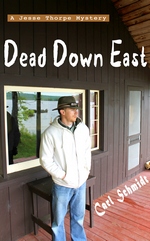
Dead Down East by Carl Schmidt

Dead Down EastDead Down East

by Carl Schmidt
Series: Jesse Thorpe, #1

Kindle Edition, 244 pg.
Carl Schmidt, 2016

Read: December 8 – 9, 2016


Jesse Thorpe is a carpenter and member of a local band, who happens to be a P. I. on the side. The P. I. part doesn’t seem to take up too much of his time or draw much attention to itself, few people in his life know that’s one of his professions. Still, he’s had a few clients, taken care of a few cases — enough to give him some confidence in what he does. Then one day, a fishing trip is interrupted by a former client, who just found herself in the middle of circumstances surrounding the murder of her married lover. Who happens — well, happened — to be the Governor of Maine.

Maybe Jesse could use a little more experience.

It doesn’t take long before Jesse is working for his former client and two other people to investigate the murder, while the FBI and local police are stymied. Jesse’s client isn’t the only one that the Governor had an affair with, and the investigation into the affairs keeps Jesse busy and turns up plenty of motives for murder. It’ll take all of Jesse’s creativity, and the efforts of a motley crew of clients, bandmates, his sexy girlfriend, a friendly policeman, and a lotta luck for Jesse to clear the innocent and make sure the guilty pay.

I really don’t think the psychic adds anything beyond a chuckle or two, but that could just be me.

There were a few places where the book could’ve used some editing and proofreading — but only one that took me out of the scene, so I’m not going to get into it. Well, there was also the repeated use of “FBI Officers” instead of “Agents,” but that was easy enough to chuckle about and move on.

The first couple of chapters were difficult to wade through — dialogue seemed to be more about short speeches than anything, and the first few people talking about the murder sounded like they were contributing to or reading a news release about it. But once Jesse gets hired and things start to happen, Schmidt settles in and the writing improves. The only complaint I have after this is that he tends to over-explain things — especially the humor. He needs to trust himself and his readers a bit more and dial that back.

There’s not much more to say, Dead Down East is a pretty good mystery with a cast of characters that I’d enjoy seeing more of. Give Jesse a shot.

Disclaimer: I received this book from the author in exchange for my honest opinion — which influenced me not one whit, but I do appreciate it. I’m sorry that I filed it under “December Reads” and not “October Reads” like I’d said I would.

—–

3 Stars

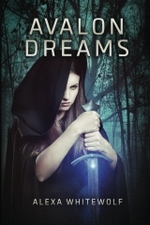
Avalon Dreams by Alexa Whitewolf

Avalon DreamsAvalon Dreams

by Alexa Whitewolf

Kindle Edition, 659 pg.
2016

Read: December 5 – 7, 2016


There’s a decent novel hidden in these pages, and I do appreciate what Whitewolf tried to do, but it just didn’t succeed for me. But let’s focus on the positive for a bit.

Vivienne Du Lac, who in a future life was The Lady of the Lake (as in, “The Lady of the Lake, her arm clad in the purest shimmering samite, held aloft Excalibur from the bosom of the water…”) has been reincarnated into the modern life as a nervous, socially awkward historical researcher. One day, the reincarnation of her former bodyguard, Sébastien, shows up in town and everything goes to pot.

Sébastien is dealing with the effects of an ancient curse, and is torn between his strong desire to serve and protect Vivienne, while being convinced that he’ll cause her harm. In her previous life, Vivienne was served by a demon dog — who finds himself as a large Caucasian Shepherd, with diminished magic. Alistair’s a fun character — sort of a canine Ben Kenobi.

I really liked the fact that while, yes, this was your typical Chosen One fantasy; this particular Chosen One was an adult woman. This particular Chosen One has been brought back to stop the former apprentice of Merlin, Carleigh, from wreaking havoc on the 21st Century. He’s a very powerful necromancer now, and only someone of pure magic has a chance against him. I’m not really sure what this pure magic is, but that’s beside the point. It’s not just Carleigh they have to prevail over — he’s got a contemporary henchman, some druids, and Sébastien has run afoul of the Mob.

I’ve got to say that I’m not sure what anyone (Sébastien in particular) sees in Vivienne, she’s pretty self-involved, treats everyone like a servant, and generally seems pretty spoiled. That said, it’s really easy to find yourself rooting for her and her guardians. The romance works because of their past (where, as royalty she acted a lot less like one than she does as a researcher).

There’s some strong Arthurian themes throughout this book, mixed in with some contemporary tropes — a mix that’s sure to satisfy.

Here’s my problem with this book — besides the personality of the protagonist — and the only thing that keeps me from strongly recommending this: the language. Whitewolf just doesn’t have the command of English to write this kind of book without a strong editor. She writes as if she had a Romanian-to-English Dictionary open next to her. It’s hard to complain about someone working too hard on a book, so hard that she ends up overwriting — the emotions are overwrought, the prose can be clunky, and frequently the words are just wrong (sometimes, not by much, but enough to draw attention to themselves and stop the flow of the narrative). Now I feel like a snob and a heel for saying that, but it detracted from what could’ve been a fun read.

If you can get past the language issues, it’s a fun contemporary fantasy with Arthurian ties, and I can see where people would enjoy it — I did, but I had to work harder than I should’ve to get to that point.

Disclaimer: I received a copy of this novel from the author in exchange for my honest opinion. Thanks, Ms. Whitewolf.

—–

3 Stars

A Few Quick Questions With…Nicky Peacock

Earlier today, I blogged about Nicky Peacock’s Lost in Wonderland, not only did she send me her book, she agreed to take part in the little Q&A. Not only does she write a fun book, but she helps me generate content — a couple of my favorite traits in people. Hope you enjoy her answers, I did.

Tell me a little about your road to publication.
It’s been a long and bumpy road and, to be honest, I’m still not at my final destination yet. I’d like to write for a living, and right now that’s not a reality. I have to fit in writing with a full-time job. My dream would be to wake up every morning and know that I had all day to write and plot and socialise online with readers and other authors.

I’d always wanted to be an author; I can’t remember a time I didn’t. I’m passionate about stories, but unfortunately, I tended to lose excitement before I finished anything! I wrote a lot of beginnings and not many endings, so never sold anything. I then found the short story market. Thanks to eBooks it’s thriving and finishing a short story is much easier than a 90,000-word novel, so I wrote them for a few years. Next thing I knew I had over 35 stories published and thought I’d better start writing something longer and my first novella, Bad Blood came tumbling out of my imagination.

What was the genesis of this book/novel? Of all the dozens of ideas bouncing around your cranium — what was it about this idea that made you say, “Yup — this is the one for me.”?
It was always in my head, but last year was Alice in Wonderland‘s 150th anniversary, so I thought the time had come to get Lost in Wonderland out and set it free upon the unsuspecting world. I write YA fiction and had read lots of books about spies and the like, but wanted to take it one step further with teens who bait and catch serial killers. There’s a rather disturbing statistic that, right now, there are at least 3 active serial killers in the UK every year (The UK is about the size of just one US state, so that’s even scarier math!) and very few are caught. It boggles the mind to think of how technological advanced we are, but still can’t nail down these devils preying on the innocent. In my book, Wonderland is a vigilante agency set up to do just that, to work above the law and sometimes even under it, and to do whatever it takes to stop serial killers. The Lewis Carroll connection is through the founders of Wonderland, their daughter Alice was murdered, and the killer was only caught when they took the law into their own vengeful hands.
What’s the one (or two) book/movie/show in the last 5 years that made you say, “I wish I’d written that.”?
I’d probably have to say Twilight. Vampires are my favorite monster, and although it didn’t break the bank with uniqueness, the author really developed her world and the characters in it. This is something that can be lacking with vampire stories as they are so larger than life, the creatures themselves can act as a crutch for a storyline so the writer doesn’t bother to delve any deeper. Also, it made a tonne of money, and I’m not too proud to say that I could really use even a fraction of that right now!
What is it about YA/”Teen” fiction that attracts you? Are all your works targeted to that audience?
I do some work for adult audiences (wait, does that sound rude? LOL) But I enjoy writing for teens. Their books have come a long way since The Famous Five and to be honest, you don’t even need to pull your punches that much when it comes to violence anymore. I’d hate to think that I’d written anything patronizing to my readers or even unrealistic – even when my subject matter is anything but real. There’s also the double dip effect in this market where adult readers will buy teen books too so you can gain more exposure an author.

The YA market is very loyal. I’d like to think that my readers, as they get older will still want to read my books.

I’ve often heard that writers (or artists in general) will forget hundreds of positive reviews but always remember the negative — what’s the worst thing that someone’s said about one of your books, and has it altered your approach to future books?
I’m very lucky in that the majority of my reviews are good. It can be frustrating when reviewers effectively ‘mark you down’ for opposite opinions, for example saying the book was too descriptive and then saying it wasn’t descriptive enough. I also get annoyed when someone gives me a low star rating but doesn’t put a review with it, that way I never know why they didn’t like it and what I could change in the future to help my work.

One of the things that reviewers have said about Lost in Wonderland is that they wish it had been longer. I’m currently writing the second book in the series, The Assassin of Oz and am making this longer now to make up for it.
Thank you so much for having me here today. If you’d like to find me online:

Blog:   Twitter: Y A Facebook Page:   UK Amazon Author Page: 

US Amazon Author page:   Good Reads: Tumblr:  Authorgraph:

Thanks for your time — and the book. Looking forward to what happens next.

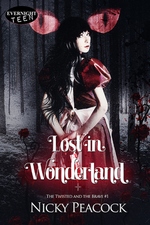
Lost in Wonderland by Nicky Peacock

Lost in WonderlandLost in Wonderland

by Nicky Peacock
Series: The Twisted and The Brave, #1

Kindle Edition, 124 pg.
Evernight Teen, 2016

Read: November 30, 2016


This story focuses on Kayla — a young woman who looks years younger than she is (young enough to be appealing to the Humbert Humberts of the world as well as old enough to come across as a young co-ed), which is helpful in her vocation. She’s basically bait for serial predators (who the authorities can’t/haven’t done anything to) as part of her work with Wonderland. Wonderland is a group run by former federal agents bankrolled by a largely mysterious billionaire. Each “Wonderlander” goes by a code name derived from the Lewis Carroll book, and can quote sections relevant to their moniker (and recognize others quoting their parts). She and her colleagues — Rabbit and Chesire (Kayla’s Mouse) — lure the killers/molesters somewhere, take them out and then have someone come in clean up after them.

Her brother, Shilo, is locked up in a Mental Health facility for a handful of reasons, but the largest is his insistence that a man who dresses in orange is his constant companion who tells him what he should do. No one else can see or hear Mr. Custard, naturally, so Shilo is on the receiving end of all sorts of treatments. Neither the drugs, the talk therapy, or anything else seems to be working — Mr. Custard is still there, as much as Shilo might try to pretend he’s not.

Both siblings are reacting to the disappearance/abandonment of their mother while they were young and the suicide of their father not long after in very different ways, but both of their atypical lives can be traced to these incidents. Now it seems that someone is killing women near their childhood home, and there’s something drawing both of them back their to confront the killer.

The story is an interesting mix of Supernatural and Thriller stories, and once I saw that’s where she was going, I wasn’t sure that Peacock was going to be that successful with it — very few are. I’m not talking straight-up Urban Fantasy, I’m talking about a Suspense/Thriller that mixes in some sort of magic/monster where bullets and explosions should be. The last time I read a mystery where the author tried this, it ruined the book — it’s tricky. The heightened reality that she was using already helps, but it doesn’t guarantee success, Peacock tried a tricky thing and made it work, that’s no small feat.

Still, there’s only a little supernatural to this — there’s a human villain, human protagonists, human costs, human relationships at the core of this novel. Peacock’s up to the challenge of writing them, no doubt about it.

I liked the characters — especially Kayla. The story moved along well, the action was convincing — and the predators were just horrible enough that you didn’t really care that much that vigilante action took care of them rather than the law. Sure, the book could really have used one more thorough edit. More importantly, the facility that Shilo lives in draws more from One Flew Over the Cuckoo’s Nest or Gotham‘s depiction of Arkham than reality — and as annoying as that is, really, if you’re looking for realism, you’ve dropped this book before it gets to that.

Can she follow this up with an equally successful sequel? That might be trickier, but I’m looking forward to seeing her try.

Disclaimer: I received a copy of this novel from the author in exchange for my honest opinions.

—–

3 Stars

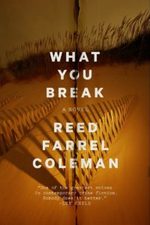
What You Break by Reed Farrel Coleman

This is one of those I spent a couple of days futzing around with — not sure I made it better (or worse) by doing so — I re-arranged a lot, that’s the best I can say. Both Murphy novels are tough to talk about in the abstract, which I think is a pretty good thing. There’s not a lot of fat on them — just good lean prose.

What You BreakWhat You Break

by Reed Farrel Coleman
Series: Gus Murphy, #2

eARC, 368 pg.
G.P. Putnam’s Sons, 2017

Read: December 1 – 5, 2016


Why? It’s three letters that permeate this novel. We’re all familiar with the need for an answer to that question. From the time that a toddler starts ever so persistently asking that question until the end, we keep wondering, “why?” Few need the answer as much as someone who has to deal with the unexpected death of a younger family member. In Where It Hurts, we saw just what the lack of an answer did to Gus Murphy and his life. So when a grandfather comes to Gus for help finding out why his granddaughter was brutally murdered, there’s no way that he can turn his back on the request. Especially given the inducements being offered.

He wasn’t recruited to solve the murder — the police have a man awaiting sentencing for the crime. But he won’t tell anyone anything about the crime or his relationship (or lack thereof) to the victim. The grandfather, Micah Spears, rubs Gus wrong from the get-go — if it weren’t for Father Bill’s endorsement, and his understanding of Spears’ deep need to know, Gus would’ve walked. It probably would’ve been better for him if he had. Almost no one — especially her family, the police (many of whom are still angry for what Gus turned up in the last book) — wants him to pursue this. The more Gus learns about Linh Trang (she preferred “LT”), the more he becomes convinced that there’s no reason for the killer to want her dead, which just makes the “Why?” even more pressing.

Before he can really start to work for Spears, Gus has a few other why’s to answer — why did his friend/co-worker, Slava, just drive off with the mysterious new guest at the hotel? Why did a Russian gangster get assassinated before Gus’ eyes shortly after Slava and the guest talk to him? Why is there a very formidable Russian running around Long Island looking for Slava? The focus of the novel is on the Spears case, but this storyline casts a shadow over everything. I didn’t really spend too much time in Where It Hurts worried about what would happen to anyone, and the Spears case is more of a puzzle than anything — but there’s peril to this Russian story, and the reader will become convinced that whatever happens in it, will have a large impact on Gus (and not just because of Slava’s involvement).

Gus has grown a bit, made some steps toward health since we last saw him, but he has a lot of work to do. Things with his ex- are about where they were previously, but with less anger (mutually), his romance is progressing with Maggie, and so on. Basically, Gus is becoming someone different from just the ex-cop with a dead son. That sill the core of his being, but there’s something more to it than that — maybe even some room for happiness. It’s hard to discuss briefly, but simply: Gus was better off by the end of Where it Hurts than he was at the beginning, and at the start of this novel, he was better off yet. As for the ending of this book? Well, read it and decide for yourself.

This book deals with some pretty potent things — as Coleman did when we met Gus — there’s love, friendship, loss, grief, confusion and resentment, to name a few of the ingredients in the emotional cauldron everything in the novel is steeping in. Not just from Gus, Slava and Spears — but everyone in the book is dealing with things that no one should have to, but most of us do. I’d like (but cannot expect) to circle back around and see how LT’s friends are doing in a couple of years, ditto for her sister and ex-step-grandmother. I’d like a lot more time with a judge that Gus interviews, as well as Gus’ lawyer. I expect the latter, at least, will be granted to me.

Spears and Gus do get some answers as to why LT was killed — but, as is so often the case, really those answers don’t satisfy much and lead to further questions. No tidy bows here for anything — which isn’t to say the concluding scenes of the novel won’t satisfy the reader, just that there’s no pat endings or rides off into the sunset. Just survivors (not saying how many of them there’ll be) moving on. The Epilogue will stay with you. That’s really all I can say.

This book put me through the wringer — not as much as Gus and Slava were, but still — Coleman has really topped himself from Where it Hurts, we know these people better now, so he can push them further. I lost sleep with this one, which isn’t that unusual, but I lost more sleep staying up to get through this than I have in a long time. There’s a darkness, an emptiness throughout that wasn’t there in our first encounter with Gus — or if it was, it’s changed in source and intensity. I’m not sure many readers will like where Gus is by the time we get to book 3 or 4 (including me) — but I’ll understand it. Coleman’s making sure his writing and characterization is honest, as real as fiction can get.

Once again, he delivers a crime novel that could be mistaken for a non-genre novel (as if such a thing exists), suitable for thoughtful crime readers or those who don’t mind crime to show up in a novel about a parent redefining himself after the death of a child.

Disclaimer: I received this eARC from G.P. Putnam’s Sons via NetGalley in exchange for this post — thanks to both for this. It didn’t change my opinions on the book, I was simply able to form them a couple of months early.

—–

4 1/2 Stars

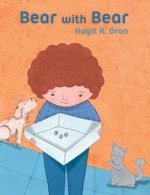
Bear with Bear by Hagit R. Oron, Galia Armeland

Bear with BearBear with Bear

by Hagit R. Oron, Galia Armeland (Illustrator)
PDF (but you can buy the Kindle Edition), 31 pg.
Orons, 2016

Read: November 30, 2016


Hagit Oron has branched off from her adventures with Elphie to come up with something for slightly older readers. This is the story of Bear, a young man in search of a pet. He has a few hurdles — his parents (his mother in particular), his sister’s qualms about several representatives of the animal kingdom, and reality (he doesn’t ask for a Hippopotamus for Christmas or anything that outlandish, but it wouldn’t have surprised me). I really liked the siblings relationship as depicted here — it felt real, it felt relatable.

I’m not sure that I buy the 6-9 age range for this story — but I’m not an expert, 5-7 would be my guess. But whatever, target ages like that are best used (and/or ignored) by those who know the kid best.

The thing that will appeal most to older readers is that if you click an icon in the lower corner of the page, it’ll take you to another page that gives you some insight into the factual basis behind the part of the story you just read — or showing just how fictional it was. Oron drew from her own family’s pet hunt for inspiration and she details how she went about taking that inspiration and turning it into the story. It’s an added touch that I think could really help a lot of younger readers. Now, my review copy didn’t have that function, so I can’t tell you how well it worked — I assume it’s pretty straightforward in operation — but I did get to read those pages, and appreciated what Oron was trying to accomplish with them.

Armeland’s art pops off the page. It’s simple and attractive, but it feels like there’s something wrong with calling it “simple” — I don’t mean it as an insult, it’s the first word that comes to mind. But there’s a lot of subtle things going on with the illustrations, too — so it’s not simplistic. Ugh, I clearly shouldn’t talk about art — I liked it, I thought it fit the story, and it didn’t feel like the art in kids’ books that I’ve seen a million times before.

It was a nice story, told in a good way that should appeal to younger readers — with a nice twist that’ll capture the imagination of many. Maybe even inspire some young writers out there, now that they’ve seen how their lives can be the basis of fiction. I continue to be a Oron fan, probably more of one now than before.

Disclaimer: I received this book from the author in exchange for my honest take, and I thank her for it.

—–

3.5 Stars

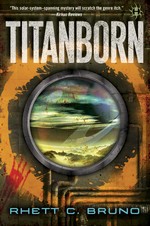
Titanborn by Rhett C. Bruno (revised)

TitanbornTitanborn

by Rhett C. Bruno

Kindle Edition, 246 pg.
Hydra, 2016

Read: November 28 – 29, 2016

I’ve been to the rotting sewer tunnels submerged beneath the Martian domes. I’ve been to the most remote slums on Earth, and to the depths of asteroid mining colonies where being able to see the outline of your own hand in front of your face was considered bright. I’ve seen death all over and been on the end of the killing more times than I cared to count . . .

When he’s not reminiscing like an inverse-Roy Batty, Malcolm Graves is a bounty hunter of sorts — working for one of the handful of corporations that really run the solar system. He’s been at it longer than most, and has no intention of retiring anytime soon. His body, however, might have other things in mind — he’s slowing a bit, both in reflex and thought — add in a little bad luck, and Malcolm’s starting to worry about his future.

So when he’s near the site of a terrorist attack during Earth’s biggest celebration, he seizes the opportunity to get some justice and re-establish his position with the company. Sure, they’re saddling him with a partner rather than letting him work alone, but if that’s what it takes. . . . Only it’s not just a partner, it’s a young guy, fresh from an elite training program for exceptional cadets. Zhram is almost an android, it seems.

Their investigation brings them into contact with a seditious group, trying to overthrow the ruling forces on Saturn’s moon, Titan, so that the descendants of the original colonists (Titanborn). It soon becomes a race against time — can the duo find those responsible for the crime on earth and bring them in before the movement can grow and begin to make inroads against the ruling powers? Why they attempt to do so, their partnership grows and the two being to trust and learn from each other. Zhram is one of the more promising characters in the Lt. Commander Data/Odo/Sheldon Cooper-vein of people trying to learn to be more human that I’ve seen recently.

At its core, the central relationship is the classic mismatched police partners (see the Aykroyd/Hanks Dragnet, Lethal Weapon), but with a SF twist (see The Caves of Steel and Almost Human). The book is full of themes, tropes and scenarios straight from these (and similar) sources. Which isn’t to say that Titanborn is derivative — it’s part of the tradition, reflecting the best parts of its antecedents, shaping them to tell Bruno’s story.

The writing was strong (I thought a couple of times early on that he overwrote a line or two, but nothing too horrible) — the fight scenes good, the tech was believable, etc. An all-around well constructed novel.

I’ve said it before, I’ll say it again — it doesn’t matter if you tell a story that’s been told before, or using tropes commonly used — it’s how you use those tropes, how you tell the story — and Bruno did it in a very satisfactory way. I liked Malcolm from the get-go, I enjoyed watching the budding partnership between he and Zhaff, and even though I pegged (most of) the solution very early on, I really dug the reveal. I liked the characters, I appreciated the way that Bruno paced things and guided us through the shaky political landscape (and at least some of the reasons for the instability). I’d gladly read another half-dozen (at least) novels about these two racing around the solar system.

Disclaimer: This was provided to me by the author in exchange for my honest take on the book — note that I said “honest” and not “timely.” I was supposed to have this done months ago. My thanks for the book and apologies for the tardiness, Mr. Bruno.

—–

3 Stars

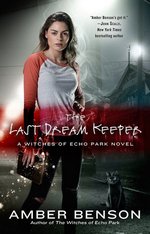
The Last Dream Keeper by Amber Benson

The Last Dream KeeperThe Last Dream Keeper

by Amber Benson

Series: The Witches of Echo Park, #2

Paperback, 307 pg.

Ace, 2016

Read: March 25, 2016

Picking up right from where The Witches of Echo Park left off, Benson takes her coven deeper into the conflict with the mysterious forces threatening the Witches Council. The opening chapters of this book had me hooked soundly and almost immediately brought me right back to where I was when the first book ended. You want Lyse and the rest to really gel, to become the family they could be (and might have been before Eleanora’s death). Sure, you want them to get to the bottom of things, thwart evil and all that — but mostly you want to see them form a strong unit, maybe have a taste of happiness.

But circumstances won’t let that happen. Somewhere around the midway point (I think maybe a little beofre) the book takes a huge turn — the coven splits up. Some on personal missions, others off on an effort to enlist others to their cause, and some to keep things going at home. This was a risky move — these books are at their strongest when you have these women interacting with each other, drawing on each other’s strengths, augmenting their own weaknesses. So to eliminate this possibility takes real guts — I’m not sure I liked the move, but what Benson does with that kicks everything into a different gear — more action-packed and explosive. The magic that so defined the series up to this point is still there, it’s just used pretty differently.

And when I say that the plot takes this book in dramatically different directions than you expect, it is almost impossible to believe that the closing pages of this book and the closing pages of The Witches of Echo Park belong to the same series — much less are separated by only one novel. Somehow, however, Benson pulls it off — I really have no idea how. When I think about it, it doesn’t make any sense — but in the moment, it absolutely worked. I couldn’t turn the pages fast enough, and when it was done I started looking forward to whatever craziness Benson’s got in store for us.

—–

4 Stars

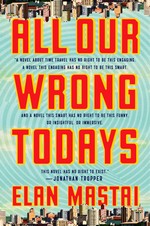
All Our Wrong Todays by Elan Mastai

All Our Wrong TodaysAll Our Wrong Todays

by Elan Mastai
eARC, 384 pg.
Dutton, 2017

Read: November 21 – 23, 2016

Avery Brooks famously asked, “Where are the flying cars? I was promised flying cars! I don’t see any flying cars! Why? Why? Why?” Elan Mastai’s book finally provides the answer. Simply put: we had it — flying cars, routine space flights, robots/other tech dressing us, feeding us, doing the everyday jobs that need to be done so that humans can focus on working in labs to make the world an even better place, to make the next technological leap forward. Essentially, everything that Science Fiction of the 1950’s told us to expect, we lived in George Jetson’s world.

Until July 11, 2016 when the first time machine was turned on and things went wrong, resulting in 40 years of history being rewritten and one man — Tom Barren — was the only one to know that we are now living in a dystopia. It’s a dystopia for everyone on Earth, but Tom, that is — his life in the 2016 that we know is much better than it was in the “original” 2016. So now Tom has to decide, does he try to restore the timeline (if he can even figure out how to do so), or does he keep things the way they are?

That’s less than you can see on Goodreads/Mastai’s site/Web retailers — and yet I think I gave away too much. But really, that’s barely scratching the surface.

There’s a great mix of detail to the science (at least the ideas and theories behind it), yet keeping it at the level where we don’t get bogged down in technicalities (and kept Mastai from having to work them out) — he gets away with it by comparing it to the way that we don’t really understand how hydroelectric dams or incandescent light bulbs work.

There’s the literary equivalent to that scene from The Wire‘s 4th episode — it’s a mixture of genius and profanity and poetry. Mostly profanity.

We’re going to be talking about Elan Mastai the way we recently talked about Ernest Cline or Andy Weir next year (assuming I can predict anything) — and he deserves it. The voice grabs you right away from the humor, the honesty — the trouble with time travel grammar. I really wish that Jonathan Tropper’s endorsement of the book wasn’t right there on the front cover, because it feels like a cheat to compare Mastai to him now, but I want to. He’s got the same mix of humor, heart, drama, inspiration as Tropper, he just blends science fiction themes in with those. 

Tom Barren’s a great character (a questionable person, but a great character) that you’ll love spending time with. There are really a lot of great characters here, but he’s the only one I feel safe discussing. There are characters with warts, strengths, weaknesses, courage, bravery, humanity in all shapes and sizes — some noble, some despicable, some pathetic. As is frequently the case, seeing multiple versions of the same characters in the various timelines tells you a lot about the people and/or worlds they live in.

Tom’s father, the one who developed the time machine — has some fantastic theories about time travel — it’s not just about time, it’s about space (between the earth’s rotation, movement through space, etc.), and for time travel to be really possible, both have to be addressed. Not only does it clear the TARDIS from every critique of time travelers/machines mentioned in the book, but it’s a really, really good point.

It’s one of those magic books that you don’t want to end, because you’ll have to leave the characters and world — but that you can’t get through fast enough because you just have to know how it turns out.
Is it flawless? No, I’m sure it’s not, but unlike ever other book I’ve read this year (including the ones I’ve loved), I can’t think of a single problem. That says a lot to me.

I have not been able to stop talking about this book for a week now — I think my wife and kids have started ignoring me when I bring it up. All Our Wrong Todays is a book that practically demands over-hyping — it’s only a huge amount of restraint that keeps me from spilling everything. I have a list of people I want to buy this for (started compiling it when I was about 10% finished), and the list is currently long enough now that I wouldn’t be able to buy any books for myself until June 2017 — so, sorry everyone, buy your own.

I don’t know if I’ll be able to watch/read more time travel again — especially time travel involving love stories — but man, it’s absolutely worth it if this was my last. Pre-order this one now so that you can dive into it as soon as possible.

—–

5 Stars

Disclaimer: I received this eARC from Dutton via NetGalley in exchange for this post — thanks to both for this.


Page 260 of 351

Powered by WordPress & Theme by Anders Norén