Category: Fiction Page 330 of 351

Gun Machine by Warren Ellis

Gun MachineGun Machine by Warren Ellis
My rating: 4 of 5 stars

This is a great read — think of it as the love child of a Michael Connelly novel and a William Gibson novel. If that’s the kind of thing that appeals to you, go grab this now. If not, well, you should grab it anyway, just so you can see how wrong you are.

I can’t think of anything to say about this book without spoiling anything not already on the jacket. Nearly perfect from cover to cover — there was one too-good-to-be-true coincidence that provided the necessary bit of information at just the right time. But that can be forgiven, given the way it worked out.

This is my first novel by Ellis, won’t be my last.

Insane City by Dave Barry

Insane CityInsane City by Dave Barry
My rating: 3 of 5 stars

Ridiculous. Utterly Ridiculous. Which is what it was going for, so good on Barry.

I didn’t think it was as satisfying a novel as his first two solo works, bu the further I got into it, and the more out of control the plot got, the more I warmed to it and the more I laughed.

The ending’s fairly predictable, but pretty satisfying — and funny.

Lots of laughs to be had

The Darwin Elevator by Jason M. Houg

The Darwin Elevator
The Darwin Elevator by Jason M. Hough
My rating: 4 of 5 stars

Well, this was a heckuva read. Solidly built world, you can see it — practically smell it. Yeah, it takes a little while to fill the picture in, but really from the get-go you have a pretty clear idea what this particular distopia is like.

But it’s more than just another distopian novel about survival — thankfully. Actually, it’s hard to put a finger on exactly what kind of SF novel this is without giving away everything, because every now and then — just when you think you have an idea what kind of book this is going to be, and what’s going on and what’s going to happen — Hough comes along, slaps you upside the head and says, “Nope, not that,” and proceeds to pull the rug out from underneath you. Characters you think you’ll be spending time with for the trilogy are killed. Constants turn out to be temporary. The shifts in direction aren’t such to give you whiplash, but it is enough to make you rethink everything you’ve read/predicted up to that point.

At some point, I started to mentally fill out one of those AD&D alignment grids for the characters — with 2 exceptions (and I guess you could make the argument for another one or two) they’re all some sort of “Neutral.” A couple of “Neutral Good”s, one “Neutral Evil,” (and of course, the exceptions — one “Lawful Good” and one “Chaotic Evil” (or “Total D*ck”), but on the whole, everyone is “Neutral”, just out to survive. Maybe find a little comfort and fun, but mostly just trying to survive in this uncertain world. Which is no mean feat.

It’s that need to survive that creates most of the conflict, most of the motivation for characters — and makes the whole thing so compelling. Almost every decision becomes a matter of life or death — sometimes for the person making the decision, sometimes for large groups of people, occasionally for the human race.

In the end, I think more questions were raised than were answered — but I didn’t feel cheated by any means, it wasn’t that Hough bit off more than he could chew, or left a lot of red (or potentially red) herrings laying around. Nope. He answered questions, he resolved plotlines, saw characters through their arcs. And those answers, resolutions and arcs led organically to new ones. The way it should be. He didn’t end things on a cliffhanger, but there’s almost no way someone could read that last line and not get impatient waiting for the sequel.

Indexing, Episode 7: Bread Crumbs by Seanan McGuire

—-

IndexingIndexing by Seanan McGuire
Series: Indexing, #1.7

My rating: 3 of 5 stars

Episode 7: Bread Crumbs
Well, didn’t see any of that coming. Wow. Well, not totally true — I’d figured something a lot like what happened with Demi at the end of the episode was coming. But McGuire’s been leading us to that for awhile now, so that’s not a knock on her ability to surprise the reader. Given how many different things happened in this episode, that’s still a really good ratio.

More stuff — little things, episodic things, character things, overarching plot things, comic things, curious things, puzzling things — happened in this episode than any other. The pacing was far different, too — there was an urgency to everything that unfolded that matched what was going on for the characters. The team split up to deal with several narrative events — their night was chaotic, messy, and terrible — and the writing matched that. I read this a few days ago, and more than any single plot point, that feeling sticks with me.

Not that the plot points have faded — this is one of those bits of writing that burns itself into your brain for awhile. Every character is well-served, even the constantly under-utilized Andy. He gets more ink — and action — here than in the first six episodes combined. We learn a lot about him along the way — and while Jeff is featured as much as he usually is, we learn as much about him as Andy.

This is an episode where the changes to the narrative are front and center, on display for Henry’s team to see as clearly as it is for the reader — and the rest of the Agency. Not just the potentially earth-shattering events are lived through, but paradigm-shifting realizations are reached. The road for these five just got a lot bumpier ahead.

In the midst of this heaviness, McGuire puts a well-placed bit of comedy (possibly two, depending how you take the latter). Henry and Sloane are working to keep a Peter Pan from attempting to launch himself off a roof and discover that he really can’t fly. I wondered if instead of trying to stop him, what if they made him think a lot of happy thoughts — would that have actually permitted him to fly? In a world where a Snow White manifestation can actually talk to birds, I wouldn’t have thought so. But maybe. With time running out and their normal efforts failing, Sloane does the smartest, most inventive thing I’ve seen anyone in this book do to help this boy grow up. I laughed out loud as I realized what she was up to, and kept it up through her execution. I’m still not sure why Henry was so against it.

I’m more invested in this story than I’ve been at any point since I started reading it, and cannot wait for Episode 8.

Leverage: The Con Job by Matt Forbeck

Leverage: The Con JobLeverage: The Con Job by Matt Forbeck
My rating: 2 of 5 stars

Wow, it’s so easy to read men like Lee Goldberg and think that all tie-in novels are really good, this is one of those books that serves as a cold dose of reality. This was sloppy, lazy, heavy-handed and overly-reliant on inside jokes and name dropping. Most of those revolved around Wil Wheaton — and, yes, were amusing. But there were just so, so many of them it became annoying, I started calling this book “Leverage: Forbeck Less-Than-Threes Wheaton.”

I’ll be back for the next book, because I was such a fan of the series and these characters, not because of this book — just thankful it’s a different author.

Indexing, Episode 6: Fox’s Tongue by Seanan McGuire

IndexingIndexing by Seanan McGuire
Series: Indexing, #1.6

My rating: 3 of 5 stars

Episode 6: Fox’s Tongue
Again, I’ll just say that without more grounding in the normal way the narrative works in this world it’s hard to get too invested in/fully understand the way it’s working differently now. If McGuire’d asked me, I’d have told her to give us an episode or two of the status quo before Henry has to toss caution to the wind and recruit Demi. But the status is not quo — and McGuire didn’t ask me, so who cares? (frankly, as long as I get my regular Toby Daye fixes, I really don’t care how the rest of her stuff comes out, even this one, which I’m generally positive about.)

This particular case is interesting enough on its face — but once you go behind the surface, this could get really, really ugly. The plot twists and turns in these few pages are very engaging, just the kind of thing to really draw in the reader.

The character moments for Henry and Sloane are likely the best in this series — Henry seems capable and useful — something I’ve not really seen from her — particularly when she dips into her Snow White-ness for the sake of the investigation. And Sloane grappling with her (true?) self was very effective. I was less impressed with the use of Demi here — her being overly honest and complete with her reports was a good, rookie touch. But where’s the training, why weren’t her teammates on top of that thing — she needs to be trained, not only in the written words and procedures, but in the unwritten policies of her team. They’ve really dropped the ball with her.

McGuire really seems to be pointing at someone as the Big Bad of the series — I’m not sure I want to go where she appears to be leading — it’s almost too easy that way. Then again, sometimes the subtle approach isn’t the best. I guess I’ll see over the next 6 installments.

Indexing, Episode 5: Cruel Sister by Seanan McGuire

Whoops, behind again. Further than I thought, too. I knew I needed to read/talk about Episode 6, but I hadn’t realized that Episode 5 wasn’t up yet — I’d have sworn I posted it last month. Maybe I did. Maybe Internet Termites came along and ate it, leaving the rest of this blog.

—-

IndexingIndexing by Seanan McGuire
Series: Indexing, #1.5

My rating: 3 of 5 stars

Episode 5: Cruel Sister
I thought I had things figured out — at least for the next 2-3 episodes, I thought she’d take the memetic incursion from the last episode and put it to work, and that this would last for a few episodes, if not turning into the Big Bad for the 12 as a whole.

What a relief to be wrong — the way that McGuire took things instead — a good, honest heart-to-heart rather than repeated covert assassination attempts might be smaller on the Drama Meter, but it ranks pretty high on my satisfactory use of characters meter. Characters — particularly those who work in close quarters together — need to talk more and combat less (not that I have a problem with good fight scenes, etc. — it’s just when they’re necessary and/or unavoidable, not the result of sit-com type misunderstandings and circumstances)

The cases that Henry and her team (aka, Henry and People Who Serve a Purpose) have been dealing with lately, the narrative isn’t acting like they expect/have been lead to believe is necessary. That’s definitely the situation this time, which for some reason appeals to me more than the others. Maybe it’s the way that this one veered from the norm, maybe it’s because I’m getting a better and better idea what the norm is supposed to be. Or maybe I just have a thing for people poisoning their families.

I hope it’s not the latter.

I’m thinking we could use more development of each idea in this episode (and in retrospect, the previous episodes, too) — it felt really rushed. Almost too rushed to keep going with. I don’t think each of these is a book-length idea (but it might be), but they need more space than they’re currently getting, at least 2x the words.

Still, a good read, with a lot of tantalizing possibilities for the next episodes. I need to just stop trying to guess what’s going to happen and just enjoy the ride. Don’t see that happening, but that’s what I should do.

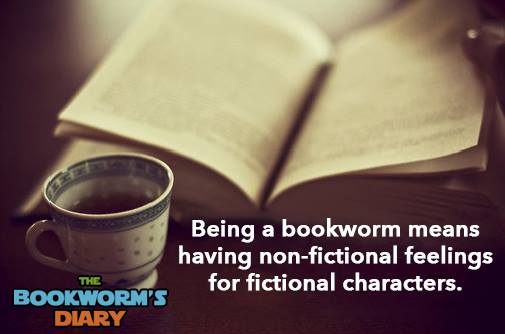
Non-Fictional Feelings for Fictional Characters

A slightly different post this morning, I’ve been trying some behind-the-scenes work here on the blog this morning — composition, infrastructure, design, etc. The books that I’m overdue to review are hard to write about, I’m plugging away at 4 different reviews right now that I absolutely want to get right , and that’s time-consuming. Also, Grossman’s YOU: A Novel took 2 or 3 days longer to read than I’d expected — worth the time, but it did sort of mess up my schedule. So, like I said. Something different.

—–

I saw that picture on Grammarly.com‘s facebook page*, and as one does, shared it, which prompted a friend to ask what some of my favorite fictional characters were. I decided to limit the list to fictional characters from books (a. see the picture and b. see this blog), and to characters I had “non-fictional feelings” for — Hannibal Lecter was a favorite (for 2 books, anyway), but I had no emotional attachment to him, or Evanovich‘s Ranger — fun character, but don’t really care about the guy. Here, with added commentary, is my list.

  • Archie Goodwin — this is the name that jumped immediately to mind. Archie’s the big brother I never had — the quick, agile wit; the athleticism; the way with the ladies — and the rest of the things that older brothers so often exemplify to those of us who never had one (on the other hand, we didn’t have to share a bedroom). ‘Course he makes the list.
  • Spenser — it’s almost impossible to spend as much time in a guy’s head as I have Spenser’s (or Archie’s) and not have some sort of emotional bond there. Everything I said about Archie applies here too, actually.
  • Harry Dresden — Chicago’s resident Wizard P. I. He feels like a friend. Hanging with Harry for a night of RPGs, Double Whoppers, and McAnally’s beer sounds ideal.
  • Scout Finch — she’s plucky, honest, a born-reader, and loves her pa (even when she doesn’t understand him). She’s had a soft spot in my heart longer than most of the people on this list.
  • Hermione Granger — sure, her famous buddy still gets all the press. But it’s this brave, clever, stubborn and resourceful gal who’s the most consistent hero in the series — and the one you can count on for genuine emotional moments. (this isn’t to take away anything from Ron, Luna, Albus, Neville, Sirius, Dobby, etc. — but Hermione alone manages to do it in every book in the series)
  • Chet Little / Oberon — it felt like a cheat listing these separately, and it just looked wrong to leave one of them off the list. So…I cheated. Both of these charming gentlemen will win you over within a few pages (in Dog On It and Hounded, respectively), and after you spend a few books with them, they’ll have stolen your heart. They make you laugh, they make you worry — and in Hunted, Oberon commits himself to one of the bravest acts I’ve seen, and choked me up a bit. The humans these guys live with almost make the list just on their testimony.
  • Angela Gennaro — if you hadn’t grown attached to Angie already, especially after Darkness, Take my Hand‘s events, there’s just no way you can’t fall apart with her at the end of Gone, Baby, Gone

Let me hear from you, reader/follower/happener-upon-this-post — who do you have non-fictional feelings for?

—–

* I looked but couldn’t find the source for this, otherwise I’d have cited it. If you know who should get the credit, please let me know.

Archie Meets Nero Wolfe: A Prequel to Rex Stout’s Nero Wolfe Mysteries by Robert Goldsborough

A slightly briefer version of this appears on Goodreads.

—–

Archie Meets Nero Wolfe: A Prequel to Rex Stout's Nero Wolfe Mysteries
Archie Meets Nero Wolfe: A Prequel to Rex Stout’s Nero Wolfe Mysteries by Robert Goldsborough

My rating: 2 of 5 stars

Back in Junior High when I first discovered the Nero Wolfe/Archie Goodwin books, I was quite relieved to learn that his family had approved a new author to write new books in the series. Murder in E Minor was pretty good — even if it sort of spoiled A Family Affair, it read like Stout on an off-day. His follow-up, Death on a Deadline, did some interesting things and was good enough. But from there, the quality really started slipping, and I can honestly say I really didn’t enjoy Silver Spire or The Missing Chapter at all — not because the latter was about an author continuing a popular series and dealing with backlash from the fans (that was actually sort of amusing). The passion and drive Goldsborough had initially was clearly gone — it’s this experience that keeps me from wholly embracing Ace Atkins as Spenser’s new scribe (as much as I really want to).

So why did I pick up Archie Meets Nero Wolfe? Well, it’d been eighteen years — so for Goldsborough to come back, there had to be a good reason — a story he cared about. He had time to get the voice right, the details “just so.” I was more than a little curious, too, just how did he see this initial meeting?

Oh, and, fine — I’ll be honest. You put out anything with the label “Nero Wolfe” on it and I’ll read it. Janet Evanovich, Nick Hornby, or Richard Russo wants to take a crack at it? I’ll bite.*

But, I did put it off for months. Take that, Goldsborough.

But I had hope. And that hope was buttressed after a few pages when I read:

…I got grilled by a surly lieutenant named Rowcliff, who had bulging eyes and a snarling voice that broke into a stutter when he got excited, which seemed to be much of the time.
He kept trying to get me to say that I fired at the robbers first. I was nervous, but when I wouldn’t budge off my story, his stuttering got worse, which would have been funny under different circumstances.

. That was a nice character moment. I looked forward to more of them. I even had Evernote ready to capture them like that one. That’s the only quotation I bothered grabbing.

There are two things you have to have (at this point) for an acceptable (if not good) Nero Wolfe/Archie Goodwin book. You need the characters we know and love and an interesting plot. Here, Goldsborough falls short on both counts.

To be fair(-ish), I thought he got Saul Panzer and Fred Durkin fairly close to right. Fritz and Rowcliff were pretty dead-on (and not really that present), maybe Stebbins, too. Cramer, Orrie and Bill were off. It was nice to spend some time with Del Bascom — and given how little time we spend with Bascom in the books, you can’t really judge how Goldsborough did with him.

Archie’s a tough one to peg — he’s new to New York at this time, fresh out of Ohio — so we can understand he’s not the detective we meet in Fer-de-Lance yet. He has to learn the city, learn more about being a detective — especially doing it Wolfe’s way, and essentially grow up. Sure, there’s traces of our man here — his attitude, his smart-mouth, his ability to handle himself in a moment of crisis. We see Archie’s appreciation for non-gourmet, but well-prepared, food — and a palate ready for education once he comes into Fritz’ influence. I don’t remember him being so fixated on coffee, either. I think there’s enough of Archie there to give Goldsborough credit for his characterization, but something’s holding me back.

I didn’t buy Wolfe at all — this is the big one. The others are seen in different lights than we normally are exposed to them, which can explain away a lot of the weaknesses of their portrayals — but you have to nail Wolfe or the whole thing is a waste of time. And beyond the beer, the dramatic entrance, his provision for guests . . . it was just a fat guy in a suit playing a part.

And as for plot? Pfui. This wasn’t much of a mystery, the bad guys do most of the work. Saul does almost everything commendable (and yes, you could make the argument that this is often the case) — Wolfe himself doesn’t solve much at all. He still holds the big gathering in his office — pretty much because he has to.

A lot of the attitudes expressed — say, for the child’s emotional well-being following the kidnapping, for example — seemed anachronistic. As did the language the characters used to describe that and similar ideas. I’d stopped caring by the point I noticed these piling up, so I didn’t take notes.

Lastly, I don’t buy at all the explanation Wolfe gives for hiring Archie. It’s just we’re at the end of the book, and it has to happen, so he makes up an excuse with no real justification behind it.

In the end, I’ve got to call this one unsatisfactory

If Robert Goldsborough dips back into this well? Will I read his next one? Yes, absolutely. I’ll hate myself, but I will.

I might wait a year or two, first.

—–

* I have nothing against any of these authors, at all, I like them a lot. I just don’t think they’re right for the books. Lee Goldberg, on the other hand…


City of Dark Magic by Magnus Flyte

City of Dark Magic
City of Dark Magic by Magnus Flyte
My rating: 2.5 of 5 stars

Doctoral candidate Sara Westen gets a summer job (that she didn’t apply for) in Prague to help a royal Czech family in the creation of a museum displaying the greatness of that family over the centuries, as they’ve recently been reunited with their treasures after the pillaging of the Nazis and Communists. Once there, she stumbles into international (as well as inter-chronological) intrigue, the mysterious apparent suicide of her mentor, and paranormal events of some order. Oh, and there’s sex, too. Can’t forget that, it’s part of the sales pitch.

I don’t know. I just don’t know.

On the one hand, this is well-written, clever, surprising, all the twists and turns you could ask for (and then some), a novel approach to time travel and supernatural-ish storytelling. The hero, Sarah Weston is great — the kind of strong women character you can relate to. The writing is brisk, and often amusing. The conclusion is wild, heart-warming, and not what anyone would expect. It’d almost seem worth reading just for the depiction of Beethoven and the way his music effects even people in the 21st century.

But it left me cold and apathetic. I had to force myself to push beyond page 100, and the only urgency I felt towards the finish was so I could move on to something else (although it was pleasant enough while reading, there was just nothing that kept me going). As amusing as I found some of the characters — the blind girl/musical savant, the impossible and very talented dwarf, a very American Czech prince, the gun-loving Asian from Texas, — I didn’t care about any of them. I wouldn’t have been surprised if the villain of the piece had twirled her moustache at some point. (yes, her moustache…I’d believe she’d have grown one just to twirl at appropriate moments).

And don’t get me wrong, I’m neither a prude nor the son of a prude, but the sex was a too graphic. It felt very incongruous to the rest of the book — especially the first “encounter” Weston had in Prague, which appears to be only semi-consensual for all involved. That really put me off, and I’m surprised two women writers would’ve included that and put it in even a slightly positive light.

Page 330 of 351

Powered by WordPress & Theme by Anders Norén