Category: Science Fiction Page 31 of 34

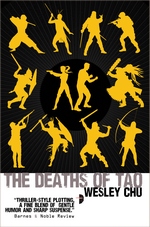
The Deaths of Tao by Wesley Chu

The Deaths of Tao (Tao, #2)The Deaths of Tao

by Wesley Chu
Series: Tao Trilogy, #2


Mass Market Paperback, 462 pg.
Angry Robot Books, 2013
Read: October 17 – 24, 2014
It’s been a few years since the events of The Lives of Tao, and things have not gone well for Roen Tam, either personally or in the war. He’s basically dropped out of everything, going rogue, running covert ops for Tao while ignoring Prophus’ command structure. Tao’s sure he understands what’s going on in the world better than anyone else, and so he pushes Roen to leave everything behind and find evidence for Tao’s theory.

Meanwhile, Jill — and Raji — have wormed their way into the corridors of power in the Capitol, moving and shaking on behalf of Prophus while also keeping her cover as a Senatorial aide intact. This is where Prophus seems to be holding its own – but barely.

We bounce around between Roen, Jill, and a new Gengix host, Enzo, who is trying to find a level of dominance very quickly for himself in the Gengix hierarchy. He’s rash, impetuous, and egotistical — not the signs of a great leader. But the Gengix he’s hosting is wise, methodical, honorable and tries to impress these characteristics on this host.

But like I said, things aren’t going well for the Prophus — they’re on the verge of losing this war once and for all, clinging to power and influence some areas, absolutely losing it in others. They’re so close to the brink that they eventually are driven to one final act of desperation that will change everything forever.

As the title suggests, The Deaths of Tao is darker (like any good 2nd volume of a trilogy), not as fun (understandable given the darkness, but would’ve been helpful), and slower paced than The Lives of Tao. But, still, I was enjoying it enough to keep going — and I wanted to see what happened to Roen and the rest. Hopefully get to see my favorite Prophus host whip that Gengix Enzo around a bit. But Chapter 29? Made everything up to that point worth it. And excitement, the pace, and the stakes picked up after that (not the stakes for the whole armies, obviously, but for Roen and Jill)

Still, it took until Chapter 29 for this really to come together for me — and that’s far too long. Which is strange, because up until that point, I’d say this was better structured than its predecessor. It built better in plot development, character and tension. But Chapter 29 made me rethink that, it’s just too much of a jump in development and voice.

I find it hard to understand — except for strength in numbers — just how the Gengix are winning this thing. The Prophus seem to come out on top — if not even with — the Gengix almost every time we see them. It’s difficult to extrapolate from this to them almost losing this war. Yet that’s exactly the situation they’re in, and you believe it, up until you think about it a day or two later.

Giving it three stars — as good as the last 150 pages or so were, as huge as the ending was — it was a slog up until that point. I just couldn’t connect with Roen or Tao (or anyone else). But believe you me, I’m anticipating The Rebirths of Tao and expect it to blow me away. Just wish this had done that.

—–

3 Stars

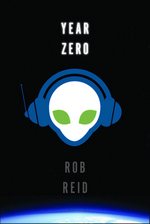
From the Archives: Year Zero by Rob Reid

Year ZeroYear Zero

by Rob Reid

Hardcover, 364 pg.
Del Rey, 2012
Read: October 27 – 29, 2012

Aren’t we at the point yet where just because something involves aliens, spaceships and more than a few laughs, we don’t have to invoke Douglas Adams? (not that I have anything against the man or his work) But this book owes more to Scalzi’s Agent to the Stars than to anything about Arthur, Ford or Zaphod (or even Dirk). Yet that doesn’t stop 70% or so of the reviews from mentioning Adams. Time to move on folks — or at least realize there are others out there doing funny SF.

I’d give this 4.75 stars, really. Rounded up. But whatever, the important thing is that this book is a hoot. There’s nothing about this that isn’t funny–the plot, the characters, the commentary on the music industry, congressional shenanigans, trendy restaurants, Microsoft…whatever Reid touched on, he hit squarely and hilariously. I laughed out loud a whole lot. And then some more.

I think towards the end, plot lines and plot points got a bit out of control. But honestly, he just reminded me of most of Christopher Buckley‘s work in that regard (and several other ways now that I think of it)–though I think Reid did a better job of pulling it all together at the end than Buckley usually does.

And the coda? Perfect. And more than made up for any flaws.

—–

5 Stars

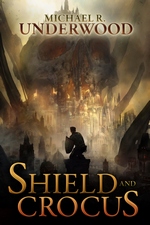
Shield and Crocus by Michael R. Underwood

Shield and CrocusShield and Crocus

by Michael R. Underwood

Paperback, 391 pg.
47 North, 2014
Read: June 26 – July 02, 2014

The level of detail in this world is astounding, it reads like it could be the 4th installment or so in a long-running series — the worldbuilding is just fantastic. I don’t know for a fact that Underwood has the history of Audec-Hal, of these races all mapped out for centuries before, and these characters lives detailed going back to birth — but it reads that way. He seems to know them all that well — but best of all, he doesn’t share all the homework he’s done with you, but you can tell he’s done it. The care, the detail, the intricacy, the strangeness of all of this — I mean strange in a good way, that somehow makes total sense in context — is so impressive. I don’t think I can adequately express my appreciation of the imagination and craft here.

We come into this city which is a shadow of itself — no longer in the heyday of its republic, it’s now a city controlled by competing tyrants. Where the citizens live in a sort of fearful servitude, a new generation being raised to know only this reality, and their elders in danger of forgetting what came before. Now where most writers would put a scrappy insurgency here, made up of soldiers, former government officials, and young ideologues, Underwood zigs instead of zags. Instead? We get the Justice League — or maybe the Justice Society (last time I checked, JSA was more welcoming of elderly heroes) — a band of costumed vigilantes doing what they can to destabilize the tyrants and protect the citizenry.

Right there, that’s enough. I’m in. I’m buying the T-shirts, pre-ordering any sequels, seeking out fanart (feel free to direct me to any shirts or art, btw).

The team’s leader, the Fist Sentinel is a Batman/Blue Beetle (Ted Kord)-esque figure. Getting by on his wits, fists and gadgets (tho’ some of his are magic, something that Batman and Beetle couldn’t say). He’s advanced in years, and doesn’t have much fight left in him, but he’s too stubborn/committed to quit. Then there’s the Shield — a sort-of guardian of the city, a mystic mantle that passes to new bearers after the death of the previous — a literal shield, which gives the bearer increased strength, etc. is the mark of the mantle. The current Shield is the Sentinel’s adopted son — think Captain America dosed by magic instead of revolutionary science. There’s a speedster, a woman with super-strength, someone who can control rocks with her mind, someone with mental powers — and a loosely organized group of mundane types who act as spies.

I’m getting into recapping too much here — this should be enough to whet your appetite. And there’s so much more to say in the setup, the details, the people.

Wonderfully told, well-plotted, well-paced. It’s everything I hoped and expected from Underwood.

But.

I didn’t care about these people. I was curious how things would turn out, I was pulling for The First Sentinel and the Shield. But honestly? I didn’t care about them. I know Underwood is capable of making me care about characters — seemingly effortlessly. But something here was off. I’m able to rave about this as a display of care, skill, and imagination — but there’s a distance between the reader and the characters and I just don’t think he bridged it.

A couple of items other things worthy of note: Both before and immediately upon release, I heard a lot of talk about the map in this book — which seemed a bit odd, but then I saw the map. It is so cool. Possibly the greatest map in the history of fantasy fiction — it’s like nothing you’ve seen before. Underwood states, “It all started with a doodle on the back of a grocery list. Now, rendered by a professional, it is amazing. :)” He’s right. The cover art’s pretty great, too.

Basically, this is a book I admire more than I enjoyed. What Underwood constructed here was fantastic, I just couldn’t connect with it emotionally the way I wanted to (the way I can with most of the people in his Ree Reyes series). His care for the world, for his characters is more than evident. He just didn’t do enough to get me to share that. Your results may vary, you might think I’m out to lunch here. That could be — I still really recommend this novel, just not as strongly as I’d expected to.

—–

4 Stars

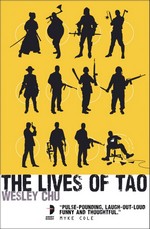
The Lives of Tao by Wesley Chu

The Lives of Tao (Tao, #1)The Lives of Tao

by Wesley Chu
Series: Tao Trilogy, #1


Paperback, 460 pg.
Angry Robot, 2014
Read: May 29 – June 4, 2014

Last spring, it seemed that every writer I follow on Twitter was gushing about this book, but it really didn’t seem like my kind of thing. But last week, I saw it on the new book library shelf and decided to give it a shot. So glad I did. In case you haven’t seen it, the back cover blurb is:

When out-of-shape IT technician Roen woke up and started hearing voices in his head, he naturally assumed he was losing it. He wasn’t. He now has a passenger in his brain – an ancient alien life-form called Tao, whose race crash-landed on Earth before the first fish crawled out of the oceans. Now split into two opposing factions – the peace-loving, but under-represented Prophus, and the savage, powerful Genjix – the aliens have been in a state of civil war for centuries. Both sides are searching for a way off-planet, and the Genjix will sacrifice the entire human race, if that’s what it takes. Meanwhile, Roen is having to train to be the ultimate secret agent. Like that’s going to end up well…

Roen’s obviously not your typical hero, or even your atypical hero. But he’s a good guy that you eventually like (as difficult as that can be to imagine when we first encounter him). Which is good, because he’s our entry point in to this world, and an entry point that you can’t stand doesn’t make for fun reading. As he gets to understand his place in this new reality he’s been exposed to, as he begins to understand how these aliens have changed world history — we get to, too.

This doesn’t seem like Chu’s first book, he writes with panache, skill and confidence. His action scenes feel authentic, his world is intricate and believable, and he tells his story in a compelling manner that keeps you turning pages.

There’s some real heart here amongst the SF action. Often in SF, particularly the more high-concept SF, characters can be 1- or 2-dimensional. Not here, the most minor of characters seem real, seem like someone you could bump into at the water cooler, public transportation or a government office. You get to like them as people, not just as representatives of Prophus or Genjix — and that’s key. People with convictions, aspirations and relate-able motivations. As long as Chu keeps that up, this series will be one to stick with.

While I liked the banter, the back-and-forth between Roen and Tao, Roen and the others — but I didn’t find the book as hilarious as so many others have. I just see it as a good suspense novel (with a wicked twist) featuring some snarky characters. And that’s good enough to enjoy this and to bring me back for more.

—–

4 Stars

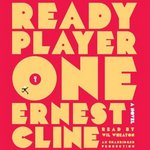
Ready Player One (Audiobook) by Ernest Cline, Wil Wheaton

Ready Player OneReady Player One

by Ernest Cline, Wil Wheaton

Unabridged Audiobook, 15 hrs and 46 mins
Random House Audio, 2011
Read: March 19 – 27, 2014

As much as I enjoy a good audiobook, I rarely have time for them, and I usually only listen to books that I’ve previously read. When my family needed something to listen to on a road trip last month, this was an automatic top contender — the printed version of this was probably my favorite book of 2011, and I was due for another read.

I’m so glad we picked this one, it was long enough (an important consideration for a road trip) and it was marvelously done. Wil Wheaton was an inspired choice to read this — not only is he an experienced, and accomplished audiobook performer (is that the right word?); but being who he is — an Internet/Nerd icon and a 1980’s child star — he adds a layer of authenticity and authority to the book.

I’m not going to talk about the book, I can’t. I’ve tried it before, and failed. But it’s just about perfect — funny, adventurous, immersed in pop culture (particularly from the 80’s, my formative years), smart, with heart — a lot of it.

So when you add one of the best performances of Wheaton’s career to that, you’ve got something worth spending 15 hours with. If only for his Sean Connery impression.* Wheaton captures the flavor, the pathos, the charm of the book and the characters that inhabit it. Go grab the book and give it a read. The audiobook’s almost as good. If you’ve read it, the audiobook’s a good way to revisit it.

—–

* There are several other “if only”s I could’ve used there, that’s just the first that came to mind. As Alan Sepinwall would put it, Deyanu!

—–

5 Stars

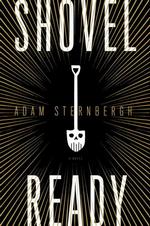
Shovel Ready by Adam Sternbergh

Shovel ReadyShovel Ready

by Adam Sternbergh

Hardcover, 256 pg
Crown, 2014
Read: May 1 – 3, 2014

It’s the near future, NYC has been rendered nearly uninhabitable by terrorist attacks and most of those that are still there aren’t really in NYC — they’re permanently jacked in to a virtual reality, kept alive by IV feeding bags. (think of a dystopian vision of Ready Player One‘s OASIS)

One of the few not hooked to the VR world is Mr. Spademan, a hitman. He doesn’t care who, he doesn’t care why, as long as the money’s right and he’s given a name, he’ll take the job. Once he’s taken the job, you might as well consider it done, he never fails, he never quits.

Well, until this job. Otherwise, it really wouldn’t be much of a story now, would it? Something happens that keeps Spademan from doing what he does — and the aftermath is pretty deadly. Spademan, his friends/allies, and those around them will be fighting for their lives before long as they plunge into a world of the ultra-rich, ultra-pampered and pseudo-religious.

The voice that Sternbergh employs is strong — you want to hear this guy tell his story. It’s a little heavy-handed from time to time — particularly at the beginning. But there’s a purpose for it, I think — at first I thought it was just a product of this being his first novel, but that’s condescending, and blind. Sternbergh knew exactly what he was doing — persevere through the heavy-handedness and you’ll understand why it was there.

A great mix of noir, SF, and suspense — with a little extra thrown in. It’d be easy to just chalk up this book to a fun combination of style, setting, and premise. But it’d be a mistake, there’s real heart here. Heart, genuine suspense, and a good story (yeah, and style, setting, and premise).

—–

3.5 Stars

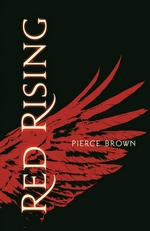
Red Rising by Pierce Brown

Red Rising (Red Rising Trilogy, #1)Red Rising

by Pierce Brown
Series: Red Rising, #1

Hardcover, 382 pg.
Del Rey, 2014
Read: Feb 26 – Mar 6, 2014

I’m having a hard time deciding what to say about this one. To really talk about it would require me spoiling every plot point that I loved (most of which I didn’t see coming). So I won’t. I’ll just say that I really, really dug this book.

I don’t want to just compare this to The Hunger Games, as much as reviews/blurbs/etc. make a guy want to. There are some surface-level similarities, yeah. And you could make the case (as I did when just starting the book) that Brown’s Mars was just the place for people who thought Collins’ Panem was a bit easy. In fact several parts of this feel like >The Hunger Games dialed up to 11. The working/living conditions for Darrow and his family are more severe, what Darrow has done to him to prepare him for what’s to come makes what Cinna et al. do to Katniss look like child dress-up, Darrow plays a deadly game on a larger scale than Katniss, and so on. But Darrow’s motivation is different than Katniss’ — she’s trying to survive, he’s trying to do far more (and much of the time, survival’s pretty low on his list) — the stakes he’s playing for are greater, and he will go to lengths that Ms. Everdeen doesn’t have to.

There are a few moments when things seem too slow, or meandering, or even redundant — but each time, I was wrong, and Brown made it all pay off. Visceral was the word that kept coming back to me as I read the book. I had almost visceral reactions to some of the horrors depicted, I could feel the grime and muck (literal and metaphorical) that Darrow crawled around in.

This shows every indication of leading to something epic in the next volume, leaving Mars behind and moving to other planets and/or the space between. As well as seeing if Darrow can retain his self and purpose — and how far will he be willing to go to carry it out.

There is a classic SF reference in Part IV that made me giggle with delight (in the middle of a pretty grim part of a fairly grim book, so I appreciated the placement). I won’t spoil it, but Pierce Brown has bought a lot of loyalty from me with two simple words.

Go grab this one.

—–

5 Stars

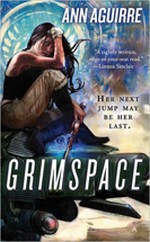
Dusted Off: Grimspace by Ann Aguirre

Grimspace (Sirantha Jax, #1)Grimspace

by Ann Aguirre
Mass-Market Paperback, 312 pg.
Penguin Group, 2008
Read: June 19-20, 2012

Action-packed, complexly-plotted, character-driven. Grimspace is a heckuva first book (would’ve been a heckuva 3rd, book, too). Not perfect, but so good that you put up with the short-comings.

This is more Ronald D. Moore/Joss Whedon-y S.F. than a Roddenberry/Lucas SF. The characters are people: flawed, self-deceived, selfish, scared… You grow to care about them, not just what happens (which would be interesting enough on its own, actually).

Actually, now that I’ve said it above, I’m more and more convinced this is Firefly without the livestock or distinctive dialogue. Can’t wait til I get my hands on the sequel. 4 Stars

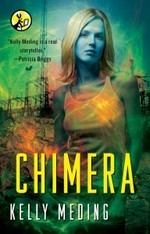
Chimera by Kelly Meding

Chimera (MetaWars, #4)Chimera

by Kelly Meding
ePub, 242 pages
Pocket Star, 2013
Read: Feb. 14-25, 2015


    • Let’s see here,

Chimera

    gives us:

  • a first-person account of super-hero life from an under-represented type of Super-Hero — Check!
  • Personal conflicts, Personal demons, general turmoil — moreso than most X-Men, even — heroes that carry emotional scars in addition to those earned in battle — Check!
  • Impending Government Persecution of Super-Heroes — Check!
  • A sex scene that goes on far too long for comfort — but is thankfully easily skippable — Check!

Yup. Chimera is a MetaWars book. It carries all the marks.

Renee Duval, aka Flex, is the focus this time around. She and a notorious ex-Bane have been dispatched to investigate a series of thefts that have to be being carried out by one or more teen Metas. With the threat of officially sanctioned internment of Metas hovering over them, the last thing the Rangers need is some punk kids bringing down the heat on them and any other law-abiding Meta. So Renee and Chimera have their work cut out for them — particularly considering that Renee’s doing her best to hang on to her anti-Bane sentiment, far after the rest of her team is softening. What they discover is unsettling for them, and doesn’t exactly fill the reader with a sense of joy, either.

One the one hand, I get Meding’s motive for varying P.O.V. characters in each book — and in many ways, I prefer this to the books that jump P.O.V. every chapter or so. But it’s also a weakness — for example — Trance was our entry into this world, we saw it all through her eyes. But we don’t get a whole lot of Trance any more — and what we do is just in brief bursts of conversation, and we don’t get the same impression of, knowledge of, experience of her. Still, Flex is a strong, yet flawed character, and it was nice to get in her head.

Plenty of action, some solid character growth, good plot advancement — Chimera is another good installment in a very satisfactory series. For a dystopian future, there’s something welcoming about this world, and I enjoy any time I get to spend in it. This book took me a freakishly long time to finish. That’s not a reflection on the character(s), the story, or the author — I was apparently busier and more tired than I realized until I saw just how long I’d spent reading the book (I’m not so unaware to not notice it was taking me awhile, just didn’t see how long I was taking). It was a good read, an engaging read.

—–

3.5 Stars

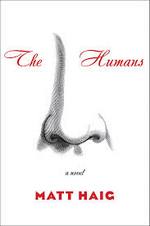
The Humans by Matt Haig

The HumansThe Humans

by Matt Haig
Hardcover, 304 pg.
Simon & Schuster, 2013
Read: Feb. 4-6, 2014

A couple of years back, I remember enjoying Haig’s The Radley’s about a family of vampires who’ve stopped feeding on humans, and have (mostly) assimilated into everyday society. It was fun, quirky, and had a lot more to offer than I’d have guessed. So when I stumbled onto this at the library, I had to grab it (and shame on me for not keeping an eye out for more by him).

The concept’s pretty simple: a brilliant mathematician has just made a break-through that puts humanity far, far ahead of where an alien race thinks they ought to be in terms of development based on how emotional and violent we are as a race. So, they send one of their own to kill him, take on his form and eradicate any and all people who might have knowledge of this breakthrough. Along the way, said assassin starts to understand and even appreciate humanity’s quirks and tries to stop the killing. Along the way we are treated to his observations about humanity. For example,

…I was able to work out that what humans may have lacked in physical attractiveness, they made up for in gullibility. You could tell them anything in a convincing-enough voice and they would believe it. Anything, of course, except the truth.

Basically, the key rule is, if you want to appear sane on Earth, you have to be in the right place, wearing the right clothes, saying the right things, and only stepping on the right kind of grass.

Or this description of browsing a bookstore:

Understandably, humans need to know what kind of book they are about to read, because time is money and money costs time and there’s no time like the present and all of that. They need to know if it is a love story. Or a murder story. Or a story about aliens. Perhaps the book they have in their hands is a war story. It wouldn’t be a surprise.
There are other questions too that humans have in bookstores. Such as, is it one of those books they read to feel clever, or one of those they will pretend they never read in order to stay looking clever? Will it make them laugh or cry? Or will it simply force them to stare out of the window watching the tracks of raindrops? Is it a true story? Or is it a false one? Is it the kind of story that will work on their brain or one which aims for lower organs? Is it one of those books that ends up acquiring religious followers or getting burned by them? Is it a book about mathematics or — like everything else in the universe — simply because of it? And also, of course, there is the ultimate, all-important questions: does it have a dog in it?

(amen to that last question)

A lot of these observations reminded me of the classic article, “Body Ritual among the Nacirema,” that social science undergrads have chuckled at for decades. And, at a point they got a little tired — but by the point that the book threatened to become an endless series of “here’s another way humans are odd” riffs, the story took over, and the characters became more than a collection of quirks. Which isn’t to say that the alien stopped having the observations, they were just mixed in with enough plot and character development that they became seasoning.

Another danger for the reader is that you could easily get so busy chuckling at things like a partial list of inventions that humans don’t know how to handle: “the atomic bomb, the Internet, the semicolon”; or the observation that a cat “was very much like a dog. But smaller, and without the self-esteem issues.” that you can let the poignant and thoughtful things slip by. This was not unlike Scalzi’s Redshirts in that way (it was on my mind because I was reading this when the news was released about the Redshirts TV adaptation).

Funny, moving, profound (not as profound as it wants to be, I don’t think — but close), look at what it means to be human, what it means to live, to love and why we bother with any of it.

—–

4 1/2 Stars

Page 31 of 34

Powered by WordPress & Theme by Anders Norén