Category: The Hybrid Helix

A Few Quick Questions With…JCM Berne

It’s Publication Day for Partial Function by JCM Berne and what better way to commemorate it than with a Q&A with the author his own bad self?


Give us a quick origin story—how old were you when you caught the Writing Bug? What made you decide “I’m going to get serious about it now” (whenever that happened to be)? etc.
I wrote what we’d call fanfic (I had never heard the term) in elementary school, but I didn’t try to write an actual story until just after dropping out of grad school. I was inspired by RA Salvatore – The Cleric Quintet – and I wanted to write fantasy stories about dwarves. Something about his dwarves really struck a chord in my imagination. This was around 1998.

I wrote a couple of novels, went nowhere with them, and tried again in 2006. Self-publishing as we know it didn’t really exist back then, so I basically gave up. In 2019 I got the bug again – I had a little bit of time, and Invincible gave me the same writing itch that I’d gotten from Salvatore – and I wrote Wistful Ascending in one big burst, promising myself that I’d put it on Amazon even if it sucked. Which I did! (for the record, he ended up putting it on Amazon without it sucking)

What came first—the desire to take a break from The Hybrid Helix or this story? How important was it for you to take this break?
I didn’t exactly want to take a break. I wanted to write something more marketable – HH is a very tough sell, commercially (it’s a superhero story that doesn’t include superhero conventions like an origin story or supervillains, and it’s VERY hard to describe – count the reviews that say, “this isn’t what I expected!” – it’s a lot of reviews.) A lot of my target readers are much more into fantasy. And I really, really wanted to do better in SPFBO, which is totally an ego thing and not rational in any sense. AND I wanted something with less pressure. Every HH book gets harder, because I have to keep in mind the series-level story and the book-level story simultaneously. With a standalone I can drop all of that pressure.

So I decided to start from a killer pitch, instead of the weirdness that is Wistful Ascending, and write a straight fantasy (instead of superhero/sci-fi) with a straightforward narrative and see what happened. And I failed, because of course I did. I should have made Akina an Elven Ranger and set the story in a setting that could pass for an amateur D&D campaign. But I love fisticuffs and dinosaurs more than I love archery, and I had the worldbuilding basically done (it’s the same universe as HH, broadly speaking), and I didn’t want to take six extra months to do it.

Another aspect of doing something new was trying to write something cheaper. The HH books – with the cover artist, narrator, and editor I’m committed to – are huge money pits. I wanted the chance to release something that wouldn’t cost an arm and a leg. And I failed again, though Partial Function cost me a lot less than a HH book, it didn’t end up being anywhere near as bare-bones as I intended.

I’ve heard authors say that they learn something while writing each book. What did Partial Function teach you that The Hybrid Helix hasn’t? How was the experience different in this new world?
I learned that, once again, my sense for what other people will enjoy is not very good. I had very little confidence in this book. I mean, I knew I loved it, and I knew it did what I wanted it to do from a craft perspective, but I didn’t really think other people would like it. And so far, the reception has been really positive. People aren’t hung up on the weird stuff in the book as much as I thought.

It’s a nice feeling, but also disturbing, because it’s good to have people like your art, but it’s also a bummer to know I’m not good at judging my audience. I suppose I might as well just go on writing what I love and hoping.

You’ve described yourself as a “kitchen sink writer,” I used more words to describe it, and greatly prefer your pared-down version—what do you mean by that? Is that just who you are, or did you make decision along the way to become one? (I never expected to ask a nature vs. nurture question)
I have a lot of interests, in fiction and outside it, and I like to throw stuff from all of that into my books. Infinity bagua is actually a really interesting martial arts idea – bagua is a real martial art in which training is focused on walking in circles (I’m oversimplifying), and infinity walks are a real training tool used by some very serious coaches, so combining them isn’t actually as random and silly as it sounds. I’ve read a lot of manga and American comics and watched a LOT of martial arts movies, so I threw a lot of pieces from them into this.

It was never really a decision. If I try to write something more straightforward, without a lot of weird things thrown in – if I had tried to make this “Taken, but set in Shannara” – I get bored. This isn’t my day job: if the writing gets boring, I’ll quit. I have no idea what would change if this WERE my day job and I really had to write something commercial, but that’s a question for another lifetime.

I want to ask a couple of questions about Partial Function characters. I have a handful about Zhu, but…I can’t think of a way to ask them without spoiling something. So, what would you want a prospective reader to know about her? (basically, say whatever you want about Zhu)
I included Zhu because I was too lazy to draw a map. In fantasy novels, travel is a big thing – you have to have a map, measure distances, calculate the average distance a wagon can travel over rough terrain in a day, etc. etc. etc. I had no enthusiasm for that. So I gave everybody teleportation magic and let them hop around to my heart’s content.

Once I put Zhu on the team, she had to do more than just be a human taxi. She’s a teenager, so I made her snarky, because the day I write a non-snarky teenager is the day they can pull the plug on my life support. It’s low hanging fruit, basically. But I didn’t want to make her too obnoxious, or rebellious for its own sake, because those traits annoy me, so I tempered that out a bit.

The other piece of it is allowing us to see a little bit of Akina-as-a-mom. That part was mostly accidental, but I felt like it raised the stakes to see that side of her. I’ve seen the “I’ve got to rescue my kids because I was a negligent parent and it’s my way to work out my guilt” trope in other stories and I hate it. Akina was a good mom, in her own opinion, and she wanted her girls back because she loved them. Full stop.

After that, Zhu just became fun. Once I have a character’s voice in my head, it’s joy to give them their own dialogue, their own jokes, with their own timing and approach. Good jokes are character-specific (I learned that from Howard Tayler).

I talked a little bit about Remy in my original post about the book, and you told me he was important to you. Can you unpack that a bit?
I love all the main characters, but I feel like Remy is the least sexy. Sort of. People are desperate for action moms in fantasy – it’s something I’ve heard repeated – and people love competent younger characters coming into their own. And come on, everybody loves animal companions, especially when they’re adorable. But big guys who are good at fighting aren’t in short supply.

To me, Remy was important because of what he wasn’t, in some ways. He loves Akina with zero romantic or sexual intent, and vice versa. They’re genuine friends, and he’ll do anything for her, exactly the same way he’d have done anything for Petrik. And I like that kind of relationship. I feel like the expectation is that we find out halfway through that he would have had some spark for Akina and been pining after her for years, and I just wanted to pull the plug on that. He doesn’t want to have sex with Akina, at all, period. He just loves her, and she loves him, and that’s that.

Who are some of the bigger influences you have in your writing—this book and others—whether or not readers can see them, you know they’re there?
I’m 52 and I’ve been a compulsive consumer of media for about 42 of those years, so there’s an awful lot.

For writing style I have to say some RA Salvatore (who I forget to mention as often as I should) and Jim Butcher. But I was writing like this before Storm Front was published, so maybe that’s not quite right. Maybe my influences were more Glen Cook (PI Garrett Cook, not Black Company Cook, in terms of style) and Steven Brust.

I also take a lot from comics, too many to remember. Brubaker, Starlin, Chaykin . . . I wouldn’t know where to stop. Ellis. Moench. I had a bad habit when I was younger of buying comics and not paying attention to the creative team, so I didn’t even know who was influencing me, but they were.

And for this book in particular, I use a lot of movie influences. Taken, John Wick, Crouching Tiger, Hidden Dragon. Jurassic Park! And a lot of anime and manga. Those influences are big in HH, but maybe even bigger in Partial Function. I never wanted to see Wistful Ascending adapted to film (I mean, I wouldn’t say no, but it was never a thing I cared about) but I’d LOVE to see a series made of PF.

What’s next for JCM Berne, author? I’ve seen some things you’ve posted on social media sites, but I can’t tell how serious you’re being—and either way, I’m very intrigued.
I have a bad habit of getting excited about something, planning it, writing a chapter, then realizing the voice doesn’t work for me. Well, that’s not the bad habit, but posting about it on twitter IS. My progression fantasy about tiny dragons is a solid idea but I just didn’t enjoy writing it as much as I thought.
Right now I have three ongoing project. I’m going to continue the Hybrid Helix, because I haven’t even gotten to the point yet. I have no idea how long that will be, but I can’t imagine fitting the story I want to tell into ten or fewer books. 12? 17? We’ll see.
I wrote Partial Function as a standalone, and I didn’t deliberately throw anything in there that was meant to seed a sequel (unlike Wistful Ascending, which I wrote from the start as the entry point to a series). The story is over, and any sequel has to have a new story. I didn’t really have a good idea for that sequel until a couple of weeks ago, but now I think I have one. I might write that in December, or the next HH, I haven’t decided yet.
The third project is The Grimdwarf, a story about an immortal, cursed Dwarf who keeps trying to die in battle. It’s sort of an homage to Gotrek and Felix, except Felix is a woman and they have a dog. I’m playing with the structure, writing it almost like a manga. Some chapters are standalones, some are tied together into arcs, but I’m not building it into novel-length pieces – some arcs might be novel-length, but some might be much shorter, and I’m allowing that deliberately.
I have no idea what to do with this. It’s a story I love, personally, but I don’t know if other people will want to read it. Lots of punching, lots of banter, some worldbuilding, a touch of pathos. I might just give it away (say, a chapter a week) to patreon patrons or people who get my newsletter or just toss it onto Royal Road and say, “here you go!” A lot depends on reception. I will see how much I can get done this month – sort of a fake NanoWriMo (since it’s not really a novel) – and maybe get some alpha/beta readers to tell me if I should trunk it or not.

Thanks for your time—and thanks for Partial Function—I had such a blast with this and hope it finds the audience it deserves!
Thank you so much, HC! Positive critical reception is a huge part of why I’m still writing. I’m very glad you gave this book a chance.

Partial Function is out NOWgo grab yourself a copy.


A Few Quick Questions

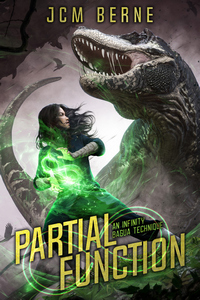
Partial Function by JCM Berne: A Mom With A Particular Set of Skills

Partial FunctionPartial Function

by JCM Berne

DETAILS:
Publication Date: November 7, 2023
Format: eARC
Length: 361 pgs.
Read Date: October 9-10, 2023

The First Chapter

Don’t worry, I’m not about to go through this book chapter-by-chapter talking about each one—there are thirty chapters, and while I know I can go on and on about books that I like…

No, I’m going to focus on the first chapter for a moment for one reason—your reaction to the first chapter is going to tell you everything you need to know about this book. If you read that chapter (and everyone who’s stumbled onto this post should do at least that) and you think “Yeah, I can see myself enjoying this book.” You almost certainly will. If you read it and think, “Oh yeah! Give me more of that!!” You definitely need to read on. If you read this chapter and aren’t that interested in going on—trust that instinct and move on with your life. Also, I feel bad for you. (but I say that without judgment, even if it doesn’t sound like it).

This chapter isn’t quite the novel in microcosm, but it comes close—it has the spirit, the humor, the action, the supernaturally-charged martial arts, and the panache that will characterize the rest of the book. Anddddd, best of all, it features a very good dog. The book will bring in more characters than just Akina Azure and her dog (frustratingly named Dog*), which is the biggest reason I can’t say this chapter is a microcosm.

* It’s not just this that Akina has in common with Walt Longmire—I actually could write a post comparing the two—but this is my biggest complaint with both of them. You two have great canine companions, they deserve a great name.

So, What’s Partial Function About, Anyway?

I don’t know that I can do better than the description I was given for the cover reveal a couple of weeks ago—I’ve tried, and I keep unintentionally borrowing elements from it, so let’s just use it:

If Taken starred Michelle Yeoh and was set on a Jurassic Park-inspired Cradle.

Monster hunter Akina Azure inherited the most powerful weapon in the martial world before retiring to a peaceful life raising her twin girls.

The Reaver has them kidnapped, thinking Akina will trade that weapon for their safe return.

Will she? Or will she use it to wreak a terrible retribution on the men who took her girls?

You get one guess.

I’ll expand a bit on that, though.

Akina was part of a legendary band of adventurers, The Five Fangs, and then she and her husband Petrick (also one of the band) retired to go live far away and start a family. None of their friends have seen—or heard—from them or of them in years. Long enough for them to raise twins into their teens before Petrick died of blood plague (I don’t know what that is, but the name alone…).

Now, Akina tracks down one of the Fangs, Remy, to help her. She needs his connections to put her in touch with the people she needs to put her rescue plan into action. It wouldn’t hurt to have one of the few people alive that she trusts to have her back, either.

Remy isn’t crazy about the idea, but he can’t say no to Akina. These two past-their-prime warriors are soon joined by a much younger fighter (who is not quite in her prime and has a lot to learn first) that they can’t entirely trust, but can certainly use. Three people and a dog against the most powerful, feared, and twisted warrior (and his army) living. That’s if they can dodge the kaiju-esque monsters along the way.

It’s really not a fair fight.

Fantasy’s Answer to Sam Axe

I predict that most people talking about this book are going to focus on Akina—as they should. And I’m tempted to spend a lot of time talking about Dog, because he’s such a good boy.

But I want to hone in on Remy for a bit. He’s so essential to the way this book works, and I think he’s so easy to overlook. Sure, Akina and Zhu have some good, snappy, dialogue, and Dog being dog is amusing. Remy’s easily the funniest character in the novel and can be seen as only comic relief. That’s an error.

A couple of days ago, in an earlier draft of this post, I made a joke about him essentially being Sam Axe from Burn Notice. I haven’t been able to get that comparison out of my mind. It’s so on the nose. Remy serves as Akina’s Devil’s Advocate, voice of reason, conscience, and confessor. He’s the only one she fully trusts anymore. He knows someone (or knows someone who knows someone) everywhere they go and can get them whatever resources they need. In a fight, he’s almost as good as Akina and saves her on more than one occasion.

He covers all this with a commitment to doing nothing but drinking, womanizing, and lazing about all day—which is pretty much what he’s been doing since Petrick took Akina off to who-knows-where. When called upon, he steps into action, griping the entire time about how it’s cutting into his drinking. Again—Sam Axe.

If you’ve ever wondered what a wuxia-adjacent Bruce Campbell would be like, this is the book for you.

Okay, setting that all aside—at the end of the day, you’re going to like Remy and trust him to do the right thing more than pretty much anyone else in the book (see the next section for a hint of that). His agenda is pretty clear—do the right thing by his friend, do the right thing in general, and then leave everyone to their business so he can get back to pickling his liver. He may not understand the nuances of everything going on—but he’s honest, he’s clever, and he’s tough. Just the kind of guy you want to have around.

The Central Question of the Book

Most—possibly all—of the “bad guys” in this novel wouldn’t describe themselves that way. They think they’re doing the right thing to save the world, or at least civilization. Not just the right thing—the only thing that will save humanity.

But they’re so focused on the ends that they cross all sorts of lines when it comes to means. They do things to increase their power that are repugnant to the reader and just about every character in the novel. Honestly, kidnapping Akina’s twins in order to compel her to surrender her weapon is pretty much the mildest thing the “villains” like the Reaver do to secure the ability they think will help them.

It’d be easy to write them off here—ends don’t justify the means and all that, right?

But when you stop and think about the steps that Akina takes to enable her to rescue the twins? It’s hard to think of her as a hero (and she doesn’t pretend to be one, in fact, she outright denies it).

The novel focuses on Akina; she’s nice (generally) to Remy, Zhu, and her dog as they travel; she’s funny; she defends young women from creeps and slavers…and so on. So you reflexively think of her as a “good guy” a “hero.”

As we read Partial Function, we’re thinking about things like Taken. So let’s start there—are the actions that Bryan Mills takes to rescue Kim, the right thing to do? Sure some of them—but all of them? How about John Wick—think of the death and destruction that comes from him getting his vengeance? We’re inclined to think of Mills* and Wick as the heroes—but are they? I’d ask the same thing about Akina.

* Who am I kidding? None of us think of him as Mills, we think “Liam Neeson”—or “Liam Neesons,” maybe. No one thinks of him as Bryan Mills.

Now, that isn’t a criticism of her as a character. I loved Akina. I wanted to see her win, her whole plan was brilliant, I enjoyed watching her fight, banter, be corrected, and wreak vengeance. Maybe even more than I enjoyed Neeson or Wick doing the same.

I’m just not sure I should.

So, what did I think about Partial Function?

I have a couple of pages of notes that I can’t get to. There are so many quotable moments—because of heart or laughs. Berne’s got a way with words that I’m tempted to call Butcher-esque, and I just want more of it. But I need to get moving, so let’s just say that I had so, so, so much fun with this. Between this, Chu’s The War Arts Saga, and talking a little to Tao Wong this summer, I’ve decided I need to make more room in my reading for wuxia-inspired works.

The world-building deserves a paragraph or five to celebrate it (but it’s taken me 2 weeks to get this much written, I’m not risking putting this off any longer). For example, I should talk about the kaiju-ish creatures, but beyond saying they’re dinosaurish animals with powers that love snacking on humans (when they’re not stomping on them), I don’t know what to say. The political/clan system serves the whole thing well and I’d enjoy seeing more of it in a future installment.

Partial Function is a fast, enjoyable, action-packed read with a lot of heart and just enough humor to help you deal with the stakes and destruction. And these characters? I loved getting to know them and spending time with them. There’s a lot to chew on in these pages if you’re in a thoughtful mood, and if you’re not? You don’t need to, you can just enjoy the ride.

This was intended as a stand-alone, but the door is open for another adventure or so for the survivors. If we get a sequel, I’ll be first in line for it. If we don’t? This is going down as one of my favorite fantasy stand-alones. Either way—I’m encouraging you to read the first chapter and apply what I opened with. I’m sure there will be those who don’t get into this, but I can’t understand why.

Disclaimer: I received this eARC from the author—after repeated requests—in exchange for this post and my honest opinion.


5 Stars

 
Irresponsible Reader Pilcrow Icon

COVER REVEAL: Partial Function by JCM Berne

I’m very pleased to welcome Day 2 of the Cover Reveal for JCM Berne’s Partial Function to The Irresponsible Reader this morning! This means you’ve likely seen it already, but just in case…also, it’s such a cool cover, for such a cool book (as i’ll hopefully expand upon in a day or three), how could I say no? Before we get to revealing the cover, let’s learn a little bit about the book and author, shall we? I won’t take too much of your time, and then we can lay our eyes on the cover.

Book Details:

Book Title: Partial Function by JCM Berne
Genre: (wuxia-adjacent) Fantasy
Release Date: November 7, 2023

About the Book

If Taken starred Michelle Yeoh and was set on a Jurassic Park-inspired Cradle.

Monster hunter Akina Azure inherited the most powerful weapon in the martial world before retiring to a peaceful life raising her twin girls.

The Reaver has them kidnapped, thinking Akina will trade that weapon for their safe return.

Will she? Or will she use it to wreak a terrible retribution on the men who took her girls?

You get one guess.

About the Author

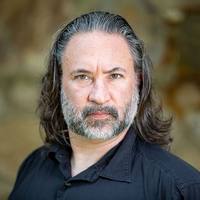
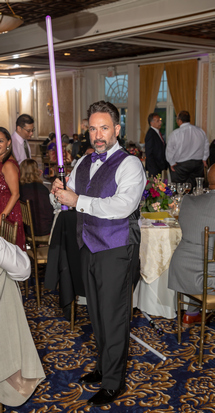
JCM BerneJCM Berne has reached middle age without outgrowing the notion that superheroes are cool. Code monkey by day, by night he slaves over a hot keyboard to prove that superhero stories can be engaging and funny without being dark or silly.

Linktree ~ Author Website ~ Twitter ~ Instagram ~ Facebook ~ Threads ~ BlueSky ~ Book Berne-ing authortube show ~ Free short story

and now…

The Cover

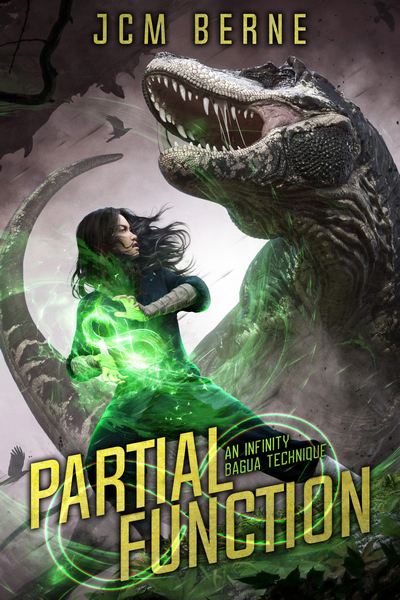
Partial Function Cover

That’s a spiffy cover, right? I’m telling ya, the book is even better.

It’s out November 7, be ready to jump on it then!

Irresponsible Reader Pilcrow Icon

The Inside Scoop—A Q&A with JCM Berne About Self-Publishing

Inside Scoop logo
I’ve talked about him all week, and now it’s time to hear from the man himself, JCM Berne. Without his help, there’d have been a lot less for you to read and me to post this week. And as anyone who has read his fiction, watched his Youtube videos, or has interacted with him in any way will expect, this particular entry in the series is as fun to read as it is useful and informative. Without further ado:


Before we get into things, why don’t you give the reader a brief introduction to you and your work.
I am JCM Berne. I write superhero stories. For grownups. No, they’re not silly. No, they’re not deconstructions. Or anti-heroes. Or gritty. Or hyper violent. Yes, they’re for grownups, I said that already. Yes, I’m serious. Yes there are bears, and sentient space stations, and giant bug monsters. No, really, none of it is silly.

It’s a story about regret and redemption, humor and happiness, coffee and donuts. Some people call it slice-of-life, but there are some war crimes and mass murders, so it’s not exactly cozy fantasy.

My website: jcmberne.com (shocking, I know!)

My books can be found at: https://a.co/d/5LoNrHZ

Best place to talk to me is twitter (my DMs are open!): @joeberne1

What are some of the biggest misconceptions you find that readers have about self-published books?
I’ll summarize it like this: people know that in, say, fantasy, Tor, Baen, Orbit, and whoever else you consider the ‘real’ publishers are releasing a certain number of books each month. People imagine that those companies are actually getting the BEST books. That if those companies release 50 books, the BEST indie book that month is, at most, the 51st best book being released globally.

That is incredibly far from the truth. The major publishers are finding, at best, a fraction of the best books according to their own editorial taste.

If your taste doesn’t exactly align with the Tor (or Orbit or Baen) staff (and it probably doesn’t), the BEST book for you that month might be one that those companies have all passed over. Maybe you want something more original. Or less original! Or litRPG. Or a non-ironic superhero story! The big companies are only releasing books in a very narrow window of genre and style.

Additionally, the process of getting a book through slush piles and into an editor’s hands is so onerous and so luck-dependent that there’s a good chance the best book in any given month was never even looked at by an agent, let alone an acquiring editor at Tor.

If you can find review outlets that you trust, you might find that THEY find better books than Tor can ever manage.

The second set of misconceptions is that self-published books are low quality – more typos, ugly covers, poor editing, etc. This is absolutely true some of the time, but it’s not hard to find self-published books of higher objective quality than trades. It just varies more (the worst self-published books are much, much lower quality, because there’s no gatekeeping at all).

What kind of costs are associated with self-publishing a book? Do you hire one or more editors, or one editor for a couple of passes? Cover artist? Anyone to help with layout, design, etc.? Beta readers? Or do you take it all on yourself? Are you actually making any money at this, or are you still focused on breaking-even while building an audience?
Cover: as low as $50 – but you’d have to be very lucky to find one that cheap that matches your book and still looks decent. Really good covers are very findable in the $1000 range. I spend over $4k on mine (which is probably a really poor investment, but I’m not a smart businessperson).

Editing: Varies. Most self-published authors writing GOOD books are hiring a line editor and copy editor and getting some developmental editing done (I am an exception, I don’t use developmental editors, because I’m just that arrogant). Minimum $1000 for a book and usually closer to $2-4k.

Layout and design – some people hire this out, but there’s software like Atticus ($100 lifetime purchase) that make it really easy to do.

Beta readers – people do hire beta readers, who cost a lot less than editors (usually under $100 for a beta read). Hiring beta readers is a lot less common than just trading with other writers.

Audio narrator: some people do this themselves, but a good audio narrator is around $200+ per finished hour. My book, for example, was about 13 hours. You can go higher.

Marketing: That’s the open-ended part. Blog tours, ads on amazon, newsletters, etc. You can spend absolutely any amount.

I am not making any money at this. Some indie authors are. Some support themselves doing this – more often those in high volume genres, like romance. I hear about indie authors hitting seven figure incomes (I assume that’s US dollars, not rupees or anything). I personally am eager to one day come close to recouping what I’ve already spent (nowhere near it).

Are there tools, mentors, websites you’ve found to help you through this process? Or did you stumble through blindly on your own?
I figured out a lot of it myself. I had early mentors in Ande Li and Maurice Alvarez, who I talked to because they’re friends in real life who had been publishing books for a while!

Once I got a foothold in the community, I got a LOT more help from authors on various Discord servers. I’ve found self published authors very willing to share advice and strategies. It’s a bizarrely supportive community.

How do you juggle marketing/PR/etc. with writing new work? (along with day jobs, family, hobbies, etc., etc.)
I keep telling myself it’s cheaper, and less time consuming, than a drug addiction. Not sure it’s true, but that’s what I tell myself. (that’s the second time someone’s said that—or words to that effect—today. I’m not sure if that’s a good or a bad sign that multiple people think this way)

What made you decide that self-publishing was the direction you wanted to go? How often do you question that choice? How do you get through the self-doubt?
Honestly, I spent a small amount of time trying to find agents that might be interested in my book and got nowhere. It’s possible that some are out there and I just couldn’t find them. Believe me, if I thought I could have gotten a contract from Tor, I would have. I also feel my particular book doesn’t pitch well. I’ve never been able to come up with a brief (1 sentence) description that sounded anything other than a bit dumb. My strength obviously isn’t marketing!

I almost never question that choice, in the sense that to this day I still can’t come up with a good pitch for my book, and I don’t think there’s a route to a traditional contract that would have ever worked for me.

If I had held out for that, I’d be waiting still, and I wouldn’t have the readers I have, who I treasure.

Have you thought about trying to get a deal with major (or indie) publishers for upcoming works, or are you planning on sticking with self-publishing?
I have an independent book coming soon that pitches well (Taken, if it starred Michelle Yeoh and was set on Cradle – a retired monster hunter wrecks a continent when her children are kidnapped.) I tried to get a deal and failed. I’m not sure the patience for that anymore – especially when I’m in a position where I can get literally hundreds of people to read my next book with a few tweets.

Odds are, you’re doing this from love/passion, not to pay the bills. What keeps you going? I’m assuming there are more “who”s than “what”s, actually—who is it?
It creates plenty of bills… not paying any of them yet! While I do dream of making a profit at some point, I’m pretty happy with what’s going on right now.

I love to tell stories. I love crafting them, the slow reveal, figuring out ways to change the emotional impact. I constantly make up stories, even if it’s just in my own head.

Writing is, for me, incredibly fulfilling for that reason!

I tell people this: if you don’t have to write, don’t. It’s frustrating, time consuming, and difficult. If you aren’t driven to do it, don’t punish yourself! But if you’re compelled to write, then by all means, become an author. Just don’t quit your day job!

Self-publishing tends to have fewer external deadlines keeping one accountable. How do you maintain your work process or work ethic?
I have a system.

I book slots with my line editor, who usually fills her schedule 4-6 months in advance. Then I am forced to finish my books to get them to her.

Because I love my line editor (she makes my books more authentically mine than I can manage on my own), I am deeply afraid of disappointing her, so it works!

I do not recommend this system. Do as I say, not as I do.

If you were to start the process over with the experience you have now, what would you do differently?
I would probably write a different genre. Superheroes are a tough sell, much tougher than I expected, and getting readers to take my books seriously is hard (I’m surprised you read it, HC, given what you generally review) [Really? I loves me some good super-hero stuff, I need to do better at talking about that]. On the other hand, this genre is what I really love, so maybe I’d have decided to go with it regardless, and just had lowered expectations.

Maybe that’s what I’d do differently: moderate my expectations.

How do you decide a book is finally finished and ready? (or how do you avoid “perfection as the enemy of good”?)
This is the tricky thing!

I set a deadline – usually announcing things on twitter, or booking a slot with my line editor – and just try to get it as good as it can get before then. But you have to couple that sort of process with a willingness to bail (and eat the editorial cost, or kill some of the buzz you’ve generated) if the product you have really isn’t up to par.

So far, I haven’t done that. It helps that my goal is a really fulfilling series, not a really fulfilling book, and I remind myself that every series has some subpar entries. But really it just takes an enormous amount of confidence, earned or not, to release a book, and you just have to do it.

Thanks for your time and participation! Hope you enjoyed it! And do know that there are many of us out here who appreciate and applaud what you do (and our number is growing)!
Thank YOU so much! Reviewers and influencers are all that stand between relative obscurity and complete obscurity for us authors! (Sorry, I wrote that sentence wrong, then read what it said, and it’s too funny for me to fix). Writing is inherently communicative. Having readers who really understand what I was trying to do in my books is what makes writing them worthwhile, and to be honest, I only KNOW they ‘got’ the meaning when I can read an actual review. Not that a buy or a star rating aren’t great – they are – but it doesn’t mean as much.

Be sure to give The Hybrid Helix (and anything else Berne puts out) a try!


Self-Published Authors Appreciation Week Footer

Clker-Free-Vector-Images from Pixabay
The 2023 Self-Published Authors Appreciation Week Logo was made by Witty and Sarcastic Book Club

I Have Far Too Many Things to Say about Wistful Ascending by JCM Berne (But I Try)

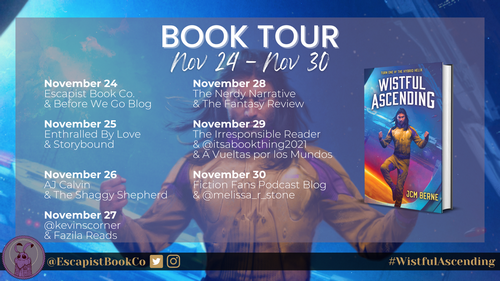
Wistful Ascending Tour Banner

Wistful AscendingWistful Ascending

by JCM Berne

DETAILS:
Series: Hybrid Helix, #1
Publisher: The Gnost House
Publication Date: September 5, 2020
Format: eBook
Length: 395 pg.
Read Date: November 24-28, 2022
Support Independent Bookstores - Visit IndieBound.org

A Word About this Post

If I approached this novel the way I typically would, you wouldn’t read it. I wouldn’t blame you, because I wouldn’t either. It would just be too long to bother with. There’s just too much that I want to talk about here. So I’m going to do this differently, I’ll provide a little setup, give a couple of pros and cons in bullet points (many of these bullet points would be 2-3 paragraphs otherwise), and then a wrap-up thought.

There’s still a good chance that this is going to be too long, but I tried.

What’s Wistful Ascending About?

For some time, Rohan was one of the most feared warriors in the il’Drach Fleet. As a human/il’Drach Hybrid, he had powers and abilities beyond what most are capable of—flight, super strength, speed, stamina, healing, etc. He tires of that way of life and retires to the space-station Wistful, just outside the empire, and gets a fairly menial job. Work, a couple of beers, and sleep—before starting it again the next day. That’s the kind of life he wants.

And it works for a while. Then a previously dormant wormhole opens up and refugees from the other side of the galaxy (or further) show up. Then scientists from the Empire arrive to study that wormhole. Dangers, soldiers, spies, and assassins are suddenly all over Wistful and Rohan is called upon to defend his home, his friends, and himself.

The Cons

This is going to be a short list:
bullet The Title. Yeah, it’s fitting. But it’s not really an eye-catcher, is it?

bullet The Prologue is one of those action-packed intros that stops just before something major happens before giving us “X Hours Earlier,” “Y Days Before,” etc. Twelve Days, in this particular case. I don’t get the appeal of this kind of introduction, and while I can’t say that I’ve never seen it done well, the percentage is pretty low. I don’t understand why writers keep going back to that device, someone must like it.

The Pros

Basically everything else.

However accurate, that’s probably not that helpful. So let me share some highlights.
bullet In the tradition of William Munny, John Rambo, John Wick, Clay Cooper, and countless others, you have a man of war, a man of violence who has made a conscious decision to leave that to pursue a quiet life, a peaceful life—a life of no notoriety. Then circumstances compel them to return (hopefully temporarily) to that life they had forsaken. Who doesn’t like this kind of story?
bullet Before he joined the il’Drach Fleet, Rohan was a super-hero on earth—or tried to be, he apparently didn’t get much attention due to being on the weaker side. Which is just a great idea for an origin. If nothing else, it makes Rohan instantly accessible to the reader—we get his humor, his references, and have heard stories like his before. Also, by “weaker” think Invincible/Mark Grayson compared to Omni-Man/Nolan Grayson. So technically weaker, but not a major downgrade. Also, hold on to that Invincible comparison—we’ll be coming back to it.
bullet So his father was an alien, but his mother was from India and she relocated to Canada when he was very young. That’s a lot of cultures to draw from, it explains his tastes in food—and it keeps Rohan from being a Clark Kent/Mark Grayson/etc. clone.
bullet Not only does Rohan have nifty superpowers (as do some of his opponents)—the way that Berne describes their use is just fantastic—really. If it’s not the best description of super-powers in prose that I’ve read in the decades I’ve been reading them, it’s so close as to be negligible (and I’m too lazy to dig up the couple of contenders that I’m thinking of to do the comparison).
bullet Beyond that—his explanation for the source of the powers in the metaphysical sense? Think of the Force in episodes 4-6, and then do a better job of explaining it.
bullet (there’s a later explanation of how those abilities manifest themselves in the Hybrids that’s pretty clever, too)
bullet There are kaiju. Or kaiju-esque creatures.
bullet Wistful, the space station Rohan lives on and works for, is the kind of multi-species hive of activity and commerce that’s catnip for Space Opera/SF junkies. And the alien races/cultures that are represented there are well-designed and interesting. Really, if Berne gave us an illustrated guide to his aliens, I’d snap it up.
bullet Wistful is a sentient space station (I’m on a roll with these lately), who actually has legal jurisdiction over the solar system she occupies. Can be a party to treaties, etc. How cool is that?
bullet It’s not just space stations, either. Ships of a certain size are sentient, too. They grow and develop. They have wills and desires of their own—for example, there’s a ship that got tired of being a troop transport and changed themselves (with the appropriate approvals, etc., I’m sure) into a science vessel because they wanted to learn and explore. I’d take a novel just about that ship.
bullet The explanation behind the way the ships/stations act and have sentience, etc. in contradistinction to those of other cultures is interesting and fits in with the world that Berne created so well.
bullet I don’t know how I’ve made it this long in this list (which is longer than I anticipated and makes me all the more certain I shouldn’t have tried a traditional post) without mentioning the humor. Think Jim Butcher. Think Invincible. Think Peter Parker at his best. Think MCU’s Guardians of the Galaxy. Think Nicholas Eames. You get that humor throughout the novel and it’s shown through all the characters in some way (at least those not trying to kill someone at the moment), but it’s particularly expressed in Rohan’s point of view and the way he talks to himself.
bullet But more particularly Rohan’s banter with just about everyone—it’s almost at the level of the Giffen/DeMatteis Justice League
bullet Most of the characters—from Wistful’s security chief to the staff at Rohan’s favorite place to get breakfast are so well-developed and distinctive, with such interesting points of view and characteristics that you almost want every scene to be twice as long just to spend time with them.
bullet This is related to the depiction of super-abilities. But these fight scenes are dynamite. One of the problems a lot of writers have with Superman, for example, is when someone like him lets loose and say punches a guy—bad things happen. I remember an old DC role-playing game when I was a kid—no one wanted to be Supes because it was too easy to kill someone. Now, people like Robert Kirkman embraced that, and the pages of Invincible (I told you to hang on to that) are dripping with blood, gore, bits of bone, and the debris of buildings/mountains everywhere. We get the same kind of power on display here with the same kind of consequences (also, several displays of Rohan not letting that happen).
bullet Related to those fights. Seriously. Don’t make Rohan angry. You wouldn’t like him when he’s angry (he sure doesn’t—see the first bullet point in this list)
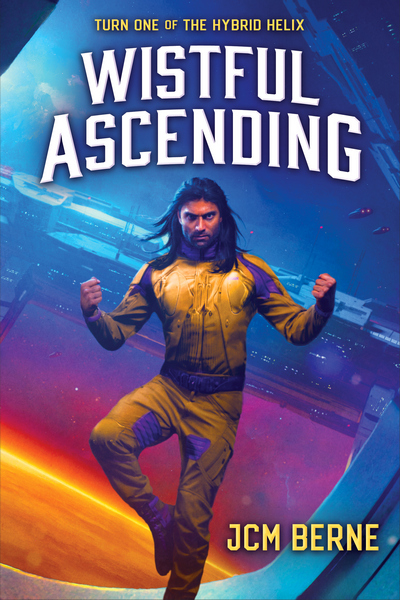
bullet One more Invincible note—doesn’t that cover kind of look like Chris McGrath did a take on a Ryan Ottley cover? I don’t know who the cover artist was, but I loved it.
bullet Lastly, aside from the Prologue issue (which is my personal taste, but it’s my blog so I get to call it an issue), the way Berne plotted this thing, constructed the story, doled out information, and everything else along those lines was so well done, so impressive that you have to believe that he’s been at this a long time.

Okay, I lied. I have one more point:
bullet Talking bears in space. Well, an alien species that happens to look like sentient, talking bears, who have the strength of large bears, and enjoy catching/eating fish. So….close enough. I’ll say it again: talking bears in space.

So, it’s pretty clear already, but what did I think about Wistful Ascending?

I want to say more—believe it or not. I don’t think I’ve captured how excited I was reading this and am now while trying to talk about it.

I was talking to a friend about Wistful Ascending the other day, or maybe I was just trying to—like with this post, I struggled. I said, “It’s like he’s doing “Scenes from a Hat” from Who’s Line is it Anyway?, but instead of transitioning from one idea to the next, it’s like Berne takes each idea as it’s pulled out and adds it to the story. He says ‘Yes, And’ to everything.—’Sentient Space Station? Okay. Golden-Age Super-Hero Sidekicks who’ve become old scientists? Fine. Kaiju? Sure thing!'” I’d honestly love to know what he thought wouldn’t work in this novel.

And the maddening thing, the thing I can’t wrap my brain around is that it somehow all works. Because that was my friend’s first reaction—”oh, that’s just way too much for one book, the guy needs to edit.” I had to say no, it somehow all comes together just fine, “I don’t understand how, but it’s working great. I’m loving it. I want to become his new best friend.”

And readers, I was at the 52% point when we had that chat. I still didn’t know everything he could do with the book. I wasn’t kidding when I listed two things as cons to this book. I couldn’t think of anything else that I didn’t like.

I’m not saying this is the best thing I’ve read this year (but it might be). I’m definitely not suggesting everyone’s going to relish it the way I did. But, boy howdy, this hit all the right spots for me. I couldn’t get enough of this. And yeah, I want to be JCM Berne’s new friend.

Nevertheless, it’s getting 4.5 stars from me because of the Prologue, because I round up for Goodreads and Amazon, and because I like to give an author room to get more stars as a series progresses and they get better at their craft. And if that half a star dissuades anyone from reading the book, they weren’t paying attention to anything I said above.


4 1/2 Stars

This post contains an affiliate link. If you purchase from it, I will get a small commission at no additional cost to you. As always, the opinions expressed are my own.


My thanks to Escapist Book Tours for the invitation to participate in this tour and the materials (including the novel) they provided. The opinions expressed by me are honest and my own.

Escapist Book Tours

BOOK SPOTLIGHT & GIVEAWAY: Wistful Ascending by JCM Berne

I’m very pleased to welcome the Escapist Book Tour for JCM Berne’s Wistful Ascending to The Irresponsible Reader this morning! In addition to this little spotlight post, my take on the novel will be coming along in a bit. Be sure you scroll down to the bottom of this post for the Giveaway! But first, let’s start by learning a little about this book, okay?

Wistful Ascending Tour Banner

Book Details:

Book Title: Wistful Ascending by JCM Berne
Series: Hybrid Helix
Publisher: The Gnost House
Release date: September 5, 2020
Format: Hardcover/Paperback/Ebook/Audiobook
Length: 395 pages
Genre: Science-Fantasy/Superhero/Space Opera
Intended Age Group: Adult
Wistful Ascending Cover

About the Book

Retired from a career as a weapon of mass destruction for the Imperial Fleet, Rohan wants little more than decent coffee, a chance for romance, and a career that doesn’t result in half a galaxy shuddering at the mention of his name.

When a long-dormant wormhole opens near his employer, the sentient space station Wistful, the Empire takes renewed interest in the system. As scientists and spies converge, Rohan struggles to protect his friends and his peaceful life without again becoming the type of monster that can’t have either.

See Also:

If Harry Dresden and Thor Had a BabyThe Only Tollywood Inspired Superhero Book You’ve Considered This YearDragonball Z with 100% Less Constipation

Book Links

Amazon ~ Goodreads

About the Author

JCM BerneJCM Berne has reached middle age without outgrowing the notion that superheroes are cool. Code monkey by day, by night he slaves over a hot keyboard to prove that superhero stories can be engaging and funny without being dark or silly.

Linktree ~ Author Website ~ Twitter ~ Instagram ~ Facebook ~ Free short story

Giveaway

Prize: An eBook, Audiobook, or Paperback Copy of Wistful Ascending!
Starts: November 24, 2022 at 12:00am EST
Ends: November 30, 2022 at 11:59pm EST
a Rafflecopter giveaway

Direct link: http://www.rafflecopter.com/rafl/display/79e197ac70/


My thanks to Escapist Book Tours for the invitation to participate in this tour and the materials (including the novel) they provided. The opinions expressed by me are honest and my own.

Escapist Book Tours

Page 2 of 2

Powered by WordPress & Theme by Anders Norén