Category: Steampunk Page 5 of 6

The Diamond Conspiracy by Pip Ballantine & Tee Morris

The Diamond ConspiracyThe Diamond Conspiracy

by Pip Ballantine & Tee Morris
Series: Ministry of Peculiar Occurrences, #4

Mass Market Paperback, 357 pg.
Ace, 2015
Read: April 9 – 15, 2015
Most authors let a series go for awhile before they break formula, but not these two — here were are in Book #4, and they’re shaking things up in this follow-up to that intriguing cliffhanger. On the one hand, I wish they’d given us a one or two more of the standard Brooks & Braun head off on a mission somewhere (even to another country or something like their trip to the States) before this one — but I’m not sure it could’ve waited.

This is not a good year for me and Book 4s. Like, Pocket Apocalypse, this one took me far too long to get into. There was no point where I wasn’t interested, where I thought the story dragged or anything — but I think it took 5 days to read half of this book, but only one other to read the last half. I’m not sure what to make of that, honestly, but it’s annoying, if nothing else.

You get a glimpse of what’s coming in the previous book — the Ministry has been decommissioned. The agents who served the Crown so faithfully are now hunted by her government. Yet, they stay true to their mission, as you’d expect. Not the easiest task, even for these agents, used to the peculiar and the impossible. And what they’re about to go up against is a lot more peculiar than they’re used to. I’m always a sucker for tales of second chances — and we got a few here, to boot. This book really has a little bit of everything.

Beyond the events of the story, there is just so much here to blow the reader’s mind — events, revelations, characters — in the last hundred pages that I cannot talk about without utterly ruining the experience for anyone. But if you don’t sit up in your chairs a little straighter, mouth agape, at least twice in Chapters 14 and 15 (for example), there’s something wrong with you. And the last chapter? Great, just great.

I’ve always enjoyed the back and forth between the Brooks and Braun, but now they’ve added this flirtatious (and then some) aspect to it, making the scenes between two cackle with a new energy. The growth in their relationship feels natural, and doesn’t go too far. Sure, they’re ga-ga over each other, and in the first blush of new love — but they’re still professionals, with work to be done. Now that there’s a little more trust in each other, maybe that works better, but it’s still the same base relationship we’ve been following since Phoenix Rising.

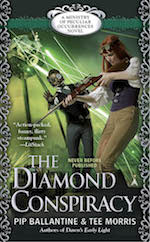
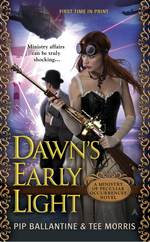
One final thought: Is it just me or does that position Eliza is in on the cover look: 1. really uncomfortable, and 2. not that useful for shooting?

A dash of steam=punk, a bit of romance, some intrigue, some “you’ve got to be kidding me” moments, and good character progression. This is one of my favorite series going, and this entry just solidifies it.

—–

4 Stars

Agatha H. and the Voice of the Castle by Phil & Kaja Foglio

Agatha H and the Voice of the CastleAgatha H. and the Voice of the Castle

by Phil Foglio & Kaja Foglio

Hardcover, 485 pg.
Night Shade Books, 2014
Read: January 26 – 29, 2015
When I started this, I had one big question: since I hadn’t read the comics this one was based on (unlike the first two), would that effect my understanding or enjoyment of the novel? Nope. Not a bit. Which I think is a good thing.

Like the other two installments, this is just fun to read. The writing is full of joy, zip, and panache. The narration, descriptions, characters, and escapades are just fun. I couldn’t tell you how often I had to stop to chuckle (or more) at what looks like a throwaway line, but probably took 5-6 tries to get just right — and was absolutely worth the effort.

The whole gang is back — plus a few new characters, most of which I want to spend more time with (others I’ve already had my fill with). I think the city and residents of Mechanicsburg are great, and I hope we get to spend more time with both. Ditto for a certain self-aware piece of architecture. I still love the Jaegers, even if I typically have to stop and really think about the pronunciation of every one of their syllables — which, honestly, makes it more fun.

My only complaint — well, I have two, actually. The biggest is that the last 100 or so pages seem like the authors are just spinning their wheels. Which is just frustrating. The other is a common one for me — anytime another person takes over someone’s body, so that it’s hard to tell who’s doing what? Boring. Hate it. Silly plot contrivance that I hope goes away soon, but will probably stick around for a long, long time.

Still, not enough to crush my enjoyment of the book as a whole and or to keep me from wanting the next one soon.

If you’ve read the first two novels, there’s nothing for me to say other than, keep going. If you haven’t — don’t start with this, it won’t make sense. Go back to Agatha H and the Airship City and enjoy.

—–

4 Stars

Review Catch Up: Beautiful Redemption; Breach Zone; Chasing the Prophecy; Fiddlehead

I’ve got a backlog of 40-plus reviews I’ve been meaning to write — some of them, I just have to admit aren’t going to get done. But I’m going to try my level best. The four books I’ve decided to tackle in one fell swoop are the concluding novels from series I enjoy, and yet I’ve had trouble reviewing them. On the whole, there’s no reason for it — I should’ve had at least a few paragraphs of material on these, but I can’t seem to muster it (especially given how much time has gone by).

But I do want to clear these off my to-do list, so, without further ado, a few words on these series finales:

Beautiful RedemptionBeautiful Redemption

by Kami Garcia and Margaret Stohl

Paperback, 451 pg.
Penguin Books, 2012
Read: November 19 – 20, 2013

On the one hand, this was not at all like the rest of the series — and yet it was a very fitting conclusion. Garcia and Stohl wrapped up everything that needed wrapped up, answered every lingering question (not always as I expected), and generally, did so in an emotionally satisfying way. I wouldn’t have thought that this book would lead to a spin-off series, but it fits.

If you’re into Paranormal YA, this was a very satisfying conclusion, and probably the best of that genre I’ve read.
4 Stars

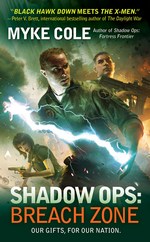
Breach ZoneBreach Zone

by Myke Cole

eBook, 384 pg.
Ace, 2014
Read: January 31 – February 04, 2014

I really, really liked all of Myke Cole’s Shadow Ops series — a gritty, believable mix of Contemporary Military and Fantasy, and yet, I’ve never reviewed one of his books. Don’t ask me why.

This, the conclusion to the trilogy, is just outstanding. You know how at the end of (pretty much) every fantasy novel, there’s this big, epic battle that takes up most of the last ¼ – ⅓ of the novel? That’s pretty much this entire book. Okay, not really — there’s plenty of backstory, character development and wrapping up the trilogy. But while reading, it sure felt like it was an epic fantasy battle on the streets and in the waters of New York. Somewhere in there, Cole looks gain at questions of patriotism, duty, ethics and morality — and how people of integrity can try to harmonize them all (and, more often, how those with integrity can’t harmonize them all). Seriously, awesome stuff.
4 Stars

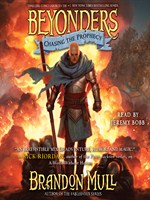
Chasing the ProphecyChasing the Prophecy

by Brandon Mull

Hardcover, 512 pg.
Aladdi, 2013
Read: December 2 – 5, 2013

Wow — Mull concluded his Beyonder’s trilogy in a fantastic fashion. Given the target audience, I couldn’t believe how many deaths there were in this book. But, not in a gory or exploitative way. Just a huge body count. But, the core of this book remained the same: these two Beyonders, Rachel and Jason, risking everything for the sake of Lyrian. There’s sacrifice, honor, loyalty, and courage — all the necessary elements of a tale full of heroes — natives and Beyonders, warriors and children, those with many lives and those with only one to lose. Which is not to say it’s not fun — there’s a lot of fun to be had by the characters and the readers. Great way to go out.
4 Stars

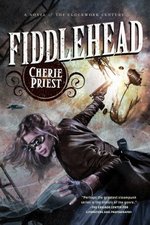
FiddleheadFiddlehead

by Cherie Priest

Paperback, 368 pg.
Tom Doherty Associates, 2013
Read: November 12 – 14, 2013

Nice looking book — love the cover, the layout and the graphics are great. I miss the brown ink — what gives, Tor? Sure, the content is the important thing, it’s just nice when the package it’s wrapped in is nice to look at. Speaking of content — this (like the rest of this group) is a fitting — and thrilling — conclusion to the series. Lincoln (wheelchair-bound following the unsuccessful assassination attempt at Ford’s Theater) and President Grant working together near the end of the Civil War to protect a freeman scientist who built an early computer — the eponymous Fiddlehead. Fiddlehead is the best chance to end the War without making everything worse. The presidents, with the assistance of Pinkerton agent Maria Boyd and intelligence from — well, everywhere else this series has focused — in order to begin to deal with the Rotters. I think it’s possible that Boyd is my favorite character in the series — in the Top 3, anyway.

I just didn’t want this series to end, I understand it needed to, but man…just didn’t want that.
4 1/2 Stars

Endsinger by Jay Kristoff

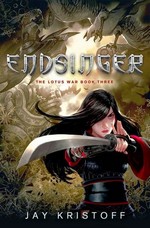
Endsinger (The Lotus War, #3)Endsinger

by Jay Kristoff

Hardcover, 432 pg.
Thomas Dunne Books, 2014
Read: Dec. 16 – 23, 2014

Let me show you what one little girl can do.

Of course, if you’ve read the first two novels in The Lotus War, you’ll know the list of what this one particular little girl can’t do is probably much shorter. The only question at this point is, can one little girl survive?

Kristoff has quite the wringer to put you through before you get the answer to that. For example, within the first thirty pages — thirty — Kristoff reveals something about a character I’d grown to have a certain affection for, and pitied after what happened to them in the previous book which makes me question everything I thought about them. And then he does something to that character I’m not sure I’ll forgive him for (will still read him, don’t get me wrong, I’ll just bear a grudge).

On the other hand, Endsinger is filled with so many fist-pumping moments, and fun sentences — like

Hiro laughed like a man who’d only read about it in books.

that you can keep pressing on — and actually enjoy the book. Another example of this:

Michi’s foot connected with the Inquisitor’s groin like a redlining goods train. It was the kind of kick that made one’s testicles throw up their hands and move to a monastery in the Hogosha mountains. It was the kind of kick that made orphans of a man’s grandchildren.

I mean, that’s something that Bruce Willis should be saying as he takes on Hans Gruber’s second-cousin or whatever.

I’m not going to describe much plot-wise here. It’d be too difficult to do it justice at this point — if you haven’t read the first two books anyway, there’s not a lot you’ll understand here without a lot of effort on my part. And if you’ve read the first two, you don’t need that to be an inducement to read the this one. It’d be easy in a book like Endsinger to just point every character at the final battle, throw in an obstacle or two along the way and let that be that. Heck, just coming up with an excuse to have Yoshi and Buruu travel around for 70-100 pages as the best buddy comedy pair to come along lately would’ve been a very satisfying way of spending time before the big battle. Instead, we get character development — a lot of it. We get mysteries explained. We get new characters, we learn new things about characters that we’ve known really well since book one (or thought we did, anyway). And they’re all thrown at a couple of really big battles, with some obstacles to overcome along the way.

The themes of the first two books continue to be explored here. The two that stuck out the most for me were: what makes a hero, what do they look like and what’s worth fighting for — honor, family, love, something else. Heroes aren’t what you think they are, don’t look like you think they should like — even (especially) to themselves. But everyone knows one when they see and/or hear one. As for what’s worth fighting for? That’s different for every one.

You don’t think people should know what happened here?”
“Oh, I think they should know, no doubt. I just don’t think they’ll care.”
“How could they not?”
“Because it will be different next time. It always is.”
“Different?” Akithito frowned at the cloudwalker captain.
“Different,” the Blackbird nodded. “Whatever they fight over. It’ll have a different name or a different shape — religion or territory or black or white. People will look back on us and say ‘we could never be that blind.’ People don’t learn from history. Not people who count, anyway.”

There’s a measure of cynicism, realism and idealism in Kristoff’s exploration of these (and other) themes. It’s tough, and probably ill-advised, to try to pin one of these viewpoints on Kristoff. But it seems to me that idealism’s voice is a bit louder than the rest.

Kristoff is great at keeping you on your toes. Things are bleak, but you start to think that hope is on the horizon, that one cavalry or another is coming — and coming soon. And then the hope is dashed. Or you start to think that all hope is gone and things are going to fall to ruin, and this is going to turn into a YA historical dystopian series, but then a new source of hope, a new rabbit gets pulled from a hat. He blindsides you time after time, from every direction.

Kristoff is great at his pacing, there are many moments he lets breathe, lets the readers and the characters observe everything going on, taking in all the sensory information and the thoughts of everyone. But he’s also capable of throwing in a sudden scene to grab the reader. The quick scenes bouncing around between the various characters in the heat of battle really work well to keep the tension high (though that can be a bit confusing unless you force yourself to slow down and read carefully — which is the last thing you want to do at that moment).

After awhile — about three-quarters through the book, after all the death, destruction, and (seemingly) climactic confrontations and battles getting you to that point, you simply can’t believe Kristoff can keep it going. How can the book last so many more pages? Is he going to give us a Peter Jackson’s Return of the King-style multi-epilogue? Probably not, it really seem to be Kristoff’s style. And then Kristoff shows you how he’s going to fill the rest of the book, and you pity all his characters, even those you’ve grown to despise, because that’s just not right.

In the end, Endsinger is a very satisfying conclusion to one of my favorite series in recent years. It’d have been easy for him to go for a “Everybody lives, Rose” kind of thing, where Hiro and the Lotus Guild are destroyed, Yukiko and Buruu are universally hailed as heroes, the Kage take over, and happily ever after. But he doesn’t give us that. Instead, we get the kind of conclusion promised in the first two books: it was emotionally satisfying (and induced a wide range of emotions, and may have involved a Kleenex or two on my part), it gave characters real conclusions to their arcs (not all happy endings), it tied up what needed to be tied up and it pointed towards the future. I’m going to miss this world and most of these characters. But I’m glad Kristoff didn’t try to milk this longer — it’s great as it is.

—–

5 Stars

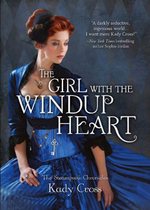
The Girl with the Windup Heart by Kady Cross

The Girl with the Windup Heart (Steampunk Chronicles, #4)The Girl with the Windup Heart

by Kady Cross

Hardcover, 400 pg.
Harlequin TEEN, 2014
Read: July 5 – 7, 2014

When my wife’s friend recommended this series to us, I didn’t even notice it was published by Harlequin Teen until I was well into the first (and best) of the series. By contrast, I don’t think there was a page in this one that didn’t scream Harlequin, Teen, or both. Still, I’d enjoyed this X-Men in Steampunk Victorian England series up til now, so I persevered. But I’d read about half of the novel before I really “got into” the story.

There were basically two storylines in this novel — the B story (oddly, the one the book is titled for) is all about the highly advanced automaton that Jack discovered in the previous novel becoming a “real life girl” — just like her favorite, Pinocchio. There were some interesting moments in this story — and if it had been given more time to breathe — maybe taking place over a few weeks, rather than a couple of days — I’d have bought it and been invested in it.

The A story was even more rushed. Further proof that you can’t keep a bad man down, The Machinist is back — again. This time, a full-fledged resident of the Aether, he kidnaps Griffin and begins to exact his revenge. Finley goes off to rescue him — with a little technical support from her friends. This is one of the bigger problems with this installment — the series is strongest when it’s dealing with all the interpersonal relationships — not just the romantic ties — seeing the characters interact with each other. There was so little of that this time, it felt like a different series. Sam didn’t get to be too Sam-ish. Both he and Emily mostly worked behind the scenes — ditto for Jasper and Wildcat (when they weren’t off helping Jack in the B story). Emily and Finley got 1 or 2 good scenes together, but that’s about it.

Anyway, Finley goes off to save Griffin and runs into a couple of blasts from the past. One of which was simply an unnecessary plot complication — and was dispatched as such. The other was probably the best part of this book. Probably its saving grace.

Initially, I was disappointed to read that this was the conclusion to the Steampunk Chronicles. But by the end, I think it’s time — and clearly Cross did, too. There’s no getting around the idea that she was wrapping things up (and rushed a few things to get to that point). Still, readers that have been with Griffin’s little crew up to this point will appreciate seeing how things end. The book may have been not terribly impressive, but the series as a whole was still a fun Steampunk-ish tale. Because of the aforementioned saving grace and the series as a whole, I’ll give this 3-stars. It should probably get 2 – 2.5.

—–

3 Stars

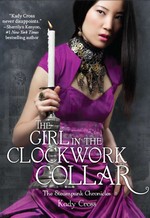
Dusted Off: The Girl in the Clockwork Collar by Kady Cross

The Girl in the Clockwork Collar (Steampunk Chronicles, #2)The Girl in the Clockwork Collar

by Kady Cross

Hardcover, 416 pg.
Harlequin Teen, 2012
Jul. 16-18, 2012

A rollicking good read — lots of action, humor, a splash of romance. On the whole, a sequel that surpasses it’s predecessor (though most of that was due to world-building, set-up, and whatnot).

Sure, there was plenty of rehashing key conflicts from the first book, more than was needed. But once you accept that, it’s easy to deal with.

The villain is convincing, the plot twist is easy to spot a few miles away, but it still works. I’m hoping there are many more of these to come.

—–

3 Stars

Dusted Off: The Falling Machine by Andrew P. Mayer

The Falling Machine (The Society of Steam, #1)The Falling Machine

by Andrew P. Mayer

Paperback, 284 pg.
Pyr, 2011
Read: Jul. 11-14, 2012>

This was an utterly okay book. I can’t say I didn’t enjoy it, and I certainly didn’t hate it, I felt a general “eh, whatever” towards it.

I do think the take on the status of women in 1880’s New York was a bit too heavy handed–most other steampunk authors can show strong women dealing with a less feminist age without sounding like they’re harping on it to the point you just don’t care anymore (see: Ballantine, Philippa/Morris, Tee, Cherie Priest, Steven Harper, Kady Cross for a few examples).

The Super-Hero story reminded me a lot of the one told in the superior After the Golden Age by Carrie Vaughn (as did many of the heroes).

Most of the characters were flat, the resolution was rushed and unfulfilling, the cliffhanger was more of a “they just stopped telling the story” than a “what will happen next?”

(okay, after reading what I just wrote, maybe it was less than okay…hmmm….)

—–

2 Stars

Dawn’s Early Light by Pip Ballantine and Tee Morris

Dawn's Early Light (Ministry of Peculiar Occurrences, #3)Dawn’s Early Light

by Pip Ballantine and Tee Morris
Series: Ministry of Peculiar Occurrences, #3

Mass-Market Paperback, 374 pg.
Ace, 2014

Read: April 23 – May 1

Agents Braun and Books are back in action — this time in the U.S. of A. Teamed up with a pair of agents from the Office of the Supernatural and the Metaphysical, they set out to investigate a rash of missing ships (of both the air and sea varieties) along the Eastern Seaboard. While full enough of the requisite peril and adventure, this particular investigation is wrapped up quickly — but in doing so, the four agents uncover a plot that’s far more hazardous to both nations. The Pinkertons, the House of Usher, the British Royal Family, and a couple of notable scientists/inventors from the era soon are involved in twist-filled machination to wreak havoc.

This leads the agents chasing their suspects across the continent — with stops in Detroit, Flagstaff, and San Francisco. As fun as it is to see Ballantine and Morris show us around a Steampunk Victorian England, a tour of the States is a nice change (also, nice to see a Steampunk U. S. not filled with Priest’s Rotters). Books latest invention (not to mention the toys that the team at the Ministry give them) are perfect — just the kind of things secret agents need (and could even use today), “science”-y in a suspended disbelief manner, and outlandish enough to have to be fictional.

There are two storylines that only relate to the main plot at the end of the book — one involving the House of Usher attempting to kidnap a Ministry agent, and one involving the assassin Sophia del Morte and the Prince of Wales. I could’ve easily taken another fifty pages or more with both of these. Hope to see all these characters again soon. Speaking of characters to see again soon — the scientists/inventors I mentioned earlier? Yeah, we need more of them.

Of course, the Ministry’s missions (even those not actually condoned by the Ministry) are only part of what makes these books page turners. There’s the whole Will They or Won’t They thing with Books and Braun — scratch that. There’s never been a Won’t They, just a When Will They? That’s been obvious from the get-go, honestly. It’s merely a question of what obstacles will be in the way. This time, the obstacles are the American agents — clearly set-up to be stumbling blocks on their road to romance, the fetching librarian and the gun-slinger each with enough common ground and personality to match our heroes. It was a little too heavy-handed for me, and as much as I liked the Americans as characters, I really disliked them in their role as hindrances. Sure, our authors make those storylines pay off nicely — but I didn’t enjoy the ride.

Nothing against the book, it was a fun read with a couple of characters that I enjoy spending time with, but it wasn’t as good (on the whole) as the previous two (see above paragraph) — but the last two chapters, as they revealed exactly what stakes are involved, earned it the extra half star. A fun read, but mostly one that moved pieces into place for the next book or so while tying up a couple of loose ends from the previous books. I’m really looking forward to what’s next. It’ll be great.

—–

3.5 Stars

Dusted Off: The Girl in the Steel Corset

The Girl in the Steel Corset (Steampunk Chronicles, #1)The Girl in the Steel Corset

by Kady Cross
Hardcover, 473 pg.
Harlequin Teen, 2011
Read: June 26-27, 2012

When I started this, I kept thinking, “this is the steampunk version of Twilight.” A good, fun read, but nothing to get too excited about. But as I read on, I started thinking that less and less. Maybe because it was getting better, maybe because I just got into the story fully. Doesn’t matter.

Midly predictable plot, but entertainingly told. The characters are engaging and frustrating (in a way that serves to underline how much you like them). The steam-tech is fun and well thought out. The whole super-power thing? Very well executed. Super Powers and Steampunk? That’s some peanut butter you can get in my chocolate, anytime.

Fun, fun, read–with a good jump start to the sequel.

—–

3.5 Stars

Dusted Off: Agatha H and the Clockwork Princess by Phil Foglio and Kaja Foglio

Agatha H and the Clockwork PrincessAgatha H and the Clockwork Princess

by Phil Foglio and Kaja Foglio
Hardcover, 461 pg.
Night Shade Books, 2012
Read: May 6-8, 2012

What a delightful read! All the strengths of the comic–but augmented and amplified–and, sadly, all of the weaknesses. But since the balance is so far to the “strength” side…who cares?

The last 1/4 (or so) of the book–like the source material–is just too convoluted for my taste, too many balls in the air at once. Still, I had an easier time following it in prose, so I’m not complaining too much.

If you haven’t yet–go read the comic (www.girlgeniusonline.com) tout de suite. Then go read the novels (not that I need to say that if you’ve read the comic)

Can’t wait for the next installment!

—–

4 Stars

Page 5 of 6

Powered by WordPress & Theme by Anders Norén