Category: Urban Fantasy Page 39 of 46

Attack the Geek by Michael R. Underwood

Attack the GeekAttack the Geek

by Michael R. Underwood
Series: , #2.5

eBook
Pocket Star, 2014

Read: May 22 – 23, 2015 Unlike the first two installments of this series, which I grabbed as soon as I could, I put off reading this — mostly it’s because it was a .5. On the whole, I’ve not really found much to get excited about in the point-whatevers. But I had an opening in my schedule and needed something I could read on my phone.

Man, I should’ve read this sooner.

It’s a typical Saturday night at Grognard’s Grog and Games — “V: TES tournament, half-priced Jaeger, and Grognard getting morose.” Ree’s got her hands full serving the crowd, which happens to include our friends Eastwood and Drake. This is pretty handy because while things are still going strong, the bar falls under a pretty serious attack. They’re able to hold it off for a bit, but before long, it becomes a night-long siege. It was only missing a few Uruk-Hai (or a reference to them) to be a veritable Helm’s Deep. There’s a bit more than just the siege, but I’ve gotta leave a little to you to find out for yourself.

On the one hand this is pretty much just one long-knockdown fight. But there’s more going on — and not just because it’s really a series of fights with strategic retreats to regroup, refresh, heal and strategize. But there’s more than that — Ree seems a lot more certain in her abilities, confident and capable (although she should really have learned to carry spare batteries for her phone by now). There is a little character development, a little push toward the next novel, but mostly this is action. Which does make the small character moments shine a bit brighter — you expect them in a full-fledged novel, and while Underwood usually does these moments right, here they stand out more. Most importantly, the voice is there — Underwood’s eye for action, Ree’s snark, and the 17 pop culture references per inch of text are fully present.

Because the action is limited to the events of one night, a lot of the things that would be minuses for me, actually work. For example, Ree hits the same note of lament over her romantic situation too often for a book that takes place over a couple of weeks — but over a night? Yeah, we’ve all been there. A couple of Grognard’s patrons don’t act in ways that would work/wouldn’t be suspicious over the long hall — but in the midst of a battle? Sure, absolutely.

Unlike a lot of .5 works, I don’t know if this one can be skipped in your voyage from Ree Reyes #2 to Ree Reyes #3. Even if it turns out that you can (won’t know until #3 releases — which I won’t wait to read), you shouldn’t. Grab something to drink and/or snack on and watch Ree and the gang open up a few cans of whoop-ass.

—–

3.5 Stars

The Younger Gods by Michael R. Underwood

yyyyyeeeeesh, almost, but not quite 6 months late. What is wrong with me? Let’s see if I can remember enough to make this work:

The Younger GodsThe Younger Gods

by Michael R. Underwood
Series:The Younger Gods, #1


ebook, 280 pg.
Pocket Star, 2014
Read: November 20 – 22, 2014

Are you quite sure you don’t want to even try to seek cover?” I asked.
“Cover is what stands between me and stabbing things,” [Carter] said by way of response.
Let it not be said to my resident assistant that I constrained my roommate. He was his own man. Even if that man was insane at times.

One of Michael R. Underwood’s most impressive traits is his versatility. We’ve got the fun Urban Fantasy adventures of Ree Reyes, the strange superheroes of Audec-Hal, and now, this darker UF about a cult’s white sheep trying to stop the apocalypse.

Jacob Greene — of those Greenes (apparently) — has come to New York to attend university — and get away from his family and their demon-worshiping apocalyptic cultish practices that will usher in The End of the World as We Know It. He’s had enough of all of it, and is trying to get beyond their teachings, their practices, their . . . murderous ways. It’s more difficult than he expects, especially when his sister comes to town in order to usher in Doomsday.

Jacob finds himself surrounded with a motley crew of allies — mostly in the mold of the-enemy-of-my-enemy — trying to keep his sister from accomplishing her Ultimate To-Do list. Let me tell you, this particular UF version of NYC is full of quite the assortment of magical cultures/subcultures. The rules governing them, the way they interact with each other are one of the strengths of this novel — a nice little bit of world-building that was revealed, not dumped on the reader.

Jacob, understandably, spends a good deal of the book sorting out his identity in light of his family — as well as his feelings for/about them. There are no easy answers waiting for him. It’s here, not his running away from his family, not his attempts to stop his sister, that Jacob finds that bit of humanity that he’s been missing.

Was it still love if the people that loved you were monsters? Did their actions taint everything they did, or was there some humanity in the family? Had they ever really loved one another, or was it a mask, a role that each Greene has played to further the goals of the Bold and awaken the unborn? There was a film, some film, that matched this feeling. I’d heard someone talk about it in class.

Jacob’s ending gambit had me groaning, “Underwood’s not going to do that, is he?” Turns out 1. He did; and 2. It totally worked. I couldn’t believe it. I was expecting a cheesy car wreck, but he nailed it. Note to self: don’t doubt Michael R. Underwood again.

My biggest gripe was Jacob’s language. He starts off with the most formal, stilted dialogue this side of an Austen novel; slang was a foreign language he was trying to adopt. By the end of the novel, however, a lot of that was gone. Now, it’s possible, I just got used to his language — but I don’t think so. Mostly, it was his use of slang that improved dramatically. Now, if it had happened slower — over a book or two, I wouldn’t have noticed — or, more likely, I’d have given Underwood props for it. But . . .this book covers events of a few days, far too quickly for Jacob to pull that off. Still, as far as gripes go . . . that’s pretty small.

It’s not Underwood’s best — but it’s a good start, and I can eventually see me saying something different about the series as a whole. Great magic system, a situation I’ve never encountered in any of the UF I’ve read, a solid group of characters to build from — I can honestly say that I have almost no idea what’s up next for Jacob Greene et al. But I’m looking forward to finding out.

—–

3.5 Stars

Dark Heir by Faith Hunter

Dark HeirDark Heir

by Faith Hunter
Series: Jane Yellowrock, #9

Mass Market Paperback, 363 pg.
Roc, 2015
Read: April 22 – 24, 2015
So, how much trouble does Jane Yellowrock find herself in this time out? Almost all of it, I think.

Even as she left his desiccated near-corpse hanging on the wall in Leo’s sub-basement, we all knew that Jane was going to have to deal with The Son of Darkness sooner than later. So did she. Turns out it’s a lot sooner than anyone expected or wanted (well, maybe some readers wanted it now, so sooner than Jane et al. wanted it). Joses Bar-Judas is probably the nastiest, toughest, most despicable supernatural creature we’ve encountered in these books — and I don’t see him being topped any time soon (well, maybe his brother).

The body count in this one is high — and the ramifications for that are probably going to be felt for a book or two. Oddly, the police and people of New Orleans don’t take kindly to an out-of-control vampire. Relations between the general populace and the Mithrans are near the breaking point.

But that’s not the worst — whatever this original vamp* is capable of doing — it’s far more than Jane’s ready for. Keeping fairly spoiler-free, let’s just say that whatever punishment our Skinwalker’s taken thus far is nothing compared to what she’s got coming.

Along the way, Jane learns some things — thanks to the vamps playing everything super, super close to their chests — that changes how she thinks about and understands almost everything that’s happened since she first came to New Orleans.

Which isn’t to say this is a perfect book — I’ve about had it with Molly, really. I’ll always be interested in her daughter (and the way Beast thinks of that little kit), but Hunter needs to do something interesting with Molly soon. I didn’t like the way that Jane’s church (particularly their baptismal waters) were depicted. I’ve always appreciated how in the middle of all this crazy supernatural stuff, there’s been a real drive in Jane for a connection to this church, which was fairly realistically depicted. Hunter sorta tossed that out of the window this time, and made it just as supernatural as everything else. I understand that impulse and how it fits into this world — I just like it less. Lastly, there were plenty of opportunities for Jane and Jodi (and the rest of the police) to work together here, or at least for Jane to do a better job explaining things to her pal with the badge. But for the most part, all that was shoved to the sidelines in a pretty poor way. Yes, there’s only so much Hunter can fit into 360 pages, but still.

Nevertheless, in the grand scheme of things, these are minor complaints when weighed against what Hunter did accomplish here. The chapters involving the final show-down were some of the best things I’ve read in this series, and were definitely filled with all the “what the — ?!” moments you could ask for and a couple “did I just read that?” paragraphs as well.

In the midst of things at their worst — we get some really nice moments with her not-boyfriend, Bruiser. Best of all, we’re treated to some great, heartfelt, “Awww” inducing developments with Eli and Alex. I’ve liked Alex from the get-go, but Eli is about to become my favorite character in the series (sorry, Jane).

For most of the time I’ve been reading this series, I’ve pretty much thought of it as a decent UF series to tide me over between installments of my favorites. But as of the last two or three, I think I’ve come to realize that this is one of my favorites and that I’m really, really looking forward to seeing what comes next.** Dark Heir is probably the best so far, and it’ll take something big to top it.

—–

* Not to be confused with the CW’s collection of teen heart-throb Originals.
** Which I fear means that Hunter will wrap things up in a book or two.

—–

4 1/2 Stars

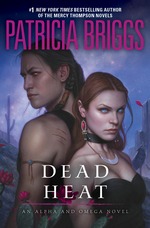
Dead Heat by Patricia Briggs

Dead HeatDead Heat

by Patricia Briggs
Series: Alpha and Omega, #4


Hardcover, 324 pg.
Ace Books, 2015
Read: March 6 – 7, 2015
One of the biggest difficulties I have here on this ol’ blog is coming up with something to say about later books in a series. What (barring a significant shift in quality) can I say that I haven’t already said? I’m honestly not sure here, but I’ll give it a try.

It’s been three years since the jaw-dropping conclusion of Fair Game, and we’re finally able to get back to Brigg’s Alpha and Omega series. Things seem to have been pretty quiet for these two. We’re not given a lot (or any, as far as I can recall) of information about what’s been going on in the lives of Charles and Anna since then, but we can guess — they’ve grown closer, Charles has done a little enforcing for his father, Anna’s. . . well, honestly, I don’t know, she’s been doing her own thing.

Hunting Game is a nice departure from the typical setup for these books. There’s no assignment, no renegade werewolf, no investigation — just Charles trying to get a gift for Anna and introducing her to an old friend. Sure — something supernatural comes up, there’s something/someone that needs to be stopped before people die. Thankfully, conveniently, fortuitously, Charles and Anna are in town and they (with the help of the local pack) can take charge to protect those who need it the most.

There’s not a lot here that will progress the story of either series, no dramatic character growth or supernatural threat that will shake things up. It’s about spending time with these people, understanding them a bit better — at least in a new light. Seeing Charles away from his family — but amidst friends that might as well be, sheds a good deal of light on his character — not just his past. It’s also interesting seeing the way this particular pack acts together (as opposed to Bran’s or Adams’s).

There’s a warmth to this book, even when things got hairy and tense — which fits a novel about an Omega — the same way that Mercy’s books have a very different feel. A welcome addition to the growing Brigg’s world.

—–

4 Stars

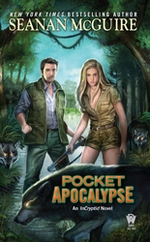
Pocket Apocalypse by Seanan McGuire

Pocket ApocalypsePocket Apocalypse

by Seanan McGuire
Series: InCryptid, #4


Mass Market Paperback, 341 pg.
DAW, 2015
Read: March 14 – 17, 2015

Airplanes: essentially buses that fly, and hence have the potential to drop out of the sky at any moment, spreading your insides — which will no doubt become your outsides sometime during the collision — across whatever you happen to have been flying over. Since we were flying mainly over ocean, I was sure the sharks would appreciate our sacrifice.

So where, pray tell, are Alex and Shelby flying off to? Her home country of Australia, to help out her family and the cryptozoologist group/alliance/whatnot they’re part of deal with the continent’s first outbreak of the werewolf virus. Unlike everyone else there, Alex has dealt with werewolves before, and he’s a Price — that has some benefit (although how much is debatable, as he soon learns). He’s also going to meet Shelby’s family for the first time. It’s pretty unclear which of these two items are the most hazardous to his health.

We’ve had a lot of exposure to the idea that the Price family isn’t like the Covenant — in motives or means. Now we’re introduced to the Thirty-Six Society, who aren’t as nasty as the Covenant is to cryptids; but nowhere near as interested in understanding and cooperating with them as the Prices are. Also, they’re not so sure that the Price’s are all that different than the Covenant (which is really odd to think about from the point-of-view of the reader). So, all told — they’re not to interested in a know-it-all Price coming in from the U. S. to tell them how to take care of a problem. Particularly when that Price is sleeping with one of their own, and perhaps leading her away from them.

I did tire a bit — more than a bit, to be honest — with the way that Alex and various members of the Tanner family had the same conversation over and over about his allegiances, intentions toward Shelby, and methods. I realize in Real Life™ that you do repeat yourself, but so much of these conversations were essentially “second verse, same as the first,” and got pretty darn tiring. It would’ve been better if Alex wasn’t quite as right as he was all the time, too.

But that’s the backdrop, really. The very real likelihood that Australia is going to be overrun with werewolves in the coming weeks is the main concern (although I’m not convinced the word count would reflect that). With so much exposure to Patricia Briggs and Carrie Vaughn (not to mention Jim Butcher, Kim Harrison, Kevin Hearne, and so on) it’s easy to forget that werewolves used to be a horror movie staple. Leave it to McGuire to remind me that werewolves are generally thought of as monsters. These werewolves are pretty monstrous, and what they do to their victims isn’t pretty.

We don’t see as many of the native cryptids as we get hints of them — the couple that we do see are pretty interesting, but I could’ve used more. As with any inCryptid novel, you have to talk about the Aeslin mice. If for no other reason than they’re fun. This is probably their best showcase yet — they’re more than comic relief here, they help out — in a way that Alex could never have predicted. Some of the raw-est emotion (and not just joy and rapture over a new religious observance) comes from these little guys. I honestly don’t know if I’ll ever tire of these mice.

Occasionally, the humor feels forced — as if McGuire’s done a word-count since the last quip and shoves one in. This is typical for the series, and still occasionally works, oddly enough. But McGuire’s narrative flows better — and is funnier — when she allows the humor to flow naturally (as much as anything as crafted as one of her books is “natural”) and not imposed on the text.

This novel contains the word “denuded” more than I can recall ever seeing in a single work — there was one chapter, in fact, that nailed that record — but “denuded” showed up later, too. It doesn’t matter one way or the other, but it showed up so frequently (and so rarely anywhere else) that it couldn’t help but make an impression.

I don’t know why, but it took me forever to really “get into” this one. From page 1 it looked interesting and entertaining, but I kept putting it down after a half a chapter or so. When it did pick up, I didn’t take the time to jot it down because I didn’t want to stop reading, but I think it was a little after page 100. From that point on, I was into it the way I expected to from the get-go, and it kept my interest to the end. I think I like this more than the others (maybe Discount Armageddon was as good), and really look forward to the next one — it’ll be good to see Verity again.

—–

4 Stars

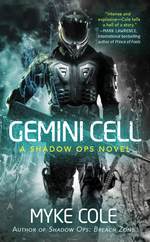
Gemini Cell by Myke Cole

Gemini CellGemini Cell

by Myke Cole

Nook, 384 pg.
Ace, 2015
Read: February 4 – 9, 2015He started off strong three novels back, but Myke Cole is one of those authors who gets discernibly better with each book (I assume that will stop at some point — not that I’m in a rush for it), and this one seems like a major step beyond Breach Zone. So when I say this is a well-written book, I mean really well-written. But man, I really didn’t enjoy this book. It’s not his fault, well, let me rephrase it: it’s not Cole’s abilities or voice this time. I don’t know what it is. I guess I just don’t like the story or the characters all that much, as skillfully as they’re delivered to us?

Early on in the Great Reawakening, years before (possibly many) the Supernatural Operations Corps is in full swing, the U. S. Government has begun to use magic resources for its own ends (and, presumably, other nations are doing the same). One of these resources is a magician who can take the recently killed and unite their body and mind (slash soul?) with the mind (slash soul? again) of a long-dead warrior to create a Firestorm-like entity to use as the ultimate special-forces operator. Because somehow, this union gives them super-strength and abilities, while not feeling any pain or bleeding. As they’re technically dead, they can use them for anything, and if things don’t go right on the mission — oh well, what’s one more corpse? It’s a little more complicated than that, but that’ll do for now.

So, we have Jim Schweitzer, loving husband, doting father, and SEAL. His professional artist wife, Sarah, doesn’t fit in with the other Navy wives, and is really tired of not knowing where he is, when he’ll be called upon for a mission, and so on — puts her foot down. Family or Team. Just as he’s about to choose, a hit squad of people who shouldn’t know who he was, somehow find out and invade their home, wounding Sarah and their son and killing Jim. Giving the magician a fresh subject. Jim turns out to be one of the best (if not the best) of this reanimated soldier project, partially because he holds on to his humanity and memories better than most.

Sarah and Jim’s team member Steven, grieve his death (unaware that he’s not totally dead) and support each other in this time — while trying to figure out just what happened to his body, which is mysteriously not available for burial.

There’s one character we spend far too much time with given what happens to him/her by the end of the novel. One character who might as well be twirling a mustache in a couple of scenes. Mostly, everyone is this mix of motives, morality and action which are probably intended to depict the gray-ish nature of us all, but frequently come across as the products of an indecisive narrator. Jim battling his new soul-mate for control is just the most obvious example of the good vs. bad in all of us.

Cole explores similar themes to his past work — how honorable people/soldiers can function in inherently less-than-honorable conditions and systems. Who, ultimately, do soldiers fight — and why they do so. Cole’s said that this is to be a not at all subtle metaphor for PTSD, and I can see that — I’m just not sure it’s a helpful one (yet).

While I said Cole’s at the top of his writerly game, this isn’t a perfect book. At least once, he repeated a metaphor within a couple of pages (I don’t normally get that picky, but that one really took me out of the moment). And his sex scenes? Not good. They’re not Tom Wolfe bad, don’t get me wrong. But they read like . . . exactly like a sex scene written by a guy who’s better suited for describing Special Operations forces eliminating high-value enemy targets.

My major beef with this book is the magic. We’re four novels into this world by now, and the previous three have established some pretty clear rules for magic — at least the types of magic usually displayed in the U.S. But it’s clear that there might be variations throughout the world. So, it’s believable that we’d find another type of magic here. Also, this takes place quite a while before the Shadow Ops series, so changes may have occurred between now and then — if magic can appear and reappear, it can evolve, right? But it still feels too different (realizing I might have misunderstood this book, or the three others) — particularly the different (deeper?) magic that comes into prominence in the final chapters. I’m not saying there’s not a decent explanation for this, there very well may be — but given what we know about the universe this just doesn’t work. Which shouldn’t take away from the really strong and effective way that Cole used this bending/breaking of his own rules, because the last couple of chapters were great.

See what I mean? I can’t decide what I think about Gemini Cell — and I’ve been thinking about this for a couple of weeks, started writing this three days ago (you probably can’t tell that a lot of effort was put into this, but trust me). At this point, the only thing I’m sure of is that I’ll be back for the sequel, Javelin Rain, and hopefully that’ll wash all this away.

—–

Rating: I’m still not sure — somewhere between 2.5 – 4.5, I think.

Saturday Miscellany – 2/7/15

Grawlix! If I didn’t know better, I’d say that The Universe, The Matrix, Loki, Coyote, Murphy’s Law or the Greek ghost Thespis was messing with me and keeping me from getting anything written or posted here. I’m a little stunned that I got this compiled, really. Hopefully, next week will be better.

Here are some odds ‘n ends over the week about books and reading that caught my eye. You’ve probably seen some/most/all of them, but just in case:

    This Week’s New Releases I’m Excited About and/or You’ll Probably See Here Soon:

  • Funny Girl by Nick Hornby — Hornby continues to explore celebrity, this time in the 1960’s with an up and coming actress. Not really what I’d have expected from him next, but I’m not sure what I did expect.
  • The Way Into Darkness by Harry Connolly — the Third and final installment in The Great Way saga. Hearing so many good things about this one already!
  • Covenant’s End by Ari Marmell — bittersweet — a new Widdershins Adventure, but sadly, it’s the last.

Lastly, I’d like to say hi and welcome to abhinavmajumder for following the blog this week. Thanks to Theinexorablenerd for the interaction.

Audio from The Severed Streets by Paul Cornell

Recently, I received an email from someone at Audible.com:

I saw your great review of THE SEVERED STREETS and I wanted to make sure that you are aware that the book is also available as an audiobook from Audible Studios. I’d love to offer you a clip from the audiobook to post on the website alongside the review as multimedia content for your readers.

Seems like a good idea to me! I wasn’t aware that they had the book — but if asked, I’d have guessed they did — what don’t they have? Still, it sounds like a good idea (and hey, she called my review “great”). I added it to my review, but thought I’d throw it up, here, too. Seems more likely that people would see it.

The Severed Streets was one of my favorite books last year (see my review, and my 2014 Honorable Mentions), and I’d strongly recommend you trying it.

Anyway, here’s the clip, sounds pretty good to me. If you’re an audiobook person, listen to the sample. If you’re not an audiobook person, you still might want to give it a try — maybe you’re an audiobook person but don’t know it.

Monday Mutterings

  • Was out of town this past weekend, so I wrote my Saturday Miscellany post a day early and then scheduled the posting. You’d have thought that I’d be clever enough to schedule something containing “1/17/2015” in the title on 1/17/2015, wouldn’t you? Well, you would be wrong.
  • While out of town, had some extra reading time — which means I’m even more behind on reviews now. Hope to chip away at that soon.
  • Part of that reading was Harry Connolly‘s A Key, an Egg, an Unfortunate Remark — I’ll spoil my review here: if you like Urban Fantasy, particularly a-typical Urban Fantasy, read this book. Releases on March 3. You can order it from Amazon or Kobo here.
  • I’ve noticed that I’m far less forgiving of typos/proofreading flubs in e-books (particularly those that are self-published) than I am of those in hardcover/paperback. Is it just me? (no, there’s no link between the last two items)

Foxglove Summer by Ben Aaronovitch

Foxglove SummerFoxglove Summer

by Ben Aaronovitch
Series: The Rivers of London, #5


Mass Market Paperback, 323 pg.
Daw Books, 2015
Read: January 9 – 10, 2014

“Hail the conquering hero,” said Beverly and held up her bottle to clink.
Sic transit Gloria mundi,” I said, because it was the first thing that came into my head — we clinked and drank. It could have been worse. I could have said, “Valar Morghulis” instead.

It’s always a pleasure to spend some time in the pages of a Peter Grant/The Rivers of London novel, but Foxglove Summer is probably the most pleasurable entry in the series since Midnight Riot (The Rivers of London for non-US types). I’m not sure I can put my finger on why that’s the case, but that’s not something I’m going to worry about. Unlike Peter’s mother, who

never saw a gift horse that she wouldn’t take down to the vet to have its mouth X-rayed — if only so she could establish its resale value.

Two young girls have vanished in a small village slightly north of London, and Peter’s sent to make sure that the (supposedly) no longer active wizard in the area had nothing to do with it. Having done so, he decides to stick around and see if he can help with some of the routine/mundane work needed.

Naturally — well, I should say, Supernaturally, it’s not long before The Powers That Be ask him to see if there’s an angle to the case that’s more up his alley than theirs. Peter finds some undeniable evidence of magic at work and things get going from there.

Nothing against London — but loved this breath of fresh air in this novel. For example, Peter’s dealing with different superior officers to not want to deal with magic/supernatural — these don’t have the antagonism that usually shows up in London, they just don’t want anything to do with it. The town is full of interesting types — including traveling fair ride owners, tavern keepers, farmers, and vacationing journalists.

As always with this series, the sheer amount of British Police acronyms and assumed knowledge of structure and procedures are a hurdle many US readers won’t want to try (I’ve been told this by a few who I’ve tried to get to read these books) — it’s a little effort, and easily worth it to overcome.

My major — only? — gripe is that Peter’s not making a lot of progress with his magic, he seems to be pretty much where he was three novels back. Yes, he’s more confident, yes, he’s able to apply his knowledge of magic with some good old-fashioned police ingenuity — but his abilities and skills are still rookie-level. Without Beverly as magic back-up, he’d be in trouble. The two of them — plus one local cop out of his depth, but committed to work — are able to handle things.

Yeah, it was nice not to focus on Lesley and the Faceless One (which isn’t to say their shadows don’t loom over a good chunk of the book), but it’s clear that they’ll be back in a really big way soon. Which I’m looking forward to, as nice as it was to have this mental palate cleanser here. Foxglove Summer was great mix of police procedural, Urban Fantasy and Folklore — both traditional and contemporary (the area’s obsession with UFOs is great) — with Aaronovitch’s deft humor, pop culture references and tight plotting. We’ve got ourselves a winner here.

—–

4 Stars

Page 39 of 46

Powered by WordPress & Theme by Anders Norén