I’ve done this a few times some years ago, but as a practice, it never stuck. But as I spend time doing this every month for myself, I might as well take a couple of minutes and post it, right? This is not going to be exhaustive list—I’ll probably read other things, too, and may not get to all of these. But as of today, this is my plan for the month.
Last month, I only missed one of the list (but it was rescheduled). I’m not sure how I’m going to do this month–I’ve got some real hefty ones ahead of me. But you never know, I have a couple of things that could slip in as well.
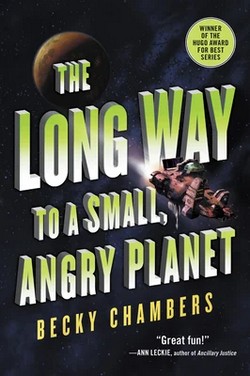 The Long Way to a Small, Angry Planet
by Becky Chambers
Rosemary Harper doesn’t expect much when she joins the crew of the aging Wayfarer. While the patched-up ship has seen better days, it offers her a bed, a chance to explore the far-off corners of the galaxy, and most importantly, some distance from her past. In this character-driven sci-fi story, the introspective young woman who learned early to keep to herself has never met anyone remotely like the ship’s diverse crew, including Sissix, the exotic reptilian pilot, chatty engineers Kizzy and Jenks who keep the ship running, and Ashby, their noble captain.

Life aboard the Wayfarer is chaotic and crazy—exactly what Rosemary wants. It’s also about to get extremely dangerous when the crew is offered the job of a lifetime. Tunneling wormholes through space to a distant planet is definitely lucrative and will keep them comfortable for years. But risking her life wasn’t part of the plan. In the far reaches of deep space, this tiny Wayfarer crew will confront a host of unexpected mishaps and thrilling sci-fi adventures that force them to depend on each other. To survive, Rosemary’s got to learn how to rely on this assortment of oddballs—an experience that teaches her about love and trust, and that having a family isn’t necessarily the worst thing in the universe.

I read this back in 2018 (and liked it better than I recalled), and it’s the next title for the Science Fiction Book Club. Time to freshen my memory. I trust 2018-me, and should have some fun.
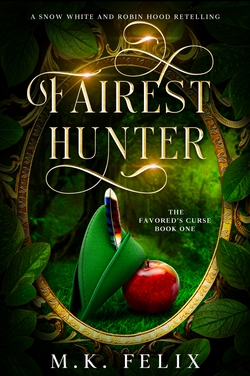 Fairest Hunter
by M. K. Felix
A rebellious huntress. A cursed prince. A coup to change it all.

Rowena:
The king spreads darkness with his words, and when he asks me to kill his own son, it’s the final tipping point for me. Guess that solves the issue of how to overthrow the tyrant. We’ll put Prince Alvor on the throne. Except, the Alvor before me is not the same one I knew growing up. This Alvor, well he’s entirely too alluring. He keeps tearing my walls down, reminding me that I'm not the only one who needs to fight for this kingdom.

Alvor:
With one glance into Rowena’s eyes, something changed. She has magic, and the more I reconnect with her, the more I'm sure she’s the key to saving our kingdom. But time is not on our side. I need to claim the throne before my father drives our kingdom into the ground with his greed. The only problem? I’m not ready to let Rowena sacrifice herself for me or my people. Especially not after she broke my curse and rekindled the sparks in my heart.
I’ve talked to Felix a couple of times at local author events, and she made this sound fun. I like combining Robin Hood and Snow White–sure, Robin Hood + anything is likely my jam. But these two together sounds promising.
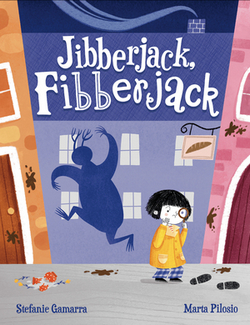 Jibberjack, Fibberjack
by Stefanie Gamarra, illustrated by Marta Pilosio
Jibberjack, Fibberjack is a clever whodunit about thinking for yourself and asking better questions.

When a mysterious creature starts scaring the chatty town of Rumorridge, only Frida asks more questions. With her detective hat, trusty notebook, and a nose for nonsense, she's sure to crack the town's monster mystery.

Things quickly get serious when strange footprints appear and the town's prized pigs go missing. Questionable monster traps and the mayor's new rules only add to everyone's nervousness.

But when smelly clues mix with stinky lies, Frida begins putting the pieces together and builds a clever trap of her own.

A gentle introduction to the concept of fear-mongering for kids ages 4-8 who love asking MANY questions.
A whodunit for 4-8 year-olds sounds fun, especially one that gets into fear-mongering? This sounds like a great way to spend some time.
 Hidden in Smoke
by Lee Goldberg
After dozens of Hollywood apartment buildings erupt in flames during a single night of terror, arson investigators Walter Sharpe and Andrew Walker are assigned to catch the serial torcher and end his spree. But then a catastrophic fire destroys a major freeway, crippling the city and forcing Sharpe and Walker to take on another massive case.

Desperate for help, they know exactly who to call: homicide detectives Eve Ronin and Duncan Pavone. Together the four detectives must quickly figure out whether the freeway disaster was a tragic accident...or the work of a mastermind with a horrific plan.

As the investigations collide, an old foe with a revenge scheme enters the fray, igniting a race against time to stop a conspiracy of deception, corruption, and murder.
It’s been bugging me since April of last year that I haven’t read this–if I’m two weeks late with a Goldberg book, it makes me itchy. And here I am 10 months late? Nope. Can’t take it.
 Only Way Out
by Tod Goldberg
Failed lawyer Robert Green has such a good plan: Crack three hundred safe-deposit boxes and sail off to South America with his brilliant, morally flexible sister, Penny. If it weren't for the damned freezing rain.

In the dying resort town of Granite Shores, cop Jack Biddle is self-appointed king--mostly of bad decisions. Between his family's crumbling legacy, a wife who just joined the city council, and life-threatening gambling debts, Jack's looking for a way out. Then he spots a van spinning off a mountain road into the valley below. In the wreckage, Jack finds a very dead Robert, millions in heisted loot...and opportunity.

All Jack has to do is clean up the mess, disappear Robert's body, make off with the fortune, and not get caught. One hitch is Penny. Another is Mitch Diamond, a wild card ex-con who knows more about the missing fortune than he lets on. Jack, Penny, and Mitch each have an endgame. But there's only one way out, and they're crashing headlong toward it.
I haven’t read this Goldberg since his days of writing Burn Notice–and assume I’ve been missing out. This one looks like a great way to reacquaint myself with him.
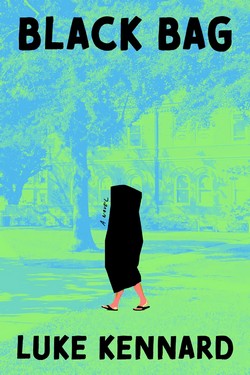 Black Bag
by Luke Kennard
In Luke Kennard’s audacious new novel, a penniless and out-of-work actor picks up a job working for Dr. Blend, a university professor who is conducting a psychological experiment. How will Dr. Blend’s students react to someone zipped into an oversized bag, sitting at the back of the lecture hall over a series of Fall lectures? The role, eagerly accepted, soon has unexpected consequences. A professor of post-humanism develops research questions of her own—in particular, can you love someone secreted away inside a black bag?—and the actor’s childhood friend forms a vision for monetizing this new situation . . .

A warped campus novel, an investigation into the crisis of masculinity, and an off-kilter love story, Black Bag is a firework of a novel: blazingly funny and profoundly humane.
I’m not sure exactly what it was that got my attention with this book. Perhaps it was due to the campus novel part of the description–it’s been a while since I read one of those, and have been talking to some others about them. Or maybe it was something else. But reading it now? I’m very curious. This should be an interesting diversion from my typical reads.
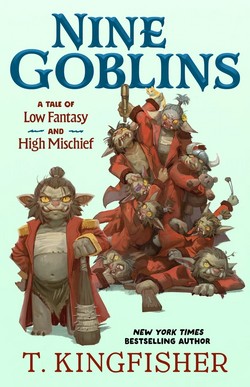 Nine Goblins: A Tale of Low Fantasy and High Mischief
by T. Kingfisher
No one knows exactly how the Goblin War began, but folks will tell you that goblins are stinking, slinking, filthy, sheep-stealing, henhouse-raiding, obnoxious, rude, and violent. Goblins would actually agree with all this, and might throw in “cowardly” and “lazy” too for good measure.

But goblins don't go around killing people for fun, no matter what the propaganda posters say. And when a confrontation with an evil wizard lands a troop of nine goblins deep behind enemy lines, goblin sergeant Nessilka must figure out how to keep her hapless band together and get them home in one piece.

Unfortunately, between them and safety lies a forest full of elves, trolls, monsters, and that most terrifying of creatures…a human being.
- This sounds fun. 2. I’ve got two big, dark, and probably bloody Fantasy books on tap this month. I could use something lighter and shorter.
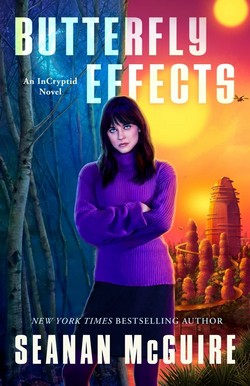 Butterfly Effects
by Seanan McGuire
Sarah Zellaby is a Johrlac, a member of a species of psychic ambush predators colloquially referred to as “cuckoos.” Eight years ago, she survived the difficult, painful process of becoming a cuckoo queen…although not without costs. In the wake of her transformation, the man she loved was entirely erased from his own mind, forcing her to reconstruct him from the memories of the people who knew and loved him.

Sarah has been struggling to come to terms with her actions ever since. But there's no one else on the planet with the power to hold her accountable—until the Johrlac authorities show up. It’s time for her to stand trial for what she's done, something which can only happen on Johrlar, home world of her species, where the population is controlled by a system of unyielding hiveminds and crime is punishable by erasure.

With Sarah’s life on the line, her family will need to find a way to cross dimensional borders and survive a hostile, telepathic world in order to get her back—before the Sarah they know ceases to exist.

But no matter what happens, actions have consequences... and Sarah Zellaby is about to learn that lesson the hard way.

Chaos, noun:
1. The inherent unpredictability in the behavior of a complex natural system.

Chaos theory, noun:
1. A branch of mathematical and physical theory that deals with the nature and consequences of chaos and chaotic systems.
2. The study of unpredictable systems.
3. See also “impossible math.”
Sure, a new InCryptid novel is an auto-read for me. But one focused on Sarah is really appealing. Sarah surrounded by Johrlacs? Appealing doesn’t cut it.
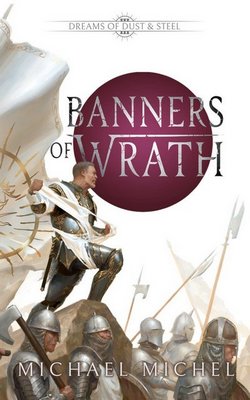 Banners of Wrath
by Michael Michel
War has come...

A Kurgish host wreaks havoc among the mountain clans, slaughtering and enslaving their way up the ladder of power.

To the east, the Scarborn fortify their position while they plot their next attack.

As chaos and social unrest unfold across Namarr, Scothea mobilizes for holy conquest. The Arrow of Light’s grip on his cultists grows stronger, his miracles ever more alarming.

Meanwhile, the battle in the River of conscious reality has just begun.

With every day that passes and every hero that dies, the odds of preventing annihilation dwindle..
This was on last month’s list–but the publication got pushed back. I still couldn’t have managed to read it last month, but I at least have a good reason for not getting to it. I don’t know if I’m ready for everything the blurb promised.
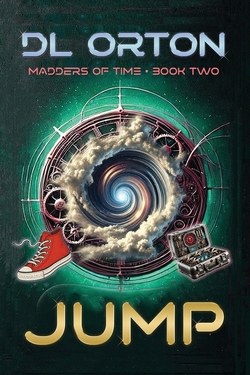 Jump
Jump
by DL Orton
The multiverse is collapsing. The time machine is broken. And humanity's last hope? Might already be dead.

Seven months after the EMPs brought the world to its knees, a handful of scientists are racing against extinction-and each other. Somewhere in a flooded skyscraper lies a wormhole generator that might be able to undo the apocalypse. If they can find it. If it still works. If it doesn't kill them first.

Meanwhile, Diego Nadales wakes up chained to a wall, his face bloodied and his memories fractured. He's being accused of terrorism, treason, and time travel. The last one, at least, is true.

Isabel is trapped inside a biodome ruled by the man she once trusted. But her bees-microscopic drones designed to save the planet-have been hijacked and weaponized. If she doesn't find a way out soon, her creation will wipe out the last threads of life on Earth.

Old friends return. New enemies rise. And somewhere in the chaos, one small spark of hope just might be enough to ignite a revolution.

The clock isn't ticking. It's broken.
I took part in a book tour for the first book in this series last year, time for book two. Time travel, multiverse, dystopia, and tiny android bees. (or were they wasps? I should check)
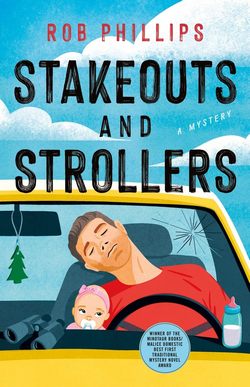 Stakeouts and Strollers
by Rob Phillips
Charlie Shaw is low on sleep. And cash. Otherwise, life is going pretty well for the ex-crime reporter: he’s happily married to his college sweetheart, he’s a first-time dad to the most adorable baby girl in existence, and he’s making ends meet as a rookie PI. But when Charlie meets Friday Finley, a frightened sixteen-year-old runaway on a stakeout-gone-wrong, his world gets a little more complicated.

Friday is looking for her estranged father Shawn, an unreliable alcoholic who left when she was young—and who also happens to be her only shot at avoiding the foster care system since her mother’s death a few weeks earlier. At first, Charlie believes the man is simply hiding out somewhere, avoiding his responsibilities as usual, but the more he investigates, the more unsettling—and dangerous—Shawn’s disappearance becomes. When his own family is threatened, Charlie realizes he’s in over his head, but can he back out now that he’s begun to care for Friday as his own?

A perfect page-turning blend of humor and high stakes, Stakeouts and Strollers is a heartwarming story of fatherhood, family, and what it really means to be a “Girl Dad.”
How cute does this sound? Come on…
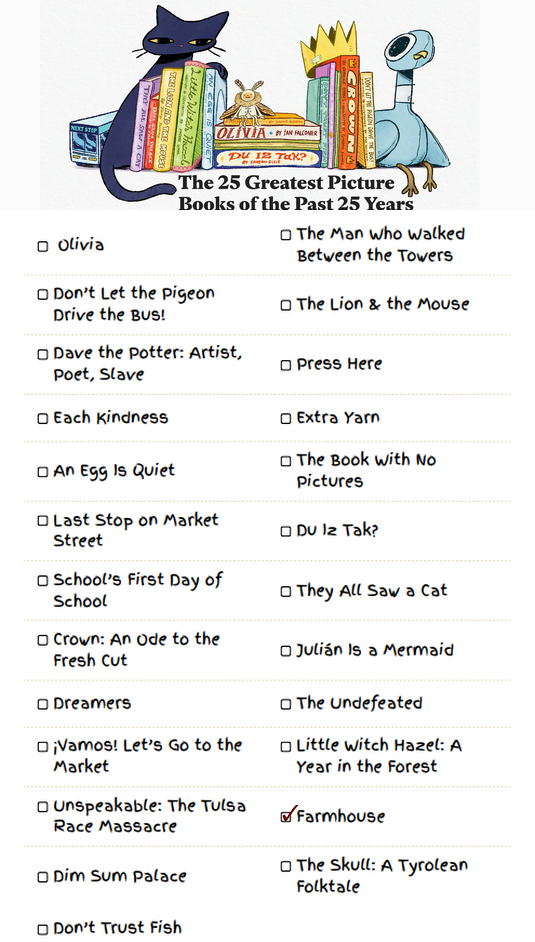
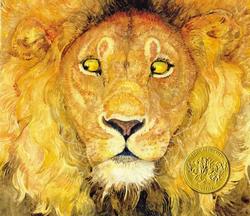 The Lion & the Mouse
by Jerry Pinkney
n award-winning artist Jerry Pinkney's wordless adaptation of one of Aesop's most beloved fables, an unlikely pair learn that no act of kindness is ever wasted. After a ferocious lion spares a cowering mouse that he'd planned to eat, the mouse later comes to his rescue, freeing him from a poacher's trap. With vivid depictions of the landscape of the African Serengeti and expressively-drawn characters, Pinkney makes this a truly special retelling, and his stunning pictures speak volumes.
This is another title in Slate’s “25 Greatest Picture Books of the Past 25 Years.
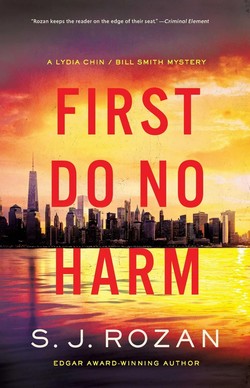 First Do No Harm
by S. J. Rozan
With River Valley Hospital in the midst of negotiations to avert a nurses' strike, a wealthy benefactor is set to give a large donation to honor of the Chief of Emergency Medicine: Dr. Elliott Chin, the brother of private investigator Lydia Chin.

Before the donation can be finalized, a member of the nurses' negotiating committee is found murdered. A morgue assistant is arrested and although he denies even knowing the victim his father and brother, both doctors at the hospital, are quick to urge him to take a plea. Another negotiating committee member abruptly resigns and a senior biomedical technician disappears. An officially off-limits section of the hospital basement turns out to be a hotbed of unauthorized—and in some cases criminal—activity.

Hired by the arrested man's lawyer, Lydia Chin and her partner Bill Smith start to dig into the events and personnel at the hospital. Among the union disputes, blackmail, thefts, lies, and a detective who really, really doesn't like them, one thing becomes clear: the dictum to "First Do No Harm” is not in effect at River Valley. As time runs short, Lydia and Bill face a complicated and dangerous task: they must unlock the hospital's secrets to save an innocent man.
Rozan’s been at her best lately, hopefully that continues (but even if it doesn’t, it’s not like she’s written a bad book). Lydia and Bill dealing with corruption in a hospital? Sounds promising.
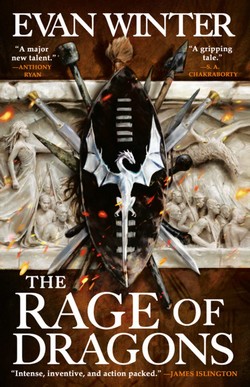 The Rage of Dragons
by Evan Winter
The Omehi people have been fighting an unwinnable war for almost two hundred years. The lucky ones are born gifted. One in every two thousand women has the power to call down dragons. One in every hundred men is able to magically transform himself into a bigger, stronger, faster killing machine.

Everyone else is fodder, destined to fight and die in the endless war.

Young, gift-less Tau knows all this, but he has a plan of escape. He's going to get himself injured, get out early, and settle down to marriage, children, and land. Only, he doesn't get the chance.

Those closest to him are brutally murdered, and his grief swiftly turns to anger. Fixated on revenge, Tau dedicates himself to an unthinkable path. He'll become the greatest swordsman to ever live, a man willing to die a hundred thousand times for the chance to kill the three who betrayed him.

The Rage of Dragons launches a stunning and powerful debut epic fantasy series that readers are already calling "the best fantasy book in years."
So, I started this one yesterday. Wow. Starts off fast and hard, and really doesn’t let up. My mind is boggled and it’s probably going to get worse (or better).
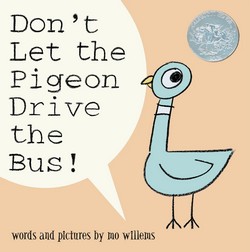 Don’t Let the Pigeon Drive the Bus!
by Mo Willems
inally, a book you can say “no” to!

When the Bus Driver takes a break from his route, a very unlikely volunteer springs up to take his place: a pigeon! But you’ve never met a pigeon like this one before. As the Pigeon pleads, wheedles, and begs his way through the book, readers answer back and decide his fate.
Another from that list. I know I’ve seen the cover to this/sequels around before. Might as well find out what’s behind the cover.

(Image by DaModernDaVinci from Pixabay)

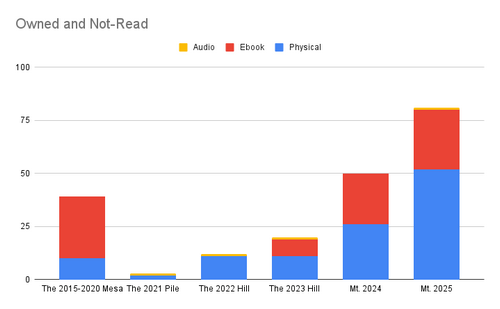
 Cut down on my Goodreads Want-to-Read list and the unread books that I own (a perennial project, but 2024 was not good for the size of that stack)—I’m going to talk about that more in a minute.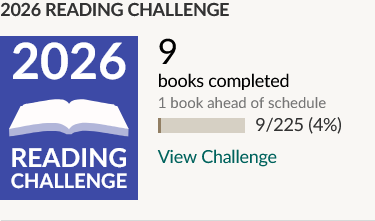
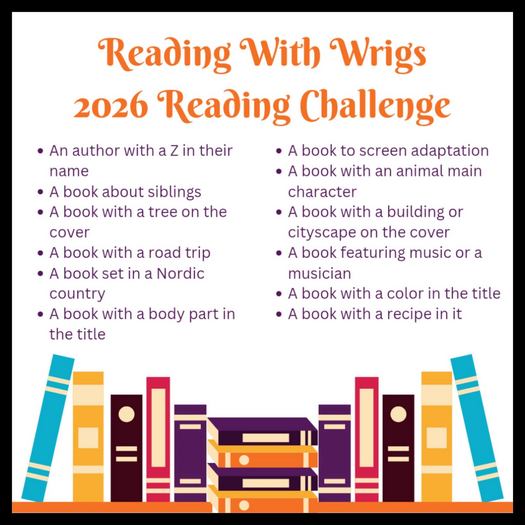

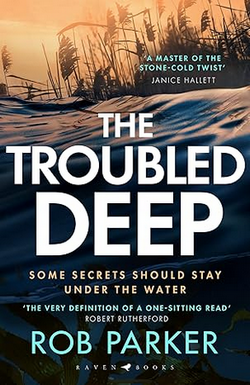
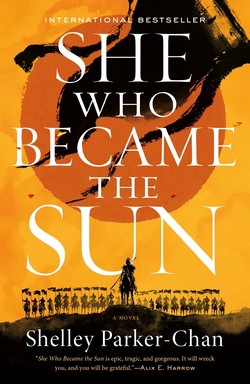
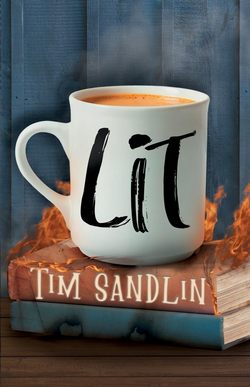
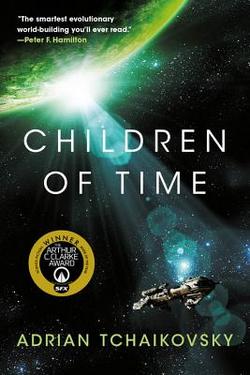
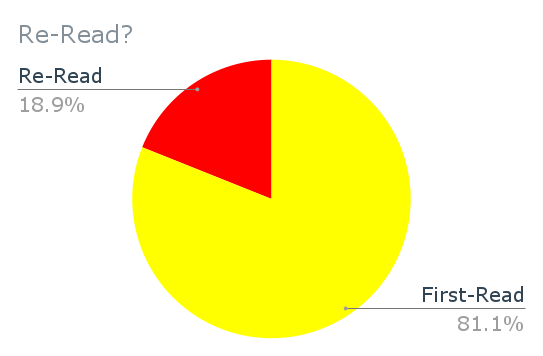 That’s a 6% uptick in re-reads. Last year, I’d predicted a big jump. I’m not sure that qualifies, but it’s good enough.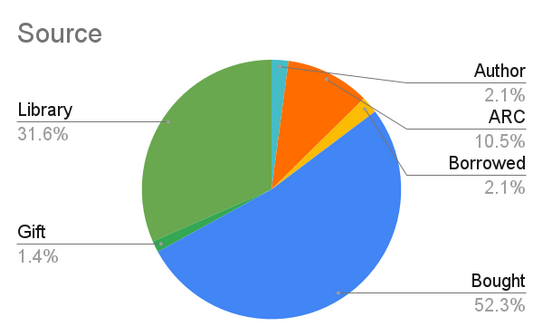
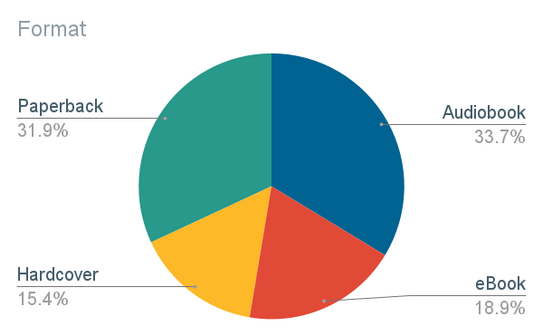 Paperbacks and eBooks went up, Hardcovers went down accordingly–and Audiobooks dipped a bit (I’d expected worse).