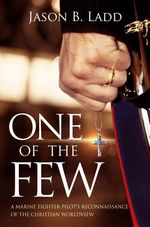
by Jason B. LaddKindle Edition, 318 pg.
Boone Shepherd, 2015
Read: June 10-17, 2016
Jason Ladd served as a Marine pilot and is a father and husband. In his early adulthood, he became a Christian. This book talks about the process he went through to become all of the above, and what he thinks and believes about Christianity. This is an interesting approach to a book — it’s mostly a collection of autobiographical anecdotes from childhood through adulthood, with a focus on his military training and service. These anecdotes are then used to illustrate spiritual insights/teachings/beliefs of the author. The earlier portions of the book are more obviously connected — a clear storyline can be seen.
I’m only saying this because Ladd told me that his book was “especially relevant to Reformed Protestant Theology Nerds.” But the theology in this thing is a mess, there isn’t a coherent Christian Worldview put forth in this book — there are portions of Christian(ish) Worldviews, but not one. And if there’s a Reformed Protestant view mentioned here, I missed it. I’m not saying that Ladd’s not a Christian, or that he doesn’t have a coherent Worldview, but he didn’t do a great job of displaying that Worldview in these pages — instead, we get a little bit of this, a little bit of that, and a dash of something else. If this was the kind of blog that critiqued theologically oriented works, my critique of Chapter 12 (for example) would be at least three times as long as his chapter. I think we’re all relieved that this isn’t that kind of blog.
The later in the book we go, the less the organization makes sense to me — clearly Ladd had an organization in mind, I just didn’t see it. He kept saying “Now it’s time to talk about ____.” What made it time to do so is beyond me, there was rarely an obvious link between topics when he said that. It doesn’t take away from the worth of the material, but the scatter-shot approach makes it hard to follow.
I recommend this with reservations — and have actually recommended it to a couple of people who I thought would appreciate it more than I did — the writing is crisp, the autobiographical/military training anecdotes are well-written and interesting, the theology needs a lot of work, but isn’t wholly without merit. If you like the concept, you’ll probably find it worth your time.
Disclaimer: I received this book from the author in exchange for my honest thoughts about it. I thank him for his patience — this is horribly overdue.
A friend started talking about this book last week, and it sounded pretty interesting. Actually, when I said “talking,” I should’ve said “raving.” Anyway, it’ll probably be a few months before I can get around to reading this, and the author’d probably prefer something sooner, so my friend is allowing me to post her review instead of mine. Thanks, Erika!
—
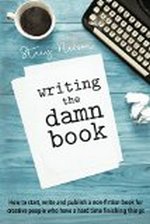
by Stacy Nelson Kindle Edition, 83 pg.
BadAss Publishing Co., 2016
Practical Magic for Alchemists Who Like to Play in the Esoteric Sandbox
by Erika Nall
(I had the privilege of reading this book before it was released to the masses.)
The “Who Is Your Reader?” section is the MOST IMPORTANT section. It stopped me dead in my tracks!
I’ve bought countless courses and trainings but something always felt off. I couldn’t quite put my finger on it. All of them had me “start with the end in mind.” I was painting these beautiful pictures of my days, my 3 months from now, my 1 year from now, and beyond. It was so yummy. It tapped into my superpower of visioneering. It satisfied my romanticism. It validated my idealism. Then I reversed engineered to create that in the present.
However, when it came to my readers and clients the “guru” always had me start at the beginning of their journey. “What are her pain points?”
EVERY. SINGLE. TIME. I start there my stomach clenches and my heart shrinks. Inside I feel small and powerless. I get confused and lack clarity. OUCH! It’s painful.
I can hear it now:
Guru: “Lean into your discomfort. Just push through it. This is good for you. This is an opportunity to grow.”
Me: “Um, I don’t think you understand this is not uncomfortable like my shoes are a little too tight or I have a bit of indigestion from the pepperoni pizza I just ate. This is killing me inside.”
Guru: “Well, that’s just a thought. Notice the thought. Let it go back from where it came. Back into nothingness.”
Me: “I don’t think you heard me. THIS IS LITERALLY KILLING ME INSIDE! I avoid death as much as possible thank-you-very-much.”
(And as an alchemist, I know I can excel in the dark art of manipulation to get what I want. I always felt like I went there when I started with pain. “I can help you. Or, better yet “I can save you.”)
Why do I die inside when I start with pain?
My reader is me. I am her. When I talk about her beginning, I am talking about my beginning. When I talk about her insecurities, I am talking about my insecurities. And believe me, they like to show up and be a part of the show anytime they can.
Now, I understand why the beginning is a terrible place to start. Brains are pretty clueless. Whatever it’s thinking, it perceives as reality. That’s its job. And, mine does it very well.
Now I understand that those sensations. That experience is also what happens when I am insecure.
When I wanted to share my message through writing, my self-assurance, my self-confidence, my self-trust was nowhere to be found. Frozen, I just stared at that incessant blinking damn cursor for hours as the insecurities played and had their fun in my head. Frustrated and feeling rather poorly about myself, I would give up. I’d walk out of my office thinking, “What’s wrong with me? How can I usually write so freely and unabashedly with great perseverance one minute, but not the next.”
I wrote the answer, “who is your reader going to BE at the end of the book?” (Honestly, I wasn’t sure if this was going to work.)
And, I felt it. For the first time I felt that what I wrote was coming from a deep place inside of me and not my head. I expected the sensation to be like a blast of, or at least a pulsating, bright light. (Well, that what I thought was suppose to happen when you are passionate and empowered.) Instead, my stomach was relax and I felt a gentle pressure across my chest. It was a constant glow and warmth like after the fire burnt up the firestarters -the tender and the kindling- and it’s just being a fire, doing what fires do. Sure there was an occasional popping of pitch, but I didn’t stop. My fingers just pounded a bit harder on the keyboard.
My breath deep and long. Every once in awhile tears would run down my face. My mind quiet. There was no judging. I just typed. I didn’t set a timer like I usually do to keep me on track. When I felt like I got up into my head, I paused, looked out the window and watched the birds for a little bit, took a few deep breaths, and went back to writing. When all that I had inside was out in black and white -unedited and raw- I looked at the clock and only 50 minutes had passed – talk about flow, baby.
I took a deep breath, exhaling slowly, coming back to my surroundings. Then my intuition said, “Is this making her BE EMPOWERED?” And, I cried.
Several times since then, I’ve tapped back into empowered and I’ve cried every time. Not because I am sad, or happy, or relieved because now I can feel the glorious ginormity of it. How badly, how passionately I want that for my readers AND for me.
You see, I was asking the wrong question. I was starting in the wrong place.
Now when I begin with the energetics of empowerment, I write within the place of security. My assurance, confidence, and trust will be front and center. And, when the writing gets hard and there is a call to perseverance, THIS is what will pull me through the challenges of spreading my message in whatever form I choose.
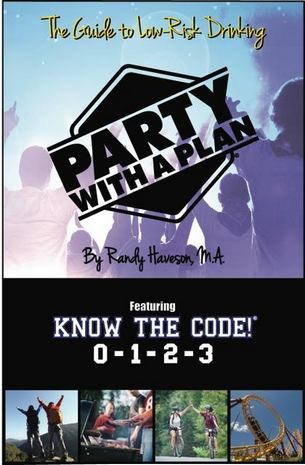
Welcome to our Book Tour stop for Party with a Plan. In addition to this blurb about the book and author, I’ve got a an interview with the Author, Randy Haveson. I haven’t read the book (yet), but you know what? It seems like a good idea — I like the approach here. Look into it.
Book Details:
Book Title: Party With a Plan Author: Randy Haveson Category: Adult nonfiction, 63 pages Genre: Health & Wellness, Self-help Publisher: RISE Publishing Release date: May 2016 Content Rating: PG-13 (Since this is a book that teaches people how to drink alcohol in a low-risk manner, it’s not really appropriate for kids.)
Book Description:
Finally! Here is a proven, practical way to drink alcohol and lower your risk for problems. Up until now, there have been two primary messages when it comes to drinking alcohol. One is “just say no,” which for the majority of the population is not an option. The other is to “drink responsibly.” But what does that mean? If you ask five random people to define responsible drinking, you will most likely get five completely different answers. This invalidates the term because it can be defined in so many different ways. Party with a Plan® gives a concise and research based formula that teaches people how to drink and lower their risk of negative consequences. It’s like creating a speed limit for drinking. If you stick to the speed limit, your chance of problems is minimal. However, the more you go over the speed limit, and the more often you go over the speed limit, the more you put yourself and others at risk. This book is long overdue!
Book Trailer:
Author’s Bio:
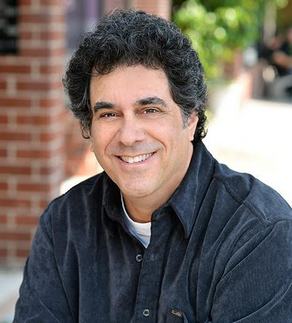
Randy Haveson knows addiction. As an alcoholic in long-term recovery (May, 1984), he has dedicated his life to helping others make more empowered choices in their lives. He is a 25 year veteran in the substance abuse field with extensive experience as a counselor, Director of Health & Alcohol Education at highly accredited universities, and speaker on over 100 campuses, speaking about harm reduction, self-esteem, leadership, and supporting students in recovery.
by Peter Davidson
Kindle Edition, 116 pg. Sweet Memories Publishing, 2016
Read: July 12, 2016
Let’s get this straight: this is not about being politically incorrect, it’s an instructional guide to being a boor, a lout, a cad . . .
I kept thinking: if I read on, I’ll get the joke, I’ll see the satire. But nope. Didn’t happen. It’s a shoddily written, cliché-ridden situational guide to being “brutally honest.”
I typically try to be thorough with these posts (especially if I’m not crazy about the book, if only to justify my problems and the time I spent reading it), but I’m not going to bother with this one. The only reason I didn’t toss this in a corner is that I didn’t think my Kindle could take it. Every second I spent reading it was a waste, it ruined my day plowing through this. I if read something as bad as this again in 2016, I may just shut this site down.
Disclaimer: I received this book from the author in exchange for this post.
Amy Poehler’s memoir-ish, Yes Please has been on my “get around to it” to it list for quite a while, but I never seemed to until I started this whole audiobook at work experiment. I picked such a good one to start with, I’m actually glad I didn’t read it first.
Poehler interweaves comedy bits with the story of her life and career, starting with her early experiences in comedy and childhood friends, moving onto her start in improv and then on to SNL and Parks and Rec. Even when she’s being serious, she can’t help but be funny — while talking about her divorce, death, Haitian orphans, etc. you want that. She talks a lot about her two sons and sounds like a loving and devoted mother (if a bit twisted).
In addition to this, she talks a good deal about how to deal with the inner voice telling young(er) women (and, I assume, older) that they’re not perfect, that their physical appearance needs to be different or they’re not that worthwhile. As I listened to this, I wanted to play it for my daughter. When she talked about sex and drugs (not that much on the former, but enough), I lost a bit of that desire, but I still might.
It’s not just Poehler’s authorial voice that makes this work so well — it’s her actual voice, too. Poehler saying these wise words, confessing the details, sharing the stories herself, and not just some hired gun (as capable as they might be) elevates the project. Bringing in Patrick Stewart to read silly poems, Kathleen Turner to do the occasional line, her parents, Meyers to reminisce, Schur to read a list of alternate candidates for Leslie Knope’s name and talk about Parks and Recreation in general — were great moves, and a blast to listen to. I’m curious what those sections are like if you just read them, but probably not enough to go try. The last chapter is a recording of a live reading she did, the audience reaction and her playing to them added just the right touch.
I can’t believe I’m saying this, but don’t read the book. Listen to the audio. It’s just that good. Heartfelt, funny, and inspirational (and did I mention funny?) — it’s everything you want from Amy Poehler (shy of another season of Parks and Rec).
by K. Scott Oliphint and Rod MayseARC, 160 pg.
P & R Publishing, 2016
Read: June 12, 2016
In the preface, after a brief sketch of Newton’s life and his career as a hymn-writer, the authors talk about how they’re going to use one of his hymns as a framework for their discussions. Because older hymns help us remember that we’re not the first believers to have to deal with certain aspects of life — and they help us remember those things that are important and distinguish them from those that are fleeting. Now, why of all the Newton hymns one could choose, they picked “Glorious Things of Thee are Spoken,” I don’t know. I looked, and realize I may have missed their explanation (and will feel pretty embarrassed when it’s pointed out to me). I don’t think it’s a bad choice, I just don’t understand why this one.
Don’t get me wrong, this is not an interpretation of or meditation upon Newton’s words. But each chapter draws on the themes of the verses of the song, and shows some of the ways you could talk about those issues and themes today. I guess you could label this an application of Newton.
Thanks to the framework of the hymn, the book covers a range of issues – the foundation of knowledge/understanding, the nature of authority, technology’s effect on our thinking, cutting, God’s promises, sin — and from time to time, I stopped reading and wondered how they started at X and ended up at Y, but the transitions were all so seamless that the text flowed easily from one to the other — and honestly, it turns out that X was related to Y, after all. Not only do they address a wide range of topics, they do so using the whole of Scripture, so you get a range of Biblical perspectives.
The authors use illustrations that should be familiar to many — you don’t have to be steeped in Evangelicalism to follow their arguments — A Christmas Carol, Neil Postman, Shakespeare, The Man Who Wasn’t There, for example. Chapter 4’s discussion of redemption begins with an extended look at a portion of Lewis’ The Lion, the Witch, and the Wardrobe. I’m not sure I needed the close reading of the White Witch’s plot to kill Aslan in exchange of Edmund, I’m not sure anyone over the age of 6 needs it to see how it applies to Christian redemption. But that’s a minor complaint.
It is really a deceptively easy read. The prose is smooth enough that you can get through the text without noticing the deep thoughts you’re encountering. I remember looking down and wondering how I could be 25% with a Oliphint book so quickly. It has to be Mays’ influence.* But when you read closely (as you really ought), Mays and Oliphint are dealing with important topics that everyone needs to think about, and they don’t do so in a cavalier or surface-level manner. An easy-to-read manner, yes, but not surface-y.
I even liked the discussion questions – I almost never like them and wonder why authors/publishers bother. But, these were helpful and I think would be great fodder for discussion groups.
Unshakable is a very useful, thought-provoking work that’s pretty accessible for a wide-ranging of readers: believer, unbeliever, student, older-than-typical student. I heartily recommend it.
Disclaimer: In exchange for my honest thoughts, I received this book via NetGalley and P&R Publishing. Thanks very much!
— *that’s not a criticism of Oliphint, just underlining how easy a read it was. My only criticism of Oliphint’s work is that there are so few of them.
Late last year, I was approached by Walt Hackman to read and review his book, No Problem, Mr. Walt. Which was absolutely not my kind of book, but there was something about it that appealed to me. I’m glad I did, it was quite a tale. I reposted my take on it earlier today, in honor of the book launch tomorrow. Walt was kind enough to take part in a Q & A with me — which was enough to make me want to re-read the book. Hopefully, it convinces some of you to give it a first read.
I’m always interested in the writing process, why writers make the choices they make along the way — why did you decide to approach your story by mixing Chinese history with the story of your junk?
When I started to outline and write “No Problem, Mr. Walt” it was not in chronological order. As each Chapter unfolded, I found myself writing about subject matter that emerged along with my story – like the reference to caulking from Marco Polo’s journal or the Cultural Revolution – and it occurred to me that including snippets of Chinese history would assist the reader by providing context to make my story more relevant. So, at the beginning of Chapter Two I begin with “I think it is safe to say that the average American may suffer a bit of historical amnesia regarding China’s recent history. Therefore, I have decided to start in the next chapter with the last Emperor Pu Yi in the early 1900s, and present the reader with a brief history up to the present; these bits of history will be presented at the beginning of each chapter. If you understand China’s recent past, it will be easier to understand references to history in the story, and easier to understand present-day China.”
For that matter, why did you decide to Where there some anecdotes/memories that you wanted to put in the book, but couldn’t find a way to fit them into the narrative? Care to share any?
Yes, there are a few but these stand out: the initial draft included poetry that I wrote depicting experiences I had such as the bus ride in Chapter 23. However, the editor felt including them would take away from the story’s narrative so I kept the content they included but the poems themselves were removed.
More importantly, my journey began with the sudden death of my only son Wally, which is something I find very difficult to talk or write about even to this day. I feel there are no words adequate to explain the anguish, sadness and magnitude of our loss. Those parts of the story that dealt with “Rebuilding a (my) Life” were tough for me to write (and rewrite). That being said, Wally’s death was the catalyst that propelled me on that improbable journey and is an important part of the story even though I only talk about it briefly in the Preface. I did the best I could to address it but feel that in a future revision I might find a better way to tell that part of the story. My daughter Lynn is a writer and owned the Mei Wen Ti from 2000 to 2008, I think hers might be the voice that best explains that time in our lives and we’ve been discussing a collaboration.
What was the biggest surprise about the writing itself?
Steven King said in On Writing, “….I believe the first draft of a book – even a long one – should take no longer than three months, the length of a season.” For me, my biggest surprise was how long it took me to write the book. Not months but years!
I tell people it was easier to build a boat in China than it was to write a book about it. Even though I approached my writing with discipline, I found it impossible for me to write a fixed amount daily or weekly like King suggested. I set a goal and really believed that I would get the book completed before the China Olympics in 2008. But looking back, I would still do it all over again because this project has never been about notoriety or money, I have always thought it could be a good story that people might enjoy.
A lot of what makes a writer are the books that he’s read — what books in particular do you think made you the writer you are/the book the book it is? (other than the books on Chinese history, etc.) .
Before starting the book, I read Steven King’s On Writing. One of his main points is that generally, if you want to be a good writer you must be a good reader. I’ve always been an avid reader but I began reading a lot more beginning with every book Steinbeck ever wrote. Somehow, knowing I was going to write a book caused me to notice writing subtleties and styles that I liked. After all the Steinbeck, I read Hemingway’s Boat, The Sun Also Risesand A Farewell to Arms, etc. Even though King’s On Writing is centered around writing fiction, it helped me and I often referenced it along the way.
You’ve lived quite a life — is there another book in you?
The answer is yes. I have given this more thought than you can imagine. I’d like to write a revision of No Problem, Mr. Walt that would meet approval for sale in China (i.e. tone down any reference to Communism that might be viewed as “unfavorable”) And similar to how I included Chinese history for western audiences, this version would be a juxtaposition that includes U.S. history and customs.
On my trips to China, people were fascinated about the junk (surprisingly, you don’t see a whole lot of them especially the size and style of the Mei Wen Ti) and the fact that I was even there building it. Junks (sail boats) have not been built in China now for many years since the introduction of modern engines. Many people I met wanted to know what I was doing in China, why I walked to the bus station and rode the bus, why I was wearing cowboy boots, if I liked the food, if I could tell them about California, why the U.S. was selling our latest jets to Taiwan, etc. Lastly, I believe the book is a simple story that the current generation of Chinese people would enjoy. The collaborative work with my daughter is also a possibility since No Problem, Mr. Walt ends with the delivery of the Mei Wen Ti on the docks in San Pedro. The story that proceeded to unfold after the Mei Wen Ti hit U.S. soil (or rather, water) is a unique one all its own!
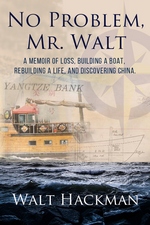
by Walt Hackman
ARC
Publish Authority, 2016
Read: February 18 – 26, 2016
Walt Hackman led an interesting life — sometimes, too interesting. At the age of 55, while trying to decide how to move forward from some major life changes and recover from a great tragedy, he decides to fulfill a long-held dream and move onto a boat. The question was only: what kind of boat?
He decides on a Chinese Junk. And then proceeds to figure out how to get one built for him — not a replica, not a used Junk — but an authentic, Chinese, made they way they’ve been made for centuries, built just for him.
As mid-life crises go, it’s a lot more creative and original than a red Porsche. *
The process was long, involved, troubled, and confusing. Which is works out well for the reader, because it makes for an interesting story for Walt to tell. He walks us through the process involving banks, embassies, multi-national shipping, translators (professional and not), engineers, trans-pacific flights, and a whole lot of tea.
But it’s not just a story about getting his Junk built — it’s a story about Hackman learning how to get things done in China, what he learned about the culture, and how he applied that. For me, this was the most appealing part (really, as interesting as it was, the boat portion of his tale was pretty straightforward).
Hackman did a lot of research into Chinese culture and history — and shares that with his reader. You could get a quick and dirty understanding of Chinese history just by reading the little his chapter introductions. But it’s not just about the big things like the Great Wall, the history of Chinese shipbuilding, various leaders, and whatnot — he talks about culture — the need to make sure everyone saves face in a discussion (and how to ensure that), and even Chinese singing and fighting (??) crickets — which are sometimes kept as pets, in tiny little boxes.
It wouldn’t be a book about international travel, business, and misunderstandings without some travel horror stories — but wow, he had some doozies. Which is probably why those kind of stories are so ubiquitous, they’re great bits of temporary drama that everyone can relate to. They’re also great reinforcement for those of us who aren’t that into travel to stay home.
Second only to travel horrors, are stories about food when it comes to narratives about other countries/cultures. Hackman described both restaurant and home-cooked meals. He gave a lot of detail about home-cooking — both by his Chinese-American friend and her family in China. Also, thanks to an encounter Hackman had walking around and talking to strangers, I learned more about the traditional way to prepare duck than I ever wanted/needed to know.
Most of us have seen enough travel shows, documentaries, etc. about China to get the idea just how foreign a land it is to Western eyes (even The Drew Carey Show sufficiently demonstrated that), and Hackman’s descriptions helped reinforce that. But more effective was his bringing things like coming home to the aftermath of the L. A. Riots (that he had no idea were happening) demonstrated the contrast with his time in China and underlined how otherworldly it can be over there (although in the age of 24-hour news cycles and smartphones, that might not be as stark now.).
It’d be easy to expect this book to be an exploration of Hackman’s dealing with the emotional and familial hardships in his life — but nope. It’s just what it promises: a story about a man trying to get a boat built. That other stuff happens, you can tell, but that’s not what this book is about — part of me would’ve like to see how his construction project helped him find the distance or whatever he needed — but I just found it refreshing that he didn’t use this story as an excuse to deal with all that in print.
Actually, now that I think of it — that’s pretty typical of Hackman — he doesn’t share his thought process (by and large) with the reader. We don’t really get an explanation for his choice of Chinese Junk, just that after some thought, he picked that. We see the results of his thinking, we see some of what his research (both via book and being around the culture) have taught him — but we get almost nothing of the process. Now, that’s a strange approach for this kind of book (at least by current standards), but it works.
The book’s subtitle is: “Building a Boat, Rebuilding a Life, & Discovering China.” Well, Walt Hackman does all three, but we really only get to see two of those. Building his boat and discovering China are enough to carry the book, and allow him to do the rebuilding. This is not the kind of book I normally read, but when Hackman contacted me about reading an ARC, something about it made me sign on — and I’m glad I did. It’s a fascinating book and an easy, rewarding read. Give it a shot, I think you’ll be pleasantly surprised.
Disclaimer: I was provided an Advance Reader Copy in exchange for an honest review – I still might end up getting a hard copy, just so I can have that cover to look at easily (can’t tell much from that thumbnail, but it’s great – click through to the website and check it out).
* I’m not trying to make light of everything Hackman was going for, his crises were a lot worse than most.
…something basic to every person— religious or not, atheistic or theistic. Everyone is wired to worship. We are always worshiping. We never stop. You are worshiping right now. You may be worshiping wrongly, but you are worshiping. We can’t help it— God built us that way. We are always giving our hearts and our hopes to someone or to something— a leader or a relationship, a job or a future success. The question for you and me is: what or whom are you worshiping right now? Is that object of worship good enough and wise enough and strong enough to bear the weight of your life?
Those questions by Charles Drew sum up the focus of this book. Who or what is the focus of/recipient of our worship?
Most books on worship focus on the how, the why, the “style” of worship — but this collection of essays (formed from addresses at the Philadelphia Conference of Reformed Theology over many years) thinks of it in different terms — Who is The One we worship? What’s He like? Why does He want us to worship?
Jonathan L. Masters took a break from podcasting (and, I assume, other things — but I only know the podcast) to edit and compile these essays from such notables as: D. A. Carson, Bryan Chapell, Charles Drew, Michael Haykin, Michael Horton, R. Albert Mohler, Richard D. Phillips, Joseph “Skip” Ryan, and Philip Ryken.
As a collection from various years, there’s some repetition of texts considered, no controlling theme (outside the title), and a lack of purposeful connection between the individual chapters. Also, there are variations in quality between the pieces. And Dr. Mohler just doesn’t seem to fit in tone or content to the rest. Not that there was anything terribly wrong about his chapter, it just didn’t seem to match up. Whereas Dr. Phillips reminded me (he showed up twice in these pages) how much I find him compelling to read or listen to.
All the authors bring a nice mix of theology, devotion, and encouragement as they try to remind us of the character and nature of the God we worship. Each chapter is easily accessible to any reader who wants to put in a minimal effort. Even the essays that didn’t engage me immediately ended up winning me over (again, except Mohler’s).
Phillip Ryken reminds us of the place of theology in our worship — not to the side, or relegated to some dark corner. On the contrary, our worship is theological, and the two inform each other.
Do you know what the Israelites did when the Egyptians finally were destroyed? They didn’t stand on the shores of the Red Sea arguing about the sovereignty of God, worrying about reprobation or its fairness. They glorified God because they had seen how glorious he was, not only in the mercy that he had shown to them, but also in the condemnation of sin and the way that he had brought justice. They were not trying to defend the sovereignty of God; they were simply celebrating it: “I will sing to the Lord, for he is highly exalted. The horse and its rider he has hurled into the sea. The Lord is my strength and my song; he has become my salvation” (Ex. 15:1–2 NIV).
. A solid collection of essays reminding us of who our focus is to be on — The God We Worship. Whether you read this a chapter or two a day on the Lord’s Day, or in one big sitting — this is a book that will help you remember that we are to glorify and enjoy Him forever.
I received this eARC from the good folks at NetGalley in exchange for this review.
You know what this book could’ve used? An introduction. Just something to ground the reader in the books intention, design, scope . . . something. It just dives in, you flip from the Table of Contents to the first entry.
The only way you know what the book is for is to have read the description from Goodreads/ebook seller:
If you want to spark new ideas for worlds, plots or characters, you want Ideas and Inspiration for Fantasy and Science Fiction Writers. Medicinal corpses, the jargons of thieves and carnies, Nazi UFOs, the colonization of space and green children from nowhere are only a few of the topics covered. This sourcebook is for all writers of fantasy or science fiction–whether novels, short stories, games, or any other form of storytelling.
The afterword touches on it a little, but who wants that at the end of a book?
Smoother writing, maybe a touch of personality to the writing would’ve been a plus, too.
It’s not something you can read cover-to-cover, it’s a resource book that you can consult, or flip through. I’m pretty sure I’ve read almost all of it over the course of a couple of weeks. It sparked an idea or two (not that I have time for them), but that’s about it.
I guess, this book set out to do what it intended, is thorough, easy to read, so . . . 3 stars? Next time you’re trying to prepare for NaNoWriMo or a Creative Writing course, give it a thumb-through.
Disclaimer: This book was provided to me by the author in exchange for an honest review.