Category: Theology/Christian Living Page 29 of 32

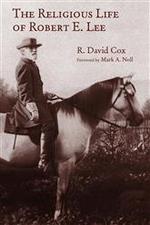
The Religious Life of Robert E. Lee by R. David Cox

The Religious Life of Robert E. LeeThe Religious Life of Robert E. Lee

by R. David Cox
Series: Library of Religious Biography

PDF (will be published as paperback), 259 pg.
Wm. B. Eerdmans Publishing Company, 2017

Read: December 25, 2016 – January 1, 2017

I feel always as safe in the wilderness as in a crowded city. I know in whose powerful hands I am, & in them rely, & I feel that in all our life we are upheld & sustained by Divine Providence. But that Providence requires us to use the means he has put under our control. He deigns no blessing to idle & inactive wishes, & the only miracle he now exhibits to us, is the power he gives to truth & justice, to work their way in this wicked world.

So wrote Robert E. Lee in a letter to his wife while serving in Texas, and according to R. David Cox it summarizes his theology. If you have to sum up a man’s theology in 3 sentences, that’s a decent one to have.

Robert E. Lee was no theologian, he wasn’t a pastor or preacher or religious scholar of any kind. He was a churchman, however. Seemingly a faithful one who served as he could — and he was a believer in the middle of a tumultuous time for American Protestantism and American as a whole, as such what he thought about the tumult from his religious perspective is instructive and fascinating reading. Which is pretty much why anyone might want to read this (and probably why Cox wrote the thing).

By and large, the book is a chronological look at Lee’s life, what’s going on in the national and ecclesiastical culture, and how Lee (and his family members — particularly his wife) responded to it and how his faith grew throughout his life. It’s not exactly a biography, but it is biographical. There were a couple of chapters that stepped back from the chronological look, and examined Lee’s perspectives on specific topics (the above quotation about providence comes from one of those). I particularly enjoyed and appreciated those.

I was surprised how little space was devoted to the years of The War Between the States, honestly. It may be that there wasn’t that much material — Lee was probably too busy to write a lot of things in letters that he might normally have (like: thoughts about sermons heard, theology, ecclesiastical concerns, etc.), that’d certain be understandable. Cox might be the one historian who doesn’t like writing about that time period. It might just be that his pre- and post- War writings were better material for the book — there are any number of good reasons for it, I was just surprised that the one thing the man is best known for is so little represented in the book.

One of the drawbacks of this book is the author’s perspective on Lee himself (at least what came across to me as his perspective, I could have read him wrong, he could have written it in such a way as to be easily misinterpreted, etc.). I’m not saying that I want a hagiography, nor do I want Cox to be some sort of Lee fanboy. A critical eye is essential. There’s an element of Chronological Snobbery (to borrow Lewis’ phrase) here when reflecting on Lee’s racial and political views. I have no problem with Cox disagreeing with them (I disagree with many of them), but he came across as patronizing (at least on the border of it). To a lesser degree, I thought the same about some of Lee’s religious views. But this didn’t crop up often, and when it did, it was easy to gloss over or ignore. It’s a drawback to the book, but not a reason to avoid it. If anything, Cox came across as detached and neutral when it came to the subject and his religion (it was impossible to tell if Cox shared any aspect of belief with Lee) 98% of the time. It’s just that 2% or so . . .

This is a part of Eerdman’s Library of Religious Biography series — which I hadn’t heard of until now. I have one sitting at the top of my To Be Bought pile (talked about it last month in a Saturday Miscellany post), but I didn’t realize it was part of a series. The books in the series are intended to “link the lives of their subjects – not always thought of as ‘religious’ persons – to the broader cultural contexts and religious issues that surrounded them.” It’s a fascinating concept, and I’m glad this series exists. I hope to get more of them soon.

This was a fascinating read, if a bit dry and detached. Neither’s bad, and may be commendable under the right circumstances (which may include such a divisive figure as Lee), but it doesn’t make for the best read. That, plus my ambivalence towards some of Cox’s attitudes toward the subject, makes me rate this 3 Stars. That’s still a recommendation, and I’ll gladly tell anyone to read it — believer or nonbeliever — if they want to understand Lee better, but I’m not that enthusiastic about the book.

Disclaimer: I received this eARC from Wm. B. Eerdmans Publishing Company via NetGalley in exchange for this post — thanks to both for this opportunity.
N.B.: As this was an ARC, any quotations above may be changed in the published work — I will endeavor to verify them as soon as possible.

—–

3 Stars

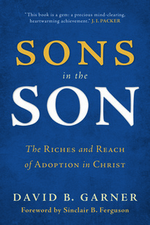
Sons in the Son by David B. Garner

Sons in the Son Sons in the Son: The Riches and Reach of Adoption in Christ

by David B. Garner

eARC, 400 pg.
P & R , 2017

Read: October 23 – December 11, 2016

At the heart of Pauline soteriology is the redemptive-historically charged concept of adoption (huiothesia). For Paul, the entirety of our redemption—from the mind of God before creation itself until its eschatological completion in our bodily resurrection—is expressed by filial reality, filial identity, and a filially framed union. As we will see in the following pages, this filial grace in Christ Jesus is expressly and implicitly, in Pauline theology, adoption.

I remember the first time I was really introduced to the doctrine of Adoption — sure, the idea had been mentioned throughout my Christian life, and using some material from an Ancient History class on Roman culture, I’d developed my understanding a bit, but it wasn’t until I’d been Reformed for a year or two that I heard someone seriously discuss the doctrine — the elder of the church I belonged to at the time walked us through the Westminster Confession’s teaching on it — the most robust development and explanation of the doctrine in Reformed Confessional history. I recall being struck by this teaching, how vital it was — and then hearing very little about it (on the whole) for the next couple of decades.

You see, despite being one of the three benefits the Westminster Shorter Catechism says that they who are effectually called partake of in this life (the other two being justification and sanctification, with several benefits that flow from or accompany these three), by and large, it’s been ignored in favor of the other two. Garner will describe it as a “deafening theological silence characterizing huiothesia [adoption] since the WCF.” It’s a slight exaggeration, but only slight.

Garner wants to push this doctrine to the forefront, to the limelight that it deserves, has pursued this in various forms throughout the years, and now brings it all into focus through this outstanding book.

He begins by describing various approaches to the topic — historically, linguistically, and so on — and sets out how he will proceed and build upon the best (primarily: Calvin and Westminster). This is a daunting section, but does well setting forth the landscape. It was interesting and thorough, I don’t know that it wowed me at any point, but it certainly whet my appetite for that which lay ahead.

Part 2 is where the major Biblical heavy lifting takes place — Garner goes for in-depth exegetical looks at each text that touches on the topic, building both a case for each text individually, as well as a Biblical-Theological whole. I will be honest, a lot of this went over my head — at least the details. But Garner writes in a way to ensure that even untrained laity can follow the his train of thought.

In part 3, Garner brings Adoption into Systematic Theology, primarily discussing its relation to Justification and Sanctification. He brushes up against some of the recent Justification controversies here, and demonstrates how a better understanding of Adoption, can (and should) play a significant role in resolving them. He does similar work with some Sanctification controversies — but not as much, partially because Justification has been a larger issue of late, and because historically Adoption has been (incorrectly) considered as forensically as Justification. This section probably takes more work to understand than the Exegetical section, but that could be just because I don’t try to get too much of a handle on the Greek, and I don’t have that hang up with English. Takes more work, sure, but doable.

Garner isn’t writing for laity explicitly, but he doesn’t write in a way that’s only accessible by theologians and scholars. Yeah, you sometimes there’s a lot of technical jargon to wade through, but it can be done (if nothing else, you feel smarter — and probably learn a couple of things). It was a bit weightier than most of what I’ve been reading lately, and I took my time with it to make sure it didn’t overwhelm me (it easily could have).

It’s absolutely worth the effort — this book is full of pastoral application, it will help you understand and appreciate the Pauline texts — and will deepen your assurance. This is quite possibly the best book I’ve read this year. Read this one. I will re-read it — I’m even going to buy a hard copy when this is released, you should, too.

Disclaimer: I received this eARC from P & R Publishing via NetGalley in exchange for this post — thanks to both for this. I meant it, I’m buying a hard copy as soon as I can.
N.B.: As this was an ARC, any quotations above may be changed in the published work — I will endeavor to verify them as soon as possible.

—–
5 Stars

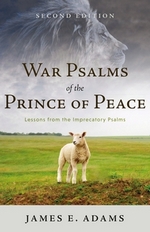
War Psalms of the Prince of Peace (2nd. Edition) by James E. Adams

War Psalms of the Prince of PeaceWar Psalms of the Prince of Peace: Lessons from the Imprecatory Psalms, Second Edition

by James E. Adams

eARC, 176 pg.
P & R Publishing, 2016

Read: December 18, 2016


This is the 25th Anniversary Edition of the book — revised and expanded, no less. I was so glad to get the opportunity to read this one — I’ve got a copy of the original edition, which I’ve read 3 or 4 times, and referred to often. So to get to read a new edition — and to have an excuse to revisit the book — I had to jump at the chance.

Adams begins by reassuring Twentieth Century Christians (and I assume those of us in the Twenty-First Century, too) that the Imprecatory Psalms do belong in Scripture, are just as inspired as the rest, and have a place in the life and piety of his readers. Imprecatory Psalms, I should probably mention, are those Psalms that call for the destruction or judgment of the psalmist’s enemies. From there, Adams argues that no only do they belong in our Bibles, but (like the other Psalms) they belong in Christ’s mouth. To prove this, he compares the Imprecatory Psalms to the Psalms of Repentance — if Jesus Christ can say/sing the latter properly, then it’s fitting for him to sing/pray the former. I’m not positive that’s the best argument he could make, but I tell you, Adams makes it work (it helps that he spent far more space than I just did).

Given that they’re part of the Bible, and that if they’re fitting to be used by Christ, then they have a place in the life of the New Testament saint — but what is that place? How are we to use them? Do we get to call down the wrath of God on our enemies? (Short answer: NO).

This here is the heart of the book, and where Adams is at his best. Yes, we are to pray these prayers, sing these psalms —

You may say, “This is the last thing my church needs! If our hearts are too lazy and cold to pray for those we love, how can we think of praying for enemies, as we find in the Psalms?” But I would challenge you, isn’t this the cause of our lack of prayer? We have not learned from the Lord Jesus how to pray!

Learning to pray these psalms is a theme he returns to time and again —

Without assistance how can we ever righteously pray this prayer? I answer this question unequivocally: We never can! We cannot pray this prayer on our own . . . not because we are too good, but rather because we are too prone to evil! Yet we must learn to pray it.

But why are we to pray these prayers?

Why are we taught to pray for God’s judgment on the enemy? So that they will be converted! Nothing could be clearer from this prayer [Ps. 83].

That’s the core of the book, right there — I’ll let you read his explanation, but that’s the ballgame.

On the whole, I can’t tell you what was revised, nor can I say exactly how it was expanded — and there’s just no way I’m going to break out my original and read them in parallel to give you the list. What this primarily tells me is that what he did to improve the book came in fairly seamlessly. So I’m guessing that means we’re talking about minor tweaks and clarifications — no major new sections or anything. Would I have preferred a new chapter or two? Some more in-depth explorations of particular psalms? Yes. But the book didn’t need a new chapter or two, and it wasn’t intended to be that narrow in focus, so that kind of material would’ve felt out of place.

This is an easy read — clear, crisp writing that is deep enough to make you think, but written in a way that you don’t notice that you’re dealing with weighty theology. Adams writes with conviction, passion, and care – which is always helpful but particularly so with a topic like this. You don’t want a dry dissertation here, you need heart to go with the thinking. There’s a sensitivity here, which is needed, but more than anything a desire to treat the Bible (and the Spirit who inspired it) as it ought to be.

This is a gem — it was a gem 25 years ago when it was published, and it’s a gem today.

Disclaimer: I received this eARC from P & R Publishing via NetGalley in exchange for this post — thanks to both for this.
N.B.: As this was an ARC, any quotations above may be changed in the published work — I will endeavor to verify them as soon as possible.

—–

4 Stars

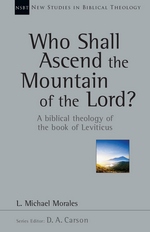
Who Shall Ascend the Mountain of the Lord? by L. Michael Morales

Who Shall Ascend the Mountain of the Lord Who Shall Ascend the Mountain of the Lord?: A Biblical Theology of the Book of Leviticus

by L. Michael Morales
Series: New Studies in Biblical Theology, #37

Paperback, 306 pg.
IVP Academic, 2015

Read: October 16 – November 27, 2016


So this is another one of those books that I’m not really qualified to talk about, but . . . whoops, here I go.

Morales doesn’t give us what you typically find/look for in a study of Leviticus — detailed explanations — or dodges — of the various purity laws and other commands and regulations contained in it. Instead, he begins by explaining his conclusion that Leviticus is the center of the Pentateuch, and that Chapter 16 is the center of it. Beginning in Genesis, everything is leading up to the Day of Atonement, and then everything from that is to be seen as the result of, or in light of that day.

That’s a lousy summary, but that’s the best you’re going to get from me in a couple of sentences. The argument is so detailed, so complex that I can’t really do much better without spending a few pages on it — and no one wants to read that (especially since you can read Morales doing a better job). At first, I thought that it was an interesting idea, but it really didn’t matter much. But as I read on and understood what he was doing better, it started to capture my imagination and draw me in. This was well argued, well researched — and well explained for even non-technical types like me.

But when it comes to Biblical Theology, the proof in the pudding comes from tying in his theses to the unfolding story of redemption — first in Israel’s story and then showing how it leads to Christ and His work on earth, His Ascension and pouring out of His Spirit to prepare a people to meet with Him on Mount Zion. The last two chapters were fantastic — and I’m going to have to reread them a few times to really wrap my brain around it all. There were moments of beauty here — it’s hard for an academically-inclined work to inspire and touch the emotions of a reader, but Morales did it.

This volume is the first I’ve read in New Studies in Biblical Theology (I believe it’s the first I heard of it, too) — the series is edited by D. A. Carson. The series aims “to simultaneously instruct and to edify, to interact with current scholarship and to point the way ahead. . . While volume notes interact with the best of recent research, the text of each work avoids untransliterated Greek and Hebrew or too much specialist jargon. The volumes are written within the framework of confessional evangelicalism, but they also engage a variety of other relevant viewpoints and significant literature.” If this is a representative volume, it won’t be my last in the series. If I can just pick another — the list of 41 is daunting — just too many choices.

Anyway, Who Shall Ascend was a challenging, interesting, educational and inspiring work — there’s not much more that you can ask for. If you’re up for the work, I heartily recommend it.

—–

4 Stars

John Bunyan and the Grace of Fearing God by Joel R. Beeke and Paul M. Smalley

John Bunyan and the Grace of Fearing GodJohn Bunyan and the Grace of Fearing God

by Joel R. Beeke, Paul M. Smalley

eARC, 160 pg.
P & R Publishing, 2016

Read: October 2 – 9, 2016


This brief book is a look at the life — spiritual and natural — of John Bunyan and his understanding of the fear of the Lord as traced through his writings.

I’ll be the first to admit that I have only the most basic understanding of Bunyan beyond The Pilgrim’s Progress and that quotation from John Owen about his preaching (only cited twice in this book), so I can’t judge the scholarship of Beeke and Smalley when it comes to that. I can say that I thought their approach to both the man and the material could’ve been deeper. The brief biographical material did everything it needed to — it wasn’t too long and it covered the bases, giving an understanding of what he went through and his historical context.

After the biographical section, the authors turn to the Fear of God, and soon lay out this distinction:

…Bunyan deduced that God forbids some fear as ungodly, but commends another kind of fear. This distinction proves to be crucial for Bunyan’s theology, allowing him to differentiate unhealthy, sinful fear from the spiritually sound and fruitful fear of the Lord.

They examine the ungodly fear some more and then look at various spiritually sound fears — and the ways that is can promote growth in holiness and perseverance.

A lot of this material was helpful — I’m not sure if it was because of the way that Beeke and Smalley compiled it or Bunyan’s insights that helped me the most, but I don’t think I understood any of the ideas the way I wanted to. Yes, the authors would point me at Bunyan and the Bible as a resource, but I think they could’ve helped me more.

I thought the evangelical appeal at the end of the book a little out of place — it didn’t seem to fit the intentions or voice of the book up to that point — and I can’t imagine that anyone who isn’t a convert reading this book. I hope I’m wrong and that this is an effective tool, I should stress — but it seemed inorganic.

This isn’t a bad book, it’s just a slight one. It’s too much of a survey, not an examination or an explanation. There’s no depth to the look at Bunyan, while there certainly appears to be breadth. I might have walked away with a better understanding of what kinds of things Bunyan wrote and when — but I don’t think it furthered my understanding of the man or his writing beyond that. If the authors had given use another 100 – 150 pages and I think I’d be writing something very positive.

Disclaimer: I received this eARC from P&R Publishing via NetGalley in exchange for this post — thanks to both for this.
N.B.: As this was an ARC, any quotations above may be changed in the published work — I will endeavor to verify them as soon as possible.

—–
3 Stars

Prophet, Priest, and King by Richard P. Belcher, Jr.

Prophet, Priest, and KingProphet, Priest, and King: The Roles of Christ in the Bible and Our Roles Today

by Richard P. Belcher, Jr.

eARC, 224 pg.
P&R Publishing, 2016

Read: September 11 – 25, 2016

Throughout Church History, however varying in degree, theologians have focuses on the offices of Jesus Christ as Prophet, Priest and King. The present is probably one of those period that doesn’t emphasize them too much — at least, not the Prophet and King (even as Presbyterian and Reformed children recite them in their catechisms). It’s probably time for us to take another look at them in detail. This is Belcher’s aim, at least. As he says,

This book will address the work of Christ in light of the roles of Prophet, Priest, and King and will then draw out implications for the church.

(I’d originally spent 2 or 3 sentences saying that, when I spotted it in his opening paragraphs — always go with pithy).

That’s pretty much the book, after the introductory chapter, setting the stage, Belcher examines each office in turn, a chapter on the Old Testament definition, history and development of the office, followed by a chapter on Christ’s fulfillment of the office during his estate of humiliation, and then in his estate of exaltation.

A redemptive-historical approach— emphasizing Christ’s fulfillment of the Old Testament —naturally lends itself to connecting with the roles, not just for Christ but also for his body, the church. This approach also has implications for preaching Christ from the Old Testament.

The examinations of the offices are very thorough, but probably not exhaustive (although they sure seem exhaustive) — I’m not sure I learned a whole lot during these chapters, but I do think that reflecting on the offices in this manner has helped me understand them more and in a deeper way as leading to Christ. 

There are study questions at the end of each chapter that are a handy means of reviewing, but don’t encourage much further study and thought. But I can see where they’d be useful for a class or discussion group.

While examining the Old Testament office of King, Belcher Mention digresses for a while to examine the question “Is there a Royal Priesthood in Israel?” What does the OT mean when it talks about Kings offering sacrifices, if that’s the role of the priest. I’d wondered idly about that a time or two, but hadn’t realized how complex the question can be.

In the nation of Israel the roles of prophet, priest, and king are basically kept separate to define their meanings. But it is significant that these roles come together in both the description of Adam and Eve and the description of Israel’s mission. Thus it makes sense that the Old Testament would begin to describe the coming future ruler as carrying out the combined roles (Ps. 110; Zech. 6: 11–13). 26 These are fulfilled in Christ, who is Prophet, Priest, and King during his earthly ministry. He fulfills them in his work of salvation and continues in these roles on behalf of his people in his ascension. The work of Christ lays the basis for restoring these roles to human beings in their service to God, to the church, and to the world.

Therefore, the final chapter looks at how The Church can fulfill her mission via these roles. I found this chapter fascinating — easily the best in the book. It, too, is not exhaustive, but merely outlines the ways The Church (as a whole and as individuals) can function. I wish almost everything in this chapter had been more developed and explored.

This is sound, solid, careful writing. Sure, it could use some personality — but it doesn’t need it. It’s just not that engaging — but for those interested in the topic (or see a need to develop that interest), this is a good investment of time. For a careful examination of something too often ignored, this is a worthy read.

Disclaimer: I received this eARC from P&R Publishing via NetGalley in exchange for this post — thanks to both for this.
N.B.: As this was an ARC, any quotations above may be changed in the published work — I will endeavor to verify them as soon as possible.

—–

3.5 Stars

Biblical Authority after Babel by Kevin J. Vanhoozer

Biblical Authority after BabelBiblical Authority after Babel: Retrieving the Solas in the Spirit of Mere Protestant Christianity

by Kevin J. Vanhoozer

eARC, 288 pg.
Brazos Press, 2016

Read: August 21 – September 4, 2016


With the 500th Anniversary of the Protestant Reformation’s accidental start coming up next year, we’ll be seeing a lot of books celebrating and/or critiquing the movement (more than usual, that is). This is one of the former, but done mostly in the way of a defense against some of the most common critiques. There’s a very real sense in which I’m not qualified to discuss this book — and I’m really looking forward to reading reviews from those who are. But, there’s another sense in which I am — I’m a Christian, I like to read and think about these issues, and VanHoozer wrote a book about them, so, you know — I might as well blather on about it some.

In the Introduction, Vanhoozer rehearses some of the more common critiques of Protestantism, mostly relying on those talking about the lack of organizational unity and those that relate that level of disunity to the doctrine of Sola Scriptura:

One adjective seems custom-made to describe the unintended consequence of the Reformation. It is a word that I never come across except in the descriptions or criticisms of Protestantism: “fissiparous”—“inclined to cause or undergo division into separate parts of groups,” from the Latin fissus, past participle of findere (to split; cf . “fissure” ).

In much of the introduction, he seems to buy into the conventional wisdom/stereotypes of Protestantism/what Protestantism teaches — including a weird reading of the Ann Hutchison case — using too many scattered quotations out of context from various authorities to build the case.

To respond to the fissiparousness of Protestantism (which he does lament), Vanhoozer uses the “Solas” of the Reformation to show why the problem isn’t inherent in Protestantism’s principles — the examination of the Solas (rooted in Sola Gratia) provides the framework for the rest of the book and his apologetic. I really appreciated this way of framing his argument, and think I need to work on doing that myself.

Throughout this work, Vanhoozer

will be arguing not for the superiority of [his] own Reformed tribe but for “mere Protestant Christianity.” This refers neither to a lost “golden age” nor to a particular cultural instantiation of Protestantism, but rather to a set of seminal insights —- encapsulated by the five solas — that represent a standing challenge, and encouragement, to the church.

While I have some concerns of the “Mere Christianity” and “Mere Orthodoxy” approaches that are gaining popularity in some circles, I can’t fault this. Sure, he’d be able to make a stronger case if he did argue for the superiority of Reformed thinking (if you ask me), but given the arguments he’s responding to it makes sense to adopt this approach.

As he looks at each Sola, he begins by examining what the Reformers meant by the phrase (too frequently different from what their heirs mean by the phrase). He then looks at competing views (historical and contemporary — with an emphasis on the contemporary), focusing each discussion on the doctrine’s relationship to Bible, Church and Authority. He starts with Grace Alone, moves on to Faith Alone, Scripture Alone, then In Christ Alone and finishing with For the Glory of God Alone. The latter part begins with a look at “The Lord’s Supper as a Test of Christian Unity.” Even the most ardent Protestant would have to admit that this is where the Reformers stumbled most — when Luther and the Reformed couldn’t come to an acceptable consensus on the meaning and nature of this Sacrament, our fissiparousness became most evident and quite possibly firmly established as a mark of Protestantism. For my money, everything else comes as a result of this failure — so for VanHoozer to focus on it at this point, really resonated with the reading/studies I’ve been doing lately. Sure, it’s not that novel an approach, but as a reader, when an author seems to be on the same page, it draws you in.

I do think some of the more technical arguments he makes get a little too creative, maybe too focused on innovation and novelty — but I’m pretty cautious when it comes to this stuff. So again, I’m looking forward to seeing what others make of this.

This isn’t an academic work, but it’ll appeal most to the academically-inclined (whether by occupation or temperament/interest). Lay people shouldn’t be put off by it, but it will be a challenge at times. Frequently, he’s deceptively easy to read — you’ll be chuckling at some remark, smiling at a bit of whimsy, and miss the fact that he’s left the shallow end of the pool for something deep and thoughtful. Re-reading paragraphs and sections is highly recommended.

Vanhoozer writes with a very engaging style, some great metaphors and imagery. One paragraph I picked while reading to try to explain this to my wife went like this: It began with some historical notes; then made references to Philip Schaff, John Nevins, and John Calvin; moved on to a quote by Augustine; and ended with a line from a line from Lewis’ The Last Battle (one that elicited a grin in addition to sealing his point). Yes, sometimes he lets that creativity run away from him — okay, he does that often (my notes are filled with that observation). I found myself frequently giving mental fist pumps to something he said and then almost immediately holding up a palm to say, “slow down!” On more than one occasion, I wondered if I was being charmed by his writing more than being convinced by it. I don’t think so, ultimately, but it’s something to be aware of.

One last note that I won’t develop because it was a slight digression for him at one point, but I really appreciated his discussion of Biblical vs. Systematic theology. It was a creative way to frame the discussion, and a helpful one at that.

On the whole, I might have cringed at or questioned his thinking, some of the details of his arguments, but typically I thought his conclusions were spot on. Which probably says more about me than him. There’s a few area to be cautious of here, but largely this is an encouraging, well-constructed, challenging and encouraging read. For those ready to gird up their minds, I’d strongly encourage picking this up. This was my first encounter with Vanhoozer outside the occasional footnote in someone else’s work — I don’t think it’ll be my last.

Disclaimer: I received this eARC from Brazos Press via NetGalley in exchange for this post — thanks to both for this.
N.B.: As this was an ARC, any quotations above may be changed in the published work — I will endeavor to verify them as soon as possible.

—–
4 Stars

The Essential Trinity by Brandon D. Crowe and Carl R. Trueman, eds.

The Essential Trinity The Essential Trinity: New Testament Foundations and Practical Relevance

by Brandon D. Crowe and Carl R. Trueman, eds.

Paperback, 273 pg.
Inter-Varsity Press, 2016

Read: July 31 – August 14, 2016

As far as consistency of quality amongst edited volumes goes, Crowe and Trueman have assembled one of the stronger line-ups I’ve read in a while — men from a spectrum of persuasions of Evangelical-ish thought have given the Church fourteen articles (approximately 20 pages each) to deepen our thinking about the Trinity. The aim was for a volume that “eschews overly technical discussion and focuses attention on the importance of the doctrine for every Christian.”

In Part 1, the articles look at the “trinitarian contours of every corpus of the New Testament, along with a chapter reflecting on the Old Testament roots of trinitarian doctrine.” If there are weak chapters in the volume, they’re in this part — but they aren’t that weak, either. Crowe’s chapter on Matthew is excellent, but the chapters on the Mark, Luke-Acts and John aren’t far off that Mark. Brian S. Rosner’s chapter on “Paul and the Trinity” is worth the price of the book. The chapters on the rest of the epistles are very helpful (particularity Hebrews). Mark S. Gignilliat’s article, “The Trinity and the Old Testament: real presence or imposition?” is very helpful and insightful — and as an added bonus, it’s the most stylistically entertaining and engaging piece in the book.

Benjamin Gladd’s chapter exploring Daniel’s influence on Revelation’s view of the Trinity is the biggest mental workout you’ll get in the book. I appreciated the material covered and the argument Gladd makes, but I’m going to have to read it a few more times before I think I have a good handle on it.

Part 2 addresses the importance of the Trinity for everyday living — many would say the doctrine is impractical and only belongs in Statements of Faith and academia. The authors here show the fallacy of that. It begins with a brief, but excellent, description of the doctrine by Scott R. Swain. Carl Trueman has the next chapter, “The Trinity and prayer,” which is probably as valuable as Rosner’s — it’s actually about more than prayer, but the material specifically on prayer is great — hugely indebted to John Owen (but not uncritically so). Robert Letham’s chapter on “The Trinity and worship” also draws deeply from Owen; if he doesn’t move you to worship as you understand the work of the Trinity in it, you aren’t paying attention (I probably have more problems with some of what he says than anything else in the book). Michael Reeves, typically, made me chuckle in his chapter on preaching — but he did more than that, too.

Timely, convicting, thoughtful and inspiring, this examination of the Trinity in Scripture and Life should be a great benefit to any believer ho reads it. It may not be the easiest thing read all year (but really, it’s not that difficult), but it’ll be one of the most rewarding.

—–

4 Stars

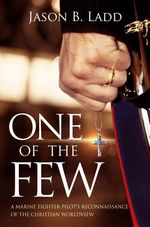
One of the Few by Jason B. Ladd

One of the Few One of the Few: A Marine Fighter Pilot’s Reconnaissance of the Christian Worldview

by Jason B. Ladd
Kindle Edition, 318 pg.
Boone Shepherd, 2015

Read: June 10-17, 2016


Jason Ladd served as a Marine pilot and is a father and husband. In his early adulthood, he became a Christian. This book talks about the process he went through to become all of the above, and what he thinks and believes about Christianity. This is an interesting approach to a book — it’s mostly a collection of autobiographical anecdotes from childhood through adulthood, with a focus on his military training and service. These anecdotes are then used to illustrate spiritual insights/teachings/beliefs of the author. The earlier portions of the book are more obviously connected — a clear storyline can be seen.

I’m only saying this because Ladd told me that his book was “especially relevant to Reformed Protestant Theology Nerds.” But the theology in this thing is a mess, there isn’t a coherent Christian Worldview put forth in this book — there are portions of Christian(ish) Worldviews, but not one. And if there’s a Reformed Protestant view mentioned here, I missed it. I’m not saying that Ladd’s not a Christian, or that he doesn’t have a coherent Worldview, but he didn’t do a great job of displaying that Worldview in these pages — instead, we get a little bit of this, a little bit of that, and a dash of something else. If this was the kind of blog that critiqued theologically oriented works, my critique of Chapter 12 (for example) would be at least three times as long as his chapter. I think we’re all relieved that this isn’t that kind of blog.

The later in the book we go, the less the organization makes sense to me — clearly Ladd had an organization in mind, I just didn’t see it. He kept saying “Now it’s time to talk about ____.” What made it time to do so is beyond me, there was rarely an obvious link between topics when he said that. It doesn’t take away from the worth of the material, but the scatter-shot approach makes it hard to follow.

I recommend this with reservations — and have actually recommended it to a couple of people who I thought would appreciate it more than I did — the writing is crisp, the autobiographical/military training anecdotes are well-written and interesting, the theology needs a lot of work, but isn’t wholly without merit. If you like the concept, you’ll probably find it worth your time.

Disclaimer: I received this book from the author in exchange for my honest thoughts about it. I thank him for his patience — this is horribly overdue.

—–

3 Stars

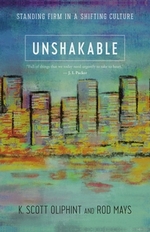
Unshakable by K. Scott Oliphint and Rod Mays

UnshakableUnshakable: Standing Firm in a Shifting Culture

by K. Scott Oliphint and Rod Mays

eARC, 160 pg.
P & R Publishing, 2016
Read: June 12, 2016

In the preface, after a brief sketch of Newton’s life and his career as a hymn-writer, the authors talk about how they’re going to use one of his hymns as a framework for their discussions. Because older hymns help us remember that we’re not the first believers to have to deal with certain aspects of life — and they help us remember those things that are important and distinguish them from those that are fleeting. Now, why of all the Newton hymns one could choose, they picked “Glorious Things of Thee are Spoken,” I don’t know. I looked, and realize I may have missed their explanation (and will feel pretty embarrassed when it’s pointed out to me). I don’t think it’s a bad choice, I just don’t understand why this one.

Don’t get me wrong, this is not an interpretation of or meditation upon Newton’s words. But each chapter draws on the themes of the verses of the song, and shows some of the ways you could talk about those issues and themes today. I guess you could label this an application of Newton.

Thanks to the framework of the hymn, the book covers a range of issues – the foundation of knowledge/understanding, the nature of authority, technology’s effect on our thinking, cutting, God’s promises, sin — and from time to time, I stopped reading and wondered how they started at X and ended up at Y, but the transitions were all so seamless that the text flowed easily from one to the other — and honestly, it turns out that X was related to Y, after all. Not only do they address a wide range of topics, they do so using the whole of Scripture, so you get a range of Biblical perspectives.

The authors use illustrations that should be familiar to many — you don’t have to be steeped in Evangelicalism to follow their arguments — A Christmas Carol, Neil Postman, Shakespeare, The Man Who Wasn’t There, for example. Chapter 4’s discussion of redemption begins with an extended look at a portion of Lewis’ The Lion, the Witch, and the Wardrobe. I’m not sure I needed the close reading of the White Witch’s plot to kill Aslan in exchange of Edmund, I’m not sure anyone over the age of 6 needs it to see how it applies to Christian redemption. But that’s a minor complaint.

It is really a deceptively easy read. The prose is smooth enough that you can get through the text without noticing the deep thoughts you’re encountering. I remember looking down and wondering how I could be 25% with a Oliphint book so quickly. It has to be Mays’ influence.* But when you read closely (as you really ought), Mays and Oliphint are dealing with important topics that everyone needs to think about, and they don’t do so in a cavalier or surface-level manner. An easy-to-read manner, yes, but not surface-y.

I even liked the discussion questions – I almost never like them and wonder why authors/publishers bother. But, these were helpful and I think would be great fodder for discussion groups.

Unshakable is a very useful, thought-provoking work that’s pretty accessible for a wide-ranging of readers: believer, unbeliever, student, older-than-typical student. I heartily recommend it.

Disclaimer: In exchange for my honest thoughts, I received this book via NetGalley and P&R Publishing. Thanks very much!

*that’s not a criticism of Oliphint, just underlining how easy a read it was. My only criticism of Oliphint’s work is that there are so few of them.

—–

3.5 Stars

Page 29 of 32

Powered by WordPress & Theme by Anders Norén