Category: Theology/Christian Living Page 30 of 32

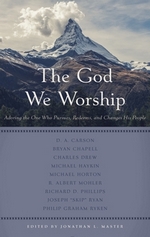
The God We Worship edited by Jonathan L. Master

The God We WorshipThe God We Worship: Adoring the One Who Pursues, Redeems, and Changes His People

by Jonathan L. Master, ed.

eARC, 192 pg.
P & R Publishing, 2016

Read: May 15, 2016

…something basic to every person— religious or not, atheistic or theistic. Everyone is wired to worship. We are always worshiping. We never stop. You are worshiping right now. You may be worshiping wrongly, but you are worshiping. We can’t help it— God built us that way. We are always giving our hearts and our hopes to someone or to something— a leader or a relationship, a job or a future success. The question for you and me is: what or whom are you worshiping right now? Is that object of worship good enough and wise enough and strong enough to bear the weight of your life?

Those questions by Charles Drew sum up the focus of this book. Who or what is the focus of/recipient of our worship?

Most books on worship focus on the how, the why, the “style” of worship — but this collection of essays (formed from addresses at the Philadelphia Conference of Reformed Theology over many years) thinks of it in different terms — Who is The One we worship? What’s He like? Why does He want us to worship?

Jonathan L. Masters took a break from podcasting (and, I assume, other things — but I only know the podcast) to edit and compile these essays from such notables as: D. A. Carson, Bryan Chapell, Charles Drew, Michael Haykin, Michael Horton, R. Albert Mohler, Richard D. Phillips, Joseph “Skip” Ryan, and Philip Ryken.

As a collection from various years, there’s some repetition of texts considered, no controlling theme (outside the title), and a lack of purposeful connection between the individual chapters. Also, there are variations in quality between the pieces. And Dr. Mohler just doesn’t seem to fit in tone or content to the rest. Not that there was anything terribly wrong about his chapter, it just didn’t seem to match up. Whereas Dr. Phillips reminded me (he showed up twice in these pages) how much I find him compelling to read or listen to.

All the authors bring a nice mix of theology, devotion, and encouragement as they try to remind us of the character and nature of the God we worship. Each chapter is easily accessible to any reader who wants to put in a minimal effort. Even the essays that didn’t engage me immediately ended up winning me over (again, except Mohler’s).

Phillip Ryken reminds us of the place of theology in our worship — not to the side, or relegated to some dark corner. On the contrary, our worship is theological, and the two inform each other.

Do you know what the Israelites did when the Egyptians finally were destroyed? They didn’t stand on the shores of the Red Sea arguing about the sovereignty of God, worrying about reprobation or its fairness. They glorified God because they had seen how glorious he was, not only in the mercy that he had shown to them, but also in the condemnation of sin and the way that he had brought justice. They were not trying to defend the sovereignty of God; they were simply celebrating it: “I will sing to the Lord, for he is highly exalted. The horse and its rider he has hurled into the sea. The Lord is my strength and my song; he has become my salvation” (Ex. 15:1–2 NIV).

. A solid collection of essays reminding us of who our focus is to be on — The God We Worship. Whether you read this a chapter or two a day on the Lord’s Day, or in one big sitting — this is a book that will help you remember that we are to glorify and enjoy Him forever.

I received this eARC from the good folks at NetGalley in exchange for this review.

—–

3 Stars

God’s Glory Alone—The Majestic Heart of Christian Faith and Life by David VanDrunen

God's Glory Alone—The Majestic Heart of Christian Faith and LifeGod’s Glory Alone—The Majestic Heart of Christian Faith and Life: What the Reformers Taught…and Why It Still Matters

by David VanDrunen
Series: The 5 Solas Series

Paperback, 171 pg.
Zondervan, 2015
Read: March 6, 2016


VanDrunen begins by discussing the Reformers’ emphasis on the Glory of God and the way that impacted the movement, its concerns, goals and means. I don’t recall being struck by any particular insights here, but it was a pretty worthwhile overview.

The strongest section was Part 2, where VanDrunen considered the Biblical teachings on God’s glory. How God’s glory was manifested in the cloud during the Exodus and following, then how the Incarnation of the Son displayed His glory. Finally, he considered the glorification of God’s saints and how that leads to God being glorified. This part could have been more detailed and more extended to greater effect and use if you ask me, but it was a good start to one’s own investigation to the topic.

In Part 3, “Living for God’s Glory Today,” VanDrunen seeks to apply these thoughts to our daily lives — which sadly, was the weakest part of the book. He had a lot to say about the way that smartphones/social media/the Internet is affecting our minds/attention spans and therefore the way we act in worship/respond to the preached Word, etc. — and on the whole, his comments were probably sound, but the way he 1. presented his case, 2. dwelt on it, 3. kept beating this equine after it had expired made him seem like a cranky Luddite rather than a thoughtful teacher with pastoral concerns.

He did however, use Rebecca Konyndyk DeYoung’s material on Vainglory from her book, Glittering Vices (and her book on Vainglory in particular) in a much more interesting way than she did — so that’s a plus.

In the end, it really didn’t do much for me, but was solid enough to recommend. A pretty easy, if sometimes dry, read (hard to imagine that this subject would lend itself to a dry book). I’m still planning on getting the rest of the series, hoping the other authors give something more engaging.

—–

3 Stars

Confessions of a Clumsy Christian: Unqualified by Jennifer Wilson

Confessions of a Clumsy Christian: UnqualifiedConfessions of a Clumsy Christian: Unqualified: Honest Answers to Real Questions About Being Good Enough for God

by Jennifer Wilson

E-book, 89 pg.
2016

Read:February 7, 2016

This was a tough one for me to write — in fact, I think I spent at least twice as long deciding what to write and then writing this as I did reading the book.

Jennifer Wilson had the kind of past that many of us have had — false starts with faith, personal problems, family problems, addictions, job woes, etc. — struggling from time to time with trying to be good enough to become a Christian — at some point, she realized she couldn’t and that God didn’t want someone who was good enough (who could be?), but someone “unqualified” to be a Christian. She talks about some of her problems, doubts and fears both before and after her conversion, in an effort to reassure others that “qualified Christians” just don’t exist.

Let’s get the easy stuff out of the way: Wilson writes in a charming, engaging manner — pleasant, breezy, conversational. This makes the book a quick and easy read — sometimes deceptively so, considering the topics covered. She comes across as very open and honest, very genuine.

There were plenty of typos and grammatical mistakes in the edition I read — none were too distracting, though, so you could get past it. You almost have to forgive the mistakes in the midst of an author telling you how often she has and continues to fail in various areas.

There are plenty of books I shouldn’t write — for example, novels that are supposed to go anywhere beyond the NaNoWriMo word count verification; books on care of felines; diet books — 2 of these may change in time, my fiction could improve or I could get in shape. If either happens, I’ll write those books. And at some point, Jennifer Wilson may be ready to write this book. She states, over and over again that she’s a new Christian. At one point, she describes herself as “barely an apprentice Christian.” I have to ask, why is she writing a book about it then? I’m not saying she shouldn’t ever — but maybe she should get some roots down. She wants to write about her past? Her coming to faith? Her struggles as a new Christian? Fine — more than fine, she’s helpful. But when she goes further than that, she gets herself in trouble.

John Murray once wrote, “The difference between truth and error is not a chasm but a razor’s edge.” I fear that Wilson spent so much time walking down the razor’s edge she must have really cut up her feet. For example, she advised a friend, “[God] is in pain, watching you, His precious daughter, suffer so much.” I don’t see any biblical writer speaking of God in this way. She writes, “God, my heavenly father, doesn’t want me, His daughter to suffer in pain.” Please tell that to Joseph, Job, Paul, and Jesus for starters. The Epistles are replete with instructions about suffering, about the purpose of suffering, of rejoicing in our suffering. I have to wonder, what God is she talking about?

Wilson’s clear that she doesn’t know the Bible very well — that right there should give her pause before weighing in on Biblical concerns, no?

I know she’s trying to be amusing in her writing — and she usually succeeds — but I think a little more care surrounding God, His works, and the ways He’s revealed Himself would be helpful. Self-deprecating humor, humor at the apparent vicissitudes of life, absolutely fair game. But there are some things that we ought to treat reverently even in the midst of irreverence.

There is a lot to be commended about this book — particularly when she describes her own struggles past and present. But the solutions suggested are frequently problematic, when not downright unbiblical. It’s written-well enough, I’m just pretty sure it shouldn’t have been written at this time. I wish Wilson’d waited until she was past the apprentice stage to write this. I’m not just saying that, I want to like this book — I’d like to recommend it to others, but I just can’t. Aimee Byrd (not just her, but she’s a good starting point) has been writing recently about the deplorable nature of Christian books marketed for and by women, sadly, this book is evidence that she knows what she’s talking about.

Disclaimer: I was given a copy of this book by the author in exchange for an honest review. She probably had something else in mind.

—–

2 Stars

Songs of a Suffering King by J. V. Fesko

Songs of a Suffering KingSongs of a Suffering King: The Grand Christ Hymn of Psalms 1–8

by J. V. Fesko

Kindle Edition, 123 pg.
Reformation Heritage Books, 2014

Read: January 17, 2016


This is a “small survey” (his words) of the first 8 Psalms, looking at them as testifying of Christ — His experiences, His heart, His prayers, His praise. Fesko doesn’t ignore the original author or context, but his focus is reading them through the filter of John 5:27/Luke 24:27. With that filter, it’s easy to see how the first 8 Psalms (as a microcosm of the Psalter as a whole) testify to Jesus Christ.

This book was just “oooohkay.” Maybe I came in with too high of expectations. I get that Fesko was writing for a more popular audience than some of this other work — but this seemed very shallow. There wasn’t a whole lot to sink my teeth into. I’m glad he made this material very accessible — it’s the kind of thing the Church needs more of. I’m just afraid he didn’t hit the right balance of content and ease of understanding.

The content was good, I do think each chapter helped me understand the Psalm in question a little better (more than that at least twice). The conclusion is very strong — probably the best chapter in the book. I just wish he’d brought some of that strength to bear on the earlier chapters.

The book contained some great insights, but it was primarily surface-level material. I just wanted more from the book. Maybe I wanted too much, but I don’t think so. There were a couple of “wow!” moments for me that lead me to rate this at 3-stars rather than 2 1/2 (but if he’d developed those ideas for more than the one or two sentences he gave them I’d have gone with 4). It’s a nice, quick easy read with some good devotional material, but it could’ve been more without making it too technical.

—–

3 Stars

Do More Better by Tim Challies

Do More BetterDo More Better: A Practical Guide to Productivity

by Tim Challies

PDF, 114 pg.
Cruciform Press, 2015
Read: December 11 – 12, 2015


Abraham Lincoln reportedly said about someone’s book, ” People who like this sort of thing will find this the sort of thing they like.” If it were chronologically possible, he might have been talking about Do More Better. I am not the person who likes this sort of thing, but I have profited from reading some productivity-improvement books — this does not fit into that category. Could it help some people? I don’t see why not, but there’s a lot of people who won’t see their lives fitting into his mold (count me as one of them).

But honestly? I was turned off by the book before he started the practical section. I’m not going to give a detailed analysis, this isn’t the type of blog to do that, but I can give a thumbnail.

The first few chapters, the theory, or groundwork for his productivity guidelines are pretty questionable. Despite Challies’ proof-texting, I’m not convinced that any apostle or prophet encouraged anything along these lines (you could make the case that Solomon’s Proverbs could be used to these ends, not that I see Challies appealing to them). It looks so much like the kind of schemes we Americans (and, I suppose, Canadians) like — if I just do X, Y and Z, I can be whatever I want to be. If I eat all my veggies, especially the gross tasting ones, I can grow up big and strong. If I implement Method Q with Style R and Teaching S on a consistent basis, I’ll have well-adjusted, successful kids. And so on.

Chapter 5 on are so programmatic, so specific to his own scheme, that it’s restrictive (I’m sure he’d argue these aren’t hard-and-fast rules, only guidelines, but to implement them as he suggests, you’d pretty much have to treat them as hard and fast for however long it takes to set them as habits). I’d spend so much time for the first few weeks with his book in one hand and my Galaxy Note in the other, just making sure I was doing what I was supposed to be doing as far as my Tasks, Calendar and Information were concerned — even before my weekly Reviews. How would I get anything else done? Good question. As an example — I’ve been an Evernote junkie for 4 years now (this was composed on Evernote), but to use it the way he wants me to would take a focused readjustment.

Lastly, this is the kind of book that can only be produced in the affluent West. More than one author/speaker has talked about “The Cave Test” when it comes to evaluating worship “styles” — if it can be duplicated in a cave while meeting in secret, it’s fitting for Christians. While reading this, I wondered just how many countries (or parts thereof) in this world, where practicing Challies’ principles would be possible. The fact that a large percentage of the Church could not (and has not) been able to think in these terms — much less put this into practice — says a lot about their role in the Christian life.

I suppose I should say something about the writing — it’s certainly competent, clear and succinct. But it’s not at all interesting. Can you write about productivity/time management/etc. in an interesting, even entertaining fashion? Sure — see Chris Hardwick’s The Nerdist Way (not at all Rated G) as one example — but that’s not saying you have to. I don’t need to be entertained every second of the day, but if you want me to stay with a book (even a short one), you need to be more interesting than my microwave’s Instruction Manual. This was just so bland it was hard to keep focused.

I’m not suggesting that no one read this book, if reading the product description makes you think it could help you, I’m not going to argue. But I’m certainly not going to to suggest anyone go out and grab a copy — or even to borrow one. Do I think it’d be better if he removed his purported theological underpinnings from this? Yes. I’m also convinced it wouldn’t make a lick of difference to Chapters 5-10 in application (which speaks volumes).

—–

I received this book from the kind people of Cruciform Press for this review, I hope they don’t regret it.

—–

1 1/2 Stars

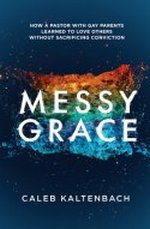
Messy Grace by Caleb Kaltenbach

Messy GraceMessy Grace: How a Pastor with Gay Parents Learned to Love Others Without Sacrificing Conviction

by Caleb Kaltenbach
Trade Paperback, 203 pg.
WaterBrook Press, 2015
Read: December 6, 2015

Straight off, I could tell Mr. Kaltenbach and I approach things very differently. There is a looseness to his language that I can’t tolerate on theological matters — I, like the noted Richard Rogers, serve a precise God*, and it gives me hives to read people who don’t — though I readily acknowledge (and lament) that he’s speaking in the Evangelical Vernacular. By page 5, I was grimacing at his phraseology. Particularly his use of “messy” and it’s connection to grace, and his insistence that there’s a “tension” between grace and truth — but I’ll return to that in a bit.

The first few chapters outline the problems between the perceived (and, sadly, sometimes real) destructive attitudes of Christians towards LGBT people and the perceived (and, sadly, sometimes real) combative stances and attitudes of LGBT people towards Christians. Kaltenbach illustrated this with episodes from his own childhood and what he’s seen in the pastorate. Sadly, he’s too impressed with generalizing from his autobiography (it’s not a totally improper strategy, but Kaltenbach doesn’t bring in anything to buttress his arguments). He also displays an over-reliance on platitudes and catch-phrases. Worst of all, he’s good at using stereotypes and generalizations when calling for those he’s stereotyping/generalizing to stop stereotyping and using generalizations about LGBT people.

I admit I was thoroughly annoyed with him by the time I got to chapter 6, when he (largely and temporarily) put aside the anecdotes and actually got around to explaining the Scriptural view on the topic at hand by brief glances at various texts, responses to critics, and so on. Could this chapter have been better? His explanations less open to criticism by theological opponents? Yes. That said, it was pretty good — and a very good introduction to the ideas he offered (his “More Reading” list at the end of the book contains much that would do a better job on this point).

I have several reservations and problems with Kaltenbach doctrinally and theologically. Actually, despite frequent use of the word “grace,” I’m not sure what he means by the term, but I’m pretty sure it’s not what the biblical writers mean by χαρις. In a fallen world, plagued by sin (a term Kaltenbach avoids), the favor of God, the goodwill of God towards undeserving sinners because of Christ’s work on their behalf (my quick and dirty definition of grace) will be messy, it will be found in messy situations with messy people — because there are no other kinds of people. Calling grace “messy” is like saying it’s “undeserved.” There is no other kind. Kaltenbach also spends a good deal of time talking about a tension between grace and truth, and I don’t see that where he locates it in the Scriptural witness, or anywhere else. In fact, throughout the Old and New Testaments, the two go hand in hand.

Both his dependence upon the Pericope Adulterae (John 7:53-8:11) for his approach to those who differ from him and his indictment of Imprecatory Psalms make me worry about his view of scripture. I can’t help but wonder, built on such an unstable foundation, how much of Kaltenbach’s arguments can stand.

That said, from Chapter 6 on, there is little I flat-out disagreed with — the differences ranged from minor quibbles to exceptions — but he said nothing that I’d say was entirely wrong or baseless, and I could appreciate what he said and where he was coming from. Both his understanding of the biblical teaching on sex, and the way that Christians should interact with, think about, and treat those with whom they disagree on sensitive issues is commendable and spot-on. As this is the point of the book, however sloppily he goes about it, I have to like that.

It’s a good 101 book (maybe a 080?), but one should grab his “More Reading” list and work through it — Champagne Butterfield’s book would be the best to start with if you like the memoir aspect of this book.

* If you’re unfamiliar with the story, see DeYoung’s quotation of Packer here.

—–

I received this book from the ever-so-nice people at Blogging for Books for this review.

—–

3 Stars

Heaven on Earth by Thomas Brooks

Heaven On EarthHeaven On Earth

by Thomas Brooks

ebook
originally published 1654
Read: May 11 – 25, 2014

I just might have myself a new favorite Puritan (I’m not the only one who has a list, right?). I’m kicking myself for not getting to Brooks earlier in life. What a wonderful book — I’m looking forward to getting to read more by him.

Aesthetically, this is fantastic. The language sings — the book begs to be read aloud (and I frequently did so, interrupting whatever anyone around me was doing). You can feel the passion, the fervor throughout. A few paragraphs from different chapters illustrate this:

Divine light reaches the heart as well as the head. The beams of divine light shining in upon the soul through the glorious face of Christ are very working; they warm the heart, they affect the heart, they new mold the heart. Divine knowledge masters the heart, it guides the heart, it governs the heart, it sustains the heart, it relieves the heart. Knowledge which swims in the head only, and sinks not down into the heart, does no more good than the unicorn’s horn in the unicorn’s head.

The only ground of God’s love is his grace. The ground of God’s love is only and wholly in himself. There is neither portion nor proportion in us to draw his love. There is no love nor loveliness in us that should cause a beam of his love to shine upon us. There is that enmity, that filthiness, that treacherousness, that unfaithfulness, to be found in every man’s bosom, which might justly put God upon glorifying himself in their eternal ruin, and to write their names in his black book in characters of blood and wrath. God will have all blessings and happiness to flow from free grace.

Faith is the first pin which moves the soul; it is the spring in the watch which sets all the golden wheels of love, joy, comfort, and peace a-going. Faith is a root-grace, from whence springs all the sweet flowers of joy and peace. Faith is like the bee, it will suck sweetness out of every flower; it will extract light out of darkness, comforts out of distresses, mercies out of miseries, wine out of water, honey out of the rock, and meat out of the eater, Judg 14:14.

But beyond that, the book is sound, it is orthodox, it is Biblical — throughout Brooks points the reader to The Book and The One Who inspired it. His aim is to show “that believers may in this life attain unto a well-grounded assurance of their everlasting happiness and blessedness.” He then goes on to examine the nature of that assurance, hindrances that keep believers from it, reasons to encourage believers to seek it, and how they can go about it, the difference between true and counterfeit assurance, as well as answering questions about assurance. Examining the doctrine from so many angles, you really feel (and probably do) that you come away from this book having an exhaustive look at the doctrine.

Chapter 6 — which takes more than its fair share of space, almost half of the book — is an extended detour from the point of the book, but it still serves to support the theme. He begins by saying, “In the previous chapter, you saw the seven choice things which accompany salvation. But for your further and fuller edification, satisfaction, confirmation, and consolation, it will be very necessary that I show you,” these seven choice things. Which are:

(1.) What knowledge that is, which accompanies salvation.
(2.) What faith that is, which accompanies salvation.
(3.) What repentance that is, which accompanies salvation.
(4.) What obedience that is, which accompanies salvation.
(5.) What love that is, which accompanies salvation.
(6.) What prayer that is, which accompanies salvation.
(7.) What perseverance that is, which accompanies salvation.

It is such a great chapter, and would make a remarkable little booklet unto itself that I really can’t complain too much that it’s such a departure from the rest of the book (though it did take me a little bit to get used to the notion).

Banner of Truth puts this out in paperback, monergism.com puts this out as a free e-book. Either way you go for it, this is a treasure I heartily suggest you grab.

—–

5 Stars

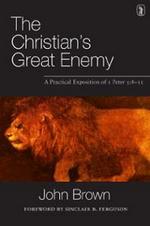
The Christian’s Great Enemy: A Practical Exposition of 1 Peter 5:8-11 by John Brown

The Christian's Great Enemy: A Practical Exposition of 1 Peter 5:8-11The Christian’s Great Enemy: A Practical Exposition of 1 Peter 5:8-11

by John Brown

Paperback, 86 pg.
Banner of Truth, 2013
Read: June 1, 2014

Good, solid exposition of 1 Peter 5:8-11. No fireworks here, but plain, straightforward language — no rhetorical heights, no dazzling quotations, just straight-forward, orthodox discussion of the passage.

Brown calmly and thoroughly starts at the beginning of the passage and proceeds carefully, clause by clause through it. He doesn’t go off on any paranoid hunts for demons/Satan under every rock or anything. But he examines the ways of the world and the hearts of man and shows where the evil one will and can pounce — and how he will go about doing so. From there, he moves on to the hows, whys, and wherefores of our resistance — giving warnings, inducements, and encouragements to help along the way.

I can’t say I was dazzled by Brown’s work, but I was refreshed by it. I was reminded of my duties and pitfalls along the way. If you’re looking for sound teaching on the passage/topic but are intimidated by (or have no time for) Satan’s Temptations by Gilpin or The Christian in Complete Armour by Gurnall, this would be a great one to pick up.

—–

3.5 Stars

John Knox by Simonetta Carr, Matt Abraxas (Illustrator)

John KnoxJohn Knox

by Simonetta Carr, Matt Abraxas (Illustrator)
Hardcover, 64 pgs.
Reformation Heritage Books, 2014
Read: May 25, 2014

I’m tempted to say, for a children’s book, this is quite good. But honestly? For a brief biography for any reading level, it’s quite good.

In these pages we get a good picture of Knox’s life (public and private), his historical context, and his teachings/beliefs. Essentially, everything you could want. There’s excitement, there’s hardship, there’s triumph and there’s tragedy. This isn’t a hagiography — Carr isn’t afraid to point out weaknesses, or problems with Knox (although she could’ve gone a little further in that direction). Nor is this all sweetness and light, as you might expect from a children’s book. While not dwelling on the details of the violence in Knox’s Scotland, she doesn’t sweep it under the rug, either.

The illustrations are great — the map, the photos and historic portraits are as well. Abraxas does a really good job in making his illustrations pop — but not to the degree that they become the focal point. The text carries this book, but the illustrations aid the text, as it should be.

Assuming this is a representative sample (and, based on a couple of interviews I’ve heard with Carr, I think it is), this is “Christian Biographies For Young Readers” series to get for anyone with kids. Or anyone just wanting small biographies to teach them Church History without having to wade through a tome like Shelley or González.

—–

4 1/2 Stars

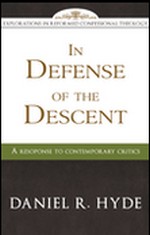
In Defense of the Descent by Daniel R. Hyde

This is the first book of a series edited by Daniel Hyde and Mark Jones called, “Explorations in Reformed Confessional Theology.” Although I haven’t read it, I’ve heard an interview with the author of the second book in the series. Based on that interview and this book, the only thing I can say is, “Where’s the rest of the series?”

—–

In Defense Of The Descent (Explorations In Reformed Confessional Theology)In Defense Of The Descent

by Daniel R Hyde

Paperback, 88 pg.
Reformation Heritage Books, 2010
Read: April 27, 2014

Wow. Hyde crammed a lot of history and theology (and history of theology) into these 74 pages! This book could’ve easily been another 50 pages longer if he’d taken the time to fully flesh out some of these points. But the book isn’t lacking because he didn’t do that — not at all. It’s just concentrated, a double shot of espresso instead of the grande drip it could have been.

We may like to think our generation (or so) is the first to be enlightened enough to have qualms with the clause in The Apostle’s Creed, “He descended into Hell,” but that’s just not the case. It’s a centuries-old controversy, and each time the orthodox response has been, “keep the descent,” and Hyde sees no reason to change that.

Hyde examines 6* possible interpretations of the phrase — from the ridiculous (and heretical) to the orthodox. While his critiques of the more lacking views are helpful, he’s at his strongest when he’s giving a positive presentation. When Hyde explains the Reformed and Presbyterian view of the descent clause — first as expressed by the Westminster Larger Catechism (Q. 50), and then as expressed by the Heidelberg (Q. 44). At this point Hyde interacts with a variety of Reformed theologians and catechisms to fully explain the perspective — all very helpful.

Other highlights are his careful examinations of Ephesians 4:7-10 and 1 Peter 3:18-19 (used to support some explanations of the clause) and the four benefits to retaining the clause — a very pastoral section.

It’s short, sweet, to the point. For the believer who feels strange every time they confess “He descended into hell,” Hyde helps you understand just what you’re saying, so next time that clause comes up you can boldly and confidently confess that it is just what you believe.

—–

* 5, really. Two of them are just flip-sides of the same explanation.

—–

4 Stars

Page 30 of 32

Powered by WordPress & Theme by Anders Norén