

Category: Theology/Christian Living

The Masculine Mandate: God’s Calling To Men by Richard D. Phillips

The Masculine Mandate: God's Calling To Men
The Masculine Mandate: God’s Calling To Men by Richard D. Phillips
My rating: 3 of 5 stars

A few years ago, I spent a couple of weeks staying with a friend in South Carolina. His church didn’t have an evening service, so he would frequently attend the church pastored by Richard Phillips, and he took me along that first week I was there. He preached on the role and duties of husbands from Ephesians 5 — I don’t remember much about the sermon, most of his points have been incorporated into the rest of the sermons/books/expositions I’ve heard/read on the passage. I do remember how humbled, convicted, and challenged I felt afterward. My friend told me on the way home that we were going back the next week for sure, because after all that directed at him, his wife needed to get preached at the same way (as I recall, instead of hitting wives with both barrels like he did husbands, Phillips only gave them one barrel and used the other one at husbands again).

The Masculine Mandate wasn’t as convicting or powerful as that sermon was (books seldom are, if you ask me) — but it was definitely in the same vein. The Mandate that Phillips focuses on is God’s purpose of the first man (and through him, all others descending from him) in Genesis 2:15, “The Lord God took the man and put him in the garden of Eden to work it and keep it.” His primary concern is to show how contemporary man can and should “work” and “keep” in every sphere of life, yet this book is very Gospel-centered, and he makes it clear that the only way to achieve this mandate is via Ordinary Means-enabled sanctification.

The initial chapters developed these doctrinal points to provide a foundation for the practical chapters. While I thought he was spot-on with his teaching, and frequently insightful, I did wonder why he picked the particular passages he built these chapters around, and why others were excluded, don’t get me wrong, I’m not suggesting that he dodged passages/topics — not at all. All in all, Phillips did develop his teaching on “work” and “keep” enough that when he moves to the more practical chapters, the reader is prepared to see the application of doctrine, not just a list of “do’s.”

Like any good preacher, Philips uses Biblical examples and exemplars throughout to illustrate his points. For example, Boaz is shown as the husband model we should aspire to. And a particularly strong and convicting chapter is about using John the Baptizer as a model for a servant attitude. This put some flesh to hid teaching beyond sound thinking and his own experience.

He spends more time on the role of man in marriage than in anything else — fittingly enough — and much of it echoes what I probably heard in that sermon years ago. He covers topics familiar to many, without being stale — he even finds fresh insight (or at least it doesn’t seem stale) in the well-worn territory of comparing storge/eros/philo/agape. Speaking of man as protector (as part of keeping) in the marriage, the idea that struck me most profoundly is that, “The main threat against which a man must protect his wife is his own sin.” That’ll keep you up at night.

From marriage, he moves on to speaking of working and keeping as father, friend, and church member (a good chapter that could have been made better if he included more on what we unordained should do, as there are many more of us than the ordained).

A helpful book, a thoughtful — and thought-provoking book. Not the last word on the subject (not intended to be, either). But well worth the time and attention of a man seeking to live according to biblical mandates.

Christ Of The Bible And The Church’s Faith by Geoffrey Grogan

Christ Of The Bible And The Church
Christ Of The Bible And The Church by Grogan, Geoffrey
My rating: 2 of 5 stars

It’s tough to know what to say about this, it’s a wholly carefully-written, exhaustive, entirely orthodox look at Christ as set forth in Scripture and in the doctrines of the Church. It’s an apologetic for the Faith once delivered as well as an explanation of it.

However, wow. It just didn’t work for me at all. The points I liked, I’ve seen better developed, better explained elsewhere. His most evangelical moments seemed half-hearted and perfunctory (although I don’t think they were, it just struck me that way). He is far too concerned with unbelieving scholarship, and does not respond to critics with as much force and thoroughness as he ought. There’s just doesn’t seem to be much heart to this work.

Your results may vary, certainly any book carrying the cover blurbs on it that this does would catch my eye, and I’d expect to be well worth the time, but this just didn’t work for me.

Dusted Off: Summer Reading: Getting the Gospel Right by Cornelis P. Venema

I’ve been waiting for Dr. Venema’s book on the New Perspective for quite some time, and was quite excited to see Getting the Gospel Right in the latest BoT flyer–and my wife could probably testify to my outraged yell when I saw the page count. “This is what we’ve been waiting for?!?!” 112 pages? Bah.

But at GA, Dr. Venema spoke during the MARS luncheon (very tasty, btw) and said two things that made me feel better about the book. 1. They’d brought some for commissioners to purchase at half-price and 2. This book was sort of a teaser for a longer, less popularly written work to come out in the fall. Yay! So I picked up a copy 🙂 I wouldn’t let myself spend any more money on the way home for another novel, so I kept this out of the suitcase so I could finish up the trip with it–figured a popular-level book based on material I’ve read would be just the thing for 10 pm after a long day of sitting in airports/flying–and it was.

As I said, the material in the book is based on articles that Dr. Venema had written previously (which I found very helpful) and you can probably get the heart of it in the lectures he delivered at Denver’s Providence OPC last year (go listen!)

That said–good book. Carefully written and crystal clear in its presentation–both positively and negatively. A great place to start. Or if you’ve already started, and then let yourself get stale on some of the issues, good way to kick start the ol’ gray matter.

Dusted Off: Almost as Handy as The Hitchhiker’s Guide to the Galaxy

But the last thing that would apply are the word’s “Don’t Panic” in large, friendly letters on the cover. A Field Guide to Evangelicals and Their Habitat by Joel Kilpatrick (whom you know from Lark News: A good source for Christian news) is quite the handy guidebook. The premise is fairly straightforward, and can easily be figured out from the title. It’s a very funny satirical introduction to the strange North American creature called the “evangelical.”

We’re told how to recognize Evangelicals in the wild, what kind of fun they have, how they worship (priceless), how they mate, how they educate their young, etc. It also includes a handy glossary of Evangelical Terms–and of course, the words to Footprints and The Legend of the Sand Dollar. Absolute must have’s to understand Evangelicals.

As with all satire, there’s some parts that really miss–but there are parts that are direct hits. Overall, it’s well worth the time worth several chuckles–and the occasionally out-loud laugh.

It’s really best to not read this book straight through. The humor wears a bit thin if you do, actually gets grating. Take it in bits and pieces here and there, and it’ll stay fresh.

Oh yeah, if you don’t appreciate the humor in Credenda/Agenda–skip this. Kilpatrick’s satire isn’t as sharp (his tongue is more blunt, not serrated), but while it’s not the same style, it is the same genre.

(H/T to kletois for pointing out that my original title was garbledygook)

Dusted Off: Quick Shot: When Grace Comes Home

No energy to do a bigger review. But this is a book to get. Basically, it’s purpose is to answer the big “So What?” question regarding the Doctrines of Grace. What difference does Calvinism make to the way you live? How does it effect your prayer, your assurance, your sanctification, the way you look at evangelism or adversity? The chapter on “Law & Liberty” is better than many books written on either subject. Good read. Easy read. Powerful read. Haven’t seen my wife this into a book not written by J. K. Rowling in years.
My pal, Mark Gibson (or whoever writes the “Book of the Month” blurb for his church says:

If anyone is foolish enough to think that theology, particularly Calvinistic theology, is impractical, he needs to read this book. And even if you don’t, read it anyway. Terry Johnson has provided a splendid work on how right theology bears upon our worship, character, suffering, witness and growth in the Christian life. This is exactly what the evangelical church needs because, whether evangelicals know it or not, their future as a viable movement depends upon the rediscovery of such God-honoring theology.

Basically, get it and read it.

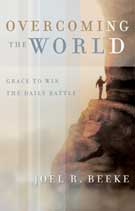
Dusted Off: Overcoming the World: A Review

Joel Beeke is fast becoming one of my “go-to” guys when it comes to contemporary theology, and this book is a stellar example why I’m turning to him faster than “bigger named” Reformed writers. I’ll start with my complaints and then move into the reasons I think any Christian who is not yet completely sanctified should read this book.

There are two drawbacks to this book. The first is that Part Four is addressed to Ministers. And that’s fine, don’t get me wrong. But it’s not marketed that way, it’s marketed for the general audience, not as an expansion on talks he did at a ministerial conference (so it makes sense that one talk would be focused particularly on ministers). It’s not too difficult for a non-minister to find application for their own life in those chapters, but, there’s some real gold that many probably won’t bother to look for since it’s in a chapter about pastors.

Second problem is bigger. Beeke’s attitude toward entertainment: movies, TV, novels, magazines. Now in the aforementioned Part Four, he talks about being careful with worldly entertainment–I have no problem with that and would echo it. But in Part One, he gets overly-specific, IMO, and ends up wandering into “the doctrines and commandments of men” area, neglecting that “God alone is Lord of the conscience” (WCF XX:2). On the whole, I was able to do a little mental edit around those issues and keep his point intact. I may return to this issue in a later blog.

I guess I should mention that the only problems I had with Parts Two and Three were that they were just too convicting.

So on to the good stuff:
The first paragraph of the Preface gives a better summary of the purpose of the book than I could hope to:

Worldliness is destroying the church of Jesus Christ. Christians and churches that fall prey to it lose their saltiness. The time is thus right for us to biblically expose and condemn worldliness, and to promote the alternatives of genuine piety and holiness.

What follows is practical guidance for living that life–what Beeke elsewhere describes as “Experimental Calvinism.”

In Part One: Overcoming the World by Faith, Beeke lays the groundwork: what is worldliness, why we should overcome it, some basic steps in that direction, and encouragement to the task. My complaints about liberty/entertainment come in here, but on the whole it’s well worth it.

Beeke then moves on to a case study in Part Two: Overcoming the World through Piety: Calvin’s Answer to Worldliness. Here we are treated (and I do mean treated) to a survey of the teaching of, and life of, piety in John Calvin, the great Reformer. What does Experimental Calvinism look like? It looks like Calvin. It’s wrapped up in the Church, it’s found in communion with the Lord, it’s found being lived by the believer. This part of the book will encourage you to greater faithfulness, while showing you just what you’re missing.

Part Three: Overcoming the World through Holiness is the heart of the book. He echoes the Biblical stress on “vital, progressive sanctification.”

concretely, then, what must you cultivate? (1) Imitation of the character of Jehovah; (2) conformity to the image of Christ; and (3) submission to the Holy Spirit.

While this section does mention particular sins the believer needs to beware of, the weight of the material is oriented to the heights we are to scale. It’s here, where we see how far short of the mark we are, that our sins are exposed to a greater degree than they are when he says “watch out for X.” There are many, many wonderful concrete portions counsel here that I want to quote, but I can’t seem to find a decent place to start and stop. Pure gold.

As I said earlier, the weakness of Part Four: Overcoming the World in the Ministry is it’s (stated) focus on Ministers. But the practical advice in private holiness, prayer, communing with God, properly prioritizing your family, dealing with pride and criticism, and motivations to overcome worldliness are worth reading for everyone.

I am in awe of (but not letting myself covet) Beeke’s ability to effortlessly and seamlessly mix quotes/illustrations from Scripture; Puritan/Reformer quotes; contemporary authors; and his own insight and experience into such clean and effective prose. I know it wasn’t effortless gaining that ability, but to see it in action is a pleasure.

Well-written, accessible to a wide range of reader, and addressing a vitally important issue. I cannot recommend this book highly enough.

Ugh…it took a lot longer to read this thing, and to write the review, than I figured. How does Challies do it? hmmmm, lot less TV posts on his blog. Could that be it?

nahhhhhh

Dusted Off: Debating Calvinism

Well . . . had some time to kill in a waiting room today, so I read Debating

Calvinism
. It’s been sitting on my shelf since it was published, flipped

through briefly, but I hadn’t found the time to read it yet. In retrospect,

not sure I should have.

Don’t get me wrong–Dr. White’s presentations and responses were thoroughly

orthodox, and sometimes I could enjoy the replies to Hunt. But by and

large, I didn’t learn anything. Which is fine–I’d like to think that I’ve

got the basics of Calvinism down by now.

So what about Dave Hunt? Well, never thought much of him–especially after

the original radio interview Dr. White did with him, and hearing some of his

teaching leading up to that monumental waste of paper and ink called, What

Love Is This (insert that lahaye quote here–and what a disappointing

century this will be . . . . ), and then seeing the debate with Dr. Pipa.

I’d have thought that following that disastrous book, and only moderately

better debate, I couldn’t think less of Hunt.

WOW! WAS I WRONG!

Ugh. Horrible. Terrible. Horrific.

I will say this . . . I think one of his quotations from Augustine I found

the kernel of the application for my sermon this week. But that’s not what

he wanted me to get out of it, I was supposed to read it and say, “Whoa, I

don’t want anything to do with a system that is at all related to his

terrible thinker.” Oh well . . .

Dusted Off: Truth in Advertising

Well, I got my copy of Debating Calvinism today. And as it ws reported on www.aomin.org recently:

It’s Big, It’s Thick, It’s Sorta Fluffy

“It is thick (427 pages), but it is typeset rather loosely (i.e., considerably less text on a page than most of the books I am accustomed to reading, or writing), hence my description as ‘fluffy.'”

Hopefully I can do more than look at the title page soon . . .

Page 32 of 32

Powered by WordPress & Theme by Anders Norén