Category: YA/MG/Children’s Books Page 14 of 42

Please Return to the Lands of Luxury by Jon Tilton: An MG Tale (in a Dystopian World) About What Matters Most

Please Return to the Lands of LuxuryPlease Return to the Lands of Luxury

by Jon Tilton

DETAILS:
Series: The Lands of Luxury, #1
Publisher: Blueberry Finch
Publication Date: March 21, 2023
Format: eBook
Length: 188 pg.
Read Date: March 22-23, 2023

What’s Please Return to the Lands of Luxury About?

Jane, Timothy, and Rodney are three children living in the community of Yarborough. Yarborough is a small(ish) group of people living on an island of trash. I’m not being metaphorical here—it’s a landmass that serves as a dumping ground for the refuse of the rest of the world (at least a continent). Like the rest of their neighbors, the children spend their days scavenging for things they can use and eat out of the refuse. Robots that run the place provide a daily allowance of water for each resident.

One day Jane finds a doll—almost pristine in condition—the nicest thing she or her friends can remember finding. The boys encourage her to cherish it and take it for her own—but the one who can read tells her that the attached tag says, “Please return to Gloria Thatcher.” It includes an address—in Paradise City, the source of the rubbish they live off of and among.

Jane knows that if she’d lost something so fantastic she’d be heartbroken without it—and she has the means to get it back into Gloria’s hands. She only has to risk her life to escape the island and make it to Paradise City. It seems like the right thing to do—and it shouldn’t take that long, she can probably get it done and be back in time for the next water distribution.

Her friends try to talk her out of it—but they fail. Once they realize she’s gone, they attempt to find and rescue her.

All three of them end up in dangerous situations—for both their physical and emotional well-being—and end up learning a lot about the world they live in.

It’s Dystopian, but Not

Most Dystopian novels are about people realizing the problems in their particular dystopia—or realizing they have the opportunity and ability to fight against those problems. I have nothing against those novels—I have (and likely will continue to) like many of those.

What I appreciate more (at least I think I do…maybe I’ll take this sentence back) is another kind of dystopian novel. The protagonists are sometimes aware the system is rigged, that things could be better. Sometimes, they don’t realize that’s where they are—like the fish who doesn’t realize it’s wet, it’s just life. But they press on, making do with what they have—or making things a little nicer for themselves and those around them—however temporarily. Those seem more realistic, more relatable, you know?

This falls into the latter camp—the people (even the kids) in Yarborough realize that life is hard and that theirs is harder than most. They don’t spend time dreaming of social change, of bettering their station in life, or anything like that. They’re surviving, helping each other, and trying to stay alive—finding joy in little treasures they find and in each other (and in hiding a harmonica from someone who doesn’t know how to play one, but keeps trying anyway*).

* Any parent—including, at one point, my own—can relate to this move. Yes, it’s mean—but it’s merciful to everyone else.

Stand-Alone vs. Series

This is kind of related to the previous point—I was a little discouraged to learn that this is part of a planned trilogy (at least, maybe more). I liked visiting this world and not having any real explanation for how things got to this point. How society evolved in the way it did, how a community emerged on a trash pile that should be bereft of life, what may happen now that some people in Paradise City know that the government and/or company have been lying to them about what goes on on the trash piles, and so on.

Sure, I was mildly curious, but I was more invested in the story than the world.

But now, to tell the story of Jane, Rodney, and Timothy after this book, we’ll need answers to the above—and maybe more—if the story is going to hold up. And I can’t imagine that the answers will make this a more interesting place—or that the following stories will match this one. Also, I’m a little worried that it’s going to end up being preachy—always a danger for books aimed at this audience, and I think the danger is greater in a dystopian world.

I hope that Tilton is able to make me eat my words and that he delivers a satisfying series. But at the moment, this story is enough time in the world for me.

So, what did I think about Please Return to the Lands of Luxury?

My finger is not on the pulse of MG fiction—I don’t know that in the recent resurgence of dystopian fiction (especially on the YA front) if it’s carried over into the MG world too much. I can remember a little bit of it from when I was that young, but I don’t remember my kids reading much like that. So take everything I say about MG dystopian fiction with a grain of salt.

I really liked the way that Tilton presented this world. Sure, there are things I’m not sure are all that consistent. For example, I don’t know how or why Timothy learned to read—particularly as much as he does. I absolutely get why Rodney and Jane can’t. There’s a lot about the culture in Yarborough that I don’t understand—and it’s fine, I don’t need to for this novel. But what we saw was enough. The tech makes sense (both the good and the bad about it), the consumerism seems more realistic than what we see in most dystopian fiction, and so on. And it was all really well communicated to be understood by the target audience.

The characters were great—everyone was well-designed. I liked how the adults in Paradise City were earnest, caring, well-intentioned, and clueless about what they were doing. Given time and a little opportunity for thought, I think the latter could work itself out. They just didn’t have the time to wrap their brains around what was happening in order to be anything other than clueless. But the way they stepped up when presented with the need and opportunity is exactly the kind of thing I like seeing in MG fiction.

It was exciting enough—with good tension (even if it was pretty easy to see who would survive and how—at least for older readers). But as good as the life-and-death material was, the interpersonal relationships were better. It mattered more how Rodney and Timothy got past the mutual offenses than if they lived. I cared more about Jane’s feelings, misunderstandings, and care for her home and friends than I did about the danger she faced—and so on. Tilton did a good job balancing all the aspects of this novel—and majored on the right aspects when he had to make a choice.

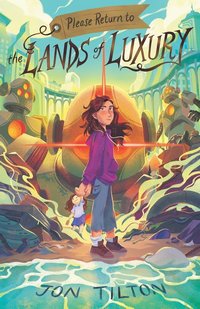
A quick aside—this cover just pops! It feels playful and vibrant, but there’s something undeniably ominous in those robots—so, you know, it matches the book. Sylvia Bi did a great job on this cover.

Misgivings about the next books aside, I’m coming back for them. I recommend Please Return to the Lands of Luxury for adults who find the idea of MG dystopian fiction intriguing and I heartily recommend it to anyone who might be shopping for an MG reader.


3.5 Stars

This post contains an affiliate link. If you purchase from it, I will get a small commission at no additional cost to you. As always, the opinions expressed are my own.


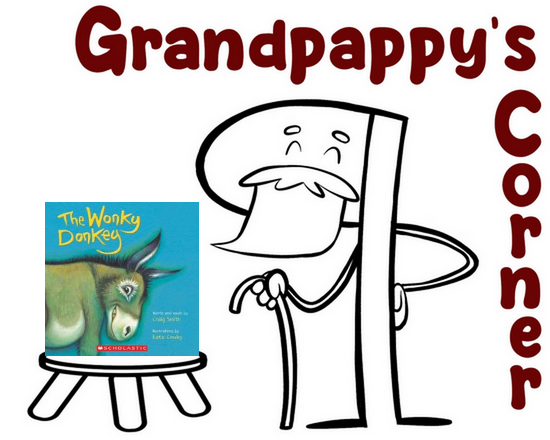
Grandpappy’s Corner: The Wonky Donkey by Craig Smith, Katz Cowley (Illustrator): Tongue-Tying Magic

Grandpappy's Corner Logo

The Wonky Donkey

by Craig Smith, Katz Cowley (Illustrations)

DETAILS:
Publisher: Cartwheel Books
Publication Date: December 29, 2020
Format: Board Book
Length: 21 pgs.
Read Date: March 8, 2023


What’s Wonky Donkey About?

Lifted from the lyrics of a children’s song, the book starts:

I was walking down the road and I saw…
a donkey,
Hee Haw!

And goes on from there to describe this unfortunate equine in more and more detailed (and ridiculous) ways–starting with its three legs, going on to describe its taste in music, coffee consumption, attitude, attractiveness, and so on.

Let’s Talk about the Art for a Minute

Katz Cowley is fantastic. The natural world and physical objects are presented in a great realistic fashion–heightened just a bit. The titular donkey and a bird that shows up in every scene, however, are a goofy cartoonish exaggeration of that fashion

I don’t know who decided to give this donkey a prosthetic leg–but it only comes up in the illustrations, so I’m going to give Cowley credit for it. It’s a great detail on many levels.

The expressions on the bird and donkey are the stars of the show–better than the words (by a crooked hair). I don’t know how a child can look at them and not want to stare. Or not wanting to pick up the book for another reading session.

Especially when a child is the age of the target audience, the adult reading the book is going to see themselves in the coffee-less expression of the donkey on the page talking about the caffeine deprivation. So everyone wins?

You can see some of the art, and learn more about the book, on Cowley’s website.

How is it to Read Aloud?

Ohhh boy. This is going to be hard to convey. First, it was only after I’d read this that I took the time to track down the song, but I couldn’t help but get a sing-songy cadence and voice as I read it. I also found myself talking faster and faster as I went through the book–like there was this unconscious effort on my part to spend the same amount of time reading each pair of pages–like a snowball rolling downhill, growing bigger and getting faster. This is great and all, but it’s also kind of a workout of both stamina and verbal dexterity.

You can’t help having fun with these lines–even as they build up and repeat like the 12 Days of Christmas. Really, try being expressionless or frowny while saying “He was a hanky-panky crank stink-dinky lanky honky-tonky wink wonky donkey.” You can’t, can you?

You might need to start using a spirometer before cracking this thing open though. As fun as it is, you’re going to end up getting requests for encores, and after 2-3 readings in a row, it’s going to lose a little bit of its charm. So keep something else around so you can switch to it for a minute or two before having to come back.

(between you and me, the song isn’t my style. I really hope the Grandcritter doesn’t discover it, because it feels like the kind of thing that’d you’d have to listen to 30 times a day–like that ditty about an infant scaleless predatory fish)

So, what did I think about Wonky Donkey?

A couple of weeks ago, my wife was telling a friend about our prep work for grandkids, including all the books we’re starting to stockpile. Once she got over being aghast that we’d never heard of The Wonky Donkey, she insisted that we fix this. We dutifully complied and it’s either one of the best moves we’ve made or one of the worst (see what I said above about reading it).

Joking aside, this is a great book for the intended age group. I’m going to have to do a deep dive into both the work of Smith and Cowley.

The other thing my wife’s friend told us was to get the board book–and she was right again. Parents/Grandparents/Etc. Do NOT get the paperback or hardcover. If the child(ren) doesn’t/don’t like the book, you’ll have spent too much money. If they do like the book (the more likely outcome), they will destroy it. It’s going to demand the number of re-re-re-re-reads that anything else won’t hold up to it. It’s also going to end up being one of those books a kid is going to carry around with them and flip through themselves–a lot. Paperbacks/hardcovers will not survive the gumming, accidental ripping, deliberate ripping, and overall expressions of toddler love that are so destructive.

I can’t see where this doesn’t become a tongue-tying obsession. The book you know the kid will love, you enjoy (the first few times a day you read it), you end up memorizing without trying to and just hope your lung capacity holds out during. It’s fun, it’s goofy, and it’s the kind of thing you’ll look back on in fondness.


4 Stars

This post contains an affiliate link. If you purchase from it, I will get a small commission at no additional cost to you. As always, the opinions expressed are my own.

Grandpappy Icon

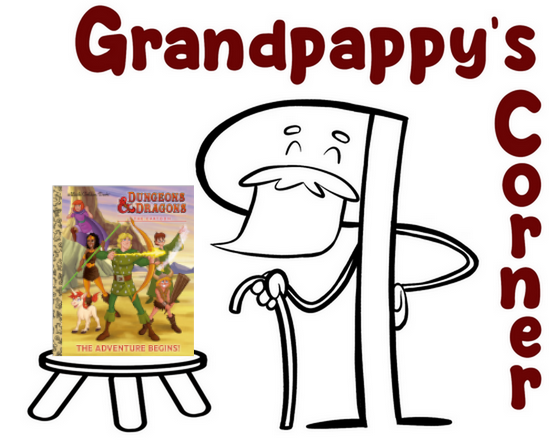
Grandpappy’s Corner: The Adventure Begins! (Dungeons & Dragons) by Dennis R. Shealy, Nate Lovett (Illustrator): Nostalgia for the Adult, an Adventure Story for the Kid

Grandpappy's Corner Logo

The Adventure Begins!
(Dungeons & Dragons)

by Dennis R. Shealy, Nate Lovett (Illustrator)

DETAILS:
Publisher: Golden Books
Publication Date: January 03, 2023
Format: Hardcover
Length: 23 pg.
Read Date: February 8, 2023


What’s The Adventure Begins! About?

This is essentially the Dungeons & Dragons cartoon episode, “The Night of No Tomorrow” turned into a book for the pre-reading/very early reading set. Which is one of the best ideas I’ve come across this year.

For those of you young enough not to be aware of it, for three seasons (only 27 episodes) starting in 1983, there was a Saturday Morning cartoon based on Dungeons & Dragons. On the show, a few friends (and the little brother of one of them) were sucked into a world full of dragons, wizards, unicorns, and other magical things/beings. A small little fellow, calling himself the Dungeon Master, equipped these children with weapons and abilities to keep themselves safe and guided them through the world to try to find a way back home.

This particular book tells the story of them being brought into the world, equipped, and through their first adventure.

Let’s Talk about the Art for a Minute

The art is very much like what I remember from the cartoon—but it seems a little simpler, a little more like the kind of thing you find in a Little Golden Book (not at all coincidentally, that’s what this was). Lovett did a great job of capturing the look of the show and translating it into a book for kids.

Sure, I think people are a bit too smiley in it overall given the subject, but that’s to be expected for this kind of book, so I’m not complaining. Basically, it’s everything a guy could hope for.

There are some samples on Lovett’s website, in case you want to check them out.

How is it to Read Aloud?

It’s a little wordier than most of the Children’s Books that I’ve been playing around with lately—it’s got a better story, and some heft to it (for what it is). I think this is the kind of thing to read to an older toddler (also, the pages are very easy to tear, so keep it away from those who want to taste their books).

It’s not the most verbally-engaging read—but at the point where the reader is transitioning into stories, you’re not looking for fun rhymes and goofy things to say, you’re looking for a simple story. And that’s what’s delivered here, with good art to support that. I’m really looking forward to reading this to an audience in the near-future.

So, what did I think about The Adventure Begins!?

I was on the homepage of a certain online bookseller and this cover was shown under the heading, “You might like” (or words to that effect). It seemed too good to be true—a Little Golden Book take on this show? I put it in the shopping cart without further reflection.* I was a big fan of the show back when it was on, and have often wished that there were more episodes. Somehow, back when they aired reruns of all animated shows so frequently, I don’t think I ever saw this particular episode. So getting to see the friends get into this world for the first time was a little bonus for me.

* Maybe I checked out the price. Hopefully, I checked the price first. If my wife asks, I absolutely did.

Do you need to know the show to appreciate this? Nope—which is good, it’s not streaming and the DVDs are cost-prohibitive.* The grandcritter’s dad has had no previous exposure to the show and liked the book (which is good, I got it as a way to introduce the critter to their dad’s hobby). I doubt we’ll get it, but I’d appreciate a couple of sequels—the title does say “Begins,” after all.

* Yes, I went looking as soon as I saw this book. I might have even scoped out action figures for the cartoon, which are not as cost-prohibitive.

This is a fun age-appropriate story, a nice nostalgia-hit for people of a certain age, and full of eye-grabbing art. I’m glad the store’s algorithm decided I needed to see it.


3 Stars

This post contains an affiliate link. If you purchase from it, I will get a small commission at no additional cost to you. As always, the opinions expressed are my own.
Grandpappy Icon

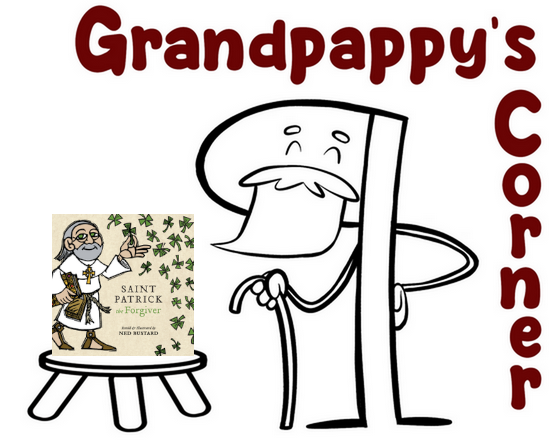
Grandpappy’s Corner: Saint Patrick the Forgiver by Ned Bustard: Patrick’s Story Told for Wee Ones

Grandpappy's Corner Logo

Saint Patrick the Forgiver:
The History and Legends of Ireland’s Bishop

Written and Illustrated by Ned Bustard

DETAILS:
Publisher: IVP Kids
Publication Date: February 21, 2023
Format: eARC
Length: 32 pg.
Read Date: February 17, 2023
Support Independent Bookstores - Visit IndieBound.org

What’s Saint Patrick the Forgiver About?

Drawing on both legends about him and Patrick’s Confessions, this book tells the life story of Patrick of Ireland for the youngest set.

It starts off with his childhood and touches briefly on his period of slavery before moving into his return home and the call to Ireland. It doesn’t gloss over the hard parts of his life, but it doesn’t dwell on them, either. The focus is on Patrick forgiving those who wronged him, spreading the gospel—and even teaching the Trinity via the shamrock.

The book even covers some of the myths that arose around Patrick—baptizing a giant, driving out the snakes, etc.—working that in seamlessly with the book and not distracting from the main point.

Let’s Talk about the Art for a Minute

This art is great—it’s friendly and cartoonish, with great colors and details. Bustard also weaves in traditional Celtic knots and Christian art (like elements seen in The Book of Kells, etc.). So we’ve got a pretty modern feel with a lot of Irish elements thrown in to ground it in Patrick’s history.

Are kids going to get that? Nope. Will the adults reading it with/to the kids? Quite likely. And if not, I think they’ll still appreciate it the art, even if they’re not familiar with the influences Bustard is drawing from.

Click here for a two page sample (picture and text) on the Publisher’s site. I’m not sure it’s the image I’d have used, but it’s representative.

How is it to Read Aloud?

It’s pretty fun—the rhythm is easy and the rhymes are nice (and only one or two of them seemed like stretching things to make the rhyme).

The Grandcritter isn’t around yet to listen to me read this, but I still read most of it aloud just to see how it went—I think it went pretty smoothly and I could have some fun with it.

So, what did I think about Saint Patrick the Forgiver?

This was a great way to give an age-appropriate lesson in forgiveness while telling the story of one of the heroes of the faith. I was entertained, and even chuckled a couple of times.

It’s a great combination of story, art, rhyme, and lesson. I can see this winning over little audiences as much as it did me. Hopefully, it’ll lodge in their minds enough that they’ll want to learn more about Patrick as they grow older and through him the Three-in-One that Patrick spent his life teaching about.

I strongly recommend this quick little read.

Disclaimer: I received this eARC from InterVarsity Press via NetGalley in exchange for this post—thanks to both for this.


5 Stars

This post contains an affiliate link. If you purchase from it, I will get a small commission at no additional cost to you. As always, the opinions expressed are my own.

Grandpappy Icon

Announcing Grandpappy’s Corner—A New Regular Feature

I’m very excited to announce a new regular feature that I’m calling Grandpappy’s Corner.
Grandpappy's Corner Logo
I’ve always gladly accepted requests from Children’s and Picture Book Authors to talk about their books–and I’ve even bought a few for that sole purpose (although those tend to skew towards Picture Books for the Adult Audience). But in the coming weeks (for reasons that should be self-evident), I’m going to start buying* and reading many more of them on a pretty regular basis. So, if I’m going to be paying attention to them more, I’m going to be blogging about them more.

* Okay, the purchasing has already started. What’s your point?

So why bother coming up with a new name for these posts, come up with a logo, etc.? Well, I’m going to be thinking of them a little differently, I think. I’ve always sort of tried to think about how it’d be to read them to a kid, how a kid might react, etc. But I’m going to focus on that a lot more. I want to talk about the art from the POV of the Reader (read: me) and the Read-To (read: the GrandCritter). I want to talk about what I experience as I read it aloud, what I think of the book, as well as what the Critter does, how they react, etc. (once they get to the point where I can notice a reaction). So to focus on that sort of thing, I want to change how I write about these books.

Also, it’ll make it easier for me to find them/point readers to them.

My first post along these lines should go up tomorrow–and maybe one more this week. I’m not going to flood the page with them, but they will appear frequently.

I can’t close out this post without calling attention to Idaho’s own Jeremy Billups, children’s book author/illustrator, (check out his website, and here’s every time he’s come up on the blog) who drew my Grandpappy Pilcrow figure. I love him.

Grandpappy Icon

The Silk Empress by Josef Matulich: A Rollicking Steampunk Adventure on the High Silk Road

Be sure to come back this afternoon for a Q&A with the author, Josef Matulich


The Silk EmpressThe Silk Empress

by Josef Matulich

DETAILS:
Publisher: Dalmatian Alley Books
Publication Date: December 11, 2022
Format: eBook
Length: 332 pg.
Read Date: February 2-6, 2023
Support Independent Bookstores - Visit IndieBound.org


N/B: After I wrote this post, I saw that Matulich calls this “an adult novel with YA sensibilities” in our Q&A. That is a great way to describe the book, but I read it under the impression given by a certain eBook seller who labeled it as for readers of 12-18, and judged it accordingly. Some of what I said below reflects that. So take those with a grain of salt.

Finally, the Captain spoke: “You’re insane.”

“And that’s what will save us all,”Feng Po said with a smile. “We have about ten seconds before our friends out here realize we aren’t going to fall out of the sky by ourselves. If you have a brighter idea, I will be glad to execute it.”

The Captain spent five of those ten seconds in silence. He came back on the wire with a grunt and an unhappy tone.

“This is what Mme. Streif hired you for. You’d better be right.”

“If I’m not, I’ll be dead and wrong, and that should make you very happy in the Afterlife.”

What’s The Silk Empress About?

Our hero is Algie Piggrem (not surprisingly, nicknamed “Pig” by many), a twelve-year-old First Mate’s apprentice on the airship Wu Zetian flying along the High Silk Road between China and Europe. In the first chapter he and the first mate, Feng Po McLaren, try out some experimental weapons to fight off some air pirates. Algie is fueled more by adventure stories from penny dreadfuls than by common sense or an instinct for survival and takes risks with a panache that will endear him to the reader immediately.

This attack, and the way that Algie and Feng Po succeeded, will bring them (especially Algie) to the attention of the owner of their company, a regional British governor, and others—before he knows it, Algie is in the middle of some high-stakes intrigue.

The Flashbacks

I am depending upon you to do something both brilliant and short-sighted.”

That comes late in the novel, but it’s in the flashbacks that we get to see how Algie develops this ability.

We get to see a little bit of what happened to Algie right after he was orphaned—how he reacts to that, both in good and unfortunate ways—in flashbacks scattered throughout, leading up to the time he joined the crew of Wu Zetian. The way his mother raised him and the books that he read shaping his mind to act in certain ways (or at least attempt to) tells us a lot about him in the present, and how he has grown and learned from those days.

He shows his gallant and would-be heroic impulses from the beginning—his impulsivity and creativity, too. He learns (the hard way) that he can’t win every time, but it doesn’t stop him.

The Worldbuilding

if you have problems believing that a man from Nigeria might be able to outdo the best minds of the British Empire, I could bring in Mister Liu to explain the science of these fire suppression spheres,” Mme. Streif said coolly. “His English is quite good and he can speak very slowly if you have problems with the larger words.”

The worldbuilding here is outstanding. The obvious thing to look at in a Steampunk book is the tech—I really enjoyed that, both the airship Wu Zetian (and the rest) as well as the smaller, everyday tech. The revolutionary stuff that Algie and the rest encounter—like the clockwork dragon, and similar automatons, is just fantastic. It’s precisely the kind of thing you go looking for in a Steampunk work—it sounds great and you get just a hint of the kind of science that would make it possible. It’s enough like your typical Steampunk technology to feel familiar, but Matulich puts his own spin (helped in large part by the setting) on it, so it feels fresh.

The setting and the people it’s populated with, however, are probably even better than the Steampunk-ness. In addition to the typical Victorian English that usually populate Steampunk, you have people like the Scottish-born (and accented), Feng Po McLaren. But beyond him, there are characters of ethnicities and nationalities like Uyghurs, Chinese, Nigerians, Americans, and French citizens. These all come from a variety of religious, social, and economic backgrounds and combine in this book with a mix of curiosity and acceptance—as well as a decent helping of elitism and racism (as is to be sadly expected). It’s a great way to show how the kind of transportation and technology in this world is bringing things together a little faster than it did in our reality—in addition to the diversity just making things entertaining.

The use of so many non-English phrases (translated in endnotes) is a fun—if occasionally frustrating—plus as well. There were times I was annoyed by having to break from the action to look up the translation—although context would carry you through a scene if you want to finish it before checking the note.

The Illustrations

There are a few illustrations by Seth Lyons (who also did the great cover) starting off each chapter. A few didn’t do much for me, most were pretty good—a few were excellent. I don’t know that the book needs them—but I certainly don’t think they hurt it. Overall, they’re a nice little touch and do a great job of capturing and reflecting the tone and gadgets of the book. They might be a real bonus to a young reader dipping his toe into steampunk for the first time and isn’t sure how to imagine some things.

So, what did I think about The Silk Empress?

“There is a picaroon cutter lying in wait for us about seven kilometers off the port bow.”

“Air pirates?”

“So they are called in Adventure Stories for Boys. I usually just call them well-armed layabouts. Less pressure to live up to expectations that way.”

I’ve tried to stay pretty vague above while talking about a few things that really stood out—because half of the fun of this novel is in the discovery of this world and learning with Algie just what he’s found himself in the middle of. It’s a bonkers adventure—fit for one of Algie’s adventure novels.

I’ve only read one other YA Steampunk—Westerfeld’s Leviathan trilogy—so that’s all I have to compare this to. Matulich’s world is just as intricate and volatile, this book is just a bit leaner than any of Westerfeld’s. Also, this is more fun. That’s not a knock on Leviathan—they’re in a war and trying to stop it. This is more of an action/adventure lark (at least initially). But fans of one should check out the other. Some of the humor is a bit more “adult” than YA—but it’ll either fly right over the heads of a reader or give them a grin.

It’s not just the action or antics that make this an entertaining read—Matulich’s a writer that you want to read. There is a subtle charm to his phrasing, for example—he can take a pretty straightforward sentence or sentiment and tweak it just a bit to make it something that’ll stand out.

I don’t know if there are more books in this universe planned—but man, I hope so. I could live with this as a stand-alone, but I’d really appreciate at least a duology. I’m betting you’ll feel the same way. But first, you need to read The Silk Empress, and I encourage you to do so (and then pass it along to a YA reader).


3.5 Stars

This post contains an affiliate link. If you purchase from it, I will get a small commission at no additional cost to you. As always, the opinions expressed are my own.
Pet by Akwaeke Emezi: Packs a Powerful Punch

PetPet

by Akwaeke Emezi

DETAILS:
Series: Pet, #1
Publisher: Make Me a World
Publication Date: September 10, 2019
Format: Hardcover
Length: 203
Read Date: December 19, 2022
Support Independent Bookstores - Visit IndieBound.org

Also, the problem is, when you think you’ve been without monsters for so long, sometimes you forget what they look like, what they sound like, no matter how much remembering your education urges you to do. It’s not the same when the monsters are gone. You’re only remembering shadows of them, stories that seem to be limited to the pages or screens you read them from. Flat and dull things. So, yes, people forget. But forgetting is dangerous.

Forgetting is how the monsters come back.

What’s Pet About?

Jam and her best friend, Redemption, live in the city of Lucille—a city that’s evolved beyond things like bigotry, crime, inequality, and more. Just ask anyone who lives there—that’s what they’re told, that’s what they believe.

But then Jam is visited by a creature from another world. This creature is there to hunt—not everything is as good and pure as the people of Lucille believe, and this creature is here to hunt someone hurting someone. And the creature (Pet) wants Jam to help with the hunt. Pet can’t tell Jam what the issue is, their prey is at Redemption’s home.

Redemption tries to tell his family about the problem, but no one believes him—that kind of thing doesn’t happen anymore. Everyone knows that.

The World

Lucille is in many ways a dream city—some sort of revolution occurred (it wasn’t entirely peaceful, but we don’t get details). And a Progressive utopia has been established for a generation or so. No sexism, no bigotry, full equality for all, no ableism, no crime, no want. And everyone (as far as the reader can see) buys into the vision for the city.

Am pretty sure those who aren’t that interested in this vision for life aren’t in Lucille anymore, whether voluntarily or not.

It feels oppressive, honestly. A benevolent oppression, it seems, but I’m not sure that’s really that much better.

One danger of this thorough monoculture, complete with everyone buying into the belief, is that humans aren’t good. There will be problems, criminals, broken people, and those who will find ways to get pleasure from hurting others (in various ways)—in short, sinners (however you want to define sinners). If the cultural orthodoxy is that this has been fixed, no one will look for the outlier. No one will look out for the victim, either. As mentioned in the opening quote—that’s a danger.

Harry Harrison painted a similar picture in his Stainless Steel Rat novels (although his outliers were frequently the heroes of the story as often as the villains—and the government was on the look for them).

Pet

I really liked Pet—particularly as he is in the last third or so of the book. I’m not entirely convinced by all his actions and what he tells Jam about himself at the beginning—it’s not that I think he was lying, I just wonder how consistent he is from beginning to the end.

I figure if I re-read the book a time or two, I’d end up being convinced, though. He’s probably the same being throughout, and I just understood him better at the end. Either way, he’s definitely someone you don’t want hunting you.

So, what did I think about Pet?

I bounced all over when it came to what to say about this novel.

It’s too short, really. Problems arise and are solved too quickly. And some of the rich, deep, thoughts weren’t given enough time and space to breathe—really, everything seemed like it was given short shrift.

But.

Oh man, this was just so wonderfully composed. Not a wasted word. Such a rich amount of world-building went into this—all the characters were so fully realized. And Emezi doesn’t need 3-4 paragraphs to do something like most writers—a sentence or two will do. Lovely and efficient prose.

This makes me think I’m wrong, and the book isn’t too short and everything is given enough space and time. But I’m not.

The worldbuilding alone is fantastic—no matter what I might think of the world. The story is haunting and disturbing in all the right ways. I can easily see why someone would become a big fan of Emezi based on this work, and I’m intrigued by the sequel/companion novel. If this wasn’t so abbreviated, I’d imagine that I’d be a giant fan (or a massive naysayer, come to think of it).

Either way, I’m glad I read this and do recommend it—there’s a lot to chew on here, and I’m looking forward to discussing it with Nisha, who recommended it to me for this Challenge. (I expect a lot of “you just don’t understand, Uncle H.” And I probably don’t)


Quick Update—called it:
3 Stars?! YOU JUST DON'T UNDERSTAND!!!


3 Stars

This post contains an affiliate link. If you purchase from it, I will get a small commission at no additional cost to you. As always, the opinions expressed are my own.

The Irresponsible Reader’s Guide to Picture Books

This is a work in progress, for sure. I’ve spent the last two or three years fully intending on coming up with a post to Picture Books (or similar books), and it’s always seemed like a thing to do in December. And then things get away from me, and doing it in January or February seems out of place. I’m not sure why. At least for next year, I’ll have something to start from, and should be able to get this up earlier in December (and maybe a bit more robust).

It’s too late for this to be of any use for gift-giving (unless you’re into e-books, and I’ve read almost all of these that way) this holiday season, if you’re that kind of person—but any day is a good excuse to give a kid a book to read, right? Here’s a few to start with, my favorite picture books from the last few years.


Snobbity SnowmanSnobbity Snowman

by Maria Bardyukova, Quiet Riley, Jr.

Fun art work. Some fantastic use of language (especially when read aloud). A nice little story with a good moral. Ticks off every box.

My full post about the book.

Baby Dragon's Big SneezeBaby Dragon’s Big Sneeze

by Sheryl Bass, Remesh Ram (Illustrator)

A cute dragon, solid rhymes, and a sweet story.

My full post about the book.

BeardedBearded

by Jeremy Billups

I love the artwork, these characters became favorites at first site.

My full post about the book.

Bearded TooBearded Too

by Jeremy Billups

See what I said above.

My full post about the book.

Sea This and Sea ThatSea This and Sea That

by Jeremy Billups

The art clearly shares DNA with his other work, but it couldn’t be more different. Good jokes. A visual feast.

My full post about the book.

Mike Nero and the Superhero SchoolMike Nero and the Superhero School

by Natasha Carlow, Kyle Stephen (Illustrator)

A little heavy on the moral, but it’s one to get heavy with.

My full post about the book.

The Day That A Ran AwayThe Day That A Ran Away

by B.C.R. Fegan, Lenny Wen (Illustrator)

Fegan and Wen are a dynamic duo—I’d read (and re-read) their books for fun.

My full post about the book.

Don't Ever Look Behind Door 32Don’t Ever Look Behind Door 32

by B.C.R. Fegan, Lenny Wen (Illustrator)

See above.

My full post about the book.

Henry and the Hidden TreasureHenry and the Hidden Treasure

by B.C.R. Fegan, Lenny Wen (Illustrator)

See above.

My full post about the book.

The World's Greatest MousetrapThe World’s Greatest Mousetrap

by B.C.R. Fegan, Fanny Liem (Illustrator)

A Rube Goldberg mousetrap. A frustrated would-be reader. A cute mouse. A great combo.

My full post about the book.

Kitties Are Not Good To EatKitties Are Not Good To Eat

by Cassandra Gelvin

Cute cat photos and handy advice.

My full post about the book.

Noodle and the No Bones DayNoodle and the No Bones Day

by Jonathan Graziano, Dan Tavis (Illustrator)

The origin story of the late, great Noodle.

My full post about the book.

A Tale of Wonderful WhiffsA Tale of Wonderful Whiffs

by Sophie Loosveldt, Isabella Croker (Illustrator)

A nice premise, some distinctive art, and a cute pug.

My full post about the book.

1 2 3 Count with Me on Granddad's Farm1 2 3 Count with Me on Granddad’s Farm

by Valerie Johnson, Cee Biscoe (Illustrator)

Okay story, cute pics, great fodder for discussion.

My full post about the book.

The Day My Fart Followed Me To HockeyThe Day My Fart Followed Me To Hockey

by Sam Lawrence & Ben Jackson, Danko Herrera (Illustrator)

Stupid, childish humor—perfect for the audience (and close enough for those older who read it). Adorable art. Charming book.

My full post about the book.

Noam’s MonstersNoam’s Monsters

by Shai Levinger, Kaustuv Brahmachari (Illustrator), Ephrat Abisror (Translator)

A great way to talk about anxieties and fears with your little ones.

My full post about the book.

The Legend of the Christmas WitchThe Legend of the Christmas Witch

by Dan Murphy & Aubrey Plaza, Julia Iredale (Illustrator)

An alternate take on Santa’s origin—and his twin sister.

My full post about the book.

Bear with BearBear with Bear

by Hagit R. Oron, Galia Armeland (Illustrator)

A great e-book (I don’t know how/if the hyperlinked material would translate into hard copy). There’s a good twist to this story that makes it especially appealing.

My full post about the book.

Bravo and ElphieBravo and Elphie

by Hagit R. Oron, Or Oron (Illustrator)

The collaborations between Hagit and Or Oron about cute, little Elphie and her friends and family are as charming as you want.

My full post about the book.

Elphie and Dad go on an Epic AdventureElphie and Dad go on an Epic Adventure

by Hagit R. Oron, Or Oron (Illustrator)

See above.

My full post about the book.

Elphie Goes Trick or TreatingElphie Goes Trick or Treating

by Hagit R. Oron, Or Oron (Illustrator)

See above.

My full post about the book.

Leo & The Lightning DragonsLeo & The Lightning Dragons

by Gill White, Gilli B (Illustrator)

The rhymes are cute, the story is very positive, great illustrations, and the imagery of the Lightning Dragon fighting inside Leo is a great way to get the idea of epilepsy across to a picture book reader.

My full post about the book.

The Return of the Christmas Witch by Dan Murphy and Aubrey Plaza, Julia Iredale (Illustrator): The Witch Returns to Battle a Dystopian Holiday

The Return of the Christmas WitchThe Return of the Christmas Witch

by Dan Murphy & Aubrey Plaza, Julia Iredale (Illustrator)

DETAILS:
Series: The Christmas Witch, #2
Publisher: Viking Books for Young Readers
Publication Date: October 10, 2022
Format: Hardcover
Length: 56 pg.
Read Date: December 17, 2022
Support Independent Bookstores - Visit IndieBound.org

What’s The Return of the Christmas Witch About?

Kristtörn wakes from her frozen slumber to find a world she cannot recognize—it’s a dystopian world where the joy of Christmas is gone and everyone is left with an automated, sanitized, homogenized, corporation-run day of market-driven consumption. Santa is nowhere to be found—and many doubt he ever existed—in his place, we have the Kringle Corporation.

We get to spend time with one family—grandmother remembers Santa and longs for his return, but her grandchildren don’t (but aren’t fans of Kringle, either). Kristtörn watches the girl and the two strike up a relationship at a distance, and ultimately team up to take down the corporation and bring back Kristtörn’s brother.

That’s a sloppy job on my part, but it’ll do for these purposes. Murphy and Plaza tell it so much better.

The Artwork

On the whole, I’d just want to repeat what I said about the first book, so I will.

Iredale’s work struck me like a classic storybook, the kind of art that was in the books I read as a kid—especially the books that were old by the time I read them. It was fitting for the kind of story. It wasn’t knock-out gorgeous, and I think it would’ve hurt the book overall had it been. There’s some sharpness to the art—almost the kind of thing that would’ve been carved into wood.

It’s vibrant and I can’t imagine a kid who won’t want to pour over the pictures as much as the story.

So much for repeating—I did think this work wasn’t as well done as the previous book. There are a couple of illustrations that…sloppy isn’t the right word, but they don’t seem as finished. It felt like Iredale ran out of time and rushed one or two drawings/characters. That’s likely not right—and probably not that fair of me to say. But that was my impression. I doubt that any of the target audience will pick up on it (or care if they do), but it surprised me that I wasn’t as impressed with the art.

So, what did I think about The Return of the Christmas Witch?

This takes a darker turn than I expected from this story—the first book had a hint of this, and it’s not out of place, but I raised an eyebrow at the dystopia. That said—I thought it was a great choice, and offered a new take on the usual “over-commercialization of Christmas” and “we need to get back to the essence of the holiday” stories. But that’s what it is at its core—and I’m all for that kind of story.

I did think the ending felt a little rushed—like the authors ran into a hard page limit/word count. It wouldn’t have taken much more, but after the well-established set-up, I thought we needed a little more development to the magical ending.

The door is left open to one more book in the series—it’s maybe even suggested. If so, I’m totally on board for it. I can see the authors leaving it here, too—and I’d be okay with that.

The words-to-image ratio for this kind of book leans toward the words side, so that will limit some younger fans—but as long as there’s a willing adult around, I think this will satisfy fans of the first book.


3 Stars

This post contains an affiliate link. If you purchase from it, I will get a small commission at no additional cost to you. As always, the opinions expressed are my own.

The Legend of the Christmas Witch by Dan Murphy and Aubrey Plaza, Julia Iredale (Illustrator): The Story of Santa’s Misunderstood Sister

The Legend of the Christmas WitchThe Legend of the Christmas Witch

by Dan Murphy & Aubrey Plaza, Julia Iredale (Illustrator)

DETAILS:
Series: The Christmas Witch, #1
Publisher: Viking Books for Young Readers
Publication Date: November 15, 2021
Format: Hardcover
Length: 56 pg.
Read Date: December 3, 2022
Support Independent Bookstores - Visit IndieBound.org

Santa and Me

Let’s start with a personal note, I’m apprehensive (at best) about man-made religious holidays. I don’t do Christmas posts here—and almost without exception, if you see a book on here having to do with any Winter holiday, it’ll be because it’s part of a longer series that I already read.

But having been indoctrinated in American mass culture, I was on the receiving end of more stories, shows, and movies about Santa Claus (both growing up and since) than anyone else. And I’ve probably seen variations on his origin than Batman and Spider-Man combined (and if I never have to see Ben Parker or Thomas and Martha Wayne killed again, it will be too soon). They’re not my favorite things, but I tend to enjoy them and am always ready for a new one.

Which brings us to:

What’s The Legend of the Christmas Witch About?

We open with a couple of twin children, Kristoffer and Kristtörn, both of them have some magic which they mostly use in the games they play with each other. They have no parents when we meet them, and don’t appear to remember them.

They’re separated at one point, and Kristoffer is taken in by a couple from a nearby village and grows up among people—eventually delivering baked goods from his adoptive mother’s bakery. Kristtörn is heartbroken by their separation, and a witch from the woods comes along to raise her.

Time passes and Kristoffer becomes Santa Claus. Kristtörn tries to make contact with him but is unable to. So she starts visiting places just before Christmas Eve, hoping their paths cross. A legend around her (mostly misunderstanding her) grows at the same pace as her brother’s does.

This all leads somewhere, but I’m not going to go further than that.

The Artwork

Iredale’s work struck me like a classic storybook, the kind of art that was in the books I read as a kid—especially the books that were old by the time I read them. It was fitting for the kind of story. It wasn’t knock-out gorgeous, and I think it would’ve hurt the book overall had it been. There’s some sharpness to the art—almost the kind of thing that would’ve been carved into wood.

It’s vibrant and I can’t imagine a kid who won’t want to pour over the pictures as much as the story.

So, what did I think about The Legend of the Christmas Witch?

The best way to describe this book is—imagine that the Grimm Brothers wrote a story about where Santa came from as well as telling us about his sister. Now imagine that someone took that Grimm’s Fairy Tale and sanitized it for contemporary kids. That result would be a lot like this. A little dark, a little light…

Because of that tone, I do think that parents/caregivers/etc. should exercise some judgment in who gets to read this one—some of it is going to go over the heads of young ones of a certain age, and some of it could be considered too dark for some little ones. But for the right reader, this take on Santa’s origin is going to be a lot of fun.

I’m glad that I indulged my curiosity, I’m not going to suggest that this filled me with the Christmas spirit or anything, I’m not off to buy the biggest goose for anyone and my heart is the same size as it was before. But when it comes to a reworking of the Santa Myth, this was a very satisfying one.


3 Stars

This post contains an affiliate link. If you purchase from it, I will get a small commission at no additional cost to you. As always, the opinions expressed are my own.
Page 14 of 42

Powered by WordPress & Theme by Anders Norén