Category: YA/MG/Children’s Books Page 35 of 42

Dorothy Must Die (Audiobook) by Danielle Paige, Devon Sorvari

Dorothy Must DieDorothy Must Die

by Danielle Paige, Devon Sorvari (Narrator)
Series: Dorothy Must Die, #1

Unabridged Audiobook, 14 hours and 12 minutes
HarperAudio, 2016

Read: May 25 – 27, 2016


So, imagine a world where Baum’s books (and that movie) are present and beloved — but also, are non-fiction (not that anyone who isn’t from our world gets that). I think that made sense. Anyway…in modern-day Kansas, there’s a girl, Amy Gumm, who isn’t having the best time. Her mother lives (well, exists) in a drug and alcohol-induced stupor. She has a pet rat (who she hates), and not much else in her life, other than a dream of getting out.

This being a story about Oz that starts in Kansas, a tornado hits. And, lo and behold, it transports Amy, her trailer house and the rat to Oz. But it’s not the Oz Dorothy landed in anymore.

There’s a new ruler — Ozma and the Wizard are out (well, Ozma’s technically in charge, but she’s not). Magic is being changed — corrupted, stolen. The realm is in ruins — Oz is a dystopia, and the Tin Man, Cowardly Lion and Scarecrow are mutated, monstrous versions of themselves and Dorothy is behind it all. Amy is recruited — as an otherworlder, it has to be her — by a group of rebels to kill Dorothy.

It’s got all the makings of something interesting, and just isn’t. It’s not bad, it’s just dull. The excesses that Dorothy and her friends indulge in are predictable and unimpressive. The last chapter or so really only existed to push things into a sequel.

Actually, I’m just going to stop at this point — I don’t care enough to carry on. And if I did, I’m afraid this would come across as a critique or a tearing-down of the book. And I don’t want it to be, because I wasn’t provoked enough to do that. I was generally (not wholly) unmoved.

As far as the audio performance goes — I just didn’t appreciate whatever Sorvari was doing. The narration seemed angry, clipped. And yes, that matches Amy (especially early on) — fine. But I don’t need to hear 14 hours of ticked off descriptions of scenery, character appearances, etc.

I may, if the Library has a copy, get around to the next volume — but I’m not going to worry too much about it. It wasn’t a waste of time, I liked bits of it, but on the whole — it just didn’t do anything for me. The story was okay; the narrator was frequently annoying, but otherwise was okay. With such a promising premise, it’s disappointing that nothing much was done with it.

—–

2 1/2 Stars

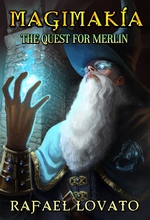
The Quest for Merlin: Magimakía by Rafael Lovato

The Quest for MerlinThe Quest for Merlin

by Rafael Lovato
Series: Magimakía, Book 1

Kindle Edition, 286 pg.
Howling Wolf, 2016

Read: June 20 – 22, 2016

I guess this is life. Maybe, strange things happen without much meaning.

The number of strange things happening around Oliver is pretty large.

So, hundreds of years ago, Merlin put himself in a suspended animation of sorts, and hid his body behind some clever little puzzle — like a video game. Wizards have made a few attempts to find him, but they haven’t worked out (obviously). The last attempt ended in death, destruction and betrayal.

More than a decade later, it’s time for another shot — one last shot. Merlin’s last male descendant, Oliver (although I’m not really sure about the math on that — sure, he’s a dork and awkward with females, but there’s no reason to think that Oliver couldn’t have kids). Oliver has no clue that he’s a Wizard (I guess the owl from Hogwarts got lost), his mother’s memory has been magically wiped, so she has no clue, either.

Oliver’s kidnapped (for his own good) and whisked away to begin to learn about his heritage while being introduced to a world of elves, witches, trolls, goblins, demons, seraphs and more. Most of whom are on the verge of war with each other, and only Merlin can stop it.

Oliver, a mind-reading goblin, a couple of attractive adolescent witches (he’s a 15-year-old nerd, of course that’s how he categorizes them), and an old friend of his father are the key to bringing back Merlin and saving the world. This isn’t your typical Merlin — or your typical anything — beyond the very typical socially awkward teenage male protagonist.

The plot, on the whole, was so-so. It got the job done, but never really grabbed me. The characters were . . . all right. Nothing special, nothing we haven’t seen before, but nothing eye-roll inducing or annoying. The world-building was very detailed, intriguing, and impressive — although sometime it wasn’t explained clearly. Still, if anything would bring me back for a second novel, it’d be the world-building. I don’t think the chapters of Goblins speaking to Goblins were anywhere near as funny as Lovato seemed to think they were, but I admire the fact that he stuck with them for as long as he did.

There were a few quirks that caught my eye — each race’s magic is characterized by a color, and Lovato spends a lot of time talking about them — so much so that I wondered if Hal Jordan and the Guardians of Oa were going to show up. I’m not sure I remember reading anything where the hero gets knocked out so often — it’s worse than Daredevil, Season 1. It’s not a huge thing, but there’s a difference between someone being a novice/rookie and someone being pathetically helpless. Reduce the knock-outs by 20% and I probably wouldn’t say anything.

My main complaint was the language — a few idiomatic phrases were off, the dialogue was frequently stilted, a lot of the word choices were not wrong, but certainly not right. About halfway through the book, I skipped ahead and read about the author — the fact that he’s a non-native English speaker explained just about every problem I had with the mechanics of the writing and I was able to ignore them. That’s precisely how it reads, and if I’d known that going in, I’d probably have enjoyed the whole experience a little more. Still, far too often Lovato uses three words when one would do.

Not a great book, but an entertaining read — and at the end of the day, that’s enough. For a little atypical YA fantasy, this would be well worth a look.

Disclaimer: I received this book from the author in exchange for this post, the honest thoughts contained above, and participation in the Book Tour.

—–

3 Stars


GUEST POST: Behind the Scenes – Rafael Lovato


Rafael LovatoMagimakía – the quest for Merlin is the first book of a contemporary fantasy series for Young Adults that explores the universe of RPG and MMORPG. In it, Oliver, a naive young virgin bullied 15 year old boy, without any knowledge of magic, trying to find the mage Merlin and save the Order of Mages and Witches of undoubted extinction, ends his journey victim of a magnificent and at the same time terrible event.

From a young age I always wanted to write a fantasy novel, because of my experience with (MMO)RPG games like Diablo and World of Warcraft. The magical universe, the battles and the powerful characters fascinated me. But writing a fantasy book is not something simple. So, after five books published and feeling capable of a foray into this universe, I finally wrote Magimakía – The search for Merlin.

The first step was to choose about what would be the story, and what kind of races and powers I would use in it. Since I always liked fantasy movies, and there was no way for me to escape this influence, I took Tolkien’s idea of introducing demons as non-religious entities (from ​​Lord of the Rings, the battle between Gandalf and the Balrog). Alongside the demons, I brought angels, who resemble paladins, also not religious, and mages, witches, elves, trolls and goblins.

Regarding the writing itself, to construct the history I used the Hollywood structure, with the characteristics turning points structure (10%, 25%, 50%, 75% and 95%). Also, took great care to develop the “arc of the characters”, and build well-marked voices for the three book narratives: Benjamin, goblins and Oliver. The scenes and sequels respect the international structure (Scene: objective, obstacle and disaster; sequel: reaction dilemma and decision), and wrote the entire text within the MRU’s technique (motivation and reaction units).

The story itself respects the dynamics of the RPG universe, with close attention to powers mathematics. This means that all races powers are balanced, as well as the most powerful entities. To a careful analysis, you can identify that in the mechanics of battles there are warriors, generals, mini-bosses, bosses, and world bosses. This engine respects the dynamics of RPG games, to appeal to the book’s target audience, who are young adult video-gamers aged 12 to 25 (and adults too, of course).

The book was originally written in Portuguese and published in Brazil by Editora Zap Book (eBook and print) and in Portugal by Editora Chiado (print and eBook), both in June/15. Availing the fact that I speak English fluently, I wrote the English version of the book, and introduced it to a US editor, for editing. I was fortunate to present the manuscript to Ravenswood, who did not hesitate to offer me a publishing contract.

About myself, I am a well-established Brazilian author with six books commercially published, being Magimakía – the quest for Merlin the latest. Recently the Oxford University Press bought a short story of my to use in their courseware as writing model for fiction short stories, already published in the book Portuguese language for 6th grade, by Oxford. Magimakía already is the best-selling book of my Brazilian Publisher, which is starting a national advertising campaign of the book.


The Quest for Merlin: Magimakía by Rafael Lovato Book Tour

Welcome to our Book Tour stop for The Quest for Merlin: Magimakía. In addition to this blurb about the book and author, I’ve got a a Guest Post from Rafael Lovato about the life of this book up to this point and my 2¢ about the book.

Book Details:

Title: The Quest for Merlin: Magimakía (Book 1)
Author: Rafael Lovato
Release Date: June 30, 2016
Page Count: 286
ISBN: 978-1530797950 & 1530797950
Imprint: Howling Wolf

Keywords: young adult fantasy, goblin hero, angels and demons, witchcraft, RPG games, elves fairies trolls, merlin series
Genre(s): Young Adult/Fantasy/ Action Adventure

Synopsis:

The Quest for Merlin is the first book of the Young Adult fantasy series Magimakía, goblin word meaning “The Great Battle of Mages and Witches.”

Follow Oliver’s journey, a skinny, naive 15 year old boy who knows nothing about magic, let alone how to survive high school as a bullied and outcast teen, as he attempts to help save the Order of Mages from destined extinction.

Kidnapped by a midget goblin and his troll cohorts, Oliver’s only hope is to learn the whereabouts of the all powerful Merlin who has been missing for over 500 years.

With the help of two witches, Avery and Violet, Oliver begins his journey in a world full of potions, spells, and bubbling cauldrons, learning a lot about witchcraft and magic.

You will be spellbound as you are transported into this amazing landscape where anything could happen, as tragic events unfold that could keep Oliver from saving Merlin and the entire world of Mages and Witches!

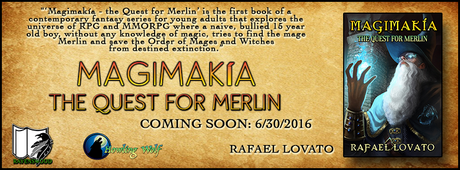
One Liner: Magimakía – the Quest for Merlin is the first book of a contemporary fantasy series for young adults that explores the universe of RPG and MMORPG where a naive, bullied 15 year old boy, without any knowledge of magic, tries to find the mage Merlin and save the Order of Mages and Witches from destined extinction.

Author Bio:

Rafael Lovato is a Brazilian author with six books published commercially in Brazil, and one in Portugal, Magimakía, a busca por Merlin. This is his first book published in the US. In 2014, the prestigious Oxford University Press bought one of his award-winning short story to use in their courseware as writing model to teach students, already published in the book Portuguese language for 6th Grade, by Oxford.

For More Info:

Book Page: http://ravenswoodpublishing.com/bookpages/magimakiabookone.html

Author Links: http://www.rlovato.com.br
https://www.facebook.com/operegrinojoshua
https://twitter.com/rlovatoescritor

Amazon US: http://www.amazon.com/The-Quest-Merlin-Magimakía-Book-ebook/dp/B01EI2R4V8
Amazon UK: http://www.amazon.co.uk/Quest-Merlin-Magimakía-Book-ebook/dp/B01EI2R4V8
Amazon CA: https://www.amazon.ca/dp/B01EI2R4V8
Barnes & Noble: http://www.barnesandnoble.com/w/the-quest-for-merlin-rafael-lovato/1123675514;jsessionid=3E933572BB6A6699C9EB512693D80A46.prodny_store01-atgap05?ean=2940153226026
Kobo: https://store.kobobooks.com/en-us/ebook/the-quest-for-merlin
Google Play: https://play.google.com/store/books/details/Rafael_Lovato_The_Quest_for_Merlin_Magimak%C3%ADa?id=S7b-CwAAQBAJ&hl=en
iBooks: https://itunes.apple.com/us/book/id1105254907
Createspace: https://www.createspace.com/6173524


Thursday, 1:17 PM by Michael Landweber

Thursday, 1:17 PMThursday, 1:17 PM

by Michael Landweber

Kindle Edition, 208 pg.
Coffeetown Press, 2016

Read: May 18 – 19, 2016

Towel Day is tomorrow, so it seems apropos to start with a couple of Douglas Adams lines that I’d imagine Duck quoted to himself, assuming he read the book: “This must be Thursday . . .I never could get the hang of Thursdays.” and “Time is an illusion. Lunchtime doubly so.” Now, if anyone could empathize with Arthur and Ford, it’s Duck.

(like I need an excuse to quote Adams, really, but I’ll take one)

And you never know, maybe he had read Adams, after all:

We’d read Fight Club in Mr. Lorenzo’s Anarchy in Modern American Fiction class . . . And Lord of the Rings in Ms. Tutwell’s Geography of Fictional Lands seminar, which somehow got me Social Studies credit. Damn, I went to a really questionable high school.

So, earlier today, I posted something from the publisher with the idea behind this one. Basically, Duck’s head is nowhere near where it should be as he walks the busy streets of D. C. and he steps out in front of a car that doesn’t hit him. Not because of lightning-fast reflexes of the driver, nor because of fantastic brakes, or because some hero pulled/pushed/tackled him out of the way. Nope, none of those — but because faster than you can say “Rod Serling,” time stopped.

Now our 17-year-old protagonist has to figure out: what happened (if he can); how to survive in this Frozen World (if he can); and most importantly — how can he get things moving again (if he can).

Simple enough premise, right? Yup. One that seems like you’ve probably read/seen it a few times (seems that way, but I can’t remember once) — but Landweber executes it like he’s the first. It feels fresh, new and innovative — while being an old stand-by, figure out how he pulled that off and I’ll probably end up talking about your book, too.

As we talked about a little while ago, there are very strict rules governing this reality and Duck figures them out pretty fast (at least fast enough to survive awhile).

Now seems like a good place to explain what people feel like in the frozen world. Skin feels like skin, hair like hair, lips like lips. It’s one of those things that is almost normal. When no one moves, you expect them to feel like molded plastic, like mannequins, limbs swiveling on set pivots without much range. A secondary possibility was that everyone would feel rubbery, like the well-preserved fetal pig [Duck’s friend] Grace dissected for me. Wrong on both counts.

The inert water hung down from the showerhead like strands of silk caressing his body. I touched one and it came away from its cohorts, wet and liquid on my fingertips.

And, yes, that sounds kind of creepy going around touching skin, hair, lips, some dude’s shower water — but don’t worry, that’s only because it is creepy. And Duck would be the first to admit that (probably while blushing). One reason I liked the paragraphs I quoted was because, yeah, molded plastic is exactly how I’d have figured it to feel.

Duck composing a “Guidebook” to how to live in this kind of reality ticks off a few boxes: lets us see his personality, lets him talk about his experimentation to discover the rules in a slightly more objective way than the rest of his narration, and lets him give the readers an info dump — several, actually — without it feeling like one. A very nice move there.

Landweber gives us a few details a little at a time about this reality, what Duck’s been going through in the days/weeks/months leading up to stepping in front of the car (like where that nickname comes from — a tale that’s both tragic and funny). As little as he’s been paying attention to the outside world, it might as well have stopped. So one of the things he does during this time is figure out what’s been going on with his friends — between family crisis and adolescent male hormones, he’s missed a lot. He just hopes that he can make up for this time.

For the most part, this book comes across as light entertainment — but there are (at least) two big dramatic stories at play here in addition to the fun and games. There’s death, the nature of love (and reality of lust, teenage style), growing up, friendship, hurting others . . . and Duck coming to grips with all of these, and coping with them isn’t done in a heavy-handed, or overly serious manner. On the whole, while you’re chuckling about something he’ll slide right into a consideration of one of the heavier themes. Over and over again, Landweber does this seamlessly so you barely notice it. No mean trick to pull off.

In addition to that, Duck deals with some pretty deep ethical questions (and doesn’t always come up with the right answer). His father, a philosopher, had posited that:

there is no good or evil without time. Empirically, he argued, man’s actions in themselves are not right or wrong. It is only the interaction of those deeds with the passage of time and the judgments of others that leads to morality. If you were to freeze time at the instant of the act, and never allow for there to be recriminations or regret or accusations or revenge, then the act itself becomes a meaningless one. No matter what that act is. Merely a moment detached from all other moments. A moment without consequence.

Duck’s got more than enough of these detached moments, moments without consequences, to deal with. And watching him deal with these ideas and try to be moral (frequently) is a really nice touch that I don’t think I expected from the premise.

It’s told in a light tone — and never gets spooky or too tense, but that doesn’t stop what Duck is dealing with from being serious — and dealt with seriously (much of the time). Landweber balances that pretty well most of the time — while keeping Duck as believable as possible in this situation. It is a compelling read, a fun read, and a moving read. Breezy enough to keep the YA crowd engaged, and thoughtful enough to make it worthwhile.

You really want to go get your hands on this one, readers, you’ll enjoy it.

Disclaimer: I received a copy of this book from the author in exchange for an honest review.

—–

4 Stars

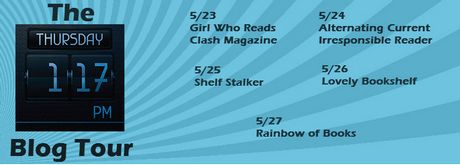
Thursday, 1:17 PM Book Tour

Thursday, 1:17 PMTime stopped. You didn’t. Now what?

Duck is 17. He will never be 18.

Tomorrow is his birthday. It will never be tomorrow.

Time stopped at 1:17 p.m. on a beautiful Thursday afternoon in Washington, DC. Duck is the only person moving in a world where all other living beings have been frozen into statues in an endless diorama. Duck was already in limbo, having lost his mother to cancer and his father to mental illness.

Now, faced with the unimaginable, he approaches his dilemma with the eye of an anthropologist and the heart of a teenager trying to do the right thing under the strangest of circumstances. Ultimately, he realizes that while he doesn’t understand the boundaries between friendship and love, that uncertain territory may be the key to restarting the world.

Trade Paperback – Available now
Publisher: Coffeetown Press
ISBN13: 9781603813570
208 pages

Coming up: We’ve got a Guest Post from Michael Landweber, a Q & A with him, too — and finally, my $.02 about the book. Come back and check these posts out (the links will work when the posts go up) — or just go get the book. Whatever.

Calamity by Brandon Sanderson

CalamityCalamity

by Brandon Sanderson
Series: The Reckoners, #3

Hardcover, 417 pg.
Delacorte Press, 2016

Read: March 30 – April 2, 2016

There was more connectivity between city-states in the Fractured States than I’d once assumed. Perhaps the Epics could have survived without any kind of infrastructure, but they tended to want subjects to rule. What good was it to be an all-powerful force of destruction and fury if you didn’t have peasants to murder now and then? Unfortunately peasants had to eat, or they’d go and die before you got a chance to murder them.

That meant building up some kind of structure in your city, finding some kind of product you could trade. Cities that could produce a surplus of food could trade for power cells, weapons or luxuries. I found that satisfying. When they’d first appeared, the Epics had wantonly destroyed anything and everything, ruining the national infrastructure. Now they were forced to bring it all back, becoming administrators.

Life was so unfair. You couldn’t both destroy everything around you and live like a king.

I really enjoyed Steelheart, the first novel in this trilogy — and Firefight was a lot of fun, if not as good — it wasn’t anything serious, weighty, or bogged-down with teenage drama. Just a fun story about super-powered individuals ruling over a post-apocalyptic dystopia and the non-super-powered rebels trying to take them down. So, how’d Brandon Sanderson wrap things up? In a very mixed bag — an ending that was honest, consistent, and fitting for the series, but one I really didn’t care for.

Which is going to take some explanation.

David’s voice is as friendly, upbeat, and nerdy in the way that charmed me in the beginning. Even weighted down with added burdens and losses, he’s hung onto his core personality. His metaphors are as painful as ever — his ability to get his teammates to go along with the biggest of hare-brained schemes is intact and still astounding.

I wanted answers. They were probably here somewhere. Maybe I’d find them behind that group of robotic war drones that were extending their gun arms from behind the freezers in front of me.

Oh.

But he isn’t the same kid we met on the streets of Newcago — he’s lost his drive for revenge, it’s evolved into something else (and/or been revealed or better understood to be something else). He’s not out for blood, not out for simply overthrowing the Epics. He still wants to stop them, to restore rule to non-Epics and free them from the tyranny they’re under. But it’s because of wrong and right, for deeper reasons, purer motives.

He’s not the only one who’s changed and grown — Megan, the love of his life and former foe, has greater understanding of herself and her powers, she’s gaining more and more control of both. Part of it is self-acceptance, part of it is David’s faith in her. Either way, she’s a more entertaining character — and a less threatening force (at least as far as The Reckoners are concerned).

Thanks to their travel and experience, David and the others have a better understanding of how the world works (see the above quotation for a hint) — and some of the Epics have had to make adjustments, if for no other reason to keep their subjects alive and working. From a surprising source, we learn how the Reckoners tech works — as do they — and it’s pretty odd (and interesting). Not only that — the source of Calamity, the source of the Epics’ powers is revealed. You really can’t ask for more than that.

Well, actually you can — one of the other things that comes out of the growth and development of David (and the rest) over the series, and especially over this book, are some underlying themes that come out. They’ve been there since the beginning if you knew how to look, but here, Sanderson makes them explicit. I really appreciated them as they surfaced — I’m not sure that a lot of the YA crowd that this is targeted for would as much as I did, but many would. The last scene is pretty heartwarming, really — something I wouldn’t have expected at pretty much any point in the series (and has nothing to do with romance, for the record).

So why am I lukewarm about this? While the execution was consistent, the tone was right on-pitch and Sanderson didn’t cheat anywhere along the way to the series conclusion, I just didn’t like it. I didn’t like the explanation given for the source of the powers. I didn’t like the way the last half of the book played out (mostly everything after the last battle with the Prof, really — so less than half, but the groundwork was laid at about the 50% mark). Sanderson told the story he wanted to, in a way that made sense to the rest of the series, and he never copped out or went for high drama over being true to his story. So I can’t judge it too harshly. I just didn’t care for the way it played out. Which pretty much just means that Sanderson wrote the ending he wanted and not the one I wanted. Sure, I think it’s tacky, but you can add that to the very long list of things that he didn’t ask me.

I wasn’t wowed, wasn’t thrilled with things in the end. But I really can’t complain about any of it. Fans of — or at least readers of — the series should check out the conclusion, just to get the closure it brings. Hopefully, you’ll get more out of it than I did.

—–

3 Stars

A Few Quick Questions With…Hagit Oron

Earlier, I posted a piece about Elphie and Dad go on an Epic Adventure by Hagit R. Oron and Or Oron. Hagit was nice enough to take part in a Q&A with me. I kept it short and sweet, because I’d rather she work on her next book than take too much time with me, y’know? Hagit gave some great answers, hope you enjoy this — and be sure to check out her books!

Good depictions of Fathers are pretty hard to come by, so I wanted to say thanks for that. What made you decide to tell as story about a Dad and his kid rather than the typical Mom?
Well, I love stories about fathers and sons. “Out Stealing Horses” by Per Petterson is one of my favorite books and it is truly an inspiration.

I was also inspired by the relationship between my Dad and his Dad. My grandpa was a strict uptight guy. As he grew older he left all that behind and became this soft mellow sweet person, somewhat like Elphie’s father at the end of the story.

By the way, the next book features Elphie’s Mom, but I guess she isn’t the typical picture book Mom as well. I like my characters to be different and unique.

Why elephants? Is there something deep going on — something symbolic maybe. Are they just fun to draw?
I was fortunate enough to view elephants in their natural habitat at Africa, and I fell in love with them. They are so complex. I mean, on one hand they are these huge heavy animals, but on the other hand they are delicate and sensitive. You expect to hear an elephant’s footsteps at the savanna, but you don’t hear a thing. They are so grace and walk very lightly. I knew I was going to write something about elephants after my visit to Africa, but I didn’t have anything concrete until I saw this episode of “the myth busters” a few years ago. They were trying to check if elephants are afraid of mice, (which was confirmed), and boom! I got the idea for the entire series of Elphie’s books.

My daughter, Or, who is the illustrator says that they are also fun to draw. J

Are you drawing on your own experiences for these stories? I see that Goodreads has this listed as the beginning of a series — how many do you have planned?
I guess a writer always writes about her own experience, one way or another. . .
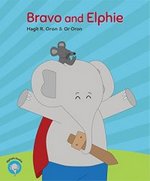
There are currently 4 stories on Elphie’s books. All of them feature the same characters: Elphie, Dad or Mom, Elpie’s somewhat wild friend Phante, and Bravo – Elphie’s pet mouse which is introduced on the next book.

Each book tells a different story, which is told through Elphie’s eyes in first person.
These are all sweet little stories about a child daily experiences, but I do hope adults readers would enjoy them too. It’s like a kidlit with a wink.

Can you talk about your process a bit? What comes first — the words or the pictures? Is it more of a simultaneous thing?
I always start with the words. For some parts of the story it is a simultaneous. For this story, the pages about Elphie and his Dad return from the shop and fight a dragon, rescue a princess etc were simultaneous, because I wanted the illustrations to tell the story together with the words. So I wrote instructions for the illustrations as well.
In the writing of Elphie and Dad go on an Epic Adventure, what was the biggest surprise about the writing itself? Either, “I can’t believe X is so easy!” or “If I had known Y was going to be so hard, I’d have skipped this and watched more TV”.
The biggest surprise about this book was writing it. J

Usually, I plot a story in my head and I think about it for weeks before I write the first word, but this came out as a whole in one sitting completely unprepared.

“Elphie and Dad Go On an Epic Adventure” was actually the third book I wrote in this series. We were already working on illustrations for “Bravo Elphie”, but we liked this story so much and decided to make it our debut.

Elphie and Dad go on an Epic Adventure by Hagit R. Oron, Or Oron

Elphie and Dad go on an Epic Adventure Elphie and Dad go on an Epic Adventure

by Hagit R. Oron, Or Oron (Illustrator)
Series: Elphie’s Books, #1

Kindle Edition
, 25 pg.
Orons, 2016
Read: March 15, 2016


Picture books are not the usual fare around here, true. But Hagit Oron asked, and I figured, why not? Now, can I get this post up without using more words than the book did?

Elphie is a little elephant accompanying his dad on an errand — but his dad is one of the good ones, and instead of dragging Elphie along — he entices the child by promising an “epic adventure”. Wearing a cape and carrying a wooden sword, the two set out for a walk to the store.

Along the way, Elphie does battle with imaginary foes, and has one very close call that wasn’t imaginary enough. With some guidance from Dad, a great imagination, and a helpful store clerk — Elphie has an epic adventure indeed.

I really appreciated Dad — he’s not perfect (he gets distracted in a very real and relatable way), but he’s trying — and he recovers from a mistake well. A good guy, not a buffoon, not a super-hero. There’s not enough dads like that in books.

The art is great. The colors are vibrant, the drawings pop just right. It’s not fantastic, which I honestly get annoyed by in kids’ books. It’s friendly and eye-catching, very accessible, and engaging — enough so that you get drawn into it, but not so much that it detracts from the words. The art serves the story — and will keep the attention of those who can’t yet read.

It’s been a few years (almost ten) since I’ve read picture books on a regular basis. This is just the kind of thing I’d have liked then, and would’ve read — and then have been “compelled” to read again (and again and again). For those with kids — or grandkids — or who might have a kid nearby your Kindle, pick it up.

Disclaimer: I was provided with a copy of this book by the author in exchange for this post.

—–

3 Stars

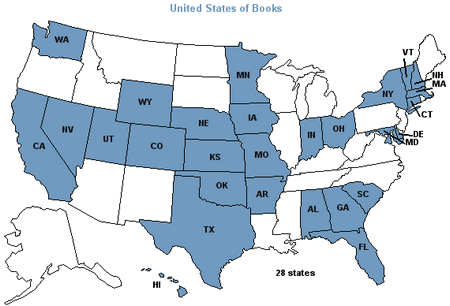
United States of Books – The Absolutely True Diary of a Part-Time Indian by Sherman Alexie

The Absolutely True Diary of a Part-Time IndianThe Absolutely True Diary of a Part-Time Indian

by Sherman Alexie, Ellen Forney (Illustrator)

Author: Elisha at Rainy Day Reviews

Entertainment Weekly says about their Washington state pick– “Alexie grapples with serious issues through the not-always-serious voice of a 14-year-old caught between his life on the reservation and his entry into an all-white high school.”

Synopsis:

Bestselling author Sherman Alexie tells the story of Junior, a budding cartoonist growing up on the Spokane Indian Reservation. Determined to take his future into his own hands, Junior leaves his troubled school on the rez to attend an all-white farm town high school where the only other Indian is the school mascot.

Heartbreaking, funny, and beautifully written, The Absolutely True Diary of a Part-Time Indian, which is based on the author’s own experiences, coupled with poignant drawings by Ellen Forney that reflect the character’s art, chronicles the contemporary adolescence of one Native American boy as he attempts to break away from the life he was destined to live.

Review:

I was intrigued with this book once I learned that this story was based on the author’s own experience. I was not aware of the coarse language in the book until I began reading it; which in my opinion makes this read inappropriate for younger readers. However, that said, I did appreciate that even though this teenager saw a lot of heartache and injustice, including racism and death, there is a lot of laughs throughout the story.

I like the narration of the book, hence the title. That was different than the typical read. Gave it a different feel from a story being told. Even with the racial divide in the story that the boy dealt with, I think this story is very relatable to other young adults out there (tragedy in life, being bullied, and the instability that life can bring with its ever-changing twists that life tends to do to all of us. All in all, a good book and a quick read that I would definitely recommend to everyone to read.

* Disclaimer: language may be coarse for some readers*

Page 35 of 42

Powered by WordPress & Theme by Anders Norén