Saturday Miscellany — 3/16/19

Story behind this late post isn’t as interesting — but nicer — than last week’s. If you’re curious, check out my other blog in a bit (bit = 1-48 hours). Otherwise, here are the odds ‘n ends over the week about books and reading that caught my eye. You’ve probably seen some/most/all of them, but just in case:

    This Week’s New Releases I’m Excited About and/or You’ll Probably See Here Soon:

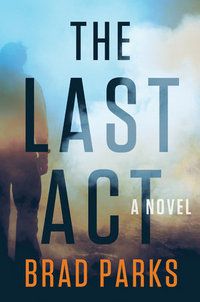
  • The Last Act by Brad Parks — an out of work actor goes undercover in prison. Not really the Feel Good Novel of the Year, but what else do you expect from Brad Parks? I had a bit more to say about it recently.
  • Titan Shade by Dan Stout — Alien Nation + whatever that Will Smith Urban Fantasy Netflix movie was + Life on Mars (UK version). Or something. UF about a homicide cop in the 70s. Looks like it could be fun.
  • Instant Karma by Todd Morr — disgraced ex-cop becomes a security advisor to the underworld. Also looks like fun — it’s on my Kindle, hoping to get to it before the end of the year (I wish that was a joke…)

Lastly, I’d like to say hi and extend a warm welcome to Erwin Wensley, dragonflybooks, virgoebooks and BOOKVENGER-44 for following the blog this week.

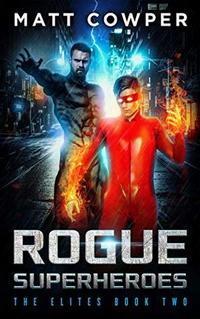
Rogue Superheroes by Matt Cowper: Unintended Consequences Wreak All Sorts of Havoc on the Heroes’ Lives

Rogue SuperheroesRogue Superheroes

by Matt Cowper
Series: The Elites, #2

Kindle Edition, 242pg.
2019

Read: March 7- 8, 2019

When we left Nightstriker at the end of The World Savers, he was trying to apply the new convictions he’d adopted after The Elites encounter with the Giftgiver and his followers. Yes, the primary task for heroes like himself was to take on super-human threats, but other sources of injustice should be in their sights as well. Starting with corrupt politicians and government officials. Nightstriker, who seems to accumulate intelligence on everyone he stands next to in line at Starbucks, had plenty of dirt on them all — and starts releasing some of this information to the Press. Suddenly, officials are forced to resign in droves — and the stresses on the fault-lines of society increase exponentially.

Suddenly, the nation seems on the verge of civil war, and Nightstriker comes clean to the team about what he’s done. Before they can even decide how to react, their HQ is attacked and the President identifies Nightstriker (and because of him the rest of the Elites) as the source of the leaks and exposé stories. As they try to get out of the rubble that was their HQ, a new, government-controlled, team of heroes comes to arrest them. Before the Elites can really wrap their minds around what’s going on they’re on the run, hiding and licking their wounds.

So the Elites have to clean up their image, defeat the new team, and try to help fix the mess that Nightstriker inadvertently created by not thinking things through as he should have. It’s a good thing they’re super-heroes, or this could be very daunting.

That’s not the whole book — like before, a significant portion of the book is devoted to Sam (Blaze’s) continued maturing and the growth of his powers. There are heavy prices for him to pay along those likes I have to say, but especially for the reader — it’s all worth it. The rest of the team have strong storylines — and a good number of people from the previous book make appearances (some pretty significant). It’s easy (and right) to focus on his “Big Three” and what’s going on with them, but without the rest of these characters, the book wouldn’t work.

In the midst of a story where the stakes are so high — Cowper throws in a lot of smaller stories, a good number of scenes that aren’t involved in the overall story, but develop the characters well. It’s a well-balanced story, just enough of things that aren’t the overarching stories to round out things so you can take in all the details of the rest.

I cannot tell you how many times Cowper did things with these characters I didn’t see coming. Things happened to people (powered or not) and then the heroes reacted in ways that were shocking. Despite the fact that this is only the second book in a series, Cowper is clearly playing for keeps and won’t be satisfied with simply injuring some characters. More than once, I had to go back and read a couple of paragraphs again just to make sure that Cowper had the chutzpah to do what I thought he did. “I couldn’t have read that right, because that’s just . . . nope, he did do that.” It wasn’t deconstruction and shocking moves for the sake of it, there was a reason for it all and it served the story, but wow.

But that’s not to say that everything is dark and grim — yes, Cowper’s Super-Hero stories are more like a movie directed by Zack Snyder than one directed by Patty Jenkins or Jon Favreau, but there are moments of joy, of small victories, even a little romance. The moments with Blaze and Metal Girl continue to be enjoyable and are a great break from the Nightstriker drama (even when the moments with the two aren’t happy times). The character Anna, introduced late in The World Savers proved to be another source of relief from the tensions — which is odd, because things don’t really go that well for her for most of the book.

Slab and Buckshot continue (in my opinion) to be under-served, but they both had opportunities to shine here, and we saw more aspects of their character. I do understand why they don’t get the time devoted to them that Metal Girl, Blaze and Nightstriker get — I really do. Also, I’ll probably complain about Slab’s use until Cowper gives him POV chapters that make up at least a third of a novel. Still, Cowper uses the characters well and I like them a lot — he’s probably right to give them the “screen time” that he does. It’s better to leave readers wanting more, anyway, right? Rather than a “I don’t know why we spent so much time with Buckshot, when we could’ve got some more awkward flirtation from Blaze” situation.

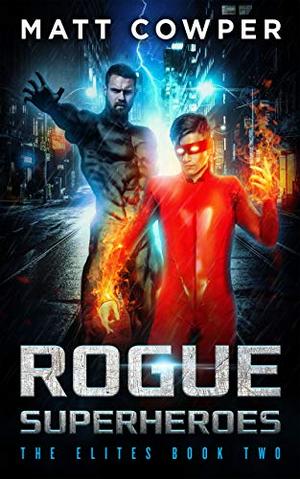
A quick note — I thought the original cover for The World Savers was just fine. But the new cover, that matches the look of this cover, is just outstanding (as is this one). It’s a small thing, but the covers are great.

I had a blast with The World Savers, but Rogue Superheroes surpassed it on every front, and I was excited to read it. I’m not sure how Cowper continues the story from where it is — The Elites and the world around them were pushed to such extremes in these pages that topping this book might prove too much to try — but if instead of trying to climb that mountain, he goes around it just right, it could be very satisfying. I am really looking forward to seeing how he proceeds (and how wrong he proves me).

For solid super-hero action, a dash of intrigue and some jaw-dropping outcomes, Rogue Superheroes will satisfy any reader, and I encourage you to go grab it.

Disclaimer: I received a copy of this novel from the author in exchange for my honest opinion about it.

—–

4 Stars

LetsReadIndie Reading Challenge

Coming Attractions (I hope…)

The last three nights I’ve sat down to write my next post and have promptly fallen asleep before finishing a paragraph. Which is quite annoying, because I’m not more tired than normal (I don’t think) and I am very excited about these three books.

So in lieu of an actual post, given largely as proof of life, here’s a quick glance at what’s coming down the pike. Hopefully starting in 24 hours.

Who Killed the Fonz?Who Killed the Fonz?

by James Boice

This is funny, heartfelt, a goofy idea, and a far better book than it has any right to be.

Rogue SuperheroesRogue Superheroes

by Matt Cowper

This takes everything he did right in The World Savers and improves on it (at least a little) while continuing the story.

No Country for Old GnomesNo Country for Old Gnomes

by Delilah S. Dawson and Kevin Hearne

Set in the same kingdom as Kill the Farmboy, and features (at least for a couple of pages) the same characters, but focuses on a new cast. I figured this was going to be almost as good as its predecessor, but it’s better in every way — better characters, better story, and more laughs. None of which I’d have thought likely.

Pub Day Repost: The Last Act by Brad Parks: He’s in the jailhouse now

The Last ActThe Last Act

by Brad Parks

ARC, 368 pg.
Dutton Books, 2019
Read: February 26 – 27, 2019

Inspired by the Wachovia Bank scandal from a few years back, Brad Parks’ third stand-alone is a departure in a sense from his previous two. Rather than crimes close to home for his protagonists, this is crime on an international scale, with most of the figures involved never laying eyes on each other.

Mitch Dupree was a high-level bank executive who was convicted of aiding a Mexican drug cartel by laundering a lot of money. He’s been sentenced to a minimum security prison in West Virginia. If after reading this — or even while reading it — you want a few more details about what happened with Dupree before the novel starts (or more specifics about the events leading up to his arrest), check out the prequel short story, The Whistle Blower. He has made it known both far and wide that he has a large amount of evidence against the cartel tucked away safely — and as long as he and/or his family are alive, that evidence stays hidden.

Naturally, the DEA, FBI and the cartel want to get their hands on it — and are willing to do some above and beyond work to get it.

Enter Tommy Jump — he’d risen to fame and prominence (and a Tony nomination) as a child on Broadway, but as he aged into adulthood the parts dried up. He’s on the verge of calling it quits — at least for a couple of decades. He’s approached by a childhood friend, Danny Ruiz, flashing a shiny FBI badge and an interesting job offer. Danny and his partner, Rick Gilmartin, want Tommy to go undercover with an assumed identity of a bank robber and serve time in the same prison. He has six months to get close to Dupree, win his trust and get the location of the documents. If the intelligence he gathers leads to indictments, he gets a hefty bonus on top of the pretty nice initial paycheck (all the funds come from civil forfeiture, and the well seems to run pretty deep). Given that his fiancé — a painter waiting to be discovered — just told him she was pregnant, any kind of pay-day sounds good to an out-of-work actor, one with a pay-day that could set them up for years? How can he pass that up?

The early stages of the plan go pretty smoothly — Tommy’s given a new identity, develops a cover story and is sentenced to the same prison. He arrives and gets settled — not really making friends, but getting well acquainted with fellow inmates, who show him the ropes and help him get acclimated. It goes so smoothly, actually, that it bugged me a little. Sure, he’s an actor, but this isn’t a play, there’s no script, and it seems easy. But, Tommy’s such a likeable guy, a winning narrator that I just kept shrugging off my skepticism and rolled with it — I wanted things to work out for Tommy and Amanda, I wanted to see what happened with Dupree — so whatever it took to get me to seeing if things would work out for them I could accept.

And then — because this is a thriller, because Parks is good at torturing his readers (that’s why we keep coming back), and because no one is as lucky as Tommy seemed to be — everything got nearly impossible. On a dime, the momentum changes and suddenly thing look incredibly grim for Tommy, Amanda, Dupree and several other characters. Naturally, at the same time the bottom fell out and I was reeling from a pretty significant reveal, my lunch break ended and I had to get back to work with no time to process things. I know it’s stupid, but it felt like Parks planned it that way.

The novel alternates between Tommy chapters and chapters with Amanda, one of the cartel’s higher-ups and his efforts to find the evidence, Danny and Rick, and Mitch Dupree’s wife. I was honestly surprised how much time we got with Amanda and Mrs. Dupree — both of whom had their own character arcs independent of (although influenced by) Tommy and Mitch. I could’ve used a little more of both of them — not that Parks short-changed them in any way, but their stories were so interesting that I would’ve enjoyed it. Alternatively, by the end of the book (especially in light of The Whistle Blower), I was surprised how little time we got with Mitch Dupree — again, it’s not that he was short-changed, I just would’ve assumed we’d have more time with him. And what time we do have with him was by and large mediated through Tommy or his wife.

Beyond that, all the characters are well-drawn, well-developed and the kind that you would like to spend more time with. Parks has always displayed a great knack at creating characters that you can easily imagine coming across in real life — no matter their walk of life. They’re not all good people (particularly those who are aligned with the cartel), but they’re all believable people.

Before I get back to what Parks did right, I have a couple of problems that I want to talk about — as always, I’m afraid that the amount of space I spend talking about them is going to give the idea that I had real problems with the book as a whole. I didn’t. It’s just a couple of issues — issues that take more space to explain than the bits I like take. Still, they’re worth talking about.

I’m not 100% convinced that Parks adequately gets the point across about how dangerous this cartel that Tommy’s mixed up in is. Don’t get me wrong, it’s not like he portrays them as cuddly or anything. But I’m still not sure I got a large sense of threat and doom from them–Tommy and Dupree carry that sense, they’re adequately scared (especially Dupree), but I’m not sure that Parks gets the readers to be. I know he’s capable of it, I’m just not sure he did it here.

Similarly, I think he could’ve done a better job depicting life in the minimum security prison, the daily ins and outs — the lack of privacy, the loneliness, the hardships. I’m struggling for words here — the deprivations from a life of liberty that make prison a place you want to avoid, even a minimum security prison.. . It honestly felt like Tommy had an easier time getting up to stuff (including out-of-the-building excursions) in the middle of the night than Harry, Ron and Hermione did at Hogwarts. Or to put it in a different light — Say Nothing‘s Scott Sampson’s pretty sizeable home and nice office, felt far more confining than the prison did. And the small house that Melanie Barrick called home in Closer Than You Know seemed much more restricting and frightening than Tommy’s incarceration (as did the county jail she spent time in).

That said — what Parks was able to convey very strongly was the life-and-death nature of the situation that Tommy, Dupree, and Dupree’s wife was in. Also, the questions of identity, the future consequences of everyone’s actions loomed large here and dominated their thoughts, motives and actions. Where Scott and Melanie’s stories were much more immediate in their focus (yes, with long-range repercussions, but a very intense focus on the immediate future), Tommy’s story and his own focus is on the future. He spends very little time thinking about the now of things, most of his eye is on a decade away — which is likely tied in to his sentence.

As I mentioned earlier, when things started going bad for Tommy, they went really bad — and the rest of the book didn’t lighten up on him. It’s almost as if Parks lulled readers into letting their guard down before hitting them hard (actually, it’s probably exactly that). The twists and turns start to come fast and relentlessly. The beginning of the book is interesting and winning — and then once the hook is set, Parks just messes with you and you can’t relax until everything is over. In his previous stand-alones, Parks pretty much kept the tension and suspense going from the first chapter theory the end. In this book, he saved almost all of it until the end, so it hits you harder. So it stops being about characters that you’d like to see succeed or find out more about, to characters that you like and have to know if they’re going to survive with their wits, health and family intact — and you have to know it right now.

About the same time that things got intense, I had a realization — I think I’ve figured out what makes Parks’ novels work so well, how he gets his readers to commit — in The Last Act — and everything else he writes — what matters most is family. Ultimately, all his books are celebrations of family, and what people will go through for the sake of family. It’s tucked away in some of the Carter Ross books — but, without going back to reread any, I’m pretty sure its there. But especially in his stand-alones, this is Parks’ recurring theme. It’s the way he connects his audience to whatever his protagonist is going through and to the protagonists themselves. There’s something instinctive, primal about the way that Parks portrays family and the lengths that individuals will go through for them — whether the family is just starting or well-established. something that Tommy and Dupree have a conversation about made that click with/for me — and thinking about it is the only thing that got me to think about putting this book down for a moment.

I’ve yet to be disappointed by a Parks book, I’ve enjoyed all of them — and this is no exception. I do think there’s something special about this one, both in Park’s construction of the novel and what it’s saying about the characters. He takes some risks, and does some things he hadn’t done before, and I was pleased to see the results. There’s a lot of heart in The Last Act, a lot of tension, and more hope than you might expect. There’s also some things said about the drug war and the prison system that are worth reflecting on. I’m not sure what else I can say to convince you to try this, so I’ll just call that good.

Disclaimer: I received this ARC from Dutton Books, which did not influence anything I had to say about it — it just means I was able to say something about it before the publication date. I do thank them for the opportunity, however.

—–

4 Stars

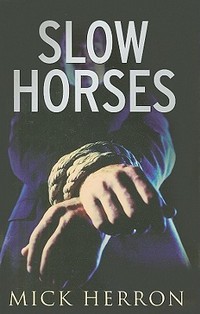
Slow Horses by Mick Herron: A solid, if slow-building, entry point to a spy series.

Slow HorsesSlow Horses

by Mick Herron
Series: Slough House, #1
Hardcover, 329 pg.
Soho Constable, 2010
Read: March 1 – 4, 2019

’What you have to bear in mind’–the O.B.’s words–’is that worst sometimes does come to worst.’

The worst had increased exponentially over the last few years.

The O.B.’s words of advice for his grandson turns out to be a bit more. I don’t think Herron placed this on page 2 to be a thesis statement for the book — but it really could be one. River Cartwright was musing about the way things were going for Intelligence officers (and people in related vocations) when it came to predicting what terrorists of various stripes would do. If September 11, July 7, and similar dates have taught Intelligence officers (and people in general), anything it is that sometimes the worst case is actually what happens. (actually, what do I know, maybe it was a thesis for the novel)

Of course, it doesn’t just happen for terrorist attacks — sometimes it happens for someone’s career. Take River Cartwright — after the events on page 2 (and the rest of that first chapter) — and his colleagues. Each of them had worked for the Intelligence service, many of them were rising stars (or stars that had already risen), until they messed up. Sometimes it’s in a large-scale drill, sometimes it was in the course of duty — but they all made an embarrassing mistake, misstep or failure of another stripe, resulting them being assigned to Slough House. In Slough House, all the officers still technically do intelligence work — reviewing transcripts of cell phone conversations for certain words and phrases, for example. But it’s all low priority, low importance work. Far from the important work that the rest of MI-5 (and the rest) do. They’re dubbed the “Slow Horses” and if they aren’t forgotten about by the rest of the service, they’re mocked.

One day, a Slow Horse brushes up against something that approaches “real” work and River takes the results are taken to MI-5’s HQ for them to follow-up on (after making a copy). About the same time that happens, a young Pakistani immigrant is kidnapped by a nationalist group that promises to behead him on the Internet. River decides to try to follow up on this intel, thinking it might lead to the kidnappers. And well, chaos ensues, and let’s leave it there.

Honestly, I had a lot of flashbacks to the show MI-5 (aka Spooks), throughout. The story has a very British spy feel, with more clandestine meetings, history and significant looks than an American spy story (which largely revolve around attractive people shooting things). But these Slow Horses aren’t the type that Nicola Walker, Peter Firth, and Miranda Raison would deal with — at best, they’re the ones those people would pass in the hall. But all of them wanted to get back to the major leagues — they all had the drive, the chip on their shoulder, the need to lose the embarrassment. It makes for an interesting motivation — it’s not just about saving the young man, it’s about them doing it.

The characters are quite a rag-tag bunch, who really don’t like each other much at the beginning — they all know that Slough House is a dead-end and resent being there — and transfer that resentment onto the others stuck there with them. An actual team gets forged through the events of this novel and the characters find things about each other that they can relate to — and maybe even admire.

It’s a solid spy story, and one told with restrained humor — it’s not a comedy by any means, but there are comic sensibilities throughout. Herron could’ve easily turned it into a humorous spy story about rejects trying to save the day. But he plays it pretty straight, there are things to grin about — or at least smile wryly about. But by and large this is a serious story told seriously. And it’s well done — it’s a well-constructed story and by the time the big twist is revealed, you care about the players enough to react appropriately.

But man, it was slow. Once things started happening, it flowed pretty smoothly and quickly. But those early chapters, where Herron was setting up his dominoes, were a slog. It took awhile to figure out why we were spending so much time with X, Y and Z. But when he started knocking the dominoes over? You understood why he’d spent the time and were glad he did. The slow pace of the early chapters were entirely justified, thankfully. Still, I think we could’ve had a better hook early on.

I do think that the later books in the series will be able to build on what’s established here and be less slow, and using the characters we met here get into the action quicker. I’m planning on reading at least a couple more in this series because I did enjoy this one, and think that Herron can build this into a great series. It’s a good entry point into something that promises to be better.

—–

3 Stars

2019 Library Love Challenge 2019 Cloak & Dagger Challenge

Saturday Miscellany — 3/9/19

So I was awakened at shortly after 5 this morning with my wife telling me our 20-year-old had severe abdominal pains and needed to go to the ER, 11 hours later, we were home, one appendix lighter. 1. That’s really incredible. 2. That’s my best excuse for not getting this posted on time that I’ve ever had ? 3. I read more today than I typically do on a Saturday, so, that’s a nice bonus.

I did manage to accumulate a few odds ‘n ends over the week about books and reading that caught my eye. You’ve probably seen some/most/all of them, but just in case:

    This Week’s New Releases I’m Excited About and/or You’ll Probably See Here Soon:

  • That Ain’t Witchcraft by Seanan McGuire — The 8th InCryptid novel and the 3rd featuring Annie — after the way the last one ended, I’m very eager (and a little apprehensive) to dive in.
  • A Friend Is a Gift You Give Yourself by William Boyle — “A funny, gritty, touching narrative about the strength of three New York women caught in a world of abusive men, broken families, and mob violence,” as NPR so helpfully summarizes it. Their review is worth a read.
  • Another Kingdom by Andrew Klavan — a screenwriter finds himself in a fantasy kingdom — and in trouble. Then he finds himself back in L.A. And then back and forth. Something tells me that Klavan’s approach to a portal fantasy ain’t that typical.

Lastly, I’d like to say hi and extend a warm welcome to TheArtOfLife for following the blog this week.

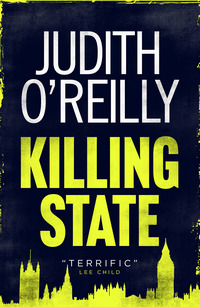
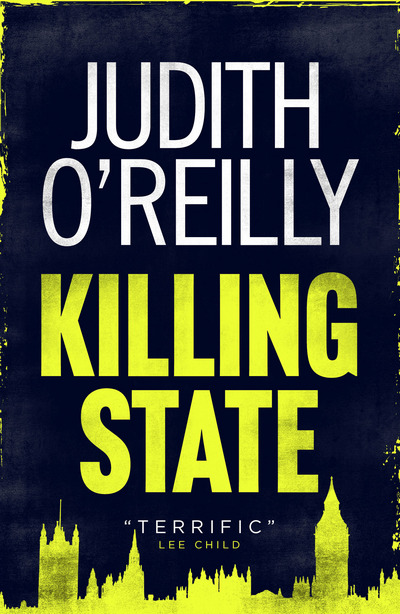
Killing State by Judith O’Reilly: I Can’t Suitably Encapsulate this Gripping Thriller

Killing StateKilling State

by Judith O’Reilly
Series: Michael North, #1

Kindle Edition, 496 pg.
Head of Zeus, 2019

Read: March 5 – 7, 2019

           “You should come with me.”

He turned over the offer in his mind.

Why would he?

Because she was stop-your-heart beautiful.

Then again, the world teemed with beautiful women. Because he wanted to know how it ended.

Badly, he predicted.

What happens when an assassin doesn’t get the expected reaction from his target? Honor Jones, MP, tells him to let her finish her cigarette and asks him a question, “Where’s Peggy?” The assassin in question, Michael North, doesn’t know who Peggy is, much less where she is. What he does know is that he can’t kill this woman — maybe it’s because (unlike the rest of his targets) he wasn’t given a reason for her execution, maybe it’s her attitude, maybe he’s just getting tired of killing (not to be confused with Martin Q. Blank’s newfound respect for life) — certainly her beauty doesn’t hurt.

His refusal to kill her doesn’t go down well with his employer — an extra-governmental body dedicated to the preservation of the British government. That morning, he’s contacted in person with strict instructions to get the job done or face the (fatal) consequences. Instead, North tried to get her out of the country and ends up saving her from a different assassin. Not very shockingly, North also finds instructions to kill him on this assassin’s corpse. By this point, North is smitten with Honor and is committed (whether either of them consciously realize it) to helping her survive and find her friend Peggy.

At the moment, it’s clear that Honor’s search for her dear friend is tied to the kill order. Peggy’s an astronomer, largely apolitical, and not tied to any endeavor that would normally put her on the radar of anyone outside of astronomical/academic circles. Nevertheless, she’s somehow set these dominoes falling, and now Honor and North are running from killers across the country as they seek to learn why Peggy has disappeared.

This hunt for Peggy will push North and Honor to — and past — their limits. It will see them both injured. Both under threat of grave bodily harm (and death) through violence — and both will have to take steps to defend themselves. Around them, the culture and government face shifts and challenges from within that threaten to change everything that Britons know about themselves. On top of all that — there are some great character moments, real growth and change that happen ways that you can believe — not just the clear result of authorial fiat, but because that’s what happens when people face what they did.

Plots involving large-scale conspiracies frequently leave me cold — O’Reilly not only convinces me that her conspiracy is worth reading, but she’s effective enough with it to make me enjoy it. I struggle to accept plots involving psychiatric professionals and loved ones trying to convince a character that the reality they know (and the audience knows) isn’t real, but is the result of delusion brought on by some psychological condition. Now this one isn’t as involved as say, “Normal Again” from Buffy the Vampire Slayer, but it’s there — and O’Reilly sticks with it long enough to accomplish what she needs to for her story, but she doesn’t milk drama out of it. There are a few other things like this — tricks, plotlines, tropes — that I typically avoid or get annoyed by, but I accepted and enjoyed here.

My notes are filled with “O’Reilly isn’t going to try ___, is she?” entries, followed by “Yeah, she is — and it works.” She squeezes in so many of these things that I’m tempted to doubt my memory about them — and I’m writing this less than a day after I read it! For reasons of space, time, and readability I’ve limited myself in what I’ve addressed in this post. I had a lot of other things I wanted to say, and even had drafts talking about. But I ended up restricting myself — not just because of spoilers (though, as always, that’s part of it) — but because O’Reilly stuffs this novel with so many ideas, plot points and details that I can’t talk about it all without the post becoming unreadable. I don’t know how she manages to put it all in while maintaining the pounding pace. It’s truly noteworthy and laudable that she pulls it off. I can’t even express this without producing an ungainly paragraph.

Michael North is a larger-than-life character, but honestly more grounded in reality than many assassin/lone warrior types in Thriller fiction. Part of that comes from O’Reilly’s restraint in describing him — he’s never depicted as anything superlative. He’s simply a skilled and surprisingly dedicated combat veteran in a series of tight situations that even he is shocked that he survives as long as he does.

Similarly, Honor is one of many beautiful women in the world (as North himself notes above) — she’s one of many dedicated elected public servants, she’s one of many people who’ve overcome difficult pasts thanks to the help of a friend/loved one. She also isn’t depicted as a superlative anything — just the right person in the right place at the right time. Even if that right place is in front of Michael North’s knife. And yes, the name Honor is ripe with possibilities and symbolism — O’Reilly takes advantage of it. Not as much as some authors would’ve, but she gets her money’s worth out of the name.

There is an plausibility-stretching character — a young computer whiz (actually, she’s something beyond whiz, but I can’t think of a term that fits her), who North allies himself with temporarily. But between her attitude and role in the overall story, I can’t see any reader not suspending disbelief enough to embrace her.

Most of this book takes place in moral gray areas (as it almost has to given North’s profession), but that doesn’t stop O’Reilly’s villains from clearly being villains and her heroes clearly being heroic. Killing State doesn’t try to go for some sort of situational ethics or a “yes, but” approach to the morality of te characters — which may or may not have been successful.

The plot moves like the proverbial roller coaster — ups, downs, rushes, and loops all at a pace that you just hope to keep up with. Fair warning — once the hook is set (and it’ll be early on), you won’t want to put the book down and you’ll likely get in trouble with deadlines and schedules. Things won’t really end the way you expect them to — I had a handful of expected conclusions that I had to discard along the way (although some I didn’t have to discard until the last moments) — but when you’re finished with the book, you’ll likely realize that there’s no other way for things to have fallen out.

There’s a sequel expected later this year — I honestly can’t imagine that it’ll be able to live up to this. But I wouldn’t put it past O’Reilly to confound my expectations again. I had a lot of fun with this novel and was regularly impressed with O’Reilly (and North and Honor). I expect that I’m not alone, and soon I’ll see a lot of very positive buzz surrounding this book.

—
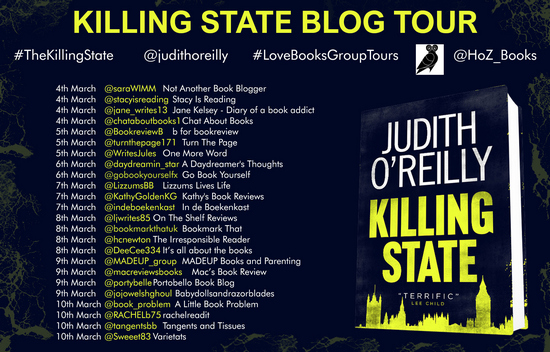
My thanks to Love Books Group for the invitation to participate in this tour and the materials (including the book) they provided.

—–

4 Stars

Head of Zeus
Love Books Group

BOOK SPOTLIGHT: Killing State by Judith O’Reilly

Today I welcome the Book Tour for the gripping Killing State by Judith O’Reilly. Along with this spotlight post, I’ll be giving my take on the novel here in a bit.

Book Details:

Book Title: Killing State by Judith O’Reilly
Publisher: Head of Zeus
Release date: March 7, 2019
Format: Hardcover/ebook
Length: 496 pages
Killing State Cover

Book Blurb:

WHAT IF THE PERSON YOU’RE ORDERED TO KILL IS THE WOMAN YOU WANT TO PROTECT?

Michael North, assassin and spy-for-hire, is very good at killing bad guys. But what happens when his shadowy bosses at the dark heart of the post-Brexit British government, order him to kill an innocent woman and North can’t bring himself to do it?

The woman is rising political star, Honor Jones, MP. She has started asking dangerous questions about the powerful men running her country. The trouble is, Honour doesn’t know when to stop. And, now that he’s met her, neither does North…

Praise for Killing State:

“A terrific future-shock thriller.” Lee Child
“Fast-paced and packed with action.” Mick Herron
“A gritty, action-packed page-turner.” Andy McNab
“New thriller writers come and go. I suspect this lady will stick around.” Frederick Forsyth
“Thought-provoking, pacy and thrilling.” Sunday Mirror
“Gripping and twisty” India Knight
“Grabs you from page one and won’t let you go… Action-packed from start to finish – but with tenderness and great characterisation too. Fast, sharply-written, clever and intense.” Jeremy Vine, BBC2
“A high-octane plot that centres around the dark heart of British political power. A great debut.” Sunday Times

About Judith O’Reilly:

Judith O'ReillyJudith O’Reilly is the author of Wife in the North, a top-three Sunday Times bestseller and BBC Radio 4 Book of the Week. Judith is a former political producer with BBC 2’s Newsnight and ITN’s Channel 4 News, and, when she isn’t writing novels, she writes for The Sunday Times. Judith lives in Durham.

Judith O’Reilly’s Social Media:

Website ~ Twitter ~ Facebook


—
My thanks to Love Books Group for the invitation to participate in this tour and the materials (including the book) they provided.

Head of Zeus
Love Books Group

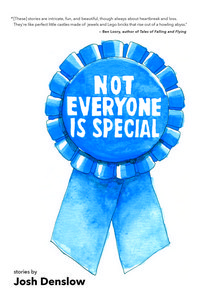
Not Everyone is Special by Josh Denslow: A Short Story Collection that’ll Gobsmack You at Least Once

Not Everyone is SpecialNot Everyone is Special

by Josh Denslow


eARC, 160 pg.
7.13 Books, 2019

Read: February 2 – 24, 2019

I’m not sure what to say about this collection of 15 short stories. They’re all really well-written — there was one or two I didn’t care for, two that I really liked — but they all showed skill, craft, and achieved what I think Denslow intended to achieve. But I’m not sure that I can muster up any excitement over the collection.

Some of the stories fall into the SF/Speculative Fiction category, but by and large these are “General Fiction” (whatever exactly that is). Some are comic, some are very tragic (I think you could make the case for all of the stories containing elements of both).

“Proximity” a bittersweet story about a young man on the brink of maturity (but resisting stepping over it) who happens to be able to teleport is one of the best things I’ve read in months. A great combination of imagination and story, that sadly, I read the same day I read the best novel I’ve read so far this year, and completely forgot about until I started flipping through this book again while writing this. (but, man, am I glad I remember it now…)

Then there’s “Mousetrap,” which starts with the line,

I want to find a not scary way to tell my sister that I’m contemplating killing myself, but I don’t want her to think that it has to do with the fact that she asked me to start paying rent.

And openings don’t get much better than that (the story lives up to it).

There are a handful of other really high high points in this collection. I can’t talk about “Dorian Vandercleef” beyond encouraging you to read it — but you really should. “Blake Bishop Believes in Love” is sweet, grotesque and unpleasant (intentionally so). “Extra Ticket,” a story about a teenager dealing (and not well) with grieving over a friend’s death would serve as a handy example of the concept of “poignant,” if you ever find yourself in need of one.

I might not be over-the-moon with this book, but I did like it. I can even see me being in a situation where I’d re-read parts or all of it (I don’t normally re-read short story books, but I’m not opposed to the idea). I would absolutely read more by Denslow — long form or short form. Not Everyone is Special is a good book — some of the stories might even be more than good. I’d absolutely encourage you to get your hands on this to judge for yourself. I promise you’ll find at least one story that’ll knock your socks off.

—–

3.5 Stars
Disclaimer: I received this book from the author in exchange for this post and my honest opinion, which is what I provided.
LetsReadIndie Reading Challenge

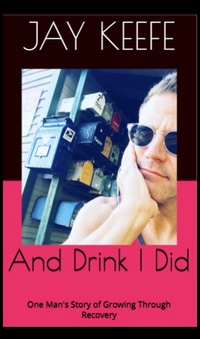
And Drink I Did: One Man’s Story of Growing Through Recovery by Jay Keefe: An underdeveloped, but powerful memoir of addiction and recovery

And Drink I DidAnd Drink I Did: One Man’s Story of Growing Through Recovery

by Jay Keefe


Kindle Edition, 154 pg.
2018

Read: March 2 – 5, 2019

This is one of those books that’s pretty well summed up by the title and subtitle. There’s not a lot more to say, really. But I’ll flesh it out a little — the first two chapters are primarily focused on his pre-alcohol life to gain some insight into his alcoholism. He begins by saying that he doesn’t know why he’s an alcoholic, he doesn’t know what made him one — moreover, it doesn’t matter. What does matter is that he is an alcoholic. That doesn’t stop him from thinking and writing about his childhood — not in an effort to justify or explain away his alcoholism, but to understand it. He explains some early emotional experiences, as part of this — and even his earliest memories of OCD.

This might be the closest I’ve gotten to understanding the compulsion’s sensation:

I didn’t feel right or complete until I had done specific tasks.

Even after I did them, there was still a lingering sense that something was off. When people ask me to describe it, the best I can do is to say it’s like an itch that can’t be scratched- kind of like when the top of your mouth tickles, and you use your tongue to scratch it, but it doesn’t really help because your tongue just isn’t the right instrument to scratch an itch.

It’s like that.

Kind of.

Then he explained his initial drinking experiences and how alcohol made him feel. It reminded me of a similar passage in Mose Kasher’s memoir of addiction.

I always felt a void and had no idea how to fill it.

Alcohol filled that void perfectly.

It took me out of myself.

I could relax. . . .

Alcohol quelled the OCD too.

I didn’t clean when I was drunk.

It didn’t bother me that things weren’t in their place.

I didn’t sweat the small stuff, so to speak.

And I knew I wasn’t sweating it. That was the beauty of it.

It’s so easy for people — especially for non-addicts — to pin drugs and alcohol use and abuse to people who are partying or having a good time and can’t stop. For Kasher, it was about feeling normal; for Keefe it’s about quieting the OCD, about not having the self-doubt and insecurities that plagued him. It’s about self-medicating. Addiction’s never more understandable to me than when I hear someone talking like that — who wouldn’t want that experience? Forget about feeling good, just getting to neutral — no problems.

Anyway, from there Keefe spends a few chapters talking about his experiences drinking — at one point he says that other addicts’ war stories never impressed him, and initially you get the feeling that’s hypocritical because he talks a lot about some of the stupid or out of control things he did while drinking. But he never glorified the experience, he never celebrates what happened — it’s just a list of things he did. Like reciting the tasks (largely routine) at work you completed one week. More than once I found myself wondering how Keefe is still living — and he probably did, too, while writing it.

He then talks about his early days of recovery — his early 12-Step days and when it started to work for him, and how that changed his life. How being sober didn’t fix all of his problems, and how he still has impulse control issues and what he’s done to minimize the problems that causes him. Then he discusses his current circumstances, with a few years of sobriety behind him — how he’s doing, what he’s doing with himself, and that he’s still an alcoholic, living in fear of stumbling.

Those last couple of chapters, in particular are really powerful.

I’m a little of two minds about this book — you can see from what I’ve quoted how this book reads. Paragraphs that are 1 or 2 sentences long (there are some that are a little longer), some aren’t even complete sentences. The book largely reads like a very detailed outline — at best like a good first draft. Also, the timeline’s a little fuzzy and his knack for not using names all the time when talking about his life doesn’t help keep things clear.

None of that keeps the book from making an impact. It’s moving, it’s powerful, and you have a very real sense of what he went through. So Keefe’s not Tobias Wolff or Frank McCourt — who cares? The book accomplishes what he sets out to accomplish, is insightful, touching and inspiring. That’s good enough for me.

—–

3 Stars
Disclaimer: I received this book from the author in exchange for this post and my honest opinion, which is what I provided.
LetsReadIndie Reading Challenge

Page 415 of 631

Powered by WordPress & Theme by Anders Norén