The Promise by Robert Crais

The PromiseThe Promise

by Robert Crais
Series: Elvis Cole, #14 / Joe Pike, #5
Hardcover, 402 pg.

G.P. Putnam’s Sons, 2015

Read: November 10 – 11, 2015


Elvis has been hired to find Amy Breslyn, from her pictures he says, “She looked like a sad version of someone’s marshmallow aunt: a kindly woman, slightly out-of-date, who wore sensible shoes and minded her own business.” But his client paints a picture of a woman who has been making some very unwise life choices lately, and she’s worried. Once Elvis scratches beneath the surface of Amy’s life, her recent lifestyle is far worse than “unwise.” Can the World’s Greatest Detective help her?

You strip away all the bells, whistles, multi-perspectives, co-mingling of series, and whatnot and you’ve got yourself a classic, prototypical Elvis Cole story. There’s a missing person that he’s hired to find, he goes through a bunch of stuff to find that person — ticking off a police department and a criminal enterprise in the process. At some point, he finds the person, but also discovers this person is in a world of hurt from the government/the criminals she’s crossed paths with, which he will try to extricate them from. Excitement, deception and bullets ensue. Pike does his thing. Elvis does his. Happy ending — or as close as you can get in this world we live in.

It’s with the bells and whistles that this one stands apart from your usual Elvis Cole book — which is both a good and a bad thing for the book.

Good, because we got to see so many characters that we enjoy and/or love interacting and teaming up.

But . . .

For the first few chapters it didn’t feel right — as an Elvis Cole book, it worked as a suspense novel — there was just too much bouncing around between the various point-of-view characters. By chapter 6 or 7, things settled down and back to what it should be. Still, The Promise probably stretches the limit of acceptable point-of-view characters: Mr. Rollins (the criminal we meet in the opening pages), Elvis, Joe, Jon Stone, Scott, and even Maggie — we’re an imp, a bastard and a khaleesi short of George R. R. Martin epic.*

It’s in trying to serve all these characters that the novel struggles — for example, I could’ve used more Pike. Sure, he’s effective when he’s around — but he’s barely around. After bringing in Jon Stone, Pike’s more of a backup than anything else — okay, fine, this was Stone’s kind of work. But still, if it’s listed as a Joe Pike novel we should see Joe do some Pike-level stuff. I don’t even think that Elvis said anything about him twitching the corner of his mouth in response to a joke! That might even disqualify it as an Elvis Cole.

Now, the Jon Stone material — especially his POV chapters — was great, and if it hadn’t been at the expense of Pike, I would write a healthy paragraph praising it.

The Maggie and Scott story might have been the most compelling part of the book. Scratch that, for me (at least, your mileage may vary) the Maggie and Scott story was the most compelling part of the book. It was fairly predictable, but executed so well that you just don’t care. This is a problem when they’re not the central figures in the book. I think the novel suffered from Spider-Man 3 Syndrome** — just too many characters running around to do a good job with.

I got enough of the Maggie and Scott material, same for the Jon Stone (except for the bit that you’re designed to want more of). But I needed more Joe being Joe, I wanted more Joe/Elvis interaction, more Elvis/Scott, more Elvis investigating, more — well, more Elvis, I guess is what I’m saying. Every time it seemed that the story was picking up steam and we were on track, we got someone else’s POV and had to start building momentum again.

Don’t get me wrong, I talked so much about the problems I had to fully explain them — I really enjoyed it, I just didn’t love it. After waiting so long, you’d hoped that this would’ve been dazzlingly great, instead The Promise will have to settle for being very enjoyable. Like I said at the outset, it’s a classic Elvis Cole story — and there are few things I’d rather read. I’m looking forward to re-reading this in a year or so, and I may put up a more favorable post when I do.


Okay, now that I’m thinking about it, who wouldn’t love to see Joe Pike smack Joffrey around a little bit?
8
I’d call it Batman Forever or Batman and Robin Syndrome, but those two had much worse problems than a plethora of characters

—–

4 Stars

Any Other Name by Craig Johnson

Any Other NameAny Other Name

by Craig Johnson
Series: Walt Longmire, #10

Hardcover, 317 pg.

Viking, 2014

Read: November 14 – 16, 2015

“I want to warn you that if you put Walter on this you’re going to find out what it’s all about, one way or the other.” Another pause, and I could imagine the face that was peering down at her, a visage to which I was accustomed. “You’re sure you want that? Because he’s like a gun; once you point him and pull the trigger, it’s too late to change your mind.”

There’s the problem, isn’t it? Walt won’t stop for anything once he starts. A perennial conflict in the Longmire series is Walt’s devotion to his friends/Cady and his duty as a sheriff (often more felt than real), part of its recurrence is because it always works as a plot device (as tired as it may feel — which is part of the whole thing, it’s just as tired for Cady as it is for the reader). Part of that is because I expect that it’s a strong reflection of reality (unlike, say the beating that Walt takes in this one and then the near super-human feats he accomplishes shortly thereafter).

Detective Gerald Holman shot himself — and did so in a fairly unusual manner. That aside, it’s a pretty cut-and-dried suicide. But his widow doesn’t buy it. Which isn’t that unusual, but because she doesn’t buy it, their old friend Lucian Connally doesn’t buy it — he’s just not that kind of guy. So Lucian drags Walt to the next county and gets him to investigate it — the sheriff there doesn’t see the need, but isn’t going to stop him. Lucian gives the widow the warning up above, and she agrees to it, as does Walt — even with the birth of his grandchild just days away in Philadelphia.

Along the way, Vic and Henry show up — as does a very unlikely friend of Walt’s from a couple of books back. Vic’s recovered physically from A Serpent’s Tooth, but the rest of her has a bit to go. Henry’s just Henry — and I’m pretty sure that’s all he’ll ever be. Walt befriends/drafts a local police officer, who also comes through for him in a pretty big way. Actually, meeting Officer Corbin Dougherty was one of my favorite parts of the book:

… he looked vaguely familiar….

“You date my daughter?”

“I did.” He blushed up to his blond crew cut. “The first time I came to pick her up you tossed me a shotgun shell.”

“I did?”

“Yeah, you said they went a lot faster after eleven o’clock.”

I nodded. “I used to think I was a tough guy.”

I liked this exchange for a few reasons: 1. It’s amusing, 2. It reminds me of one of the best exchanges between Raylan Givens and Wynn Duffy on Justified, 3. It illustrates the difference between Walt and Raylan. I don’t know if Raylan will ever get to the point where he could say that last line and mean it, but you know Walt did (and is probably embarrassed that he ever said it in the first place — Raylan may have rued uttering that to Wynn because of the fallout, but he sure wasn’t embarrassed).

The kinds of criminal activity that Walt turns up during his investigation of the suicide and Holman’s last cases that probably led him to it makes a guy miss Absaroka County and its apocalyptic cults, generations-long feuds, drug smuggling, serial killers and whatnot. But throughout it all, you know that Walt and his posse will bring justice to those who drove Holman over the edge.

To be honest, the ending of this one felt rushed — Walt had a hard deadline to meet, and so he had to rush things a bit on his end — and it felt like Johnson did, too. There was no cheating on the final reveal of his investigation — Johnson’s too careful for that, and he’s not one for red herrings, so you know the detail that leads Walt to the conclusion was important when you saw it the second time. But, I didn’t think it was well explained, the clues fit, but I didn’t see the motive working — at least not as given. It didn’t ruin the experience for me, but it took a little shine off of it.

—–
3 Stars

Blameless by Gail Carriger

BlamelessBlameless

by Gail Carriger
Series: The Parasol Protectorate, #3

Mass Market Paperback, 355 pg.
Orbit, 2010
Read: November 12 – 14, 2015

… a pitcher of some dark liquid that smelled like heaven. Floote poured a portion for her into his cup

Alexia took a tentative sip and was quite overwhelmed by an acute sense of betrayal. It was absolutely
vole tasting, a mixture of quinine and burnt dandelion leaves.

“That, I am to assume, is the infamous coffee?”

Madame Lefoux nodded, pouring herself a splash and then adding a good deal of honey and milk. Alexia could not believe a whole hive of honey capable of rescuing the foul drink. Imagine preferring that to tea!

It’s just a couple of weeks since the surprising twist at the end of Changeless, and Alexia is just beginning to see just how bad the fallout is going to be for her. Almost friendless, encouraged (strongly) to leave her family home, jobless, husbandless — she’s reeling. Then the vampires start to try to kill her. Which is a little more than anyone should be asked to take. So Alexia, Madame Lefoux and Floote take off for Italy to see if the Templars can shed some light on Alexia’s current predicament.

Big mistake. But you can discover that on your own.

Here in book 3, there’s not much to say — I seriously just love the way that Carriger writes, it’s just delicious. I enjoy the characters, the world, the conflict — and this is really just more of the same delightful prose that Carriger’s already given us. Beyond that? A few semi-baked thoughts is all you get out of me here:

  • I enjoyed the narration, the dialogue, and so on. Ivy writing a letter just might be better than Ivy talking — her malapropisms are too much fun. It was nice to see a responsible streak in her, nevertheless.
  • Floote’s hiding more than we previously thought, I hope something makes him crack.
  • The effects of garlic on vampires, and basil on werewolves in this world gave me a good chuckle.
  • At the end of the day, Professor Lyall shines brightest here — it’s been clear all along that he’s powerful, capable, and resourceful — but he really gets to strut his stuff here, while Lord Maccon is licking his wounds and drowning his sorrows. That was fun to see.
  • In between the assassination attempts, the bullets, the supernatural goings-on, and everything else, there were a couple of really sweet moments. Making everything just a little more human.

If you enjoyed the first two volumes of this series, I bet you’ll enjoy this one. If you haven’t enjoyed those — why are you reading this? This particular Book 3 is not a jumping on point — go back to Soulless and start from there. You’ll be glad you did.

—–

3 Stars

Saturday Miscellany: 11/14/15

Odds ‘n ends over the week about books and reading that caught my eye. You’ve probably seen some/most/all of them, but just in case:

  • Worldbuilders 2015 — It’s that time, folks. Who’s ready to make the world a better place while winning fabulous prizes?
  • Unpublished Charlotte Brontë Works Discovered — sure, they might be the 19th Century equivalent of Go Set a Watchman, but they might not be…
  • Raymond Chandler Didn’t Care About Plot — I found this fascinating, and something I’m going to have to read a few times — Chandler on American English, plot, and detective fiction.
  • Why You Should Read for 20 Minutes Every Day — drawing upon research we’ve looked at before, but you can never read this kind of thing often enough
  • The End Of The End Of The World — “Everyone loves a good apocalypse. But some writers are opting for optimistic, solution-oriented sci-fi instead.”
  • Similarly, New Republic ran this piece: The New Utopians — “Kim Stanley Robinson and the novelists who want to build a better future through science fiction.” I’m not sure I buy all this, but it’s food for thought.
  • On the other end of the spectrum, closer to our time, and a lot less optimistic, Free Beacon ran Mizzou and the Master of Our Universe — how Tom Wolfe is the right filter to see current events through. Not just a great look at Wolfe, but some pretty sharp thinking, if you ask me.
  • After all that heavy stuff, we turn to Bustle’s 11 Books That Will Put You In A Good Mood
  • The books of our souls — on Rereading and what it tells us. I really like this one, wish I’d written something very much like this

    This Week’s New Releases I’m Excited About and/or You’ll Probably See Here Soon:

  • The Promise by Robert Crais — is finally out and was worth the wait. Trying to finish my post on this one now, just what his fans wanted.
  • Winter by Marissa Meyer — The Lunar Chronicles concludes and from what I hear, it goes out strong.
  • Rules for a Knight by Ethan Hawke — this looks fascinating
  • Dear Mr. You by Mary-Louise Parker — An epistolary memoir, I guess is what you’d call this. If only for style, this looks interesting.
  • Home by Matt Dunn — you can’t go home again, right? But why?
  • Mad Men Carousel: The Complete Critical Companion by Matt Zoller Seitz — some of the best writing you’ll find on one of the best shows you’ve seen.

Thanks to Dessa for the interaction — you need to check out her series Cover to Cover (and the rest of the blog, too). Also, thanks to Obsidian Blue and Dany Spike for the conversation over on the BookLikes version
.

Never Tell by Alafair Burke

Never TellNever Tell

by Alafair Burke
Series: Ellie Hatcher, #4

Hardcover, 348 pg.

HarperCollins Publishers, 2012

Read: November 9 – 10, 2015

Ellie Hatcher and her partner, Rogan are called to a very nice townhouse to start investigating a homicide. At least that’s how it was called in. As far as the EMTs, the police officers that were first on the scene, and Ellie’s instincts are concerned, it was a suicide. But the distraught mother has money and is married to a music producer of some note, so when they squawk “murder”, Rogan and Hatcher at least have to spend some time considering it one.

There are a number of little signs all along that point to homicide, but suicide is obvious, easy, and quick to handle. Even as evidence starts to pile up, Ellie resists seeing suicide. The greater part of this is written as her coming to grips with her father’s all those years ago. I didn’t buy that explanation, really — I couldn’t see why Ellie hadn’t jumped in with gusto, just in case. That seems more consistent with her character than this cynical cop we see here.

There’s another story here — somewhat tied to the other, but you’re never sure just how much it’s tied together until the end. A woman who was repeatedly raped by her mother’s boyfriend a decade or so ago, is seeking healing, seeking to tell her story. So she starts an anonymous blog, “Second Acts: Confessions of a Former Victim and Current Survivor.” But she starts receiving threats, threats that demand to be taken seriously (but not enough to involve the police until she’s forced to) — which just empower her to continue. At a certain point, the threats become more personal, and maybe the anonymity isn’t as strong as the blogger thought. You’d think following 212 that Hatcher and Rogan would be more willing to believe the level of violence threatened here, but they don’t seem to take it seriously until forced to either (although, once this lands on their radar, they handle it better than the suicide/homicide).

I liked — as characters, not necessarily as people — the mourning mother and most of the social circle of the dead girl, and the lady who runs the homeless shelter. But everyone else pretty much left me cold. Jess had so little to do this time, it’s a wonder Burke used him at all. The Max storyline was okay, but seemed a little pat and tired — especially in the way that Ellie and Max reacted to each other. I’m not looking for much out of that part of the series, but I’d like something interesting. Nothing Rogan did really caught my attention, he served as an okay foil for Ellie/someone to spur her on, but it really could have been any other character doing the same. Thankfully, the stories were strong enough to keep me invested.

In the end, this is a solid mystery, with plenty of red herrings and half-told-truths to keep the reader and the detectives questioning what they see in front of them. Ellie Hatcher continues to be a character worth spending time with — even when she’s wrong.

—–

3 Stars

The Sword of Summer by Rick Riordan

The Sword of SummerThe Sword of Summer

by Rick Riordan
Series: Magnus Chase and the Gods of Asgard, #1

Hardcover, 491 pg.
Disney – Hyperion Books, 2015
Read: November 6 – 7, 2015

Maybe you’re thinking, Oh, Magnus, you didn’t really die. Otherwise you couldn’t be narrating this story. You just came close. Then you were miraculously rescued, blah, blah, blah.

Nope. I actually died. One hundred percent: guts impaled, vital organs burned, head smacked into a frozen river from forty feet up, every bone in my body broken, lungs filled with ice water.

The medical term for that is dead.

Gee, Magnus, what did it feel like?

It hurt. A lot. Thanks for asking.

Welcome to Rick Riordan’s latest tale of the offspring of mythological deities and the humans silly enough to fall for them. We’ve done the Greek pantheon, spent some time with the Egyptians, and came back for another round with the Greeks — this time with their Roman counterparts, but now we’re in for something new: Norse mythology. A whole new kettle of fish. This involves a new type of central character, a new kind of setting, new challenges. Which gives us the best thing from Riordan since the Percy Jackson & the Olympians series.

Magnus Chase is a homeless teen, orphaned a couple of years back when his mother was killed. Since then, he’s lived on the streets of Boston, spending his days in museums and libraries, learning as much as he can about whatever, and establishing relationships with generous restaurant employees and fellow homeless people. Two of whom track him down one day to let him know that there are people looking for him. It turns out that this is his sixteenth birthday and life just got a lot more dangerous for him. The people seeking him are family and they’re sure that he’s about to be hunted by beings he doesn’t believe exist.

The quotation above shows how well that being hunted works out for Magnus.

But he goes down fighting — to save himself, bystanders, and a couple of friends. So a Valkyrie (who happens to be Muslim, a combination that fascinates me) takes him to Valhalla — where he makes some more interesting friends, and enjoys a quality of (after-)life that’s far better than the streets. But then, someone casts doubt on the worthiness of his selection, which puts that Valkyrie in hot water.

So now Magnus has to take things into his own hands, prove that he’s worthy, defend the Valkyrie, and prevent Ragnarok from starting — or, if things go wrong, kick it off. It could go either way, really. One of the best pieces of advice he gets — the thing that inspires him is:

The thing about fate, Magnus: even if we can’t change the big picture, our choices can alter the details. That’s how we rebel against destiny, how we make our mark.

Now it’s just a question of what kind of mark he leaves.

Love, love the voice/attitude, I’ve seen some criticisms of it from parents, but I think it’s fun, and it’s just the kind of thing to feed into his audience (both the target and those who’ve grown up reading Riordan and still read him despite no longer being age-appropriate). It’s the clearest, crispest, funniest narrative voice since the Percy books — and might end up surpassing them by the end of this series.

I really don’t know that much about Norse mythology — world tree, Ratatoskr, Asgard, Valhalla, Odin, ravens, Hel, etc. I’ve got, but the details are really fuzzy. Most of what I know about Norse myth comes from Kevin Hearne’s Iron Druid Chronicles and Jacqueline Carey’s Daisy Johanssen/Agent of Hel Urban Fantasy books. So I’m learning a lot — and I assume younger readers will, too. The few pages of supplemental materials in back of the book are such a nice help! I really enjoy Riordan’s take on these mythological figures — both those I know and those I’m new to. I think the Thor you meet in these pages is fantastic. Yeah, Hearne’s Thor is a better character, but Riordan’s Thor induced more chuckles.

There are some great chapter titles here — I tend to ignore them (anything beyond a number is a distraction), which is short-sighted, I realize, but that’s what I do. In this book? It’d be really dumb to skip them. Every now and then I’d stop to go back and read the last few that I’d missed. If they’re not the funniest (and most creative) lines in the book — they’re in the top 2%.

The tie-in to the Percy Jackson books is obvious (and I felt really stupid having to have it spelled out for me in the opening chapters rather than sussing it out much earlier) and unexpected, but I can’t wait to see how that develops. But even more entertaining are the jokes about aspects of the Percy-verse — flat-out funny, and nice bit of fan service, too. Oh, and they won’t make a lick of difference to the Riordan-novice.

I just realized that I haven’t even addressed the titular sword. I don’t know what to say about it without ruining anything, but if I was eleven years old? It’d be my favorite sword ever — better than Excalibur or anything that Tolkien could offer (as someone much older than 11, I don’t think that, but I wouldn’t argue with my younger self).

One other thing — I read a review from one review site that I respect that dampened by enthusiasm for getting this — but I decided that Riordan had earned my trust (and I was curious), so I gave this a shot. That review complained about the sarcasm — I don’t get that, but apparently that’s a thing for some parents. And they complained about the addition of cussing — now maybe I missed it, but outside of the taking the names of Norse gods in vain (and that could be argued), the only cussing I saw was in dialogue tags. As in “…,’ he cussed.” Seriously? If we have to shield our middle graders from the concept of cussing, they’re not going to survive the middle grades. There were a few other complains that were about as baseless as these — I kept waiting to see these problems as I read and missed every single one.

Which isn’t to say this is a perfect book — but man, it’s the best he’s done in quite a while. The problems I have are really not worth getting into, they don’t ruin the experience, and if you’ve read Riordan before, you’ll be expecting them (they’re less problematic in this book than the last 2-3). The Sword of Summer is funny, exciting, with real heart — just the thing for middle grade readers (or those who don’t mind reading below their fighting weight).

—–

4 Stars

X by Sue Grafton

this is rushed, I’m having Internet shortages this week (long story, don’t ask), so I want to get this posted while I can. I may end up polishing it up within the day, if there are problems/typos/incomplete sentences, etc. — leave a comment

XX

by Sue Grafton
Series: Kinsey Millhone, #24

Hardcover, 403 pg.
Marian Wood Books/Putnam, 2015
Read: October 28 – 30, 2015

I’d forgotten how slow these books start, if I didn’t have confidence in Grafton built over 23 previous novels, I don’t know if I’d have kept going. By page 100, I was curious about both mysteries, engaged enough to keep going – but still no serial killer, no interesting crime — a lot of X’s in character names and whatnot — enough that you know Grafton intended them. The highlight had been meeting Cheney Phillips’ mom, fer crying out loud! You’d think with just three books in the series remaining, Grafton would be pulling out all stops to make this dazzle the readers, but nope. This book is possibly the most subtle, where the actual mystery, the heart of the book is lost in the midst of the mundane — not unlike actual life. Really, most of this book was the Adventures of Kinsey Millhone, Busybody with Too Much Time on Her Hands.

By this point, if we know nothing else, we’ve learned that you do not move into Kinsey and Henry’s neighborhood. If Kinsey decides she doesn’t like you, your life is going to be pried into, turned upside down, and — ultimately — you’ll find yourself living somewhere else. Gladys Kravitz has nothing on Kinsey. Now, whether it’s a gold-digger sniffing around Henry, an insane nurse, or what have you, Kinsey’s gut has been right — but she can’t bat a thousand, can she? Still, Henry gets some new neighbors who get him to run all over town on their behalf while he obsesses with a potential drought and water rationing — and by obsesses, I mean he turns in to Adrian Monk. Kinsey sees them taking advantage of Henry and steps in. I really didn’t like this storyline — Kinsey came off as a shrew (and, yes, I get it — part of this series has always been showing her warts and all — still, I want to expect more from her), no matter how rude and manipulative and possibly worse these new neighbors may be.

There’s another storyline that’s kicked off in the Prologue — I noted after reading it that we wouldn’t return to that for 300 pages or so. I was off by about 100, a mistake I’m willing to make. But it didn’t come back in the way I expected. Kinsey is hired for a job, and after completing it, she’s visited by the police, and she learns that she wasn’t working for who she thought she was — and that’s just the beginning of the problems — so she starts digging into her client, and what that client wanted her to accomplish anyway. This is one of the strangest, and possibly the most pointless, mystery Kinsey’s reported to us. With an oddly sentimental ending.

Pete Wolinsky, investigator of dubious morality from W is for Wasted (and Kinsey’s early days as a P. I.) turns up again. His widow, Ruthie, is facing an IRS audit and asks Kinsey to look through the papers she still has of his laying around for any financial records. Kinsey gets around to it eventually, and in the process finds some well-hidden materials and a coded message. Henry, puzzle-writer extraordinaire, decodes it and comes up with a list of names — some of which have a connection to one of Pete’s cases that Kinsey was aware of, but the rest are a mystery. This starts needling at Kinsey’s curiosity (which is already purring along thanks to the mysterious client above), and she starts going over Pete’s tracks, trying to see what was so important that he would feel compelled to leave notes in a code. Not only does this involve going back over Pete’s case, but decades before — and then back to the present. The rocks she turns over reveal a good deal, and maybe even help Kinsey learn to appreciate Pete in a way she should’ve while he was still with us.

We do check in with Jonah Robb, Robert Dietz, and the aforementioned Cheney Phillips, but nothing happens at all even approaching romance. Which is fine by me, Kinsey on her own is more interesting than Kinsey trying to make things work with a guy. Naturally, we spend a little time at Rosie’s and see William make a bold fashion choice. Yeah, it’s just that exciting a book.

There’s a character early on that the reader (and Kinsey) pegs as the major villain of the piece, but he’s never focused on to the exclusion of all the other moving pieces, so that when things get serious and dangerous, it’s almost as much of a surprise to the reader as it is to Kinsey. I think the way Grafton pulls off handling the storyline, letting the danger get hidden in the shuffle is what made me rank it so high. Actually, as I write this I’m wanting to rank it lower, but I’m going to trust my initial judgment on this (but honestly, I’ve read a couple of 2 star reviews for this that I wholeheartedly agree with). It was nice going back to Santa Teresa to spend time with the old gang, but I’m really hoping Grafton makes these next two a little more worth the effort.

—–

4 Stars

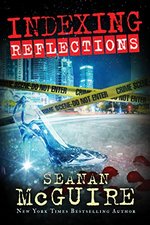
Indexing: Reflections, Episode Seven: False Love’s Kiss by Seanan McGuire

Indexing: ReflectionsIndexing: Reflections, Episode Seven: False Love’s Kiss

by Seanan McGuire
Series: Indexing, #2.7

Kindle
47North, 2015
Read: November 5, 2015

So we were going to do this the hard way. Fine. I’m Sloane Winters: I invented the hard way. “You want to ignore what’s right in front of your faces, that’s okay by me. I’ll just laugh even harder when it turns around and bites you. Assholes.”
“Thanks for the motivational speech, Sloane,” said Andrew, wrinkling his nose. “Any time I start to feel like things are going well, all I have to do is remember your contributions to this team.”

Henry’s a cool character, but man, Sloane is just a fun narrator — assuming that things get back to their heightened “normal,” I’m going miss her.

So there’s a Fairy Tale incursion, a Godfather Death, that I’ve never heard of — but man, it doesn’t sound like fodder for a Disney movie, I’ll tell you that. Opening with this is a great setup for the chapter — there’s drama, a little action, and a few laughs. Have I mentioned I really enjoy reading about Sloane?

Then things take a turn for the dramatic — Henry’s back from her little mission, but . . . something’s not right. Even if it has nothing to do with stopping evil/saving the world, I hope they can take care of whatever’s not right just for Jeffrey’s sake. And then we get a Rapunzel in action — and a not-so-typical Sloane solution.

I’ve enjoyed what we’ve seen from Ciara so far — but her working on the locks, and how she describes it? It’s just gold. Probably the highlight of the episode. I hope, if there’s another sequel, she doesn’t disappear into HR.

I think having this chapter before the last would’ve been more interesting — just to see if we’d have been able to figure why Sloane’s Spidey-Sense was going off, without a very strong possibility having been talked about last chapter. Even if I’m wrong, watching this unfold is going to be very interesting. Possibly more interesting than seeing what happens with Birdie and Elise.

—–

4 Stars

Saturday Miscellany – 11/7/15

Odds ‘n ends over the week about books and reading that caught my eye. You’ve probably seen some/most/all of them, but just in case:

  • How DeLillo Nailed Us in ‘White Noise’ — Man…I need to re-read this novel. My first blog was called “White Noise” because of this book, and it’s been far too long since I’ve let it nail me.
  • Literature vs. Genre – Seconds out (Part 1) — Mike Carey — a heckuva UF/Horror/Comic writer — writes a pretty good piece on this recurring theme. I particularly appreciate the line (as apparently the editors did, as they used it as a pull quote), “One thing you tend to notice after a while, though: it’s almost never writers of genre fiction who are picking the fight.” Killer last paragraph, too.
  • The Guardian ran a nice Q & A with Nick Hornby this week. He was also on The Nerdist Podcast today, the first 20 minutes have been fun, looking forward to getting to hear the rest.
  • TIME magazine had a little tidbit from George R. R. Martin on the ending to Game of Thrones.
  • Rick Riordan dropped some news last week.
  • The Case of the Missing ‘Encyclopedia Brown’ Movie — not only an interesting piece about the past and future of filmed adaptations, history of the series (that meant so much to me as a kid) I was unaware of.

    This Week’s New Releases I’m Excited About and/or You’ll Probably See Here Soon:

  • The Crossing by Michael Connelly — I’ve tried really hard not to learn anything about this book featuring Harry Bosch and Mickey Haller, but what little has slipped past my defenses has: A. ruined a bit of The Burning Room, which I hope to get to next week; and B. whet my appetite for this one.
  • Made to Kill by Adam Christopher — I don’t know if I can read this without constant comparisons to A. Lee Martinez‘s The Automatic Detective, but it’d probably be worth a shot.
  • The Builders by Daniel Polansky — Anthropomorphic animals in a dystopian-looking world. Myke Cole‘s blurb seals it for me: “Nobody does dark like Polansky. The Builders is Redwall meets Unforgiven, combining the endearing wit of Disney’s Robin Hood with all the grit and violence of a spaghetti western.”
  • The Ark: Children of a Dead Earth Book One by Patrick S. Tomlinson — S.F. P.I. novel in a great setting.
  • Black Wolves by Kate Elliott — a fantasy world going through cultural/religious/etc. changes. She wrote a Big Idea on Whatever for this.
  • Mystic by Jason Denzel — a great-looking epic fantasy that’s not that epic. There’s a Big Idea for this, too.

Lastly, I’d like to say hi and welcome to Wizard for following the blog this week, and to Obsidian Blue and Marjorie for following the Booklikes version.

Reread Project: Suspect by Robert Crais

SuspectSuspect

by Robert Crais

Hardcover, 309 pg.
G.P. Putnam’s Sons, 2013

Read: November 3, 2015

This isn’t steel and nylon. It’s nerve. You clip one end to you, you clip the other to this animal, it ain’t for dragging him down the street. You feel him through this nerve, and he feels you, and what flows through here flows both ways — anxiety, fear, discipline, approval — right through this nerve without you and your dog ever even having to look at each other, without you ever having to say a word. He can feel it, and you can feel it. too.

Thus spake Dominick Leland, LAPD K-9 corps’ sergeant and alpha. It’s that kind of devotion to the animals that characterizes this book. These people take their dogs seriously (well, it takes Scott a little bit, but that’s the point), almost too seriously.*

Someone on the Facebook Robert Crais FanClub mentioned re-reading this to prepare for the release next week of Crais’ The Promise which will feature (who knows how much) the two stars of this novel. Seemed like such a good idea, I pounced on it, too. So glad I did, I remember really liking this book, but I didn’t remember how much I really, really, really liked this book.

This is the story of two partners grieving the loss of their most recent partners, and recovering from wounds both physical and psychological while trying to move past the trauma by gearing up for a new assignment for the future. One of the pair is a once-SWAT-bound LAPD officer, and the other is a former explosive sniffing German Shepherd with the Marines in Afghanistan. Which adds a bit of novelty to the situation.

That Prologue is one of the most effective opening chapters I can think of — it’s like the first ten minutes or so of Pixar’s Up — warmth, purpose, courage, heartbreak — there’s almost nothing more you could ask of it.

I love the way Crais describes Maggie’s sniffing/scenting for work. For that matter, Maggie’s perspective in general is great — not goofy or cartoonish, played for laughs or anything like that. Sure, some of it is projection, some of it is just guess-work, some of it is poetic license — but it’s all good, authentic, writing.

I guess the same could be said for what Officer Scott James goes through — I don’t know what PTSD is like, really. I just know about it from various literary/dramatic sources. But this sure seems to work — the guilt, the fear, the stress, the nightmares, the obsession, it rings as true. Granted, Maggie’s got a greater emotional pull (who doesn’t love a good dog?), and is a little less familiar than Scott — but at least we can relate to his suffering and him.

As with almost everything Crais writes, this takes place in the world inhabited by Elvis Cole, Joe Pike and the rest. We see that by a brief interaction between one of the detectives and John Chen (who as also mentioned by name earlier). Brief interactions with Chen are probably the best for all involved, and here he was John Chen at his John Chen-iest — I just love it. Although thanks to Gotham, I’m getting an Edward Nigma-vibe off of him, thankfully, I know better. (right?)

From the start, this gets you right in the emotions, and Crais keeps you there. You’re drawn to Maggie, and because of her, Scott. You get invested more easily than with other new characters because of Maggie With about 40 pages to go, even though I knew how it ended, I still was tense. That’s good writing. Period. End of discussion. And for the record, my eyes totally did not get misty at the end, I don’t know why you’d ask.

When I blogged about this back in 2013, I said “I don’t think this is the best Crais novel . . .but, given the way this worms into your heart, it’s probably my favorite.” It’s still probably not his best, but it’s better than I thought it was initially (I was more concerned with plot and character than craft, I think) — probably in the top 5, and it is my favorite so far.

—–

* Yeah, totally kidding. Not possible to be too serious about your dog.

—–

5 Stars

Page 545 of 626

Powered by WordPress & Theme by Anders Norén