Saturday Miscellany — 1/3/15

Odds ‘n ends over the week about books and reading that caught my eye. You’ve probably seen some/most/all of them, but just in case:

  • Pulp’s Big Moment: How Emily Brontë met Mickey Spillane. — The Birth and Early History of Pocket Books (paperbacks).
  • Phew, only 2 more Best of 2014 lists to post here — I’m working on mine, wanted to have it up yesterday, but . . .hopefully Monday (and by saying that, I’ve doomed it ’til Friday)
  • How to Write a Book Review — Author J. S. Morin provides some handy (and pain-free) guidelines
  • 31 New Year’s Resolutions for Book Nerds — I really liked — even admired — some of these resolutions from the B&N editors — some I thought were just wrong.
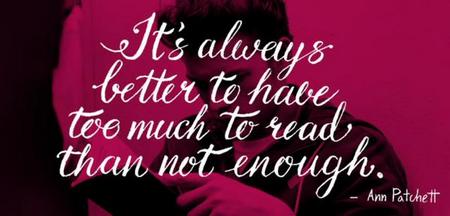
  • Speaking of resolutions, How To Read More — A Lot More — Ryan Holiday has some really helpful advice if this is one of your goals. There’s a thing or two here I should incorporate. (I may have posted this one already, but I’m too lazy — and have too much to read — to go check).
  • How to read more — Austin Kleon was inspired by Holiday’s list and has some other useful suggestions.
  • In an odd coincidence, the other day I came across another reference to Kleon’s blog — a post he put up in 2009 about Nancy Pearl’s “The Rule of 50”, which is so good that in addition to the link, I’m just going to copy here:

    Believe me, nobody is going to get any points in heaven by slogging their way through a book they aren’t enjoying but think they ought to read. I live by what I call ‘the rule of fifty,’ which acknowledges that time is short and the world of books is immense. If you’re fifty years old or younger, give every book about fifty pages before you decide to commit yourself to reading it, or give it up. If you’re over fifty, which is when time gets even shorter, subtract your age from 100. The result is the number of pages you should read before deciding.
    from Book Lust

    Only 1 New Release I’m Excited About this week — but it’s a great way to close out 2014. January’s new releases just might kill me, but we’ll get to that next week:

  • Low Midnight by Carrie Vaughn — Cormac takes over! Well, at least for one book. Psyched to read this one.

Lastly, I’d like to say hi and welcome to Manny Rutinel for following the blog this week.

As You Wish: Inconceivable Tales from the Making of The Princess Bride by Cary Elwes with Joe Layden

As You Wish: Inconceivable Tales from the Making of The Princess BrideAs You Wish: Inconceivable Tales from the Making of The Princess Bride

by Cary Elwes with Joe Layden

Hardcover, 259 pg.
Touchstone, 2014
Read: December 31, 2014
I’m not the world’s biggest Cary Elwes fan — I’ve never not enjoyed him, but I’ve never sat down and said “I should find an Elwes movie to watch” or “oh, Elwes is in that movie/show? Gotta watch it now.” So when I saw this book on the shelves, I thought “how nice for him that he wrote a memoir,” and since he was in his Dread Pirate Roberts getup that he’s not one of those actors who’s running from the one thing that made them “big.” But I had no real interest in reading it — enough so that I didn’t even read the subtitle, which probably would’ve piqued my interest.

So it wasn’t until he was a guest on Kevin Pollak’s Chat Show that I learned anything about the book (audio version is here, the video version is here and either would be well-worth your time) and decided I really wanted to read this book.

This is also one of the biggest reasons not to read the book — Elwes tells about half the stories in the book during the interview. And hearing him tell them, clearly enjoy the memories, and do pretty good impressions and entertaining voices while doing so is more enjoyable than reading them after the fact.

Still, I’m glad I read the book — there are plenty of other stories about the making of that wonderful movie, some details he doesn’t give of the stories he did — and some bits from interviews that Elwes and/or the writer working with him did with the cast, director, writer and producer. I laughed out loud at one of the new stories, and enjoyed many of the others.

It’s clear that Elwes loved making this movie and the way it’s become a favorite of so many. There are some funny stories (most of them), some interesting behind the scenes stuff, and some perspective on his fellow cast members.

Particularly, this book reads as a mini-tribute to Andre the Giant. If there’s a good biography of him, I should track it down, the man had a fascinating life. This book needs to be read for the story of Andre the Giant farting during filming alone — I promise that it will make your inner-8-year-old boy laugh (even if you’re a grown woman who didn’t realize you had an inner-8-year-old boy).

Not the best book I’ve ever read about making a film, but probably the warmest. A very pleasant read, and I’d really recommend it to fans of The Princess Bride. I’ve got to find the time to watch the movie now…and maybe re-read the book, too.

—–

4 Stars

Thanks for a Great 2014

So, that’s 2014, eh? 169 books read (short of my goal by 21), 211 posts (short of my goal by a couple hundred), almost triple the traffic over last year.

I did a quick breakdown of how my reading broke down by genre over the last few years. There were a few anomalies this year (what’s up with my Urban Fantasy and General Fiction numbers?) which makes it interesting for me, anyway — don’t know about the rest of you.

Genre 2014 2013 2012 2012-2014
Fantasy 11 (7%) 15 (8%) 12 (6%) 38 (7%)
General Fiction/Literature 7 (4%) 30 (16%) 30 (14%) 67 (12%)
Humor 3 (2%) 0 (0%) 0 (0%) 3 (1%)
Mystery/Suspense 62 (37%) 63 (33%) 73 (35%) 198 (35%)
Non-Fiction 4 (2%) 2 (1%) 11 (5%) 17 (3%)
Science Fiction 17 (10%) 14 (7%) 11 (5%) 42 (7%)
Steampunk 3 (2%) 3 (2%) 11 (5%) 17 (3%)
Theology/Christian Living 42 (25%) 37 (19%) 10 (5%) 89 (16%)
Urban Fantasy 20 (12%) 26 (14%) 48 (23%) 94 (17%)
Western 0 (0%) 0 (0%) 1 (0%) 1 (0%)

Hopefully everything will be higher next year — books, posts, and traffic. We’ll see — I’m doing the Goodreads Challenge again (same goal as the last 2 years, 190) and I think I’m going to try to work in The Book Riot 2015 Read Harder Challenge
. I might throw in a couple other “projects” that I’ve been thinking about.

Broken Soul by Faith Hunter

Broken Soul (Jane Yellowrock, #8)Broken Soul

by Faith Hunter
Series: Jane Yellowrock, #8

Mass Market Paperback, 329 pages
Published October 7th 2014 by Roc
Read: December 27 – 30, 2014
In many ways, Broken Soul functions merely to clear the deck of lingering plot lines, tie up a few loose ends, and set things up for the next few novels. But wow – what a way to accomplish all that!

There’s murder, mayhem, romance, torture, destruction, intrigue, a whole new supernatural species, bombs, tattooed vamps, a whole lotta secrets revealed, and Sabina cracks up at something Jane says (which is as strange and creepifying you’d think).

While everyone’s adjusting to the new status quo after the shakeup in Black Arts, the New Orleans vampires receive word that the Europeans are coming for a visit. And maybe to invade and take over a more hospitable part of the world for the Mithrans. So Jane, Del and the rest start to prepare — when said new species (new to us readers, not to the vampires) attacks. And honestly, all the most powerful vampires in The Big Easy and everyone’s favorite skinwalker are no match for the beastie.

Then things get worse. Possibly the best fight scenes that Hunter’s given us are here — two or three of them, actually.

While her professional life is getting even more interesting than usual, Jane’s personal life gets put in order — and shaken up, but in a good way.

On the tamer side of things is a section of the book where Jane realizes two things about herself: 1. She’s put down roots in New Orleans (and in the lives of people like Eli and Alex) and 2. (her words) she’s become a girl — with girly tastes and clothes. This was some good, earned character development that Hunter pulled off with a lot of humor.

For my taste, the sexyfuntime was a bit too prolonged and detailed — we could’ve left those two a little more privacy. Then again, it never came close to The Wise Man’s Fear, so I shouldn’t complain.

There was a point or two that I was a little worried Hunter was going to back to the ‘I realized I’d said that out loud” well too often. But the line worked every time, so, who am I to say what’s too often?

Hunter’s clearly got some big things in store for Janie and the rest — I can’t wait to see what that’s going to be. So glad there’s only a few months until the Dark Heir. This would work as a jumping on point to the series if you’re looking for one, but you’d be better off going back to the beginning.

—–

4 Stars

Broadchurch: A Novel by Erin Kelly (based on the story by Chris Chibnall)

Broadchurch: A NovelBroadchurch: A Novel

by Erin Kelly

Hardcover, 448 pg.
Minotaur Books, 2014
Read: December 25 – 26, 2014It’s difficult for me to get the proper perspective on this one. I’ve watched the series this novel is based on multiple times, I watched all of the FOX adaptation, Gracepoint, I’ve thought and talked about the events surrounding the death of Danny Latimer (or Solano) more than people should. Which makes me either the ideal reader for this, or the worst. I’m not sure. Honestly, when this book came out, I was intrigued, but not that compelled to give it a shot until I read that hints for the second series would be included.

I’ve got a few ideas what those hints might be, but really, there’s not much here that wasn’t on the screen (which is as it should be). Still, it was a good use of time, I thought.

The advantage of Kelly’s novel over the series is in the details, the little things she can point out that the viewer might miss, or that the camera couldn’t show. We see the Ellie’s blowup about Hardy’s ubiquitous lists building up. There’s breathing room for small, quiet moments like those early on between Rev. Coates and Danny’s grandmother. You can tell there’s a relationship between them in the show, but we get to see some of it here, which is nice.

Kelly nails — absolutely nails — the relationships between the characters, in all the nuances, all the humanity these characters were imbued with. The loves, the friendship, the banter, the . . . distrust, the antipathy, the suspicion . .. all of it.

The biggest things the novel has going for it is that we get a get a better sense of the effect this death has on the community. We’re told that it is in the show, but here we’re told, but we also see it in ways beyond Becca’s inn being too vacant.

Kelly does make a few tweaks — notably when things happen, honestly, the timeline makes a bit more sense to me — and is definitely clearer, we get a much better sense how long things go along. One change is that Chloe (the sister) isn’t in school when she takes off and goes to hang out with her boyfriend (it seemed to early for her to be in school, but a good way to demonstrate her trying to get back to normal life). Anyway, the changes she made were small — almost unnoticeable — and entirely forgivable (when they weren’t improvements).

Kelly gives almost no physical descriptions of anything or anyone. I wouldn’t know what Rev. Paul Coates looked like if I didn’t know what Arthur Darvill looked like. You get a tidbit or two about Hardy’s height, Tom Miller and Danny Latimer’s hair (and Joe Miller and Nige Carter’s lack of it), Becca Fisher’s looks. But on the whole, there’s practically no physical description of the characters. Which is fairly annoying — especially for those who read the book while skipping the series, I’d think.

At the end of the day, this is a gripping story about the first murder in a small town’s living memory and what happens to everyone it touches. There’s hope, there’s despair (lots of it), there’s love, there’s . . . eh, I said it before, I’ll just say it again: humanity.

Watch it, read it — do both. This is a heckuva story.

—–

3.5 Stars

Endsinger by Jay Kristoff

Endsinger (The Lotus War, #3)Endsinger

by Jay Kristoff

Hardcover, 432 pg.
Thomas Dunne Books, 2014
Read: Dec. 16 – 23, 2014

Let me show you what one little girl can do.

Of course, if you’ve read the first two novels in The Lotus War, you’ll know the list of what this one particular little girl can’t do is probably much shorter. The only question at this point is, can one little girl survive?

Kristoff has quite the wringer to put you through before you get the answer to that. For example, within the first thirty pages — thirty — Kristoff reveals something about a character I’d grown to have a certain affection for, and pitied after what happened to them in the previous book which makes me question everything I thought about them. And then he does something to that character I’m not sure I’ll forgive him for (will still read him, don’t get me wrong, I’ll just bear a grudge).

On the other hand, Endsinger is filled with so many fist-pumping moments, and fun sentences — like

Hiro laughed like a man who’d only read about it in books.

that you can keep pressing on — and actually enjoy the book. Another example of this:

Michi’s foot connected with the Inquisitor’s groin like a redlining goods train. It was the kind of kick that made one’s testicles throw up their hands and move to a monastery in the Hogosha mountains. It was the kind of kick that made orphans of a man’s grandchildren.

I mean, that’s something that Bruce Willis should be saying as he takes on Hans Gruber’s second-cousin or whatever.

I’m not going to describe much plot-wise here. It’d be too difficult to do it justice at this point — if you haven’t read the first two books anyway, there’s not a lot you’ll understand here without a lot of effort on my part. And if you’ve read the first two, you don’t need that to be an inducement to read the this one. It’d be easy in a book like Endsinger to just point every character at the final battle, throw in an obstacle or two along the way and let that be that. Heck, just coming up with an excuse to have Yoshi and Buruu travel around for 70-100 pages as the best buddy comedy pair to come along lately would’ve been a very satisfying way of spending time before the big battle. Instead, we get character development — a lot of it. We get mysteries explained. We get new characters, we learn new things about characters that we’ve known really well since book one (or thought we did, anyway). And they’re all thrown at a couple of really big battles, with some obstacles to overcome along the way.

The themes of the first two books continue to be explored here. The two that stuck out the most for me were: what makes a hero, what do they look like and what’s worth fighting for — honor, family, love, something else. Heroes aren’t what you think they are, don’t look like you think they should like — even (especially) to themselves. But everyone knows one when they see and/or hear one. As for what’s worth fighting for? That’s different for every one.

You don’t think people should know what happened here?”
“Oh, I think they should know, no doubt. I just don’t think they’ll care.”
“How could they not?”
“Because it will be different next time. It always is.”
“Different?” Akithito frowned at the cloudwalker captain.
“Different,” the Blackbird nodded. “Whatever they fight over. It’ll have a different name or a different shape — religion or territory or black or white. People will look back on us and say ‘we could never be that blind.’ People don’t learn from history. Not people who count, anyway.”

There’s a measure of cynicism, realism and idealism in Kristoff’s exploration of these (and other) themes. It’s tough, and probably ill-advised, to try to pin one of these viewpoints on Kristoff. But it seems to me that idealism’s voice is a bit louder than the rest.

Kristoff is great at keeping you on your toes. Things are bleak, but you start to think that hope is on the horizon, that one cavalry or another is coming — and coming soon. And then the hope is dashed. Or you start to think that all hope is gone and things are going to fall to ruin, and this is going to turn into a YA historical dystopian series, but then a new source of hope, a new rabbit gets pulled from a hat. He blindsides you time after time, from every direction.

Kristoff is great at his pacing, there are many moments he lets breathe, lets the readers and the characters observe everything going on, taking in all the sensory information and the thoughts of everyone. But he’s also capable of throwing in a sudden scene to grab the reader. The quick scenes bouncing around between the various characters in the heat of battle really work well to keep the tension high (though that can be a bit confusing unless you force yourself to slow down and read carefully — which is the last thing you want to do at that moment).

After awhile — about three-quarters through the book, after all the death, destruction, and (seemingly) climactic confrontations and battles getting you to that point, you simply can’t believe Kristoff can keep it going. How can the book last so many more pages? Is he going to give us a Peter Jackson’s Return of the King-style multi-epilogue? Probably not, it really seem to be Kristoff’s style. And then Kristoff shows you how he’s going to fill the rest of the book, and you pity all his characters, even those you’ve grown to despise, because that’s just not right.

In the end, Endsinger is a very satisfying conclusion to one of my favorite series in recent years. It’d have been easy for him to go for a “Everybody lives, Rose” kind of thing, where Hiro and the Lotus Guild are destroyed, Yukiko and Buruu are universally hailed as heroes, the Kage take over, and happily ever after. But he doesn’t give us that. Instead, we get the kind of conclusion promised in the first two books: it was emotionally satisfying (and induced a wide range of emotions, and may have involved a Kleenex or two on my part), it gave characters real conclusions to their arcs (not all happy endings), it tied up what needed to be tied up and it pointed towards the future. I’m going to miss this world and most of these characters. But I’m glad Kristoff didn’t try to milk this longer — it’s great as it is.

—–

5 Stars

Saturday Miscellany — 12/27/14

Two whole weeks with nothing reviewed. Was two paragraphs away from having one up yesterday. Actually, I’m about two – four paragraphs away from having a bunch go up. Need to buckle down and finish those.

Anyway, here are the odds ‘n ends over the week about books and reading that caught my eye. You’ve probably seen some/most/all of them, but just in case:

    Not too surprisingly, very, very little was released this week — and nothing that caught my eye. There’s at least one thing I know will come out next week (I ordered it months ago, and will hopefully get to read it this year).

Saturday Miscellany — 12/20/14

Hey, remember when I reviewed things here? Posted fairly frequently, too. Honestly can’t tell you why this month or so has been so dry. I promise, I’m trying. Spent a part of each of the last few weeks thinking I was going to get ahead of the game, and each one has found me further behind.

Anyway, I did get a really big list of odds ‘n ends over the week about books and reading that caught my eye. You’ve probably seen some/most/all of them, but just in case:

    A big, fat goose egg with New Releases this week — there’s at least one next week to close out the year.

Saturday Miscellany — 12/13/14

Odds ‘n ends over the week about books and reading that caught my eye. You’ve probably seen some/most/all of them, but just in case:

    I didn’t see a single new release this week that interested me, continuing the general sluggishness of the month, and giving many of us a chance to play catchup.


Categories: Books, News/Misc.
Tags:

Hostile Witness by William Lashner

Hostile WitnessHostile Witness

by William Lashner

Hardcover, 501 pages
Published May 1st 1995 by ReganBooks
Read: December 2 – 6, 2014So this summer, on the recommendation of a reader, I read Marked Man, the sixth book about Victor Carl, the unfortunately named Philadelphia lawyer. I wasn’t wowed by it, but I enjoyed it enough that I wanted to go back to the beginning and try at least one more in the series.

I’m not convinced that was such a great idea. It wasn’t until the last 100 pages that I cared about anything going on in this book — I even started to really like it, actually. But 80% of the way through a book is far too late for that.

My main problem with the book is the characterization of Victor Carl. He’s still at the beginning of his career, but not so fresh that he should be so naïve. For most of the novel, like an obedient show dog, Carl’s led around by his greed, ambition, and that part of anatomy not known for its thinking skills. It’s hard to watch someone who should be a bit more cynical to act this way. If he was truly wet behind the ears, if he was really that young, if he was Forrest Gump — it might be different. But a kid who worked his way up from his beginnings through law school and a few years of practice should know better. Even as fresh to the profession as he is, Victor comes across as too world weary to get taken in so easily.

The book is easily one hundred pages longer than it needed to be — if not more — but most of the extra time is justifiable, and I only noticed it because I wasn’t really enjoying things.

The sense of place is strong. I know next to nothing about Philly. Lashner’s writing at least makes me feel I understand it a bit. The way that (early) Parker, Lehane and Tapply helped me think I understand Boston. Or a few dozen authors make me think I understand parts of New York City.

Obviously, over the course of a long series things are going to change in a character — either because the author changes his mind/forgets something (Inspector Cramer chewing rather than smoking cigars, Spenser’s time in the prosecutor’s office changing counties) or there’s some sort of character growth. So it’s not surprising that Victor in book 1 would be different in book 6. I don’t remember his eyes watering whenever he’s in a confrontation from Marked Man, but it’s all over the place here. Did he grow out of it? Did Lashner just drop it? Is my memory bad? (I’m leaning towards “no” based on how often he’s mentioning it here, he’d have to mention it a lot then).

No matter what, I can’t begrudge the time spent with this book because it introduced me to Morris Kapustin — the elderly, Orthodox Jewish P.I. He’s funny, he’s easy to underestimate and overlook. Really funny to read. I’d read a Kapustin series in a heartbeat — I’d probably collect first editions of them. Sadly, something tells me that character won’t be around long.

This was good enough to justify the effort, but not so good that I could really recommend. I’m mildly curious about the new phase of Victor’s career, and how that gets him to Marked Man, but not overly so. I might be back for #2 if I hit a lull next year, but I’m not going to exert a lot of effort to pick it up.

—–

2 1/2 Stars

Page 566 of 627

Powered by WordPress & Theme by Anders Norén