Tag: 3 Stars Page 39 of 55

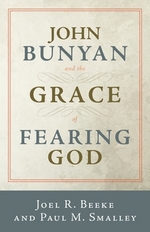
John Bunyan and the Grace of Fearing God by Joel R. Beeke and Paul M. Smalley

John Bunyan and the Grace of Fearing GodJohn Bunyan and the Grace of Fearing God

by Joel R. Beeke, Paul M. Smalley

eARC, 160 pg.
P & R Publishing, 2016

Read: October 2 – 9, 2016


This brief book is a look at the life — spiritual and natural — of John Bunyan and his understanding of the fear of the Lord as traced through his writings.

I’ll be the first to admit that I have only the most basic understanding of Bunyan beyond The Pilgrim’s Progress and that quotation from John Owen about his preaching (only cited twice in this book), so I can’t judge the scholarship of Beeke and Smalley when it comes to that. I can say that I thought their approach to both the man and the material could’ve been deeper. The brief biographical material did everything it needed to — it wasn’t too long and it covered the bases, giving an understanding of what he went through and his historical context.

After the biographical section, the authors turn to the Fear of God, and soon lay out this distinction:

…Bunyan deduced that God forbids some fear as ungodly, but commends another kind of fear. This distinction proves to be crucial for Bunyan’s theology, allowing him to differentiate unhealthy, sinful fear from the spiritually sound and fruitful fear of the Lord.

They examine the ungodly fear some more and then look at various spiritually sound fears — and the ways that is can promote growth in holiness and perseverance.

A lot of this material was helpful — I’m not sure if it was because of the way that Beeke and Smalley compiled it or Bunyan’s insights that helped me the most, but I don’t think I understood any of the ideas the way I wanted to. Yes, the authors would point me at Bunyan and the Bible as a resource, but I think they could’ve helped me more.

I thought the evangelical appeal at the end of the book a little out of place — it didn’t seem to fit the intentions or voice of the book up to that point — and I can’t imagine that anyone who isn’t a convert reading this book. I hope I’m wrong and that this is an effective tool, I should stress — but it seemed inorganic.

This isn’t a bad book, it’s just a slight one. It’s too much of a survey, not an examination or an explanation. There’s no depth to the look at Bunyan, while there certainly appears to be breadth. I might have walked away with a better understanding of what kinds of things Bunyan wrote and when — but I don’t think it furthered my understanding of the man or his writing beyond that. If the authors had given use another 100 – 150 pages and I think I’d be writing something very positive.

Disclaimer: I received this eARC from P&R Publishing via NetGalley in exchange for this post — thanks to both for this.
N.B.: As this was an ARC, any quotations above may be changed in the published work — I will endeavor to verify them as soon as possible.

—–

3 Stars

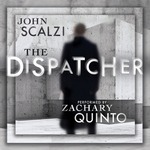
The Dispatcher (Audiobook) by John Scalzi, Zachary Quinto

The Dispatcher The Dispatcher

by John Scalzi, Zachary Quinto (Narrator)
Series: The Dispatcher, #1


Unabridged Audiobook, 2 hrs, 19 min.
Audible Studios, 2016

Read: October 5, 2016


Last year, when he was in Boise, I heard John Scalzi read the first chapter of this book and I’ve been waiting for this ever since.

It’s an Urban Fantasy set in a world where natural or accidental death is possible, but if you’re murdered there’s an almost 100% possibility that you’ll come back to life. Huh? Yeah — heckuva hook, right? There’s no explanation for this, it just started — and it may just end at some point. But in the meantime people are taking full advantage of this.

Tony Valdez is a dispatcher — insurance companies and individuals have started hiring dispatchers to “dispatch” someone just before they die, so there’s a good chance — a fantastic chance, really — that they’ll survive. One of Tony’s coworkers has disappeared and a Chicago police detective has drafted him to help her track down his colleague. To find him, they have to look into the dark side of the dispatcher trade and the desperate lengths some will go through to extend the lives of their loved ones or themselves.

It was a fun book to listen to, a story that drew you in and drug you along to the gripping end. But once it was over, and I started thinking about it, all sorts of questions came to mind, not really plot holes, just things that weren’t adequately addressed. I think a lot of it was length, if this had been a novel, some of them wouldn’t have come up. The more I thought of it, it was almost like this novella was Scalzi’s attempt to prove a point/win a bet that, yes, he can write UF. A strongly written, convincing story that entertained from beginning to end — but there was just no heart to it, it just seemed like a writing exercise.

Quinto did a bang-up job — I think I only thought of him as the actor once or twice — he nailed every bit of this. If that whole movie star thing doesn’t work out for him, he could have a future doing this sort of thing. I should probably give this an extra star just for his work.

Very entertaining, a great experience — just don’t think about it too terribly much.

—–

3 Stars

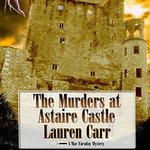
The Murders at Astaire Castle (Audiobook) by Lauren Carr, Dan Lawson

Now for the last post on The Murders at Astaire Castle (Audiobook) book tour.

The Murders at Astaire Castle (Audiobook)

by Lauren Carr,Dan Lawson(Narrator)

Series: The Mac Faraday Mysteries, #5

Unabridged Audiobook, 8 hrs, 9 min.
Acorn Book Services, 2014

Read: September 7 – 9, 2016

So Mac Faraday stumbles onto a haunted castle where one of his favorite authors was murdered — as were many others — that he just happens to own. Shortly after him finding it, more people are murdered. Just what this retired (and seemingly bored) detective needs: a complicated mystery to sink his teeth into.

The investigation brings up a lot of memories for the locals — most particularly, his half-brother, the Police Chief. The two of them dive into investigating the murder cases both cold and red-hot. There’s some good banter, some shamefully wasted cognac, a lot of antics from Mac’s German Shepherd, and more twists and turns than your typical small-town murder brings along.

With murders that are this old, a lot of old memories are dredged up, so for the locals, this is a pretty messy case. Old scars, old enemies, old heart-breaks are brought back to the surface and examined.

The killer is pretty clever — a little hard to believe, but since when aren’t they? The solution was as obvious as it was outlandish — but the trick is in the telling of the story, not in how reality-based it was. On that score, Carr did a capable job.

There were infodumps galore in the opening chapters — mostly thinly disguised as dialogue. It’s like one of the squints from Bones or the non-Beckett detectives from Castle dropped in. The recall the hotel manager, security chief, etc. had for the murders that happened over a decade ago was pretty clear and accurate. It’s also surprising how little Mac knew about the murder of an author he seemed to be so into (seriously, if Steven King was murdered in a horrible fashion — who wouldn’t know something about that?)

Lawson gave us a competent narration, with odd inflections from time to time, like a NaturallySpeaking voice. The way he pronounced it made me very unclear what Mac’s girlfriend’s name was until I could get online and look it up.

I’m not doing a great job selling this thing — because it’s hard not to spoil anything while talking about this book’s strengths — they are there. The characters are likeable, the puzzle is good (and Carr doesn’t cheat with the clues). It wasn’t the best thing I ever read, but it was entertaining enough to stay with it — an enjoyable book to keep your mind occupied while working out, doing data entry, etc. And then somewhere around the 7:45 minute mark, things fells apart for me. That last chapter just about ruined the whole thing for me. Then, the epilogue answered a big remaining question, but it was one that I’d figured out in Chapter 2 or 3 — and I think most readers would’ve, too. Getting it “revealed” like that just annoyed me. Still, it seems like this one was enough of a divergent from Carr’s typical mystery — if so, the things that were the weakest parts of this book would probably not be around in the others, which would lead me to think they’d be worth a shot. Mystery fans should take a chance on this series — even this installment.

Disclaimer: I received a copy of the audiobook in exchange for my honest opinion and participation in this tour.

—–

3 Stars

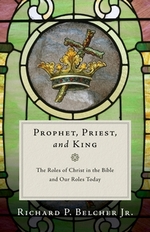
Prophet, Priest, and King by Richard P. Belcher, Jr.

Prophet, Priest, and KingProphet, Priest, and King: The Roles of Christ in the Bible and Our Roles Today

by Richard P. Belcher, Jr.

eARC, 224 pg.
P&R Publishing, 2016

Read: September 11 – 25, 2016

Throughout Church History, however varying in degree, theologians have focuses on the offices of Jesus Christ as Prophet, Priest and King. The present is probably one of those period that doesn’t emphasize them too much — at least, not the Prophet and King (even as Presbyterian and Reformed children recite them in their catechisms). It’s probably time for us to take another look at them in detail. This is Belcher’s aim, at least. As he says,

This book will address the work of Christ in light of the roles of Prophet, Priest, and King and will then draw out implications for the church.

(I’d originally spent 2 or 3 sentences saying that, when I spotted it in his opening paragraphs — always go with pithy).

That’s pretty much the book, after the introductory chapter, setting the stage, Belcher examines each office in turn, a chapter on the Old Testament definition, history and development of the office, followed by a chapter on Christ’s fulfillment of the office during his estate of humiliation, and then in his estate of exaltation.

A redemptive-historical approach— emphasizing Christ’s fulfillment of the Old Testament —naturally lends itself to connecting with the roles, not just for Christ but also for his body, the church. This approach also has implications for preaching Christ from the Old Testament.

The examinations of the offices are very thorough, but probably not exhaustive (although they sure seem exhaustive) — I’m not sure I learned a whole lot during these chapters, but I do think that reflecting on the offices in this manner has helped me understand them more and in a deeper way as leading to Christ. 

There are study questions at the end of each chapter that are a handy means of reviewing, but don’t encourage much further study and thought. But I can see where they’d be useful for a class or discussion group.

While examining the Old Testament office of King, Belcher Mention digresses for a while to examine the question “Is there a Royal Priesthood in Israel?” What does the OT mean when it talks about Kings offering sacrifices, if that’s the role of the priest. I’d wondered idly about that a time or two, but hadn’t realized how complex the question can be.

In the nation of Israel the roles of prophet, priest, and king are basically kept separate to define their meanings. But it is significant that these roles come together in both the description of Adam and Eve and the description of Israel’s mission. Thus it makes sense that the Old Testament would begin to describe the coming future ruler as carrying out the combined roles (Ps. 110; Zech. 6: 11–13). 26 These are fulfilled in Christ, who is Prophet, Priest, and King during his earthly ministry. He fulfills them in his work of salvation and continues in these roles on behalf of his people in his ascension. The work of Christ lays the basis for restoring these roles to human beings in their service to God, to the church, and to the world.

Therefore, the final chapter looks at how The Church can fulfill her mission via these roles. I found this chapter fascinating — easily the best in the book. It, too, is not exhaustive, but merely outlines the ways The Church (as a whole and as individuals) can function. I wish almost everything in this chapter had been more developed and explored.

This is sound, solid, careful writing. Sure, it could use some personality — but it doesn’t need it. It’s just not that engaging — but for those interested in the topic (or see a need to develop that interest), this is a good investment of time. For a careful examination of something too often ignored, this is a worthy read.

Disclaimer: I received this eARC from P&R Publishing via NetGalley in exchange for this post — thanks to both for this.
N.B.: As this was an ARC, any quotations above may be changed in the published work — I will endeavor to verify them as soon as possible.

—–
3.5 Stars

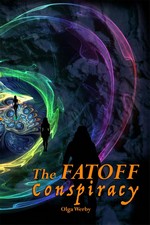
The FATOFF Conspiracy by Olga Werby

The FATOFF ConspiracyThe FATOFF Conspiracy

by Olga Werby

Kindle Edition, 317 pg.
2015

Read: August 29, 2016


This is a pretty creepy dystopian tale about a culture on the brink of disaster (self-caused, it should be stressed). Americans have lost the war on obesity and all but the elitist of the elite are dangerously obese (while tucking away a good portion of that fat into a pocket dimension), in pain, struggling, dying young and yet eating almost constantly.

Cindy Rella (and yeah, it took me until the 27% mark to figure out why that name rang a bell) comes up with a long-shot scheme to get herself government assistance to restore her to her formerly thin and healthy self). Cindy’s plan falls apart in a very dramatic (and embarrassing) fashion. Her life falls apart soon after — thankfully she has a couple of friends.

One of whom is involved in an underground movement to restore the place of actual food in the world and remove the whole food industry that is slowly killing the populace. Cindy starts exercising a bit, eating better — nothing extreme, just basic weight-loss stuff: eat less, move more — focusing on real food, not the SF foodstuff they’re all eating. The diet stuff was worked in pretty well — Werby doesn’t beat you up with it.

Most novels of this type would’ve spent a chapter or two explaining the Tech better, explaining how society got to where it was (who in their right mind starts this?) and is in. Werby just dives in to the problems, to the Tech breaking down and leaves the past in the past. Maybe in other books, I’d want more explanation, I’d want the background, but it works here. Honestly, I’m not sure that I want to know how society got to this point, because I’d like to eat sometime this month, and I might not be able to if she got into it.

The characters were okay. I liked Cindy and just about everybody else — there were a couple of villains who could’ve been better developed. Actually, this is one of the weaknesses of the book — everyone could’ve been a bit better developed. It’s like she took the cake out of the oven 5 minutes early (okay, not the best metaphor for the book, maybe I should’ve said she had us sit down when the bench’s new paint job was allllmost dry). Outside the basic plot and worldbuilding, everything needed just a bit more nuance, filled out a bit.

I enjoyed this book, but it could’ve been a little better. It was enjoyable and kept me interested — and a little horrified once all the pieces were revealed.

Disclaimer: I received a copy of this from the author in exchange for my honest — and belated thoughts. I got it in under the wire for September, but it was supposed to be in August. Ugh. Sorry!

—–

3 Stars

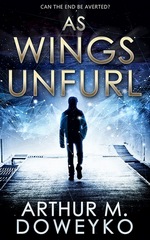
As Wings Unfurl by Arthur M. Doweyko

As Wings Unfurl Book Tour Banner

As Wings Unfurl As Wings Unfurl

by Arthur M. Doweyko

Kindle Edition, 280 pg.
Red Adept Publishing, LLC, 2016

Read: September 19 – 20, 2016


Apple Bogdanski is a morphine-addicted Vietnam vet still having trouble re-acclimating himself to civilian life. The re-acclimation becomes more difficult when the small Book Store he works at is broken into by some pretty nasty guys. There’s some fisticuffs, some gunplay and some damaged books. What keeps Apple from being as damaged as the books is a mysterious stranger, Angela. She’s a stranger, yes, but one that Apple is convinced he’s known for years — maybe his whole life — but he can’t put his finger on the “how” and “where” of such knowledge. What’s more important to Apple at the moment is that she’s saved his bacon from these thugs and is pretty attractive — a winning combination to be sure — he’s just not sure how she saved him, the explanation defies belief.

These events plunge Apple into a plot involving multiple intelligent races on Earth, a group of guys somewhere in outer space, a corrupt and powerful Roman Catholic Church, more beings like Angela and a good deal to chew on. Oh, and multiple threats to Apple’s life.

Aside from Apple, there are some pretty interesting characters here. We don’t ever really learn what kind of creature/being that Angela (or any of her kind) actually are — we do learn a lot about them, don’t worry, just not everything. Outside of battle, their abilities are a little to hard to get a real handle on. I was intrigued and wondered a lot — there’s evidence to support at least one interpretation, but it’s just a guess, so I’ll spare you. Shilog and Yowl are pretty interesting characters and one of them becomes pretty important to how things are moving through the later part of the book. I’m not going to fill you in on the details about them, because watching it be revealed is one of the most satisfying parts of the book.

There are some really painful anachronisms here — probably due to poor editing — they don’t ruin any plot points or anything, but they take you out of the moment enough to say, “Oh come on,” or something like that and make you doubt Doweyko’s idea to place things in ’75. Other than denying everyone around the action cell phones/cell phone cameras and surveillance cameras on every street corner, I don’t see the point in that setting, honestly. Again, it’s nothing to kill the story, but it’s enough to detract from it because you spend far too much time trying to figure it out.

This got the job done, and that’s about it, it was entertaining enough to keep you moving. But there’s nothing here that made me sit up and pay attention. I liked Apple as a character, and Angela really started to grown on me by the end. I do suggest picking it up if you have the means, but I wouldn’t urge you to rush into it.

Disclaimer: I received a copy of this novel from the author in exchange for my honest thoughts.

—–

3 Stars

Catch & Neutralize by Chris Grams

Catch & NeutralizeCatch & Neutralize

by Chris Grams

Kindle Edition, 335 pg.
2016

Read: September 5 – 6, 2016


Before I get into this novel, let me tell you a little about my process: After deciding to read a book, I tend to forget what it’s about rightaway — if for no other reason than I’m too frequently tempted to predict what the book’ll be like. So when it comes to series and/or author’s I like, all I need to know is “Oh, a new Faith Hunter book is out!” or “Ahhh, a Jonathan Tropper that I haven’t read — sweet!” That’s all I need. Similarly, when it’s a book by someone new, or a new series — or when an author (case in point) asks me to read their new book — once I’ve decided I’m down for it, I’ll let the details slide, so I’m fresh for the book.

So when I opened this one (see, there’s a link) and read the first few chapters, I kept asking myself “I said ‘yes’ to this?” Not because it was bad — it wasn’t — it’s just not the kind of book that I’d normally read. A little later, I went to log that I’d started the book in Goodreads and read the blurb there — I didn’t recognize it as the book I was reading. A chapter or two later, it was exactly what the blurb said. And that’s both good and bad. Let’s see if I can explain my point.

In the first few chapters we meet Mark — a super-smart geneticist who’s also (for good reason) super-jealous. He’s pretty sure his wife is having an affair (as is the reader), and he’s understandably upset. He takes a few steps that most husbands don’t — but most husbands don’t have his apparent personal budget or friends in the right fields. He also happens to meet a willing accomplice — perhaps too willing, as she’s young, pretty and talented, and a little tempting for a guy who’s pretty sure his marriage is on the rocks. But whatever — now, at this point, I’m interested, invested — I’m rooting for Mark (at least a little), and really hoping he doesn’t end up killing his wife or something similarly stupid/misguided.

Insert the sound of a needle scratch, because we’re done with Mark at this point — without warning or anything, and we meet Angie (Mark’s wife) and Tiffany, and a little creep of a waiter. We learn at this point that Angie’s been faithful, is actually ga-ga over Mark and the actions that have led him to his horrible conclusion are actually her working for a vigilante group that takes down criminals who’ve gotten away with crimes against women and children. It turns out that Tiffany is, too — but she might be playing a little fast and loose with the organization’s rules. There’s a strange combination of play and danger in the interactions between Angie and Tiffany — it’s pretty fun as long as you think of them as fictional characters. If you think of them as real people, it’s just scary.

And that feeling gets so much worse once Tiffany and Angie get their hands on a couple of rapists and pedophiles. This is also where things between the two women go off the rails. It’s not long after this that Mark comes back into the picture — and the book changes again. It was Book A with Mark’s chapters, it becomes an entirely different book (B) in the Angie and Tiffany focus (the one that matches the Goodreads/Amazon/Gram website blurb — and was the kind of book I’d normally be interested in) and then becomes Book C after Mark shows up (and maybe becomes D a little later). Where most authors would’ve intertwined A and B, so that C flows from them; this is almost like changing the channels on TV between the three. I’m not saying it’s good or bad — it’s jarring and unexpected, but maybe that’s what Grams was going for — it actually kinda works. But man, it made for odd transitions. Along this lines, the dénouement has the feel of an entirely different book, too — something like the overly-cheery final scene in a 80’s cop drama.

Now, there’s some tense gunfighting scenes, some torture, some double-crossing, and a whole lot of questions that aren’t answered. Each of the books I mentioned above are pretty well-written and grabbing, if somewhat disturbing — it’s just bringing them together that didn’t work for me. The characters are well-constructed — sure they might act in ways that are hard to understand sometimes, occasionally in near-insane ways — the reader will be drawn-in and compelled to keep going with these people.

Oh, and the little creep of a waiter? Yeah, he turns out to be worse than initially thought (and, I promise you, his first impression is a bad one), and well, things really don't go his way.

This is definitely written like it could kick-off a series, and if that's the case, I'm very interested in what comes next, if for no other reasons than so I can see if Grams can pull it off. But mostly, because I'd like to see what comes next

Disclaimer: I received a copy of this novel from the author in exchange for my honest opinion — I hope she doesn’t regret that too much, especially since I let our agreed upon posting date pass without a word. Ms. Grams, you’re a class act. Thanks.

—–

3 Stars

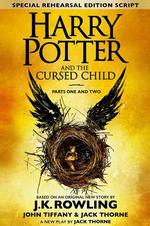
Harry Potter and the Cursed Child by J.K. Rowling, John Tiffany & Jack Thorne

Harry Potter and the Cursed ChildHarry Potter and the Cursed Child – Parts One and Two (Special Rehearsal Edition)

by J.K. Rowling, John Tiffany & Jack Thorne
Series: Harry Potter, #8

Hardcover, 308 pg.
Scholastic, Inc., 2016
Read: September 2, 2016

I went into this with low expectations for a few reasons (negative buzz being one of many), and sadly had them all met — I don’t think anything were exceeded.

This is fan-fiction, pure and simple. Sure, it’s official fan-fiction written in conjunction with Rowling — but it’s not the same series, it doesn’t feel the same. It feels like someone’s trying to recapture what they had, in just a slightly different form. I’m fine with that — if people want to throw money at Rowling, Tiffany and Thorne for doing this? Let them. Let’s just not pretend it’s more than what it is.

The story primarily focuses on Harry and Ginny’s middle child, Albus. Albus is pretty uncomfortable living in the shadow of the Boy Who Lived — he doesn’t like the notoriety or pressure that comes with that territory. Which is absolutely understandable — especially now that he’s at Hogwarts, where Harry’s legend is strongest. Between that, and typical teenager strife with Dad leads Albus to take some really big risks with banned magical technology.

These risks center on time travel — and this is where it lost me. I just can’t stand the kind of stories where someone goes back in time with perfectly good intentions and messes things up, changing the future so much that it’s not recognizable. So then they (or someone else) have to go back in time again to prevent/minimize the damage. And magically, this second (or third) intervention restores everything back to the way it was before the time travelers left. Sure, this is a series in which magical things like that are clearly possible. But there’s possible and too-incredible. It almost doesn’t matter how good this story/execution was, I wouldn’t be crazy about it.

The writing was . . . okay. Nothing spectacular, nothing that had the same …”magic” as the other books in the series. It’s not as bad as many claim — but it’s not as good as others claim either. How some of this can be staged, I just can’t imagine. I’m not saying it can’t be — but wow, that’s a real technical challenge, I’d think.

There were some nice moments, some great fan-service stuff — and I’m very glad I got to meet Scorpius Malfoy. I’d rather spend time with him than any of the rest of the descendants of the original series, there’s something very cool about this kid. I should also mention that there’s some nice father-son moments with Harry and Albus.

On the whole, I’m glad I read this, but I really can’t get crazy about it.

—–

3 Stars

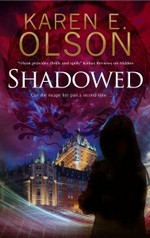
Shadowed by Karen E. Olson

ShadowedShadowed

by Karen E. Olson
Series:Nicole Jones, #2

Hardcover, 220 pg.
Severn House Publishers, 2016

Read: August 19 – 20, 2016


When we last saw Nicole Jones, she was running away from the new life she’d built for herself — the job, home, friends — rattled by the presence of the FBI and the criminals from her past. The idyll was gone, and her life and freedom depended on her making a break for it. So, she headed for the border and the Great White North beyond.

She tried to convince herself that her next home, next identity, would be as long-lasting (at least) as her previous. But she knew better, deep down — and the readers did, too. Not just because it’s a sequel, but now that everyone knows that she’s out there, they’ll look harder. So Nicole has to be ready to run again, and she does so when the time is right. Which leads her to new risks and dangers, as well as to a greater understanding of what happened in her early criminal career to set her on this path.

There were a couple of times I thought Nicole was too trusting, too willing to not be suspicious. She really made some bad moves there. But honestly, I’m not sure she was in a position to do much else. Shadowed was, on the whole, a lot less realistic-feeling than Hidden, but oh well — it may not have been full of verisimilitude, but it followed the rules that Olson laid out before, and it was entertaining enough that you got over that.

I saw a few of the twists coming (or at least something that looked like them), and by a certain point I had 97.3% of the rest of the book worked out to an uncanny accuracy. That other 2.7? Totally blindsided me. More importantly — the stuff that I’d guessed, the stuff that I hadn’t (and couldn’t), and everything else was written in an engaging, entertaining and controlled fashion. I’ve read too many crime novels lately that seemed chaotic from time to time, where things happen because the author wanted them to, whether or not it fit the story — this one wasn’t anything like that. Olson knows what she’s doing, and you can tell that throughout.

This didn’t wow me the way that Hidden did, but I liked the world — I still really like Nicole — it hooked me almost from the get-go, and definitely left me wanting to know what’s next. Olson continues to impress and satisfy.

—–

3 Stars

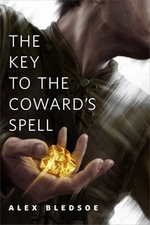
The Key to the Coward’s Spell by Alex Bledsoe

The Key to the Coward's SpellThe Key to the Coward’s Spell

by Alex Bledsoe
Series: Eddie LaCrosse, #?

Kindle Edition, 27 pg.
Tor Books, 2016

Read: September 3, 2016


This over-before-you-realize-it short story is a welcome dip of the toe back into the world of Eddie LaCrosse, sword jockey (i.e., medieval private eye). Bledsoe’s Tufa series is one of the best things around, but man, I enjoy this series so much.

LaCrosse has been hired by a local blacksmith to find his kidnapped son. LaCrosse is sporting a broken arm, so he’s going to need a little more help than normal, Jane Argo, for one — and some new faces, too. There’s really not a lot to say, here — half of the action takes place before the story starts. LaCrosse gets a little more intel, and then jumps into action.

The action is brief and to the point — with a nice twist or two along the way. Nothing special, but it’s a good couple of sequences. And a brief reminder that no matter what you dress it up in — modern time/tech/clothing, generic fantasy tropes, SF, whatever — there are some forms of evil that transcend those details and are just evil that need to be fought in whatever little way we can.

Yeah, it was fun to spend some time in this world and with LaCrosse and everyone. But man, just as you get into it, the story’s over. Just not enough to really satisfy, but it was a fun taste. I don’t know that this is a good intro to the character (it might be), but it’s a good reminder for those who’ve met him before that they want to read more about him.

—–

3 Stars

Page 39 of 55

Powered by WordPress & Theme by Anders Norén