Tag: 3 Stars Page 44 of 55

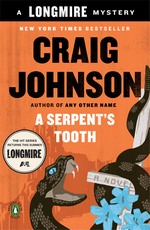
A Serpent’s Tooth by Craig Johnson

A Serpent's ToothA Serpent’s Tooth

by Craig Johnson
Series: Walt Longmire, #9

Paperback, 335 pg.
Penguin Books, 2014
Read: October 17 – 19, 2015

So it seems that Craig Johnson had some things about religion that he wanted to get off of his chest. It almost felt like that came first, and the story came second — maybe not, maybe he just took the opportunity that the story gave him, what do I know? Raised by a Methodist mother and an atheistic/agnostic/irreligious father, Walt and Martha repeated that pattern once he came home and married (although it appears Walt attended services fairly frequently with her), after her death, he’s left the Church behind. As he told Henry, he’s spent more time in Indian religious ceremonies than Christian since Martha.

So, he’s in a jaded state of mind when he encounters a LDS splinter group — add in Vic’s lapsed Catholicism, and the Absaroka County Sheriff’s Department spends a lot of time almost offending a few World Religions. It helps (both the insulting, and insulating Walt/Johnson from giving actual offense) that this particular splinter group is a little more unhinged than normal.

On the one hand, there are comic elements involving the cult — a senior citizen of indeterminate age claiming to be a historic figure over 200 years old, a yet-older nude sunbather who builds spaceships in his backyard. There are also heart-tugging elements, the teenager who’s never seen a television or movie before (and becomes obsessed), him and other teens being cast out of their homes/families and left to wander, the little girl with a developmental disability abandoned on the roadside for entire days to sell baked goods. But, at least for Walt, more importantly there suspicious elements surrounding a Texas-based cult that moved to South Dakota and now seems to be expanding in a handful of Western and Mid-Western states — and the missing mother of the movie junkie. And guns, lots of new, expensive guns.

In addition, we get a lot of good time with the citizenry of Absaroka County (not as much time in the diner as usual), learn a little bit more about the youth of Walt and Henry, see things move along for Walt and Vic, and see a major shakeup for the Sheriff’s Department. Throw all this together, and you get a solid, satisfying read.

Absolutely nothing here did anything to remove the worries Walt has for Cady thanks to Virgil’s warning/prophecy/vision from Hell is Empty. Hoping that gets resolved soon, if only so Johnson stops teasing.

Not Johnson’s best, but there’s nothing to complain about here, and plenty to enjoy.

—–

3 Stars

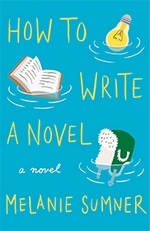
How to Write a Novel by Melanie Sumner

How to Write a NovelHow to Write a Novel

by Melanie Sumner
Paperback, 287 pg.
Vintage, 2015
Read: September 28, 2015

Aristotle — but you can call her Aris — Thibodeau is a 12 1/2 year-old would-be novelist. Under the guidance of her English teacher, school librarian and English-professor mother, she’s trying to write a novel in the next 30 days. Once it’s sold, she figures she’ll be able to make enough money so her mom can quit her job, still take care of her brother with his counseling/medication and find a husband. Aris does have a candidate in mind for her step-dad, but is open to someone else. We get to see precious little of her writing, but we do get to follow her on her journey through the novel writing process, and the family turmoil and drama surrounding it. Actually, as I write that, I have a hard time believing everything that happened outside of her novel took less than 30 days.

There’s a strong self-awareness to the narration — from Aris stopping the action to describe something she’s lacking in her novel, and then providing it in the narration to the sections of the book being labeled “Rising Action,” “Denouement,” etc. Typically, it works, but there were a couple of instances where it seemed forced or overdone.

There are two really strong points to this novel. Sumner can write a sentence that just sings I grabbed three examples from the opening pages — we get voice, humor, and a crystal-clear idea of the character she’s describing (and the one doing the describing):

Diane is forty-three now, short and either curvy or chubby, depending on her mood, with a button nose and blondish bangs that are always falling in her face.

Then he grinned. Papa was old before braces came out, so his teeth are slightly crooked, just enough to make him look like he can tell a good joke.

. . . ladies in the South don’t shake hands. Instead, they fold their cool fingers over yours and press ever so gently, leaning in close until you smell breath mints and the eau de toilette behind each ear. Then they say something awful. A few days after Joe [Aris’ father] died, Grandma and knelt beside Diane’s [Aris’ mother] bed and folded her fingers over her hand. After looking into her eyes for a moment, she whispered, “Why didn’t he ever have a better job?”

Don’t ya just luuuuv Grandma?

The other strong point (maybe half of a point) is her characters — Aris, Diane, her brother Max — are great. Diane’s student, Charles and his mother are pretty well-drawn. The librarian Ms. Chu wasn’t that fleshed out, but she didn’t need to be, and she was well drawn enough that you want to see more. These are real people, you could build a book around any of them alone. But the rest — and I’m only talking about characters that should be well-drawn — just aren’t. Aris’ grandparents don’t become much more than they were described above. The worst is Aris’s choice for her future step-dad, their current volunteer nanny: Penn MacGuffin*. He’s an accumulation of ticks, quirks, and clichĂ©s, but there’s not a person in the middle of that.

The more I think about it, the less I’m sure I like How to Write a Novel as a novel, however frequently clever it is. There are some great scenes, dazzling sentences, charming characters here; it was a pleasure to read. But I’m just not sure there’s much there beyond that.


* I’m not going to mention how long it took me to realize what his name meant — let’s just say it was before this moment, and I felt really, really stupid

—–

3 Stars

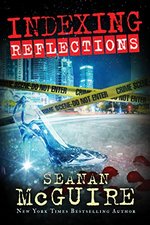
Indexing: Reflections, Episode 4: Split Ends by Seanan McGuire

Indexing: ReflectionsIndexing: Reflections, Episode Four: Split Ends

by Seanan McGuire
Series: Indexing, #2.4
Kindle Edition
47North, 2015
Read: September 23, 2015

This is one is hard to think about as an individual episode. There’s some plot advancement, yes. But mostly this is about the team getting some new intel, evaluating it, and then coming up with a plan to get more information — there are some unorthodox moves required to obtain this more, but if they’re going to get anywhere towards capturing Elise before more lives are lost, they’re going to have to make them.

The new information they are given is huge. It’s not unexpected for the reader, and you could make the case that Henry should’ve been expecting it. But it’s more than believable that she wouldn’t have.

Yes, this installment is mostly about investigation, and not busting heads, or messing with narrative incursions, or anything. So it’s hard to discuss — but it is really well executed, what the reader and Henry learn is interesting and thought-provoking. Not only about the case they’re working on, but we get a better understanding (or at least the beginning of a better understanding) of how the whole Fairy Tale narrative functions.

There’s suspense, there’s Sloane being Sloane, there’s a cliffhanger ending. Not easy to write about, but easy enough to read and start waiting on the next chapter — maybe more urgently than I’m used to.

—–

3 Stars

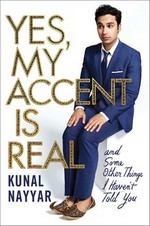
Yes, My Accent Is Real by Kunal Nayyar

Yes, My Accent Is RealYes, My Accent Is Real: and Some Other Things I Haven’t Told You

by Kunal Nayyar
Hardcover, 242 pg.

Atria Books, 2015

Read: September 23 – 24, 2015


This book was all sorts of okay. Occasionally more, rarely less.

It’s a series of (primarily) autobiographical essays about his childhood in India, his family, his time in Portland during college, training as an actor, and his break on a little show you may have heard of, The Big Bang Theory. He closed the book by talking about meeting, courting and marrying his wife — probably the book’s emotional highpoint (the portions about his father are a close second).

Some are a page or two in length, some are longer. Nayyar doesn’t always come across looking good, he’s quick to point out his own shortcomings and how he’s trying to be a better person following that. Overall, he’s a decent guy, and that comes across pretty clearly.

As a fan of Raj, like (I’m assuming) 98.75% of the readers of this book, I enjoyed what little time he spent talking about the character and playing him. I particularly appreciated what he said about Raj’s selective mutism, the choices he made to depict that, and the audience’s reaction to that.

Some of these stories, I’d heard Nayyar tell before — like on Aisha Tyler’s podcast — in written form, with new (or fewer) details was nice, and unlike some, having previous exposure didn’t hurt the book.

Pleasant enough, funny, charming, even touching. It was a nice read. If you enjoy his acting, you’ll likely enjoy it. Yes, My Accent Is Real isn’t a must read, but it’s worth your time.

—–

3 Stars

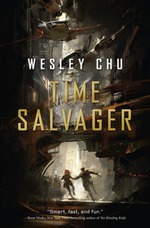
Time Salvager by Wesley Chu

Time SalvagerTime Salvager

by Wesley Chu
Series: Time Salvager, #1
Hardcover, 380 pg.

Tor Books, 2015

Read: September 12 – 15, 2015


Guess I should start with this: there’s nothing in these pages that’ll remind you of Chu’s Tao books. They could be written by completely different authors. Which is a combination of good news and bad news. The good news is that the reader doesn’t get a deja vu feeling reading, Chu’s ability as a writer and worldbuilder is displayed, and we get to see that he’s not a one-trick pony. The bad news is, the Tao books were better.

Not that this is bad, it’s just not Tao.

Chu is really smart about the way that he introduces us to the world, to the concept of Time Laws, and ChronoCom and all the rest of the things that you can read about in the jacket copy (or at the link above). Maybe it shows that I read too much bad SF as a kid, but I’m still really impressed by SF writers who are able to blend things into dialogue and story rather than just resorting to info dumps.

This is a Time Travel story where the Time Travel’s not really all that important. It’s just a tool. Like a cell phone — something that people use, but don’t really understand. No one (well, one person) here understands how it works, but they can use it. Ditto for all the nifty future-gadgets. So it makes it easy for us to not worry about it, too, and just go with the flow.

When you clear away all the bells and whistles this is a pretty straight-forward story about corporate greed, ecological/societal collapse, and a few people trying to do the right thing with the cards stacked against them (even if that pits them against each other). The bells and whistles turn this into a SF/Time Travel/Dystopian Love Story.

Not the best thing I’ve ever read by Chu, but interesting enough to make me glad I read it, and I’ll be back for #2. Maybe with is he can do something to make the series something I can get excited about.

—–

3 Stars

Indexing: Reflections, Episode 3: Brotherly Love by Seanan McGuire

Indexing: ReflectionsIndexing: Reflections, Episode Three: Brotherly Love

by Seanan McGuire
Series: Indexing, #2.3
Kindle
47North, 2015
Read: September 8, 2015

Now this is what I’m talking about. A solid, solid entry. We get Henry’s brother back; we get a good, contained story — yet with serialized elements that we’ll see play out; we see fallout from Episode 2; and thanks to Elsie’s particular brand of magic, we — and the characters — see something new.

There’s an incursion near the school where Henry’s brother, Gerry, teaches. Thankfully, it has nothing to do with him, it’s just near him. It’s also near his school, and the children in it — children who, it should be said, are the primary targets of the incursion. So Henry and her team are dispatched to wrangle with the press, school administration, and whoever — or whatever — is out there wanting to snack on kids.

The solution to this comes a bit easily, but the challenge to this episode isn’t solving eh narrative incursion, it’s in figuring out just what’s going on — how this is the result of Elsie’s escape — and then trying to see what the impact is going to be on Henry’s team (the stress on Demi and Henry this episode in particular). We don’t see Elsie at all — just what she’s done, but that’s enough.

Other than the ending coming a page or two earlier than I’d expected, I thought this one worked pretty well. We’ve only had 15 episodes of this series, and already McGuire is playing with the conventions, I like that. Some people would wait until the third book to mess with things like this, but why wait? Go for it while you can. Especially if you can tell good stories while re-writing your own rules, and that’s exactly what McGuire has done here.

—–

3.5 Stars

Who Let The Dog Out? by David Rosenfelt

Who Let The Dog Out?Who Let The Dog Out?

by David Rosenfelt
Series: Andy Carpenter, #13
Hardcover, 324 pg.
Minotaur Books, 2015
Read: September 4 – 5, 2015

As Michael Corleone said in The Godfather, Part Ill, “Just when I thought I was out, they pull me back in.” The fact that it was the worst movie in the history of movies does not take away from the truth of that statement, as it relates to my legal career.

Poor, beleaguered Andy Carpenter. Dragged, kicking and screaming back into the courtroom to defend someone he really doesn’t care about, but by doing so he gets to investigate a crime he’s really concerned with.

As we all expect, that crime involves a dog.

The Tara Foundation, the dog rescue shelter that Andy runs with his former client, Willie, is broken into. The thief does a very professional job and takes off with one dog. Professional or not, the thief didn’t take into account how devoted Andy and Willie are to these animals and how obsessive they can be about them. It doesn’t take them long at all to track down the dog…and the corpse he’s next to.

Andy wants to know more about the dog, and the dog’s owner who turns out to be a fugitive, suspected of murder. The only way he can keep his foot in this case is to defend the man accused of the killing. He eventually does figure out who kills the thief, but it’s almost accidental — it’s certainly incidental to anything else going on. Just one of the little bits of pleasure this provided was that “ah ha” moment.

During the trial — the stage of many of this series’ highlights — Andy treats us to an amusing clinic on all the ways that a couple of lawyers (and people in other professions) can use the word “frankly,” including all the shades of meaning that word can provide. Like so many of Andy’s lessons, this was worth the ticket price.

Rosenfelt brings us yet another storylines that could summed up as: It looks like a simple crime, but is actually the linchpin to uncovering a major terrorist plot/international crime syndicate (minor spoiler that if you read more than a couple of chapters you’d see for yourself). I’m getting a little sick of these. The terrorist plot, by the way, makes me reconsider the plausibility of a similar plan in Robert B. Parker’s Night Passage. I’d always thought that the weakest part of an otherwise compelling read, seeing it now in light of this book makes me think there was something there. Still, for crying out loud, Mr. Rosenfelt, let major criminal enterprises and terrorist organizations figure out that a trip through Patterson, NJ is asking for trouble. Local conspiracies, okay. But major international conspiracies? You’ve got to stop going to that well so often. Or period.

My other worry about this is Ricky. If you haven’t read this far in the series, you may want to skip the rest of this paragraph. About half of the material around Ricky was cute and fun — just like it was in Hounded. The other half (mostly involving stale sit-com like bits about kids’ sports) teetered on painful. I fear that this series might be like the older comedies who felt compelled to add the cute little kid late in the run (Andy on Family Ties, Cousin Oliver on The Brady Bunch, Olivia on The Cosby Show, Chrissy on Growing Pains, etc., etc., etc.). If that’s the case, I worry about the future of the series.

Don’t get me wrong — I enjoyed this overall. I can suspend my beefs with this series as it goes on and enjoy Andy’s laziness, his awe of Marcus, Marcus’ awe-inducing self, the hacking seniors, and all the rest. I don’t open up an Andy Carpenter novel expecting to be hanging in suspense, to be chilled, to be challenged in any way; I expect to spend a couple of hours in some pleasant company and sometimes to get a fun puzzle. In that sense Who Let the Dog Out? delivered enough.

—–

3 Stars

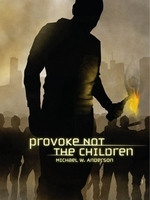
Provoke Not The Children by Michael W. Anderson

Provoke Not The ChildrenProvoke Not The Children

by Michael W. Anderson


Kindle Edition, 348 pg.
Amazon Digital Services, Inc., 2014
Read: August 27 – 31, 2014

Some dystopian futures seem plausible — even inevitable — 1984, The Hunger Games; while others seem impossible — Divergent, Red Rising. Anderson’s world is possibly the most plausible I’ve read.

In this future U. S., parents are no longer responsible for the day-to-day raising, nurturing, or educating of their children (they are still responsible for paying for all that). Instead, they entrust their children to the care of Proxies. Proxies are professional child-raisers. The idea is that these people know exactly what an individual child needs for full academic, social, psychological and physical progress and health, and are far better suited to ensuring children receive this care than an y parent could hope to. So after years and years of more and more parents turning to this option, it becomes mandatory for all children in the U. S. to be handed over to the professionals.

What do parents do with all this time they’re not, you know, parenting? Why, they’re making themselves the best possible versions of themselves that they can. Kids just get in the way of paying attention to yourself, your career, your well-being, and so on. (other than having someone to show off at parties and to inherit what you have left, I’m not sure what the point is to having kids in this world — but let’s just assume the biological imperatives win out or something.)

Now, with a government mandate of this size, regulations are going to come into play. And where there are regulations, you need people to enforce them. Enter our hero, Chase Stern. Chase is a Proxy Review Officer — he travels the Northwest working to make sure that children are being cared for by Proxies, and that the Proxies are doing things right.

Naturally, not all are. In fact, there’s a very disturbing number of Proxies getting away with fraud, abuse, and neglect. Chase blows the proverbial whistle on this unpleasant truth and is first publicly pilloried for this, but that soon turns into the opportunity for Chase to be part of the reforms of the Proxy Industry. The cure proposed may turn out to be worse for society as a whole, and the children in particular, than the disease.

Great premise, right? Hard to go wrong with a setup like that.

And yet, Anderson doesn’t quite pull it off. He’s close. I don’t think he was ready to write characters and a story to go with ideas this big quite yet. The pacing was strange at times, and I think the book would’ve been better served if we’d gotten to see more of the process involved — not just opening chapters with a “In the months/years since the end of the last chapter, many things happened”-type summary. Also, there’s a whole lot more telling than showing going on here, his characters gave a lot of speeches. Not quite as bad as Asimov in Foundation*, but along the same lines.

The biggest problem with this book is the characters. They’re flat. They’re not people. The novel is entirely from Chase’s perspective and he comes closest to being a person. But even he’s flat. There’s no growth, nothing other than his crusade to reform. Yes, Chase had been the kind of parent who was in a rush to get his kids Proxied so that he could fulfill himself, and then something happens and he changes into the kind of guy who cares about the welfare of children. Whatever changes he goes through — say, learning how to lobby congresspeople — just appear in between chapters.

That said, Maria, is one of the — I want to say evil, but she’s too shallow for that. Maria’s about the most wretched, vile, hateful character I’ve ever read (her husband, Conrad, is about as bad — but he does less, so maybe he’s just a self-centered twit, not a force for all that is wrong with the world). There are a couple of other characters here that are more actively malicious, too. Still, they’re all little more than amalgamation of characteristics. But Anderson has trouble with the white hat characters. Perhaps he understands human nature too well for that.

There was a very unfortunate typo in the edition I read — and I was taken out of the scene during the climatic confrontation. I’ve emailed the author and he said he’d be fixing it. That’s the big advantage of self-publishing ebooks. Anton Strout, for example, tells the story about someone pointing out a similar problem in one of his fight scenes years after the publication, which will remain in the paperbacks. Anderson’s error is gone. Welcome to the 21st century.

Provoke Not the Children had a killer concept, and a chilling world that you’ll keep thinking about for days. The story’s almost, but not quite where it needs to be. I still recommend it in the end, but don’t expect too much from the narrative. I expect in a book or two, Anderson’s execution will match his world-building.


* I remember that being very speech-filled, I think that’s even talked about in the forward Asimov wrote in the edition I last read 20+ years ago. Hope I’m not wrong about that, it’s just the best example I could come up with at the moment. Besides, being compared to Asimov in Foundation should be seen as a compliment.

—–

3 Stars

Indexing: Reflections, Episode 2: Broken Glass by Seanan McGuire

Indexing: ReflectionsIndexing: Reflections, Episode Two: Broken Glass

by Seanan McGuire
Series: Indexing, #2.2
Kindle
47North, 2015
Read: August 27, 2015
So, having reassembled the team, reviewed the events of the last book and refocused both readers and characters to their mission, it’s time to get the ball rolling on this season.

Once again, McGuire introduces the AFI team to a problem that seems sort of light-hearted at first (investigating a House that Jack Built, complete with lines like, “Sloane had managed to locate the cat that chased the rat”) — but with some dark undertones. But before we get too far into it, Henry and the crew are interrupted and have to swing off in another direction. And this direction is a doozy — the prison to hold the Fairy Tales who’ve fully manifested in a bad-for-society way — has a jail break. It’s not just any jail break either, because the Narrative has seemingly done something impossible along the way. But I’ll let Henry spell that part out to ya. I’ll just say that I really like where this is going.

On the one hand, I thought what we learned about Demi in the previous episode helped us understand her better, and demonstrated her commitment to the cause/team. So when many of the same notes where struck this episode, I wasn’t thrilled — but, what we heard/saw this time, was different enough to justify it. Seriously, Demi is either going to be a superstar in the AFI, or when she turns and stabs everyone in the back, it’s going to hurt a lot. I’m hoping for the former, am (trying to) ready for the latter.

Elsie, the escapee, is either going to be a great Big Bad for this season, a great underling, solider for a better Big Bad, or a nice warm-up for the next few weeks until we get to the Big Bad. Mid-sentence there, I thought of several other options for Elsie’s role. Whatever that role ends up being, I think I’m going to enjoy her.

Overall, it’s more of a set-up chapter than anything else, but it was very promising and entertaining. Which is good enough.

—–

3 Stars

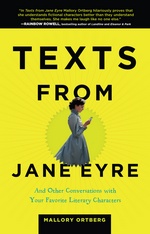
Texts from Jane Eyre by Mallory Ortberg

Texts from Jane EyreTexts from Jane Eyre: And Other Conversations with Your Favorite Literary Characters

by Mallory Ortberg; Illustrated by Madeline Gobbo

Hardcover, 226 pg.

Henry Holt and Co., 2014

Read: August 13, 2015


The answer to the question nobody asked: What would some of the most famous literary figures (characters/writers) say if they texted their friends and family? Well, Mallory Ortberg asked it, I guess. Most of the answers she cooked up are worth reading — some will induce chuckles, maybe a guffaw, and many smiles.

The Jane Eyre conversations (as might be suggested from the title) are the best of the batch — although the Poe material is just as strong (Hamlet’s close to that). The rest is a step or two back, in my estimation. Some of the rest of the material is pretty weak, but Ortberg makes the most of it. Typically, the reader’s appreciation of these text messages will line up with their familiarity with the source material.

Still, no collection is going to be free from bad apples, and The Hunger Games‘ conversations aren’t just weak, they’re disappointing. I don’t see how Ortberg could’ve missed so completely. But that’s just 2 pages out of 200, that’s more than a pretty decent percentage.

A nice break from heavier reading, I recommend taking these a few pages at a time — not the whole book in a sitting or two (although it’d be easy to knock out that way). Try for too many at once, and they lose their punch. Some funny stuff for book nerds here.

—–

3 Stars

Page 44 of 55

Powered by WordPress & Theme by Anders Norén