Tag: 4 1/2 Stars Page 26 of 30

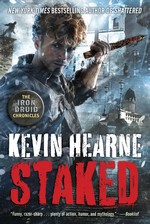
Staked by Kevin Hearne

Sigh. This was supposed to post yesterday morning…been one of those weeks. I have been working on blog-content, though, just nothing for you to see quite yet.

StakedStaked

by Kevin Hearne
Series: The Iron Druid Chronicles, #8

Hardcover, 310 pg.
Del Rey, 2016

Read: January 27 – 29, 2016

The Timmie’s on York Street sported a garish green-and-yellow-striped awning, a fire hydrant out front in case of donut grease fire, and a convenient signpost pointing the way to public parking. “What kind of ungodly breakfast meat do you want from here?” I asked Oberon as I tied him up to the sign.

<The religion of the meat doesn’t affect its taste,> my hound replied, a pedantic note creeping into his voice.

“What?”

<Godly bacon and ungodly bacon taste the same, Atticus.>

“Bacon it is. Now be nice to people who look scared of you while I’m in side. Do not pee on the hydrant, and no barking.”

<Awww. I like to watch them jump. Sometimes they make squeaky noises.>

Of course I approach the penultimate novel in one of my favorite Urban Fantasy series with mixed emotions — on the one hand, I’m excited to join Atticus, Oberon, et al. for the first time since June, 2014; on the other hand, penultimate is too close to the end for my taste — I’m going to miss exchanges like the quotation I opened up with if nothing else. Still, it’s Hearne, so it was bound to be a good time, my messed-up feelings notwithstanding.

Once again — the inclusion of a “The Story so Far” introduction — a multiple page summary of the series (wittily recounted) to help readers get re-oriented is just golden and should be a requirement for any series over three books long. Seriously, make this happen publishers.

One thought I keep coming back to while thinking about this book (and the series, I guess, as we approach the end) is what the series would be without Oberon. His personality, his canine-ness, and his relationship with Atticus is what set this apart from everything else early on. Would the series have gone on as long as it has — would Hounded have earned a sequel without him? I’m not so sure.

Anyway, that’s a thought for another time, let’s focus on Staked. There are so many plates spinning in this one that I’m going to spend a little more time than usual on plot.

What Hearne said about the entry in Three Slices being vital? That wasn’t hyperbole. I would’ve been so lost without it. Get it.

Atticus and Oberon are busy, busy bees. They tried to take care of Atticus’ relationship with the Olympians, which mostly worked out. Atticus helped out a ghost. “Merely” helped prevent a genocide, which will have a big impact on the brewing conflict with Loki et al. Then there’s the vampire situation — things are getting worse in Theophilus’ war against the Druids and Atticus decides it’s time to end it all. Thanks to the intelligence he gained in Three Slices, he has a plan. Obviously, given the title of the book, this is his focus. We’ve seen Atticus in some pretty violent situations, but his face-offs with vampires and their helpers in this book might just take things to a different level. There’s some diplomacy for Atticus on various fronts, too — but mostly we get a lot of Atticus as Jack Reacher.

Then there’s Granuaile and Orlaith. I don’t have a lot to say about Orlaith — she’s amusing and I like her, but she’s no Oberon. These chapters are the low-point of the book for me. Granuaile is off running some mini-quests, starting with things that are a result of her confrontation with Loki in Three Slices make sense, and even some of what she does as sort of a spin-off from that, I can understand (but honestly, she could delay them). But there’s a couple of pet projects of hers that seem like things she could put off. It seems selfish and foolhardy of her not to be more involved with Atticus’s problems (not that she’s fully aware of the extent of them, but that’s another issue). I’m not saying that the little missus needs to be at her man’s beck-and-call or anything, but her activities are more long-range in focus, the vampire menace is immediate and large (as we get serious demonstrations of). Actually, a lot of what she does seems foolish and doesn’t work out the way it ought. But I’ll complain more about Oberon’s Clever Girl in a bit.

Owen is starting to settle in to his new time, making plans and starting a life — that’s great, but probably something he should’ve back burnered for a month or two, because he’s also got a pretty big problem in Tír na nÓg that he should be more focused on, there are going to be significant consequence to his half-hearted efforts in that regard. But hey, we got this little bit of wisdom from the Archdruid:

I know that when ye think o’ love you’re supposed to think o’ kissy faces and scented soap and hummin’ happy songs together, but there’s another vital part to it that people rarely admit to themselves: We want somebody to rescue us from other people. From talking to them, I mean, or from the burden of giving a damn about what they say. We don’t want to be polite and stifle our farts, now, do we? We want to let ’em rip and we want to be with someone who won’t care if we do, who will love us regardless and fart right back besides.

It was great to see the Hammers of Zion again — and in a different role, too. We see that the vampires have more tricks up their sleeves than anyone was expecting — as befits a race that’s survived as long as they have. The Sisters of the Three Auroras are back as well, and I’m not so sure it’s wise to be as fully trusting of them as certain Druids seem to be.

I spent most of the book dissatisfied. I understand the need/desire for the three druids to be off on their own, pursuing their own destinies or quests or what have you. But it was just a bit too disparate for my taste. They’re all adults, they’re independent creatures — but fer cryin’ out loud, they should be interacting with each other more. Two of them are supposed to be in a relationship — silence for as long should raise an eyebrow or something, right? Owen’s still learning his way around, and it’s irresponsible to just dump him on Greta. As big, as life-altering (if not life-ending), as important as what Atticus is involved in, he needs to call in backup. Sure he’s been on his own for centuries, but he’s not anymore. How many of the horrible consequences of his war on the vampires could’ve been avoided if he’d just brought in the team?

Whatever my problems, whatever complaints I had, the questions I had about where this book/series were going were wiped away in the climatic battle scenes. Sure, we had to ignore a whole lot of spinning plates that are starting to wobble to get to it, but — Wow! That was just great. From the hirsute magic, the vampires cutting loose, the druids opening up cans of Whoop Ass, to the glamour keeping the muggles oblivious to the bloodbath around them — and all points in between. Just wow. One day, that bit deserves a beat-by-beat breakdown.

Towards the end of the book, Atticus evaluates the state of his relationship with Granuaile, and reaches conclusions that I (and probably many readers) have as well. I’m not sure I’m as at peace with the direction it’s headed in as he is, but it’s probably for the best. Honestly, I’m not so sure I expect Atticus to make it out of Book Number 9, so my misgivings might be moot. Also, for the last couple of books, I’ve stopped enjoying reading Granuaile. While she was a bartender or an apprentice, she was a hoot. Now that she’s moved up to being a full-fledged Druid, I dunno, all the joy’s been sucked out of her character and her interactions with Atticus for me. I think her evolution, her growth, maturation (whatever you want to call it) has been organic and makes sense, I think Hearne’s been honest with her as a character, but it wasn’t necessary for it to go that way. Still, I trust Hearne’s treatment of her, she’s just something I put up with now, rather than enjoy.

So, now the wait begins for the final book — and, I assume, Ragnarok. Because why wouldn’t a series that started with conflict in the Tuatha Dé Danann end with the Norse apocalypse (with a side dish of Olympian revenge, maybe?)?

—–

4 1/2 Stars

Winter by Marissa Meyer

WinterWinter

by Marissa Meyer
Series: The Lunar Chronicles, #4

Hardcover, 824 pg.
Feiwel and Friends, 2015

Read: January 19 – 22, 2016

So, the first book I really blog about is the conclusion to the tetralogy — not the best way to go about it, but it’ll have to do.

Primarily because I started this blog after I’d read the first two books in this series, and only slightly due to laziness, I’ve only blogged about one other of The Lunar Chronicles — the “.5” preceding this one, Fairest. Which makes this a little hard to do, but not that much. Basically, what Meyer has done is combining and intertwining the stories about Cinderella, Little Red Riding Hood, Rapunzel and Snow White; removing the magic, inserting computers, cybernetics, and space ships; and setting the entire thing in a future where Earth and the Moon are on verge of war. Couple that with Meyer’s voice and skill? This series is a crowd pleaser.

During Part I, I felt like The Grandson in The Princess Bride, “Is this a kissing book?” There was just so much smooching, significant looks, and avowals of affection that it got close to annoying. That said, it was so nice reading a YA book where (almost) everyone was open and honest about their attractions and (almost) everyone had their feelings reciprocated. Those that weren’t that open might as well have been, they were all pretty horrible at keeping things secret. Over all, it was sweet, it was cute, it was like a fairy tale.

What are the odds, right?

But after that? A great mix of character moments and action. On the one hand, Meyer takes her time setting things up — but on the other hand — she doesn’t have to take time and introduce anyone knew this time. All the players are known quantities, the relationships are set up between all of them, and there are two major goals at work — Stop Levana, or Stop Cinder. Everything else is frosting.

Clear directions, clear motives, it’s a crisp, well-paced adventure story at this point — yeah, there’s a little politics, there’s a little subterfuge — but basically, it’s “Let’s raise an army and storm the castle.” Which doesn’t mean everything’s a cake walk, of course. There’s some tension, real hardships and peril — am I allowed to say that there were a couple of times when thing seemed pretty Grimm?

This is based on a fairy tale, and that needs to be borne in mind as you read it. That being said, Meyer makes it very easy to forget that and by the time that the part of Winter that was the most-Snow White-y, I’d forgotten that’s what this novel was about. You’d have thought between a. the cover, and b. the time I’ve spent in the world of Indexing lately, I’d have seen it coming. But I didn’t until I was right in the middle of the scene — which made it much more effective for me.

Meyer is great with her characters, and you can get attached to even those we meet for the first time in these pages — for those who’ve been around since the beginning? Hate to say good-bye to them, especially Iko the android. In the end, I think this is one of the more emotionally satisfying series conclusions I’ve read recently.

—–

4 1/2 Stars

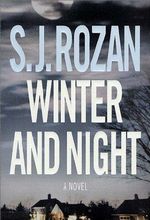
Winter and Night by S. J. Rozan

Winter and NightWinter and Night

by S. J. Rozan
Series: Lydia Chin & Bill Smith, #8

Hardcover, 338 pg.
Minotaur Books, 2002
Read: December 11 – 14, 2015

On the whole, I enjoy the Lydia Chin novels in this series more than the Bill Smith ones, while I’d say the Bill Smith novels are better novels. Winter and Night was the best of both worlds — it was probably the best written in the series, and I really enjoyed it.

Bill gets a call in the middle of the night to come help a teen that the NYPD has taken into custody. He does brings the kid, Gary, home with him and hears a vague sob story about how Gary’s just trying to help, trying to do the right thing. And then he runs away. Bill gets Lydia to start looking for Gary in NYC while he goes to check out the kid’s hometown.

There’s more wrong in the small town Gary ran from than just a missing kid. This little town is football-crazy, I’m talking Texas football crazy, the kind of thing you think King of the Hill and Friday Night Lights is making too much of, but start to wonder if they’re not. Then there’s a dead high schooler. And seemingly every person in the town is telling Bill not to think that this had anything to do with a rape and murder over 20 years ago. Which, just gets him wondering, naturally.

This case gets under Bill’s skin, hitting close to home, and worse. Lydia compares him to a patched-up furnace that’s about to explode. He gets pretty close a couple of times, actually. Making this a rougher, more raw, more violent story (not that Bill’s books are absent violence). Because this is so close to him, he makes some really dumb mistakes — Bill, Lydia and the police spend a few chapters trying to prevent a crime that’s just not going to happen, and I spent far too much time annoyed with them from not seeing things are clearly as I could.

How does Rozan do it? Seriously, you get the same two characters in two different novels or four different always know each taking the lead and is like it’s two different series. You know, there’s a certain feel when you read a Robert Crais book — Elvis Cole book or a Joe Pike book, the books are different, and the two protagonists/narrative voiced are different. But you can tell they’re by the same writer. Not the case here — at all — it’s not even close. If you told me the two different people writing the series I’d absolutely believe you.

For my money, this is the best in the series (so far). Thoughtful, suspenseful, moody . . . everything you want in a P. I. novel.

—–

4 1/2 Stars

The Devil Wins by Reed Farrel Coleman

The Devil WinsRobert B. Parker’s The Devil Wins

by Reed Farrel Coleman
Series: Jesse Stone, #14
Hardcover, 342 pg.

G.P. Putnam’s Sons, 2015

Read: September 11, 2015


There’s no good reason for me to have difficulty writing about Coleman’s Jesse Stone, but I twice in a row now, I have. It looks like it’ll take me less than a month to get this up, so that’s something I guess (but it should’ve taken me less than a day!) But man, I love these books!

In this one, on page 3 there was a line I wanted to read to my wife, on page 4 I was grinning. It was so good to be back in Paradise, MA. Chapter 2 served as a a reminder this wasn’t Parker’s Stone, this was Coleman’s. Which is not necessarily better or worse, just different — it’s still the same world, populated with the same people, it’s just told differently. The Devil Wins started strong and stayed that way.

One of the things that distinguished this series from the Spenser series (and later, Randall — which felt like Spenser) was the atmosphere — this was a gray world (so well captured in the movies). Not just morally (and that could be argued, I think), but weather, mood, outlook on life of the characters — economy of the community, even. Later, Parker seemed to pull back on that — either deliberately, or for the same reason that Spenser’s backstory changed. Coleman has returned to the gray, and amped it up a bit, his style brings that into focus. His dialogue might not be as snappy (and it’s not), but it’s thoughtful, as is the narrative and his descriptions. You can almost feel this world as much as see it.

Every town has its dark secrets, the events people don’t like to remember, or discuss, or admit they happened. Paradise has a few of those, I’d wager — one of them was that about twenty-five years ago, two high school girls disappeared without a trace. While most presumed (maybe hoped) that they’d been killed, there were no suspects, no motive, no evidence. Eventually, time moved on and the town collectively repressed the events. A fresh homicide investigation leads to the discovery of two much older bodies — everyone assumes (and it’s quickly confirmed) that it’s these two girls. Now Jesse has to deal with two investigations — one fairly low-priority, and one that is bringing back ghosts for everyone in Paradise (and is attracting plenty of attention from the rest of the world).

After putting his own mark on Jesse in Blind Spot, Coleman moves on to Suitcase Simpson and Molly. Don’t get me wrong, this is still Jesse’s book, and his presence dominates the narrative. But it’s in these pages that Coleman plants his flag on Suit and Molly. Suit is possibly at his most self-aware here, almost dying can do that to a person (making Coleman’s tweak totally justified), we don’t get as much time with him as we do with Molly, but what we do is golden. More importantly, Jesse has to be honest with himself about Suit — and that clarity will drive their relationship going forward. If Coleman hadn’t delivered with the rest of the book, but had with this? It’d have been worth it.

Parker, Coleman (and Brandman) hadn’t given us too many details about Molly outside of her outstanding work as Jesse’s conscience, aide, and friend. We got the little fling with Crow, and some references to her family, and that’s it. Which is exactly the way that Officer Crane wants it. But sometimes, you can’t keep that wall between your personal and professional as high as you want to — sometimes the past comes back to haunt you — and it does in spades for poor Molly. In the end, we don’t learn that much about her that we didn’t know, but it’s easy to see how what Coleman shows us helped shape her into the woman she is. (Minor spoiler ahead, skip to the next paragraph if you want) One of the two girls was Molly’s best friend, and by all rights, she should’ve been with her the night they disappeared. The discovery of the bodies, what they learn during the investigation, shake the seemingly unflappable Officer Crane to her core.

One more reason for her boss to take care of business. Not that he really needs it. Especially when more bodies start to show up.

Best part of this book for me? There’s no Gino Fish. There’s no deus ex mafia providing the solution for Jesse. It’s procedure, dogged determination and criminal stupidity — plus a little dumb luck that helps Jesse conclude what happened twenty-five years ago and today.

In addition to the great character work with our old friends, we get to focus on three new friends of Jesse’s in this book — two of whom are long-time residents of Paradise that we haven’t encountered yet, one is new to town. Jesse enlists the assistance of the editor of Paradise’s newspaper with the historical elements of his case (the police files were not up to snuff) in exchange for exclusives on a story starting to get some national attention. An insurance agent/city councilman who has been Jesse’s biggest supporter in Paradise’s government encourages him to keep on track and solve the crimes in a hurry (and when that fails, turns to threats). There’s a new Medical Examiner in the area (whose departure from NYC is similar to a certain LAPD detective’s) who befriends Jesse — she’s smart, attractive, and interested in more — but for now they decide on friendship.

I guess I should quickly mention the other women in Jesse’s life, having talked about Tamara Elkins. She’s talked about a couple of times, but we don’t get to see the new character from the Blind Spot, Diana Evans, which is a shame. I hope that changes soon, Coleman certainly leaves the door open for it, although Coleman’s going to have to start using surnames that don’t sound so similar. I thought Jen was around juuuuuust enough for my taste (I also appreciated the talk about Sunny Randall).

I find it amusing how many people I’ve seen complain about Jesse’s drinking being talked about so much. His battle with the bottle was a focus from Day 1 — sometimes more successful, sometimes less so — but always, always a presence, often discussed no matter if he was drinking or not. It’s there, it’s looming, Stone battles it as he does the rest of his demons (the “it could have been” of baseball, and Jen) — while doing what he can for these girls and the community.

Once again, Coleman strikes the right atmosphere and mood, captures the essence of the characters — while not keeping them frozen in amber, tells a very Parker-esque story in his own manner, and makes me seriously consider moving to a fictional Massachusetts town, despite the troubling homicide rate. It wasn’t as good as his first foray into this world, but I’m not sure it could’ve been, and it was close enough to justify reading it a few times anyway. Please, sir, I want some more.

—–

4 1/2 Stars

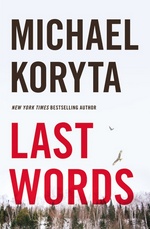
Last Words by Michael Koryta

Last WordsLast Words

by Michael Koryta
Series: Mark Novak, #1

Hardcover, 420 pg.

Little, Brown and Company, 2015

Read: September 7 – 8, 2015


There’s part of me that still hasn’t gotten over the fact that Koryta stopped writing Lincoln Perry novels, enough so, that I’ve only read 2 of his stand-alones. But I was intrigued by the idea that he was starting another series featuring a P. I. It took about 3 seconds of reading the Publisher’s Description to see that this was going to be pretty different than any other P. I. series around.

This book centers on two men haunted by their pasts and a pair of deaths that happened on the same date, a few years apart — coincidence? That depends who you ask.

Our P. I. is Mark Novak, who works for a group of lawyers trying to clear men on death row. Before she was killed, his wife worked for them, too. She was killed during an investigation, after a fight with Mark. No one has come close to catching her killer. It’s understating things to say that before Mark met Lauren, his life was a mess, and she helped him get things together. Without her, things are starting to fall apart for him.

Ridley Barnes never really fit in anywhere or with anyone in the small Indiana town of Garrison, except the caves nearby. Something about the caves calmed him, centered him, gave him a purpose — he knew those caves better than anyone alive. So when a teenage girl gets lost in them, he’s the perfect candidate to lead the search. And then, when he recovers her body, but can’t account for his time during the search, or really remember where he found her, or where he’d been at all — he suddenly becomes the top suspect in her murder. There wasn’t enough evidence to convict or even arrest him, but for some small towns that kind of thing is just a formality. He was convicted almost immediately in the court of public opinion, and has been even more ostracized than before. More than a decade later, Ridley just wants to know what happened — if he killed the girl, he’s willing to do the time. If he didn’t, he’d like to have his name cleared.

This is not the type of thing that Innocence, Inc. does. They take on convicted murderers clients, not suspects. Especially not suspects in very cold cases that will never go to trial. But Mark’s boss sends him to do a preliminary investigation anyway, mostly to keep him busy. Mark isn’t exactly welcomed to Garrison with open arms, people just assuming he’s there to clear Ridley, and not quite believing him when he says that he isn’t.

Mark commits a few missteps right out of the gate, which turn public opinion against him even more. But something has flipped a switch in his brain and he’s not going to let go until he gets some resolution for the girl, clears his name from the problems he’s caused, and demonstrated to his boss that he can be trusted still/again. Not necessarily in that order.

That’s a very sketchy overview of the set up. I don’t think I’ve read anything quite like that before. If you were to draw the plot as a map, it’d look like some deranged roller coaster — tight corners, backtracks, loops, big dives into darkness. Unlike an actual roller coaster, I was able to get through this without losing everything I’d eaten since February.

Koryta tells this story with his typical skill, you can tell that he’s built Mark Novak to last a few novels. There’s more of his story that needs to be told than is here, and the character can be used in different settings. Unlike just about everyone in last years’ Those Who Wish Me Dead — which I thought was great — I don’t think there was a single character in that novel that I could see being interested in for another novel. Ridley is almost as complex, and you want him to get the answers he needs just to get a little peace (most of the time — there’s a time or two where you don’t mind him suffering).

Garrison, IN is pretty much every small town in mystery/thriller fiction, and its citizens are pretty much stock characters. On the whole, neither the town nor the people feel that way. Which is entirely due to Koryta’s skill and Mark’s voice.

And then there’s the cave, or caverns — I’m not familiar enough with the geology to nail the distinctives between the two. There’s a strong sense of place, of foreboding, of danger to it. Especially in Ridley’s mind, the cave is almost a Byronic character — dark, mysterious, dangerous, yet attractive. Yes, there was a time or two I was glad to be reading about the cave in a very wide and open room.

Oh, sure, and it’s a real handy metaphor for the depths of the human mind, psyche, soul, etc.

This is a very well constructed mystery novel, the writing is excellent, the characters are keepers, you can almost feel the winter air — really, there’s very little to not rave about with this. It’s pretty clear what book 2 holds, but I’m really not at all sure what a third would bring. But I’m eager to find out.

—–

4 1/2 Stars

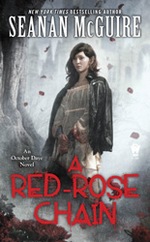
A Red-Rose Chain by Seanan McGuire

A Red-Rose ChainA Red-Rose Chain

by Seanan McGuire
Series: Toby Daye, #9

Mass Market Paperback, 358 pg.
DAW, 2015
Read: September 2 – 3, 2015

“Wow. Your ego has grown since we’ve known each other, hasn’t it?”

“Ah, but, you see, I have wooed and won the woman of my dreams. Admittedly, some of those dreams would be more properly termed ‘nightmares,’ but I don’t believe we get to be that picky when talking about such things . . . If my ego had not grown, it would surely be a sign that I was no true cat, and you would leave me for another.”

And that, folks, is why half of McGuire’s readers want to be Tybalt and the other have want to have a Tybalt in their lives. A Red-Rose Chain is chock-full of these kind of moments sprinkled between espionage, intrigue and peril.

Queen Windermere is still trying to figure out the whole Queen of the Mists thing, getting her howe and her kingdom running the way they should, and what not when a message is delivered: the Kingdom of Silences has declared war and in three days will begin attacking. King Rhys of Silences (which is in Portland, OR) was put on his throne by the bogus Queen of the Mists that Windermere recently overthrew, and he seems to be getting nervous about his position.

Who else would Windermere appoint as her ambassador to negotiate peace in the three days than Toby? Pretty much anyone in her kingdom. Which seems to be the conventional wisdom — and Toby agrees — but for her own reasons (some of which Toby eventually guesses) the Queen insists. She also doesn’t have a lot of options (see previous paragraph). So Toby and her fiance head off to stop a war instead of instigating one — and they take along Quentin, May, and Walther (the alchemist/Chemistry professor) to lend a helping hand.

Now, he’s no Blind Michael, but Rhys is one of the more despicable people in this series so far. And while he observes all the necessary formalities and whatnot, it’s pretty clear that his heart isn’t ion the whole negotiating thing, and he’s just biding his time until he can attack. The last time these two kingdoms battled was a century or so earlier, and while they prevailed, it didn’t go well for the Kingdom of the Mists — this time, it’s sure to be worse. A perception strengthened once we see how Shadows treats a diplomatic party. So Toby can’t fail.

Toby’s got her friends with her, but in many ways, she’s more on her own that usual — she doesn’t have all the resources to call upon in Portland that she does in SF, but she makes the most out of what she has. At the end of the day, it’s Toby’s series and she’s the one that carries the weight of the plot and the weight of the weight of the mission on her shoulders. McGuire pushes her in ways that she hasn’t been pushed before. I wasn’t thrilled with a couple of the moves McGuire made in the final couple of chapters — not bad writing/plotting, I just didn’t like what Toby had to go through. She prevails, naturally — though, not unscathed, but through grit, determination and the loyalty she commands (and returns) from her allies.

As a small break from the diplomatic tension, we spend a little time with Tybalt’s Portland counterpart. The two are very different from each other, (which is nice to see the variations in personality), but clearly have a a good deal of respect for each other. There’s an interesting shared past for either of them that we’re teased with, too. Would’ve been nice to get more, maybe one day. For the present, it’s nice just to get a little bit more of Tybalt’s pre-Toby history.

Looking ahead to #10 and beyond, I’m a little worried that things are going too well for Toby — particularly where Tybalt is involved. Will McGuire let her be that happy for long? At all?

That’s a worry for another day, for now, I’m going to say that this is one of my favorite reads of the year and leave it at that.

—–

4 1/2 Stars

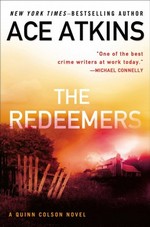
The Redeemers by Ace Atkins

The RedeemersThe Redeemers

by Ace Atkins
Series: Quinn Colson, #5

Hardcover, 370 pg.
G.P. Putnam’s Sons , 2015
Read: August 7 – 10, 2015

The first thing you want to do after being shot is make sure you are not shot again.

That sentence just makes me grin. Which, honestly, is not something that someone spends a lot of time doing while reading a Quinn Colson novel. But The Redeemers is not your typical Quinn Colson novel.

We start off with Quinn on one of his last days as sheriff — Johnny Stagg, the man Boss Hogg wanted to be, finally worked his magic and got the election result that he worked so hard for — Quinn’s out and a man of his backing is in. Most readers are going to instinctively prefer Colson. and want to not like his successor, Rusty Wise. Rusty was most recently an insurance salesman, although he did work as a police officer for a time (nothing to noteworthy in his career — or at least not that Stagg didn’t bury). The problem with being anti-Rusty is that he’s actually a decent guy (sorry, Johnny), who honestly thought he could do a better job than Colson — and gets thrown into the fire on his first day (hours before it, really). Now, we all know — and Lillie Virgil will tell you — Wise is no Colson, not even close. But he’s trying.

On the other end of the spectrum, are a few idiotic criminals — you’ve got the so-called master safe cracker and his University of Alabama Football-obsessed nephew/apprentice, hired by a local to help he and his friend get revenge on a crooked businessman. I’m fairly certain these criminals had noticed that they had no place to live without Elmore Leonard, so they dropped by to see how they’d fare in Tibbehah County. Short answer: they were better off before. If you don’t chuckle at these numbskulls at least one, call your doctor and get your funny bone checked. Lille and Wise have the lead on this investigation, but the wife of their victim gets Colson to check into it a bit, too.

He gets pulled in because that woman is the aunt of Anna Lee — who has definitively left her husband, who has definitively left town, so she and Quinn can definitively do something about their old flame. Which is just one of the balls that Quinn has to keep in the air on the personal side — his father’s moving into Quinn’s house and bringing his horses on to Quinn’s land; his sister Caddy has fallen way off the wagon again; and Quinn’s unemployed — unless he wants to get a job at the new Wal-Mart, he’s going to have to do something about that. There’s an element of “oh, this again?” with Caddy’s struggles with drug addiction. But what do you want from that kind of thing? And with Quinn’s father, I felt a strong, “ugh, how long are we going to out up with this guy?” (I think Quinn agrees with me),

You have to ask (and people do), why does Quinn stay in Jericho? For that matter, why does Caddy (not just because Quinn drags her back), why does Lillie? Part of it is because it’s where they grew up, where they are home. Part of it, is hard to pin down, but Quinn touches on it while talking with the federal agent, undercover in Stagg’s business:

“There’s more to the place than the ugliness,” Quinn said. “Maybe someday I can take you out hunting and fishing and you can know more than just that . . . truck stop. Get out on Choctaw Lake and out into the National Forest.”
“I’d like that.”
“Folks like Stagg and Cobb haven’t ripped all the guts out of the place,” Quinn said. “There’s still a lot left.”

I do fear that Assistant Sheriff Lillie Virgil is given short shrift again. Yes, every time she’s used, she’s: competent, dangerous, smarter than most people in the room with her. She just seems to get the short end of the stick when it comes to story, to emotional arcs, and the like. I want more for her — professionally, personally, and narratively. Now, along the same lines, but perhaps more importantly: can someone arrange a novel/short story/something where Lille and Vic Moretti team up? Yes, it’s possible that would be just too much feminine toughness and gunplay for audiences. But surely, it has to be tried.

For the most part the book keeps trudging along — interesting, occasionally funny — but nothing special — Stagg’s up to his thing, Quinn’s figuring out his next move, the Leonard refugees are seemingly trying to get caught. But nothing that really grabs you. Until you get to the last 60± pages, that is. After lulling the reader into a false sense of security, Atkins packed a while lotta happenings, and loose ends being tied up and bodies being dropped into these pages. Action, and emotion, and a dream sequence that seems straight out of Craig Johnson.

In interviews, Atkins states that the next novel is going to be dark (which is part of why this is so light) — I’m a little worried about what that means. I’m pretty sure the only one who’s safe is the guy who’s name is in the series title (though it wouldn’t surprise me if he got really banged up — but he’ll survive).

—–

4 1/2 Stars

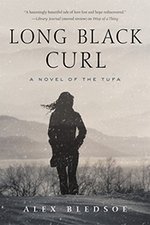
Long Black Curl by Alex Bledsoe

Long Black CurlLong Black Curl

by Alex Bledsoe
Series: Tufa, #3

Hardcover, 377 pg.

Tor Books, 2015

Read: June 11 – 13, 2015

5 Stars
This book was practically un-put-downable. Not because I was driven to find out what happens next — like a Finder, or Child etc. This is one of those kind of books you don’t want to put down because you don’t want to leave that world, not for a minute, to step back into this one, as nice as it is — filled with your stuff, and your great wife and frequently tolerable children. But this book’s little corner of Appalachia that touches another world (in more ways than one) is a place you just want to exist in. Granted, I’d rather be in one of the earlier books than this one (not a reflection of the quality of the book, just the events portrayed).

Not all that long ago, especially by Tufa standards, Bo-Kate Wisby and her beau, Jefferson Powell wreaked all sorts of havoc. They were so terrible that they were banished from the community, unable to return — or, worst of all, make music. WHen you think of some of the despicable things that have happened or have been described in the previous two novels by citizens in good standing, you get an idea just how bad this was. Both have spent decades yearning to return, to play music — but have had to settle for incredibly successful careers in the music business. Which would be a special kind of torture and pleasure — being that close but not able to partake, still being able to appreciate it though. Somehow, however, this curse was lifted without anyone realizing it.

Well, anyone but Bo-Kate. She returns to get revenge and bow the Tufa to her will, destroying their heritage, their way of life and instituting her own. Her approach is not subtle, she clearly learned a little bit from the “Shock and Awe” tactics of a recent war. My jaw almost dropped when i saw the first step that was taken by Bo-Kate. I — like most of the Tufa — didn’t think that was possible, or at least likely. Although there was something to appreciate about that action, there wasn’t in the rest of what she did to the community — I can’t think of any fictional character I’ve had such a visceral reaction to (especially this quickly) this side of Joffrey Lannister Baratheon, first of his name.

It should go without saying with this world, the way the rest of the Tufa respond and defend themselves isn’t how you’d expect. Which goes double for how things play out.

Thankfully, I did really enjoy the rest of the Wisbys — especially Bo-Kate’s sister. I hope to spend more time with them. Actually, I liked getting to know all the new characters — including Bo-Kate’s allies (or those characters who weren’t new, but we hadn’t really spent time with). The characters in this community are so well drawn, so real that you almost don’t need a plot to enjoy a book about them.

As always, I’m jealous of the relationship between these people and music. I don’t have it — a couple of my kids do, at least. I think the way the two banished Tufa react to their returning musical ability tells you almost everything you need to know about them. These are books that need to come with their own score, their own soundtrack. Sadly, I don’t think humans are capable of putting out anything worthy of the books. As good as some of the music inspired by this series has been, it’s not good enough to live up to Tufa standards.

Two things that detracted from the book for me. First is the sex. Not that Bledsoe’s a model of Victorian attitudes toward sex before this, but Long Black Curl is pretty sexually explicit — moreso and more often than before (I’m reasonably sure, but am not interested enough to go back and check). I don’t think it was necessary, but don’t think it hurt things. It was just one of those things that seemed to stick out to me.

Secondly, this is absolutely the most straight-forward of the series, which is both a strength and a weakness. It’s more accessible. There’s almost no doubt whatsoever whats going on. The previous two books haven’t been exactly subtle about the magic and how it works out in the lives of the Tufa — but (and I’m struggling to express this the way I want to) they mostly just let us see what happened and say “hey, that’s magic.” There’s some winking and nudging, but primarily the reader has to do the heavy lifting. To switch metaphors, Bledsoe gave us all the numbers and equations, but we had solve for x on our own. But here? It’s all spelled out. It’s somewhat refreshing, but a little disappointing, too.

But that’s just a little tarnish to the series. It’s still one of the best out there. This book changes the world, but not so much that you won’t recognize it — this is all about growth, development. It does my heart good to know that Bledoe is writing #5 at the moment, so we’ve got at least a few hundred more pages of this world to come.

You can absolutely start here, but I think you’d be better off starting with the first, The Hum and the Shiver to you can catch all the nuance and atmosphere and all that. What it means that character X shows up and does Y. That kind of thing. Either way, dive into this world.

—–

4 1/2 Stars

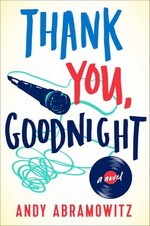
Thank You, Goodnight by Andy Abramowitz

Thank You, GoodnightThank You, Goodnight”

by Andy Abramowitz
Hardcover, 338 pg.
Touchstone, 2015
Read: June 30 – July 3, 2015

In most instances, space between people grows like mold, neglected just long enough to be noticed. You intended to wipe it clean, but the more of it there is, the more daunting a task it becomes to erase it. Not so with me and the band. I’d discontinued those people as if they were a premium cable channel that I’d finally realized was broadcasting nothing I wanted to watch.

From passages like that, a nice mix of thoughtful, sentimental, with a bit of a grin; to the out-and-out funny, like the funniest suicide attempt I’ve read in a long time, possibly ever (something worthy Save Steve Holland’s Lane Myer, but longer); this book covers the spectrum. Not only covers it, but does so with assurance and panache. It’s one of those first novels that makes you wonder what could possibly be done as a follow up.

Teddy Tremble is a successful enough lawyer for someone who’s heart isn’t really in it, while still being good at it. He’s sort of coasting through life — being good enough at his job, good enough with his girlfriend of forever, good enough for his social circle, but not good enough for his father (but after meeting him, you understand that’s just a given). He’s forty-ish and realizes that life is going to pretty much stay this way. On the whole, he seems okay with that — but in the back of his mind he knows he’s not. He won an Academy Award. His band was huge for a little while in the 1990’s, before his hubris ruined things. Sure, things are good enough now, but once upon a time they were great.

Then through a truly humbling and bewildering set of circumstances, Teddy comes across a group of huge Tremble fans. Seriously, die-hard doesn’t begin to describe these people. Think something akin to the kind of people that organized the first Star Trek convention back when it wasn’t a cultural phenomenon, just a short-lived and then canceled show. This changes everything. The adulation, the attention, the satisfaction of performing gets under his skin and he starts writing music for the first time in a long time.

Pretty soon, he’s (forgive the cliché) trying to get the band back together — his agent and producer are on board, convinced that what he’s written exceeds his former quality. Incidentally, both of these characters are the kind that we readers hope to come across — supporting characters that threaten to steal the entire novel, but when used properly just make the whole thing better.

Anyway, with these two on board — Teddy just has to convince the rest of the band to give it a shot, to trust him. Maybe even to forgive him for what he did to them so long ago. Then he has to convince music fans to take them seriously. Neither of these tasks is going to be easy. Both are practically impossible, really.

The book starts out as pretty entertaining, definitely amusing. But it doesn’t stop there — it gets better, deeper, emotionally richer all the while. By the time I got to (and through) Chapter 20, I tweeted that, “Not sure I need to read another word (am going to), but that was as close to perfect as it gets.” I’m still thinking about it a month later.

At various places through the novel, Teddy observes: “One day I’ll die, and this will be one of the things I did with my time.” I’m not sure if I’ve ever seen one sentence used so many different ways with so many different meanings depending on the context. Sometimes he’s says it wryly, sometimes caustically, sometimes wistfully, sometimes with pride. It’s one of those writerly things that when you see it in action, you wonder why more people don’t try it.

Each of these characters — the agent, the producer, the bandmates, their (sometimes very odd) families, Teddy’s girlfriend, associates in the law firm, and others — are well-drawn. Occasionally familiar, without being stock characters or cliché, each character ends up being strong enough that you want to spend at least a little more time with them. But Abramowtitz is too capable of steward of his resources and gives us just enough to leave us wanting more.

I’ve seen a lot of comparisons of Thank You to Hornby’s High Fidelity and Tropper’s This is Where I Leave You. I don’t get that. Maybe it’s just because these people haven’t read anything else by these authors — they should be comparing this to Hornby’s Juliet, Naked and Tropper’s One Last Thing Before I Go (to be fair, I have seen a little of this comparison, but no one else that I’ve seen has tagged Juliet). These three cover some of the same territory, and Abramowitz comes out looking really good in that company. Don’t get me wrong, I really liked Juliet, I know I liked it more than most people I know. But I don’t think it was as good as it wanted to be or as it thought it was. Thank You seems to do the things that Juliet was wanting to do but didn’t get done. I’m not necessarily saying it’s a better book (I might lean that way), but this is more successful in the areas they overlap. Similarly, while I wouldn’t say that One Last Thing is a bad book, it can’t hold a candle to this one. I’m not trying to make this a competition, but for this first-time novelist to get things better than old pros like Hornby and Tropper says so much about him.

One day I’ll die, and reading this will be one of the things I did with my time. I’m so glad it was.

—–

4 1/2 Stars

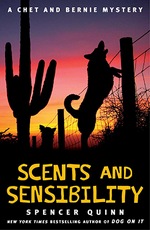
Scents and Sensibility by Spencer Quinn

Scents and SensibilityScents and Sensibility

by Spencer Quinn
Series: Chet and Bernie, #8

Hardcover, 305 pg.

Atria Books, 2015

Read: July 16 – 17, 2015Bernie Little is back from his cross-country adventures, not much worse for wear, probably with a little coin in his pocket (knowing Bernie. He gets home to find one of his elderly neighbors in the hospital and her husband being investigated by some overreaching environmental authority. Which gets Bernie’s protective instincts engaged. Oh, yeah, and there’s a hole in Bernie’s wall where a safe used to be. That’s in the mix, too — but it takes a back seat to the Parsons’ plight.

It seems that the Parsons’ son was recently released from prison, making the timing of Mr. Parson’s troubles (and the missing safe), a little suspicious. Bernie starts investigating the son — which leads into looking at the crime that put him away in the first place. Which leads Bernie to cross paths with an old rival. An old rival who may have had something to do with the fact that Bernie is no longer employed by the Phoenix Police Department.

The past and present mingle with the personal and professional for Bernie as the case gets more complicated and dangerous. Which makes this a pretty decent detective novel — then throw in our loyal narrator, Chet with his uniquely irrepressible voice and perspective. That’s a thick layer of icing on a pretty good cake.

Which I guess makes the presence of a young dog who looks and smells like Chet (he’s the source of the latter observation) a nice fondant?

I think the illustration is getting away from me, so I’d better move on.

There are a few certainties in crime fiction, in every novel: a vehicle operated by Stephanie Plum will explode; Nero Wolfe will have beer; Harry Bosch will listen to jazz; and Chet will be separated from Bernie. Sometimes, this annoys me because it seems so forced, but this time it snuck up on me so naturally that I was three or four paragraphs into it before I realized it had happened. There’s some other Ce and Bernie mainstays here: Bernie says something he regrets to Suzie; Bernie’s ex seems to go out of her way to misunderstand Bernie, Chet is spoiled and eats like a goat. Really, it has all the elements of this series, Quinn just uses them better than usual here.

A compelling story, the characters back in their stride, and we learn a little bit more about Bernie — if that’s all this had, I’d jumping with excitement. But when you add those last few paragraphs? Forget it — this is the best thing Quinn’s done since introducing us to this pair.

—–

4 1/2 Stars

Page 26 of 30

Powered by WordPress & Theme by Anders Norén