Tag: 4 1/2 Stars Page 27 of 30

Kitty Saves the World by Carrie Vaughn

Kitty Saves the WorldKitty Saves the World

by Carrie Vaughn
Series: Kitty Norville, #14

ARC, 325 pg.
Tor Books, 2015
Read: July 14 – 15, 2015
4 1/2 Stars
Easy title to live up to, no?

About the same time that I posted my review of the previous book, Low Midnight, where I talked about “future Kitty novels,” Carrie Vaughn announced that this one would be the end. So much for my predictive ability. Now, at the end, I see that Low Midnight was well-placed in the series, and I have a better understanding of the role it played in setting up this book. Which is not to say that I wouldn’t have preferred a few more books in this series, but if Vaughn had to end it now, I’m glad she did it like this.

This couldn’t be less obvious a last novel. Kitty name checks and/or visits everybody we’ve met along the way, it’s like the last few minutes of “The End of Time” before The Doctor regenerates into Matt Smith. But Vaughn does it so smoothly, it’s only when you stop and think about who’s shown up that you even notice what she’s done.

I don’t really have much to say about this — it’s the 14th and final novel in a series. Don’t let this be the first one you read — do let this be the last. Start with one of the first few (if not the first, Kitty and the Midnight Hour).

This is different than the rest of the series, not just because it’s the end. There’s plenty of action to be found — not a lot of time for character development, growth, relationships, new characters (well, maybe a couple) — it’s all about Regina Luporum and her allies versus Dux Bellorum, anything else is a distraction (however pleasant a distraction). Which isn’t to say that the characters are unimportant — it’s Carrie Vaughn, characters are the core. But they’re very busy here, and don’t have a lot of time to chat, reflect, or anything like that — they have a world to save.

The final showdown with Roman didn’t go as expected, but better. The scenes following that were great, and the ending was everything a fan could hope for.

One criticism — and, now that I think about it, this applies to the series as a whole — Kitty tells us time after time that her pack is what’s important, it drives her restaurant/bar New Moon, it keeps her in Denver, it’s what motivates her, blah, blah, blah. But really, outside of the occasional chat while picking up an order with Shaun and references to the group hunting on the Full Moon, we don’t see them. The pack that Kitty cares about is the other one — Ben, Cormac, Amelia, Alette, Odysseus Grant, Tina, Rick, Matt, and the others that fill her life and align themselves with her against the Long Game. I’d be fine with it if Kitty were just a little bit more honest with herself/us about it.

I’m going to miss Kitty, Ben, Cormac and the rest, and the next year is going to feel a little strange not getting any new adventures from them. But this was a great way to say goodbye.

—–

4 1/2 Stars

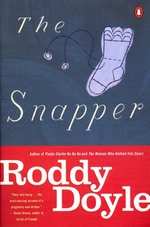
Reread Project: The Snapper by Roddy Doyle

The SnapperThe Snapper

by Roddy Doyle
Series: The Barrytown Trilogy, #2

Paperback, 212 pg.

Penguin, 1992

Read: May 20 – 21, 2015Naturally, after one of the best rock band novels ever — one fully of music, laughs, and style — Doyle follows it up with a heartfelt story of a young woman who gets pregnant after a one-night stand. Who wouldn’t?

Now, Sharon (the young woman in question) is the sister of Jimmy Rabbitte — The Commitments’ manager. So there is a tie — and we saw a little of their father and the rest of the family last time. Still, this feels so different, it’s hard to conceive of them being part of a trilogy. Oh well — it works — so who cares?. Carried along by Doyle’s inimitable style, this story — which could easily have been maudlin, overly sentimental, or sappy; comes across as genuine and heartfelt instead.
Where The Commitments was full of laughs, raunch, and style; The Snapper is full of laughs, family and heart. It’s not just about one member of the family this time — it’s all of them. The focus is on Sharon and her father, Jimmy, Sr.

Sharon finds herself “up the pole,” much to her distress. She knows who the father is, a one-night stand (something far less meaningful, actually) she wishes had never happened. Unwilling to let anyone know the father’s real identity, she makes one up (which also relieves her of the need to let the real guy have anything to do with the kid). Initially, she’s in sort of a denial — she knows the baby will change everything. But that’s months away — right now, she and her friends can still hit the pub after she gets off working at the supermarket and pretend that everything’s just like it was a couple of weeks ago. Eventually, she starts to make the changes necessary, but only when she has to. There’s personal growth here for Sharon, when she has no choice. But honestly — other than questionable taste in men, and an utter lack of awareness about Fetal Alcohol Syndrome — she seems like she’s got her head screwed on right already.

Jimmy, Sr. seems like the kind of guy you’d like to hang out in a pub with occasionally — I think he (and his friends) would get old quickly if you hung out with them all the time. Generous, funny, and gregarious. Maybe not the most responsible guy around — but he’s making ends meet (mostly), and doing (almost) his best for his kids. Eventually, he seems to get his act together for Sharon — or at least he tries. Which just makes you like him more — even as (because?) he just doesn’t make it some times.

While these two are on the forefront of Doyle’s attention, we do get some time with Sharon’s siblings (even Jimmy, Jr. — a little bit — who’s still trying to make it in the music business) and long-suffering mother. We watch the family stumble along through financial woes, various school clubs, a bicycle club or two, and being the subject of neighborhood gossip. These all might not be as well-rounded as Sharon and her father are, but they’re close enough that you think you know them.

Back in college, I read The Commitments a lot — but I think I read The Snapper more. It’s not as fun as its predecessor, but it’s a better novel — populated with actual people, actual growth, and something that looks a lot like actual life for many people. The Rabbites could be your neighbors, and you’d be happy to have them, which makes getting to spend time with them between the covers of a book just that pleasant.

—–

4 1/2 Stars

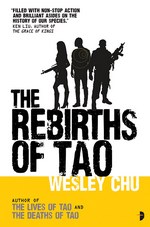
The Rebirths of Tao by Wesley Chu

The Rebirths of TaoThe Rebirths of Tao

by Wesley Chu
Series: Tao Trilogy, #3

Mass Market Paperback, 506 pg.
Angry Robot Books, 2015
Read: June 15 – 20, 2015That was satisfying.

Really, that’s about all I have to say about this one. But let’s see if I can’t expand a bit. Overall, I enjoyed The Lives more than this, and this one engaged me more throughout than The Deaths did, but The Rebirths brought the Tao Trilogy to a satisfying conclusion, wrapping up what needed to be wrapped up, dealing with all the arcs that needed to be concluded and generally leaving things in a place where we can say goodbye to these characters (not that we necessarily want to, but we can) — oh, and was a solid SF adventure in its own right.

One personal note, a large part of the action takes place in Ontario, Oregon. Most people reading this book aren’t going to think much about that at all, but I grew up about 10 minutes away from Ontario — so I thought that was pretty cool. On the other hand, now I know how Bostonians feel when reading Robert B. Parker or Dennis Lehane, or a life-long Chicago resident when reading Jim Butcher. The geography is bad, and if you wanted to buy a nicer car, you wouldn’t bother driving to Boise, you’d get the same car (probably cheaper) in Ontario.

But that matters so little to the book as a whole, that those four sentences are at least two too many.

So, anyway, this book (like The Deaths) takes place a few years after we’d left Roen and the rest. His son, Cameron, is a teenager — with all the stubbornness, rebellion, and hormone-addled fun that entails. Of course, his rebellion takes the form of wanting to join in the war against the Genjix, while his parents do all they can to steer him away.

It’s safe to say that very few (if any) of the Quasing are happy with Jill’s little revelation at the end of The Deaths — Genjix or Prophus — which puts them in the same boat as humanity. Governments all over the world are attempting to hunt down any and all Quasing. Which hasn’t done any favors for the Prophus, but at least seems to have hurt the Genjix effort more.

Which is not to say they’re down for the count by any means. Enzo, the Adonis, is still out there strutting like a peacock and working to bring about the end of humanity. We finally get to see the Genjix plan in full, and I’ve got to say, reading about their plan for re-making Earth makes me really glad that this is fiction.

Right?

So, we’ve got the Ontario storyline — which looks like a pretty routine mission for Roen and Marcos (yeah, not quite Felix & Oscar, but close enough), until it gets bad. And then worse. There’s a conflict in the leadership of the Genjix (so nice to see that even some of them don’t like Enzo). And then there’s a major breach in security which leaves the rest of our Prophus friends on the run — our focus is on Cameron, but not exclusively here. I was a little surprised how Chu concluded the Ontario storyline — which is what made it effective, really. These three threads, ultimately, naturally, converged into one big battle — like the two books before.

Once again, what Chu did with Roen between the books isn’t exactly what one expects, but it fits his character. Ditto for Jill. We didn’t know Cameron enough for me to say. Tao? Sure — Tao’s the same, being centuries old helps him stay consistent. When it comes to the machinery of the Genjix, Prophus and the US Government (and/or everyone else) — things didn’t go the way I figured they would following The Deaths — but I think I liked it more that way. It’s because of the fallout from Jill’s revelation that most of the character changes happened the way they did. Chu really was effective here.

There are some great fight scenes, if that’s your kind of thing (and if it’s not, why are you reading these books?). The final scene is as epic — yet personal — as you want from the end of a third book in a trilogy. Part of that battle are back-to-back hand-to-hand combat scenes featuring an Adonis vessel and people near and dear to us. By this point, I had no idea what Chu was going to give us and I was hanging on every hit. I’m so glad that Chu sprinkles so much humor through these books — after these fights were over, I needed the joke that followed.

It may not work for everyone, but I really liked where everything was left off. Particularly for Enzo.

A really solid novel, a satisfying conclusion — making the Tao trilogy a keeper. I’m very much looking forward to what Chu’s got in store next.

—–

4 1/2 Stars

I Am Princess X by Cherie Priest (Kali Ciesemier, Illustrator)

I Am Princess X I Am Princess X

by Cherie Priest, Kali Ciesemier, Illustrator

Hardcover, 227 pg.
Arthur A. Levine Books, 2015

Read: June 4, 2015

This book starts off just like the book description tells you — it’s practically an outline of the first 40 pages. Somehow, even if all they were doing was fulfilling the book jacket copy, the opening chapters sucked me in more and more with each detail until the last sentence on page 35. That line was just creepy. At that point, I put my finger in the book to save the page, called to my daughter (who’d showed minor interest on the book) and told her that unless Priest screwed things up, she had to read this (and seriously , what were the odds of Priest doing that?).

Years after the death of her best friend, Libby, May starts to see drawings around town of something the two had created together (and no one else knew about). How is that possible? She does everything she can to find out, but that doesn’t tell her anything other than that there’s a (pretty popular) webcomic out there starring their creation. There’s a self-proclaimed computer guru (Patrick — he prefers Trick, though) living a few floors below her dad that May hires/cons into going the extra technological mile for her. Their investigation doesn’t remain online, and before long the two are running all over Seattle. They dance between employer/employee; condescending college-aged twerp/younger, slightly naive teen; pals throughout in a way that seems organic and real. It’s probably the most realistic thing in the book after the death of Libby. While I’m talking about them — the hijinks the pair get into in the cemetery result in either the funniest or the grossest line of dialog I’ve read this year. Possibly both.

This isn’t the kind of comic/prose hybrid that Jeff Kinney, James Patterson, Stephen Pastis, etc. are doing — Priest uses the comic pages (taken from the fictional webcomic) to further the plot, to help us see what May and Trick are reading/seeing. Rather than trying to describe (and likely not succeeding all that often) a series of panels and the artwork, we just get them. Shorter, sweeter, to the point. A great merger of the two media. Ciesemier’s art is spot-on, I could easily read a webcomic she draws.

This is a YA novel with no love triangle, no romantic love period — that’s practically enough of a sales pitch for me right there. Friendship — that’s the emotional core driving this. The old friendship between Libby and May, that death hasn’t changed too much; the budding friendship between May and Trick, and another one that’s in spoiler territory. Nowhere along the lines is there even a whiff of anything else between these characters. What a breath of fresh air! There’s some actual parenting (not perfect, but humans trying) along the line, too — a couple of pretty good dads — something else I don’t see a lot in YA. So yay there, too.

It’s an implausible story grounded in three real characters (May, Trick and May’s dad) — and a couple of others that could have been as grounded if we’d gotten a few more pages from them. For the story this is trying to tell? That’s just enough to carry it.

We see the villain enough to find him threatening and somewhat believable, learn enough about him to support that, but not enough that we can develop any sympathy for him — he’s mostly shadow, which frequently feels like under-writing or a cheat by the author. But here it felt like a device to underline the threat he poses.

This is pure escapist adventure reading — no muss, no fuss, no frills. The story matches the medium of a webcomic pretty well. Sure, it could’ve been a deeper, more reflective novel — or even a slightly more realistic one. But it doesn’t need to be. Have I rated better written/constructed novels lower than this? Oh yeah. But this novel was exactly everything it promised to be, everything it needed to be. This grabbed me from the start and didn’t let go until it was done.

As an added bonus for people like me, I’m pretty sure there’s a tip o’ the hat to Robert B. Parker in these pages. That just brought a smile to my face.

—–

—–

4 1/2 Stars

Three Parts Dead by Max Gladstone

Three Parts DeadThree Parts Dead

by Max Gladstone
Series:Craft Sequence, #1

Hardcover, 333 pg.
Tor Books, 2012
Read: June 1 – 3, 2015

Good grief. I don’t know what to say. Three Parts Dead is a unique reading experience. I spent a lot of time not exactly sure I understood everything going on, but I was riveted (and yes, I understood things eventually — just some of the magic took awhile to register).

The closest thing I can come up with to compare this to is Michael R. Underwood’s Shield and Crocus without the super-heroes, but with Wizard-Lawyers, Vampires, and Gargoyles that can eat Anton Strout’s Stannis for lunch.

Forget my attempt at plot summary, it’s just not going to work — click the links above and read Gladstone’s (or whoever put together his site). This is smart, compelling — occasionally gorgeous — writing. The world building is fantastic. These characters — I’m going to be thinking about them for awhile. Actually, that’s true for the book as a whole. I’m going to be thinking about all of it for awhile. Love it when I read a book like that — this one is going to stick with me.

There’s SF elements, fantasy elements, some mystery, a little legal thriller, some oddly pro-cigarette imagery… a little bit of something for everyone, tied together to make something that’ll knock your socks off.

I can pretty much promise you that you’ve never read anything like Three Parts Dead. That may not be enough of a reason to pick it up, but it you really should.

—–

4 1/2 Stars

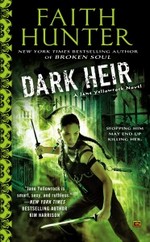
Dark Heir by Faith Hunter

Dark HeirDark Heir

by Faith Hunter
Series: Jane Yellowrock, #9

Mass Market Paperback, 363 pg.
Roc, 2015
Read: April 22 – 24, 2015
So, how much trouble does Jane Yellowrock find herself in this time out? Almost all of it, I think.

Even as she left his desiccated near-corpse hanging on the wall in Leo’s sub-basement, we all knew that Jane was going to have to deal with The Son of Darkness sooner than later. So did she. Turns out it’s a lot sooner than anyone expected or wanted (well, maybe some readers wanted it now, so sooner than Jane et al. wanted it). Joses Bar-Judas is probably the nastiest, toughest, most despicable supernatural creature we’ve encountered in these books — and I don’t see him being topped any time soon (well, maybe his brother).

The body count in this one is high — and the ramifications for that are probably going to be felt for a book or two. Oddly, the police and people of New Orleans don’t take kindly to an out-of-control vampire. Relations between the general populace and the Mithrans are near the breaking point.

But that’s not the worst — whatever this original vamp* is capable of doing — it’s far more than Jane’s ready for. Keeping fairly spoiler-free, let’s just say that whatever punishment our Skinwalker’s taken thus far is nothing compared to what she’s got coming.

Along the way, Jane learns some things — thanks to the vamps playing everything super, super close to their chests — that changes how she thinks about and understands almost everything that’s happened since she first came to New Orleans.

Which isn’t to say this is a perfect book — I’ve about had it with Molly, really. I’ll always be interested in her daughter (and the way Beast thinks of that little kit), but Hunter needs to do something interesting with Molly soon. I didn’t like the way that Jane’s church (particularly their baptismal waters) were depicted. I’ve always appreciated how in the middle of all this crazy supernatural stuff, there’s been a real drive in Jane for a connection to this church, which was fairly realistically depicted. Hunter sorta tossed that out of the window this time, and made it just as supernatural as everything else. I understand that impulse and how it fits into this world — I just like it less. Lastly, there were plenty of opportunities for Jane and Jodi (and the rest of the police) to work together here, or at least for Jane to do a better job explaining things to her pal with the badge. But for the most part, all that was shoved to the sidelines in a pretty poor way. Yes, there’s only so much Hunter can fit into 360 pages, but still.

Nevertheless, in the grand scheme of things, these are minor complaints when weighed against what Hunter did accomplish here. The chapters involving the final show-down were some of the best things I’ve read in this series, and were definitely filled with all the “what the — ?!” moments you could ask for and a couple “did I just read that?” paragraphs as well.

In the midst of things at their worst — we get some really nice moments with her not-boyfriend, Bruiser. Best of all, we’re treated to some great, heartfelt, “Awww” inducing developments with Eli and Alex. I’ve liked Alex from the get-go, but Eli is about to become my favorite character in the series (sorry, Jane).

For most of the time I’ve been reading this series, I’ve pretty much thought of it as a decent UF series to tide me over between installments of my favorites. But as of the last two or three, I think I’ve come to realize that this is one of my favorites and that I’m really, really looking forward to seeing what comes next.** Dark Heir is probably the best so far, and it’ll take something big to top it.

—–

* Not to be confused with the CW’s collection of teen heart-throb Originals.
** Which I fear means that Hunter will wrap things up in a book or two.

—–

4 1/2 Stars

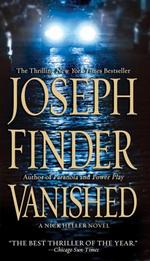
Vanished by Joseph Finder

VanishedVanished

by Joseph Finder
Series: Nick Heller, #1


Hardcover, 384 pg.
St. Martin’s Press, 2009
Read: April 7 – 8, 2015

I lost sleep over this one. Literally. I had to force myself to put this thing down so I could get a little shut-eye. Which wasn’t easy. After about 70 pages or so, I realized two things very clearly: I was hooked on this book and was going to have to get the next one in the series very soon. Neither feeling went away.

Last year, when I read FaceOff, the Jack Reacher/Nick Heller story was probably my favorite, so when I found myself wandering the library last week, with every thing on my “to get list” unavailable, I figured I’d finally give a full-length Heller story a try. Clearly, one of the better moves I’ve made.

Nick Heller is former Army Special Ops, turned corporate espionage hotshot. His estranged brother, Roger, is abducted (at best) leaving an injured wife behind. His nephew, Gabe, freaks out and calls his uncle for help, not willing to trust the police. So Nick, with “a very particular set of skills,” starts looking for his brother.

Heller’s similar to Reacher, but has more of a cerebral approach to things. I’m not sure that’s necessarily fair, maybe it’s that he takes a less direct approach to Reacher’s bull in a china shop approach. That’s not quite it, either. There’s something similar, yet very distinctive about their approaches. It’s more than just the fact that Heller has money and resources (and friends and family . . . ), while Reacher has a fresh set of clothes, a new toothbrush and whatever weapon he can take off a foe. Heller definitely has a better sense of humor — and a cell phone, maybe that’s it.

Heller definitely has to work — suffers some real investigative setbacks, is flat-out wrong on several fronts, blunders a bit, and has to go through some real emotional hardship. Making him human enough to really engage the reader (in a way that Reacher never can — not that I want to keep comparing the two).

Well paced, intelligent, some cool spycraft, some good fight scenes and a lot less gunplay than you’d expect — this is a thriller well worth your time.

—–

4 1/2 Stars

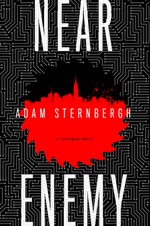
Near Enemy by Adam Sternbergh

Near EnemyNear Enemy

by Adam Sternbergh

Hardcover, 306 pg.
Crown, 2015
Read: January 14 – 16, 2015I will admit to being a bit nervous about this — Shovel Ready hit me in a sweet spot and I wasn’t sure that Sternbergh was going to be able to follow it up with an unnecessary (I thought) sequel. Also, as long as I’m being honest — without looking at my post or notes, I’m not sure I could’ve described what about Shovel Ready appealed to be so much. It took less than 2 pages of Near Enemy for it to come back to me — yeah, good story, world building and all; but it was the voice and the distinctive way Sternbergh employed the voice that really worked for me. Obviously, in two pages I had no idea if he could pull it off in terms of story/character/etc., but that voice was there, so I was going to enjoy finding out.

Even more than Shovel Ready (I think), this is a Cyberpunk novel as told by Elmore Leonard. It’s been a year since we left Spademan and the rest, and if there’s anyone who expected a happily ever after for any involved, well, I think they didn’t pay close enough attention to the book. Perseophone and her baby are tucked away upstate, and Spademan’s back to work. Once again, though, he doesn’t complete a hit. He finds the target, Lesser, while he’s in the Limnosphere, and is persuaded to wait a moment until he emerges. Lesser gives the wildest story about what happened to him inside — so wild it’s technically impossible. Spademan’s curiosity is piqued, so he lets Lesser live while he looks into the veracity of his claims.

Spademan’s investigation leads him into a maze of politics, police corruption, Islamic activism, assassins that make Spademan look amateurish, and a strange quasi-religious/quasi-Luddite group. The plot’s really not that twisty — it can’t be while being told in Sternbergh’s minimalistic style — but it’s definitely not straight-forward. And though I saw the big surprise twists coming — their reveals were very satisfying. It’s violent — but not as violent as you’d think a novel about an assassin in a very dystopian New York would be.

One example of the violence is a fight scene in the Limnosphere that suggests the climactic battle in The Matrix missed a golden opportunity by not taking fuller advantage of the impossible and/or strange that would be possible in a virtual world.

Of course the ugliness isn’t limited to the damage that people can do to others’ bodies — there’s plenty of other trauma to be found. One example is Spademan’s description of how the City reacted to the last major terrorist attack:

Cops came after midnight.
Special ops. Special cops. The lethal kind, who never bothered to memorize Miranda rights.
Clad in black. Move in tandem.
Red laser dots dancing over locked doorways.
Hand signals. Gloved hands. Give the go-ahead.
Boots unleashed on doors. Doors caved in with a clatter. Suspects scrambling as they’re yanked from their beds, still tangled up in the sheets. Some half-dressed, some half-cursing, dragged into hallways under sweeping flashlight beams, wrists zipped up in plastic cuffs, then shoved down the staircase. Some more than shoved.
A few unfortunate escape attempts shot down as they fought back. Or at least that’s how it got written up in the reports.

At the same time, in the midst of the blackness, there’s moments of happiness, contentment, camaraderie.

There’s a real heart to this character, real sadness — maybe even hope. When you thinking you’ve got Spademan figured out — he does something you don’t see coming. There’s this flashback to a High School (maybe Junior High) English teacher working with Spademan that’ll tug on your heartstrings.

Near Enemy successfully builds on Shovel Ready expanding the world, characters and story strongly, as well as setting things up for (I’m guessing) a final climactic novel that is going to knock my socks off.

This is the kind of book that makes you want to call in sick, blow off appointments and resent the fact that you have loved ones that want to spend time with you (and that, ordinarily, you want to spend time with, too). It’s as immersive as the Limnosphere, with none of the side effects, and just as addictive.

Note:I received this book for free from Blogging for Books for this review. Which was generous and cool of them, but didn’t impact what I said about the book.

—–

4 1/2 Stars

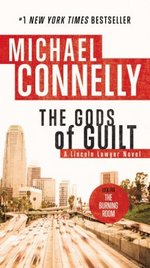
The Gods of Guilt by Michael Connelly

The Gods of GuiltThe Gods of Guilt

by Michael Connelly
Series: Mickey Haller, #5

Mass Market Paperback, 464 pg.
Vision, 2014
Read: January 1 – 6, 2015

Getting a not-guilty verdict was a long shot. Even when you knew in your gut that you were sitting next to an innocent man at the defense table, you also knew that the NGs came grudgingly from a system designed only to deal with the guilty.

Which is why most novels about lawyers are about defense lawyers — there’s more drama when they win (Mickey’s cynicism/realism also says something about our judicial system — but that’s a matter for another kind of blog). Note how little time Rachel Knight, the prosecutor, spends in court in her novels.

But from Perry Mason to Ben Matlock to Andy Carpenter to the real life attorneys, we want to read about and watch defense attorneys. We want to see them work within (and outside) the system, up to the point where the jury, the “Gods of Guilt” decide the fate of the defendant. Sometimes these “Gods” choose correctly, sometimes not. We rarely think of the consequences of these verdicts — in fiction, we almost never see them.

This novel is practically all about those consequences — and the events spiraling out of them. Almost a decade ago, Mickey Haller used some information one of his client’s possessed to get her a good deal. Which worked out nicely for all concerned (except the guy she had the information about), until she winds up dead — after telling her accused killer that if he’s in legal trouble, Mickey Haller is the only name to call.

Mickey’s dealing with some more immediate consequences — a man he successfully defended went on to get drunk and run down an innocent mother and child. Mickey’s blamed for this — which derails his D.A. campaign and derails his relationship with his daughter (who knew one of the victims).

So, when Mickey is presented with a prospective client he believes is innocent, he grabs at the chance for a little public and familial redemption. But before these “Gods” can weigh in, there’s a long road to be walked, prices to pay, deals to be made, and secrets to uncover.

I’d forgotten how slow these books start — Connelly’s masterful and putting the pieces together in a way that makes the ending seem inevitable — once you get there. But man, at times the build up can bog you down. Sure, there were other things going on — but it took me 3 days to get through the first 200-250 pages, and then 1 day for the next 150-200, because as slow as things start — when it all starts to come together, it’s a smooth and fast ride.

Aside from the twisty and tricky plot, is, of course, character — which is really what brings readers back to this kind of series. And there’s a lot to think about in this one.

For one, there’s the new character, David “Legal” Siegel, Mickey’s father’s law partner. He’s living in a fairly totalitarian retirement home (probably for good reason, not that Legal or Mickey seem to care), but still has fantastic defense instincts and helps Mickey and his associate, Jennifer Aronson, with some of their more clever strategies. He’s a fun addition to the cast, and I hope to see more of him.

I wasn’t quite as impressed with Jennifer Aronson’s characterization. I don’t care how new she is to the whole criminal defense thing, there’s no way that someone with any kind of experience — or a TV — needs to have the concept of “burner phone” explained. I get that Jennifer Aronson needs to have some things explained to her — and the reader via Aronson — but c’mon, really? Still, it’s good to see Mickey mentoring someone, and having someone else in the firm to do some legwork does open up narrative possibilities for future novels. Although, Mickey keeps talking about Aronson leaving him and being more successful than him — is this Connelly setting up a spin-off series?

Cisco, Earl, Lorna 2 and Maggie were along as well — nothing both notable and not-spoilery to say about them. They played their narrative roles well, and as they should. There’s a notable exception to this, but can’t talk about it now.

Naturally, the focus is on Micky Haller, in the courtroom (and associated areas), he’s a shark. He’s a pro. He’s a wiz. And he knows it — which sometimes makes you groan, other times you relish it. Connelly’s honest enough to make Mickey’s confidence come back to bite him — it happened once during this trial, and even though I pretty much saw it coming, I still gave him a sympathetic wince. There was another point where I was actually talking back to the book, begging Mickey not to be so cocky. Fairly sure that things were going so well for him that he would screw things up with a witness/suspect.

As (almost) always, his personal life is in shambles. Mickey’s relationship with his daughter, Hayley, is always one of the more endearing aspects of this series, and to see the estrangement between them is rough. Connelly isn’t a guy that typically gets emotional reactions (other than suspense, and satisfaction from victory) from a reader — but Mickey having to covertly watch his daughter’s soccer practice through binoculars? No way that doesn’t tug on a heart string (while you hope no one catches him in the act and thinks he’s some sort of predator).

Throughout The Gods of Guilt there’s a Palpable sense of loneliness to Mickey, he’s always looking for people to be watching him in court. Thanks to the election loss, the DUI, etc. people’s perceptions of him are really damaged, really negative. All Mickey wants is someone, anyone really, to see him doing well, to see him doing something good. Sure, it’s better if it’s someone he cares about seeing him do that, however, and he’s always looking for it.

Naturally, things wrap up in a satisfying manner, and then we’re treated to one of the best closing paragraphs that Connelly’s written (if not the best, and he’s written too many of them for this lazy blogger to verify). The last four paragraphs cement in the reader’s mind just what kind of person the Lincoln Lawyer really is beneath the headlines, the courtroom antics, and the car.

A slow-burn of a read, like I said, but once you reach the tipping point, the reader is hanging on every word — just like the jury, Mickey’s Gods of Guilt are to the drama unfolding before them.

—–

4 1/2 Stars

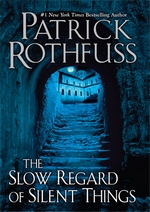
The Slow Regard of Silent Things by Patrick Rothfuss

The Slow Regard of Silent Things (Tales from Temerant)The Slow Regard of Silent Things

by Patrick Rothfuss

Hardcover, 159 pg.
DAW Books, 2014
Read: October 30 – 31, 2014You know what? I’ll be honest here. It’s been so long since I’ve read The Wise Man’s Fear that I’ve forgotten everyone’s name except Kvothe and Bast (although I frequently think Bash). So when I heard that this little book would be focusing on Auri, I thought Denna instead. A couple pages in I knew I was wrong, so I took a quick trip to http://kingkiller.wikia.com/ and got my names straight. Finally having the right character associated with the name, I was probably more excited than ever about this book, more time with the mysterious and strange Auri? Yes, please.

There’s no real plot-line, no story — it’s more of a slice-of-life kind of thing. How does Auri spend a week — in what seems a representative, yet atypical, sample. It’s truly rewarding to see how Auri’s mind works — and to get an inkling of an idea how she fits in (or, at least, fit in) to The University.

The voice isn’t that of Kvothe, it’s nothing like Kvothe’s voice — which is a huge relief for many who wondered if Rothfuss could sound any other way. No, it’s just how Auri should sound. He (not at all surprisingly) captured her essence so well. For someone we know so little about, it’s astounding to me how often I read a line or paragraph or whatever and said, “Yes, this is her exactly.”

It’s tough for me to know how to say anything about this (in case you hadn’t noticed), so let me just stop trying: The Slow Regard of Silent Things is a nice read. A light, sad, whimsical read — with bit of darkness in the background (it only shows up in the vaguest sense). Just a pleasure.

I don’t know if Rothfuss has more things like this planned, or if the next things we’ll see out of him is the end of the Kingkiller Chronicles. While hoping for the latter, I’ll take either after reading this.

—–

4 1/2 Stars

Page 27 of 30

Powered by WordPress & Theme by Anders Norén