Tag: 4 1/2 Stars Page 28 of 30

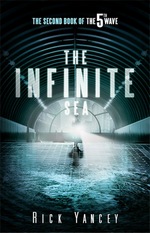
The Infinite Sea by Rick Yancey

The Infinite Sea (The 5th Wave, #2)The Infinite Sea

by Rick Yancey
Series: The 5th Wave, #2

Hardcover, 300 pg.
Putnam Juvenile, 2014
Read: October 4 – 5, 2014
Man, talk about trepidation. Did I want to pick up this book? Was there any chance it could live up to The 5th Wave? Slim to none. But man, I wanted to find out what happens to the Earth. I wanted to know if we ever figure out what the aliens want with the Earth, why they’re eliminating humanity in the way they are. So, prepared to be disappointed, I cracked the cover.

And Yancey doesn’t try to match — or even try to top — The 5th Wave. He writes a very different book. Not one that grabbed me as thoroughly, but one that works in its own way. Where The 5th Wave was a bullet train that you just tried to hang on to — The Infinite Sea was roller coaster you’re riding while blindfolded — the ride lopping, diving, screaming around a corner with no warning, leaving your stomach behind you.

Yancey can’t even give us a Prologue to reorient ourselves to this world, to get our feet under us so we can say, “Oh yeah, this is what’s going on…” before resuming the action. Sure, it starts to seem like that, but nope. He’s right there to pull the rug out from under us at the first possible moment, in a way that catches the reader just as off-guard as the bits of remaining humanity will be.

I read some criticism lately about The 5th Wave that complained about the lack of motivation given for the aliens to do what they’re doing — it makes no sense, and therefore the reviewer couldn’t buy into the book with a motive-less enemy. But to me, that’s why the book worked. Humanity doesn’t understand what’s going on, so there’s no reason we human readers should either. Try as they might, there’s just no figuring out what’s going on other then their great need to survive.

On the whole, we spend time with the characters we met in the first book, those that survived — and, in flashbacks, some that didn’t, Cassie, Sam, Ben/Zombie, and a few others I won’t name because I can’t be sure I won’t spoil something by doing so. We say good-by to some of them, too. We meet a few other characters, too. Some of which we’ll see again. It’s that kind of series. But we get to know almost all of them better, the last book was all about getting to know a couple of these characters really well. This time, we get backstories on everyone, even if it’s pages/paragraphs before they die. This is important, I feel more grounded in this world the more I get to know characters who aren’t Cassie, Evan or Ringer.

And we get some more mature, experienced — and in some cases, informed — hints at what’s really been going on. Still, not enough to placate that other reviewer, I bet — or, really anyone. At one point, Cassie’s complaining about her interactions since Day 1 with Evan.

Every time I edge too close to something, he deflected by telling me how much he loved me or how I saved him or some other swoony, pseudo-profound observation about the nature of my magnificence.

I chuckled as I read it, because this is pretty much Yancey’s modus operandi — just when you get close to learning something, being told something, a character figuring something out, etc. — something explodes or someone starts shooting. Or both. Not a way to tell a narrative that satisfies everyone or to show off brilliant world-building. But a it’s great way to keep pages turning.

I found this to be a very satisfying read. As I said, I didn’t expect to be as taken with this book as I was its predecessor, and I wasn’t — but in a way, I’m sucked into this series more than before. I really don’t know the last time I said “son of a — “* out loud at a book as much as I did with this one. It’s probably not since Butcher’s Changes that I’ve called a writer so many names as I’ve read. Yancey just keeps throwing me for loops. Not the best book I’ve ever read, not high literature, but edge-of-your-seat thrills, convincing characters, and honestly come by surprises. Really entertaining stuff. That’s all I ask for.

—–

* I seriously don’t finish the sentence, because I’m too busy shaking off whatever trauma is thrown my way and getting back into things to bother.

—–

4 1/2 Stars

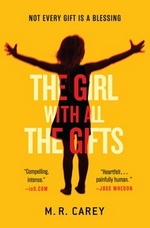
The Girl With All the Gifts by M.R. Carey

The Girl With All the GiftsThe Girl With All the Gifts

by M.R. Carey

Hardcover, 403 pg.
Orbit, 2014
Read: September 22 – 23, 2014

I HATE ZOMBIE STORIES, I should get that out of the way up front.

So why this book? Well, I put this book on my TBR list based on a tweet from the director of the most recent Much Ado About Nothing movie and a vague, yet promising, book blurb. If I’d waited until it was reviewed, or more detailed descriptions were available, I probably wouldn’t have started this. Having started it, and then figuring out what it’s about, I stopped reading it several times during the first two hundred pages — but I kept finding myself in waiting rooms, or just waiting for something, with nothing else to read — or was curious about how the next chapter would deal with plot point X. Before I knew it, I was 50% done, so I might as well finish.

There’s a little more to it than that — this book just got me, and I couldn’t stop reading it, really. Little Melanie — in all her innocent, caring, devoted, Zombie genius glory, is delightful. This book is a wonderful combination of childhood optimism, stark darkness, hope, love, despair and megalomania . . . told in a voice that’s in the same breath amusing and gut wrenching.

This is another one of those that I don’t know how to talk about without spoiling in on multiple fronts. Carey (author of the Felix Castor UF books and The Unwritten comics — and many other things I haven’t gotten around to) has created something special here, something unlike anything else I’ve read from him. Think Let the Right One In, but endearing and without the creepy sexual vibe. That’s not entirely accurate, but it’s not inaccurate, either.

I guess let’s just leave it as this: it’s a zombie novel, that I couldn’t put down and almost gave 5 stars to. Pretty remarkable accomplishment by my standards.

—–

4 1/2 Stars

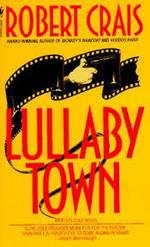
Reread Project: Lullaby Town by Robert Crais

Lullaby Town (Elvis Cole, #3)Lullaby Town

by Robert Crais
Series: Elvis Cole, #3

Mass Market Paperback, 352 pg.
Bantam, 1993
Read: August 21, 2014


The third book in the Elvis Cole series is about sixty pages longer than the previous — and it was about sixty pages longer than the first. This isn’t a trend that will continue, I say with some relief (in fact, I believe the next will be shorter). But the growth isn’t just in page count; it’s in depth of story, depth of character, and the way Crais deals with making sure neither plot nor character get short-shrifted in this.

There’s an obvious effort here to establish a series continuity here with The Monkey’s Raincoat. We get the return of Pat Kyle and her laugh — and that would be enough to help establish this book’s place in the Cole-verse, but we get more. As he spends time sticking out like a sore thumb in a small town, he reminisces about the first time he visited Watts with Cleon Tyner and felt the same way. We also see (and get a reference to) Ellen Lang, briefly. She’s doing much better than she was when we saw her last. In Stalking the Angel, Elvis makes reference to keeping in touch with a couple of former clients, and with Ellen’s appearance we see him doing that again. Unlike with the clients in Stalking, she wasn’t there as a plot device, she was just there to let series readers know that she was still around. I really appreciate little touches like that.

If one’s an incident, two’s a coincidence, and three’s a pattern, we have ourselves a legitimate pattern established. For the third book in a row, Elvis is approached by a potential client/representative of a potential client who is difficult or obnoxious. Elvis will say that he’s not taking the case for the difficult client/client representative, but he will for the likable/put-upon representative/client. I can see why Crais uses this — Elvis gets to show some independence, some graciousness to the non-obnoxious person, and even a little wit in the way he phrases it. But, it’s getting to be lazy returning to this so often. Then again, if I wasn’t reading these so close to each other, I probably wouldn’t have noticed this pattern. So who am I to say?

So here’s the setup: Peter Alan Nelson, the 3rd biggest director in the world (mostly action flicks, apparently — a proto-Michael Bay, but one who’s not as Bay-ish, let’s hope) dumped his wife and kid just before he made it big. It’s been ten years and he’s feeling bad about that now, and wants to get to know his son. So the studio hires Elvis to find them. He does so, she’s living on the other side of the country, appears to have actually done okay for herself, the boy seems good — really, the last thing they need is a brash, self-obsessed, Hollywood type to interrupt their lives. But that’s what Elvis was paid to help with — but first he wants to check into something odd about Nelson’s ex. Turns out, she’s under the thumb of the capo di tutti capi. So before Elvis unleashes Hurricane Peter into their lives, he and Joe Pike will have to see about removing that thumb.

The tension is high, the solution isn’t obvious — and isn’t easy to achieve, either. Elvis does a pretty neat job investigating things to find Heather Lloyd in the first place and he has to do plenty more to figure out how to extricate her from this situation. There’s a good deal of sleuthing in this book, which really makes up for last time. Teach me to be snarky about that. Sure, they’ve got the ex-cop with all the connections and some power, Rollie George, to act as a font of all knowledge and help them navigate a city they aren’t familiar with. But that really doesn’t come across as a cheat — Elvis still has to act on the info given and turn it into something. Rollie cuts out a lot of time, but he doesn’t hand him anything wrapped in a bow. Having someone be a source of local information can really help keep things moving plot-wise.

This time out, the Peter Pan quest, protection of innocence — whatever you want to call it — is very brief and understated. If anything we see the dangers of that kind of life — Peter Alan Nelson could arguably be considered an eternal youth, with expensive toys to play with — but his demeanor, self-centeredness and lack of ethical code make him a very different kind of child than Elvis. If you’re going to hold on yo your childhood, do it the right way, or you end up as a petulant slob. There’s a child-like way of approaching things, and a childish manner. Cole’s not interested in the latter one bit. It’s interesting to watch Elvis draw the distinctions, or at least act on distinctions that he’s drawn, so that we can see what they are. You also have to wonder, seeing Peter Alan Nelson throw a fit, if Cole seeks to shed a bit of his version of Peter Pan so that he won’t act like “that guy.”

Lullaby Town has moments of humor throughout, but like Stalking, it’s not as jokey as Monkey’s was. The wit is there, he just doesn’t feel the need to break it out as often. Or when he does (and he’s not just provoking annoying clients or self-important mafia persons), there’s a purpose, to illustrate something, to reveal something — or to break monotony. Either way, Crais is learning how to let situations drive this kind of thing.

Portrait of the Big City Detective sitting on a small-town bench, ferreting. In the cold. People passed on the sidewalk, and when they did they nodded and smiled and said hello. I said hello back to them. They didn’t look as cold as me, but perhaps that was my imagination. You get used to the weather where you live. When I was in Ranger School in the Army, they sent us to northern Canada to learn to ski and to climb ice and to live in the snow with very few clothes. We got used to it. Then they sent us to Vietnam. That’s the Army.

Our knowledge of Elvis isn’t enhanced a lot by this novel, but what we do get is important. On the not-so-important side, we get a definitive note from him about giggling – he doesn’t like it (which maybe was hinted at before, but his displeasure wasn’t as explicit). We do get confirmation of a good deal here, his character, his willingness to help those who need it, but can’t afford him — that sort of thing. He gives Karen a concise explanation for why he decided to help her rather than turn things over to the police.

“And you haven’t told the police?”
“No.”
“But those men beat you up.”
I said, “I knew something was wrong and I wanted to find out what it was. Cops deal with the law. The law isn’t usually concerned with right and wrong. Ofttimes, there are very large differences.”
She shook her head as if I’d spoken Esperanto.

Elvis is solidified here as your hard-boiled hero. It’s not about legal/illegal, it’s about right and wrong — an objective morality. This is the core of Elvis Cole, and even Joe Pike — why do they do what they do? From tearing up Ellen Lang’s check, to carrying on the search for Mimi Warren after being fired, to putting themselves out on the limb for a client they were only hired to find (and who can’t pay them anything). This is it.

As the action in this one takes place no where near the LAPD, we don’t get to see the antagonism they have for Joe Pike, but we learn a little bit about him. Bit by bit, we’re getting a picture of Pike so that when we do eventually learn a good deal, there’s an impact. As tensions are at their highest between Elvis and the mafia, we get this exchange:

I asked Pike, “Are you afraid?”
He shook his head.
“Would you be afraid at midnight if we were alone?”
He walked a moment. “I have the capacity for great violence.”
I nodded. So did I. But I thought that I might still be afraid.

“Elvis?”
“Yeah?”
“I remember being afraid. I was very young.”

and that’s all we get about that. For now. But it hints at something serious — that we will explore in the future. As serious a moment as that was, I have to chuckle at Pike’s “I have the capacity for great violence.” Yeah, no kidding, buddy — never would’ve guessed.

I don’t know if I can successfully describe why I like this one so much — not that I had real problems with the first two books, but this one seems to have everything clicking and only the minor-est of problems. Funny, snappy writing, solid action, a complex solution, and growth and development in multiple secondary characters. There will be higher points in the series, but for awhile, this will be the standard by which Cole novels are measured by me.

Coming up next: Free Fall which is definitely a departure for Crais, Cole and Pike in many ways.

—–

4 1/2 Stars

—–

Drawing by Kirsty Stewart, chameleonkirsty on deviantART, used with permission.

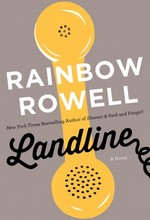
Landline by Rainbow Rowell

LandlineLandline

by Rainbow Rowell

Hardcover, 310 pg.
St. Martin’s Press, 2014
Read: August 13, 2014

If the last few years have taught us readers anything, it’s that if you want quirky, honest, heart-felt romance with real (and usually moderately overweight) people and solid laughs, Rainbow Rowell will consistently deliver for you. And if you don’t think you want that, after you read her, you’ll realize that’s just what you wanted after all. She has two YA books and now two Adult books to her credit. Her latest, Landline delivers the typical Rowell magic in her story, but this time she included something else: actual magic. Sort of.

Georgie McCool is half of a pretty successful TV writing team who are thiiiiis close to being much more successful, all they have to do is crank out a handful of scripts in the next couple of weeks and they’re in a great position to sell their first series. The catch is, this involves working over Christmas — despite Georgie’s plans to go to her mother-in-law’s in Omaha with her husband, Neal and their two daughters. Georgie says that she can’t pass up this opportunity, so Neal and the girls go off without her.

Georgie sees this as a regrettable occurrence, but one of the sacrifices she has to make to get her dream show made. Her mother, step-father and sister see it as her husband leaving her, and Georgie ends up staying with them. Which gets Georgie to worrying — especially when she can never seem to reach Neal on the phone during the day. At night, however, when her iPhone battery is dead, she has to resort to the landline in her old room and she ends up talking to Neal back before they got engaged.

Don’t ask. It makes no sense. She never bothers to explain. And it doesn’t matter. Georgie eventually figures out that’s what’s going on and she rolls with it, and the reader does, too.

These conversations, as well as the absence of her family, lead Georgie on a path down memory lane, reflecting on the beginning of their relationship and how it changed as they did. Maybe Neal had made a mistake choosing her. Maybe she’d ruined her life (and his) by choosing him. Would they have both been better off going their separate ways? Or was there something worth fighting for now? Would that matter? The clock is ticking — for Georgie’s marriage (both now and then) and her career. Is she up for it?

The tension is real, the apprehension, fear, and self-doubt (for starters) that Georgie is wrestling with is very obvious and palpable. Yet while focusing on this, Rowell’s able to create a believable world filled with a lot of interesting people. There’s Georgie’s partner/best friend, Seth and another writer on their current (and hopefully future) show — and Georgie failing to hold up her end of things there, as much as she tries.

Then there’s her sister, mother and step-father. They’re much better developed (probably only because we spend more time with them). Her mother’s a pretty implausible character, yet not a cartoon, she’s a pug fanatic, married someone much younger than her, and generally seems really happy. Her sister’s about done with high school and is figuring herself out (and mostly has) — she’s a hoot, and my biggest problem with the book is that we don’t get more of Heather. Not that there wasn’t plenty of her — and it’d require the book to take a far different shape. We get whole storylines about all the non-Neal people in her life, little vignettes showing us their character, giving us smiles in the midst of Georgie’s crisis, like:

“Kids are perceptive, Georgie. They’re like dogs”–she offered a meatball from her own fork to the pug heaped in her lap–“they know when their people are unhappy.”
“I think you may have just reverse-anthropomorphized your own grandchildren.”
Her mom waved her empty fork dismissively. “You know what I mean.”
Heather leaned into Georgie and sighed. “Sometimes I feel like her daughter. And sometimes I feel like the dog with the least ribbons.”

Not only do the supporting stories, or even the little moments like this fill out Georgie’s world and make it more interesting, they provide a breather for the reader from having to deal with the disintegrating marriage.

I know some people think we spend too much time in flashbacks, where Georgie’s remembering how she and Neal met, got to know each other, and started seeing each other, etc. But we need that. If all we get is Neal in the present, or past-Neal on the phone, we’re not going to care enough. Especially in the first couple of scenes we get with Neal, it’d be real easy to see him as unsympathetic — the guy holding Georgie and her career back. We need these flashbacks so the reader can sync their feelings about Neal with Georgie’s, so that when we read something like:

Georgie hadn’t known back then how much she was going to come to need Neal, how he was going to become like air to her.
Was that codependence? Or was it just marriage?”

or

She needed him.
Neal was home. Neal was base.
Neal was where Georgie plugged in, and synced up, and started fresh every day. He was the only one who knew her exactly as she was.

find ourselves agreeing with her, or at least seeing why she says it.

At the end of the book, there’s a lot of plot lines dangling — some very important ones, actually. Enough so, that normally, I’d devote a paragraph to complaining about it. But I won’t this time — it works for Landline. There’s a lot for Georgie to work out herself, she’s really only settled on the one most important thing, leaving the rest to be resolved another day. And that’s got to be good enough for the reader.

Not her best, but Rowell on an off day is still really, really good.

—–

4 1/2 Stars

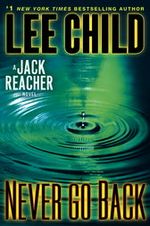
Never Go Back by Lee Child

Never Go Back (Jack Reacher, #18)Never Go Back

by Lee Child
Series: Jack Reacher, #18

Hardcover, 400 pg.
Delacorte Press, 2013
Read: July 23 – 24, 2014

The journey that Reacher started following 61 Hours is at an end — he’s back at the 110th MP, his old unit to meet the person the goes with the voice at the other end of the phone line — the new CO, Maj. Susan Turner. He’s planning on asking her to dinner, and to see what happens from there. Sure, walking from South Dakota to get a date seems extreme — but other than bringing justice to various locations between South Dakota and Virginia, what else does Reacher have in his day planner?

Sure, since this is Jack Reacher — it won’t go all that easily for him. He arrives at the gate, hoping to get a date — instead he gets a global conspiracy, a cross-country trip, a chance to visit life-changing mistakes he may have made over a decade ago, and a return to active duty. On the whole, this is a lot less violent than most Reacher novels — with a comparatively very small body count (but it is violent, and there is a body count — never fear).

This story alone is fun — Reacher being Reacher. This time he’s got a version of himself along for the ride. Turner has the job he used to have, has a lot of the same opinions, skills, background — but Turner’s made some different choices in her life, has different attitudes, making her a mirror image in many ways (not just being small and female). She’s willing to do a lot to take down the criminals behind the conspiracy, but not as far as Reacher will. She’s far more interested in the courts and the Army having a crack at the conspirators, while Reacher’s just focused on stopping them and breaking as many eggs as he has to go get his omelet made.

Turner’s own appraisal of Reacher and the reader’s own look at her in contrast to Reacher tells us a lot more about the ex-MP than what we’ve seen before (at least adding depth and color to our impression of him, if not actual new information). In many ways Susan Turner is the most objective look we’ve ever gotten of Reacher (our typical omniscient third-person narrator isn’t terribly objective when it comes to Jack Reacher). She likes him — a lot — but is very critical. I like her and think there’s probably a lot her appraisal.

This was a very satisfying read — Lee Child and his hero, firing on all cylinders, doing what they do best. Told in a pretty fresh way, with added insight into the character. Just what the doctor ordered.

—–

4 1/2 Stars

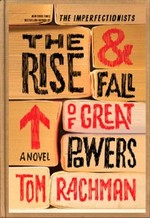
The Rise & Fall of Great Powers by Tom Rachman

The Rise & Fall of Great PowersThe Rise & Fall of Great Powers

by Tom Rachman

Hardcover, 384 pg.
The Dial Press, 2014
Read: July 15 – 19, 2014

He raised his menu.
She consulted hers. “You don’t like sweet-and-sour, do you.”
“No,” he confirmed. “I want food that can make up its mind.”

I had a real difficult time connecting to the people, the story, this book — but early on, I came upon this exchange between a man and a young girl — Tooly, the protagonist. That was enough to keep me going — that, and Rachman’s previous work, The Imperfectionists.

There are three storylines running through most of this book — Tooly in 1988, Tooly in 1999, and Tooly in 2011. We see her as a child, still growing up; we see her all grown, but still figuring out her place in the world; and then as an established adult who’s made a place in the world — but she’s still expecting/looking for the same one she tried to find in ’99.

I spent most of the novel not really sure where any of these stories were going — maybe 2/3 of it. It didn’t take me too terribly long to come to the conclusion I wouldn’t be sure for awhile, so I decided to just enjoy the ride. Which was so easy to do — Tooly spent her life surrounded by a great menagerie of people — Paul, a traveling computer technician working for various U.S. embassies in the 80s; Venn, a very charming con man; Humphrey, a Russian ex-pat and armchair intellectual; Fogg, a small-town bookseller; Sarah, a — I don’t know how to describe her, a histrionic woman with a short attention span (I guess, you eventually learn a lot more); a lout of a lawyer (whose name escapes me at the moment), who really isn’t that much of a lout; and others. It doesn’t matter what they’re talking about, you want to hear them talk, you want to see the interactions between these people and each other, or these people and Tooly. The actual plot seems secondary as long as you get bits of conversation like this (like the above quotation, this is from 1988’s story):

“I know exactly what you’re like,” Sarah affirmed.
After a long pause, Tooly responded, “What are you like?”
“Me? Well, I like bread with strawberry jam and believe raspberry jam ruins everything. I think those who joke around with such matters are barbarians. And I’m right about everything. Except in the morning, when I’m wrong.”

Each chapter moves the various stories along, bit by bit — and you get one or two strange encounters between Tooly and the other characters, you hear some strange theory about the way the world works, or how someone decides to do something, or some scheme to make sense of it all — and I can’t describe it for you better than that — just give it a read.

Eventually, Rachman decides to let you see the pattern he’s stitching — and then it all comes together, each piece falling into place and while there was no way to see all of it coming, it all feels like it fits. Not a “ohh, sure, I should’ve guessed that;” but “well, naturally — there was really no other way for that to work, was there?”

For Fogg, Humphrey, and Tooly (and most of the other characters to some extent) books are a vital part of their existence — or at least their way of thinking. They’re how they connect to the world, to people, to their experience. The various ways the characters interact with, describe, and use books are just fascinating and are right up my alley. Just for exposure to the various things this novel says about books, it’s worth slogging through all the “what’s going on?” of this read.

For example — shortly after young Tooly first meets Humphrey, she asks to see his books (he always has stacks by him, but they keep changing, so she knows he has a stash somewhere). He takes her to a closet bursting with books.

“Books,” he said, “are like mushrooms. They grow when you are not looking. Books increase by rule of compound interest: one interest leads to another interest, and this compounds into third. Next, you have so much interest there is no space in closet.”
“At my house, we put clothes in the closets.”
He sneered at this misapplication of furniture. “But where you keep literature?”

That compound interest line is a great one, isn’t it?

The Rise & Fall of Great Power is a lovely little book I can’t really talk about without over explaining. Filled with great characters; plausible, yet implausible events: an embarrassment of riches when it comes to quotable lines; interesting philosophies; stacks of books; and a dash of hope mixed a hint of existential despair. More than worth your time.

—–

4 1/2 Stars

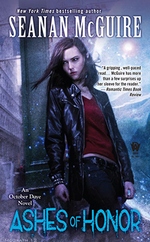
Dusted Off: Ashes of Honor by Seanan McGuire

Ashes of Honor (October Daye, #6)Ashes of Honor

by Seanan McGuire
Series: Toby Daye, #6


Mass Market Paperback, 353 pg.
DAW, 2012
Read: September 5 – 6, 2012

Best.Toby Daye.Ever.

Sure, that just means it’s the best since the last one (which was the best since the one before…and so on). But still, wow. Really wow. This series has entered the terrain of Harry Dresden or Mercy Thompson–why bother writing a proper review? The reader knows it’s going to be good, the only question is, how good is this entry–really good or just great?

Action, intrigue, splash of humor, character development, romance…this one has everything. We get more of some old friends we haven’t seen in awhile, some characters who were in danger of over-use get scaled back…

couldn’t ask for more from this one.

—–

4 1/2 Stars

The Severed Streets by Paul Cornell (Updated)

Update: A representative of Audible.com, emailed me to ask if I’d like to post a clip from the audio book with this review. Sounded like a good idea to me (no pun intended). The sample’s at the bottom of this post, give it a listen.

The Severed StreetsThe Severed Streets

by Paul Cornell

Hardcover, 416 pg.
Tor Books, 2014
Read: June 11 – 14, 2014

This Cornell guy can write.

I’m tempted to let that be all I say about this book. Won’t be (because I can’t help myself), but it’s tempting. The other thing I’m tempted to do is copy and paste the first three paragraphs of my London Falling review to start this one — I am a little annoyed to see that I spoke so much about the Bryant & May Peculiar Crimes Unit series last time, because the comparison really hit me repeatedly as I read this book. I hope neither Cornell or Fowler mind that comparison.

Straightaway, Cornell creates a world rich with atmosphere — the his depiction of the tension on the streets of London is visceral, and then when the first murder occurs, you start to wish for something a little less visceral. And that’s in the first handful of pages. Once the focus turns to the team of detectives, it takes almost no time at all to immerse yourself again in this world (one that I honestly was a little fuzzy on when I picked up the book, remembering everything about these characters took a page or two back with them). There’s a bit more esprit de corps amongst them now then when we left them in London Falling, they’ve spent more time together, are more familiar with each other — and, if nothing else, realize that they share something that no one else in the London Police does.

Now they’ve got their hands full, seeking a vicious killer that only they can see. One that seems to have connections to a popular protest movement (think the Occupy movement, but with masks) and maybe to Jack the Ripper. Add all those things together, and you’ve got yourself a real mess. To that, add multiple conflicting goals on the part of Quill and his team, a looming police strike, an overly-inquisitive media mogul, a meddling Security Service, and a city on the verge of riot — and you’ve got, well, I don’t know exactly what it is, but the word “mess” no longer can describe it.

This early in a series, I don’t have any strong emotional connection to characters — particularly in this series, which (to me) seems to lend itself to a distancing between reader and character. But when one of the team makes an unthinkable sacrifice, I realized that distance didn’t exist anymore for me, and I had to put the book down for a brief moment to think about what I’d just read. But I couldn’t keep it down for long and had to pick it up quickly — only to be hit with something worse not that long after.

Which is not to say that this whole novel is an emotional wringer, there’s more humor, more hope intrinsic to this book than its predecessor, while it doesn’t lose any of it’s edge. The celebrity cameo was hilarious in a book not typified by hilarity of any kind. And then it became more than a cameo, which was pretty cool — and then it became, brilliant. I mean, truly brilliant. And I really can’t say more about it than that without violating all sorts of my spoiler policies.

I want to say more about this book, and maybe I’ll come back and revise this later, but for now I’d better leave it at this or it’ll never get done. The Severed Streets is one of those books that will make you want to cancel plans, so you can spend more time with it. From the unnervingly impossible assassination at the beginning to the truly disturbing final sentence, and almost every point in between, this is a killer book — gripping, suspenseful, with no punches pulled on any level. Please let there be more of these soon.

—–

4 1/2 Stars

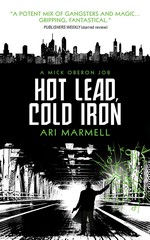
Hot Lead, Cold Iron by Ari Marmell

Hot Lead, Cold IronHot Lead, Cold Iron

by Ari Marmell

Trade Paperback, 311 pg.
Titan Books, 2014
Read: May 19 – 27, 2014

This is the way to start a series, I mean, wow. Mick Oberon is a P.I. in the rough and tumble days of late-Prohibition-era Chicago. He mixes with the mob, political figures,and other assorted low-lifes, while eking out a living — just enough to afford milk, rent and the cheap suits he wears. He can take a beating like nobody’s business, and packs a wand rather than rather than a gun. Oh yeah, and he’s fae.

I’ve got a mental checklist that I use to evaluate a new (to me) Urban Fantasy: 1. Is there a strong voice? 2. Do I like the characters/world? 3. Is the magic system interesting? (you can replace vampire/werewolf/etc. system where applicable)

Hot Lead, Cold Iron passes this test easily. Oberon’s smart, snarky — a little disdainful of humanity (but it’s not like you can really disagree with him). This Chicago is right out of The Untouchables, and when you add in the supernatural to the world (plus the Seelie/Unseelie Courts) — this world is a riot. There is so much raw material here that Marmell is set for several books. The magic system? I don’t have it all worked out after just one book, but what I’ve seen, I’ve liked. Oberson plays with luck — he takes good luck from people and uses it to power his own, he magnifies people’s bad luck to cause mishaps/mayhem, and so on. No big fireballs, or dramatic spells, just little bits of luck here and there going his way. I think that’s pretty nifty — especially the way it’s working out so far.

I’ve enjoyed Marmell’s prose in the past, and this is no different, even as it doesn’t feel like his other books. The novel is filled with great lines that are the epitome of hard-boiled P.I.s like Phillip Marlowe or Dixon Hill such as, “clad in shirt and trousers creased sharp enough to trim hedges.” Or this description of the fae world:

The colors. . . They’re intense, impossible, almost painful; entities unto themselves, rather’n mere traits of other objects. They’re stark, standing out against each other, the richest greens, the sharpest reds, the deepest browns, the brightest yellows. you could try to capture ’em in a painting, but nobody’d buy it: too fake-looking. There’s no gradation, nothing muted; the dark and light emeralds of a leaf don’t blend into each other, but sit side-by-side with clear demarcation — as if no one color here would ever lower itself to blend with another.

I hope future books spend more time in the fae world (and there’s every indication that they will), it’s slightly bent/twisted hyper-reality was truly imaginative, and unlike anyone else’s take on it. The fae camera, for example, was sort of a mix of something you’d find in a store on Diagon Alley and in Bedrock. I realize that analogy probably makes no sense — read the book and it will.

Good action, good plot, strong protagonist, strange world and intriguing magic system — everything a series’ first novel needs. Bring on the next!

—–

4 1/2 Stars

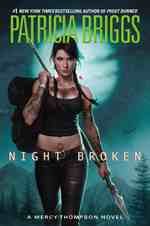
Night Broken by Patricia Briggs

Night Broken (Mercy Thompson, #8)Night Broken

by Patricia Briggs
Series: Mercy Thompson, #8


Hardcover, 341 pg.
Ace Hardcover, 2014
Read: March 19 – 20, 2014

Yay! Mercy’s back! She’s back and she’s facing off with her most potentially destructive foe . . . Adam’s ex. Oh, sure, there’s some sort of Gray Lord threatening her, a supernatural super-baddie that Mercy and her pals have never heard of, and an escaped felon who has powers a lot like Mercy . But the big danger comes from Christy.

This wasn’t a “big” novel in any real sense — seeds were planted/characters were introduced tha will be important, and I wouldn’t want to say that nothing significant happens. But, no epochal shifts, no game changers here — just straightforward case of bad guy comes to town, and Mercy et al. stop it. And along the way the final confrontation with the bad guy, we get to spend sometime with the Tri-Cities pack, as well as see some of the fallout from the last couple of books in this or the Alpha-Omega series. And that’s fine. Not every book needs to be an even, some just need to have a fun story, and maybe even move the chess pieces around a bit.

Initially, the villain of the piece looks fairly disappointing, just some stalker jerk making life difficult of Christy. But it soon becomes clear that there’s more to this guy, and it doesn’t take long to see that he’s one bad customer — creepy, dangerous, and powerful in a way I don’t think I’ve seen before. All in all, a worthy competitor for Mercy and the pack.

As always, the interplay between Mercy and the various members of the pack — or just between the pack without regard to Mercy — is fascinating. At once familial, yet competitive, not necessarily all that affectionate, yet more loyal than a troop of Marines.
The more the Jesse/Mercy relationship develops, the more I like to see it — particularly here, where much of the book can be seen as mother v. step-mother, watching Jesse maturely navigating those treacherous waters was quite satisfying.

My main (only?) quibble with the book was the way that Adam was depicted. He was continually utterly clueless about the way that Christy’s actions would/did affect Mercy. A lot of that, to be fair to the guy, can be attributed to how much he’s moved on from Christy and how devoted he is to Mercy — he doesn’t even see his ex as a potential threat. But, 1. Adam’s smarter than that and 2. given how territorial werewolves are in Briggs’ universe (and as seen in this book), it’s almost impossible to believe that he wouldn’t pick up on the territorial incursions Christy’s making.

Not the best thing that Briggs has written in this series, but not the worst. It had a good story, it was good to spend time with these characters, and I enjoyed the introduction of the new forces at play. A fun way to spend a few hours. Just about everything you could ask for.

—–

4 1/2 Stars

Page 28 of 30

Powered by WordPress & Theme by Anders Norén