Tag: 5 Stars Page 19 of 24

United States of Books – Empire Falls by Richard Russo

Believe it or not — this was almost a lot longer, but I trimmed a lot to hopefully make it better.

Empire FallsEmpire Falls

by Richard Russo

Hardcover, 483 pg.
Knopf, 2001


A few years ago, my parents took a trip through New England in the Fall to look at the leaves — I know, not an original idea, but for people from the Northwest, it’s not as common as it is for others. One of the places they drove through was Empire Falls and were telling me about some HBO series/book based there — I was vaguely aware of the book, having recently finished Russo’s Straight Man and told them that they’d probably enjoy it. I don’t think either of them gave it a shot (I could be wrong).

A few months later, I got around to reading it myself — wow. It so different in style and content from Straight Man, but it took me a long time to read, and (best of all) it was fantastic. It sent me reeling and made me want to read more by Russo. Sadly, the next book I read by him just about killed that (That Old Cape Magic). A couple of years go by and I decide to read all of his novels in order. When I get to Empire Falls, I skipped it. I just couldn’t do it again. I really didn’t enjoy about half of Russo’s novels, but I couldn’t deny the power of them, nor his skill. Nobody’s Fool, for example, I really didn’t enjoy — but here I am a couple of years later, and I still find myself thinking about a couple of characters and scenes at least three times a month. That’s staying power. (no, I haven’t gotten to the sequel that came out this year, for reasons I don’t fully understand)

Incidentally, I liked That Old Cape Magic better the second time around — actually, I think that was true for Straight Man, too. Liking Cape Magic was almost a given (would be hard to like it less), but I really enjoyed Straight Man the first time out — the second time I loved it. Both of those books deal with a different kinds characters than the rest of his books (including Empire Falls, which I’m getting to — I promise). Most of his books are about small towns and their citizens, usually dealing with economic hardships on the municipal and individual level. Frequently, cafes and bars are used to get the characters to interact with each other and there’s typically one guy who drinks too much, is fairly unreliable, yet everyone likes and enables. There’s humor, tragedy, history (actual and fictional), mixed with character and family struggles. Empire Falls checks every single box on the “what makes a Richard Russo novel” list, but does it bigger. If you’ve read Empire Falls, you’ve read almost every one of his books — which is not to say you shouldn’t read the rest (especially Straight Man and Bridge of Sighs) — but you’ll get a good idea what kind of things Russo typically deals with and how he does it.

Richard Russo is what Jonathan Tropper, Nick Hornby and Matthew Norman (and many others, probably, but these are the three I’m most familiar with) could easily become if they got a little more serious and a little darker. On the whole, the latter three are more entertaining (and funnier) — but Russo can pull that off when he wants to. You could also say that Russo is what Jonathan Franzen could be if he lightened up and got less pretentious. But mostly, you can say that I’m a giant fan.

Why am I blathering on? Mostly trying to give context for this post, but partially because it is just daunting to try to talk about this book — especially in something that’d make a decent-length blog post and not a full-fledged dissertation. But I’d better suck it up and get to it.

Empire Falls won Richard Russo his (seemingly) inevitable Pulitzer Prize in 2002 and stands as one of the greatest achievements in his storied career. It is at once a story about a town and a man, microcosms for the state and the nation; it’s both sweeping and epic while being personal and intimate.

The story centers on Miles Roby, manager of the Empire Grill in Empire Falls, ME. He has an ex-wife (who I truly despised), a daughter (who I wanted more of), an ex-mother-in-law that seems to like and respect him a lot more than her own daughter, s (even if they don’t see eye to eye much lately). But more importantly he has a patron — the town matriarch, owner of the Empire Grill, and most of the various places of employment in town. She’s a patron, a would-be surrogate mother (for a select few), and petty tyrant over the city. It’s one of those small towns where the mayor/council/etc. have real power, but it’s only the power she lets them have, you know? Francine Whiting isn’t evil — well, I’ll let you decide for yourself — but at the end of the day, she thinks she’s doing what is right for Empire Falls, the Whiting legacy and her daughter — whether or not anyone wants what she thinks is best. She still could be evil, I guess, and I could very likely made a case for it. Anyhow, let the reader decide.

The trials and dreams and efforts of Miles and his family as he tries to do something different with his life are the core of the novel — but they’re not all of it. The town is full of interesting people — many aren’t vital to the overall story (but you can’t know until the end who those are), but they all add flavor. Most are so fleshed out that you could imagine a short story/novel centered on them. While reading Song in Ordinary Time a few months back, I kept asking myself what made the people in that novel so unlikeable when in many ways they reminded me of Empire Falls‘ cast. I came to this conclusion (and have since reconsidered and still think it’s basically right): Russo uses the flaws in his characters to emphasize their humanity, Morris uses the flaws to emphasize their flaws.

But I come not to bury Morris (again), but to talk about Empire Falls, so let me focus on this a bit more: the flawed humanity isn’t pretty, it’s frequently ugly, people who make mistakes (some tragic, some dumb) are usually trying to do the right/moral/noble thing and it doesn’t work. But it’s real. This could all be real. Even Janice, Miles’ ex, is a well-developed character — and I think I’ve met a handful of people just like her — and I wouldn’t dislike her as much as I did if Russo hadn’t nailed the writing.

There’s an event towards the end — one of the two or three that you ultimately realize the whole novel has been leading up to — that in 2001 would’ve been truly shocking (shocked me a few years ago), but in many ways it’s de rigueur now. 2016 readers might be bored by it, but I can’t imagine that many readers in 2001 were. I’m not going to say more — just if you read this, put yourself in the shoes of readers from 15 years ago when you get to that bit.

Yes, Empire Falls is slow (sometimes), ponderous (sometimes) but it’s also inspiring (sometimes), heartwarming (sometimes) and many other things that I could parenthetically qualify. But every negative about it is utterly worth it for the positives.

What I learned about Maine: (haven’t done this in awhile, whoops). It’s a beautiful state, filled with people who could be better educated, who aren’t vocationally ready for what’s coming for them thanks to the technological shift in jobs. It’s a state where people, nature and industry who have been damaged by reckless policies and practices. It’s a state where nature exerts itself every now and then to remind people how powerful it is. Basically, Maine’s just like every other state in the union — just a little different.

One more thing, not that this’ll surprise many, but I’d advise skipping the HBO miniseries — yeah, it’s a fairly faithful adaptation, it just doesn’t have the heart.

I’ll be honest with you, I didn’t read this book for this series of posts — breaking a personal resolution. There were 3 reasons for this: 1. Time; 2. I really wasn’t up for the emotional punches this delivers, and 3. I didn’t need to — I still remember it well enough to discuss at a length greater than I have despite being 4 years and change since I read it. That right there should tell you something about the book — hundreds of books later and I almost feel like I read it a couple of weeks ago. I’m not sure that this is the Russo novel I’d tell people to start with (probably Straight Man), and I don’t think it’s his best (probably Bridge of Sighs (tells a story almost as epic in scope, with greater economy and greater depth when it comes to individual characters), but there’s no denying the talent on display here, the greatness of the execution, the vibrancy of the characters, or the impact it has on the reader. No brainer, 5 Stars from me.

—–

5 Stars

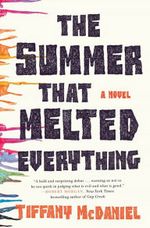
Pub Day Repost: The Summer that Melted Everything by Tiffany McDaniel

The Summer that Melted EverythingThe Summer that Melted Everything

by Tiffany McDaniel
eARC, 320 pg.
St. Martin’s Press, 2016
Read: July 18 – 19, 2016

The greatest trick the Devil ever pulled was convincing the world he didn’t exist.

Yeah, Keyser Söze’s paraphrase of C. S. Lewis’ appropriation of Charles Baudelaire isn’t part of this book, but it might just encapsulate it. Maybe.

It’s the summer of 1984 in Breathed, OH, and it’s hot. Really hot — and about to get a lot hotter. 1984 is a big year — HIV is identified as the virus that leads to AIDS, Apple releases the Macintosh, Michael Jackson’s Pepsi commercial shoot, and the following advertisement runs in the local newspaper, The Breathian:

Dear Mr. Devil, Sir Satan, Lord Lucifer, and all other crosses you bear,

I cordially invite you to Breathed, Ohio. Land of hills and hay bales, of sinners and forgivers.

May you come in peace.

With great faith,
Autopsy Bliss

Autopsy Bliss is the local prosecutor, who wants to see for himself what evil looks like. Hence the advertisement.

So who shows up in response? A bruised, short black boy dressed in tattered and torn overalls who simply seems to want some ice cream and to say hi to the man who invited him. Autopsy’s son, Fielding, is the first one in town to meet the boy and takes him home to his father (sadly, no ice cream is available in town — unbelievably — for the remainder of the Summer). The Bliss family ends up taking the lad in, and starts calling him Sal. He and Fielding become fast friends and are almost inseparable for the rest of the summer. One by one, almost everyone in this sleepy community is touched by the appearance of Sal — either first-hand or by proxy — demons (figurative), troubled family and personal histories are exposed, latent corruptions come to light, and accidents strike many. No one in Breathed will be the same after the day Sal first appears to Fielding.

The book is narrated by Fielding about 70 years after that summer looking back on the time, thinking of all the regrets he’s had since then and all the ways his time with Sal has overshadowed the ensuing decades. It honestly reminded me of A Prayer for Owen Meany because of this — little kid who talks oddly, is smarter than any of his (apparent) peers, and divides a community, while leaving an indelible mark on his closest friend (who’s not always a friend).

Almost every name (maybe every name, and I’m not clever enough to get it all) is rich in meaning and symbolism — there’s symbolism all over the place, but McDaniel gets her money’s worth with the names in particular. This book will reward close readings, and probably repeated readings as well.

There are so many depictions and descriptions of child abuse and spousal abuse that it’s almost impossible to believe that there households in that world where someone isn’t getting hit on a pretty regular basis. Thankfully, we’re spared watching characters going through it (the vast majority of the time), but there are many mentions of it.

This is not fun read, really, but I loved the whole experience, it is a rewarding read. McDaniel writes with such richness, such depth, there are phrases throughout this that will knock you out. There’s one sentence that I went back to at least a half-a-dozen times one evening — not because I needed to try to suss it out, but because I just liked it so much. The variety of ways she can describe the horrible and debilitating heat wave that struck that part of Ohio those months is pretty astounding — I’m just glad I had some sort of air conditioning most of the time I spent reading the book. Sal’s descriptions of Hell and his fellow prisoners there are full of haunting images that will stick with me for a while (some good haunting, some less-so). I’m troubled by some of what this book said about God, but since the Devil is the one who told about God, I’m not sure we’re supposed to trust his characterizations. On the other hand, just about everything that the book says about the devil seems to be spot-on.

There are no easy answers to be found here — is Sal the devil? Is someone else in town? Is there a devil at all? Are the naturalistic explanations offered here and there throughout enough? I just don’t think you can think about this book without dealing with the Baudelaire/Lewis/Söze thought.

Can’t help but wonder how things would’ve gone if he’d just gotten a little ice cream.

Disclaimer:I received this eARC via NetGalley at the author’s invitation in return for this post. My thanks to NetGalley, St. Martin’s Press, and Tiffany McDaniel for this.
N.B.: As this was an ARC, any quotations above may be changed in the published work — I will endeavor to verify them as soon as possible.

United States of Books – The Sound and the Fury by William Faulkner

The Sound and the FuryThe Sound and the Fury

by William Faulkner

Paperback, 321 pg.
Vintage, 1929


Wow, it took like 2 minutes for me to remember just how much work this guy is to read. This is not the kind of book you take to the breakroom at work for a few minutes during lunch. The Sound and the Fury, like all of Faulkner that I can remember, takes work. You have to think — especially here in Part 1. Don’t get me wrong, Part 2 is no walk in the park, but Benjy’s narration is just so difficult to wade through given his cognitive ability.

Maybe I should back up a bit — this is the story of the fall of the Compson family — a great Southern family from Jefferson, MS, through (primarily) various stream of consciousness points of view. Part 1 is told through the point of view of Benjy. Benjy is 33 year-old developmentally disabled man, and his section is almost impossible to follow. There’s no chronological sense to it, it’s impossible to follow on first read as Benjy talks about a variety of events over the course of his life. Which is not to say there’s not a certain poetry, a power to it. But man . . .

Part 2 is possibly more difficult to understand, honestly, despite being told from Benjy’s older brother’s POV. But I don’t want to talk about the details — I just hate spoilers (even if you’ve had around 90 years to catch up). There are other POVs (including — thankfully, an omniscient third-person).

The plot is one thing — the experience of reading the novel is another. You want to know the power of the English language? Read William Faulkner. I don’t know what else to say. I’m not sure I’m equipped to talk about this, really — P.I.s, wizards, werewolves, dogs? Sure. The kind of thing that wins Nobel Prizes? That’s just beyond me. This is the stuff of history — of legend, really.

There is horrible language used throughout — the kind of thing that gets books banned from schools and classrooms, so if you’re easily offended, skip this. But it’s how people talked (still do), it’s honest, it’s brutal, it’s ugly, it’s human.

This is not my favorite novel by Faulkner — nor is it something I recommend to someone who’s never read the man before (maybe, As I Lay Dying?). That said, it’s full of fantastic writing, insights into the human condition, strange southerners, tragedy, and complexity that I cannot describe. Faulkner, as always, stands so far above the pack that it’s almost not fair to other books. Of course, 5 stars, how could it be anything else?

—–

5 Stars

The Summer that Melted Everything by Tiffany McDaniel

The Summer that Melted EverythingThe Summer that Melted Everything

by Tiffany McDaniel

eARC, 320 pg.
St. Martin’s Press, 2016

Read: July 18 – 19, 2016

The greatest trick the Devil ever pulled was convincing the world he didn’t exist.

Yeah, Keyser Söze’s paraphrase of C. S. Lewis’ appropriation of Charles Baudelaire isn’t part of this book, but it might just encapsulate it. Maybe.

It’s the summer of 1984 in Breathed, OH, and it’s hot. Really hot — and about to get a lot hotter. 1984 is a big year — HIV is identified as the virus that leads to AIDS, Apple releases the Macintosh, Michael Jackson’s Pepsi commercial shoot, and the following advertisement runs in the local newspaper, The Breathian:

Dear Mr. Devil, Sir Satan, Lord Lucifer, and all other crosses you bear,

I cordially invite you to Breathed, Ohio. Land of hills and hay bales, of sinners and forgivers.

May you come in peace.

With great faith,
Autopsy Bliss

Autopsy Bliss is the local prosecutor, who wants to see for himself what evil looks like. Hence the advertisement.

So who shows up in response? A bruised, short black boy dressed in tattered and torn overalls who simply seems to want some ice cream and to say hi to the man who invited him. Autopsy’s son, Fielding, is the first one in town to meet the boy and takes him home to his father (sadly, no ice cream is available in town — unbelievably — for the remainder of the Summer). The Bliss family ends up taking the lad in, and starts calling him Sal. He and Fielding become fast friends and are almost inseparable for the rest of the summer. One by one, almost everyone in this sleepy community is touched by the appearance of Sal — either first-hand or by proxy — demons (figurative), troubled family and personal histories are exposed, latent corruptions come to light, and accidents strike many. No one in Breathed will be the same after the day Sal first appears to Fielding.

The book is narrated by Fielding about 70 years after that summer looking back on the time, thinking of all the regrets he’s had since then and all the ways his time with Sal has overshadowed the ensuing decades. It honestly reminded me of A Prayer for Owen Meany because of this — little kid who talks oddly, is smarter than any of his (apparent) peers, and divides a community, while leaving an indelible mark on his closest friend (who’s not always a friend).

Almost every name (maybe every name, and I’m not clever enough to get it all) is rich in meaning and symbolism — there’s symbolism all over the place, but McDaniel gets her money’s worth with the names in particular. This book will reward close readings, and probably repeated readings as well.

There are so many depictions and descriptions of child abuse and spousal abuse that it’s almost impossible to believe that there households in that world where someone isn’t getting hit on a pretty regular basis. Thankfully, we’re spared watching characters going through it (the vast majority of the time), but there are many mentions of it.

This is not fun read, really, but I loved the whole experience, it is a rewarding read. McDaniel writes with such richness, such depth, there are phrases throughout this that will knock you out. There’s one sentence that I went back to at least a half-a-dozen times one evening — not because I needed to try to suss it out, but because I just liked it so much. The variety of ways she can describe the horrible and debilitating heat wave that struck that part of Ohio those months is pretty astounding — I’m just glad I had some sort of air conditioning most of the time I spent reading the book. Sal’s descriptions of Hell and his fellow prisoners there are full of haunting images that will stick with me for a while (some good haunting, some less-so). I’m troubled by some of what this book said about God, but since the Devil is the one who told about God, I’m not sure we’re supposed to trust his characterizations. On the other hand, just about everything that the book says about the devil seems to be spot-on.

There are no easy answers to be found here — is Sal the devil? Is someone else in town? Is there a devil at all? Are the naturalistic explanations offered here and there throughout enough? I just don’t think you can think about this book without dealing with the Baudelaire/Lewis/Söze thought.

Can’t help but wonder how things would’ve gone if he’d just gotten a little ice cream.

Disclaimer:I received this eARC via NetGalley at the author’s invitation in return for this post. My thanks to NetGalley, St. Martin’s Press, and Tiffany McDaniel for this.
N.B.: As this was an ARC, any quotations above may be changed in the published work — I will endeavor to verify them as soon as possible.

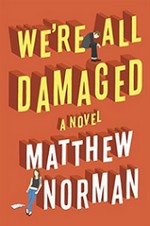
We’re All Damaged by Matthew Norman

We're All DamagedWe’re All Damaged

by Matthew Norman

Paperback, 268 pg.
Little A, 2016

Read: June 8 – 9, 2016

It’s a cruel fact that if your wife cheats on you, the guy will have a name like Tyler. Something cool–something your parents never would have had the guts to name you.

This particular Tyler is involved in Andy Carter’s wife leaving him (he’s not the cause, as Harry Burns’ buddy, Jess, would remind us, “Marriages don’t break up on account of infidelity. It’s just a symptom that something else is wrong.”). Karen uses the symptom as an excuse to dump Andy at an Applebee’s in the funniest and most tragic first chapter since Tropper’s This Is Where I Leave You.

Actually, there are several similarities between this book and This Is Where I Leave You — which is not to say that Norman’s ripping Tropper off or anything (although, it’d be a good book to steal from). It deals with some similar themes in a similar tone with similar heart. A few times Norman made me think of Tropper (I bet next time that the next time I re-read Tropper’s book, I’ll think of Norman’s).

Following the Applebee’s disaster, Andy sort of fell apart, I’ll spare you the details because Norman does a much more entertaining job of relating them than I could. But long story short, he quits his nice job and moves to from Omaha to New York and becomes a bartender, and is sort of adopted by a stray cat named Jeter (as has been well established, I’m not a cat person, but I liked Andy’s relationship — for lack of a better term — with Jeter). While licking his wounds — or whatever — he pretty much cuts off communication with his family and friends. Not out of spite or anything, but it just seems to take too much energy.

For a while now, I’ve had to keep reminding myself that I’m a nice person. Like, nice nice. Midwestern nice. Half the people who signed my high school yearbook told me so–it’s documented. A few of them even mentioned that I should never change, never ever. I once helped a blind lady walk across a grocery store parking lot in the rain. I used to run 5Ks on Saturday mornings to fight cancer and juvenile diabetes and all of that horrible shit.

Time moves on, as it tends to outside of SF novels, anyway. Before he knows it, Andy’s being stood up for a blind date and he gets a call that his grandfather is about to die. A grandfather that Andy’s pretty much ignored for over a year. So Andy goes home, after promising his boss/friend that he won’t have anything to do with Karen.

Want to bet he keeps that promise? Yeah, me neither.

He doesn’t recognize his parents, the kind of house they live in, or the notoriety his mother (a conservative radio talk show host) is enjoying. His grandfather, suffering from dementia (amongst many other things), doesn’t recognize him, either. Andy is recognized by his former best-friend/ex-brother-in-law, his brother, his parents, his ex-father-in-law, a few people he’s never met. Including someone claiming to be his sister. Oh, and Tyler.

She calls herself Daisy, “smeller of books and a marker-upper of books,” and actually has a pretty good reason to calling herself his sister. But she has other plans for him — inspired by the stories his grandfather’s been telling her, Daisy has decided to fix Andy. She sports multiple tattoos, has no discernible source of income, and marks up books. Really, not the kind of person a respectable young man should be associated with — even a formerly respectable young man. But man, I really, really liked Daisy (marking up books notwithstanding), I can almost guarantee you will, too.

You’ll probably like Andy, his grandfather, father, niece and ex-friend, too. Forget about liking Tyler, just not going to happen. I’m not sure where you’ll come down on Mom. I’m not sure where I come down on mom, either.

I’m not sure you’re supposed to have a firm opinion about her, either. My one complaint with the book has to do with Mom. The novel takes place in the weeks leading up to the
Obergefell v. Hodge
decision, and since Mom’s a conservative talk show host on the verge of nationwide fame, the case is mentioned a lot. No one, on either side of the issue, deals with it in a substantive manner — it’s all sound-bites and bumperstickers. Frankly, something so important should’ve been dealt with gravitas, not in sloganeering and cartoonish representatives. Sadly, by and large that’s all that the Internet, TV and radio gave us — so that really Mom (and her vocal opponents) were realistic representations of a lot of our country. Not the best part of it, sadly, just a large part. I can’t fault Norman for focusing on them just because they were realistic just because I wish they weren’t.

So, while maybe coming out of the ruins he’s made of his life and personality, Andy mends some fences, further ruins some more, connects with his father in a way he hadn’t in a long time, and maybe even gets a little closure. He also makes a fool out of himself, gets punched, and has to attend his grandfather’s funeral. Thanks to Daisy’s pushing, he may not be living a good life — but it’s one a lot more interesting than just wallowing in the past.

At a certain point, you pretty much figure out exactly how things are going to go in the book — and you’ll be right (except for the once or twice where you’ll be really wrong). But it doesn’t matter, because things work out the way they should, and Norman works them out in a pleasant, engaging style.

I liked Andy’s ambivalent relationship to technology — the imaginary conversations he has with Siri made me grin. And then there’s his first brush in months with Facebook.

I’ve given it some thought, and, seriously, there’s just no way Facebook can be good for you. I’m sure there have been studies, so this probably isn’t some brilliant revelation, but I’ll say it anyway. On the surface, it’s harmless enough, I guess. How bad can it really be with its endless baby posts, food pictures, and beachy foot selfies? But it’s not that simple. Mixed in with all of its silly bullshit, Facebook is the literal manifestation of all our regrets, looping and looping, for free, on our computers and phones. People who should be gone and safely out of forever are there again, one cryptic little glimpse at a time, reminding us of all the things we should or shouldn’t have done.

Seriously, Norman deserves some sort of literary prize for the “literal manifestation of all our regrets” line, right?

There’s also a cameo in here that was such a nice touch.

This was a very amusing book — frequently funny. This was also a touching book — I might have gotten misty once or twice. More than anything else, this was engaging — I was right there with Andy the whole time, cringing when he was being stupid, grinning when he was being charming or mature. I enjoyed this one so much that I can’t quite figure out how to say it. Norman belongs up there with Nick Hornby, Jonathan Tropper, Rainbow Rowell and Jennifer Weiner — he can make you laugh, make you cry, make you feel, all while telling a pretty good story. I should go back and re-read his other novel, just to be able to prove this. But until I do, just take my word for it and give this a shot.

—–

5 Stars

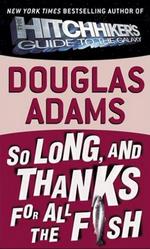
Reread Project: So Long, and Thanks For All The Fish by Douglas Adams

So Long, and Thanks For All The FishSo Long, and Thanks For All The Fish

by Douglas Adams
Series: The Hitchhiker’s Guide to the Galaxy Trilogy, #4

Mass Market Paperback, 214 pg.
Del Rey, 1999
Read: June 14, 2016

Arthur had a swordfish steak and said it made him angry. He grabbed a passing waitress by the arm and berated her.

“Why’s this fish so bloody good?” he demanded, angrily.

“Please excuse my friend,” said Fenchurch to the startled waitress. “I think he’s having a nice day at last.”

I’ve said it before, I’ll say it again: this is my favorite Douglas Adams novel. Sure, The Hitchhiker’s Guide is fantastic and I love it and you can make a strong case that at least one of the Dirk Gently novels is his best (I expect I’ll be doing so in a couple of months) — but this is the one that does it for me.

Unlike the previous three, there is an actual narrative here — it’s not a collection of scenes, jokes, and vignettes loosely tied together. Arthur Dent arrives on Earth (no, really) after traipsing from one end of the galaxy to the next; from the end of the universe, to the beginnings of life on Earth; basically all throughout time and space (sadly, without the blue box). And now he’s trying to re-acclimate to life at home. Which has somehow not been destroyed, neither has his house. In fact, everything’s pretty much like it was before.

Just with everyone convinced that the Vogon Constructor Fleet was a CIA-induced Mass Hallucination. Not everyone believes it, but most do. Two people who don’t believe that are a man named Wonko the Sane and Fenchurch. Both of whom are pretty cool characters.

I’ll skip Wonko, because the name says everything. Fenchurch, on the other hand, is perfect. She’s everything that Trillian never got the chance to be (except in the semi-disastrous final chapters of Life, the Universe, and Everything. She’s funny, smart, sexy — just what Arthur needs. I’d happily read a book just about her.

There’s a mention of Zaphod — briefly — but that’s it. So the zaniness fell into Ford’s capable lap. I’ve always liked Ford better, anyway. And he’s able (as always) to pull off the zaniness, the comedy, the . . . everything without being quite the obnoxious twit that Zaphod is.

Ford’s his usual delusional, clueless, charming, drunken self.

Here was something that Ford felt he could speak about with authority.

“Life,” he said, “is like a grapefruit.”

“Er, how so?”

Well, it’s sort of orangy-yellow and dimpled on the outside, wet and squidgy the middle. It’s got pips inside, too. Oh, and some people have half a one for breakfast.”

“Is there anyone else out there I can talk to?”

Arthur comes out of this one looking pretty good, too. He’s not whining, he’s not just getting pulled around by his dressing gown wherever whim strikes Ford (or Zaphod). He’s mature, capable, witty. He sees a problem or two and solves them (even if one of those problems is just “who was that girl I almost met the other day”?). He’s almost a wholly different guy when he’s home. Which makes him a lot like the rest of us — which is sort of the point of Arthur since we first met him.

One of the highlights of the last book was the section about flying, I’m pretty sure I said that. The section here about flying is better — Arthur teaching Fenchurch, Arthur remembering how to do it in the first place — and then the two of them flying around. It’s just about perfect.

And, of course, there are little bits like:

Of course, one never has the slightest notion what size or shape different species are going to turn out to be, but if you were to take the findings of the latest Mid-Galactic Census report as any kind of accurate guide to statistical averages you would probably guess that the craft would hold about six people, and you would be right.

You’d probably guessed that anyway. The Census report, like most such surveys, had cost an awful lot of money and told nobody anything they didn’t already know — except that every single person in the Galaxy had 2.4 legs and owned a hyena. Since this was clearly not true the whole thing eventually had to be scrapped.

    There’s a few things I’d love to go on and on about, but no one wants to read me gushing and gushing and gushing, so here are the assorted highlights:

  • The zig at the end of the Prologue.
  • Arthur’s biscuit/train station story. Seriously, I just love this.
  • Rob Mckenna
  • Wonko the Sane naming the world The Asylum and his house Outside the Asylum.
  • Wonko the Sane’s name.
  • All the California jokes. Clearly, he’d been vacationing there too much.
  • The whole thing about the lizard government and democracy is both funny and relevant.
  • Chapter 25 is just dandy.

The last chapter or two are a little weak, pretty close to the older books in tone and style. But they work, they are tied into the narrative and star Marvin. So who’s going to complain? Not me.

Really, I’ve got nothing but positive things to say about this. I love it. One of the easiest 5-star ratings I’ve ever given.

—–

5 Stars

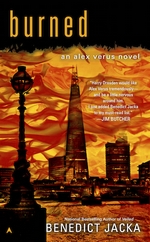
Burned by Benedict Jacka

BurnedBurned

by Benedict Jacka
Series: Alex Verus, #7

Mass Market Paperback, 326 pg.
Ace, 2016

Read: April 25 – 26, 2016

Right now I was not wandering around and seeing the sights, for three reasons. First, it was dark. Second, the city was in the middle of a civil war. And third, I was supposed to be conducting surveillance on the inhabitants of the building across the street. Which was why, instead of enjoying the experiences of travel and new cultures, I was crouched on a dusty rooftop, hiding behind a parapet, shivering in the cold, and trying to make sure that no one on the other side could see me, since from looking into the futures I already knew that they had assault rifles and were following a policy of shooting first and asking questions later.

In case you’re wondering, this isn’t an especially unusual night for me. Sometimes I really question my life choices.

Reading Burned, you almost get the idea that Benedict Jacka’s been holding back on us — at least, he’s just been getting warmed up over the last 6 novels. Either one is saying something, considering how good the series has been since it’s debut.

Jacka waits all of 6 paragraphs before getting things moving, and things don’t stop moving. The first 100 pages are great and contain more action than most Verus novels — and the rest? Just better. Marking this one as a 5-Star was a no-brainer.

So here’s the hook — someone, for reasons beyond his ken (though he has many, many theories initially), has made some political moves and Alex is going to be declared a criminal and given the death sentence in a week. Not just him, either — but those who are his dependents (Luna, Anne, Varium). The four of them are going to have to tackle this situation in very creative ways to get the sentence changed.

In the meantime, there’s a very eager group of people trying to take care of things before the deadline. To say that they’re determined would be an understatement.

To survive, to have a hope of surviving, Alex has to call upon every friend, every ally, every one-time-friend-now-something-else, every trick up his sleeve. He does it, he actually grows as a character, too.

But will it be enough to save any of them?

I want to say more, I really do — but I don’t know how to. It’s just one of those books that to talk about you really have to talk about everything. So we’ll leave it at that.

I’ve seen people call this the Changes of the Alex Verus series — and it absolutely is. I’d also call it the Staked in terms with the protagonists coming to grips with the effects that his being in the lives of his nearest and dearest has on their life, and what that means for his future involvement with them. Which is not to say that Jacka’s latest feels anything like Butcher’s or Hearne’s books — it feels like Verus just turned up half a notch. It’s just such a great read — it grabs you on page 2 and drags you along wherever it wants to take you right up until the “He is not actually doing this” moment — which are followed by a couple more of them.

There are now two things I have to look forward to: the next Alex Verus novel — and whatever novel we’ll soon be calling the Burned of ____ series.

—–

5 Stars

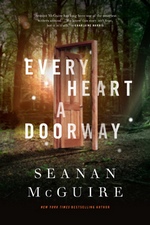
Every Heart a Doorway by Seanan McGuire

Every Heart a DoorwayEvery Heart a Doorway

by Seanan McGuire
Series: Wayward Children, #1

Hardcover, 169 pg.
Tor.com, 2016

Read: April 16, 2016

“. . . we went through. We came out on this moor that seemed to go on forever, between the mountains and the angry sea. And that sky! I’d never seen so many stars before, or such a red, red moon. The door slammed shut behind us. We couldn’t have gone back if we’d wanted to — and we didn’t want to. We were twelve. We are going to have an adventure if it killed us.”

“Did you? asked Nancy. “Have an adventure, I mean?”

“Sure,” said Jack bleakly. “It didn’t even kill us. Not permanently anyway. But it changed everything.”

One of my favorite book bloggers to read (and not just because our tastes are similar) began his take on Every Heart a Doorway by saying:

Sometimes we either meet a book (or a novella, in this case,) that is precisely the right fit for your soul, (at the moment,) or just happens to be original enough right when you need it, that it fills your life and your mind with brightness and joy.

For me, this is one of those pieces. To muddy the waters even more, I’m an unabashed fan of the author and I’m likely to pick up all of her writings without even checking the subject matter because I simply trust the woman to steer me to any shore.

If I didn’t start off by quoting that, I’d end paraphrasing/plagiarizing it.

So here’s the deal in a world where portal fantasies are possible, and children all over the world are going through them — à la Lucy Pevensie et al., Dorothy Gale, September, Quentin Coldwater, Alice, Jason Walker, etc. — and, sadly (?) most of these children end up back home. Some of them are glad to be back in this world and want to put their adventures behind them — a lot of them don’t want to be here anymore and want to return to wherever it was they went. Both kinds of children have a hard time coping in this world and need help. Eleanor West’s Home for Wayward Children is for the latter kind.

Nancy is a girl recently returned, and is very different than the girl her parents have been missing. They want her fixed, they want their daughter back — not whoever this person is with different attitudes, actions, clothes, etc. — West doesn’t promise that (but she may have allowed them to think she’ll do that, just so she can help Nancy), but she can help Nancy adjust to this world. So she joins the small student body at the private school/treatment center. The last thing Nancy wants is to be fixed, to be that girl again — which just means she fits in here, with returned kids from all over the country, who’ve been in all sorts of worlds. As Nancy begins to understand the nature of these other worlds, the effects they have on children, and why many of them want to leave again, so do we.

It turns out, all of the residents of West’s Home are going to learn that you can have plenty of adventures here, too. And that’s all I’m going to say about that.

I really liked all of these children — the adults we met, too, actually — Jack in particular. But every one of them — even the less-than-nice ones — are great characters and I’d have gladly spent another 200 pages with them, easy.

The writing is incredible — not that I’ve ever had any real problems with McGuire before, but she kicked it up a notch here — and is writing a different kind of story than I’m used to, so she writes differently. This book took me longer to read than it should’ve, because I had to go back and reread several sentences/lines/paragraphs — not because I needed to read them again for clarification, but because they were so perfect, so quotable, so . . . something. I’m not going to start quoting beyond what I opened with, because I don’t know if I could stop — Laura got two of them I made notes about. You could literally be amused, melancholy, horrified, feeling whimsy, and nervous within a couple of paragraphs — only to turn the page and start all over again. Not because she was jerking you around or anything, it’s just that kind of story, that kind of playing with language, just that kind of broken reality.

McGuire gave us such a satisfying ending — complete, tidy, fitting, bittersweet, heartwarming — and then I read another paragraph or so, and it’s so much better (and all of the above to the next degree) once you got to the actual ending. Then I closed the book and I teared up a little — for no reason at all, really, but it felt really appropriate.

Can I say this is positively Gaiman-esque without making it sound like McGuire’s derivative in any way? I don’t want to even hint at suggesting that — but man, if you like Neil Gaiman’s stuff — get this. If you’ve ever read a portal fantasy and wondered what happened to the kids afterwards– get this. If you like things that are good, and don’t mind magic in your reading — get this.

—–

5 Stars

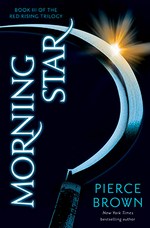
Morning Star by Pierce Brown

Morning StarMorning Star

by Pierce Brown
Series: Red Rising, #3

Hardcover, 518 pg.
Del Rey, 2016

Read: February 24 – March 3, 2016

“There is no pain. Only joy,” they chant, deep in the embrace of the god’s bread. Sefi begins the war bellow. Her voice higher than Ragnar’s. Her two wing-sisters join her. Then their wing-sisters, until dozens fill the com with their song, giving me a sense of grandeur as my mind tells my body to flee. This is why the Obsidians chant. Not to sow terror. But to feel brave, to feel kinship, instead of isolation and fear.

Sweat drips down my spine.

Fear is not real.

Holiday deactivates her safety.

“Njar la tagag . . . ”

My razor goes rigid.

PulseWeapon shudders and whines, priming.

Body trembles. Mouth full of ashes. Wear the mask. Hide the man. Feel nothing. See everything. Move and kill. Move and kill. I am not a man. They are not men.

The chanting swells. . . “Syn tir rjyka!”

Fear is not real.

If you’re watching, Eo, it’s time to close your eyes.

The Reaper has come. And he’s brought hell with him.

And when The Reaper, Darrow of Lykos, says he’s brought hell with him, you’d best believe it.

With books that come later in a series — especially with the last volume — there are huge expectations and hopes. Sometimes the book’s a disappointment; sometimes it’s as good as you hoped — every now and then, it’s better than you’d hoped. And then there are the times you get something like Morning Star. I want to avoid hyperbole, and I don’t want to over-sell, so let me just say that Pierce Brown delivered. I’m not sure how to talk about this book — one of my most anticipated reads of 2016 — other than to say it did not disappoint in the slightest, and if it doesn’t find its way to my favorite reads of 2016, I’d be flummoxed (although that would mean we have an unbelievably good 9 months ahead).

We pick up about a year after Golden Son — well, that’s not true. We start off with one of those aggravating teases for events later in the book before starting the actual story. If I’m going to complain about it in Freedom’s Child a couple of weeks ago, I’d better complain about it here. Thankfully, it’s a brief tease and you can forget it quickly because Chapter 1 doesn’t wait too long to get to the brutality that this series is so capable of bringing, making you forget about trivial things like bad ways to start a novel. I’m not going to get into the plot — if you’re curious, start with Red Rising and catch up. If you’ve read one or two of these books, I just want to assure you that you should grab this.

Red Rising was like the love child of Ender’s Game and The Hunger Games hopped up on amphetamines, steroids and too much Red Bull. Golden Sun was a roller coaster of stomach-lurching twists and turns and shattered hopes. Morning Star has elements of both, but it also reads like a series of climatic scenes from epic novels and movies stacked on top of one another — Jackson’s The Lord of The Rings + Gladiator + The Patriot + a few more things like that on the day that Michael settles all family business. Somehow, Brown keeps the tension mounting from chapter to chapter, in a way that every battle, every encounter feels like it could be the novel’s climax. Yet when the actual climax happens you’re not prepared.

Having been trained by Golden Son, I spent a lot of time expecting a betrayal, waiting for the sucker punch I knew was coming. But it wasn’t that kind of book* — it was a book of hard choices — even compromises (the good kind) — of people doing the right thing, to the best of their understanding. Not always the best for themselves, but the best for their principles, their loved ones, their people. Family — biological family, extended family, found family — is a major theme throughout. It shouldn’t be surprising considering that this all started with a husband and wife, but when you think of The Red Rising Trilogy, family isn’t one of the first words that come to mind. Well, after you read this, it might be.

Lieutenant Commander Worf, son of Mogh, would’ve approved of so much of the action here (on both sides). The pages dripped with honor and nobility (in both classic and more modern understandings of the concepts). Despite it being a mainstay in fiction, I have a hard time buying the concept of noble deaths, but man . . . there’s one roughly midway through the that got me in just the right way. The dying was a little more protracted than Brown’s typical practice, giving him time to do more with it narratively. It was such a good piece of writing (even if all the individual elements in the scene were cliché), it’s one of the most effective parts of the series. Once it starts, you know what’s happening, you know how the effects of it will play out, but it still works. It’s like the da da da dummm at the beginning of the 5th — everyone knows it, but if an orchestra does it right? It’s powerful stuff.

Like a good general — Brown’s always a few steps ahead of the reader, well, me. As before, he surprised me all the time. There were a couple of times that I came close to seeing his play — technically — but his actual move was so much better than I’d guessed, I might as well have been moving checkers around his chess board.

Before I came across the section I quoted in my opening, I was going to use:

Now I remember hate.

I’m glad I didn’t. Morning Star isn’t about that. After Golden Son (or after Eo’s death), that’s what you expect: Darrow going all John Wick/Beatrix Kiddo/Frank Castle, but that’s not what the book is. Darrow is much more than a vengeance-machine. He’s more than rage, more than hatred — he’s full of both, no mistake. But that’s not all that’s driving him.

And because there’s more to him, the book — the series — is elevated to something beyond a great SF/Action romp. When Darrow, his friends and/or his army say something, do something to send a message, more often than not, it’s inspiring, at the very least, stirring. In the end, Darrow’s mission isn’t about destroying the Golds (although there is plenty of destruction), it’s something more.

The question is, can he fulfill this mission? What would that look like? It is so close to the final page when you get the actual answers to those (and all the other) questions you have.

Oh yeah, and Brown made me laugh out loud once. There were heartwarming moments, moments of joy, moments of awe. In the midst of the chaos, the violence, the destruction, and all the blood? Rays of humanity everywhere.

Simply put, this is the perfect conclusion for this fantastic series. I can’t think of a more fitting way for Brown to have concluded things. If you liked Red Rising and Golden Son, you’ll love this.


* Which isn’t to say that there aren’t gut punches.

—–

5 Stars

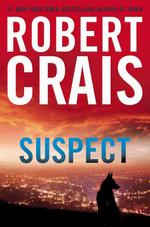
Reread Project: Suspect by Robert Crais

SuspectSuspect

by Robert Crais

Hardcover, 309 pg.
G.P. Putnam’s Sons, 2013

Read: November 3, 2015

This isn’t steel and nylon. It’s nerve. You clip one end to you, you clip the other to this animal, it ain’t for dragging him down the street. You feel him through this nerve, and he feels you, and what flows through here flows both ways — anxiety, fear, discipline, approval — right through this nerve without you and your dog ever even having to look at each other, without you ever having to say a word. He can feel it, and you can feel it. too.

Thus spake Dominick Leland, LAPD K-9 corps’ sergeant and alpha. It’s that kind of devotion to the animals that characterizes this book. These people take their dogs seriously (well, it takes Scott a little bit, but that’s the point), almost too seriously.*

Someone on the Facebook Robert Crais FanClub mentioned re-reading this to prepare for the release next week of Crais’ The Promise which will feature (who knows how much) the two stars of this novel. Seemed like such a good idea, I pounced on it, too. So glad I did, I remember really liking this book, but I didn’t remember how much I really, really, really liked this book.

This is the story of two partners grieving the loss of their most recent partners, and recovering from wounds both physical and psychological while trying to move past the trauma by gearing up for a new assignment for the future. One of the pair is a once-SWAT-bound LAPD officer, and the other is a former explosive sniffing German Shepherd with the Marines in Afghanistan. Which adds a bit of novelty to the situation.

That Prologue is one of the most effective opening chapters I can think of — it’s like the first ten minutes or so of Pixar’s Up — warmth, purpose, courage, heartbreak — there’s almost nothing more you could ask of it.

I love the way Crais describes Maggie’s sniffing/scenting for work. For that matter, Maggie’s perspective in general is great — not goofy or cartoonish, played for laughs or anything like that. Sure, some of it is projection, some of it is just guess-work, some of it is poetic license — but it’s all good, authentic, writing.

I guess the same could be said for what Officer Scott James goes through — I don’t know what PTSD is like, really. I just know about it from various literary/dramatic sources. But this sure seems to work — the guilt, the fear, the stress, the nightmares, the obsession, it rings as true. Granted, Maggie’s got a greater emotional pull (who doesn’t love a good dog?), and is a little less familiar than Scott — but at least we can relate to his suffering and him.

As with almost everything Crais writes, this takes place in the world inhabited by Elvis Cole, Joe Pike and the rest. We see that by a brief interaction between one of the detectives and John Chen (who as also mentioned by name earlier). Brief interactions with Chen are probably the best for all involved, and here he was John Chen at his John Chen-iest — I just love it. Although thanks to Gotham, I’m getting an Edward Nigma-vibe off of him, thankfully, I know better. (right?)

From the start, this gets you right in the emotions, and Crais keeps you there. You’re drawn to Maggie, and because of her, Scott. You get invested more easily than with other new characters because of Maggie With about 40 pages to go, even though I knew how it ended, I still was tense. That’s good writing. Period. End of discussion. And for the record, my eyes totally did not get misty at the end, I don’t know why you’d ask.

When I blogged about this back in 2013, I said “I don’t think this is the best Crais novel . . .but, given the way this worms into your heart, it’s probably my favorite.” It’s still probably not his best, but it’s better than I thought it was initially (I was more concerned with plot and character than craft, I think) — probably in the top 5, and it is my favorite so far.

—–

* Yeah, totally kidding. Not possible to be too serious about your dog.

—–

5 Stars

Page 19 of 24

Powered by WordPress & Theme by Anders Norén