

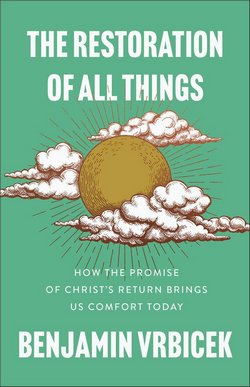
 The Restoration of All Things:
How the Promise of Christ’s Return Brings Us Comfort Today
DETAILS:
Publisher: Baker Books
Publication Date: June 23, 2026
Format: eARC
Length: 176 pg.
Read Date: July 12-26, 2026


What’s The Restoration of All Things About?
So, I grew up in the shadow of The Late Great Planet Earth, even if the churches my parents attended weren’t big on preaching about eschatology (phew!) Hal Lindsey was the default position. And it terrified me—even as little as I understood. As Larry Norman put it: “Life was filled with guns and war / And everyone got trampled on the floor / Children died, the days grew cold / A piece of bread could buy a bag of gold.” There’s nothing there that sounds appealing. Chick Tracts and related comics about The End didn’t help, either. Frankly, the last thing I wanted was Jesus to return—I knew I was supposed to, but I didn’t want to go through all that.
As I got older, I started to understand that the Scriptures—from both Testaments—didn’t speak that way of The End. Yes, there are some warnings—some stark warnings about it, particularly from our Lord’s mouth. But also, there were all these promises—Earth would be renewed, the groanings of creation would be answered, justice would be established (for the first time post-Fall), suffering would be ended. I’m not talking about some “pie in the sky after you die”—but real change, real restoration on the and of the Earth.
It’s this that Vrbicek writes to remind his readers of. Possibly to inform them of it for the first time—but it largely doesn’t read that way. For those who get weighed down by the world and their circumstances, those who face the end with trepidation for one reason or another (including childhoods—or adulthoods—like mine), Vrbicek wants us to remember that typically, the writers of Scripture point to the End with hope, with confident expectation, even longing—that all things will be restored.
So, what did I think about The Restoration of All Things?
The concluding chapter is called “Loving His Appearing.” This is pretty much the call of the book—to take seriously the warnings, to take even more seriously the promises of Christ, to take seriously the problems and struggles of a world broken by sin—and to love His anticipated return. He’s clear that this should be the goal no matter what one’s eschatology is (although he suggests it’s easier as an amillennial). Then he goes on to give a solid list of reasons to love that appearing.
The book as a whole, is a solid work. Vrbicek isn’t trying to introduce a revolutionary understanding to anything—he’s just trying to blow off a layer or two of tradition and extra-biblical culture of dust off of classic understandings. But more than that, he’s trying to remind his Christian reader of the “main and plain” teachings, to focus on that, rather than to get distracted by the details of this or that eschatological topic. He will return. He will judge. He will restore all things—creating a new heavens and a new Earth for his resurrected people.
It’s that we should long for, should anticipate—should love.
I do think his section on the imprecatory Psalms could use some re-working, if not a reconsideration, it’s just not that convincing of an approach (while better than most, it’s not as good as others). That’s my major criticism of the book as a whole—and if we’re just talking about a few paragraphs, likely a couple of pages at best—that says a lot about the book as a whole, no?
In contrast, the primary thing I appreciated about this book is how Vrbicek kept returning to the Gospel. Reminding us of the heart and character of the Judge. Of the assurances we can draw from the gospel when it comes to considering things like death and the afterlife. To considering our approach to hardship and suffering in this life. And all the other topics. We’re all really good at thinking in terms of X prophecy and how it might be fulfilled, Y promise and what we should anticipate, and so on. But we need reminders like Vrbicek’s to tie X prophecy to the gospel, Y promise to Christ’s work, and so on.
Without resorting to—or slipping into—any type of triumphalism, Vrbicek gives one of the more encouraging books on the future and eschatology I’ve read in a while. The goal isn’t rescue from this life, or to get to heaven—it’s to look with sure hope to the restoration of all things. I recommend you grab this book and enjoy the reminder.
Disclaimer: I received this eARC from Bethany House via NetGalley in exchange for this post which contains my honest opinion—thanks to both for this.
This post contains an affiliate link. If you purchase from it, I will get a small commission at no additional cost to you. As always, the opinions expressed are my own.
