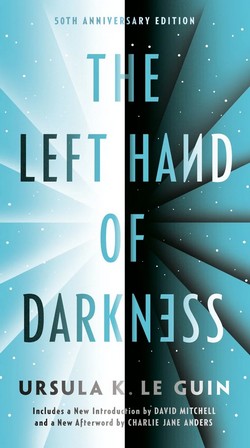
 The Left Hand of Darkness:
50th Anniversary Edition
DETAILS:
Publisher: Ace
Publication Date: March 15, 1987
Format: Paperback
Length: 300
Read Date: July 20-23, 2026


What’s The Left Hand of Darkness About?
Genry Ai is an ambassador from a Federation of Planets-type group. He’s been sent to recruit the planet of Winter (and the planet deserves the name, think a Narnia-esque “always winter, never Christmas” without any witches involved) to join them. After years of getting nowhere, some governmental upheaval forces him to leave where he’s been stationed and move to another nation to try to get them on board.
That doesn’t go too well, either. So Ai has to get creative.
The Kemmering
This could be considered a spoiler. But also, not, because I’m going to quote from the Introduction to the 50th Anniversary Edition.
For most of their twenty-six-day month and cycle, Gethenians are androgynous and celibate, but for two or three days of kemmer they become sexually active as either male or female, with no say in which. Any individual, then, can be both a mother and father, and can bear and sire children. (This physiology gives rise to the novel’s most memorable line, “The king was pregnant.”) Genly—like most of the book’s readers—possesses a single one unchanging gender, making him, from a Gethenian perspective, a biological anomaly to be pitied—or, less kindly, mistrusted as a “pervert.
When I read the novel, I was surprised at how long Le Guin took to define kemmer/kemmering despite its usage, and seeing the effects on the population, conversation, family, etc., all-around. But it really hit home for me when someone in the Book Club discussion brought up how far into the book it was (roughly 90 pages) and how things finally started to make sense for them—because they skipped the Introduction.
On the one hand, I love when authors drop you into something, and you have to figure it out—but something like this and 90 pages? That just seems cruel.
Also, there’s a lesson to be learned about Introductions, prefaces, and so on there.
Why did I pick this up? Why did I keep reading?
I picked it up because it was the Book Club choice for July. Sure, I was curious about Le Guin, just from seeing her name so often, but my curiosity had never gotten strong enough to know anything about her.
Part of what kept me going was to see if it picked up at any point. Sure, things were happening throughout, but the novel didn’t seem to care too much about the events, and more about the characters’ thoughts and reactions as they bounced around from location to location. And I wanted to know if after all the build-up, all the setting up of the dominoes—what would happen when they were knocked over?
But mostly, I kept at it to see why it was picked for our Book Club to discuss, and I wanted to be able to understand what the people who had a lot to say about the book had to say. Why are people still talking about this book 50+ years after it was published?
What does this book tell us about humanity?
I honestly don’t know how to answer this question in a couple of paragraphs. Non-spoiler paragraphs seem to make it impossible—the whole book is a meditation on that question—from a couple of different angles (at least).
I’m tempted to steal something else from the Introduction or Author’s Note, but that feels like cheating. Really, I’m only writing this because otherwise it would feel like I’m ducking out on the question. The novel wants readers to ponder this question, and while it suggests some approaches to an answer, I don’t think it has just one.
The Author’s Note
In reading a novel, any novel, we have to know perfectly well that the whole thing is nonsense, and then, while reading, believe every word of it.
In 1976, an Author’s Note was added to the novel—and it is fantastic. Not so much for what it says about this novel (although it’s not bad), but for what it says about Science Fiction and fiction in general.
I’ve read it three times—and I expect to read and cite it more—this book will remain on my shelves if only for that. I don’t know that I’ll get around to re-reading the novel (although I’m not opposed to the idea), but I will re-read Le Guin’s note.
So, what did I think about The Left Hand of Darkness?
I don’t know. I really don’t know. When I write something about it (including the incomplete paragraphs I deleted from my first draft) or talk about it, I come across as more enthusiastic than I really am.
The imagination involved in creating Gethen, the distinct biology of the humans there, the political structures, how the cultures display both the climate and the biology of the people, how all that could and would change when an alien shows up… And then you throw in the Foretellers and everything about them. Even more—you pack all that into 300 pages? (at least in this edition—you’re not going to find it clocking much higher outside of a Mass Market Paperback size). Most authors that I can think of would take at least 550 for this, and wouldn’t give us much more depth.
At the same time…most of these characters are hard to care about. Ai is too naive for this kind of work, and has the diplomacy skills of Michael Scott. Mahit Dzmare would’ve had everything taken care of years before the events of his novel kicked off. Estrahaven is a weasel, and not in a charming or sly way. At least for most of the book—I’m not sure he ends the book that way.
The plot is so thin; the novel is primarily a tour of the world and its inhabitants—which is fine; I just would’ve preferred more things happening along the way.
Like many novels of the era—especially the ones we still talk about—The Left Hand of Darkness is more about the ideas and the potentials than it is plot, character, action, and the like. And it scores on the fronts it focuses on. I’d just prefer if Le Guin had provided a better/thicker crunchy candy shell over the tasty peanut butter inside.
It’s such an impressive book, but I don’t know that I can urge anyone to give it a read.
 This post contains an affiliate link. If you purchase from it, I will get a small commission at no additional cost to you. As always, the opinions expressed are my own.