Tag: Christian Living Page 13 of 16

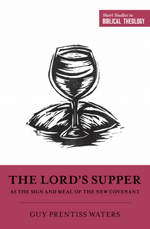
The Lord’s Supper as the Sign and Meal of the New Covenant by Guy Prentiss Waters: A Thoughtful & Encouraging Look at the Supper in its Redemptive-Historical Context

The Lord's Supper as the Sign and Meal of the New CovenantThe Lord’s Supper as the Sign and Meal of the New Covenant

by Guy Prentiss Waters
Series: Short Studies in Biblical Theology

eARC, 128 pg.
Crossway, 2019
Read: November 18, 2018

“All the salvation and redemption brought about by Christ for his disciples is founded in the body and blood he gives them to eat and drink at the Eucharist”
                                                                           — Herman Ridderbos

Waters uses that insight from Ridderbos to help explain the significance of the Lord’s Supper in the Christian religion, and thinking along these lines undergirds this entire book — not just that the Supper is something we ought to do, but something it’s vital to participate in — for our own spiritual health.

Waters begins by reviewing the basics of covenant theology — defining covenant and looking at the major covenants and how they point to Christ. Then Waters shifts to looking at the signs and seals of the various covenants — with a focus on the purpose of visible, tangible signs. The third chapter narrows that focus to covenant meals throughout redemptive history. Once the context has been firmly established, Waters introduces the Lord’s Supper with a survey of applicable biblical texts. Finally, Waters considers some practical and contemporary questions and applications. I’m not going to get into any specifics beyond this because what I want to focus on takes a lot of foundation work, and this would stop being about the book and would become a recap of the whole thing.

In a book this short (by design), I’m not sure Waters did his readers any favors by being as thorough in the first two chapters — it will be review material for many readers, and those who aren’t that grounded in covenant thinking are going to need more explanation of the ideas. Still, I appreciated what he wrote. The other three chapters were just great — I could’ve used more of all of them, but that’s not the point of the books in this series. The careful consideration of the Supper in its redemptive-historical context is so important and putting these ideas in a size and format that aren’t intimidating is going to be valuable.

I wish I had this book twenty years ago when I started studying the Lord’s Supper, it would’ve been very helpful and would’ve saved me a lot of time. I took a lot of notes while reading this and am going to spend a lot of time following up on them — and rereading this a couple of times. It’s the kind of book you want to hand out to your friends so you can talk about it with them. The last chapter was particularly helpful and encouraging. This would be a great companion read to Letham, Mathison, and Wallace (to be read after Letham, but before Mathison, probably).

Waters is one of the better academic writers the Reformed world has — thankfully, he’s also capable of producing concise and clear works for laity. This short volume demonstrates that well. It’s helpful, encouraging and I have no doubt will strengthen some believers’ in their use of the Supper as it shows others how important it is.

I’d been previously unaware of the series Short Studies in Biblical Theology, I’m pretty sure I’m going to be getting my hands on some of the other volumes. I love the idea behind the series and if they’re all this helpful, it’ll be worth it.

Disclaimer: I received this eARC from Crossway via NetGalley in exchange for this post — thanks to both for this.

—–

4 Stars

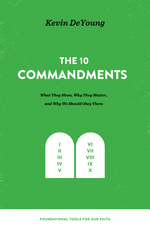
The Ten Commandments by Kevin DeYoung: A Warm, Engaging Study of God’s Revealed Will

The Ten CommandmentsThe Ten Commandments: What They Mean, Why They Matter, and Why We Should Obey Them

by Kevin DeYoung

eARC, 208 pg.
Crossway, 2018
Read: September 23, 2018

My initial thought when I saw this book was: do we need another popular-level work on The Ten Commandments? We’ve got so many already, like: Ryken’s Written in Stone, Horton’s The Law of Perfect Freedom, Packer’s Growing in Christ. We’ve got Douma’s, Watson’s and Durham’s (newly republished) on the heavier end of the spectrum, too. Why bring out a new book by DeYoung? Still, I was intrigued, so I requested a copy.

Not too surprisingly, I’m glad I did. This is typical DeYoung: a strong, affectionate, orthodox take on the Law delivered in a very accessible and affable manner. He made me think, he made me reconsider a thing or two, and he reminded me of a few things I needed reminding of.

He begins this work against the framework of the secular “anything goes” point of view, where everything certainly does not go — as much as we as a culture might rail against an external source of morality — there are things that simply cannot be said or done. Giving us a choice between humanity’s unwritten, assumed code — or God’s revealed will. DeYoung then goes on to list reasons for the study as well as the following of God’s Law.

The other important groundwork comes from the midst of his very strong chapter on the First Commandment in which he describes the role of the Law for New Covenant believers. It’s still applicable, still binding — just in a different manner. I think this could’ve been developed more — maybe in its own chapter, but what we got here was good. I do particularly appreciate his metaphor of transposition. The Law in the New Covenant is the same for believers as it was in the Old, it’s just in a different key.

Following the introduction where he lays out his framework, DeYoung turns to consider the commandments individually. This is the bulk of — and the heart of — the book, with a chapter devoted to each commandment. If the book has any value, it’ll be found here, and there’s a lot of it to be found. I briefly considered summarizing each chapter, but why steal his thunder. Also, he’s not carving out anything new here, so there’s little need. What’s new is his expression of the timeless truths, his way of explaining and applying them. If you want a quick summary of what he’ll say about each commandment read The Heidelberg Catechism questions 92-115 or the Westminster Shorter Catechism questions 39-85, and you’ll get a pretty good idea.

Instead, I’ll just comment on a few highlights and a couple of problems I had (your mileage may vary). I found his comments regarding the Fourth Commandment to be helpful, but hesitant — in his effort to not be legalistic, or overly dogmatic, he comes across as wishy-washy. I appreciated most of what he had to say about the Second Commandment, but again, he’s hesitant enough in some of his application to stumble a bit. Which is not to say that the bulk of those chapters weren’t good and helpful — they were. I think he could’ve been more consistently so.

Conversely, the chapters on the Eighth and Tenth commandments were incredibly helpful. If you ask me, these two are where the American Church and American Christians stumble more often than we realize (or care about). Publicly, Protestants are expounding so much energy on certain applications of the Sixth and Seventh commandments that one would be tempted to think that 8-10 are concerns of the past. DeYoung doesn’t let the reader think that for an instant, and if you don’t come away from these chapters with a good dose of conviction of your own sin, you probably didn’t read it too closely.

The chapter on the Third Commandment was invaluable also. It’s far too easy for Western Christians to reduce this to “don’t be a potty mouth” and far too hard for us to really get what the importance of “name of the Lord” is. DeYoung does a yeoman’s job on both fronts and does a good job expounding the meaning of this commandment.

You’ll never walk away from any of these chapters thinking that DeYoung is writing a hellfire and brimstone jeremiad against the Church, you, or anyone. He’s sharply critical of a lot of general culture, and individual inclinations, but that’s to be expected. There’s conviction and inspiration both to be found in these pages — all delivered in DeYoung’s warm, almost conversational, style — a strong blend of wit and charm with the steel in his words. I won’t get into it, but his chapter on the Third Commandment contains one of the funniest anecdotes (more in the telling than the story) I’ve read from him. Ignoring his content for a moment, his writing style is what will keep me coming back to DeYoung’s books for years to come.

I think I’ve said before, I’m not a big one for study/discussion questions in books — I like to think the engaged reader doesn’t need them and someone leading a discussion/study of a book will be clever enough to come up with their own. But, I’m obviously swimming against the tide on this because publishers keep printing them. That said, on the whole, this is a pretty good set of questions and would help someone who likes those kind of questions for their own use or for those using the book in Family Worship, Sunday School, or Bible Study.

In the end, my question, do we need another popular-level book on The Ten Commandments? Is answered yes: we need frequent — constant — reminders of the revealed will we’ve been called to obey, so we never stop striving for that perfection and never cease calling on the Spirit’s assistance. We also need to remember how great our sin and misery are so that we constantly live lives of repentance. So bring on DeYoung’s good summary. And others as well — and we need to read them, as well as the older popular-level works. And then we need to push ourselves and read some of the less-popular level ones as well.

This is a good, short set of meditations and reflections on the perfect law, the law of liberty for a contemporary audience. It’s approachable, it’s warm, it’s pointed, and it’s Gospel-centered. It’s not perfect, but it’s good. It functions well as a refresher for those who need one, and a good starting point for their own study of The Ten Commandments. I’m buying a copy (at least one) for my personal library and will be encouraging my household to read it — and anyone else who asks.

Disclaimer: I received this eARC from Crossway via NetGalley in exchange for this post — thanks to both for this.

—–

4 Stars

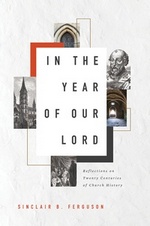
In the Year of Our Lord by Sinclair Ferguson: Sinclair Ferguson brings out the heart as well as the life of Church History

In the Year of Our LordIn the Year of Our Lord: Reflections on Twenty Centuries of Church History

by Sinclair Ferguson

eARC, 229 pg.
Reformation Trust Publishing, 2018
Read: August 26 – September 16, 2018
The seeds of this book were first published in a book Ferguson co-authored called, Church History 101: The Highlights of Twenty Centuries — he’s now taken those chapters, done more research (being retired has freed up some time for him to do some reading), and expanded that into this great survey of Church History.

After a stirring (yes, really) introduction that lays out the purpose of this volume, why the study of Church History is important and what can be gained from even the figures from Church History that may disagree with — Ferguson dives in to his survey. I really can’t say enough good about this introduction — which feels odd, that’s not supposed to be the best part of a book (and it isn’t, actually — but it’s good enough that it really could be). The body of the book is twenty chapters — in case you couldn’t guess, that’s one chapter for each completed century Anno Domini (and Ferguson is committed to the usage of that).

Each chapter starts with an excerpt from a noted piece of writing from the century in question — like The Martyrdom of Polycarp, On the Incarnation, Gottschalk;s Shorter Confession concerning Double Predestination, and Savonarola’s The Triumph of the Cross (noted, not necessarily commonly known, obviously). Following that Ferguson summarizes the events of that century — focusing on particular figures or movements that stand out. Most of these will be at least familiar to the reader by name, if not for activities and attributes. Then he closes the chapter with some words of application to the contemporary Church and a hymn from that century — most of those hymns I was totally unfamiliar with, and am so glad I was exposed to them.

The core of the chapters, the history of that century — as summarized as it may be — is so helpful. I’ve taken classes covering a lot of those chapters — and read enough on my own that I was pretty familiar with the material covered. But I learned something about even those eras and individuals I’ve studied extensively — maybe not a lot, but enough to justify the time. And even those things that were primarily review for me were well worth reading — the story of our family is one we should hear over and over again and this book is a prime example of what we need to hear.

But what about those who haven’t taken the classes, or haven’t had that much exposure to Church History outside of the last century — or maybe the first couple of centuries? This book is even better for them. It’s primarily intended as an introduction to Church History, and it excels at being one. First of all, it gives you the good bird’s eye view from the day after the last chapter of Acts to the present. Which is a perspective that’s all too easy to lose in the details — we’ve got to see the forest. But the trees are also important — and Ferguson gives enough detail (while remembering that these are brief summary chapters) that the reader can get a handle on a particular century and learn enough that they can pursue what they’re interested in. I know from reading that Celtic monasticism is something that I want to read more about (and not just by rereading Thomas Cahill), but that there are other things from that period that don’t spark my interest in the same way. Some people will react that way to Gregory I or Thomas Chalmers or something else — and Ferguson has provided the reader with enough to start on to feel comfortable pursuing that interest.

Whether for review or as an introduction — the meat of this book is just what the doctor ordered.

Even if the history wasn’t that helpful, Ferguson’s application and the hymn made the book worthwhile. Sometimes that application is comforting, sometimes it’s challenging — it’s always helpful. And the bonus of having that hymn? That’s a wonderful, devotional way to bring history to life — that’s the same Lord, the same faith being proclaimed in these words. Loved that. Starting the chapters with a doctrinally rich (if occasionally problematic) excerpt reminds us that our faith is first and foremost about truth, about ideas — but those find expression in the heart and life of the believer — as seen in the hymns.

Yes, it’s a weakness that this book focuses on the Western Church — particularly that represented in the English, Scottish and American branches. Ferguson admits that at the beginning, but that’s his tradition, that’s his background — and that’s the background for most of his, readers, too — so it’s what’s most relevant. To go beyond that would result in a tome unwieldy and not that handy for his audience (as great as it would be to see).

The structure of head (excerpt), life (history) and heart (hymn) is a fantastic outline for this book — and everything hung on that outline is clearly-written, helpful to the Christian and relevant (if only to say “don’t be like that.”) Ferguson knocked it out of the park with this one, and I can’t recommended it highly enough. Great for personal use, family devotion, Sunday Schools, Home Schools — you name it, there’s someone who can benefit from this book.

Disclaimer: I received this eARC from Reformation Trust Publishing via NetGalley in exchange for this post — thanks to both for this.

—–

4 Stars

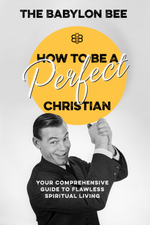
How to Be a Perfect Christian by The Babylon Bee: Winning Satire with a Point

How to Be a Perfect ChristianHow to Be a Perfect Christian: Your Comprehensive Guide to Flawless Spiritual Living

by The Babylon Bee

eARC, 208 pg.
Multnomah, 2018
Read: May 13, 2018

I’m pretty sure my introduction to the concept of satire came from the works of “Jovial” Bob Stine (this was before he discovered you could make a bazillion dollars selling horror books to kids) — The Sick Of Being Sick Book, The Cool Kids’ Guide to Summer Camp, Don’t Stand in the Soup, and How to be Funny. I hadn’t thought of him for years. Until I read How to Be a Perfect Christian, that is.

I’m not trying to suggest that this book is the equivalent of satirical children’s books from the early 80’s and late 70’s. But it’s exactly what someone who grew up reading that kind of thing should read. Also, I’m glad I got to spend a few moments remembering Jovial Bob Stine, and I wonder if I still have those books somewhere (and how un-funny would my own kids think they are).

If you’ve ever read anything from The Babylon Bee, you know what to expect from these guys. If you haven’t — you either should, or maybe this isn’t the book for you.

Styling itself as a guide to sanctification — there’s even a handy ruler at the end of each chapter helping the reader to note their progress — How to Be a Perfect Christian is a hands-on guide to making progress in Cultural Evangelicalism. There’s a chapter on picking the right Church (what can they do for me?), what things to volunteer for at church (minimum of work, maximum of exposure/attention), how to use social media (if your Quiet Time doesn’t result in an Instagram post, was there a point?). There’s a wide variety in the types of jokes here: there are dumb and obvious jokes, some subtle, some clever — all pointed. Which is the idea, they’re pointed so they can deflate contemporary American Evangelicalism — its cultural (sociopolitical/cultural) manifestations, anyway.

Yes, sometimes the prose contradicts itself — because the target or punchline on page 70 is different than the target or punchline on page 47. But that’s okay for two reasons — 1. the jokes land on both pages 70 and 47 (these numbers are made up, by the way), and 2. this books isn’t really trying to make a coherent, consistent argument. At least not for the first 98%, anyway. But the jokes are funny — not all of them laugh out loud funny, but they’ll elicit a chuckle or a grin. Some might just leave you with a general sense of amusement. Most will find a way to strike home (and there are a few duds — but everyone will have their own list of duds, I don’t think there’s one in the book that everyone will dislike).

More importantly, everyone will find themselves at the receiving end of the serrated edge of the satire more often than they’d like. But not in a guilt-inducing way, but in a — “hmm, I should probably work on that” kind of way. Which, I trust, is the point.

The last two percent (for those clever enough to do the math) that I pointed at earlier? Yeah, that’s what the whole book driving toward — the lampooning is for fun but there is an overall point under-girding everything. A point, that’s both well earned, and very needed, by cultural Christians, sincere and thoroughgoing Christians, and a waiting world.

Solid satire — laughs with an edge — directed toward a deserving target. The conclusion was equally on-point and earned. I honestly expected less from this book — yes, I knew there’s be good laughs along the way and that the necessary sacred cows would be shot at — I just wasn’t sure if The Babylon Bee could pull off a piece this long, and count the whole thing as a pleasant surprise.

Disclaimer: I received this eARC from WaterBrook & Multnomah via NetGalley in exchange for this post — thanks to both for this.

—–

4 Stars

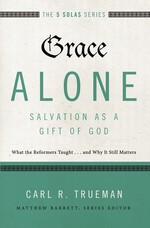
Grace Alone–Salvation as a Gift of God by Carl R. Trueman

Grace Alone--Salvation as a Gift of GodGrace Alone–Salvation as a Gift of God: What the Reformers Taught…and Why It Still Matters

by Carl R. Trueman
Series: The 5 Solas Series
Paperback, 243 pg.
Zondervan, 2017
Read: October 8 – 22, 2017


After struggling through three books in this series, I will admit to some trepidation about this one — thankfully, Carl Trueman is an author I have a bit of experience with, so I figured it’d be worth the effort. Thankfully, there wasn’t that much effort, and the book was absolutely worth the time.

Trueman organizes this book differently than the others — in Part 1, he considers Sola Gratia in Scripture and Church History. Trueman surveys the idea of grace alone through both Testaments (it’s easier than some would lead you to think to find it in the Old Testament), looking at individual texts as well as themes throughout the books. I would have liked this to be a bit longer — but I really can’t complain about it. Following that, Trueman focuses on the teachings the Church throughout history about Grace — starting with the early church, focusing on Augustine and his Confessions as emblematic of the first centuries of the church. Then he continues to focus on Augustine, but shifts the focus to the controversies sparked by the Confessions with Pelagius and his followers as the prism through which the (Western) Church discusses and teaches Grace since those days. In the next chapter, Trueman focuses on Medieval theology about grace using Aquinas as the example. Following that we get chapters on Luther and Calvin (and those who’d be allied to Calvin’s branch of the Reformation), shaking off the accumulated tradition and misunderstandings to get back to the core of Scriptural and Augustininan teaching (with help from Aquinas). Would I have appreciated another chapter or two about post-Reformational history? Sure. But they weren’t necessary to fulfill Trueman’s aims, and we get a taste of what they’d offer in Part 2.

Part 2 is title “Sola Gratia in the Church.” Grace is communicated to Christians via The Church, Preaching, Sacraments and Prayer and so Trueman a. defends that idea and then proceeds to discuss how God goes that in chapters devoted to each of those. For those of the Reformed tradition, there is nothing ground-breaking or controversial here, although Protestants from other traditions might find some of the ideas challenging. These are solid chapters of the kind of teaching I expected from this series, and I appreciated them.

In the book’s Conclusion, Trueman attempts to address the questions: “What would a ‘grace alone’ church look like today? What would characterize its life as a church? How might we recognize such a church when we see it?” The answers to these questions are a mix of doctrinal and practical ideas that he lists in ten points showing the interconnections between them. This conclusion (in building on what came before) is worth at least half the price of the book — just fantastic stuff.

I still have one to go in the series, so I may have to modify this, but this one is by far the best of the bunch — accessible, pastoral and thorough without sacrificing depth. Trueman doesn’t seem to get distracted by pet details, nor to just beat the same obvious deceased equines on this topic. If you’re going to read just one of the five, let this be it. Alternatively, if the some of the others have left you wanting, give this one a shot, I think you’ll appreciate it.

—–

4 Stars

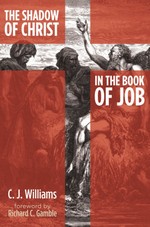
The Shadow of Christ in the Book of Job by C. J. Williams

The Shadow of Christ in the Book of JobThe Shadow of Christ in the Book of Job

by C. J. Williams

Paperback, 96 pg.
Wipf and Stock, 2017

Read: August 27, 2017


Just some quick thoughts on a quick read…

Williams begins this brief book with a chapter on typology, what is it and why should we use it. Essentially, his definition of a type is: a living prophecy concerning God’s promised (centering on Jesus) for the benefit of God’s people throughout the ages. Which is a pretty handy definition, made more so by the rest of his discussion.

That accomplished, Williams applies it to the book of Job, and its central figure. Essentially, he gives a chronological survey over 10 chapters showing the typology involved. I found these chapters refreshing in their perspective, and instructive for how to look at other biblical texts in the same light. The last chapter, “What the Book of Job Means Today,” applies it to the Christian reader, what can his takeaway be from the book as he seeks sanctification, which was pretty helpful.

This is not a commentary on Job (I’d love to read one in this vein, especially by Williams), he’s brief by design. I think he could’ve been slightly less brief without making the book inaccessible or too involved. This brevity frequently frustrating — he’ll give an idea in a sentence, or disagree with a thought in a sentence, that could easily have been a paragraph (the latter was more annoying to me). Just a little more development of some of these ideas would’ve greatly improved the book.

A helpful way of seeing how typology can be faithfully utilized, as well as a reminder of the character of our Lord seen in the lives of His saints. A good use of an hour or two of your time.

—–

3 Stars

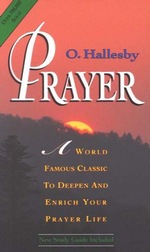
Prayer by Ole Hallsby

PrayerPrayer

by Ole Hallesby

Papberback, 176 pg.
1994 (originally 1931), Augsburg Fortress

Read: September 3 – 10, 2017


The section from Calvin’s Institutes on prayer is fantastic, Wistsius’ book is incredibly helpful, Luther’s little A Simple Way is pretty good, as is Matthew Henry’s Method, but none of them have been as much help as this little book by Norweign Lutheran Ole Hallesby (at least that’s my guess, I’ve had years to chew on those others, only a couple of weeks for Hallesby). I heard of the book briefly on an episode of Christ the Center this summer, and then they devoted an entire episode to it later — I was halfway through the book when that second episode was posted, thankfully, they didn’t say anything that spoiled the ending. If not for those podcast episodes, I probably would’ve gone my whole life without ever hearing of this book. That would’ve been a shame.

He doesn’t set out to write a comprehensive book on the subject, or a systematized theology of prayer, but to present “a few simple rules for the benefit of souls who are fainting at prayer.” It’s not much of a rule book, thankfully, as much as it wants to be — more like a collection of helpful suggestions.

Hallesby describes two things that make up the attitude of prayer — helplessness and faith. Faith that Jesus can and will answer our prayers and a realization that we are helpless and need him to even pray. What he writes about helplessness is worth the price of the book alone. I think it’s changed the way I pray already. I would quote a bit of it here — and I started to, but I wasn’t sure where I’d stop. So let me just encourage you to grab the book.

I also really appreciated his discussion of how we “think we must help God to fulfill our prayer,” by giving Him lists of suggestions for how to and times when He can answer us. Instead, we are to faithfully pour out our need to Him, and then trust that He will answer as He sees best. I’d really never thought of it in those terms but we really can end up trying to tell God the best way to go about helping us — which flies in the face of our admitted helplessness in a given situation.

Hallesby covers the work of prayer, the struggles we may have in it, some suggestions for how to learn to pray better, as well as giving some answers to common questions about prayer (that seem to be the same questions I hear others having almost 100 years after this book was written, probably questions believers had 100 years before that, too). Throughout the book, you get a strong sense of a pastoral heart behind the words and advice, which makes it all much easier to heed.

It’s not a perfect book by any means — most of my problems have to do with the fact that I’m not a Lutheran, nor a Pietist. So, anything that leans too heavily on those traditions/characteristics are obviously going to at least raise my eyebrows, but on the whole those aspects of the book are quibbles. For example, his definition of prayer involves letting God help us, or his aversion to pre-written prayers (that one has many allies in my own tradition, so it is more of a note than anything). More substantial concerns are his utter lack of reference to — much less use of — the Psalms or the Lord’s Prayer. A book on prayer that doesn’t even touch on those is mind-boggling. None of these concerns or quibbles detract too much from the book — and they’re certainly outweighed by the help the book gives.

Pound-for-pound, the best book on the subject I’ve read. Easy to read, encouraging, convicting and insightful. Highly recommended.

—–

4 Stars

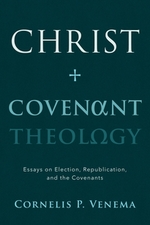
Christ and Covenant Theology by Cornelis P. Venema

Christ and Covenant TheologyChrist and Covenant Theology: Essays on Election, Republication, and the Covenants

by Cornelis P. Venema

eARC, 504 pg.
P&R Publishing, 2017
Read: July 23 – August 20, 2017


The doctrine of covenants is in many ways the heart of Reformed Theology, defining Reformed Christianity and marking the dividing line between it other forms of Protestantism. Which is not to say that after 400 years and change that we’ve managed to work out all the details. Even now controversies (of varying degrees of heat) over aspects of Covenant Theology keep blogs, twitter and theologians busy. This particular tome is a collection of essays by noted theologian and author, Cornelis P. Venema, on some of these issues. They’re all slightly re-worked articles originally published in various journals, books, etc. but in one handy collection for those who haven’t tracked them all down before.

Broken into three sections, the book covers the relationship between the Covenant of Works and the Covenant of Grace; the relation between Covenant and Election (particularly as applied to children of believers); and then “Covenant Theology in Recent Discussion,” which focuses on the Federal Vision and N. T. Wright’s view of justification.

In a nutshell — I found Part 1 to be the most intriguing, Part 2 to be the most helpful, and Part 3 didn’t do much at all for me. But that’s me, and I can’t imagine that my experience will be replicated. I’m not going to spend a lot of time summarizing his arguments — I couldn’t do a good job of that; it’s beyond the scope of this blog; and it’d take far too much time to read — he does a better job of it anyway (or just read Ferguson’s foreward, which gives an excellent overview).

Part 1, “The Covenant of Works and The Covenant of Grace” focuses on the a couple of problems surrounding the concept of the “Covenant of Works” — in chapter 1, he explores some criticisms of the concept, the history of its development and then defends it (at least in is Westminster Confessional form). Venema then moves on to look at the ways in which some contemporary Reformed theologians are seeing to find a “republication” of the Covenant of Works in the Mosaic covenant. He begins with building the case for Republication, drawn from some of the primary sources, and then critiques it. I won’t say I’ve read everything on this topic in print, but I’ve read enough to get the issues, and this is probably the fairest job I’ve seen describing the position. It’s also a pretty good critique, showing many of the problems inherent to it. This was very helpful to me, and I expect, for many.

Part 2 is wider in focus — he devotes two chapters to looking at Herman Bavinck’s understanding of Covenant, Election and the relationship between the two. Bavinck is becoming one of my favorite theologians and this study, pulling from many of his works, was useful focusing on these themes. Venema then spends two chapters on the teaching of the Canons of Dort about children of believers who die in infancy — there’s an overall pastoral tone to these chapters (and the Canons), with some good historical overviews of what lead to it and how the Canons have been used since their writing while dealing with grieving parents and others. These two chapters probably helped me more than any others in this book. Finally, leading from both of those, Venema applies the doctrine of the Covenant to the baptism of children. I read this in the original book it was published in, and it was one of the better chapters in that book — it’s still good now.

The third part dragged for me, I’ll admit. Venema does his characteristic thorough job laying out the issues with both the so-called “Federal Vision” and N. T. Wright’s ideas about justification as seen in his interpretation of Romans 5. I know better than to think that the issues surrounding the FV or NPP are dead, and I know that the issues are important enough that we need to keep exploring and expounding on them — but man, I devoted so much time and energy in the early 2000s to the FV in particular that unless he had something new to say, I just wasn’t going to get anything out of it. These chapters were a good overview and analysis, with some very good elements of critique. I do think that those who are newer to the topics, or haven’t spent a lot of time on them will profit from Venema’s work here.

What can I say about the writing? Venema’s very dry, very careful. When it comes to some of these topics, passions can flare, rhetoric can overtake even the more sanctified writers, getting them to say things more casually than they ought, even recklessly. Veneama avoid that, going out of his way to attempt to be fair to his opponents, while making it clear where he stands. This can be annoying if you’re looking for a quick answer to a controversy, but a great boon if you’re trying to understand it. It’s that care, that patience, that fairness that makes his critiques as effective. You don’t get the impression that he’s creating strawmen, or presenting the worst of his opponents, so the problems he points to are significant and deserving of your attention.

I know this book will not appeal to many — if the subtitle “Essays on Election, Republication, and the Covenants” doesn’t catch your interest, this book isn’t likely to do much for you. But if your ears perk up to just one of those areas, this is a very helpful book, a sure guide through some of the hotspots of the contemporary Reformed Church.

Disclaimer: I received this eARC from P&R Publishing via NetGalley in exchange for this post — thanks to both for this.

—–

4 Stars

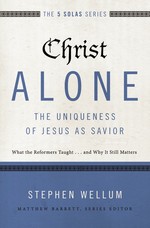
Christ Alone–The Uniqueness of Jesus as Savior by Stephen Wellum

Christ AloneChrist Alone–The Uniqueness of Jesus as Savior: What the Reformers Taught…and Why It Still Matters

by Stephen Wellum
Series: The 5 Solas Series
Paperback, 314 pg.
Zondervan, 2017
Read: June 11 – July 9, 2017

So, Stephen Wellum tackles the solus Christus Sola, the exclusivity and sufficiency of Christ as our Redeemer. It doesn’t get the press that some of the others do, but it’s as essential to the Reformation as the rest.

He begins with survey of the Biblical material surrounding the identity of Jesus Christ — as Messiah and as God the Son Incarnate. This was some solid work — I had a hard time engaging with his writing, I can’t say why, but he just didn’t hook me. It likely had to do with the fact that this book was on the heels of outstanding works on the same idea by Machen and Vos — and a related book by Crowe. Wellum demonstrated a lot of familiarity with contemporary scholarship on the topic — from all parts of the spectrum. Every few pages, I’d come across a paragraph or so that’d be really helpful. But the rest was just something I slogged through.

Part 2 focused on Christ’s Atoning work — the heart of the book, for sure. He spends two chapters defending and articulating the doctrine of the Penal Substitution. There is much to commend here — well, much to endorse, I think it could’ve been stated in a more interesting way. The biggest issue I had with his presentation here is that he reduces everything else recorded in the gospels to an “extended prologue” to the passion narratives. That’s not a characterization on my part — he states that.

The third Part focuses on the use of the doctrine in the Reformation and today, both in reference to Roman Catholicism and the wider contemporary culture. I think there was a lot of promise to this section and I wish is was better developed. As it was, it came across half-baked. Although, at this point, I’d pretty much given up on the book and maybe it was better than I thought.

On the whole, this series has been a disappointment to me — I’m going to finish it (I own one I haven’t read yet, and my series OCD is going to compel me to get the last). This one more than the others. I wouldn’t say don’t read it — there’s some really good bits here and there, and there’s nothing wrong anywhere, in fact, it’s pretty helpful. But, I don’t know, I just can’t tell anyone to go grab it, either.

—–

3 Stars

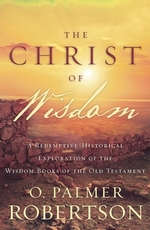
The Christ of Wisdom by O. Palmer Robertson

The Christ of WisdomThe Christ of Wisdom: A Redemptive-Historical Exploration of the Wisdom Books of the Old Testament

by O. Palmer Robertson

eARC, 432 pg.
P&R Publishing, 2017

Read: May 7 – 21, 2017


Robertson’s preface laments the way that the Wisdom Literature of the Old Testament is usually ignored in Redemptive-Historical studies —

…how do you fit these wisdom books into the flow of redemptive history that consummates in the Christ? By letting them be what they are in their own distinctiveness. They are, it should be remembered, canonical, divinely revealed, and authoritative writings that tell the world how and what to think about the deeper mysteries of human life. Rather than submitting to the moldings and bendings of modernity, these books broaden our understanding of the nature of redemptive history. Divine progress in the complete restoration of reality does not merely move in a purely linear fashion like the flight of an arrow moving across time and space without deviation until it reaches its target. This “third dimension” of redemptive history moves in a cyclical pattern. For certain aspects of God’s salvation perform according to a pattern of regulated repetition.

To ignore this dimension of redemptive history is to exclude a major portion of the old covenant canon—and that you do not want to do.

So how do you discuss these books from a RH point of view? This is what Robertson seeks to do in this book — not as a final answer, but as the beginning of a search for wisdom along these paths.

In one sense, Robertson could’ve made this easier to talk about this book — there’s not one central argument developed throughout. There’s a general discussion (brief) of wisdom, wisdom Biblically defined, that is. And then using that discussion, Robertson looks at the Wisdom Literature of the Old Testament (and Lamentations, which is not usually considered Wisdom Literature, but can function as such), summarizing each book, looking at the various forms of wisdom described and passed on through it.

Simply,

Wisdom is the ability to understand the basic principles inherent in God’s created order, and to live by those principles. Wisdom enables a person to summarize these basic principles in a succinct and memorable fashion. Wisdom is living out the whole of life with a constant awareness of accountability before a loving, gracious, and just Creator and Redeemer.

The work he does to get to this summary is well worth the time and effort to work through. Actually, that goes for everything in the book, but I’ll hold off on saying that kind of thing for a few paragraphs.

The chapter on Proverbs is, fittingly, the longest and most developed. He discusses various approaches to the book, to understanding its construction and from there trying to understand it:

A much more accurate view of the theology of Proverbs may be gained from a covenantal perspective. The wise sayings of the book are not presented in a vacuum. They are not purely moralistic aphorisms. Instead, they are steeped in theistic assumptions. These wise observations about how the world works assume that God the Creator is none other than Yahweh, the Lord of the Covenant.

This, right here, would help so much of what I’ve read about Proverbs over the last few decades. To get into everything that Robertson says about the pursuit of Wisdom, passing it on and living by it from this book would make this post unbearably long — but it builds the foundation for everything that comes. Proverbs covers Wisdom as a whole — the rest of the book deals with it in specific areas.

While dealing with the personification of Wisdom in Proverbs 8, Robertson gives an excursus, “Athanasius as the Champion of the opponents of Arianism,” that is just gold. I’d love to see this developed into something longer.

Following Proverbs, he moves on to Job. Job doesn’t give us the answers to the puzzling circumstances of life, but for those who understand the book, they learn how to puzzle through the circumstances, how to think about them — how to ask God about them. Yes, there are answers given in the book — not easy answers, not the answers anyone necessarily wants, but answers — answers tied to the hope of the Resurrection. But wisdom knows to look for those answers in the difficulties of life, with a sure faith that is willing to look at dark circumstances and say, “I don’t know why this is happening, but I trust in Him Who does.”

Ecclesiastes, is, naturally, a tricky chapter — Robertson threw me a curveball when setting aside the usual discussion of authorship of the book to note

But a related question of some significance for understanding the book has been generally neglected. This neglected question is the identity of the “target audience”of Ecclesiastes.

Chewing on this a little helps get through some of the discussion of authorship. There are so many divergent readings of Ecclesiastes that your head can swim just trying to get a sense of them, Robertson is a pretty sure guide through them before landing on his conclusion that Ecclesiastes presents a “realistic picture of life” — one that is a precursor to Paul’s discussion in Romans 8, where creation is subjected to frustration, but that this is being renewed. I do think this chapter could’ve been organized in a more straight-forward way, but I appreciate the way that Robertson makes you work through various considerations and themes before leading to his conclusions — which are all very helpful.

His discussion of Lamentations, summed up in the subtitle “How to Weep,” was one of the best things I’ve read on the book (an admittedly too-short list). You may think that’s a pretty easy thing to learn — but there’s a wise way, a godly way to weep over the tragedies that will come into our lives. The book of Lamentations teaches us that — and, here’s the RH emphasis coming through — there’s a hope tied to the wise weeping. A hope tied to faith in God’s commitment to preserving a repentant people to Himself.

Lastly, we get to the wisdom of “How to Love” (in a marital sense) in the Song of Songs. The way he reads the book is a “Redemptive-Historical” way, in

terms of the redemptive work of God in restoring humanity to the situation prevailing at the time of creation . . . a restoration of the initial blessing of man and woman in their relation to each other, just as when they first stood in each other’s presence “both naked” but feeling “no shame” (Gen. 2:25). This Song rejoices in the fullness of God’s redemption of the marriage relationship.

He concludes this chapter uniquely, with a script for a Dramatic Reading of the Song of Songs — I think there could’ve been a bit more instruction on how to approach such a Reading — and why — than he gave. But I really appreciated that part.

He could’ve used a conclusion to wrap things up — returning to the closing admonition of the opening chapter. But that’s probably just a taste thing on my part.

There’s a focus on the literary/poetic forms in each book tying in the themes and teachings of them to the way the author presents them. This kind of discussion — no matter the type of literature (inspired or not) always stretches me. I imagine I’m not alone in that — in fact, I bet many people will skip those parts. This is to their own detriment. Robertson discusses these matters in a way that takes some effort to understand, but it’s effort that pays off.

This is a truly helpful book — not full-fledged commentaries on any of the books, but helpful summaries pointed towards seeing the wisdom passed down in each book, and tied into the Redemptive work going on in history all around us. I found it interesting that the recent A Biblical-Theological Introduction to the Old Testament doesn’t approach some of these books the same way as Robertson — in some ways flatly contradicting him. I’d hoped for more overlap between the two works approaching this material from the same framework — but none of the contradictions or differences change the overall message of the Biblical material, just shadings. Honestly, in each case, I think Robertson’s readings are easier to square with the texts in consideration (and not just because he has more pages to develop his points, either).

Robertson, as always, delivers the goods with this book. The reader has to think about what he says, has to drag out their Bible and use the two books together, but will ultimately come out the better for it. I found this book to be incredibly helpful, insightful and something that drove me back to the fullness and fulfillment of all the wisdom of God — Jesus the Messiah. Just where Robertson wants his readers to focus.

Disclaimer: I received this eARC from P&R Publishing via NetGalley in exchange for this post — thanks to both for this.
N.B.: As this was an ARC, any quotations above may be changed in the published work — I will endeavor to verify them as soon as possible.

—–

4 Stars

Page 13 of 16

Powered by WordPress & Theme by Anders Norén