Tag: Christian Living Page 14 of 16

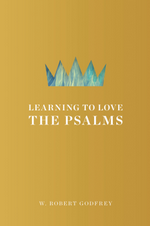
Learning to Love the Psalms by W. Robert Godfrey

Learning to Love the PsalmsLearning to Love the Psalms

by W. Robert Godfrey

eARC, 263 pg.
Reformation Trust Publishing, 2017

Read: April 2 – 16, 2017


Godfrey’s Afterword begins:

In our study, we have made a beginning of learning to love the Psalms. We have looked at some of the attractions and difficulties of the Psalter. We have summarized the great themes, subjects, and emotions of these songs. We have examined some of the forms and uses of the Psalms. But this book is at best an introduction and invitation to growing in an appreciation of the Psalter. You need to carry on with what we have started together.

That right there is a great 80 word summary of the book — both in intention and execution. If that summary appeals to you, you’ll dig the book.

Godfrey starts with a few short chapters talking about the Psalter as a whole. He discusses his own personal history with the Psalms and what attracted him to them and the benefit he’s gained — then a very quick look at Psalms in Church History (notably their impact on the Reformation). Then he discusses why people are discouraged from getting into them, how to overcome that, how to approach the Psalms and some basic things to think about why studying them/using them for yourself. He gives 10 questions to use when coming to any Psalm that are easy enough for any rookie to put to use and also for any one who had studied the Bible for years to benefit from.

Following that he looks at each of the 5 collections or books or whatever you want to call the groupings of the Psalms that make up the whole Psalter. These would be:

  • BOOK ONE – THE KING’S CONFIDENCE IN GOD’S CARE: Psalms 1– 41
  • BOOK TWO – THE KING’S COMMITMENT TO GOD’S KINGDOM: Psalms 42– 72
  • BOOK THREE – THE KING’S CRISIS OVER GOD’S PROMISES: Psalms 73– 89
  • BOOK FOUR – THE KING’S COMFORT IN GOD’S FAITHFULNESS: Psalms 90– 106
  • BOOK FIVE – THE KING’S CELEBRATION OF GOD’S SALVATION: Psalms 107– 150
  • THE CONCLUSION OF THE PSALTER: Psalms 146– 150
  • In these parts, Godfrey explores the structure and themes of each and then looks at at least 5 psalms in that book — opening them up for the reader, seeing how they work together with the other around them, in some cases how they don’t fit the theme of the rest of the book. All of these are brief, but thorough, chapters (an overview chapter and then individual chapters on each Psalm) — insightful and helpful on their own — much more so when combined with the other chapters in that section or the book as a whole. But really, if you wanted help with, say, Psalm 78 (to choose at random) as a refresher for something — the chapter on that from this book would be a great way to start. Godfrey explains:

    The intention of this study is not to provide an exhaustive exegesis of each psalm considered, but rather to open a way to a growing understanding of the Psalms. God gave His people the Psalter so that we could more and more be defined by it, so that we could find our identity in it. We as the people of God today need to learn for ourselves what it means to live in the Psalms. In a real sense, they give us words to express what it means to live as a Christian. We should live in and out of the Psalms.

    “They give us words to express what it means to live as a Christian ” I love that line — as I have really started to explore the Psalms for myself over the last couple of years, that’s really what I’ve been seeing and will immediately start using that phrase to describe it.

    These sections of the book are the heart of it — as helpful as the initial chapters are. It’s not a commentary, as he states, but it does do a great job of jump-starting your individual study. I probably jotted down more quotations from these sections than I have from others lately, and the temptation to list them all is great. I’m going to limit myself to three, just so you can get a taste of Godfrey’s language and the variety of topics/themes he addresses:

    The difference between this praise song [based on Psalm 103] and the actual psalm [103] is striking. The song is repetitive in vague terms: He has done great things. The psalm, by contrast, is specific about the various blessings received. Taking the psalms as our standard of praise should warn us against the repetitiveness of many contemporary songs and lead us to praise that is much more pointed and specific. Genuine gratitude reviews in detail the wonderful gifts of our God.

    — Both a pointed critique and a challenge/encouragement for how to go express our gratitude biblically.

    From Psalm 73:

    Pictures that reconstruct the temple almost invariably misrepresent the scene as very clean and tidy. In fact, the altar must have been a rather horrible sight of blood and charred remains. It was surrounded with the odors of blood, burnt flesh, and death. Flies probably swarmed around. What the psalmist saw was what God intended His worshipers to see: that the wages of sin is death in all its horror. The altar testified that sin leads to destruction, and the only way to avoid the just consequences of sin is to find a substitute and sacrifice. The altar testified that the blood of a spotless substitute was necessary for sin to be forgiven. . .The altar and the sacrifices point to Jesus and His saving work. He is the true sacrifice and substitute for His people.

    From his discussion of Psalm 74:

    Here is a concern often repeated in the Psalter: Why does the Lord not act more promptly in response to the needs and prayers of His people? Why? First, we should notice that this questioning by the psalmist stands against the advice offered today by some well-meaning Christians who say that we should never ask why. Such advisers voice a kind of Christian stoicism, teaching that we must just grin and bear it. The psalmist, by contrast, gives strong expression to the depths of his emotions. Indeed, God, by the example of the psalmist, encourages His people to a refreshing honesty in prayer, including honesty in expressing our emotions. Fear, anger, frustration—all are emotions that we find poured out in the Psalter. But we must remember that they are emotions expressed by a believer who still trusts his God. It is immediately after these questions that the psalmist asserts his faith in the words of verse 12.

    Again, I could keep going, but I’m going to force myself to stop. But we have here gratitude, sacrifice, mercy, despair, fear, faith and that’s just in 3 Psalms — only bits of his explorations of 3 Psalms, actually. Godfrey’s guide to the Psalter touches on almost as many aspects of the Christian life as the Psalter itself does.

    I should note that this one of those books whose end-of-chapter discussion questions are actually worth reading and using. It’s such a rarity, that it needs to be pointed out when you do see it.

    I’m not going to say that this is a flawless work, there are a few places where my notes consist primarily of question marks or “that seems like a stretch.” But most of those are on comments about the structure of the Psalter as a whole, about the organization of the “books” of the psalms and that sort of thing — which isn’t to say I disagreed with anything he said there, it’s just that he didn’t convince me. But given my lack of study on this sort of thing, it’s very possible I just need to think about it all some more. Mostly my notes are along the lines of “excellent,” “great point,” or “why didn’t I have this book years ago to help me with topic/discussion X?”

    Earlier, I quoted from the Afterword, which could’ve been longer (most of the book could’ve been longer, really — but it would’ve become imposing, intimidating and less attractive for its target audience if it had) but was a great way to sum up the book and spur the reader on for further study, reflection and devotion in the Psalms. It served as a good call to action with some very handy tips.

    Now, I must admit I didn’t read this one the way I should’ve — it would’ve taken me a couple of months to do so and I really figure that Reformation Trust wanted something a bit more timely than that from a NetGalley offering. This is the kind of book to read with a Bible and notebook within reach and to use both of them frequently. It’s a book that takes study and time to get everything out of — and I fully intended to return to this book soon for just that purpose — which isn’t to say that it’s not approachable or that it’s difficult to read. Not at all, this is one of the least technical books I’ve read in a long time when it comes to Bible Study. There’s nothing here stopping anyone from profiting from the book. But to get everything out of the volume, you need to put in the time to read what Godfrey says and reflect on it while reading (or singing) the Psalms discussed and working through them on your own.

    All in all, this is a very helpful book — a good study, a good aid for individual/group use (I think it’d be great for family worship/devotions/whatever you call it), and an encouragement to dig into one of the more intimidating yet wonderful books of the Bible in order to find those “words to express what it means to live as a Christian”. I heartily recommend this book.

    Disclaimer: I received this eARC from Reformation Trust Publishing via NetGalley in exchange for this post — thanks to both for this, I benefited from this greatly.
    N.B.: As this was an ARC, any quotations above may be changed in the published work — I will endeavor to verify them as soon as possible.

    —–

    5 Stars

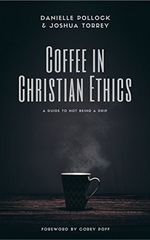
    Coffee in Christian Ethics by Danielle Pollock & Joshua Torrey

    Coffee in Christian EthicsCoffee in Christian Ethics: A Guide to Not Being a Drip

    by Danielle Pollock & Joshua Torrey

    Kindle Edition, 74 pg.
    Torrey Gazette Publishing, 2017

    Read: April 2, 2016


    I know almost nothing about these authors, or their Twitter account of the same name — I bought this because a couple of people I follow on Twitter recommended the book during a pre-order blitz and because it sounded interesting. Score 1 for Social Media Marketing.

    Here’s the official blurb:

    The need for clear communication of God’s grace in the realm of coffee is great. Because we have been forgiven, we are to forgive. Because we have been given this foretaste, we must pass on this foretaste. It is the job of Christian ethics to pass on this small foretaste. If not in coffee quality, then at least through loving our neighbor with our coffee ethics. We must think of others and their coffee consumption before ourselves. We must consider their need for coffee as greater than our own. This requires us to have a thorough understanding of coffee and how to prepare it. We must rethink the importance of coffee in everyday activities as we focus on others.

    Written by Danielle Pollock and Joshua Torrey, Coffee in Christian Ethics is a short introduction to the world of coffee. Filled with bad theology jokes, some snark, and real life stories, the goal of Coffee in Christian Ethics is to encourage Christians to use coffee in the various spheres of life as a way to love our neighbor.

    At least of the introductions or prefaces or other filler at the beginning of the book used the word “satirical” — I think I missed that. Probably too subtle for my bourgeois brain and taste. This is a frequently condescending (although it goes to great pains to say it’s not) guide to coffee — beans, roasting, drinks, accessories, etc. — with a thin layer of Christianish language and application on top. Honestly, given the satirical nature of the work, I wasn’t sure how seriously I was to take that.

    I found the use of “adult language” (to borrow a term from TV/Movie ratings) and casual attitude towards those things “whereby [God] makes himself known” (Third Commandment issues) enough to make me uncomfortable — if not more — to be found in a book on applied Christian Ethics.

    Maybe I just didn’t get it — maybe I’m too dense for the humor, too uptight, too old-fashioned, too whatever. This could be the cleverest thing to come off the press since Fran Lebowitz’ Social Studies, but I just don’t think so. I’m going to give this 2 Stars out of charity and because it made me grin twice (also, some of the information about coffee was helpful) — but I wouldn’t recommend spending time on this one to anyone.

    —–

    2 Stars

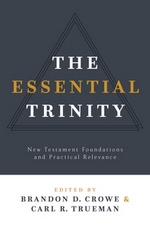
    Pub Day Repost: The Essential Trinity by Brandon D. Crowe and Carl R. Trueman, eds.

    Slightly different Pub Day Repost than I usually do — I usually post something I read an advanced copy of, but this time it’s being published by a different publisher. Still, content is the same, just a new cover, etc. Hopefully, this helps it find a larger audience.

    The Essential Trinity The Essential Trinity: New Testament Foundations and Practical Relevance

    by Brandon D. Crowe and Carl R. Trueman, eds.

    Paperback, 320 pg.
    P&R Publishing, 2017

    Read: July 31 – August 14, 2016

    As far as consistency of quality amongst edited volumes goes, Crowe and Trueman have assembled one of the stronger line-ups I’ve read in a while — men from a spectrum of persuasions of Evangelical-ish thought have given the Church fourteen articles (approximately 20 pages each) to deepen our thinking about the Trinity. The aim was for a volume that “eschews overly technical discussion and focuses attention on the importance of the doctrine for every Christian.”

    In Part 1, the articles look at the “trinitarian contours of every corpus of the New Testament, along with a chapter reflecting on the Old Testament roots of trinitarian doctrine.” If there are weak chapters in the volume, they’re in this part — but they aren’t that weak, either. Crowe’s chapter on Matthew is excellent, but the chapters on the Mark, Luke-Acts and John aren’t far off that Mark. Brian S. Rosner’s chapter on “Paul and the Trinity” is worth the price of the book. The chapters on the rest of the epistles are very helpful (particularity Hebrews). Mark S. Gignilliat’s article, “The Trinity and the Old Testament: real presence or imposition?” is very helpful and insightful — and as an added bonus, it’s the most stylistically entertaining and engaging piece in the book.

    Benjamin Gladd’s chapter exploring Daniel’s influence on Revelation’s view of the Trinity is the biggest mental workout you’ll get in the book. I appreciated the material covered and the argument Gladd makes, but I’m going to have to read it a few more times before I think I have a good handle on it.

    Part 2 addresses the importance of the Trinity for everyday living — many would say the doctrine is impractical and only belongs in Statements of Faith and academia. The authors here show the fallacy of that. It begins with a brief, but excellent, description of the doctrine by Scott R. Swain. Carl Trueman has the next chapter, “The Trinity and prayer,” which is probably as valuable as Rosner’s — it’s actually about more than prayer, but the material specifically on prayer is great — hugely indebted to John Owen (but not uncritically so). Robert Letham’s chapter on “The Trinity and worship” also draws deeply from Owen; if he doesn’t move you to worship as you understand the work of the Trinity in it, you aren’t paying attention (I probably have more problems with some of what he says than anything else in the book). Michael Reeves, typically, made me chuckle in his chapter on preaching — but he did more than that, too.

    Timely, convicting, thoughtful and inspiring, this examination of the Trinity in Scripture and Life should be a great benefit to any believer ho reads it. It may not be the easiest thing read all year (but really, it’s not that difficult), but it’ll be one of the most rewarding.

    —–

    4 Stars

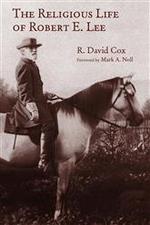
    The Religious Life of Robert E. Lee by R. David Cox

    The Religious Life of Robert E. LeeThe Religious Life of Robert E. Lee

    by R. David Cox
    Series: Library of Religious BiographyPDF (will be published as paperback), 259 pg.
    Wm. B. Eerdmans Publishing Company, 2017
    Read: December 25, 2016 – January 1, 2017

    I feel always as safe in the wilderness as in a crowded city. I know in whose powerful hands I am, & in them rely, & I feel that in all our life we are upheld & sustained by Divine Providence. But that Providence requires us to use the means he has put under our control. He deigns no blessing to idle & inactive wishes, & the only miracle he now exhibits to us, is the power he gives to truth & justice, to work their way in this wicked world.

    So wrote Robert E. Lee in a letter to his wife while serving in Texas, and according to R. David Cox it summarizes his theology. If you have to sum up a man’s theology in 3 sentences, that’s a decent one to have.

    Robert E. Lee was no theologian, he wasn’t a pastor or preacher or religious scholar of any kind. He was a churchman, however. Seemingly a faithful one who served as he could — and he was a believer in the middle of a tumultuous time for American Protestantism and American as a whole, as such what he thought about the tumult from his religious perspective is instructive and fascinating reading. Which is pretty much why anyone might want to read this (and probably why Cox wrote the thing).

    By and large, the book is a chronological look at Lee’s life, what’s going on in the national and ecclesiastical culture, and how Lee (and his family members — particularly his wife) responded to it and how his faith grew throughout his life. It’s not exactly a biography, but it is biographical. There were a couple of chapters that stepped back from the chronological look, and examined Lee’s perspectives on specific topics (the above quotation about providence comes from one of those). I particularly enjoyed and appreciated those.

    I was surprised how little space was devoted to the years of The War Between the States, honestly. It may be that there wasn’t that much material — Lee was probably too busy to write a lot of things in letters that he might normally have (like: thoughts about sermons heard, theology, ecclesiastical concerns, etc.), that’d certain be understandable. Cox might be the one historian who doesn’t like writing about that time period. It might just be that his pre- and post- War writings were better material for the book — there are any number of good reasons for it, I was just surprised that the one thing the man is best known for is so little represented in the book.

    One of the drawbacks of this book is the author’s perspective on Lee himself (at least what came across to me as his perspective, I could have read him wrong, he could have written it in such a way as to be easily misinterpreted, etc.). I’m not saying that I want a hagiography, nor do I want Cox to be some sort of Lee fanboy. A critical eye is essential. There’s an element of Chronological Snobbery (to borrow Lewis’ phrase) here when reflecting on Lee’s racial and political views. I have no problem with Cox disagreeing with them (I disagree with many of them), but he came across as patronizing (at least on the border of it). To a lesser degree, I thought the same about some of Lee’s religious views. But this didn’t crop up often, and when it did, it was easy to gloss over or ignore. It’s a drawback to the book, but not a reason to avoid it. If anything, Cox came across as detached and neutral when it came to the subject and his religion (it was impossible to tell if Cox shared any aspect of belief with Lee) 98% of the time. It’s just that 2% or so . . .

    This is a part of Eerdman’s Library of Religious Biography series — which I hadn’t heard of until now. I have one sitting at the top of my To Be Bought pile (talked about it last month in a Saturday Miscellany post), but I didn’t realize it was part of a series. The books in the series are intended to “link the lives of their subjects – not always thought of as ‘religious’ persons – to the broader cultural contexts and religious issues that surrounded them.” It’s a fascinating concept, and I’m glad this series exists. I hope to get more of them soon.

    This was a fascinating read, if a bit dry and detached. Neither’s bad, and may be commendable under the right circumstances (which may include such a divisive figure as Lee), but it doesn’t make for the best read. That, plus my ambivalence towards some of Cox’s attitudes toward the subject, makes me rate this 3 Stars. That’s still a recommendation, and I’ll gladly tell anyone to read it — believer or nonbeliever — if they want to understand Lee better, but I’m not that enthusiastic about the book.

    Disclaimer: I received this eARC from Wm. B. Eerdmans Publishing Company via NetGalley in exchange for this post — thanks to both for this opportunity.
    N.B.: As this was an ARC, any quotations above may be changed in the published work — I will endeavor to verify them as soon as possible.

    —–
    3 Stars

    No Uncertain Sound: Reformed Doctrine and Life by Reformed Forum

    No Uncertain SoundNo Uncertain Sound: Reformed Doctrine and Life

    by Reformed Forum

    Kindle Edition, 102 pg.
    Reformed Forum, 2017

    Read: March 26, 2017


    I’ve been listening to podcasts from Reformed Forum for years now — not as long as I should’ve, no doubt, but for quite awhile — and their guests, discussions and related materials have provided a lot of fodder for my reading lists (both accomplished and planned). So I was excited to hear that they were taking their first steps into book production, not just promotion. Their first book, No Uncertain Sound: Reformed Doctrine and Life is a collection of essays attempting to “set forth the salient features of [their] Reformed identity” and “facilitate the spread of” the gospel. It’s definitely a winner regarding the former, and in the right hands, will help the latter.

    Following a brief history of the Reformed Forum, there are six essays from regular contributors to the podcasts, conferences and website sponsored by the Forum. Lane G. Tipton writes about the Redemptive-Historical approach to the Scriptures, focusing on Jesus in the Old Testament’s progressive revelation of the Messiah — this essay also provides some critical interaction with Peter Enns as an added bonus. Camden M. Bucey, writes about the need for theology (professional or personal) to be both Biblical (as in Vosian) and Systematic — an approach I applaud and wish I saw more of. Jeffrey C. Waddington addresses the doctrine of has a great essay on union with Christ and the ordo salutis. Glen J. Clary writes about worship and our need to approach it correctly. James J. Cassidy’s ecclesiastical essay is very helpful and probably not what most people expect from the idea of an essay on ecclesiology. Waddington closes the book with an essay on Reformed apologetics — what’s known as Van Tillian presuppositionalism, or Covenant Apologetics.

    All the essays are thought-provoking, and will help those new to thinking in these terms as well as those who’ve been down the path a time or two. At the end of each essay is a listing of podcasts/lectures from the Reformed Forum archives so readers can dive deeper into the topics — a great, and very useful tool. For myself, the essays on the Christ in the Old Testament, Union with Christ and Worship were the more profitable in the collection, but I can easily see where other readers will gain more from the others.

    The suggested reading list is great — I’m not 100% convinced that I agree with the levels they assigned to some of the works (some are easier than they suggest, others more difficult). But a great list to have on hand without having to go dig around the website to find it.

    This is in many ways an advertisement for their podcasts and website — and it’s good at that. But it is more — thankfully. There’s a lot of meat on these bones for people to chew on — whether they’re regular listeners/readers of the Forum’s output or not. Yes, the material basic, but it’s foundational — both for one’s understanding of what Reformed Forum is about, but for establishing an understanding of Confessional Reformed thought in the Twenty-First Century. This is a good first step into the world of books for Reformed Forum, and I look forward to seeing what they do next.

    —–

    4 Stars

    No Little Women by Aimee Byrd

    No Little WomenNo Little Women: Equipping All Women in the Household of God

    by Aimee Byrd
    Paperback, 278 pg.
    P&R Publishing, 2016

    Read: February 12, 2017

    This book is — by and large — an examination and critique of contemporary Women’s Ministries, and the materials marketed towards women in a Christian context. Byrd doesn’t call for an abolition of Women’s Ministries — but does want to encourage women and the churches that they’re members of to evaluate these with a greater level of discernment, for churches to work at cultivating and equipping female members the same way they seek to for the males in the congregation.

    Byrd examines the warnings Paul gives about those seeking to deceive and lead away women — and the impact that would have on the churches of the First Century (and today!) when they succeeded in drawing away women from the truth. Why does Paul focus on women in this context? Should pastors today do the same? Which leads to a discussion of the proper means and motives for educating the females in a congregation, and the roles that women (and laymen) should have in the ministry of the Church.

    Byrd discusses (and critiques) the contemporary concept “ministries” of the Church in contrast to The Ministry of Word and Sacrament. And in that light, examines the role of “Women’s Ministries” (even if she finds the term problematic, it’s what everyone uses, so her discussion needs to use the term) in the Church today. So much goes on in even conservative, confessional churches under the umbrella of Women’s Ministry that diverges from — even flat-out contradicts — the teachings from the pulpits. How did we get to this point, and how does the Church respond to this in ways that will lead us all to maturity without causing harm and disunity in a local congregation?

    Byrd doesn’t claim to have all the answers here, but she has some good places to start. One of the biggest ways is to improve the level of involvement from Church Leadership in the Women’s Ministries/Initiatives. Another is to improve discernment in women when it comes to dealing with books/teachings marketed toward them. Byrd devotes a chapter to citing problematic (and worse!) passages in popular books targeted to the Christian Woman Non-Fiction audience, with questions that discerning (or would-be discerning) readers should be asking. She even includes questions that people should be asking about No Little Women!

    It should be noted — and stressed — that nowhere does Byrd argue for a change in the Church’s teaching on male/female relationships and roles, female ordination, or anything along those lines — she does argue that we might not be the best at applying those teachings right now.

    What makes this book poignant is Byrd’s repeated call — maybe pleading would be a better way of putting it — for Church Officers (Pastors, Elders) to pay attention to the theological and spiritual development and education of the women in their congregations (and the never stated, but obvious, indictment of the all-too-frequent abandonment of their call in this regard). Yes, when it comes to the official and regular Ministry of Word and Sacrament, these officers are doing their duty — but when it comes to the books (and other materials) marketed towards them, the studies they use, the “Women’s Ministries,” etc. — all too often, it’s ignored. Byrd asks for Shepherds and Leaders to step up and help the women in their congregations — and even gives some tips for how they can effectively relate to these oft-neglected parishioners. Do I think most of the men she’s addressing here think they’re ignoring any part their flocks? No (and I doubt Byrd does either), but they sure appear to be.

    A quick digression: At one point, Byrd cites statistics saying that Women buy 72% of the Christian Fiction sold and 59% of the Christian Non-Fiction, and another survey stating that Women read twice as much Christian Non-Fiction as men. Seriously? This is rather disheartening. What do Christian men read? Are we (on the whole) an illiterate group? This blog isn’t the proper setting for this question — and I’m sure not the one to answer it, but I hope someone takes this up (Sinclair Ferguson helps to remedy the problem in this small [and 15-year-old] booklet).

    Byrd writes in her typical straight-forward manner, in a prose that’s smooth and easy to read. Despite challenging her readers, she never comes across and condemnatory or anything but encouraging. There’s a call to action (sometimes implicit, frequently explicit), but consistently done in a positive manner. Byrd’s seeking to improve how the Church — women, pastors/elders, and laymen — carries out Her mission, not to tear down.

    Ultimately, I’m not one of the main target audiences — women and Church Officers — so I had a hard(er) time really getting into sections of this book than I’d like. But as a husband, father of a daughter, and layman concerned with the theological education of his fellow laity — a lot of this book was alarming, yet encouraging. Someone’s taking this seriously — and hopefully she’s raising enough awareness that others will follow suit. You don’t have to be a feminist or ecclesiological revolutionary to be concerned with the state of theological training of Christian women (and everything she says about Women goes for our teens and children) — it’s a matter for all laity to take up. This is as close to a must-read as I can think of.

    —–

    4 Stars

    God’s Word Alone: The Authority of Scripture by Matthew Barrett

    God's Word AloneGod’s Word Alone—The Authority of Scripture: What the Reformers Taught…and Why It Still Matters

    by Matthew Barrett
    Series: The 5 Solas Series

    Paperback, 374 pg.
    Zondervan, 2016
    Read: January 8 – 22, 2016

    For this installment in The 5 Solas Series focuses on the material principle of the Reformation, Sola Scriptura. Despite being almost 200 pages longer than VanDrunen’s entry in this series (the benefit of being the series editor is that you get more space?), this book is too short for what it tries to accomplish. Which is really the long way around for me to say that this book tries to do too much — and ends up giving shallow presentations to things that deserve more.

    Part 1 is an exploration of the understanding of — and challenges to — Biblical Authority around the time of the Reformation and through history since then. While Barrett gives a strong and competent explanation of these themes, I couldn’t help feeling that I’ve read them before — frequently — by other authors.

    Part 2, an exploration of the doctrine of Scripture/The Word of God throughout Redemptive History, I thought was very promising. This could be the backbone of a very compelling study, and I hope someone takes Barrett’s work here and builds on, expands and deepens it (if someone has already written this book — please tell me!). It’s probably here most of all, that I noticed how much space forced Barrett to stick to the surface of this subject rather than exploring it in the depth it asks for.

    Part 3 was a more polemical/apologetic focus — discussing challenges to the Authority of God’s Word. This was probably the strongest part of the book — in particular, I thought his chapter on Innerrancy was pure gold. Nothing new or particularly insightful was offered in this section, but there seemed to be a bit more passion, a bit more energy to this Part.

    This is the second in The 5 Solas Series that I’ve read, and the second that I was underwhelmed by. It’s good, but does little to commend it above many other titles on the subject. Barrett knows the subject, explains it well, but doesn’t inspire the reader to anything. I don’t mean to suggest by my frequent notes that “there was nothing new” that I need novelty — I prefer a lack of novelty to my theology. But I do want something about a book to stand out in the way it discusses things before I can really get excited about/impressed with a book.

    —–

    3 Stars

    The Religious Life of Robert E. Lee by R. David Cox

    The Religious Life of Robert E. LeeThe Religious Life of Robert E. Lee

    by R. David Cox
    Series: Library of Religious Biography

    PDF (will be published as paperback), 259 pg.
    Wm. B. Eerdmans Publishing Company, 2017

    Read: December 25, 2016 – January 1, 2017

    I feel always as safe in the wilderness as in a crowded city. I know in whose powerful hands I am, & in them rely, & I feel that in all our life we are upheld & sustained by Divine Providence. But that Providence requires us to use the means he has put under our control. He deigns no blessing to idle & inactive wishes, & the only miracle he now exhibits to us, is the power he gives to truth & justice, to work their way in this wicked world.

    So wrote Robert E. Lee in a letter to his wife while serving in Texas, and according to R. David Cox it summarizes his theology. If you have to sum up a man’s theology in 3 sentences, that’s a decent one to have.

    Robert E. Lee was no theologian, he wasn’t a pastor or preacher or religious scholar of any kind. He was a churchman, however. Seemingly a faithful one who served as he could — and he was a believer in the middle of a tumultuous time for American Protestantism and American as a whole, as such what he thought about the tumult from his religious perspective is instructive and fascinating reading. Which is pretty much why anyone might want to read this (and probably why Cox wrote the thing).

    By and large, the book is a chronological look at Lee’s life, what’s going on in the national and ecclesiastical culture, and how Lee (and his family members — particularly his wife) responded to it and how his faith grew throughout his life. It’s not exactly a biography, but it is biographical. There were a couple of chapters that stepped back from the chronological look, and examined Lee’s perspectives on specific topics (the above quotation about providence comes from one of those). I particularly enjoyed and appreciated those.

    I was surprised how little space was devoted to the years of The War Between the States, honestly. It may be that there wasn’t that much material — Lee was probably too busy to write a lot of things in letters that he might normally have (like: thoughts about sermons heard, theology, ecclesiastical concerns, etc.), that’d certain be understandable. Cox might be the one historian who doesn’t like writing about that time period. It might just be that his pre- and post- War writings were better material for the book — there are any number of good reasons for it, I was just surprised that the one thing the man is best known for is so little represented in the book.

    One of the drawbacks of this book is the author’s perspective on Lee himself (at least what came across to me as his perspective, I could have read him wrong, he could have written it in such a way as to be easily misinterpreted, etc.). I’m not saying that I want a hagiography, nor do I want Cox to be some sort of Lee fanboy. A critical eye is essential. There’s an element of Chronological Snobbery (to borrow Lewis’ phrase) here when reflecting on Lee’s racial and political views. I have no problem with Cox disagreeing with them (I disagree with many of them), but he came across as patronizing (at least on the border of it). To a lesser degree, I thought the same about some of Lee’s religious views. But this didn’t crop up often, and when it did, it was easy to gloss over or ignore. It’s a drawback to the book, but not a reason to avoid it. If anything, Cox came across as detached and neutral when it came to the subject and his religion (it was impossible to tell if Cox shared any aspect of belief with Lee) 98% of the time. It’s just that 2% or so . . .

    This is a part of Eerdman’s Library of Religious Biography series — which I hadn’t heard of until now. I have one sitting at the top of my To Be Bought pile (talked about it last month in a Saturday Miscellany post), but I didn’t realize it was part of a series. The books in the series are intended to “link the lives of their subjects – not always thought of as ‘religious’ persons – to the broader cultural contexts and religious issues that surrounded them.” It’s a fascinating concept, and I’m glad this series exists. I hope to get more of them soon.

    This was a fascinating read, if a bit dry and detached. Neither’s bad, and may be commendable under the right circumstances (which may include such a divisive figure as Lee), but it doesn’t make for the best read. That, plus my ambivalence towards some of Cox’s attitudes toward the subject, makes me rate this 3 Stars. That’s still a recommendation, and I’ll gladly tell anyone to read it — believer or nonbeliever — if they want to understand Lee better, but I’m not that enthusiastic about the book.

    Disclaimer: I received this eARC from Wm. B. Eerdmans Publishing Company via NetGalley in exchange for this post — thanks to both for this opportunity.
    N.B.: As this was an ARC, any quotations above may be changed in the published work — I will endeavor to verify them as soon as possible.

    —–

    3 Stars

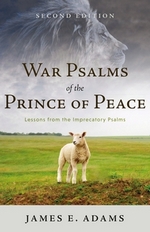
    War Psalms of the Prince of Peace (2nd. Edition) by James E. Adams

    War Psalms of the Prince of PeaceWar Psalms of the Prince of Peace: Lessons from the Imprecatory Psalms, Second Edition

    by James E. Adams

    eARC, 176 pg.
    P & R Publishing, 2016

    Read: December 18, 2016


    This is the 25th Anniversary Edition of the book — revised and expanded, no less. I was so glad to get the opportunity to read this one — I’ve got a copy of the original edition, which I’ve read 3 or 4 times, and referred to often. So to get to read a new edition — and to have an excuse to revisit the book — I had to jump at the chance.

    Adams begins by reassuring Twentieth Century Christians (and I assume those of us in the Twenty-First Century, too) that the Imprecatory Psalms do belong in Scripture, are just as inspired as the rest, and have a place in the life and piety of his readers. Imprecatory Psalms, I should probably mention, are those Psalms that call for the destruction or judgment of the psalmist’s enemies. From there, Adams argues that no only do they belong in our Bibles, but (like the other Psalms) they belong in Christ’s mouth. To prove this, he compares the Imprecatory Psalms to the Psalms of Repentance — if Jesus Christ can say/sing the latter properly, then it’s fitting for him to sing/pray the former. I’m not positive that’s the best argument he could make, but I tell you, Adams makes it work (it helps that he spent far more space than I just did).

    Given that they’re part of the Bible, and that if they’re fitting to be used by Christ, then they have a place in the life of the New Testament saint — but what is that place? How are we to use them? Do we get to call down the wrath of God on our enemies? (Short answer: NO).

    This here is the heart of the book, and where Adams is at his best. Yes, we are to pray these prayers, sing these psalms —

    You may say, “This is the last thing my church needs! If our hearts are too lazy and cold to pray for those we love, how can we think of praying for enemies, as we find in the Psalms?” But I would challenge you, isn’t this the cause of our lack of prayer? We have not learned from the Lord Jesus how to pray!

    Learning to pray these psalms is a theme he returns to time and again —

    Without assistance how can we ever righteously pray this prayer? I answer this question unequivocally: We never can! We cannot pray this prayer on our own . . . not because we are too good, but rather because we are too prone to evil! Yet we must learn to pray it.

    But why are we to pray these prayers?

    Why are we taught to pray for God’s judgment on the enemy? So that they will be converted! Nothing could be clearer from this prayer [Ps. 83].

    That’s the core of the book, right there — I’ll let you read his explanation, but that’s the ballgame.

    On the whole, I can’t tell you what was revised, nor can I say exactly how it was expanded — and there’s just no way I’m going to break out my original and read them in parallel to give you the list. What this primarily tells me is that what he did to improve the book came in fairly seamlessly. So I’m guessing that means we’re talking about minor tweaks and clarifications — no major new sections or anything. Would I have preferred a new chapter or two? Some more in-depth explorations of particular psalms? Yes. But the book didn’t need a new chapter or two, and it wasn’t intended to be that narrow in focus, so that kind of material would’ve felt out of place.

    This is an easy read — clear, crisp writing that is deep enough to make you think, but written in a way that you don’t notice that you’re dealing with weighty theology. Adams writes with conviction, passion, and care – which is always helpful but particularly so with a topic like this. You don’t want a dry dissertation here, you need heart to go with the thinking. There’s a sensitivity here, which is needed, but more than anything a desire to treat the Bible (and the Spirit who inspired it) as it ought to be.

    This is a gem — it was a gem 25 years ago when it was published, and it’s a gem today.

    Disclaimer: I received this eARC from P & R Publishing via NetGalley in exchange for this post — thanks to both for this.
    N.B.: As this was an ARC, any quotations above may be changed in the published work — I will endeavor to verify them as soon as possible.

    —–
    4 Stars

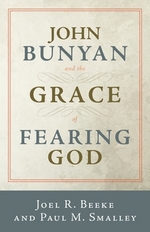
    John Bunyan and the Grace of Fearing God by Joel R. Beeke and Paul M. Smalley

    John Bunyan and the Grace of Fearing GodJohn Bunyan and the Grace of Fearing God

    by Joel R. Beeke, Paul M. Smalley

    eARC, 160 pg.
    P & R Publishing, 2016

    Read: October 2 – 9, 2016


    This brief book is a look at the life — spiritual and natural — of John Bunyan and his understanding of the fear of the Lord as traced through his writings.

    I’ll be the first to admit that I have only the most basic understanding of Bunyan beyond The Pilgrim’s Progress and that quotation from John Owen about his preaching (only cited twice in this book), so I can’t judge the scholarship of Beeke and Smalley when it comes to that. I can say that I thought their approach to both the man and the material could’ve been deeper. The brief biographical material did everything it needed to — it wasn’t too long and it covered the bases, giving an understanding of what he went through and his historical context.

    After the biographical section, the authors turn to the Fear of God, and soon lay out this distinction:

    …Bunyan deduced that God forbids some fear as ungodly, but commends another kind of fear. This distinction proves to be crucial for Bunyan’s theology, allowing him to differentiate unhealthy, sinful fear from the spiritually sound and fruitful fear of the Lord.

    They examine the ungodly fear some more and then look at various spiritually sound fears — and the ways that is can promote growth in holiness and perseverance.

    A lot of this material was helpful — I’m not sure if it was because of the way that Beeke and Smalley compiled it or Bunyan’s insights that helped me the most, but I don’t think I understood any of the ideas the way I wanted to. Yes, the authors would point me at Bunyan and the Bible as a resource, but I think they could’ve helped me more.

    I thought the evangelical appeal at the end of the book a little out of place — it didn’t seem to fit the intentions or voice of the book up to that point — and I can’t imagine that anyone who isn’t a convert reading this book. I hope I’m wrong and that this is an effective tool, I should stress — but it seemed inorganic.

    This isn’t a bad book, it’s just a slight one. It’s too much of a survey, not an examination or an explanation. There’s no depth to the look at Bunyan, while there certainly appears to be breadth. I might have walked away with a better understanding of what kinds of things Bunyan wrote and when — but I don’t think it furthered my understanding of the man or his writing beyond that. If the authors had given use another 100 – 150 pages and I think I’d be writing something very positive.

    Disclaimer: I received this eARC from P&R Publishing via NetGalley in exchange for this post — thanks to both for this.
    N.B.: As this was an ARC, any quotations above may be changed in the published work — I will endeavor to verify them as soon as possible.

    —–

    3 Stars

    Page 14 of 16

    Powered by WordPress & Theme by Anders Norén