Tag: Christian Living Page 15 of 16

Prophet, Priest, and King by Richard P. Belcher, Jr.

Prophet, Priest, and KingProphet, Priest, and King: The Roles of Christ in the Bible and Our Roles Today

by Richard P. Belcher, Jr.

eARC, 224 pg.
P&R Publishing, 2016

Read: September 11 – 25, 2016

Throughout Church History, however varying in degree, theologians have focuses on the offices of Jesus Christ as Prophet, Priest and King. The present is probably one of those period that doesn’t emphasize them too much — at least, not the Prophet and King (even as Presbyterian and Reformed children recite them in their catechisms). It’s probably time for us to take another look at them in detail. This is Belcher’s aim, at least. As he says,

This book will address the work of Christ in light of the roles of Prophet, Priest, and King and will then draw out implications for the church.

(I’d originally spent 2 or 3 sentences saying that, when I spotted it in his opening paragraphs — always go with pithy).

That’s pretty much the book, after the introductory chapter, setting the stage, Belcher examines each office in turn, a chapter on the Old Testament definition, history and development of the office, followed by a chapter on Christ’s fulfillment of the office during his estate of humiliation, and then in his estate of exaltation.

A redemptive-historical approach— emphasizing Christ’s fulfillment of the Old Testament —naturally lends itself to connecting with the roles, not just for Christ but also for his body, the church. This approach also has implications for preaching Christ from the Old Testament.

The examinations of the offices are very thorough, but probably not exhaustive (although they sure seem exhaustive) — I’m not sure I learned a whole lot during these chapters, but I do think that reflecting on the offices in this manner has helped me understand them more and in a deeper way as leading to Christ. 

There are study questions at the end of each chapter that are a handy means of reviewing, but don’t encourage much further study and thought. But I can see where they’d be useful for a class or discussion group.

While examining the Old Testament office of King, Belcher Mention digresses for a while to examine the question “Is there a Royal Priesthood in Israel?” What does the OT mean when it talks about Kings offering sacrifices, if that’s the role of the priest. I’d wondered idly about that a time or two, but hadn’t realized how complex the question can be.

In the nation of Israel the roles of prophet, priest, and king are basically kept separate to define their meanings. But it is significant that these roles come together in both the description of Adam and Eve and the description of Israel’s mission. Thus it makes sense that the Old Testament would begin to describe the coming future ruler as carrying out the combined roles (Ps. 110; Zech. 6: 11–13). 26 These are fulfilled in Christ, who is Prophet, Priest, and King during his earthly ministry. He fulfills them in his work of salvation and continues in these roles on behalf of his people in his ascension. The work of Christ lays the basis for restoring these roles to human beings in their service to God, to the church, and to the world.

Therefore, the final chapter looks at how The Church can fulfill her mission via these roles. I found this chapter fascinating — easily the best in the book. It, too, is not exhaustive, but merely outlines the ways The Church (as a whole and as individuals) can function. I wish almost everything in this chapter had been more developed and explored.

This is sound, solid, careful writing. Sure, it could use some personality — but it doesn’t need it. It’s just not that engaging — but for those interested in the topic (or see a need to develop that interest), this is a good investment of time. For a careful examination of something too often ignored, this is a worthy read.

Disclaimer: I received this eARC from P&R Publishing via NetGalley in exchange for this post — thanks to both for this.
N.B.: As this was an ARC, any quotations above may be changed in the published work — I will endeavor to verify them as soon as possible.

—–

3.5 Stars

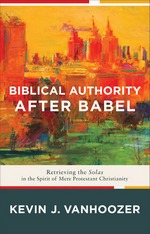
Biblical Authority after Babel by Kevin J. Vanhoozer

Biblical Authority after BabelBiblical Authority after Babel: Retrieving the Solas in the Spirit of Mere Protestant Christianity

by Kevin J. Vanhoozer

eARC, 288 pg.
Brazos Press, 2016

Read: August 21 – September 4, 2016


With the 500th Anniversary of the Protestant Reformation’s accidental start coming up next year, we’ll be seeing a lot of books celebrating and/or critiquing the movement (more than usual, that is). This is one of the former, but done mostly in the way of a defense against some of the most common critiques. There’s a very real sense in which I’m not qualified to discuss this book — and I’m really looking forward to reading reviews from those who are. But, there’s another sense in which I am — I’m a Christian, I like to read and think about these issues, and VanHoozer wrote a book about them, so, you know — I might as well blather on about it some.

In the Introduction, Vanhoozer rehearses some of the more common critiques of Protestantism, mostly relying on those talking about the lack of organizational unity and those that relate that level of disunity to the doctrine of Sola Scriptura:

One adjective seems custom-made to describe the unintended consequence of the Reformation. It is a word that I never come across except in the descriptions or criticisms of Protestantism: “fissiparous”—“inclined to cause or undergo division into separate parts of groups,” from the Latin fissus, past participle of findere (to split; cf . “fissure” ).

In much of the introduction, he seems to buy into the conventional wisdom/stereotypes of Protestantism/what Protestantism teaches — including a weird reading of the Ann Hutchison case — using too many scattered quotations out of context from various authorities to build the case.

To respond to the fissiparousness of Protestantism (which he does lament), Vanhoozer uses the “Solas” of the Reformation to show why the problem isn’t inherent in Protestantism’s principles — the examination of the Solas (rooted in Sola Gratia) provides the framework for the rest of the book and his apologetic. I really appreciated this way of framing his argument, and think I need to work on doing that myself.

Throughout this work, Vanhoozer

will be arguing not for the superiority of [his] own Reformed tribe but for “mere Protestant Christianity.” This refers neither to a lost “golden age” nor to a particular cultural instantiation of Protestantism, but rather to a set of seminal insights —- encapsulated by the five solas — that represent a standing challenge, and encouragement, to the church.

While I have some concerns of the “Mere Christianity” and “Mere Orthodoxy” approaches that are gaining popularity in some circles, I can’t fault this. Sure, he’d be able to make a stronger case if he did argue for the superiority of Reformed thinking (if you ask me), but given the arguments he’s responding to it makes sense to adopt this approach.

As he looks at each Sola, he begins by examining what the Reformers meant by the phrase (too frequently different from what their heirs mean by the phrase). He then looks at competing views (historical and contemporary — with an emphasis on the contemporary), focusing each discussion on the doctrine’s relationship to Bible, Church and Authority. He starts with Grace Alone, moves on to Faith Alone, Scripture Alone, then In Christ Alone and finishing with For the Glory of God Alone. The latter part begins with a look at “The Lord’s Supper as a Test of Christian Unity.” Even the most ardent Protestant would have to admit that this is where the Reformers stumbled most — when Luther and the Reformed couldn’t come to an acceptable consensus on the meaning and nature of this Sacrament, our fissiparousness became most evident and quite possibly firmly established as a mark of Protestantism. For my money, everything else comes as a result of this failure — so for VanHoozer to focus on it at this point, really resonated with the reading/studies I’ve been doing lately. Sure, it’s not that novel an approach, but as a reader, when an author seems to be on the same page, it draws you in.

I do think some of the more technical arguments he makes get a little too creative, maybe too focused on innovation and novelty — but I’m pretty cautious when it comes to this stuff. So again, I’m looking forward to seeing what others make of this.

This isn’t an academic work, but it’ll appeal most to the academically-inclined (whether by occupation or temperament/interest). Lay people shouldn’t be put off by it, but it will be a challenge at times. Frequently, he’s deceptively easy to read — you’ll be chuckling at some remark, smiling at a bit of whimsy, and miss the fact that he’s left the shallow end of the pool for something deep and thoughtful. Re-reading paragraphs and sections is highly recommended.

Vanhoozer writes with a very engaging style, some great metaphors and imagery. One paragraph I picked while reading to try to explain this to my wife went like this: It began with some historical notes; then made references to Philip Schaff, John Nevins, and John Calvin; moved on to a quote by Augustine; and ended with a line from a line from Lewis’ The Last Battle (one that elicited a grin in addition to sealing his point). Yes, sometimes he lets that creativity run away from him — okay, he does that often (my notes are filled with that observation). I found myself frequently giving mental fist pumps to something he said and then almost immediately holding up a palm to say, “slow down!” On more than one occasion, I wondered if I was being charmed by his writing more than being convinced by it. I don’t think so, ultimately, but it’s something to be aware of.

One last note that I won’t develop because it was a slight digression for him at one point, but I really appreciated his discussion of Biblical vs. Systematic theology. It was a creative way to frame the discussion, and a helpful one at that.

On the whole, I might have cringed at or questioned his thinking, some of the details of his arguments, but typically I thought his conclusions were spot on. Which probably says more about me than him. There’s a few area to be cautious of here, but largely this is an encouraging, well-constructed, challenging and encouraging read. For those ready to gird up their minds, I’d strongly encourage picking this up. This was my first encounter with Vanhoozer outside the occasional footnote in someone else’s work — I don’t think it’ll be my last.

Disclaimer: I received this eARC from Brazos Press via NetGalley in exchange for this post — thanks to both for this.
N.B.: As this was an ARC, any quotations above may be changed in the published work — I will endeavor to verify them as soon as possible.

—–
4 Stars

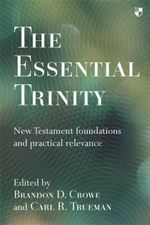
The Essential Trinity by Brandon D. Crowe and Carl R. Trueman, eds.

The Essential Trinity The Essential Trinity: New Testament Foundations and Practical Relevance

by Brandon D. Crowe and Carl R. Trueman, eds.

Paperback, 273 pg.
Inter-Varsity Press, 2016

Read: July 31 – August 14, 2016

As far as consistency of quality amongst edited volumes goes, Crowe and Trueman have assembled one of the stronger line-ups I’ve read in a while — men from a spectrum of persuasions of Evangelical-ish thought have given the Church fourteen articles (approximately 20 pages each) to deepen our thinking about the Trinity. The aim was for a volume that “eschews overly technical discussion and focuses attention on the importance of the doctrine for every Christian.”

In Part 1, the articles look at the “trinitarian contours of every corpus of the New Testament, along with a chapter reflecting on the Old Testament roots of trinitarian doctrine.” If there are weak chapters in the volume, they’re in this part — but they aren’t that weak, either. Crowe’s chapter on Matthew is excellent, but the chapters on the Mark, Luke-Acts and John aren’t far off that Mark. Brian S. Rosner’s chapter on “Paul and the Trinity” is worth the price of the book. The chapters on the rest of the epistles are very helpful (particularity Hebrews). Mark S. Gignilliat’s article, “The Trinity and the Old Testament: real presence or imposition?” is very helpful and insightful — and as an added bonus, it’s the most stylistically entertaining and engaging piece in the book.

Benjamin Gladd’s chapter exploring Daniel’s influence on Revelation’s view of the Trinity is the biggest mental workout you’ll get in the book. I appreciated the material covered and the argument Gladd makes, but I’m going to have to read it a few more times before I think I have a good handle on it.

Part 2 addresses the importance of the Trinity for everyday living — many would say the doctrine is impractical and only belongs in Statements of Faith and academia. The authors here show the fallacy of that. It begins with a brief, but excellent, description of the doctrine by Scott R. Swain. Carl Trueman has the next chapter, “The Trinity and prayer,” which is probably as valuable as Rosner’s — it’s actually about more than prayer, but the material specifically on prayer is great — hugely indebted to John Owen (but not uncritically so). Robert Letham’s chapter on “The Trinity and worship” also draws deeply from Owen; if he doesn’t move you to worship as you understand the work of the Trinity in it, you aren’t paying attention (I probably have more problems with some of what he says than anything else in the book). Michael Reeves, typically, made me chuckle in his chapter on preaching — but he did more than that, too.

Timely, convicting, thoughtful and inspiring, this examination of the Trinity in Scripture and Life should be a great benefit to any believer ho reads it. It may not be the easiest thing read all year (but really, it’s not that difficult), but it’ll be one of the most rewarding.

—–

4 Stars

One of the Few by Jason B. Ladd

One of the Few One of the Few: A Marine Fighter Pilot’s Reconnaissance of the Christian Worldview

by Jason B. Ladd
Kindle Edition, 318 pg.
Boone Shepherd, 2015

Read: June 10-17, 2016


Jason Ladd served as a Marine pilot and is a father and husband. In his early adulthood, he became a Christian. This book talks about the process he went through to become all of the above, and what he thinks and believes about Christianity. This is an interesting approach to a book — it’s mostly a collection of autobiographical anecdotes from childhood through adulthood, with a focus on his military training and service. These anecdotes are then used to illustrate spiritual insights/teachings/beliefs of the author. The earlier portions of the book are more obviously connected — a clear storyline can be seen.

I’m only saying this because Ladd told me that his book was “especially relevant to Reformed Protestant Theology Nerds.” But the theology in this thing is a mess, there isn’t a coherent Christian Worldview put forth in this book — there are portions of Christian(ish) Worldviews, but not one. And if there’s a Reformed Protestant view mentioned here, I missed it. I’m not saying that Ladd’s not a Christian, or that he doesn’t have a coherent Worldview, but he didn’t do a great job of displaying that Worldview in these pages — instead, we get a little bit of this, a little bit of that, and a dash of something else. If this was the kind of blog that critiqued theologically oriented works, my critique of Chapter 12 (for example) would be at least three times as long as his chapter. I think we’re all relieved that this isn’t that kind of blog.

The later in the book we go, the less the organization makes sense to me — clearly Ladd had an organization in mind, I just didn’t see it. He kept saying “Now it’s time to talk about ____.” What made it time to do so is beyond me, there was rarely an obvious link between topics when he said that. It doesn’t take away from the worth of the material, but the scatter-shot approach makes it hard to follow.

I recommend this with reservations — and have actually recommended it to a couple of people who I thought would appreciate it more than I did — the writing is crisp, the autobiographical/military training anecdotes are well-written and interesting, the theology needs a lot of work, but isn’t wholly without merit. If you like the concept, you’ll probably find it worth your time.

Disclaimer: I received this book from the author in exchange for my honest thoughts about it. I thank him for his patience — this is horribly overdue.

—–

3 Stars

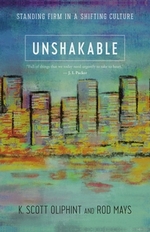
Unshakable by K. Scott Oliphint and Rod Mays

UnshakableUnshakable: Standing Firm in a Shifting Culture

by K. Scott Oliphint and Rod Mays

eARC, 160 pg.
P & R Publishing, 2016
Read: June 12, 2016

In the preface, after a brief sketch of Newton’s life and his career as a hymn-writer, the authors talk about how they’re going to use one of his hymns as a framework for their discussions. Because older hymns help us remember that we’re not the first believers to have to deal with certain aspects of life — and they help us remember those things that are important and distinguish them from those that are fleeting. Now, why of all the Newton hymns one could choose, they picked “Glorious Things of Thee are Spoken,” I don’t know. I looked, and realize I may have missed their explanation (and will feel pretty embarrassed when it’s pointed out to me). I don’t think it’s a bad choice, I just don’t understand why this one.

Don’t get me wrong, this is not an interpretation of or meditation upon Newton’s words. But each chapter draws on the themes of the verses of the song, and shows some of the ways you could talk about those issues and themes today. I guess you could label this an application of Newton.

Thanks to the framework of the hymn, the book covers a range of issues – the foundation of knowledge/understanding, the nature of authority, technology’s effect on our thinking, cutting, God’s promises, sin — and from time to time, I stopped reading and wondered how they started at X and ended up at Y, but the transitions were all so seamless that the text flowed easily from one to the other — and honestly, it turns out that X was related to Y, after all. Not only do they address a wide range of topics, they do so using the whole of Scripture, so you get a range of Biblical perspectives.

The authors use illustrations that should be familiar to many — you don’t have to be steeped in Evangelicalism to follow their arguments — A Christmas Carol, Neil Postman, Shakespeare, The Man Who Wasn’t There, for example. Chapter 4’s discussion of redemption begins with an extended look at a portion of Lewis’ The Lion, the Witch, and the Wardrobe. I’m not sure I needed the close reading of the White Witch’s plot to kill Aslan in exchange of Edmund, I’m not sure anyone over the age of 6 needs it to see how it applies to Christian redemption. But that’s a minor complaint.

It is really a deceptively easy read. The prose is smooth enough that you can get through the text without noticing the deep thoughts you’re encountering. I remember looking down and wondering how I could be 25% with a Oliphint book so quickly. It has to be Mays’ influence.* But when you read closely (as you really ought), Mays and Oliphint are dealing with important topics that everyone needs to think about, and they don’t do so in a cavalier or surface-level manner. An easy-to-read manner, yes, but not surface-y.

I even liked the discussion questions – I almost never like them and wonder why authors/publishers bother. But, these were helpful and I think would be great fodder for discussion groups.

Unshakable is a very useful, thought-provoking work that’s pretty accessible for a wide-ranging of readers: believer, unbeliever, student, older-than-typical student. I heartily recommend it.

Disclaimer: In exchange for my honest thoughts, I received this book via NetGalley and P&R Publishing. Thanks very much!

*that’s not a criticism of Oliphint, just underlining how easy a read it was. My only criticism of Oliphint’s work is that there are so few of them.

—–

3.5 Stars

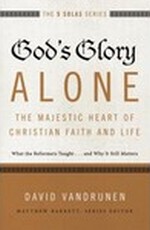
God’s Glory Alone—The Majestic Heart of Christian Faith and Life by David VanDrunen

God's Glory Alone—The Majestic Heart of Christian Faith and LifeGod’s Glory Alone—The Majestic Heart of Christian Faith and Life: What the Reformers Taught…and Why It Still Matters

by David VanDrunen
Series: The 5 Solas Series

Paperback, 171 pg.
Zondervan, 2015
Read: March 6, 2016


VanDrunen begins by discussing the Reformers’ emphasis on the Glory of God and the way that impacted the movement, its concerns, goals and means. I don’t recall being struck by any particular insights here, but it was a pretty worthwhile overview.

The strongest section was Part 2, where VanDrunen considered the Biblical teachings on God’s glory. How God’s glory was manifested in the cloud during the Exodus and following, then how the Incarnation of the Son displayed His glory. Finally, he considered the glorification of God’s saints and how that leads to God being glorified. This part could have been more detailed and more extended to greater effect and use if you ask me, but it was a good start to one’s own investigation to the topic.

In Part 3, “Living for God’s Glory Today,” VanDrunen seeks to apply these thoughts to our daily lives — which sadly, was the weakest part of the book. He had a lot to say about the way that smartphones/social media/the Internet is affecting our minds/attention spans and therefore the way we act in worship/respond to the preached Word, etc. — and on the whole, his comments were probably sound, but the way he 1. presented his case, 2. dwelt on it, 3. kept beating this equine after it had expired made him seem like a cranky Luddite rather than a thoughtful teacher with pastoral concerns.

He did however, use Rebecca Konyndyk DeYoung’s material on Vainglory from her book, Glittering Vices (and her book on Vainglory in particular) in a much more interesting way than she did — so that’s a plus.

In the end, it really didn’t do much for me, but was solid enough to recommend. A pretty easy, if sometimes dry, read (hard to imagine that this subject would lend itself to a dry book). I’m still planning on getting the rest of the series, hoping the other authors give something more engaging.

—–

3 Stars

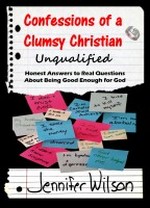
Confessions of a Clumsy Christian: Unqualified by Jennifer Wilson

Confessions of a Clumsy Christian: UnqualifiedConfessions of a Clumsy Christian: Unqualified: Honest Answers to Real Questions About Being Good Enough for God

by Jennifer Wilson

E-book, 89 pg.
2016

Read:February 7, 2016

This was a tough one for me to write — in fact, I think I spent at least twice as long deciding what to write and then writing this as I did reading the book.

Jennifer Wilson had the kind of past that many of us have had — false starts with faith, personal problems, family problems, addictions, job woes, etc. — struggling from time to time with trying to be good enough to become a Christian — at some point, she realized she couldn’t and that God didn’t want someone who was good enough (who could be?), but someone “unqualified” to be a Christian. She talks about some of her problems, doubts and fears both before and after her conversion, in an effort to reassure others that “qualified Christians” just don’t exist.

Let’s get the easy stuff out of the way: Wilson writes in a charming, engaging manner — pleasant, breezy, conversational. This makes the book a quick and easy read — sometimes deceptively so, considering the topics covered. She comes across as very open and honest, very genuine.

There were plenty of typos and grammatical mistakes in the edition I read — none were too distracting, though, so you could get past it. You almost have to forgive the mistakes in the midst of an author telling you how often she has and continues to fail in various areas.

There are plenty of books I shouldn’t write — for example, novels that are supposed to go anywhere beyond the NaNoWriMo word count verification; books on care of felines; diet books — 2 of these may change in time, my fiction could improve or I could get in shape. If either happens, I’ll write those books. And at some point, Jennifer Wilson may be ready to write this book. She states, over and over again that she’s a new Christian. At one point, she describes herself as “barely an apprentice Christian.” I have to ask, why is she writing a book about it then? I’m not saying she shouldn’t ever — but maybe she should get some roots down. She wants to write about her past? Her coming to faith? Her struggles as a new Christian? Fine — more than fine, she’s helpful. But when she goes further than that, she gets herself in trouble.

John Murray once wrote, “The difference between truth and error is not a chasm but a razor’s edge.” I fear that Wilson spent so much time walking down the razor’s edge she must have really cut up her feet. For example, she advised a friend, “[God] is in pain, watching you, His precious daughter, suffer so much.” I don’t see any biblical writer speaking of God in this way. She writes, “God, my heavenly father, doesn’t want me, His daughter to suffer in pain.” Please tell that to Joseph, Job, Paul, and Jesus for starters. The Epistles are replete with instructions about suffering, about the purpose of suffering, of rejoicing in our suffering. I have to wonder, what God is she talking about?

Wilson’s clear that she doesn’t know the Bible very well — that right there should give her pause before weighing in on Biblical concerns, no?

I know she’s trying to be amusing in her writing — and she usually succeeds — but I think a little more care surrounding God, His works, and the ways He’s revealed Himself would be helpful. Self-deprecating humor, humor at the apparent vicissitudes of life, absolutely fair game. But there are some things that we ought to treat reverently even in the midst of irreverence.

There is a lot to be commended about this book — particularly when she describes her own struggles past and present. But the solutions suggested are frequently problematic, when not downright unbiblical. It’s written-well enough, I’m just pretty sure it shouldn’t have been written at this time. I wish Wilson’d waited until she was past the apprentice stage to write this. I’m not just saying that, I want to like this book — I’d like to recommend it to others, but I just can’t. Aimee Byrd (not just her, but she’s a good starting point) has been writing recently about the deplorable nature of Christian books marketed for and by women, sadly, this book is evidence that she knows what she’s talking about.

Disclaimer: I was given a copy of this book by the author in exchange for an honest review. She probably had something else in mind.

—–

2 Stars

Songs of a Suffering King by J. V. Fesko

Songs of a Suffering KingSongs of a Suffering King: The Grand Christ Hymn of Psalms 1–8

by J. V. Fesko

Kindle Edition, 123 pg.
Reformation Heritage Books, 2014

Read: January 17, 2016


This is a “small survey” (his words) of the first 8 Psalms, looking at them as testifying of Christ — His experiences, His heart, His prayers, His praise. Fesko doesn’t ignore the original author or context, but his focus is reading them through the filter of John 5:27/Luke 24:27. With that filter, it’s easy to see how the first 8 Psalms (as a microcosm of the Psalter as a whole) testify to Jesus Christ.

This book was just “oooohkay.” Maybe I came in with too high of expectations. I get that Fesko was writing for a more popular audience than some of this other work — but this seemed very shallow. There wasn’t a whole lot to sink my teeth into. I’m glad he made this material very accessible — it’s the kind of thing the Church needs more of. I’m just afraid he didn’t hit the right balance of content and ease of understanding.

The content was good, I do think each chapter helped me understand the Psalm in question a little better (more than that at least twice). The conclusion is very strong — probably the best chapter in the book. I just wish he’d brought some of that strength to bear on the earlier chapters.

The book contained some great insights, but it was primarily surface-level material. I just wanted more from the book. Maybe I wanted too much, but I don’t think so. There were a couple of “wow!” moments for me that lead me to rate this at 3-stars rather than 2 1/2 (but if he’d developed those ideas for more than the one or two sentences he gave them I’d have gone with 4). It’s a nice, quick easy read with some good devotional material, but it could’ve been more without making it too technical.

—–

3 Stars

Do More Better by Tim Challies

Do More BetterDo More Better: A Practical Guide to Productivity

by Tim Challies

PDF, 114 pg.
Cruciform Press, 2015
Read: December 11 – 12, 2015


Abraham Lincoln reportedly said about someone’s book, ” People who like this sort of thing will find this the sort of thing they like.” If it were chronologically possible, he might have been talking about Do More Better. I am not the person who likes this sort of thing, but I have profited from reading some productivity-improvement books — this does not fit into that category. Could it help some people? I don’t see why not, but there’s a lot of people who won’t see their lives fitting into his mold (count me as one of them).

But honestly? I was turned off by the book before he started the practical section. I’m not going to give a detailed analysis, this isn’t the type of blog to do that, but I can give a thumbnail.

The first few chapters, the theory, or groundwork for his productivity guidelines are pretty questionable. Despite Challies’ proof-texting, I’m not convinced that any apostle or prophet encouraged anything along these lines (you could make the case that Solomon’s Proverbs could be used to these ends, not that I see Challies appealing to them). It looks so much like the kind of schemes we Americans (and, I suppose, Canadians) like — if I just do X, Y and Z, I can be whatever I want to be. If I eat all my veggies, especially the gross tasting ones, I can grow up big and strong. If I implement Method Q with Style R and Teaching S on a consistent basis, I’ll have well-adjusted, successful kids. And so on.

Chapter 5 on are so programmatic, so specific to his own scheme, that it’s restrictive (I’m sure he’d argue these aren’t hard-and-fast rules, only guidelines, but to implement them as he suggests, you’d pretty much have to treat them as hard and fast for however long it takes to set them as habits). I’d spend so much time for the first few weeks with his book in one hand and my Galaxy Note in the other, just making sure I was doing what I was supposed to be doing as far as my Tasks, Calendar and Information were concerned — even before my weekly Reviews. How would I get anything else done? Good question. As an example — I’ve been an Evernote junkie for 4 years now (this was composed on Evernote), but to use it the way he wants me to would take a focused readjustment.

Lastly, this is the kind of book that can only be produced in the affluent West. More than one author/speaker has talked about “The Cave Test” when it comes to evaluating worship “styles” — if it can be duplicated in a cave while meeting in secret, it’s fitting for Christians. While reading this, I wondered just how many countries (or parts thereof) in this world, where practicing Challies’ principles would be possible. The fact that a large percentage of the Church could not (and has not) been able to think in these terms — much less put this into practice — says a lot about their role in the Christian life.

I suppose I should say something about the writing — it’s certainly competent, clear and succinct. But it’s not at all interesting. Can you write about productivity/time management/etc. in an interesting, even entertaining fashion? Sure — see Chris Hardwick’s The Nerdist Way (not at all Rated G) as one example — but that’s not saying you have to. I don’t need to be entertained every second of the day, but if you want me to stay with a book (even a short one), you need to be more interesting than my microwave’s Instruction Manual. This was just so bland it was hard to keep focused.

I’m not suggesting that no one read this book, if reading the product description makes you think it could help you, I’m not going to argue. But I’m certainly not going to to suggest anyone go out and grab a copy — or even to borrow one. Do I think it’d be better if he removed his purported theological underpinnings from this? Yes. I’m also convinced it wouldn’t make a lick of difference to Chapters 5-10 in application (which speaks volumes).

—–

I received this book from the kind people of Cruciform Press for this review, I hope they don’t regret it.

—–

1 1/2 Stars

Messy Grace by Caleb Kaltenbach

Messy GraceMessy Grace: How a Pastor with Gay Parents Learned to Love Others Without Sacrificing Conviction

by Caleb Kaltenbach
Trade Paperback, 203 pg.
WaterBrook Press, 2015
Read: December 6, 2015

Straight off, I could tell Mr. Kaltenbach and I approach things very differently. There is a looseness to his language that I can’t tolerate on theological matters — I, like the noted Richard Rogers, serve a precise God*, and it gives me hives to read people who don’t — though I readily acknowledge (and lament) that he’s speaking in the Evangelical Vernacular. By page 5, I was grimacing at his phraseology. Particularly his use of “messy” and it’s connection to grace, and his insistence that there’s a “tension” between grace and truth — but I’ll return to that in a bit.

The first few chapters outline the problems between the perceived (and, sadly, sometimes real) destructive attitudes of Christians towards LGBT people and the perceived (and, sadly, sometimes real) combative stances and attitudes of LGBT people towards Christians. Kaltenbach illustrated this with episodes from his own childhood and what he’s seen in the pastorate. Sadly, he’s too impressed with generalizing from his autobiography (it’s not a totally improper strategy, but Kaltenbach doesn’t bring in anything to buttress his arguments). He also displays an over-reliance on platitudes and catch-phrases. Worst of all, he’s good at using stereotypes and generalizations when calling for those he’s stereotyping/generalizing to stop stereotyping and using generalizations about LGBT people.

I admit I was thoroughly annoyed with him by the time I got to chapter 6, when he (largely and temporarily) put aside the anecdotes and actually got around to explaining the Scriptural view on the topic at hand by brief glances at various texts, responses to critics, and so on. Could this chapter have been better? His explanations less open to criticism by theological opponents? Yes. That said, it was pretty good — and a very good introduction to the ideas he offered (his “More Reading” list at the end of the book contains much that would do a better job on this point).

I have several reservations and problems with Kaltenbach doctrinally and theologically. Actually, despite frequent use of the word “grace,” I’m not sure what he means by the term, but I’m pretty sure it’s not what the biblical writers mean by χαρις. In a fallen world, plagued by sin (a term Kaltenbach avoids), the favor of God, the goodwill of God towards undeserving sinners because of Christ’s work on their behalf (my quick and dirty definition of grace) will be messy, it will be found in messy situations with messy people — because there are no other kinds of people. Calling grace “messy” is like saying it’s “undeserved.” There is no other kind. Kaltenbach also spends a good deal of time talking about a tension between grace and truth, and I don’t see that where he locates it in the Scriptural witness, or anywhere else. In fact, throughout the Old and New Testaments, the two go hand in hand.

Both his dependence upon the Pericope Adulterae (John 7:53-8:11) for his approach to those who differ from him and his indictment of Imprecatory Psalms make me worry about his view of scripture. I can’t help but wonder, built on such an unstable foundation, how much of Kaltenbach’s arguments can stand.

That said, from Chapter 6 on, there is little I flat-out disagreed with — the differences ranged from minor quibbles to exceptions — but he said nothing that I’d say was entirely wrong or baseless, and I could appreciate what he said and where he was coming from. Both his understanding of the biblical teaching on sex, and the way that Christians should interact with, think about, and treat those with whom they disagree on sensitive issues is commendable and spot-on. As this is the point of the book, however sloppily he goes about it, I have to like that.

It’s a good 101 book (maybe a 080?), but one should grab his “More Reading” list and work through it — Champagne Butterfield’s book would be the best to start with if you like the memoir aspect of this book.

* If you’re unfamiliar with the story, see DeYoung’s quotation of Packer here.

—–

I received this book from the ever-so-nice people at Blogging for Books for this review.

—–

3 Stars

Page 15 of 16

Powered by WordPress & Theme by Anders Norén