

Tag: City Watch

Men at Arms by Terry Pratchett: “The air smelled of a limited life expectancy.”

I think this is coherent, there are five different attempts at writing something represented below. I finally filled out my outline, but I’ve spent so much time on the post, I’m not sure how much it makes sense.
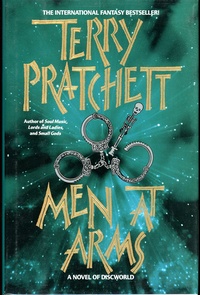

Cover of Men at Arms by Terry PratchettMen at Arms

by Terry Pratchett

DETAILS:
Series: Discworld, #15; City Watch, #2
Publisher: HarperPrism
Publication Date: January 1, 1993
Format: Hardcover
Length: 341 pg.
Read Date: August 1-5, 2025

Buy from Bookshop.org Support Indie Bookstores

“You see,” said Colon, “thieves are organized here. I mean, it’s official They’re allowed a certain amount of thieving. Not that they do much these days, mind you. If you pay them a little premium every year they give you a card and leave you alone. Saves time and effort all around.”

“And all thieves are members?” said Angua.

“Oh, yes,” said Carrot. “Can’t go thieving in Ankh-Morpork without a Guild permit. Not unless you’ve got a special talent.”

“Why? What happens? What talent?” she said.

“Well, being able to survive being hung upside down from one of the gates with your ears nailed to your knees,” said Carrot.”

What’s Men at Arms About?

The Night Watch is in flux—Captain Vimes is on the verge of retiring, and there are questions about who his successor will be. There’s a class of recruits that need to be trained—including a (gasp) woman. Our friends from the first book are trying to navigate this, train these recruits—and get their job done.

The job is made a bit more complicated when a murder victim shows up—killed by some sort of weapon no one on Discworld has seen before. Two guilds are implicated in this, the tensions between two non-human races are stoked due to the investigation, and the Night Watch has only a little time to get to the bottom of this all.

Fantasy Races

It was a state of permanent inter-species vendetta and, like all good vendettas, didn’t really need a reason any more. It was enough that it had always existed. Dwarfs hated trolls because trolls hated dwarfs, and vice versa.

I don’t remember Guards! Guards! doing a lot with the whole fantasy race thing—there were humans and dwarves, right? Maybe some mentions of others, but I don’t recall it being that big of a deal.

Here we have more dwarves and trolls—and a lot of animosity between the two races. We also have plenty of reasons to see how ridiculous expressions of this animosity (and probably even the grounds for it) really are.

I really found this a compelling aspect of the book, particularly the way that two of the Watch’s trainees (one from each race) learned to work together—it’s not in an after-school special way, but one that felt genuine.

The Gonne

A handheld firearm has found its way into Discworld, and the results are devastating.

Several people want it destroyed—and definitely don’t want it replicated. But when they get it into their possession, they can’t seem to destroy it. In fact, many become obsessed with it, it’s like they start to take orders from it.

Back in 1993 (original date of publication), Terry Pratchett saw the attraction of the power that comes from wielding a handgun and depicted it in a way that feels incredibly of the moment. Obviously, this has been something humans have been dealing with for a long time—it’s nothing new—but I don’t remember coming across something so clear, so incisive along these lines until more recently.*

* Sure, this may say more about what I’ve read than it does about Pratchett…but even the more sensitive treatments I read that are older than this don’t seem to get it as well.

So, what did I think about Men at Arms?

Colon thought Carrot was simple. Carrot often struck people as simple. And he was. Where people went wrong was thinking that simple meant the same thing as stupid.

I didn’t find this as funny as Guards! Guards!. It was quirky, and odd, and amusing—yes. Which isn’t to say that it wasn’t riddled with great lines. It was entertaining as all get out—and I enjoyed it almost as much. But it was more focused on character development, story, and social commentary than yucks and guffaws. It’s probably a better novel over all, honestly. But not as fun.

So it really wasn’t what I expected, which is a shade disappointing. But what I got instead is a superior product—with some great avenues for future stories. I didn’t expect to have emotional reactions to what happens to characters in a fantasy novel that I expected to laugh my way through! (the reactions might have been small since I didn’t know them that well, but still, it was outsized for how many pages I’d known them for)

As much as I enjoyed Captain Samuel Vimes and what happened with him—I really didn’t appreciate Sybil Ramkin. I thought she was great in Guards! Guards!, but she was a giant let-down here. I expect that to change in the future. I’m really excited about the possibilities for Vimes going forward.

Carrot…good ol’ Carrot. As great a character as I thought he was coming into this—he was far, far better throughout. Especially what we got to see of him through the eyes of other characters—particularly Lance-constable Angua von Überwald (who’s just a great addition regardless). It’s one thing to give us things from his perspective, or from the omniscient narrator’s point of view—but for us to see what others see in him, particularly the intangible stuff, and how they’re confused by his success—utterly fantastic.

Whatever my issues with Pratchett were before Guards! Guards!, they are well and truly dead and buried. I’m going to work on devoting more time to him in 2026 (if not before). This was a great read with depth I didn’t expect (but maybe should’ve) in one of the strangest fantasy worlds I’ve encountered. Funny, thoughtful, deep (in the right ways), absolutely silly (in the right ways).

4 1/2 Stars

This post contains an affiliate link. If you purchase from it, I will get a small commission at no additional cost to you. As always, the opinions expressed are my own.

Irresponsible Reader Pilcrow Icon

Guards! Guards! by Terry Pratchett: I Can See Me Becoming a Slavering Fan of This Stuff…

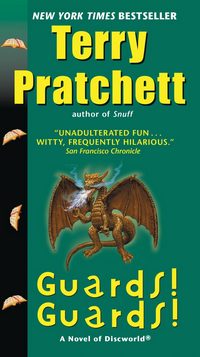
Guards! Guards!Guards! Guards!

by Terry Pratchett

DETAILS:
Series: Discworld, #8; City Watch, #1
Publisher: Harper 
Publication Date: April 30, 2013
Format: Mass Market Paperback
Length: 403
Read Date: December 15-21, 2023
Buy from Bookshop.org Support Indie Bookstores

It’s a metaphor of human bloody existence, a dragon. And if that wasn’t bad enough, it’s also a bloody great hot flying thing.

What’s Guards! Guards! About?

We start with a motley bunch of people who have been recruited by a mysterious figure to summon a dragon from another world—they don’t know this initially, but the purpose is to take over the city of Ankh-Morpork for less-than-benevolent reasons.

Meanwhile, a tall and naive young man is informed by his father that he’s not who he’s always thought he was. In fact, he’s been brought up by another species. Carrot had spent his whole life believing he was a dwarf like everyone he lived among, rather than a human. “It’s a terrible thing to be nearly sixteen and the wrong species.” Carrot has a hard time accepting this truth but does what his father tells him. He sets off for the city to become a member of the City Watch and will send his wages to his family. It’s impossible (for me, at least) to read Carrot and not think of Buddy the Elf. I don’t know if Ferrell and Favreau had this book in mind when they worked out the character—but they could’ve.

Like Buddy, Carrot doesn’t understand the human world and its nuances. He’s very literal, he’s a hard worker, doesn’t know how to be dishonest, and sees the world in black and white. So he goes about the business of the Watch like that—he’s a one-man anti-crime crusade. Arresting people the rest of the watch doesn’t have the energy to pursue—and those they’ve been told by the city leadership to leave alone.

His presence shakes up the Watch and awakens a sense of duty in them. So when they start finding traces of the dragon—and a corpse or two, this lethargic group gathers itself together and tries to save the city from the dragon, those behind it, and those who can’t be bothered to care.

And a whole bunch of other things transpire, are said, and whatnot. But that’s enough to get you started.

More Than Jokes

“Down there,” he said, “are people who will follow any dragon, worship any god, ignore any iniquity. All out of a kind of humdrum, everyday badness. Not the really high, creative loathesomeness of the great sinners, but a sort of mass-produced darkness of the soul. Sin, you might say, without a trace of originality. They accept evil not because they say yes, but because they don’t say no. I’m sorry if this offends you,”

All good novelists will work in things that have nothing to do with the characters (directly), their development, or the plot to their books. Some sort of commentary on the world, an observation about humanity or a portion of it, etc. If you ask me, the more comedic novelists are better at it than others—it’s probably that spoonful of sugar thing. That could just be my preference, I admit.

Some of the better moments in this book—at least some of the best sentences—come from moments like the above quotation. There’s some cheap cynicism to be found in these lines—but there’s some well-earned cynicism, too, in Pratchett’s ideas about government, the people led by that government, and so on. But there’s some great stuff on love and hope to be found in here, too. Pratchett’s cup is half-full at least as often as it’s half-empty.

The one-liners; the satire of Fantasy tropes, humanity in general; and the overall comedy of his world might be what he’s known for—but at least here (and likely in general), Pratchett’s observations of and commentaries on humanity are just as noteworthy.

The Library/Librarian

The truth is that even big collections of ordinary books distort space, as can readily be proved by anyone who has been around a really old-fashioned secondhand bookshop, one that looks as though they were designed by M. Escher on a bad day and has more stairways than storeys and those rows of shelves which end in little doors that are surely too small for a full-sized human to enter. The relevant equation is: Knowledge = power = energy = matter = mass; a good bookshop is just a genteel Black Hole that knows how to read.

I don’t have the time to write the essay I want to write about the Librarian, the Library, what the Librarian did to save the day, and so on. But I really wish I did (besides, I’m pretty sure someone else has—several someone elses). It’s not the—or a—main focus of the novel, but it really could be. Instead, I’ll just note that the Librarian was a highlight for me, and I hope we get a lot more of him in the future.

So, what did I think about Guards! Guards!?

“I mean, [the dragon] wouldn’t want us to go around killing its own kind, would it?”

“Well, sir, people do, sir,” said the guard sulkily.

“Ah, well,” said the captain. “That’s different.” He tapped the side of his helmet meaningfully. “That’s ’cos we’re intelligent.”

One of the things I like to ask when thinking of a comedic novel is, would it hold up if you took the jokes out and played it straight? It’s hard to answer that for Guards! Guards! because of the satirical and ridiculous aspects of the novel. But…on the whole, yeah…it’d work. Thankfully, it’s not a question we really need to spend too much time on because it’s so funny that you don’t notice parts of the story/plot/characters that might not work—and with the comedy this book is so successful it doesn’t matter.

It took very little time for me to get invested in the story—maybe not the characters (as much as I enjoyed watching Carrot fumble through his new life), but the story and the storytelling carried me until the point that I started to see the various members of the City Watch as anything other than comedy delivery systems (although that’s primarily what they were). I was entertained throughout, so much so that I didn’t really spend much time thinking about comparing this to other Pratchett books or other Fantasy comedies I’ve read—I just wanted to have fun with this. Maybe I’ll do the other stuff with later reads.

My journey to this book—and to giving Pratchett another chance—is pretty well documented. It’s not that I disliked The Color of Magic or The Light Fantastic, but I didn’t get the fuss over Pratchett after reading them. After reading Guards! Guards!? I think I get it. After reading less than a third of Guards! Guards!, I was pretty sure I got it, actually. I’m so relieved…I wondered what was wrong with me that I missed what everyone else saw in his work. There’s this great combination of jokes, situational/character-based comedy, a skewed way of depicting the world that’s honest and true while capturing the absurdities—and wonder—of the world. Pratchett respects the reader enough to not have to spell everything he’s doing out for us, but not so much that he will avoid slapstick or bodily humor.

I’m sold. If you haven’t gotten around to trying this mega-series (and surely there are like 5 of you reading this who haven’t), stick your foot in. If you’re unsure where to start, here’s a great place.

I’ll be back for more soon.


4 1/2 Stars

This post contains an affiliate link. If you purchase from it, I will get a small commission at no additional cost to you. As always, the opinions expressed are my own.
Irresponsible Reader Pilcrow Icon

Powered by WordPress & Theme by Anders Norén