 Crownfall
DETAILS:
Publication Date: March 17, 2026
Format: Paperback
Length: 501 pg.
Read Date: August 8-11, 2026


What’s Crownfall About?
For as long as most people can remember, the island of Burunt was politically independent—but its neighbors kept getting closer, and the island’s government opted to join an Empire. How that particular government came to power isn’t necessarily the cleanest or prettiest story.
This is particularly true for a certain ethnicity, the Draumer. The Draumer have existed in this world always, and are largely accepted in much of it—but not in Burunt anymore. There, they’ve been stripped of everything, hunted down, and locked up away from everyone else. The Draumer possess mystical/magical abilities that make them stand out from others, and are easy to demonize them over—and the Viceroy has made a campaign of it. Many have left Burunt, many have been incarcerated (at best). And then there are a handful like Kyndel Heim, the first character we meet—he’s on the street, thieving to survive. Kyndel also dreams of murdering the Viceroy in revenge for the suffering he’s brought to his people.
Amara, excuse me, Lady Amara is the last representative of a noble house. Her family’s wealth had been built on exporting and importing goods—following the death of her father, Amara’s mother, Dhonya kept the family’s business going. Until age-related dementia robbed her of her ability to do so, but she did a great deal of damage to the family’s business before anyone realized what was going on. Amara has now stepped up; she’s stopped the bleeding—but can she rebuild in time to stave off the debtors nipping at her heels?
Lastly, we have Major Jelert Egarro—an Imperial engineer of some renown and a lot of ability. He chose to be transferred away from the capital—and its proximity to power and access—to come to Burunt for one reason only. There’s a ban on the invention and development of weapons. The first time you read that, you like him—and worry for him. The second time he says that, you really start to worry about him. By the third time…well, you know it won’t be long before he and the reader learn what’s happening with his projects. The only question is what he’s going to do about it.
Take these three and toss them into a political system dominated by power struggles, deception, simmering rebellious movements, and deadly consequences for everyone involved, and you’ve got yourself one exciting read.
Why did I pick this up? Why did I keep reading?
I picked this up because of some of the online buzz around it and the essay I talk about below. I was curious about Vadney’s goals and the story sounded pretty cool.
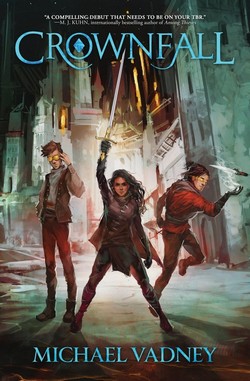
I was relieved, I have to say, when the characters came across as older than they appear (to my eyes, anyway) on the cover—which helped me get invested, somehow. But really after the second chapter from each POV, I was well and truly invested. I wanted a better understanding of the magic system that Kyndel’s throwing around; I wanted to see how Amara’s work and planning and scheming played out, and I wanted to see if Jelert’s idealism was able to remain intact. As more characters got involved, my investment grew.
And then, boy howdy, when the big surprise weapons were unveiled..forget it, I had to finish.
What does this book tell us about humanity?
I feel pretty solid about this take, after I outlined it, I noted that the back cover opens with the words, “Trust is the hardest lesson.”
Because trust was, if not the dominant theme, it was close enough that you’d be forgiven if you called it that. Trust you should exercise and extend, and trust that you shouldn’t have.
Almost every moment of this novel (and, I suppose you can say this about other novels, but this one stands out to me on this point) hinges on exercising trust—showing a moment of vulnerability, withholding confidence, deciding to go one way or the other. In a city built on mutual distrust, on fear of the Viceroy and his government—that’s really a brave act.
And throughout the city you can tell that there are a lot of people trusting/distrusting each other. Because that’s what societies are based on. You can’t live in peace for long without trusting someone or something. Humans are trusting creatures. It doesn’t always go well for us as such—as many citizens of Burunt can testify, but it’s often rewarding. And nothing can happen—nothing lasting, anyway—without it. As many other citizens of Burunt can also testify.
Nobledark in Practice
Earlier this year, Vadney wrote an essay, The Rise of Nobledark Fantasy and What It Says About Us Right Now, that I just loved. It sounded great, it resonated with what I want to see in a novel (pretty much in any genre).
And I still think that.
But in practice, Crownfall felt like…Fantasy. It really didn’t strike me as that much different from any Fantasy that I can recall, other than most Grimdark or Cozy. This is not a bad thing—there’s a reason I read Fantasy. I like Fantasy that reads like the Fantasy I read as a kid/teen (or as an adult), with similar outcomes and motivations.
Maybe I’m missing the nuance, the fine points that make Nobledark similar to “traditional” (for lack of a better term) Fantasy. It wouldn’t surprise me to learn that, actually. But I wouldn’t mind someone coming along and pointing it out to me.
So, what did I think about Crownfall?
I thought the opening chapters were a little rough. It almost felt like Vadney was just trying to get some basics about the island and the characters established so he could get on to the story, which is what he was more interested in. And I get that impulse—and once he’d established all that, the novel picked up and the writing that bugged me disappeared.
This is one of those novels that built up momentum early and then took off—but even after things got moving, it continued to build up speed. Vadney really didn’t seem to have any brakes installed on this runaway train. Which could’ve led to disaster. In this case, however, it just made for a nail-biting read up until the last few pages. It absolutely worked. Seriously, there’s a 100+ page run leading up to the quiet pages at the end, that will knock your socks off.
While there are no truly “good” characters in this novel—there are a lot of people trying their best, and while you will question a lot of the decisions they make, you will want success for them. On the other side, there are some easily identifiable “bad guys”—if not fully evil, they’re only out for themselves and care not for who they have to destroy to get their way. And there are a significant number of people caught in the middle, some tragically so—reduced to mere tools of one side. Those are the clear victims of everything going on, and if you have anything but pity for them…you should probably read it again.
On the whole, readers are going to identify who’s who in that categorization (even if you end up phrasing it differently, you’ll know what I’m talking about)—the characters will take some time coming to the right conclusions on that point. Some might call this a simplistic way for Vadney to lay things out—I think it’s just straightforward storytelling that doesn’t have to rely on that kind of twist. You get just what you think to you get character-wise, not necessarily plot-wise.
I just realized that I didn’t touch on this world—the mix of magic and tech, Vadney’s rather smooth way of showing it to the reader and explaining enough to get grounded in the world without anything feeling like an infodump. If I had a little more time, I’d add a few paragraphs about that—and I probably should. But my pillow is calling, so this will have to do: top-notch world-building, and it’s a place I wouldn’t mind getting to spend some more time in.
There’s some lightness, a hint of romance, and some good moments of friendship. There are big betrayals, disasters, and events you don’t see coming—which are all great to read. When you populate those situations with characters you’re rooting for (and against) with a plot that moves like a bullet train, you’re in for a good time.
I recommend this—I think you’ll enjoy this, reader. And you’re going to start looking for Vadney’s next novel, too.
This post contains an affiliate link. If you purchase from it, I will get a small commission at no additional cost to you. As always, the opinions expressed are my own.