Tag: Fantasy Page 47 of 54

Timothy Other: The Boy Who Climbed Marzipan Mountain by L. Sydney Abel

Timothy Other: The Boy Who Climbed Marzipan MountainTimothy Other: The Boy Who Climbed Marzipan Mountain

by L. Sydney Abel
Series: Timothy Other, #1

Kindle Edition, 325 pg.
Speaking Volumes, 2016

Read: August 11 – 13, 2016


A nameless boy is left at the Dreams and Hopes Orphanage (and don’t think I didn’t have to concentrate really hard not to flip those two every time I read/wrote the name) and is named Timothy Other — which is not the most interesting name in the book, trust me — where he spends the first twelve years of his life happy, healthy (insanely so) and cared for. Until the man who ran the orphanage dies and the bank takes ownership of the mortgaged-to-the-hilt facility. The people that take it over might as well have been Miss Hannigan and Dolores Umbridge.

Not surprisingly, Timothy wants something else in his life, runs away — and straight out of Candide ends up at Marzipan Mountain (his name for it); befriending a giant mouse, caterpillar and Sasquatch-like creature; and on the trail of his birth parents (something he learns much later); and a way to rescue the orphanage. Meanwhile, back home we learn about the nefarious schemes that are behind the takeover of the orphanage and the various motivations behind them.

Some of the subject matter and way it’s depicted seem a little more “adult,” dark or whatever than is acceptable for kids’ literature. On the whole (there might be a line or two I wouldn’t defend), this is silly and doesn’t give kids enough credit. It also ignores the history of these kind of books — from Lewis Carroll and J. M. Barrie to Rowling and Gaiman — kids can handle this stuff if presented right. Frequently better than adults can.

Eventually, Timothy and one of his new friends come back home to save the day, right wrongs, and give many the happy ending you expect given the genre and setup. There’s a bit of redemption, a bit of justice, and a lot of hope and love at work here — Dreams and Hopes, I guess you could say, as these various characters pursue the Golden Life and launch Timothy on further adventures in the sequel(s). All the makings of a good introductory novel for a series.

There’s a nice hat-tip to another British children’s fantasy series that should tickle everyone who catches it — and mean nothing at all to those who don’t.

With each major character (and most of the minor) there’s a moment or two, a couple of lines, or a scene that doesn’t seem to fit with what we’ve been told/seen about the character. It’d take too much space to illustrate this, but when you get to that scene (and you’ll recognize it just about every time), just shake it off and move on, Timothy or Edwin or Itling or whoever will get back to themselves soon.

I had a hard time nailing down the feel of this one, there’s sort of a fairy-tale feel to it. Not Grimm Brothers’ fairy-tale, but the warm-fuzzy kind (with a hint of the other), like J. K. Rowling-light. Even a dash Mrs. Piggle-Wiggle at the beginning. Later on, it morphs into a Neil Gaiman-esque children’s book feel. Now, Abel never quite hits the Rowling/MacDonald/Lewis/Gaiman tone exactly — which is good, he’s doing his own thing, but it’s in those ballparks. The one thing that would help his tone is a bit more economy of words — he takes a few too many to pull of the whimsy, the sense of play, that he seems to be going for.

Actually, that goes for pretty much the book as a whole — Abel could’ve trimmed just about everything a bit. It’s a slow read, which is not necessary a bad thing, I’ve got nothing against them. But I think it works against what he’s trying to do and I think I have a little more patience than the target audience would. I’m not saying it needs to be a hundred pages shorter — but it could read a little smoother, quicker. Really — how many people noticed the length of Goblet of Fire? You didn’t because of the way it was written (not just the exciting parts, either).

I want to be clear, I’m not saying the writing isn’t good — but the pacing and language are so close to being very good, the fact that he misses the target by a little emphasizes the fact that he missed it. This is a winsome and charming book that should enchant younger readers, if they just give it the opportunity.

Disclaimer: I received a copy of this book from the author in exchange for this post/my honest thoughts. I’d like to thank him for the book and for his patience, I took far too long with this.

—–

3 Stars

Trampling in the Land of Woe by William Galaini

Trampling in the Land of Woe Trampling in the Land of Woe

by William Galaini
Series: Patron Saints of Hell, #1

Kindle Edition, 360 pg.
Scarlet River Press, 2015

Read: August 24 – 25, 2016


This is a well-written, imaginative book with a stack of great characters — they have depth, individual voices and points of view. Coming up with the idea of this book is a stroke of something, I’m not sure what. I trust that Galaini’s parents had him tested as a child.

How do you even give a synopsis of this? Imagine Dante’s After-Life, but fuzzier on morality/religion/ethics than the Alighieri would be comfortable with. Denizens of Purgatory (and the Heavenbound) can move around from place to place (not sure if the damned can, it doesn’t appear so) — at least to “lower” levels than their own. As technology among the living advances, the dead use it, too — but instead of regular old Steam Power, they use Hellfire — which is a much better source of energy (for example). Living for thousands of years gives you plenty of time to refine your science.

Now, Alexander the Great’s right hand man, lifelong friend, and companion, Hephaestion, has decided that Alexander’s been consigned to Hell long enough and is going to liberate him. Hephaestion has been in Purgatory since his death and has spent a millennia or so preparing for his rescue mission. He’s going to sneak into Hell, track Alexander down and slip out the back door. The plan goes awry from almost the beginning and Hephaestion has to rely on newly minted friends and allies to get him where he’s going.

For some reason that’s only made clear at the end, the Jesuits aren’t fans of this, and use a variety of means (bribes, threats, assassins) to dissuade Hephaestion and his friends from their quest. Many of these assassins are ninjas. Which is just cool, I gotta say.

There’s all sorts of strange magic, odd beasts, crazy settings and some great fight scenes here — Galaini can write. Make no mistake.

But man, I just didn’t like it — I didn’t connect with any of the characters (there’s a couple I might’ve been able to, if they’d been around more), the quest seemed wrong-headed and doomed at best (as at least one person tried to tell Hephaestion), and I couldn’t muster up the interest to get invested. I persisted, in case he won me over (and Galaini came close), because I told the publisher I would, and I was mildly curious. My curiosity wasn’t rewarded, sadly. I’m not saying it’s a bad book — it’s not. It’s not a book for me.

I’m giving it 3 because it deserves at least that objectively on merit — my gut says to give it two, it just didn’t click for me — but it’s so well-written than I have to bump it up one. I do expect many would like it more than me, and if I’d read it at some other point in time, I might have liked it more (but I don’t think so).

Disclaimer: – I received a copy of this book from the publisher in exchange for my honest opinion. I thank them for the opportunity.

—–

3 Stars

The Phantom Tollbooth (Audiobook) by Norton Juster, Norman Dietz

The Phantom Tollbooth The Phantom Tollbooth

by Norton Juster, Norman Dietz (Narrator)

Unabridged Audiobook, 5 hrs, 20 min.
Recorded Books, LLC., 1993

Read: August 1, 2016

4 Stars

I needed something to listen to at work a couple of weeks back, and the only thing I could find from the library’s collection was the audio version of the children’s classic, The Phantom Tollbooth. It’s been a few years since I read this with my kids, so I figured it was worth a shot. The story of bored (and boring) Milo receiving a magic Tollbooth that transports him to a magic kingdom where he goes on an adventure to restore Rhyme and Reason to their rightful places has long been a favorite of mine.

It wasn’t a bad use of time, but was a little disappointing. A lot of the word play needs to be read, not heard — having to over-pronounce the “h” in “whether man” to make it the joke land just doesn’t work. I could list other examples, but that’ll do.

Still, most of the magic is there, you still get the overall feel of the book, the strange adventure that Milo, Tock and the Humbug have is intact, it’s just missing some of the details.

Really, any version of The Phantom Tollbooth that doesn’t feature the art of Jules Feiffer is missing something — even the cover of this one was done by someone else! Thankfully, I remembered what most of the pictures looked like and could supply them in the right spot. But it’s just not the same.

Basically, I guess I’m saying any audio-only production of this novel is hobbled out of the gate. Which is nothing against Norman Dietz’s work — he did fine, nothing spectacular, but nothing detrimental, either. Good, capable, entertaining narration — but it’s just a bad book to try to do this with, I think. (that said, apparently David Hyde Pierce did an audiobook recording of it, too — and I will grab that if I can).

If you’ve read it before — this will scratch the re-read itch if you have it. It might be a good way to entertain the kids on a road trip. But this shouldn’t be anyone’s initial exposure to the story — get the book. Really. I’m giving it 4 Stars for sentiment’s sake — and Juster’s words/story.

—–

4 Stars

Forever We Play by David Belisle

Forever We PlayForever We Play

by David Belisle

Kindle Edition, 95 pg.
David Belisle, 2016

Read: August 6, 2016


It’s been a few years since I’ve been able to watch a game, but at one point I was a semi-serious baseball fan. So when given the opportunity to read a novella where baseball is a religion, I had to try it. Especially when I’m told it’s a satire.

Now, I’ve known a few people for whom sports are a religion (see Fever Pitch — book or movie), but nothing like this. In a nutshell, Heaven is overcrowded and so entry has to be limited. Upon death, people have to pick a team and they will remain in Purgatory until that team wins the World Series. It’s more complicated and convoluted than that, but there’s the essence.

Naturally, there are a lot of Cubs fans in Purgatory.

Also, there’s a thin-ly disguised Devil running around (actually, I didn’t realize it was a disguise for a while — that’s how thin it was). He’s plotting and planning and stirring up trouble.

There’s a lot of goofiness, jokes that land, jokes that just don’t, a convoluted plot involving the last Cubs’ series win, a strange mix of various religions, and an attempt at a love story or two. I don’t think anything was as developed as it should’ve been to really tell a winning story — the characters were sketchy, the plot details too vague, and many of the jokes didn’t have enough meat to them to really get the point across. Everything came close to working, but not much did.

In the end, I enjoyed this. But man, it was a mess. A mess with a heart and wit, don’t get me wrong.

Disclaimer: I received a copy of this from the author in exchange for this post.

—–

3 Stars

Dicing with the Gods by Sean McKenzie

Dicing with the Gods

by Sean McKenzie
Series: Grug Smash, #1

ePub, 105 pg.
Nerd Incognito Press, 2016

Read: July 29, 2016


This is a short book, so I have to keep things brief and vague.

Gurg is your typical barbarian adventurer — more brawn than brains (a lot more), good in a fight, not so good in a conversation. Think of him as Tarzan with a sword, sort of.

In the middle of a typical adventure, Gurg is separated from his party and finds a magical amulet. While wearing it, he finds himself with a growing awareness that his life is governed by forces he doesn’t understand (and much of his life doesn’t really happen). He’s also just a whole lot smarter — he’s developing empathy, thinking about things other than adventuring and drinking.

What kind of impact will this have on his life? What will this do to his adventuring? When he stumbles upon an evil plot — how will he react now that he can do more than unthinkingly slash and bash his way through enemies?

This was fun — the only downside for me was the length. Thankfully, there’s a second volume in the series already out. I expected something goofier, more farcical — maybe even slapsticky. I was wrong, it is clever and amusing. But it’s also a good fantasy story. McKensie writes with skill and panache, and his characters could be in a straight-fantasy with no problem. Instead, he comes at it from a skewed perspective and takes the standard D&D party and turns it into something special. I’ll be back for more.

Disclaimer: I was given a copy of this book by the author in exchange for this post.

—–

3.5 Stars

A Few Quick Questions With…Devri Walls

Devri Walls was kind enough to participate in a Q&A with me along with providing me a copy of her book The Wizard’s Heir (see my thoughts on it from earlier today). I asked her a little bit about the book, what’s next for her, and her writing in general. In addition to Heir, she’s got a YA series and another one on the way — I’d recommend checking at least one of those out.

What’s the one (or two) book/movie/show in the last 5 years that made you say, “I wish I’d written that.”?
The Hollow City concept was genius and so fun! I would’ve loved to have come up with that and been able to work a story around those incredible pictures. Also, The Mortal Instrument Series. To be the one to have come up with Shadow Hunters… oh man! So much fun would’ve been had!
In the writing of The Wizard’s Heir, what was the biggest surprise about the writing itself?  Either, “I can’t believe X is so easy!” or “If I had known Y was going to be so hard, I’d have skipped this and watched more TV”.
I’ve written enough books, and enough drafts of books, that I can usually predict where my trouble spots will be. While annoying in their consistency, it’s not usually a surprise. On the other hand, I’m almost always surprised by a character. I’ll add a new one, intending them to play a small, meaningless part, and then fall in love and alter the plot to include them as a larger player. It’s always the best thing that could’ve happen to the story, but still a surprise.

In The Wizard’s Heir it was, Asher. Everyone, including myself, really connected with him. He was a bit of a throw away character until I added the scene where he goes to the boat to pick up supplies, and that was it, I loved him immediately and gave him a much larger role to play. The Wizard’s Heir is a stand alone novel but I’ve been approached several times about writing a second book in that world, while I don’t have one officially in the plans, if I ever did it would be written with Asher as the main character.

Who are some of your major influences? (whether or not you think those influences can be seen in your work — you know they’re there)
I’ve been influenced by Cassandra Clare, Dean Koontz, Stephen King and Cinda Williams Chima to name a few. I also pick up a little good with any great book I read. There are always little nuggets that I try to make note of to improve the next book.
I’ve often heard that writers, or artists in general, will forget hundreds of positive reviews but always remember the negative — what’s the worst thing that someone’s said about one of your books, and has it altered your approach to future books?
The worst thing? Oh man, something about, “this story would’ve been good if an author with talent had written it.” Lol. Nice, right? Negative reviews did alter my writing in the best way possible. I realized fairly quickly that the things one person complained about, someone else loved, and vice versa. In addition, where some people hate my work… with more vehement than perhaps necessary, others love what I write with a passion far and above what it probably deserves. I could write the Pulitzer prize winning novel and someone would still write a review that it was the worst pile of drivel they’d every read. Once I realized that, those negative reviews became freeing, I do the absolute best I can at the time and that’s all I can do. I push myself, hard. And I rewrite until I throw my hands up and say, I really can’t do any more.
It looks like your next book is on the verge of release, what can you tell us about that — and what comes next?
Yes! My Venator series is getting close to the release of book one. I’m always hesitant to give a date until I have return commitments from the editors but I am hoping for late August, early September.

I’m really excited about this series. I’m still working on the official blurb but it’s the story of two teenagers who cross through the St. Louis arch to an alternate dimension where everything you’ve ever read about exists—Fae and Vampires, Werewolves and Dragons. Seriously, nothing is off limits and it is so much fun to work with. I think my readers who were missing the environment of The Solus Series will be especially pleased with this. The Venator series is slated for multiple books, so that’s where my brain is at right now, but I have a whole notebook full of story ideas that I will get to eventually.

Since I don’t have an official blurb in hand yet, can I give your readers a sneak peek of the cover?

Nice looking cover! Thanks for your time, and thanks for The Wizard’s Heir.

The Wizard’s Heir by Devri Walls

The Wizard's HeirThe Wizard’s Heir

by Devri Walls

Kindle Edition, 378 pg.
SuperStorm Productions, 2015

Read: July 4, 2016


Walls does so many things right in this stand-alone fantasy, it’s hard to know where to start.

Tybolt and Auriella are Deviants –which is not as bad as it sounds, it just means that they’re immune to magic. As such, they are part of the King’s force devoted to hunting down Wizards. Thanks to the most powerful Wizard in recent history, Eriroc is in the midst of devastating drought, wholly dependent on trade with other nations for basic food supplies — which are barely enough to keep people fed enough to survive.

There’s something different about Tybolt than the other Hunters (and, come to think of it, most people in the King’s favor) — he uses the money he makes to help out those less fortunate and spends a lot of time with them. Aurielle doesn’t treat everyone as cruelly as the other fortunate souls do, but she certainly pays no heed to anyone she doesn’t have to and doesn’t understand their plight. She’s not a bad person — just oblivious, at least when we meet her. Tybolt has a great sense of humor to go with his heart, he can enjoy the simple things in life — and would do anything to get Aurielle to think of him in any way other than co-worker. If you don’t like Tybolt from the get-go, watching his charitable efforts should win you over. Asher is another Hunter who has little to do with Tybolt initially, but eventually comes to play a pivotal role in the events of the book, but you’ll have to take my word for it — and as unimportant as he seems to be at the beginning, that’ll change. Just pay attention to him.

Walls’ worldbuilding is great — on the one hand, it’s standard Fantasy fare, enough that you instantly have a good idea about the world, the culture, the conditions and politics. But she tweaks it just enough to make it her own, and differentiate it from the rest. Sometimes I wondered why she constructed things the way she did — or why she revealed them in the way she did — but in the end, I saw (well, think I saw) the reasoning behind both and could appreciate her choices.

The plot is pretty conventional, and within a few chapters there are few readers who will not know pretty exactly how the rest of the story will go. But I didn’t mind — Walls hits every beat just right, every reveal is pulled off capably, the voice used is engaging and the fun and humanity of the situation shines through enough that the reader doesn’t demand novelty. Sincerity can be just as winning as innovation, and Walls pulls that off. There were a couple of character deaths you saw coming from miles away and I still was shocked by them when they happened, ditto for “aww” moments.

I, like the book, focused on the heroic hunters above. But there are plenty of other characters running around — the King is despicable, and there are a handful of Hunters that are probably worse (and seem to pull the rest along with them). But none of them are cartoons — there are several characters that aren’t all that heroic or evil — they’re just trying to survive (which can be heroic in a not-that-heroic way), and are well-executed. No matter where they fall on the moral scale, the characters work — developed enough to fulfill their role in the book (and maybe a little more).

This book isn’t going to blow anyone away — but it will entertain, it will keep you turning pages and will engage you in its world and the lives of its characters. It’s a good, fun read. There’s excitement, a dash of romance, some magic and a few good fight scenes — pretty much what you want from a fantasy. Oh, and there’s a good definitive end — no series commitment! It’ll satisfy you and probably make you want to read more of Walls’ material.

Disclaimer: I received a copy of this book from the author in exchange for this post.

—–

3.5 Stars

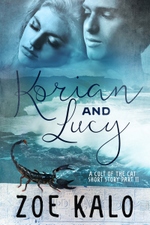
Korian and Lucy by Zoe Kalo

Updated 8/9: The author contacted me about this, and assured me that it was an editing mistake on her part that soured me on this story, which is exactly what I hoped it was, and that it’s been fixed in the current edition. Which I think makes this a 2-Star story now (maybe higher): I’m not sure it tells us anything we couldn’t assume from reading the first novel — maybe some of the characterization will play a role in later books. Instead of being bad, this is now just inessential. Still, I recommend the first book and plan on reading the second.

Korian and LucyKorian and Lucy

by Zoe Kalo
Series: Cult of the Cat, #.5

Kindle Edition, 24 pg.
2016

Read: July 12, 2016

17 years before the birth of Trinity . . .

That line right there? The setting, words 5-11 of the story, are what killed it for me. Killed it dead.

Why? This is the story about Trinity’s mother and father, their brief affair, setting off the events of Daughter of the Sun. Which means, unless one of the types of magic involved in worshiping Egyptian deities involves Seventeen Year Pregnancies, (I can’t imagine any mothers I know signing up for a religion that consigns them to pregnancies that last that long) this is a flawed and hastily edited story. There are other chronological issues, but let’s stick to that one.

Just when you’ve gotten comfortable in this story, just start getting to know the characters, the story just stops. It doesn’t end, it doesn’t resolve, it doesn’t leave on a cliff-hanger. It stops and says look for part 2! Are you kidding me?

This is racier than Daughter, easily. Where Daughter suggested, hinted, pointed at Trinity and Ara’s sexuality, this story throws it in your face. It’s not over the top, but it’s very tonally different.

It’s not all bad — the fling/affair/romance between Korian and Lucy had promise; we get the idea that Trinity’s beloved grandmother wasn’t really all the fantastic, but is more realistic; and the wheels are set in motion that will result in the events of Daughter in a mere 34 years or so.

If only this was a complete story. If only this actually made any kind of chronological sense. If only . . . I could’ve liked this as much as I liked the first novel. But, it didn’t. You’re better off not reading this one, folks. Check back for the second novel, but spend your time doing something else.

Disclaimer: I was provided with a copy of this story by the author in exchange for my honest thoughts. Much to her chagrin, no doubt.

—–

1 1/2 Stars

Daughter of the Sun by Zoe Kalo

Daughter of the SunDaughter of the Sun

by Zoe Kalo
Series: Cult of the Cat, #1

Kindle Edition, 330 pg.
2016

Read: July 1- 4, 2016


This one won me over — I spent a lot of time not enjoying it at all. I thought the characters were flat, predictable, unoriginal — and frequently acting like 11 year-olds rather than 17 year-olds. The plot was pretty obvious, the twists were telegraphed, the romance was cliché and dull. I frankly was only reading it because I had agreed to do this tour today.

But . . .

Somewhere around the 60% mark I noticed that I was into the story, and I had been for awhile.

All of the above remains true — but Kalo writes with an engaging style and gets you to like Trinity, her cousin, and just about everyone else (except the people you’re supposed to not like). You like them, you want to see them make it, and are rooting for them.

I don’t have much to say, really. It works: it’s entertaining, it’s engaging, it’s a Kane Chronicles for older readers. Could it have been better? Yes. But most books could. Read the blurb, if it sounds like the kind of book you might like, check it out — you’ll likely be satisfied.

Disclaimer: I received this book from the author in exchange for this post.

—–

3 Stars

This Review is a part of the Blogger Outreach Program by b00k r3vi3w Tours

Daughter of the Sun (Cult of the Cat series, Book 1) by Zoe Kalo Book Tour

Welcome to our Book Tour stop for Daughter of the Sun. In addition to this blurb about the book and author I’ve got my take on the book coming up soon.

Book Details:

Title: Daughter of the Sun (Cult of the Cat series, Book 1)
Author: Zoe Kalo
Genre: YA mythological fantasy
Page count: 330 pages
Release date: May 1, 2016

Blurb:

Sixteen-year-old Trinity was born during a solar eclipse and left at the doorsteps of a convent along with a torn piece of papyrus covered with ancient symbols. Raised by nuns in the English countryside, she leads a quiet life until she’s whisked away to the Island of Cats and a grandmother she never knew.

But before they can get to know each other, her grandmother dies. All that Trinity has left is a mysterious eye-shaped ring. And a thousand grieving cats. As Trinity tries to solve the enigma of the torn papyrus, she discovers a world of bloody sacrifices and evil curses, and a prophecy that points to her and her new feline abilities.

Unwilling to believe that any of the Egyptian gods could still be alive, Trinity turns to eighteen-year-old Seth and is instantly pulled into a vortex of sensations that forces her to confront her true self—and a horrifying destiny.

About the Author:

A certified bookworm, Zoe Kalo has always been obsessed with books and reading. Reading led to writing—compulsively. No surprise that at 16, she wrote her first novel, which her classmates read and passed around secretly. The pleasure of writing and sharing her fantasy worlds has stayed with her, so now she wants to pass her stories to you with no secrecy—but with lots of mystery.

A daughter of adventurous expats, she’s had the good fortune of living on 3 continents, learning 4 languages, and experiencing a multicultural life. Currently, she’s working on a Master’s degree in Comparative Literature, which she balances between writing, taking care of her clowder of cats, and searching for the perfect bottle of pinot noir.

For More Info:

Author’s Website: www.ZoeKalo.com
Facebook
Twitter

Amazon: http://www.amazon.com/Daughter-Sun-Cult-Cat-Book-ebook/dp/B01DRDUQW8

This Review is a part of the Blogger Outreach Program by b00k r3vi3w Tours

Page 47 of 54

Powered by WordPress & Theme by Anders Norén