Tag: Fantasy Page 49 of 54

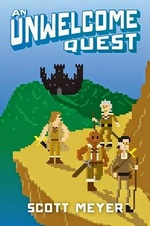
An Unwelcome Quest by Scott Meyer

An Unwelcome QuestAn Unwelcome Quest

by Scott Meyer
Series: Magic 2.0, #3
Kindle Edition, 434 pg.
47North, 2015
Read: December 3 – 4, 2015

On this dry, stony outcropping, there was a castle so Gothic it might as well have been wearing black eyeliner.

Beneath the shadow of that Phillip and three of his friends/fellow wizards have learned that they’re part of a real life video game, with real life stakes.

How’d they get there? Well, one of the first things that every wizard is told when they come back to Medieval England is that if they become a threat to the wizards way of life, they’ll be stripped of their powers and returned to their own time. In Spell or High Water, we saw one wizard find a work-around for that. Turns out, he inspired another one, Todd, to do the same. Todd’s careful, and he bides his time before revealing to anyone he’s come back so that he can cook up an elaborate revenge scheme against those that he primarily blames for his exile. They have to survive a lethal video game for a chance to battle Todd face to face.

Since Todd was sent away before Martin and Roy arrived, Todd ignored them, leaving Marvin free to go grab Brit (the Younger) and Gwen to help. Their experience in the game is a little different than the others’ — for one, Todd doesn’t realize they’re there, so what happens to them is just part of the program, there’s no interaction between Todd and them, so there’s no obstacles or challenges designed with them in mind.

Once the setup was explained, I figured there’d be a lot of satire of video games, or this would end up being a parody of some. Not at all — sure, this isn’t a particularly well-designed game, so there’s some critiquing of the game, but that’s about it. Meyer finds his humor elsewhere (phew!). Mostly, the game is pretty easy — sure, there’s some disgusting bits, some dangerous parts, but on the whole, the “players” spend a whole lot of time without much peril. Parts of the experience were almost nice:

The men also agreed that the woods were quite nice and that hiking through them might be rather pleasant if they had a choice, but they did not. Unfortunately, human nature dictated that anything, no matter how pleasant it is, can become hateful if you feel you must do it. Just ask anyone who’s ever entered a pie-eating contest.

As is the norm by now, this book is filled with Meyer’s particular brand of humor — some word play, some situational humor, some sarcasm, some character-driven humor. There’s some friendship, some romance, a little villainy, and some stupid pranks. All told in a charming, engaging way.

I do think it’s time for this series to end, but I’m going to miss these characters and their banter, this world. This book made me laugh out loud, which I don’t do often enough while reading. I’m pretty sure this was the first time I’ve chuckled at a waterboarding joke (don’t worry, it’s not offensive in context — really) — any book that can pull off that feat is worth a read.

Seeing that on the screen, that last sentence seems to be damning with faint and objectionable praise — really, it sounded good in my head.

—–

3.5 Stars

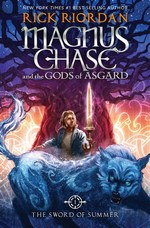
The Sword of Summer by Rick Riordan

The Sword of SummerThe Sword of Summer

by Rick Riordan
Series: Magnus Chase and the Gods of Asgard, #1

Hardcover, 491 pg.
Disney – Hyperion Books, 2015
Read: November 6 – 7, 2015

Maybe you’re thinking, Oh, Magnus, you didn’t really die. Otherwise you couldn’t be narrating this story. You just came close. Then you were miraculously rescued, blah, blah, blah.

Nope. I actually died. One hundred percent: guts impaled, vital organs burned, head smacked into a frozen river from forty feet up, every bone in my body broken, lungs filled with ice water.

The medical term for that is dead.

Gee, Magnus, what did it feel like?

It hurt. A lot. Thanks for asking.

Welcome to Rick Riordan’s latest tale of the offspring of mythological deities and the humans silly enough to fall for them. We’ve done the Greek pantheon, spent some time with the Egyptians, and came back for another round with the Greeks — this time with their Roman counterparts, but now we’re in for something new: Norse mythology. A whole new kettle of fish. This involves a new type of central character, a new kind of setting, new challenges. Which gives us the best thing from Riordan since the Percy Jackson & the Olympians series.

Magnus Chase is a homeless teen, orphaned a couple of years back when his mother was killed. Since then, he’s lived on the streets of Boston, spending his days in museums and libraries, learning as much as he can about whatever, and establishing relationships with generous restaurant employees and fellow homeless people. Two of whom track him down one day to let him know that there are people looking for him. It turns out that this is his sixteenth birthday and life just got a lot more dangerous for him. The people seeking him are family and they’re sure that he’s about to be hunted by beings he doesn’t believe exist.

The quotation above shows how well that being hunted works out for Magnus.

But he goes down fighting — to save himself, bystanders, and a couple of friends. So a Valkyrie (who happens to be Muslim, a combination that fascinates me) takes him to Valhalla — where he makes some more interesting friends, and enjoys a quality of (after-)life that’s far better than the streets. But then, someone casts doubt on the worthiness of his selection, which puts that Valkyrie in hot water.

So now Magnus has to take things into his own hands, prove that he’s worthy, defend the Valkyrie, and prevent Ragnarok from starting — or, if things go wrong, kick it off. It could go either way, really. One of the best pieces of advice he gets — the thing that inspires him is:

The thing about fate, Magnus: even if we can’t change the big picture, our choices can alter the details. That’s how we rebel against destiny, how we make our mark.

Now it’s just a question of what kind of mark he leaves.

Love, love the voice/attitude, I’ve seen some criticisms of it from parents, but I think it’s fun, and it’s just the kind of thing to feed into his audience (both the target and those who’ve grown up reading Riordan and still read him despite no longer being age-appropriate). It’s the clearest, crispest, funniest narrative voice since the Percy books — and might end up surpassing them by the end of this series.

I really don’t know that much about Norse mythology — world tree, Ratatoskr, Asgard, Valhalla, Odin, ravens, Hel, etc. I’ve got, but the details are really fuzzy. Most of what I know about Norse myth comes from Kevin Hearne’s Iron Druid Chronicles and Jacqueline Carey’s Daisy Johanssen/Agent of Hel Urban Fantasy books. So I’m learning a lot — and I assume younger readers will, too. The few pages of supplemental materials in back of the book are such a nice help! I really enjoy Riordan’s take on these mythological figures — both those I know and those I’m new to. I think the Thor you meet in these pages is fantastic. Yeah, Hearne’s Thor is a better character, but Riordan’s Thor induced more chuckles.

There are some great chapter titles here — I tend to ignore them (anything beyond a number is a distraction), which is short-sighted, I realize, but that’s what I do. In this book? It’d be really dumb to skip them. Every now and then I’d stop to go back and read the last few that I’d missed. If they’re not the funniest (and most creative) lines in the book — they’re in the top 2%.

The tie-in to the Percy Jackson books is obvious (and I felt really stupid having to have it spelled out for me in the opening chapters rather than sussing it out much earlier) and unexpected, but I can’t wait to see how that develops. But even more entertaining are the jokes about aspects of the Percy-verse — flat-out funny, and nice bit of fan service, too. Oh, and they won’t make a lick of difference to the Riordan-novice.

I just realized that I haven’t even addressed the titular sword. I don’t know what to say about it without ruining anything, but if I was eleven years old? It’d be my favorite sword ever — better than Excalibur or anything that Tolkien could offer (as someone much older than 11, I don’t think that, but I wouldn’t argue with my younger self).

One other thing — I read a review from one review site that I respect that dampened by enthusiasm for getting this — but I decided that Riordan had earned my trust (and I was curious), so I gave this a shot. That review complained about the sarcasm — I don’t get that, but apparently that’s a thing for some parents. And they complained about the addition of cussing — now maybe I missed it, but outside of the taking the names of Norse gods in vain (and that could be argued), the only cussing I saw was in dialogue tags. As in “…,’ he cussed.” Seriously? If we have to shield our middle graders from the concept of cussing, they’re not going to survive the middle grades. There were a few other complains that were about as baseless as these — I kept waiting to see these problems as I read and missed every single one.

Which isn’t to say this is a perfect book — but man, it’s the best he’s done in quite a while. The problems I have are really not worth getting into, they don’t ruin the experience, and if you’ve read Riordan before, you’ll be expecting them (they’re less problematic in this book than the last 2-3). The Sword of Summer is funny, exciting, with real heart — just the thing for middle grade readers (or those who don’t mind reading below their fighting weight).

—–

4 Stars

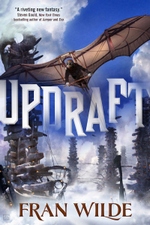
Updraft by Fran Wilde

It’s been awhile since I’ve re-written, honed, revamped, etc. a blogpost so much. I think this is coherent. I should’ve just probably put up the publisher’s description and said “Read it, it’s special.”

UpdraftUpdraft

by Fran Wilde
Hardcover, 362 pg.
Tor, 2015
Read: October 15 – 17, 2015

I don’t normally do this, but let me start with the Publisher’s Description:
In a city of living bone rising high above the clouds, where danger hides in the wind and the ground is lost to legend, a young woman must expose a dangerous secret to save everyone she loves.

Welcome to a world of wind and bone, songs and silence, betrayal and courage.

Kirit Densira cannot wait to pass her wingtest and begin flying as a trader by her mother’s side, being in service to her beloved home tower and exploring the skies beyond. When Kirit inadvertently breaks Tower Law, the city’s secretive governing body, the Singers, demand that she become one of them instead. In an attempt to save her family from greater censure, Kirit must give up her dreams to throw herself into the dangerous training at the Spire, the tallest, most forbidding tower, deep at the heart of the City.

As she grows in knowledge and power, she starts to uncover the depths of Spire secrets. Kirit begins to doubt her world and its unassailable Laws, setting in motion a chain of events that will lead to a haunting choice, and may well change the city forever—if it isn’t destroyed outright.

You know how (if historical fiction I read/watched as a kid taught me anything), fathers used to throw their kids into a creek/river/lake to teach them to swim? That’s pretty much how I felt about Wilde’s treatment of readers: just throw us in, and if we make it out of the first chapter, we’ve learned how to swim. Sometimes that approach works, sometimes it doesn’t — Wilde pulled it off. Like with Uprooted earlier this year, I just want to hang out in this world for a while, it’s so rich. I actually don’t want to live in it (unlike, say, the Tufa’s land), between my acrophobia and aviophobia, I’d be a wreck (at best). But I want to keep reading about this world.

Honestly, this is such a rich world, I’m tempted to talk about it for this entire post — the feel, the history — both myth/legend and what really happened — it’s so rich and real-feeling. We get hints at the economics of the place, the values, history, but just hints. Just enough to make you know that there’s something there. Honestly? I think I prefer not knowing, just being teased when it comes to this world. Can’t forget about the skymouths — these very, very, very strange predators at work here — I don’t know when I’ve last read something so strange. The way that Wilde writes flying is just great, it’s the literary equivalent of the original Christopher Reeve flying scenes. You buy it, you feel it, you want to do it (or you’re filled with paralyzing fear at the idea).

But, obviously, I’m not going to talk about the worldbuilding for the whole post, or I wouldn’t have said that. As great a creation that it is, it’d be nothing without the people and the story. We’ve glanced at the story, so what about the people?

Kirit has ambition, drive — she wants to fly with her mother and trade between with towers, and that’s pretty much it. A nice, happy, well-off life. When that’s thwarted (at least temporarily), she pushes back against the inevitable until she’s convinced that it’s the best option; there’s a little coercion involved, but not entirely. Her best friend, Nat, is similarly driven — but where Kirit is forward focused, all Nat wants are answers about the past. The question for their relationship becomes: can it last when the two have such divergent goals?

In the Spire, there are three main figures that she interacts with, learns from, and is shaped by. There’s Rumul, who’s been calling the shots in the Spire (and therefore the city) for so long that both he and everyone else have a hard time thinking there’s another option. Wik is the Singer who started her trouble, and realized her true potential, and is responsible for her fulfilling that potential. Sellis is her contemporary, who can’t believe that her future is tied to this novitiate doing well.

There’s a couple of younger twins — Moc and Ciel — that are of invaluable help to Kirit as she adjusts to her new reality — every time I read about them I saw WilyKit and WilyKat from the original Thundercats. And honestly I don’t think that’s too far off. There’s Sidra, who might as well be named Nellie Oleson — we don’t spend as much time with her overall as it appears we will at the beginning. I wouldn’t have minded a little more time — but I’m glad we didn’t get too much of her.

Looming over everything are Kirit’s and Nat’s mothers, Ezarit and Elna, and the shadows of their absent fathers. I wish we’d been able to see more of these mothers in action, get to see them being as wonderful as Kirit says they are (assuming she’s right). I understand why we don’t get to see that, why we just have to learn about it, but still, it’d have been nice. And we have to assume that Kirit’s appraisal of them is correct, but that’s probably easy to do.

Each of these characters (and others I don’t want to bog this down further with) are so well drawn, fully fleshed-out, that half of them (if not more) could be edited out and this would still be a compelling read. There are so many overlapping, competing, contradictory, at cross-purposes, motives, plans, hopes that it’s easy to see why any character (particularly young and unknowing) characters would be confused and unsure what to do. Maybe even sure what to do, for a time, and then seeing how they’d been used/mistaken. How often do you get something like that?

This isn’t a YA book, but it’s totally appropriate for that audience, and in many ways it aligns with YA stories/interests — Hunger Games, Divergent, or Red Rising fans will find a lot of the same themes at work. But don’t go into this looking for something like them, you’ll be disappointed. Especially if you’re looking for a love triangle — or any romantic storyline at all.

I saw on Goodreads that Wilde said this was written as a stand-alone, but that there are two sequels coming. This is one of those books that I don’t think needs a sequel, we got a good complete story here — but I’m going to be in line for it. A great piece of worldbuilding, a compelling story and some characters you want to spend time with — Updraft has it all.

—–

4 Stars

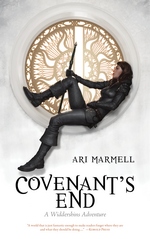
Covenant’s End by Ari Marmell

Covenant's EndCovenant’s End

by Ari Marmell
Series: Widdershins Adventures, #4
Hardcover, 265 pg.

Pyr, 2015

Read: September 10, 2015

So Ari Marmell has decided to bring our time with Widdershins to a close. On the one hand, I understand the choice. On the other hand, I enjoy these too much to let go willingly.

It turns out that the great and nasty demon that she pushed herself and her friends to — and past — the limit to defeat back in False Covenant had friends — or at least family. And thanks to Widdershins old foe Lisette, they are getting closer and closer to setting up camp in Davillon (and probably the whole world, really).

Widdershins has to call on all her allies — old, new, unwanted and not terribly wiling — and friends, play every trick in the book (and invent a few), and be prepared to sacrifice everything just to have a fighting chance here.

Emotionally, spiritually, physically — whatever she’s gone through before is nothing compared to this. While it is very much a team effort, let’s not get confused — her name is in the series title, and she’s the only one on the cover. It’s Widdershins story, and the weight of this falls on her. Yet, she faces the danger with humor, aplomb and panache (and the help the deity living in her head).

For a book as dark, foreboding, bloody and so . . . final; I sure spent a lot of time smiling and chuckling. It’s a quick, exciting read that checks off every tick box you might have for a finale.

—–

4 Stars

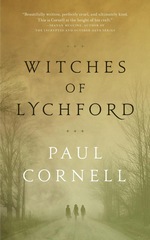
Witches of Lychford by Paul Cornell

Witches of LychfordWitches of Lychford

by Paul Cornell
Series: Witches of Lychford, #1


Kindle Edition, 144 pg.
Tor.com, 2015
Read: September 8, 2015

You ever get nervous about starting a new work by an author? Sure, in retrospect, it may seem silly to doubt, but for every Jesse Stone, there’s a Sunny Randall. As much as I like his Shadow Police series, I wasn’t sure I was up for something else by Paul Cornell. Thankfully, my apprehension was silly, because whether he’s writing about London or a small town, Cornell knows what he’s doing.

The town of Lychford is on the verge of dealing with a major assault by evil forces and for reasons you should discover for yourself, that is not something that can be allowed, because if they are allowed to invade, these supernatural forces will carry the day. So they must be stopped before they can begin in earnest.

These forces are, naturally, a large supermarket chain. What else? They’re called Sovo, and I’m sure they resemble no actual chain (or that Cornell has really good lawyers). But it seems that there’s more to them than low prices and a knack for ruining the lives of small business owners.

Now, your middle class activist types might get riled up by this, but there’s only so much that their petitions and flyers can do against the supernatural (not that they realize they’re going up against powers beyond their ken). Even when the supernatural are primarily using things like empty promises, bribes, and the allure of new jobs, there’s only so much that well-off Muggles can do (to borrow a term from some other series).

It’s going to take people able to see the otherworldly aspects of the PR Campaign that Sovo is waging to win the hearts and minds of the citizenry to thwart them. Now, typically, this is where we’d get someone like Rachel Morgan, Harry Dresden, or Peter Grant to come in and kick a little supernatural butt. Instead, we get such obvious heroes as a crackpot old lady and vicar who’s on the verge of losing her faith. Thankfully, the crackpot is actually a witch of sorts, so they’ve got a fighting chance.

For something a mere 144 pages long, this is an incredibly rich and well-developed world. The magic system seems pretty thought-out and realistic (for lack of a better word). The characters (those mentioned and a couple of others) are sharply defined and could probably carry a story by themselves.

Really, really impressive work — I’d love it if the work were longer, but honestly, I’m not sure if it’d have been as effective if it had another 1-200 more pages to develop everything. I think this ensures Cornell’s place on my “grab anything you see by” list without really caring what the subject matter is.

I was about to hit “Publish” on this when I had this thought — this reads just like one of Bledsoe’s Tufa novels would if set in England. For my money, that’s a pretty high mark.

—–

3.5 Stars

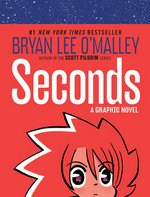
Seconds by Bryan Lee O’Malley

SecondsSeconds

by Bryan Lee O’Malley

Hardcover, 323 pg.

Ballantine Books, 2014

Read: August 14 – 15, 2015


This is a story about Katie — a pretty successful young chef, with a personal life in shambles (are there any chefs in fiction whose extra-kitchen life aren’t in shambles?), on the verge of opening her second restaurant while handing over the reins of her first. She’s been given a gift — from a source she doesn’t understand — to undo the events of one day, to rewrite history — just one, there are rules. After one not-that-terrible-but-certainly-regrettable day, she decides to use it.

Katie’s as surprised as the next guy when it works (assuming, of course, the next guy isn’t in a work of fiction). And she finds a way to break the rules. And does fixes another bad day, and another, and another and soon she’s like the guys in Richard Curtis’ (IMHO underrated) About Time, tweaking and massaging the details of the past to make her present perfect.

However, like I said, there are rules. And we all know what happens when you break the rules concerning magic. Or time travel (ask Marty McFly how things were going for him during The Enchantment Under The Sea dance). Now, actually, I thought emotionally and character-wise were richer and more interesting before the wheels come off Katie’s machinations, but it’s here where things start to count.

If I was a better judge of visual art, I’d have the vocabulary to express this next point. So apologies for that, if I’m confusing here — well, that’s what comment boxes are for. I’m not knocking in any way, the penciling here (or in other works) when I think of O’Malley’s people as cartoon-y, like children (occasionally very adult looking children) doing very non-childlike things. To me, the artwork here in O’Malley’s signature style, isn’t a fit the way it was with Scott Pilgrim. There’s a darkness to the story, a flavor to it that seems at odds with the art. Which makes the art more effective — these are twisted forces that should happen to people that look like they were drawn by Lan Medina or Peter Gross, not the fun and innocent-ish looking characters we meet in these pages. It’s more jarring, unnatural, in O’Malley’s hands.

Very entertaining, a good follow-up to his magnum opus — a different direction, feel, and populated by people with a different set of issues. Did I heart this as much as Scott Pilgrim? No. Because it’s not the kind of story I prefer. Is there anything wrong with it? No. It’s just it didn’t strike the same chord with me, mostly because O’Malley was going for a different chord. Worth your time.

—–

3.5 Stars

Spell or High Water by Scott Meyer

 Spell or High WaterSpell or High Water

by Scott Meyer
Series: Magic 2.0, #2

Kindle, 443 pg.
47North, 2014
Read: August 1 – 7, 2015

“It was an act of stubbornness, not intelligence.” Vic nodded . “Sadly, I find that stubbornness often beats intelligence eventually. Stubbornness will beat anything eventually. That’s the whole point of stubbornness.” Martin didn’t like that idea. He agreed with it, but he did not like it.

This was not as impressive or surprising (or even funny, despite bits like the above) as Off to Be the Wizard. But it was probably a better novel. It’s not as fun, but it’s a better quality read.

It’s been a couple of months since Philip assumed the leadership of the wizards in Medieval England, and he’s getting bored. When the invitation to a summit of all the magic users in the world comes, he and Martin agree to represent their group. The women of Atlantis are the organizers, and they bring 2 of every group — all over the world and from all sorts of times. Turns out a lot of people have figured out how to tap into the computer program, and they’ve come up with unique ways of interacting with it. The summit is to come up with some rules to govern the use of magic (or whatever the groups call it) and how to stop/punish people like Jimmy (more on him in a bit) who abuse it. Before they can get into the meat of the summit, these two have to deal with a murder mystery, political intrigue, romance, romantic problems, and questions of free will/determinism (because who doesn’t think that sounds fun?).

Naturally, there’s a heckuva surprise waiting for them when they get back. But that’s not for me to get into.

Atlantis is run by sorceresses, and is really the only place on Earth (throughout history) that they’ve felt safe and comfortable — which is a pretty big indictment of the rest of the world, really. This is not to say it’s the land of the Amazons or anything — there are plenty of men around. Someone has to do the non-magical work around the city, right? The male culture that has arisen is the source of plenty of cheap jokes as well as a little cultural criticism for Meyer. Atlantis as a whole — the city and how it’s made, the political structures, the male/female roles, the culture — this is the best thing that this book has to offer. Meyer really had to put the thinking cap on to come up with this — and to keep it entertaining.

I realize the previous book ended with a strong indication that the vanquished foe wasn’t down for the count. But I’d hoped that we wouldn’t see too much of him anytime soon. So much for that. Jimmy, the Wizard formerly known as Merlin, was around for a major role in this book. A larger role, really, than he played last time. Now, I didn’t really like Jimmy as a character — I know we’re not supposed to “like” him because he’s the bad guy, but that’s not what I mean. As a character, he was okay enough for one book (especially a book focused on introducing us to the other characters and world), but I didn’t want/need more of him. I’m still not crazy about him, even after the events of this book that make him a better rounded character.

There’s probably fewer jokes per inch here than in its predecessor. But those that are there were solid, the voice of the narration is light and humorous enough that you don’t miss jokes. I’m not saying there aren’t jokes — there are entire scenes that are little more than extended jokes (most of them worth it). Like its predecessor, there are bits of this book that are just great, are worth going through the whole book for, even if the book isn’t your thing. For example, the conversation that Martin has with Gilbert and Sid, who are magic users who make a living doing stage magic. That conversation hits a sweet spot for me that little else can. You may not react that way to that conversation, but there’ll be similar moments for you (that don’t work that way for me). Actually, almost every conversation between Gilbert, Sid and Martin are pretty good, particularly where the former two explain to Martin why they don’t get along.

It’s the same world as Off to Be — same kooky guys, unique magic system and plenty of chuckles; but with a richer, better developed plot, and a more expanded world. Fans of the first will definitely want to check this one out.

And, hey, learning who it was on the grassy knoll? You can’t pass that up.

—–

3 Stars

Long Black Curl by Alex Bledsoe

Long Black CurlLong Black Curl

by Alex Bledsoe
Series: Tufa, #3

Hardcover, 377 pg.

Tor Books, 2015

Read: June 11 – 13, 2015

5 Stars
This book was practically un-put-downable. Not because I was driven to find out what happens next — like a Finder, or Child etc. This is one of those kind of books you don’t want to put down because you don’t want to leave that world, not for a minute, to step back into this one, as nice as it is — filled with your stuff, and your great wife and frequently tolerable children. But this book’s little corner of Appalachia that touches another world (in more ways than one) is a place you just want to exist in. Granted, I’d rather be in one of the earlier books than this one (not a reflection of the quality of the book, just the events portrayed).

Not all that long ago, especially by Tufa standards, Bo-Kate Wisby and her beau, Jefferson Powell wreaked all sorts of havoc. They were so terrible that they were banished from the community, unable to return — or, worst of all, make music. WHen you think of some of the despicable things that have happened or have been described in the previous two novels by citizens in good standing, you get an idea just how bad this was. Both have spent decades yearning to return, to play music — but have had to settle for incredibly successful careers in the music business. Which would be a special kind of torture and pleasure — being that close but not able to partake, still being able to appreciate it though. Somehow, however, this curse was lifted without anyone realizing it.

Well, anyone but Bo-Kate. She returns to get revenge and bow the Tufa to her will, destroying their heritage, their way of life and instituting her own. Her approach is not subtle, she clearly learned a little bit from the “Shock and Awe” tactics of a recent war. My jaw almost dropped when i saw the first step that was taken by Bo-Kate. I — like most of the Tufa — didn’t think that was possible, or at least likely. Although there was something to appreciate about that action, there wasn’t in the rest of what she did to the community — I can’t think of any fictional character I’ve had such a visceral reaction to (especially this quickly) this side of Joffrey Lannister Baratheon, first of his name.

It should go without saying with this world, the way the rest of the Tufa respond and defend themselves isn’t how you’d expect. Which goes double for how things play out.

Thankfully, I did really enjoy the rest of the Wisbys — especially Bo-Kate’s sister. I hope to spend more time with them. Actually, I liked getting to know all the new characters — including Bo-Kate’s allies (or those characters who weren’t new, but we hadn’t really spent time with). The characters in this community are so well drawn, so real that you almost don’t need a plot to enjoy a book about them.

As always, I’m jealous of the relationship between these people and music. I don’t have it — a couple of my kids do, at least. I think the way the two banished Tufa react to their returning musical ability tells you almost everything you need to know about them. These are books that need to come with their own score, their own soundtrack. Sadly, I don’t think humans are capable of putting out anything worthy of the books. As good as some of the music inspired by this series has been, it’s not good enough to live up to Tufa standards.

Two things that detracted from the book for me. First is the sex. Not that Bledsoe’s a model of Victorian attitudes toward sex before this, but Long Black Curl is pretty sexually explicit — moreso and more often than before (I’m reasonably sure, but am not interested enough to go back and check). I don’t think it was necessary, but don’t think it hurt things. It was just one of those things that seemed to stick out to me.

Secondly, this is absolutely the most straight-forward of the series, which is both a strength and a weakness. It’s more accessible. There’s almost no doubt whatsoever whats going on. The previous two books haven’t been exactly subtle about the magic and how it works out in the lives of the Tufa — but (and I’m struggling to express this the way I want to) they mostly just let us see what happened and say “hey, that’s magic.” There’s some winking and nudging, but primarily the reader has to do the heavy lifting. To switch metaphors, Bledsoe gave us all the numbers and equations, but we had solve for x on our own. But here? It’s all spelled out. It’s somewhat refreshing, but a little disappointing, too.

But that’s just a little tarnish to the series. It’s still one of the best out there. This book changes the world, but not so much that you won’t recognize it — this is all about growth, development. It does my heart good to know that Bledoe is writing #5 at the moment, so we’ve got at least a few hundred more pages of this world to come.

You can absolutely start here, but I think you’d be better off starting with the first, The Hum and the Shiver to you can catch all the nuance and atmosphere and all that. What it means that character X shows up and does Y. That kind of thing. Either way, dive into this world.

—–

4 1/2 Stars

The Library at Mount Char by Scott Hawkins

The Library at Mount CharThe Library at Mount Char

by Scott Hawkins

Hardcover, 388 pg.

Crown, 2015
Read: July 20 – 24, 2015
This is not the easiest book for me to write about. I’m really torn about this. That’s not exactly true. I want to be torn about it. I spent a lot of time hating this book, and the rest wanting to hate it (and coming pretty close). I took a break on page 81 to write a healthy paragraph in my notes, which included, “by page 81 or so, I really had no idea what the book was about other than some guy inflicting horrible abuse — physical, metaphysical, mental, spiritual, psychological, and any other kinds possible — on children. All of whom, for various and sundry reasons are devoted to him.” There had been at least 4 distinct places by that point where I wanted to stop reading. But I received the book in exchange for a review, so I had to press on. It was within 10-20 pages after that rant that I found something I enjoyed.

If you’re reading an almost 400 page book and the first quarter is so terrible you’re only reading by compulsion? It’s not a good book. No matter how good that last seventy-five percent is.

And it was pretty good. There’s a man, who’s moved on beyond humanity after gaining great knowledge — after 60,000 or so years, he has pretty much gained all knowledge. You know that line about sufficiently advanced science appearing magical? Well, imagine that, but sufficiently advanced as to be on Doctor Strange’s level. For reasons unexplained for a very long time, he took a bunch of kids on as apprentices — teaching each of them one (and only one) discipline so they’d be as knowledge able as he is (and the methods he uses aren’t exactly endorsed by the NEA, John Dewey or even The Barnum and Bailey Circus). After a few decades or so, these children are grown, can almost not remember their old life — and the master disappears. Which is when things start to really fall apart. Oh yeah, there’s a postal carrier and a special forces agent who’s probably more skilled than Jack Reacher. And it’s almost impossible to explain how they’re involved.

The worldbuilding is fantastic, really, you’ve seen little like it. At least 3 of the characters are keepers. Plotting is careful and intricate (at times slow, at other times so fast you’ll have a hard time keeping up). I can’t tell you how many times it zigged when I thought it was going to zag. And each zig was completely believable and generally mind-bending. All in all, skillfully written, skillfully told. Still, not for me.

I’m not sure how to rank this. If going off of my reaction to it, I think I’d have to invent a new ranking system, something lower than no stars. But if going off of actual merit — it’s probably a 3.5-4 (maybe 4.5 star). Read it at your own risk. I received this from the people at Blogging for Books in exchange for this review. They probably wish I didn’t.

Uprooted by Naomi Novik

UprootedUprooted

by Naomi Novik

Hardcover, 435 pg.
Del Rey, 2015
Read: June 22 – 27, 2015
I hate, hate, hate when I don’t know how to talk about a book. It just drives me crazy. Uprooted is one of those books. It really needs to be experienced, rather than described. It’s completely familiar, but doesn’t do what you expect. It’s traditional, yet subversive. It deals with timeless stories, but feels contemporary. Utterly fantastic, but so often, feels real.

In short, Uprooted is magical.

I saw someone describe the protagonist and narrator, Agnieszka, as a mix of Katniss Everdeen and Jane Eyre. I like that — not only is it catchy, but it’s pretty accurate. She also reminds me a bit of Belle (especially the Disney version) and Julia from Grossman’s The Magicians.

Uprooted doesn’t grab you like a suspense novel, where you’re glued to the action, the adrenaline. It’s actually more effective and thorough — it draws you in and won’t let you go through the depth of storytelling, Agnieszka’s voice, the people and the world. You just want to live in those words.

On the one hand, I want to gush about this one. But it feels like this one needs to toot its own horn. Read the description, if it appeals to you at all, get your hands on it. It’ll be one of your favorite reads of the year.

—–

5 Stars

Page 49 of 54

Powered by WordPress & Theme by Anders Norén