Tag: Fantasy Page 50 of 54

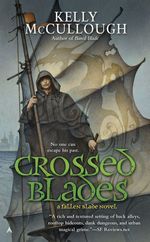
Crossed Blades by Kelly McCullough

Crossed BladesCrossed Blades

by Kelly McCullough
Series:Fallen Blade, #3

Mass Market Paperback, 258 pg.
Ace, 2012
Read: June 8, 2015
So in Bared Blade, we learn that Aral (no longer Kingslayer) isn’t as alone as we’d thought, there’s another survivor of his sect out there, doing what she can to survive and use the talents she’d been honing for her goddess. This time, we learn that there’s at least two more Blades (holy assassins, like Aral) out there — and a few trainees at various stages of development. In fact, Aral’s former fiancée, Jax, has come looking for him specifically.

So, you’d think that knowing he’s not as alone as we thought would help Aral cope, right? Not a chance.

Aral is compelled to go along with Jax on a rescue mission — along the way, a lot of duplicity is uncovered and Jax and Aral learn a lot more about what led up to the day their order and their goddess were killed.

Oh, and then swords and knives were brought out and the blood started flowing. We’re not talking Abercrombie or Martin levels here — but there was a lot of death and destruction. Aral was pretty mad, and got even madder.

And yeah, while a lot of this book was about Aral getting some payback, a most of it was exploring Aral’s character (plenty of time spent with his apprentice and former flame, too) and how he’s coping with all he’s learning, his struggles with the bottle, and what’s going to be next for him and his new face. On the whole, it seemed a whole lot less plott-y than the first two — and it worked.

It’s been two and a half years since I read a book in this series — which is pretty embarrassing, because I thought I was behind by a book — going to do my best to make sure that much time doesn’t go by before I get to the next.

—–

3.5 Stars

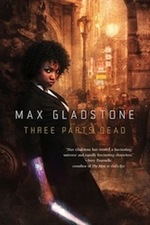
Three Parts Dead by Max Gladstone

Three Parts DeadThree Parts Dead

by Max Gladstone
Series:Craft Sequence, #1

Hardcover, 333 pg.
Tor Books, 2012
Read: June 1 – 3, 2015

Good grief. I don’t know what to say. Three Parts Dead is a unique reading experience. I spent a lot of time not exactly sure I understood everything going on, but I was riveted (and yes, I understood things eventually — just some of the magic took awhile to register).

The closest thing I can come up with to compare this to is Michael R. Underwood’s Shield and Crocus without the super-heroes, but with Wizard-Lawyers, Vampires, and Gargoyles that can eat Anton Strout’s Stannis for lunch.

Forget my attempt at plot summary, it’s just not going to work — click the links above and read Gladstone’s (or whoever put together his site). This is smart, compelling — occasionally gorgeous — writing. The world building is fantastic. These characters — I’m going to be thinking about them for awhile. Actually, that’s true for the book as a whole. I’m going to be thinking about all of it for awhile. Love it when I read a book like that — this one is going to stick with me.

There’s SF elements, fantasy elements, some mystery, a little legal thriller, some oddly pro-cigarette imagery… a little bit of something for everyone, tied together to make something that’ll knock your socks off.

I can pretty much promise you that you’ve never read anything like Three Parts Dead. That may not be enough of a reason to pick it up, but it you really should.

—–

4 1/2 Stars

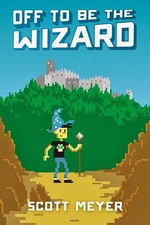
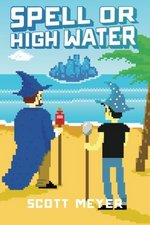
Off to Be the Wizard by Scott Meyer

Off to Be the WizardOff to Be the Wizard

by Scott Meyer
Series: Magic 2.0, #1

Kindle, 374 pg.

47North, 2014

Read: May 23 – 26, 2015

4 Stars

The first thing Martin always did when he found some new data file was to search for his own name. It may seem egocentric, but Martin wasn’t worried about that. He had spent a lot of time thinking about himself, and had come to the conclusion that he was definitely not self-absorbed.

There’s a great temptation — and frequently a rush — when discussing an amusing/funny book in SF or Fantasy to compare it with, well — the name rhymes with Schmouglas Schmadams — this can be damning, because almost nothing can live up to it. So I’m going to resist even saying the name. If anything, I think you could say this was reminiscent of Schmon Schmalzi — only funnier.

Martin Banks is the rather unimpressive hero here — a college dropout, living in a poorly-furnished apartment, working in “a cubicle farm, . . . a fluorescent-lighted, beige-walled abattoir for the human spirit where he had to spend most of his time,” and doing some minor hacking on the weekends, just to amuse himself. He stumbles upon a way to manipulate reality, to change things just a little bit here and there around him. Being human, it takes very little time before he begins using that ability in a way to draw the attention of the Federal Authorities. Which is not all that comfortable, so he heads off to England in the Middle Ages where he figures he can do okay for himself, living as a wizard using these abilities.

That’s when things start to get really entertaining (and I had no complaints up to this point). Anything more I say on this front is a horrible spoiler, so we’ll just leave it with really entertaining.

This is a coming of age tale — and, as it’s about a Millennial, it’s a delayed-coming-of-age story. But Martin’s not one of those protagonists that you have to see mature before you like him — you connect with him right away (or you’re probably wasting your time reading on). He definitely doesn’t mature in your typical way, which is part of the fun. I can’t help comparing Martin to Wesley Chu’s Roen Tan. But without the stakes that Roen had to deal with (and a nicer mentor).

Most of the characters we get to know are met after Martin’s time jump — so don’t worry if you find everyone in 2012 a little shallow and undeveloped. They are, but other people won’t be.

There are several things in the book that won’t hold up to much scrutiny — like his ability to get a smartphone signal in Dover, England in 1150. Adapt the advice Joel and the ‘bots used to give us, “just repeat to yourself . . . you should really just relax.” It’s worth it.

The book is just littered with wit — from the extended jokes, the funny visuals, or little asides like: “The fact that wristwatches weren’t invented yet made it difficult to look impatient, but he managed.” On nearly every page, there’s something to make you chuckle or laugh — or at least grin. I laughed enough that it was annoying to my family — not that I cared, mind you. But it’s not just a yuk-fest, there’s a well-written story here, in a great world with some characters you want to spend time with.

I’m looking forward to the rest of the trilogy and have promised myself that I won’t have to wait too long for it. A great mix of SF, Fantasy, Magic, Computers, the Middle Ages and laughs. What are you waiting for?

—–

4 Stars

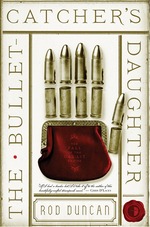
The Bullet-Catcher’s Daughter by Rod Duncan

The Bullet-Catcher’s DaughterThe Bullet-Catcher’s Daughter

by Rod Duncan
Series: Fall of the Gas-Lit Empire, #1

Mass Market Paperback, 364 pg.
Angry Robot, 2014
Read: April 27 – 29, 2015

This, my friends, is how you create a world. And populate it with a great character — and several really good supporting characters. Oh, and manage to tell a rollickingly good story while you’re at it.

The back of this book says that this is supposed to be shelved in “Fantasy,” which is just about the last thing that I’d have put it under, but . . . sure, why not? This is a very alternate history — 1973, but operating on Steampunk-ish technology after a global moratorium on technological advancement (this is just a quick and dirty summary, read the book to really get it). Edwin Barnabus makes ends meet (and that’s about it) working as a Private Intelligence Gatherer with a little help from his twin, Elizabeth, they’re looking for the missing brother of a Duchess — who is more than capable of helping ends meet for quite a while.

Here’s the thing: Edwin doesn’t exist. And underneath her Victorian-era dress, Elizabeth keeps fairly decent disguise so she can go out and about as a male when necessary. There is one pretty noticeable flaw with her disguise, but she’s pretty good at covering it up — but the fact that’s there’s such a chink in her armor makes me like it all the more.

Elizabeth is smart, resourceful, kind — and haunted by a threat from the past. You can easily see this as a later entry in an ongoing series, sort of where everything Elizabeth has worked to establish is jeopardized. The search for this missing brother will push Elizabeth to her extremes, as she dodges debt collectors, representatives of two different pseudo-governmental forces, and some very driven circus performers.

The narration is crisp, and Elizabeth is charming. Her few friends, and at least one person who may be some sort of ally — or patient enemy — are well used to round-out her universe and give her the aid she needs to get the job done.

Give it a shot. This is the first of a duology, and I’m afraid that just might not be enough.

—–

4 Stars

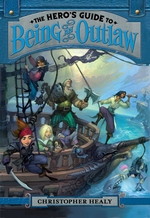
The Hero’s Guide to Being an Outlaw by Christopher Healy

The Hero’s Guide to Being an OutlawThe Hero’s Guide to Being an Outlaw

by Christopher Healy

Hardcover, 516 pg.
Walden Pond Press, 2014
Read: April 2 – 6, 2015
I started talking about the last book in this series by noting that it wasn’t as good as the first. So I should start off here by noting that this is at least as good as the first book.

It’s somewhat criminal that after reading 900 or so pages of this before that I didn’t mention Todd Harris’ art work. The covers are great, but the interior art is what seals the deal. It’s the perfect match for tone and content of writing. Not since Mary GrandPré decorated the Harry Potter books (maybe you’ve heard of them), have I enjoyed illustrations in a book so much. He’s at his best in these pages.

Following the events of Storming the Castle, our friends have scattered, (for the most part) returning home and to their lives as they knew it. They’ve had a rough go of things the last couple of years and have earned a little normalcy.

Until bounty hunters show up hunting them. Which tends to shake things up.

So it seems that that Brair Rose is dead — killed. And who else would anyone suspect but the League of Princes and the Princesses so closely associated with them? So large bounties were put on their heads, and they’ll need all the skills, courage, panache and dumb blind luck they can muster to evade capture and find the people truly responsible.

Meanwhile, the villains that the League, etc. were sure had died at the end of the last book? Yeah, well . . . maybe not. Put the two of these storylines together, add in some pirates, bards and a ghost and you’ve yourself a heckuva read.

Like the best kids’ entertainment, this includes a few reference and jokes fit for adults while sailing right over younger heads (without slipping into innuendo). My favorite example was when the (however temporarily) imprisoned Princesses met the imposing woman Val Jeanval who stole a baguette in order to use it as a weapon.

I started to list off all the goodies this book contains, when I realized my list sounded like someone else’s, so I’ll just borrow Grandpa’s: “Fencing, fighting, torture, revenge, giants, monsters, chases, escapes, true love . . . ” throw in pirates, ghosts, and witches and a lot more royalty than that other book, and you’ve just about described this. It was a fun series, with a fittingly great end. Grab it for your kids, and when they’re not looking (if they won’t share), give it a read yourself.

—–

4 Stars

The Girl Who Circumnavigated Fairyland in a Ship of Her Own Making by Catherynne M. Valente

The Girl Who Circumnavigated Fairyland in a Ship of Her Own Making The Girl Who Circumnavigated Fairyland in a Ship of Her Own Making

by Catherynne M. Valente

Hardcover, 247 pg.
Feiwel & Friends, 2011
Read: February 19 – 20, 2015

But what September chiefly noticed were their hats.
Any child knows what a witch looks like. The warts are important, yes, the hooked nose, the cruel smile. But it’s the hat that cinches it: pointy and black with a wide rim. Plenty of people have warts and hooked noses and cruel smiles but are not witches at all. Hats change everything. September knew this with all her being, deep in the place where she knew her own name . . . For one day, her father had put on a hat with golden things on it and suddenly he hadn’t been her father anymore, he had been a soldier, and he had left. Hats have power. Hats can change you into someone else.

There’s much more to be said about the true nature of seasons, sentient keys, the immorality of novelists, the thoughtfulness of smoking jackets, the desires and drives of shoes….But I’m getting ahead of myself.

So last week, I found myself on the end of a batch of pretty heavy books, and needed something light and breezy — hopefully cheery, too. So I grabbed this off my daughter’s shelf (had been meaning to get around to it since I bought it for her 3 years ago). It didn’t at all fit the bill for what I wanted, but thankfully was an enjoyable read about a girl named September and the improbable trip she takes to (and around) Fairyland.

Those were all big words, to be sure, but as it has been said, September read often, and like it best when words did not pretend to be simple, but put on their full armor and rode out with colors flying

Who couldn’t love a hero like that?

While her father is off fighting in Europe during WWII, and her mother is spending her days with Rosie the Riveter (and doing her best to take care of her daughter, it should be stressed — she hasn’t been abandoned), September is convinced to join someone calling himself The Green Wind to go for a ride on his flying leopard to visit Fairyland.

Once there, she meets all sorts of incredible people, creatures, animals . . . and other things that I can’t really describe. She befriends a Wyvern and sets off on adventures — eventually being drafted by the unpopular, practical and efficient Marquess (who replaced, the wonderful and beloved Queen) into retrieving a magic object for her. This quest sends her (literally) all around Fairyland in an effort to obtain this object and save her friends.

The sensibility here is something like taking The Phantom Tollbooth, The Last of the Really Great Whangdoodles and throwing them into a blender with Neil Gaiman’s children books. Almost. To me, and I get the sense that I’m in a distinct minority here, this comes across more as a technical exercise — “how many strange and quirky things can I work into a narrative?” Despite the setting, target audience and obvious authorial skill it feels joyless, there’s no sense of play. Unlike the other works I’ve compared it to, there’s almost no fun here.

Yes, it’s a children’s book. But it’s not just for kids — in fact, there’s a lot here that very few children will pick up on (I’m willing to bet that I missed a trick or two). Not as amusing as I hoped for/expected, still, a good read for children or adults who aren’t afraid to read a book marketed for children.

—–

3 Stars

Gemini Cell by Myke Cole

Gemini CellGemini Cell

by Myke Cole

Nook, 384 pg.
Ace, 2015
Read: February 4 – 9, 2015He started off strong three novels back, but Myke Cole is one of those authors who gets discernibly better with each book (I assume that will stop at some point — not that I’m in a rush for it), and this one seems like a major step beyond Breach Zone. So when I say this is a well-written book, I mean really well-written. But man, I really didn’t enjoy this book. It’s not his fault, well, let me rephrase it: it’s not Cole’s abilities or voice this time. I don’t know what it is. I guess I just don’t like the story or the characters all that much, as skillfully as they’re delivered to us?

Early on in the Great Reawakening, years before (possibly many) the Supernatural Operations Corps is in full swing, the U. S. Government has begun to use magic resources for its own ends (and, presumably, other nations are doing the same). One of these resources is a magician who can take the recently killed and unite their body and mind (slash soul?) with the mind (slash soul? again) of a long-dead warrior to create a Firestorm-like entity to use as the ultimate special-forces operator. Because somehow, this union gives them super-strength and abilities, while not feeling any pain or bleeding. As they’re technically dead, they can use them for anything, and if things don’t go right on the mission — oh well, what’s one more corpse? It’s a little more complicated than that, but that’ll do for now.

So, we have Jim Schweitzer, loving husband, doting father, and SEAL. His professional artist wife, Sarah, doesn’t fit in with the other Navy wives, and is really tired of not knowing where he is, when he’ll be called upon for a mission, and so on — puts her foot down. Family or Team. Just as he’s about to choose, a hit squad of people who shouldn’t know who he was, somehow find out and invade their home, wounding Sarah and their son and killing Jim. Giving the magician a fresh subject. Jim turns out to be one of the best (if not the best) of this reanimated soldier project, partially because he holds on to his humanity and memories better than most.

Sarah and Jim’s team member Steven, grieve his death (unaware that he’s not totally dead) and support each other in this time — while trying to figure out just what happened to his body, which is mysteriously not available for burial.

There’s one character we spend far too much time with given what happens to him/her by the end of the novel. One character who might as well be twirling a mustache in a couple of scenes. Mostly, everyone is this mix of motives, morality and action which are probably intended to depict the gray-ish nature of us all, but frequently come across as the products of an indecisive narrator. Jim battling his new soul-mate for control is just the most obvious example of the good vs. bad in all of us.

Cole explores similar themes to his past work — how honorable people/soldiers can function in inherently less-than-honorable conditions and systems. Who, ultimately, do soldiers fight — and why they do so. Cole’s said that this is to be a not at all subtle metaphor for PTSD, and I can see that — I’m just not sure it’s a helpful one (yet).

While I said Cole’s at the top of his writerly game, this isn’t a perfect book. At least once, he repeated a metaphor within a couple of pages (I don’t normally get that picky, but that one really took me out of the moment). And his sex scenes? Not good. They’re not Tom Wolfe bad, don’t get me wrong. But they read like . . . exactly like a sex scene written by a guy who’s better suited for describing Special Operations forces eliminating high-value enemy targets.

My major beef with this book is the magic. We’re four novels into this world by now, and the previous three have established some pretty clear rules for magic — at least the types of magic usually displayed in the U.S. But it’s clear that there might be variations throughout the world. So, it’s believable that we’d find another type of magic here. Also, this takes place quite a while before the Shadow Ops series, so changes may have occurred between now and then — if magic can appear and reappear, it can evolve, right? But it still feels too different (realizing I might have misunderstood this book, or the three others) — particularly the different (deeper?) magic that comes into prominence in the final chapters. I’m not saying there’s not a decent explanation for this, there very well may be — but given what we know about the universe this just doesn’t work. Which shouldn’t take away from the really strong and effective way that Cole used this bending/breaking of his own rules, because the last couple of chapters were great.

See what I mean? I can’t decide what I think about Gemini Cell — and I’ve been thinking about this for a couple of weeks, started writing this three days ago (you probably can’t tell that a lot of effort was put into this, but trust me). At this point, the only thing I’m sure of is that I’ll be back for the sequel, Javelin Rain, and hopefully that’ll wash all this away.

—–

Rating: I’m still not sure — somewhere between 2.5 – 4.5, I think.

Endsinger by Jay Kristoff

Endsinger (The Lotus War, #3)Endsinger

by Jay Kristoff

Hardcover, 432 pg.
Thomas Dunne Books, 2014
Read: Dec. 16 – 23, 2014

Let me show you what one little girl can do.

Of course, if you’ve read the first two novels in The Lotus War, you’ll know the list of what this one particular little girl can’t do is probably much shorter. The only question at this point is, can one little girl survive?

Kristoff has quite the wringer to put you through before you get the answer to that. For example, within the first thirty pages — thirty — Kristoff reveals something about a character I’d grown to have a certain affection for, and pitied after what happened to them in the previous book which makes me question everything I thought about them. And then he does something to that character I’m not sure I’ll forgive him for (will still read him, don’t get me wrong, I’ll just bear a grudge).

On the other hand, Endsinger is filled with so many fist-pumping moments, and fun sentences — like

Hiro laughed like a man who’d only read about it in books.

that you can keep pressing on — and actually enjoy the book. Another example of this:

Michi’s foot connected with the Inquisitor’s groin like a redlining goods train. It was the kind of kick that made one’s testicles throw up their hands and move to a monastery in the Hogosha mountains. It was the kind of kick that made orphans of a man’s grandchildren.

I mean, that’s something that Bruce Willis should be saying as he takes on Hans Gruber’s second-cousin or whatever.

I’m not going to describe much plot-wise here. It’d be too difficult to do it justice at this point — if you haven’t read the first two books anyway, there’s not a lot you’ll understand here without a lot of effort on my part. And if you’ve read the first two, you don’t need that to be an inducement to read the this one. It’d be easy in a book like Endsinger to just point every character at the final battle, throw in an obstacle or two along the way and let that be that. Heck, just coming up with an excuse to have Yoshi and Buruu travel around for 70-100 pages as the best buddy comedy pair to come along lately would’ve been a very satisfying way of spending time before the big battle. Instead, we get character development — a lot of it. We get mysteries explained. We get new characters, we learn new things about characters that we’ve known really well since book one (or thought we did, anyway). And they’re all thrown at a couple of really big battles, with some obstacles to overcome along the way.

The themes of the first two books continue to be explored here. The two that stuck out the most for me were: what makes a hero, what do they look like and what’s worth fighting for — honor, family, love, something else. Heroes aren’t what you think they are, don’t look like you think they should like — even (especially) to themselves. But everyone knows one when they see and/or hear one. As for what’s worth fighting for? That’s different for every one.

You don’t think people should know what happened here?”
“Oh, I think they should know, no doubt. I just don’t think they’ll care.”
“How could they not?”
“Because it will be different next time. It always is.”
“Different?” Akithito frowned at the cloudwalker captain.
“Different,” the Blackbird nodded. “Whatever they fight over. It’ll have a different name or a different shape — religion or territory or black or white. People will look back on us and say ‘we could never be that blind.’ People don’t learn from history. Not people who count, anyway.”

There’s a measure of cynicism, realism and idealism in Kristoff’s exploration of these (and other) themes. It’s tough, and probably ill-advised, to try to pin one of these viewpoints on Kristoff. But it seems to me that idealism’s voice is a bit louder than the rest.

Kristoff is great at keeping you on your toes. Things are bleak, but you start to think that hope is on the horizon, that one cavalry or another is coming — and coming soon. And then the hope is dashed. Or you start to think that all hope is gone and things are going to fall to ruin, and this is going to turn into a YA historical dystopian series, but then a new source of hope, a new rabbit gets pulled from a hat. He blindsides you time after time, from every direction.

Kristoff is great at his pacing, there are many moments he lets breathe, lets the readers and the characters observe everything going on, taking in all the sensory information and the thoughts of everyone. But he’s also capable of throwing in a sudden scene to grab the reader. The quick scenes bouncing around between the various characters in the heat of battle really work well to keep the tension high (though that can be a bit confusing unless you force yourself to slow down and read carefully — which is the last thing you want to do at that moment).

After awhile — about three-quarters through the book, after all the death, destruction, and (seemingly) climactic confrontations and battles getting you to that point, you simply can’t believe Kristoff can keep it going. How can the book last so many more pages? Is he going to give us a Peter Jackson’s Return of the King-style multi-epilogue? Probably not, it really seem to be Kristoff’s style. And then Kristoff shows you how he’s going to fill the rest of the book, and you pity all his characters, even those you’ve grown to despise, because that’s just not right.

In the end, Endsinger is a very satisfying conclusion to one of my favorite series in recent years. It’d have been easy for him to go for a “Everybody lives, Rose” kind of thing, where Hiro and the Lotus Guild are destroyed, Yukiko and Buruu are universally hailed as heroes, the Kage take over, and happily ever after. But he doesn’t give us that. Instead, we get the kind of conclusion promised in the first two books: it was emotionally satisfying (and induced a wide range of emotions, and may have involved a Kleenex or two on my part), it gave characters real conclusions to their arcs (not all happy endings), it tied up what needed to be tied up and it pointed towards the future. I’m going to miss this world and most of these characters. But I’m glad Kristoff didn’t try to milk this longer — it’s great as it is.

—–

5 Stars

Pickles and Ponies: A Fairy-Tale by Laura May

Pickles and Ponies: A Fairy-TalePickles and Ponies: A Fairy-Tale

by Laura May

Kindle Edition, 263 pg.
Kindle Direct Publishing, 2014
Read: November 1 – 3, 2014

Everybody knows that good princesses are always pretty, just like wicked step-mothers are always ugly and covered in warts: and Melodia was no exception to this rule. By this time she was nearly nineteen, and she was tall and healthy, with rather a wistful look to her. You probably want to know her hair colour as well, because you’ve heard how that impacts upon personality. Scientists all over Raduga (with the word ‘scientist’ being used somewhat loosely) have conducted several studies into the effects of hair colour. They’ve found that while it seems to matter very little for the princes of the realm, for princesses it’s quite the opposite. Blonde hair indicates beauty and fragility, while brunettes are supposedly street-smart and intelligent. Of course, these studies were all funded by the Prince of Hairdressers, who was allegedly running a hair dye cartel…

If Douglas Adams were to write a fairy-tale style story for a YA audience, it’d sound a lot like this. Which is at once the strength and the weakness of the book. Once you start with this voice, you’re stuck with it — it’s a commitment you have to follow through with. May does a fine job of that. But, unlike Adams, she sometimes lets her voice, her storytelling style, get in the way of the story.

But, while occasionally distracting and annoying, it’s not fatal. And if you read this in smaller chunks — I read it in two sittings — you might not even notice (at least not as much as I did).

This is a cute YA take on fairy tales, a tale of magic, friendship, and a search for true love in a land where everyone is a prince or a princess (if they’re not a King or a Queen). There’s really not much else to say. She’s not giving us fractured Snow White or Cinderella, etc. May’s working from a blank canvas — what’s happening in the castle to the right of Prince Charming’s.

Again, like Adams, I’m not entirely convinced that May’s world is really that coherent — but it doesn’t matter, the world she’s put this in is just a place for her to tell jokes and have silly things happen. Like this:

By the time nine months on the island had passed, Melodia was bored out of her wits and sorely lacking in company. She tried talking to rocks, but they were stoney in their silence. She tried talking to the moss, but it just wasn’t a fun guy. The trees asked her to leaf them alone, and eventually the princess was reduced to talking to her own reflection in the lake.

I laughed, I chuckled, I groaned, I was charmed — and I was entertained. What more could you want?

—–

The author was kind enough to provide me a copy of this book, providing me relief from the murder and mayhem I’ve found myself reading this year.

—–

3 Stars

The Scriptlings by Sorin Suciu

The ScriptlingsThe Scriptlings

by Sorin Suciu

ebook, 372 pg.
Smashwords, 2014
Read: September 6 – 8, 2014

For reasons I can’t quite put my finger on (it may have something to do with all the Douglas Adams and Terry Pratchett references I saw when reading about the book), I came to The Scriptlings with a degree of trepidation. But it didn’t take long for the book’s charm and wit to get me past that and buy into its premise and style.

Scriptlings are apprentice magicians. Magicians are born gifted — either from a magician parent or two, or the occasional child of muggle parents. Well, until now, anyway, but that’s not for me to say. For reasons that aren’t sufficiently described (and don’t need to be), each magician picks a name for themselves, the more disgusting the better. So we focus two Scriptlings and three Masters — Buggeroff, Merkin, Master Loo, Master Dung, and Master Sewer. Yeah, some of those names you really don’t want to spend that much time dwelling on, but thankfully, they quickly lose their typical connotation and just become strange names like something you’d find in any fantasy novel.

I should also mention Gertrude. The sentient and magical goat (Loo’s familiar) who occasionally thinks that she’s snake, and acts accordingly. At first, I thought she’d be a quick throwaway joke that we’d move on from quickly, but in the end, Gertrude’s a pivotal character, and brings a lot of the emotional weight to the plot.

It’s dangerous to try to quantify things like this (aside from actual word counts), but I’d wager that 1/3 of this book is made up of character and story, the other two thirds are style, attitude and jokes. I should stress this isn’t a complaint, or at least not a big one, anyway. Generally, I’d prefer that ratio to be 50/50 at least, but it works for this book. So yes, the plot is pretty slight — but you’re too busy being amused to worry about that. I should add that I really liked his use of footnotes, he’s not quite as good at it as Josh Bazell or Lisa Lutz, but who is?

I’ve seen the blending of magic and computers before, but not quite like Suciu has formulated it. That was clever enough in and of itself — you surround that with his humor and you’ve got yourself a fun way to spend a couple of hours. Ignore the Adams and Pratchett comparisons, think more Christopher Moore in Bloodsucking Fiends or You Suck. If you liked that, you’ll likely enjoy this.

This is billed as the first of a trilogy, I’m not sure I see where Suciu is headed, but I’m interested in seeing it.

—–

Note: The author was kind enough to provide me a copy of this book in exchange for a review.

—–

3 Stars

Page 50 of 54

Powered by WordPress & Theme by Anders Norén