Tag: Fantasy Page 51 of 54

The Magician’s Land by Lev Grossman

The Magician's Land (The Magicians, #3)The Magician’s Land

by Lev Grossman

Hardcover, 401 pages
Published August 5th 2014 by Viking Adult
Read: August 16 – 20, 2014

This is one of those books that I’ve been waiting for since about 30 minutes after I finished the previous book in the series — and at the same time, one I didn’t want to arrive, because that means I have to say good bye to Quentin, Brakebills, Fillory and the rest of the gang. The nods to Lewis’ The Last Battle were pretty obvious, but naturally, there was a lot more going on than that. Unlike Lewis, the book never really felt like the end of anything but a chapter in the lives of most of these characters, and that their lives went on beyond these pages (you know, those that survived). I really like that kind of finale — one which is definitely an end to the story, but one that the characters go on from, having adventures (however mundane those may be) that we don’t get to see.

It’s obvious straight away, that Quentin didn’t respond too well from the events of The Magician King all too well — but for the record, neither did Eliot. So at least that’s fair. We get Quentin’s story told to us in two timelines — first, in the present, and the other starts shortly after King. I’m sure there was a point to that, but it didn’t strike me as necessary (although I should add, now that I’ve typed this, I can actually start to appreciate why Grossman may have chosen this. Still, I’m sticking with not necessary). But it didn’t interfere with anything, either, so I’m not going to complain.

Upon his exile, Quentin ends up at Brakebills, looking for answers, looking for hope and ends up becoming an entry-level professor there. And he’s good at it, for the first time, really since his student days there, he seems content, he seems at home. You really start to think that he’s got a happy ending in a quiet life ahead of him. And you know that you’re wrong, if only because the book has a lot more pages in it — but also because you know Quentin. Still, it’s a nice oasis for both character and reader.

In the present, however, Quentin’s part of a magically powered team of thieves — by the time you get an explanation for how he ended up in this situation, with his new companion/disciple Plum, you almost don’t care. You’ve just accepted this reality, and really want to find out (as much as Plum and Quentin do) just what they’re after and how they can pull off their heist.

Part of their research requires a trip to Fillory’s Antarctica campus. Which I’d forgotten all about, much to my chagrin. Instead of traveling there as birds, they opt to travel as blue whales. A choice I just loved.

[Quentin]’d imagined that he’d get some kind of deluxe ocean-vision as part of his package of new whale-senses, but in fact he didn’t see much better than he had as a human. With his eyes on different sises of his head his binocular depth perception was shot, and having no neck, all he could do to change the view was roll his eyes around or steer his whole humongous body. Also, unnervingly, he didn’t seem to have any eyelids anymore. He couldn’t blink. The urge decreased over time, but it never completely went away.

The whole whale episode — all 3 pages and change of it — was so brilliant, that even if the rest of the book was a wreck, I’d be tempted to give it 5 stars. Your results may vary re: the whale sequence, but I can assume there’ll be something like that for you. There are lots of little moments like this in this book vying for a spot in your personal Top Ten Moments list — like, say, Eliot engaging in single-combat, or learning about the restorative power of bacon.

Meanwhile, back in Fillory, the world is ending. And, sadly, that’s not hyperbole. Enter The Last Battle parallels. This part of the book could’ve been doubled in length and I wouldn’t have blinked a bit. Eliot and Janet take off on a quest to see if it’s possible to stop the world ending — and if so, you know, to stop it.While they’re on this quest the thing that struck me most was how little we ever got to see of Fillory (and nearby lands and peoples), and how much more I wanted to see, so I really enjoyed that aspect of the story. There were some great moments for Janet in particular here. Eventually, as the world begins to end, a massive civil war erupts magical and non-magical creatures fighting against each other, alongside the humans. From Janet’s perspective we see much of this, including what happens when unicorns and centaurs enter the fray on opposing sides:

You only had to see a unicorn lay open the side of a centaur once, the ribcage flashing white when the ripped skin flopped down, to swear a mighty oath never to fuck with or even look at another unicorn again. I’m putting down the hearts and fluffy clouds and backing away slowly. Don’t want any trouble here. You can have all the rainbows.

Yet, as usual, as interesting, explosive or world-ending as the other story might be, if it didn’t involve Quentin, I just couldn’t care as much. The further into the story I got, I did get more invested in the non-Quentin story than I initially was — and it was epic enough, important enough that I should’ve been invested, but without him it wasn’t as compelling. Quentin was our entry point to this world (these worlds, rather), and he stayed the focal point. So even an actual pending apocalypse paled in comparison to Quentin as Brakebills professor. By the end of the book, this wasn’t as true as it was in the beginning, but it spent too much time being true for me to overlook it. Thankfully, shortly after that, all the storylines merge, the band gets back together (with some needed augmentation), and they finally get a solid answer about whether they can prevent the end of Fillory.

Ultimately, Quentin’s not the hero of the series, nor is Janet, or Eliot, or anyone else. It’s Grossman — his use of the characters, his use of — and exploitation of — fantasy tropes, his messing with fantasy tropes, his facility with language, metaphor, and humor is what makes this series stand out.

As with the other two books, Grossman’s word choice is this great, seamless mix of poetic, flowery, rich vocabulary (I occasionally had to look up words to make sure I was sussing out the context clues correctly) with non-ironic uses of things like “lulz” or “I heart you.” Somehow, he’s able to pull this off without the reader blinking — or even noticing it most of the time.

Grossman starts in right away puling the reader in with:

Quentin didn’t care. It was a bookstore, and he felt at home in bookstores, and he hadn’t had that feeling much lately. He was going to enjoy it. He pushed his way back through the racks of greeting cards and cat calendars, back to where the actual books were, his glasses steaming up and his coat dripping on the thin carpet. It didn’t matter where you were, if you were in a room full of books you were at least halfway home.

There’s not a reader in the world that doesn’t know that exact feeling, hasn’t had that experience. It’s sort of a magical moment before the plot begins. Then a few chapters later, he somehow supports and underlines this moment, while undercutting it with:

The lights were too bright, and there were too many TVs, but it was a bar, and that was another place, like bookstores, where Quentin felt at home. Drinks were a lot like books, really: it didn’t matter where you were, the contents of a vodka tonic were always more or less the same and you could count on them to take you away to somewhere better or at least make your present arrangements seem more manageable.

The tragic, inevitable, brilliant, and awe-inspiring climax was the way this saga had to end. It wasn’t the ending you wanted, but in retrospect, you totally you did want this ending. If that even makes sense. Grossman has given contemporary fantasy readers a real gift here in this series and I think it’ll be one that holds up pretty well to re-reading and the passing of years. I certainly look forward to testing that hypothesis. If you’ve read this far, and haven’t read The Magicians, go get started with that one, and I dare you not to plow through the rest.

—–

5 Stars

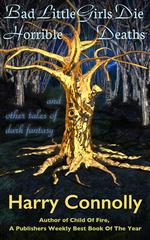
Bad Little Girls Die Horrible Deaths by Harry Connolly

Bad Little Girls Die Horrible Deaths and Other Tales of Dark FantasyBad Little Girls Die Horrible Deaths and Other Tales of Dark Fantasy

by Harry Connolly

ebook, 153 pg.
Radar Ave Press, 2014
Read: July 29 – August 23, 2014

By and large, I am not a fan of short stories. The length is typically frustrating for me — even when they don’t remind me of the various anthologies I had to use in Lit classes throughout my High School and College years. Still, I try every now and then to read some. Finding a good short story is as rewarding — if not moreso — than finding a good novel. This is a collection of ten short stories and one novelette — six of the stories are reprints, the others have been published for the first time in these pages. The novelette belongs to Connolly’s criminally under-appreciated Twenty Palaces series, and would be worth the purchase price for fans of that series. If you’ve never read that, but are interested in in trying out a variety of new fantasy worlds (including one that has some books to go with it), this is a great investment.

There was one story in the batch that I didn’t like. But even as I read it, and wasn’t enjoying it, I realized there was nothing poorly written/constructed about the story. It just wasn’t my thing. I don’t care who told the story, or how they did it, Don’t Chew Your Food wasn’t going to work for me. It’s a pretty straight-forward horror kind of thing, and that just doesn’t do it for me.

That out of the way, let’s focus on the pluses. This was a nice little variety pack of stories — the styles were all over the place, one (Hounds and the Moonlight) read like something the Brothers Grimm would’ve appreciated, another (Cargo Johnny) felt like it should’ve been introduced by Rod Serling, and another (Beyond The Game) demonstrated that Connolly can do funny — which is nice to see (also nice to have a little palate cleanser after all the mayhem and destruction).

The One Thing You Can Never Trust is a great introductory story — in just a few pages we have a political system (or two) unfolded for us, society’s way of (not) dealing with a racial divide and a new magic system. All while telling a tidy little crime story. Bad Little Girls Die Horrible Deaths is similarly a great short burst of world building with a fresh magic system — and some wonderful monsters, both human and not. Great opening paragraphs, grab you and make sure you’re along for the ride.

The main reason people are going to be picking up this collection is for the Twenty Palaces story: The Home Made Mask. And they are right to do so. I cannot get enough of this series (sadly, I’m a member of a very exclusive club). The fact that Ray and Annalise aren’t in the story much doesn’t affect that — this is the strange, creepy, capricious kind of magic at work that makes this series so compelling. Tempted to buy some Power-ball tickets just so I can commission some more of these.

I think my favorite story was Lord of Reavers, which is the closest thing to “traditional” fantasy. This tale of an almost super-human swordsman joining up with a band of raiders was great. I felt that I should’ve seen the conclusion coming sooner than I did, but it was so much fun I’m glad I didn’t. I’d read a novel or more starring this character — easy.

Most short story collections are uneven at best, full of ups and downs. Bad Little Girls . . . is an exception — 1 down, and 10 ups. Can’t ask for more than that. You’d do well to give it a try.

—–

4 Stars

He Drank, and Saw the Spider by Alex Bledsoe

He Drank, and Saw the Spider (Eddie LaCrosse, #5)He Drank, and Saw the Spider

by Alex Bledsoe

Hardcover, 320 pg.
Tor Books, 2014
Read: August 6, 2014

After a couple of adventures which aren’t quite typical in their nature, Eddie La Crosse gets back to basics with a fairly straightforward case. Well, that’s not exactly true — it ‘s just that the last two were more outlandish, more grand-adventure-y, less LaCrosse-as-sword-jokey. This is Eddie doing what he does best. Yes, there’s magic, and monsters, and all the other trappings that keep this from being something that Sue Grafton or Dennis Lehane would’ve written.

Sixteen years ago, Eddie promised a dying man on the run that he’d take care of the baby that the other man was running to protect. He found a seemingly-trustworthy family willing to take the infant in, and went on his merry way, and actually forgot all about the incidents surrounding that. Until years later, when Eddie and his girlfriend, Liz, are on vacation in that area, when suddenly it all comes back to him and he decides to try and track down the (now) young woman and see how she’s doing.

Naturally, things start to go poorly about there. He does find her — pretty easily, too — it is a small community, with an economy largely-based on sheep-herding and farming, so it’s not really a bustling metropolis where no one knows anyone else. But there’s a whole lot of interesting things happening around the young woman — royalty in disguise, a meddling sorceress, an untrustworthy mercenary-type, an over-protective mother, a dose of sibling rivalry, and some sort of articulate and super-strong inhuman creature with a healthy interest in the girl.

Even though he was just supposed to check on her and not interfere with her life — he had no intention of even introducing himself to her. Eddie can’t help himself, and before you know it, he’s neck-deep in intrigue, and danger.

On the whole, this is a fun, brisk novel — a lot of humor, some good action, nice banter and interaction between the characters (especially Eddie and Liz). A good change of pace over Dark Jenny and Wake of the Bloody Angel, which tended to be more on the serious, emotionally-charged side. Yet, even as the answers to the questions surrounding the girl’s mysterious origins become obvious, and some of the characters get to the point where they seemed a irredeemable, Bledsoe (as he can every so well) keeps you completely drawn in and even tugs the heart strings a bit as the truth is revealed to the characters. Just really, really well done.

There’s a lot of nice little touches along the way. For example, towards the end of the book, Eddie and those he’s traveling with encounter a preteen who joins their little band for a while. She’s pretty new to swearing and tries to get in as much practice as she can while with them. At first, I thought she was an odd (but entertaining) and pointless distraction. It didn’t take too long to see she was a perfect tension-breaker, just what that part of the novel needed to keep from being too tense and so much more serious than what had come before.

Eddie’s narration has never been better — humor-tinged and hard-boiled, a medieval Philip Marlowe or Elvis Cole. I liked all of these characters, and really wanted to spend more time with each of them — I don’t know how Bledsoe could’ve pulled that off without getting the whole thing to slow and ponderous (which would’ve sucked the fun out of 60-70% of these characters). This is really such a well-done and fully realized series. I can’t wait to see what happens next.

—–

4 Stars

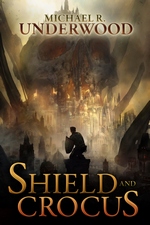
Shield and Crocus by Michael R. Underwood

Shield and CrocusShield and Crocus

by Michael R. Underwood

Paperback, 391 pg.
47 North, 2014
Read: June 26 – July 02, 2014

The level of detail in this world is astounding, it reads like it could be the 4th installment or so in a long-running series — the worldbuilding is just fantastic. I don’t know for a fact that Underwood has the history of Audec-Hal, of these races all mapped out for centuries before, and these characters lives detailed going back to birth — but it reads that way. He seems to know them all that well — but best of all, he doesn’t share all the homework he’s done with you, but you can tell he’s done it. The care, the detail, the intricacy, the strangeness of all of this — I mean strange in a good way, that somehow makes total sense in context — is so impressive. I don’t think I can adequately express my appreciation of the imagination and craft here.

We come into this city which is a shadow of itself — no longer in the heyday of its republic, it’s now a city controlled by competing tyrants. Where the citizens live in a sort of fearful servitude, a new generation being raised to know only this reality, and their elders in danger of forgetting what came before. Now where most writers would put a scrappy insurgency here, made up of soldiers, former government officials, and young ideologues, Underwood zigs instead of zags. Instead? We get the Justice League — or maybe the Justice Society (last time I checked, JSA was more welcoming of elderly heroes) — a band of costumed vigilantes doing what they can to destabilize the tyrants and protect the citizenry.

Right there, that’s enough. I’m in. I’m buying the T-shirts, pre-ordering any sequels, seeking out fanart (feel free to direct me to any shirts or art, btw).

The team’s leader, the Fist Sentinel is a Batman/Blue Beetle (Ted Kord)-esque figure. Getting by on his wits, fists and gadgets (tho’ some of his are magic, something that Batman and Beetle couldn’t say). He’s advanced in years, and doesn’t have much fight left in him, but he’s too stubborn/committed to quit. Then there’s the Shield — a sort-of guardian of the city, a mystic mantle that passes to new bearers after the death of the previous — a literal shield, which gives the bearer increased strength, etc. is the mark of the mantle. The current Shield is the Sentinel’s adopted son — think Captain America dosed by magic instead of revolutionary science. There’s a speedster, a woman with super-strength, someone who can control rocks with her mind, someone with mental powers — and a loosely organized group of mundane types who act as spies.

I’m getting into recapping too much here — this should be enough to whet your appetite. And there’s so much more to say in the setup, the details, the people.

Wonderfully told, well-plotted, well-paced. It’s everything I hoped and expected from Underwood.

But.

I didn’t care about these people. I was curious how things would turn out, I was pulling for The First Sentinel and the Shield. But honestly? I didn’t care about them. I know Underwood is capable of making me care about characters — seemingly effortlessly. But something here was off. I’m able to rave about this as a display of care, skill, and imagination — but there’s a distance between the reader and the characters and I just don’t think he bridged it.

A couple of items other things worthy of note: Both before and immediately upon release, I heard a lot of talk about the map in this book — which seemed a bit odd, but then I saw the map. It is so cool. Possibly the greatest map in the history of fantasy fiction — it’s like nothing you’ve seen before. Underwood states, “It all started with a doodle on the back of a grocery list. Now, rendered by a professional, it is amazing. :)” He’s right. The cover art’s pretty great, too.

Basically, this is a book I admire more than I enjoyed. What Underwood constructed here was fantastic, I just couldn’t connect with it emotionally the way I wanted to (the way I can with most of the people in his Ree Reyes series). His care for the world, for his characters is more than evident. He just didn’t do enough to get me to share that. Your results may vary, you might think I’m out to lunch here. That could be — I still really recommend this novel, just not as strongly as I’d expected to.

—–

4 Stars

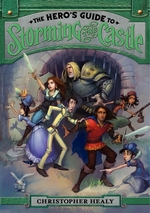
The Hero’s Guide to Storming the Castle by Christopher Healy

The Hero's Guide to Storming the Castle (The League of Princes, #2)The Hero’s Guide to Storming the Castle

by Christopher Healy

Hardcover, 477 pg.
Walden Pond Press, 2013
Read: Jun 17 – 20, 2014

This is not as good as The Hero’s Guide to Saving Your Kingdom, let me get that out of the way. But it’s hard to stay fresh with this time of humor. Still, it wasn’t stale, it was still a fun — sometimes very fun — adventure and a good story for the young — or those that can act young while reading a good book.

After their last adventure, the heroes find out that even in Fairy Tale Kingdoms, you only get 15 minutes of fame. No longer hailed as greats, their loser status has been restored and their lives are pretty much what they were before they banded together. So they all jump at the chance for further excitement, even if it comes in less-than-favorable ways. This time, the band is off to steal

We get all the characters from the first book back (at least the ones that anyone would notice), plus a few new faces — most of which I want to see again. In particuar, the character of Smimf the messenger was a great addition to the cast — he’s the proper mix of ridiculous and impossible. I could’ve used a little more of him — but not too much, I think he’s one of those characters that would grow old pretty quick.

I really enjoy Healy’s way of looking at the world and describing things, I know I posted some quotations last time, so I’ll limit myself to just one taste from this book where he explains the origin of the very nasty Warlord of Dar:

Some peole say Rundark was born out of a mad alchemist’s attempt to distill the essence of pure evil. Others claim he emerged fully grown form an erupting volcano. Although it’s also possible that he was the son of a used-cart salesman from Nebbish Village — they didn’t keep very good records in Dar.

I don’t care what age level you’re writing for, give me paragraphs like that, and I’ll read.

The last thing anyone should think about while reading this is Game of Thrones, but I couldn’t help myself. Someone needs to make a movie of this series, and they cast have to those of Maisie Williams and Rory McCann as Lila and Ruffian (quickly, before Williams grows up even more). If you watch the HBO series, I don’t know how you can read this without seeing the two of them with your mind’s eye as you read this.

I did chuckle at the tip of the cap The Princess Bride — so few in the target audience are going to get it, but for us Moms and Dads out there, it was a nice touch.

Last, but not least: Kudos to illustrator Todd Harris — his drawings are full of life and mirth. They’re the perfect accompaniment for the writing.

A lot of fun, almost as fun as the first book in the series, and well worth your time. I note there’s a third book in this series, and I really look forward to it.

—–

3 Stars

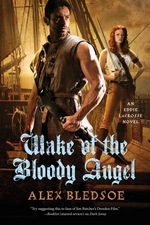
Wake of the Bloody Angel by Alex Bledsoe

Wake of the Bloody Angel (Eddie LaCrosse, #4)Wake of the Bloody Angel

by Alex Bledsoe

Paperback, 350 pages
Tor Books, 2012
Read: May 28, 2014

I looked up at the stars. Finding one pirate after twenty years was a lot like picking one star out of this sky. Just when you thought you had it, a cloud slid by and you had to start all over when it passed.

Yet that’s just what Eddie LaCrosse sets out to do — find the unfindable, track the untrackable. For those of you who don’t know — Eddie lives in a fairly standard fantasy realm, and makes his living as a “sword jockey” — what we’d call a P.I. in our world. These books are first person narratives and read a lot like good detective novels — but with swords, horses and the occasional dragon or whatnot.

Eddie doesn’t go alone on his search for a pirate — he brings along his old friend/colleague, Jane Argo. Jane’s a former pirate turned pirate hunter turned sword jockey and is as tough as that résumé suggests. Having her come along on this adventure as the Hawk/Joe Pike figure was a great addition to a series that I didn’t think required it. But now, I want more of her — back in Eddie LaCrosse #6, or in Jane Argo #1. I could be pleased either way, as long as it’s soon.

There’s adventure, piracy, sword-play, banter, friendship, and a bit of betrayal. Enough to keep you engaged, if not turning pages as quickly as you can. Every now and then, in the middle of this fun read, Bledsoe reminds you he can do more than tell a fun action story, and drop a sentence, or phrase that shows he’s just a good writer, period. One such line that stood out to me, and I’ve tried to find excuses to use in the last couple days is:

Hawk’s been called many things over the years, but you know what captures him best, in my opinion? That he’s simply a shiver looking for a spine to run up.

You get a real clear idea about this Hawk guy, the image is pretty creepy in and of itself, and yet, it looks and sounds breezy unless you think about it. I like Eddie and the rest of his world plenty — but it’s that kind of thing that keeps me coming back to Bledsoe.

Part of me is glad I read Lynch’s Red Seas Under Red Skies before this, if I hadn’t, I’d have spent too much time comparing the pirate-y bits between the two while reading — and I think Lynch would’ve come up short. Bledsoe did a great job of nailing the life of a ship (says the guy who gets too seasick to even contemplate a day-long voyage) — both the tedium of day-to-day and the excitement of the boarding.

The last thing I can think to note, is that this book briefly features the creepiest little girl I can remember since Let the Right One In. I really can’t talk about her without ruining too much, but let me just say that absolutely loved the way that Bledsoe used her.

I couldn’t have seen the ending coming, nor the details it revealed. But it worked, it absolutely worked both as an interesting plot development, and as strong character moments. So well done. Shame on me for putting this off for so long — not a mistake I’ll make again.*

—–

* and I mean that — book 5, He Drank, and Saw the Spider came out this year, and is on my hold list at the library.

—–

4 1/2 Stars

Dusted Off: Dragon Precinct by Keith R.A. DeCandido

Dragon PrecinctDragon Precinct

by Keith R.A. DeCandido
My rating: 3 of 5 stars

What a great concept–take a typical D&D-ish city, filled with Elves, Half-Elves, Halflings, Dwarves, Magic Users, etc. and throw in a typical Law & Order-ish police force investigating a variety of crimes. Most notably, a serial killer knocking off legendary members of a band of heroes embarking on an epic quest.

Not the greatest fantasy novel I’ve read in the last few months–but such a fun one, I hated for it to end. The detectives (and most of the supporting cast) were a lotta fun, and I could spend a lot more time with them, just bantering at the tavern after their shifts, much less working their cases.

—–

3 Stars

Outlander by Diana Gabaldon

Oy vey. After this, I’m forty-five books away from being caught up. 45.

—–

Outlander (Outlander, #1)Outlander

by Diana Gabaldon

Mass-Market Paperback, 870 pg.
Dell Publishing Company, 2005
Read: March 7 – 19, 2014

So when the announcement was made that this was going to be a TV series, the descriptions offered sounded intriguing — a mix of historical fiction and time travel. I figured the series was at least worth a look. I mean with that many sequels, it had to have something going for it. 50,000,000 Elvis fans can’t be wrong, you know?

Well, they’re probably not wrong, but they sure aren’t talking for me. What an exercise in futility. I literally knew nothing more about the key plot point on page 870 than I did on page 100. While I don’t demand to understand everything fully (even if there weren’t a half-dozen sequels to explain things), but I want to learn something, not just watch hundreds of pages of plot go by to get us nowhere.

So, in the days after the end WWII, an English nurse and her husband — both back from the War and reunited — go off on a second honeymoon in the Scottish Highlands. While her husband, the historian, is off talking about local history, Claire goes off for stroll and (skipping details here) finds herself face-to-face with her husband’s great-great-something-grandfather. Who turns out to be not-a-nice-man. So Claire ends up running away from this British officer with a group of Scots. Eventually, she finds herself married to one of them, falling in love with her second husband and having loads of sex. And there’s some running from the Brits, dealing with local politics, merging 18th century medicine with 20th century medicine, and getting some sort of religious instruction.

Outlander is big, sweeping, well-written, maddeningly dependent on coincidence, with one-dimensional villains and wayyyyy too much sexy-time — and, worst of all, it’s ultimately pointless. There is literally no point to this all. getting to the expected point is really what kept me going for the last 600+ pages. There are people who will love this (obviously, just do a quick Google search), but I won’t be joining that number.

—–

2 Stars

Kinslayer by Jay Kristoff

Kinslayer (The Lotus War, #2)Kinslayer

by Jay Kristoff

Hardcover, 432 pg.
Thomas Dunne Books, 2013
Read: Dec. 6-13, 2013

It’s a law that the second part of a trilogy is going to be darker in tone than the rest and will leave things in a precarious position. The mark of a really good second part of a trilogy is that even as you expect that, the tone and direness of the events affect you as they ought, and don’t just seem as ways to advance the overall story arcs to get through the third installment.

Kristoff’s Kinslayer delivered on that. And then some — I’m not sure where I expected/wanted things to go following the calamitous events at the close of Stormdancer — obviously there’d be fighting between the Guild, the Kagé rebellion, and various groups trying to fill the void left by the death of Yoritomo. And, of course, Buruu and Yukiko would be smack dab in the middle of it. Beyond that, I really had no idea.

Which is fine and dandy, because I was pretty wrong — yes, there’s conflict between the Kagé, the Lotus Guild and various Shōgun, but not all-out warfare (mostly). And for the bulk of the novel, Yukiko and Buruu aren’t directly involved in that story — they are off on an important quest on their own, their storylines intersect with the rest at the beginning and end of the novels (like Luke and R2 off to Dagobah in another noted second part of a trilogy).

Don’t get me wrong — it’s not all doom and gloom. There are more than a few chuckles, some fun times to be read here. Early on in the book, I wrote the note, “the conversations between Yukiko and Buruu are fantastic — the playfulness, the teasing, the love — it’s like Temeraire with snark.” But then things started to turn — in the capitol, in the Kagé wilderness and even with the thunder tiger and his stormdancer. Yukiko is having trouble controlling her powers, there’s division in the rebellion’s ranks, and it seems that nobody in the capitol is telling the truth to anyone about anything. Betrayal courses through this novel. It’s raw and powerful.

What makes all the betrayal effective isn’t how it moves the plots forward, but because with established and new characters, Kristoff has created characters you can believe, characters you can empathize with, identify with, care about — no matter their allegiance in the conflicts. So that when plans go awry, trust is broken, loved ones abandoned (or worse), it matters to the audience.

True to form, things are bleak — if not worse — as the novel closes, but Kristoff has set the stage for something very exciting, and many things that I’m not even going to pretend to predict. Can’t wait for what’s next.

Lastly, I am indebted to Kristoff for the Character Reference pages at the beginning and wish that more serial fiction people did something like that — an easy way to re-orient yourself in this strange world. If only there was a pronunciation guide, too. But now I’m getting greedy.

—–

5 Stars

Dusted Off: False Covenant by Ari Marmell

False Covenant (Widdershins Adventures, #2)False Covenant

by Ari Marmell
Series: Widdershins Adventures, #2

Hardcover, 281 pg.
Pyr, 2012

It doesn’t matter what Ari Marmell writes — whether the fantasy is YA or not — it’s gripping and intense. The only difference is the swearing and amount of blood.

Still reeling from the events of the first volume — the death of a close friend, a showdown with a demon, a burgeoning friendship with an up and coming star in the Guard (not a good move for a professional thief)– this adventure will push Widdershins even further and harder and will keep the pages turning ’til the jaw-dropping end.

Marmell has created a rich and elaborate world for Widdershins — the magic/mythology system, the thieves’ guild, it’s a soil that many volumes could be grown in, I certainly hope they do.

—–

4 Stars

Page 51 of 54

Powered by WordPress & Theme by Anders Norén